Ranger of the Realms

The story before the story

Before the Hobbit

The whole history of Middle-earth before Bilbo, in thirty pictures.

If you have seen the films and never opened The Silmarillion, this is the part you are missing: who Sauron worked for, why the Elves are leaving, where the Ring came from, and why there is a broken sword in Rivendell. It is a long story. This page tells it in thirty pictures, one scene each, pinned to the chart where it happened and dated where the books date it. Scroll, and the map follows.

Before the Sun

the Years of the Lamps and the Trees

Ink wash: The Music, before there was a map
1

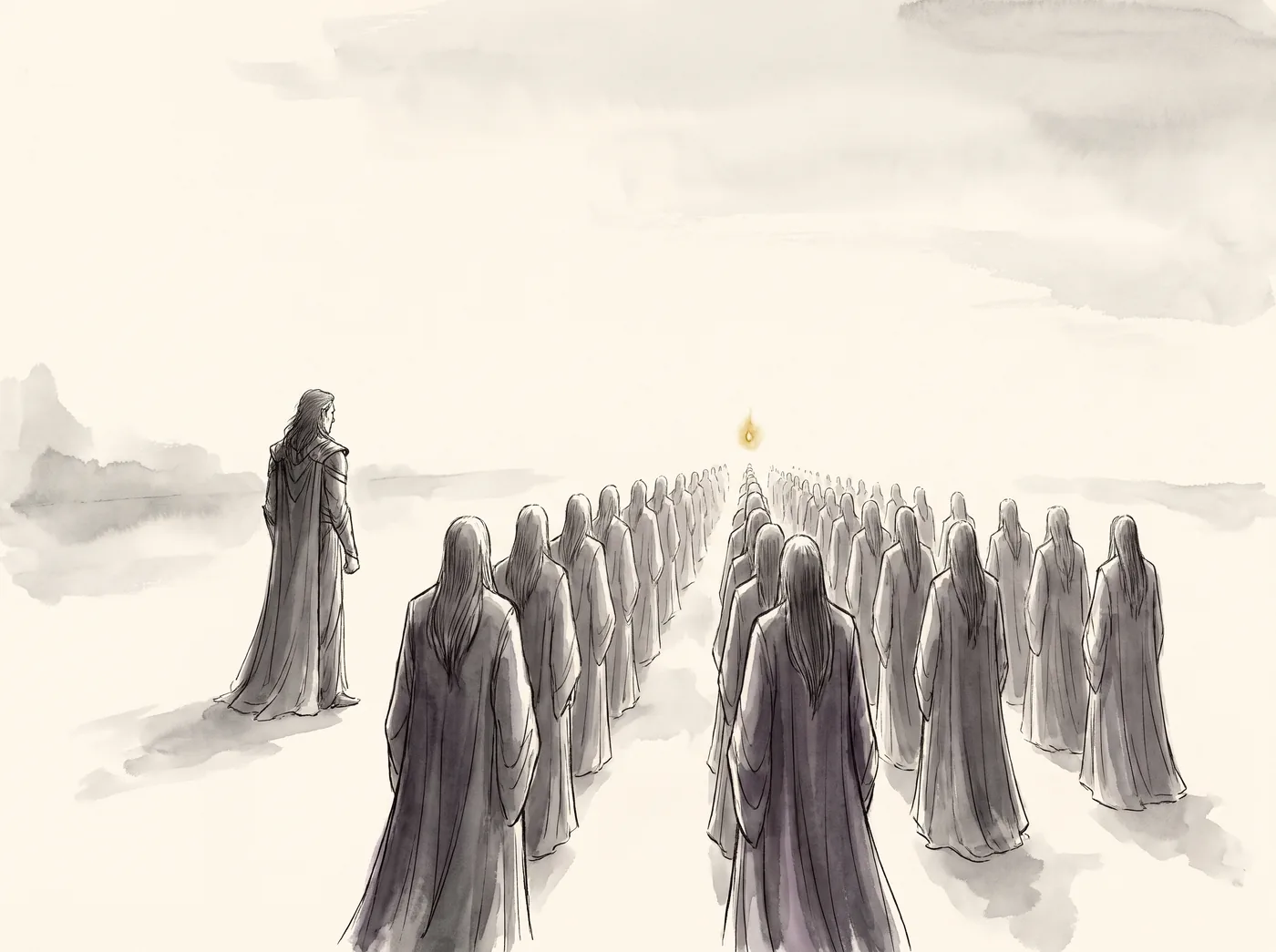
The Music

Before the world

Before there was a world there was a song. Eru, the One, showed the Ainur a theme and bade them make music of it, and the music became a vision of a world, and the vision became the world. Melkor, the mightiest of them, wove his own loud theme against it. Everything that follows, every ruin and every rescue, is that discord played out.

Eä! Let these things Be!

The Silmarillion, Ainulindalë

before there was a map

Told in full: What are the Valar? →
Ink wash: The Lamps fall, a shape of the world that no longer exists
2

The Lamps fall

The Years of the Lamps

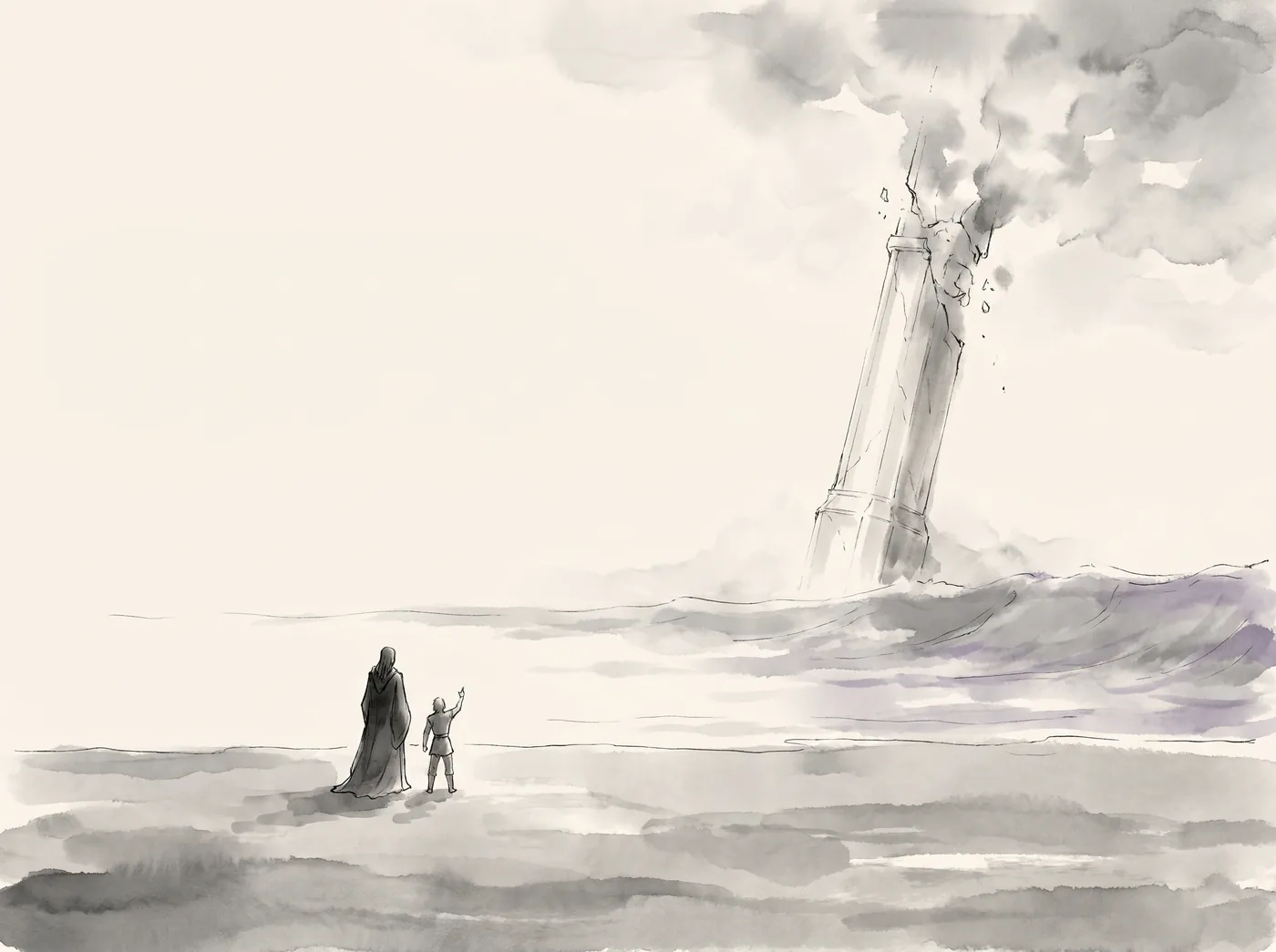
The world was lit first by two lamps on pillars taller than mountains, one in the north and one in the south, and the Valar lived on an island in the middle where the two lights met. Melkor built his fortress of Utumno in the dark of the far north and, when the moment came, threw the pillars down. Seas flooded, lands broke. The Valar left Middle-earth for Aman in the uttermost West and walled their new land with mountains.

a shape of the world that no longer exists

Told in full: Utumno, the prototype of evil →
Ink wash: The Two Trees, Valinor, in the uttermost West, beyond the Sea
3

The Two Trees

The Years of the Trees

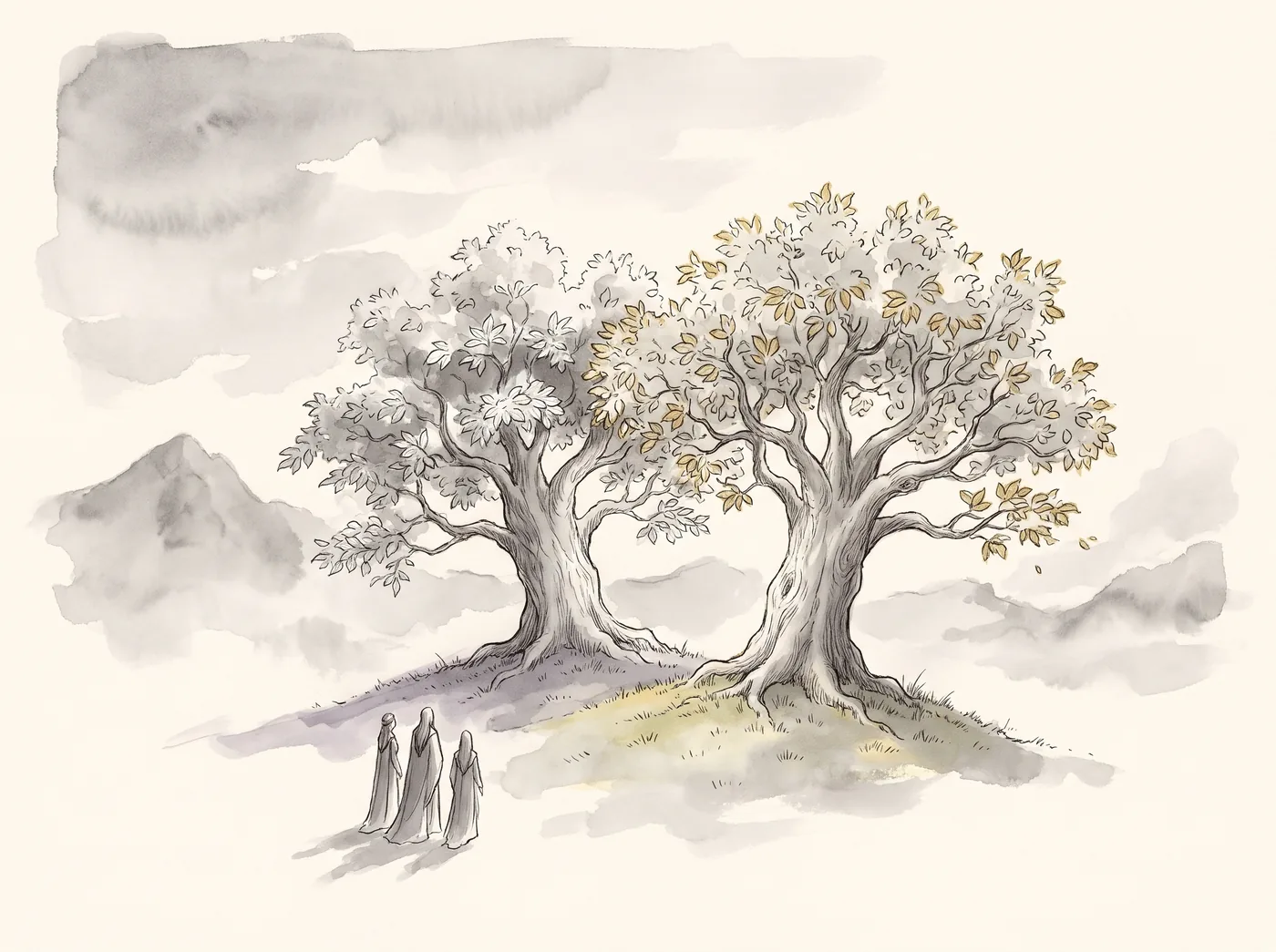
In Valinor, Yavanna sang two trees out of a green mound. Telperion gave a silver light and Laurelin a gold one, and each waxed and waned in seven hours, so that twice in every day the two lights mingled. This is the light the whole legendarium keeps trying to get back. The Silmarils hold it, the Phial of Galadriel holds a thread of it, and the Sun and Moon are its last fruit and flower.

Valinor, in the uttermost West, beyond the Sea

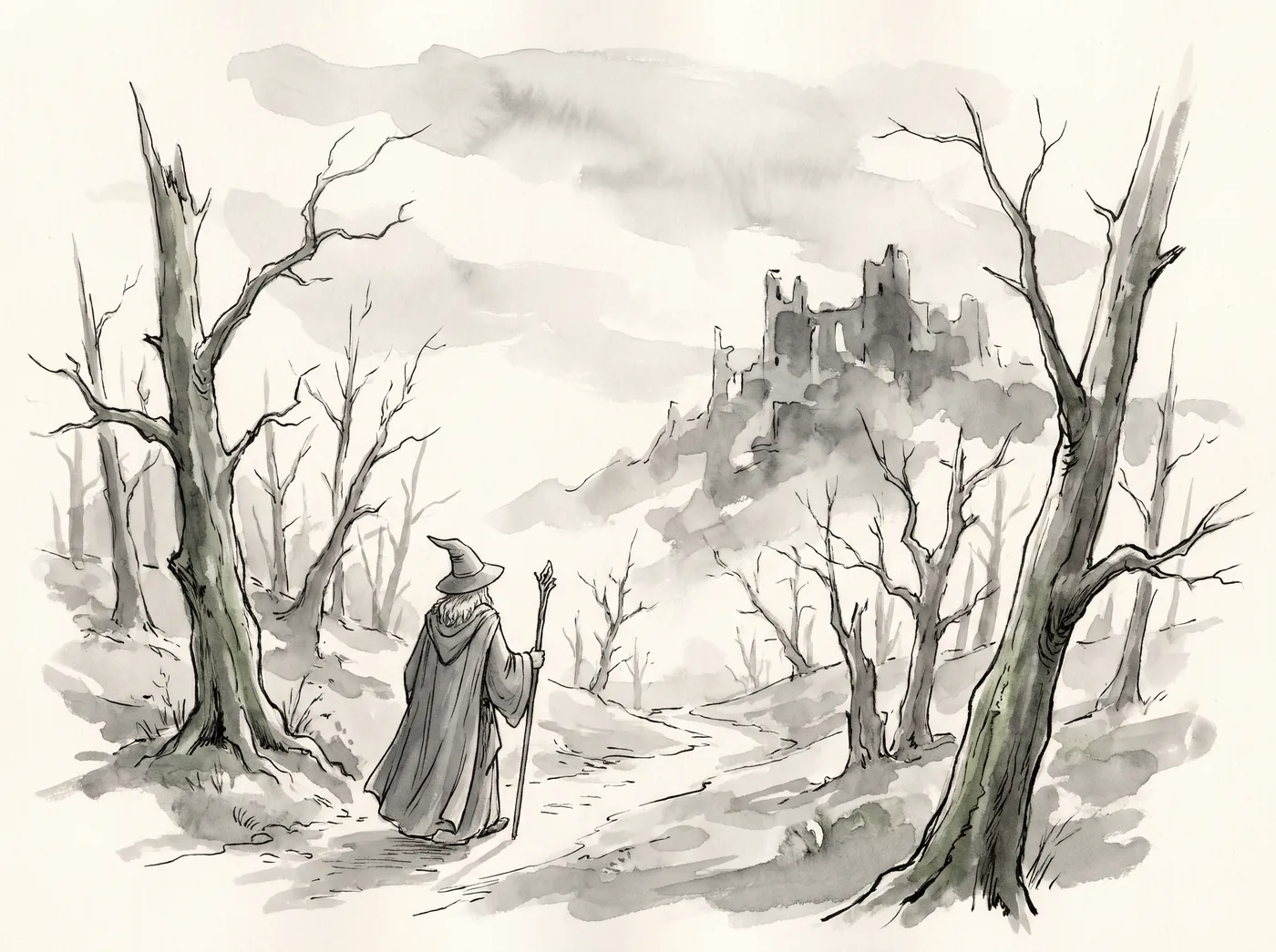
Ink wash: The Elves wake under the stars, Cuiviénen, far to the east of any chart of the Third Age
4

The Elves wake under the stars

Y.T. 1050 from the Annals

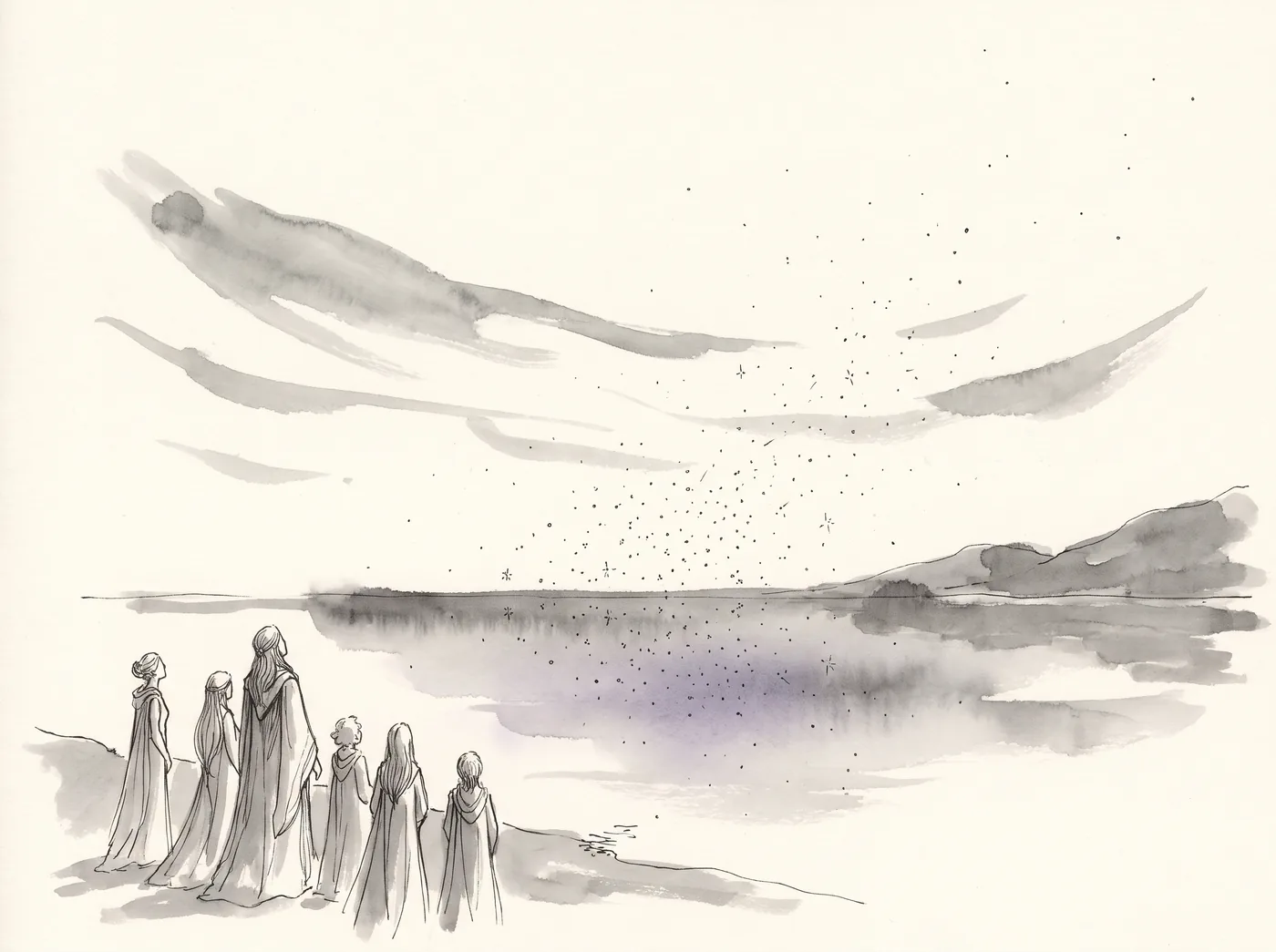
There was no sun yet. Varda made new stars for the coming of the Elves, and by a lake called Cuiviénen, far in the east of Middle-earth, they woke. The first thing they saw was the stars and the first thing they heard was water. Oromë the hunter found them. So did Melkor, and the ones his servants took into the dark are, the wisest guess, where Orcs came from.

while they dwelt yet silent by Cuiviénen their eyes beheld first of all things the stars of heaven

The Silmarillion, ch. 3, Of the Coming of the Elves and the Captivity of Melkor

Cuiviénen, far to the east of any chart of the Third Age

Told in full: The awakening of the Elves →
Ink wash: The Valar break the north, Utumno, in the far north; the land it stood in was broken
5

The Valar break the north

Y.T. 1090 to 1100 from the Annals

To make Middle-earth safe for the Elves, the Valar went to war. They broke Utumno open, chained Melkor and kept him in the halls of Mandos for three ages, and the fighting changed the shape of the world: the sea broke in upon the coasts, a great gulf opened in the south, and many lesser bays were made, of which the Bay of Balar was the chief. Then they brought the Elves west to Valinor, which is why the Elves of the stories are split into those who went and those who stayed.

Utumno, in the far north; the land it stood in was broken

Told in full: The War of the Powers →
Ink wash: The king who stopped walking, Nan Elmoth
6

The king who stopped walking

Y.T. 1130s from the Annals

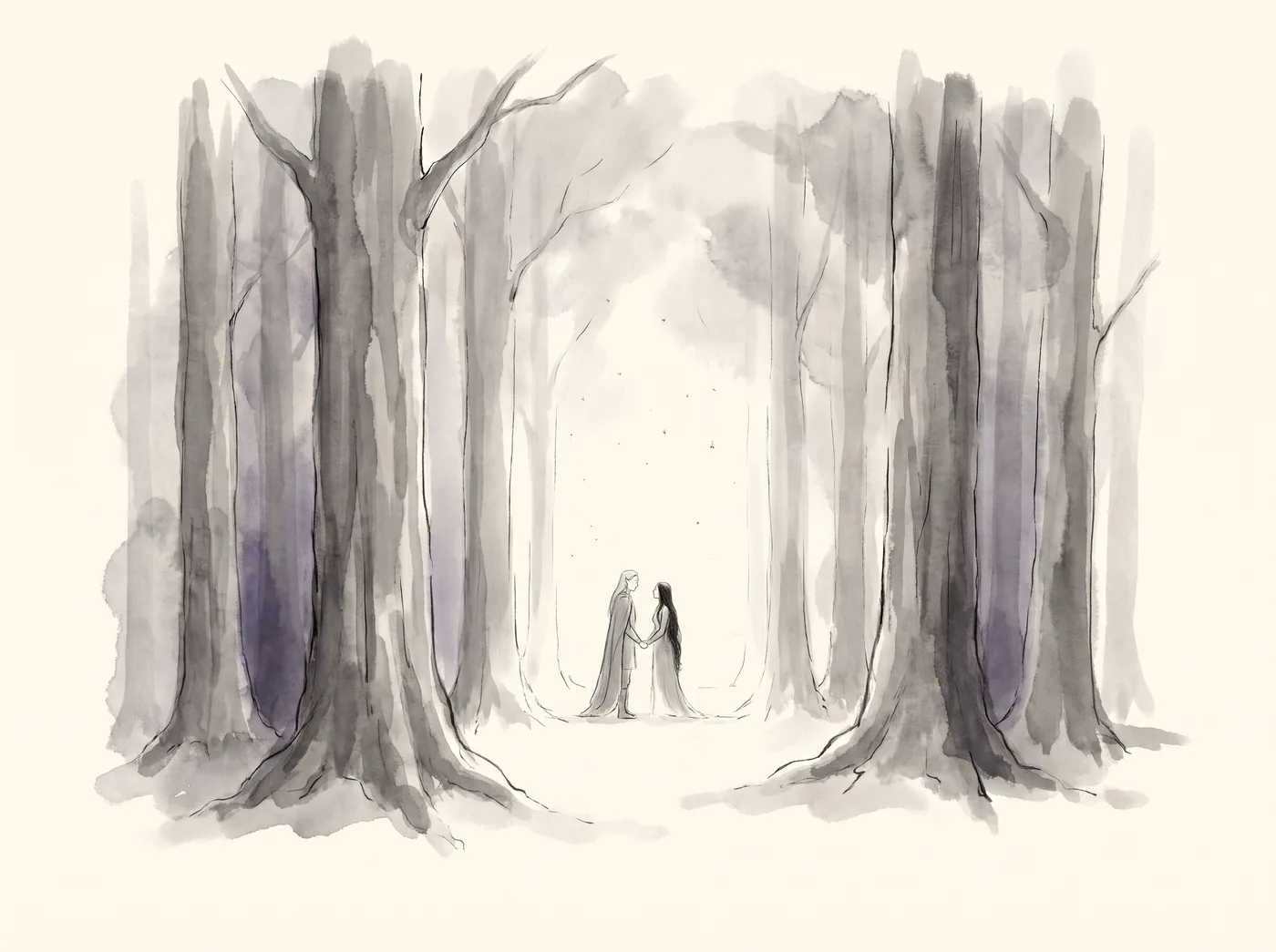
On the great march west one of the Elf-lords, Elwë, walked into a wood called Nan Elmoth and met Melian, a spirit of the Valar's own kind, and stood with her hand in his while the years went by. Most of his people went on without him; those who stayed behind to search for him became his. When he came out he was Thingol, the grey king, and with Melian he made Doriath: the Thousand Caves of Menegroth, and a fence of enchantment round the whole forest that nothing could pass without her leave.

Nan Elmoth

Told in full: Doriath, the hidden kingdom →
Ink wash: Fëanor makes the Silmarils, Tirion upon Túna, in Valinor
7

Fëanor makes the Silmarils

Y.T. 1449 to 1450 from the Annals

Fëanor, the greatest craftsman the Elves ever had, caught the mingled light of the Two Trees in three jewels. Even Varda hallowed them, so that no evil hand could hold them and not be burned. He loved them past reason and began to keep them locked away. Half of everything that happens from here to the end of the First Age is somebody trying to get these three stones.

Tirion upon Túna, in Valinor

Told in full: The Silmarils: why three jewels doomed an age →
Ink wash: The Darkening of Valinor, Ezellohar, the green mound before the gates of Valmar
8

The Darkening of Valinor

Y.T. 1495 from the Annals

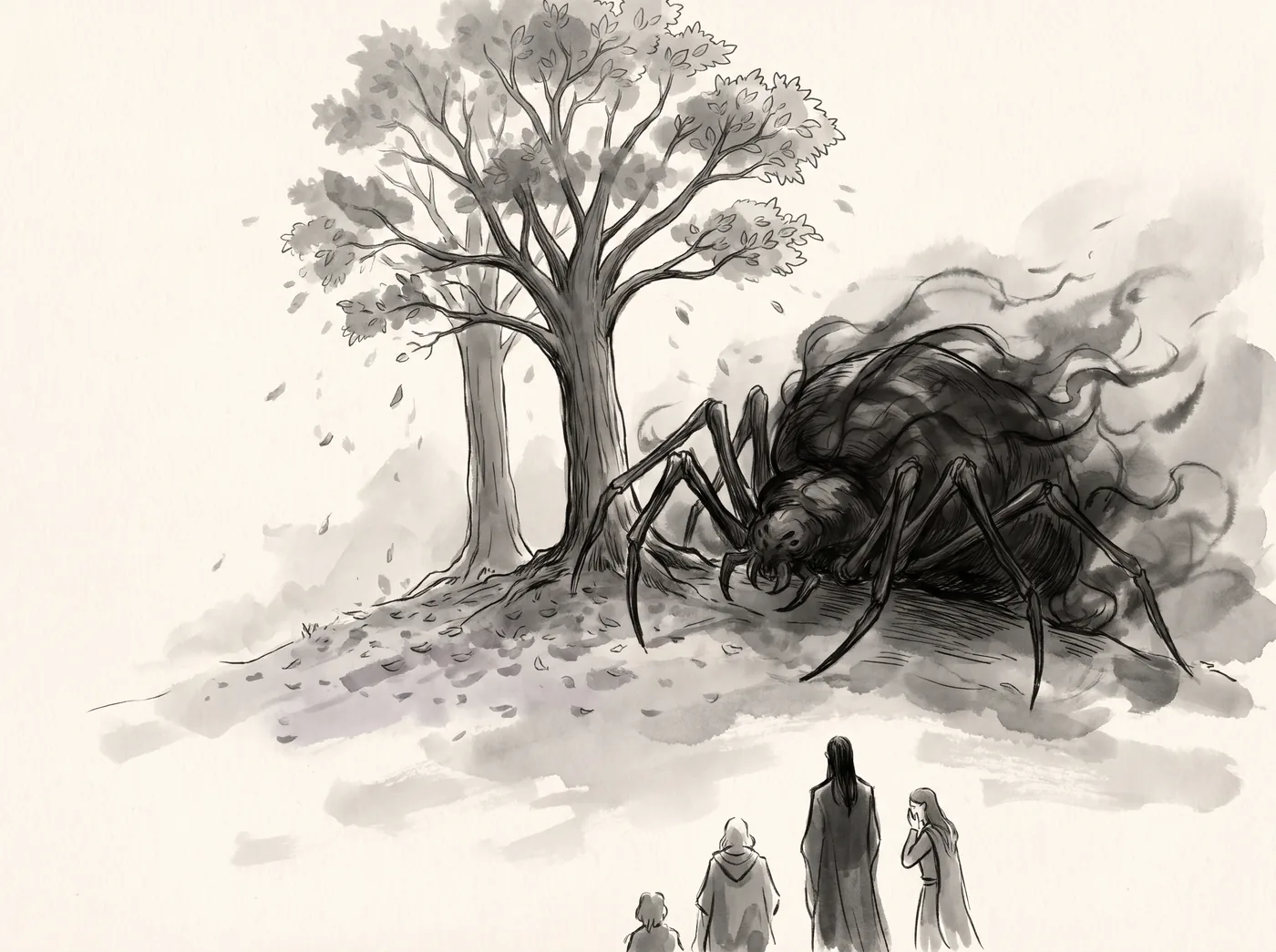
Released after three ages and pretending to be reformed, Melkor found an ally in Ungoliant, a spider-shaped hunger who lived in the dark south. Together, at a festival, they came to the Trees. Melkor stabbed them and Ungoliant drank them dry. In the dark that followed he went north, killed Fëanor's father Finwë at his door, and took the Silmarils. From then on the Elves called him Morgoth, the Black Enemy.

Ezellohar, the green mound before the gates of Valmar

Told in full: Ungoliant: is she still alive? →
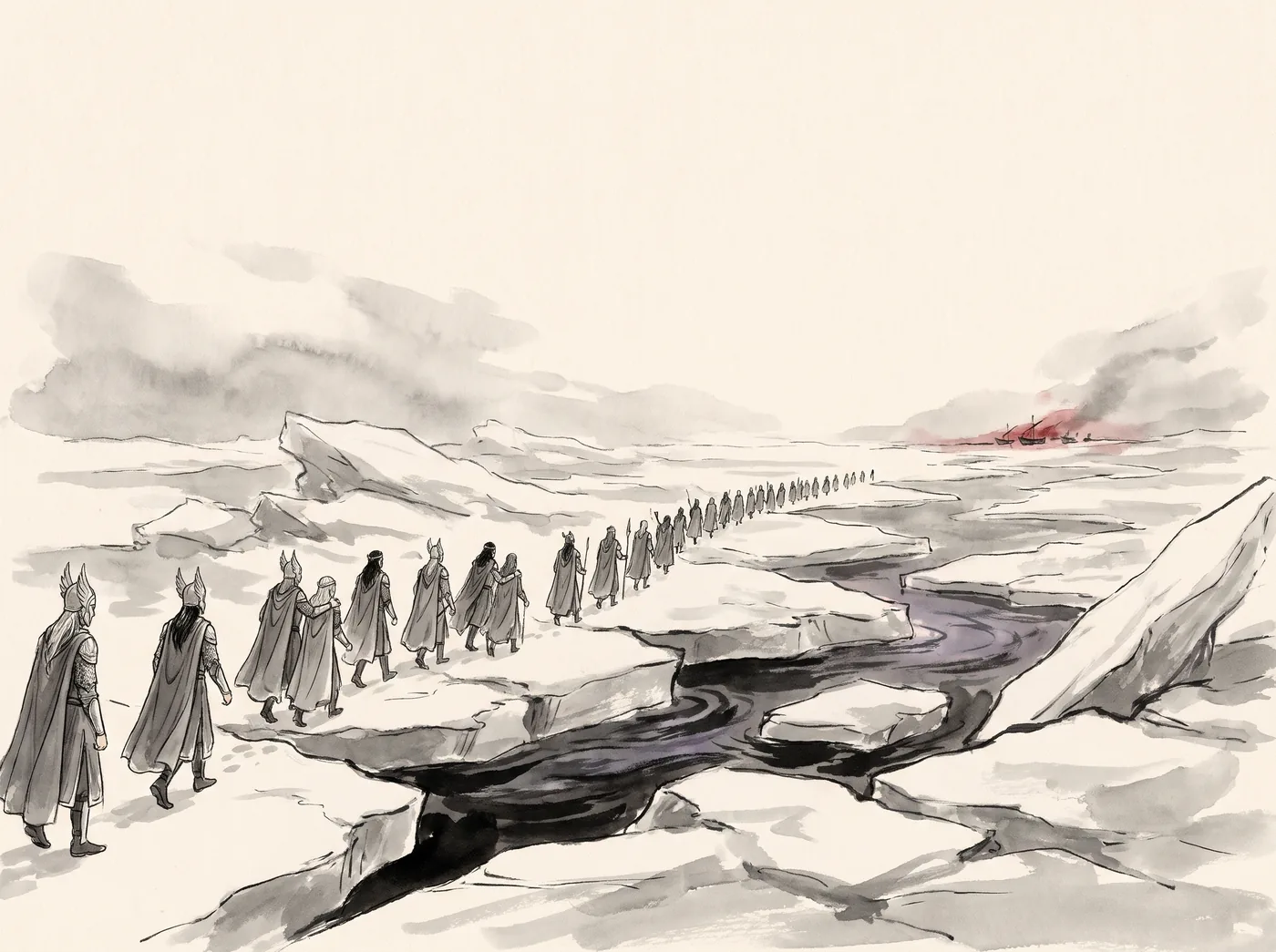
Ink wash: The Oath, the ships, the Ice, the Helcaraxë, the Grinding Ice, north of any chart
9

The Oath, the ships, the Ice

Y.T. 1495 to 1500 from the Annals

Fëanor swore an oath, with his seven sons, to pursue anyone who kept a Silmaril from them, and led most of the Noldor out of Valinor against the Valar's will. To get ships they killed their own kin at the harbour of Alqualondë. Mandos pronounced their doom. Fëanor took the ships, crossed, and burned them. His half-brother Fingolfin, abandoned on the far shore, led his people over the grinding ice of the far north on foot.

Tears unnumbered ye shall shed; and the Valar will fence Valinor against you, and shut you out

The Silmarillion, ch. 9

the Helcaraxë, the Grinding Ice, north of any chart

The First Age

the War of the Jewels

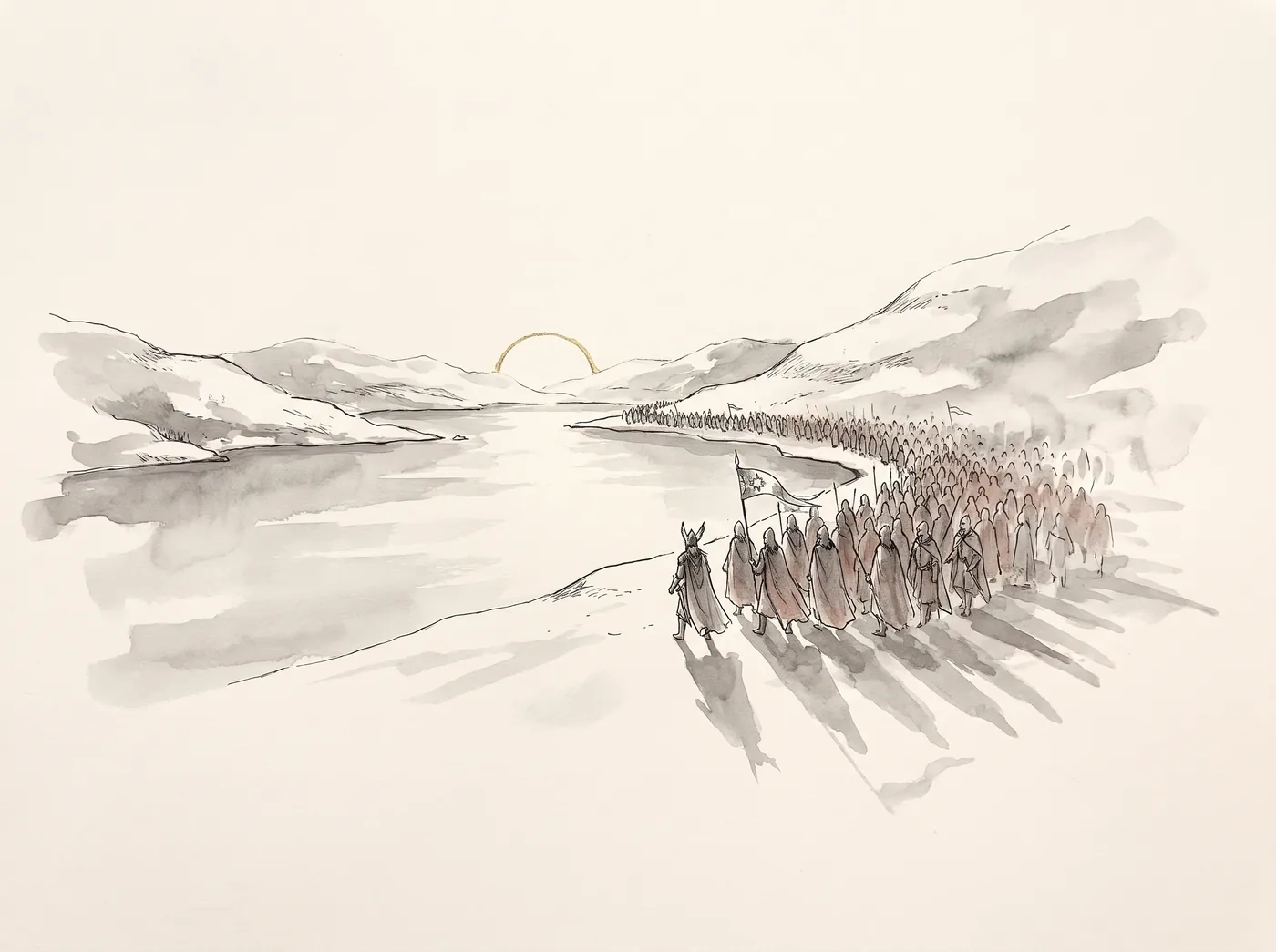
Ink wash: The Sun rises for the first time, Mithrim
10

The Sun rises for the first time

F.A. 1 from the Annals

Out of the last flower of the dead Trees the Valar made the Moon, and out of the last fruit the Sun. The Moon rose as Fingolfin's people came off the ice, and they blew their trumpets to greet it. When the Sun came up for the very first time, rising in the West, his host was marching into Mithrim with banners unfurled, and Morgoth's creatures fled into Angband. Fëanor was already dead, cut down by Balrogs within sight of Angband. The Years of the Sun are counted from this sunrise.

Mithrim

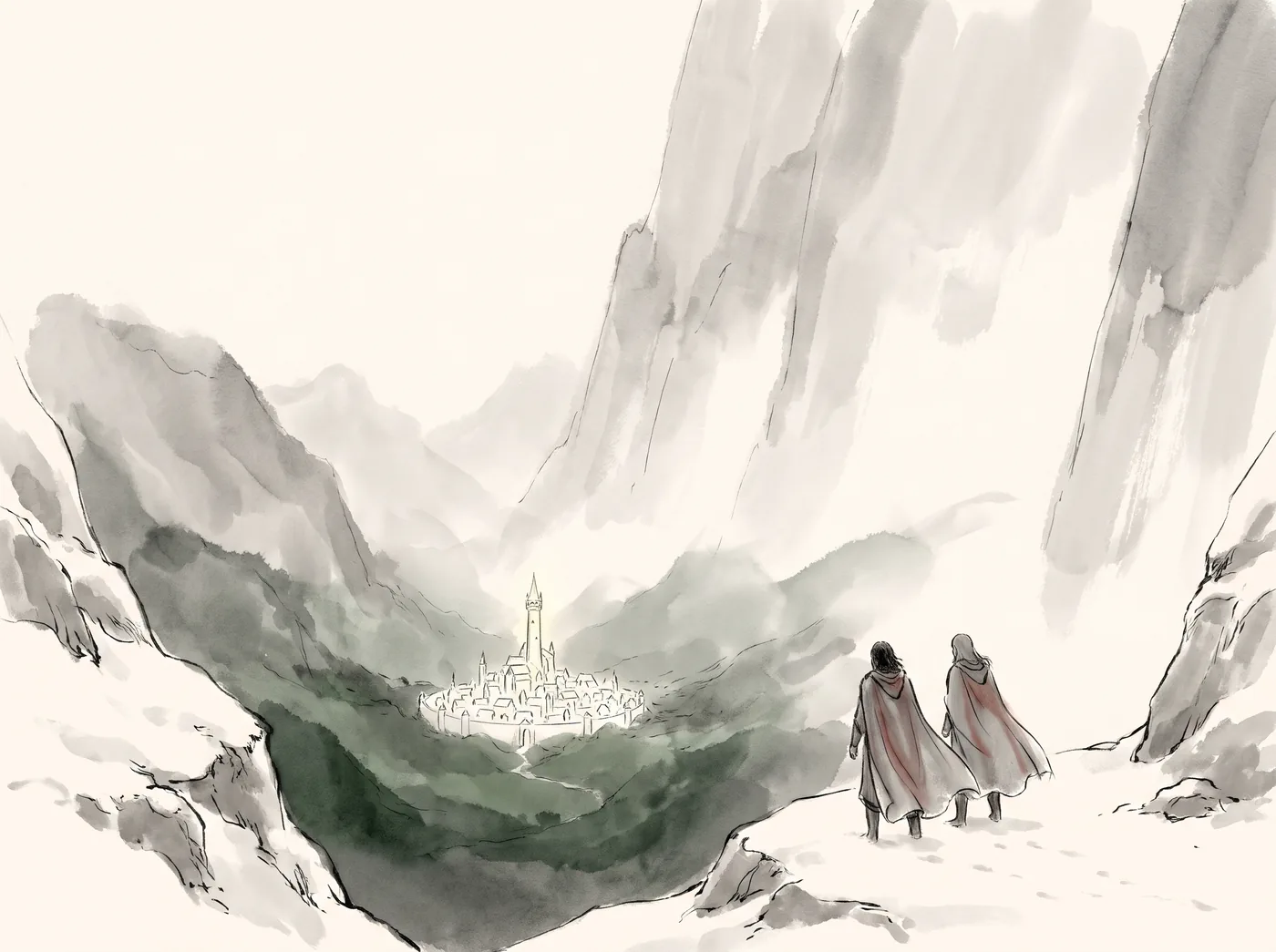
Ink wash: The Siege, and the hidden cities, Gondolin
11

The Siege, and the hidden cities

F.A. 60 to 455 from the Annals

The Noldor beat Morgoth back into Angband and sat down outside it for nearly four hundred years, a siege they could never finish because they could not get in. Behind the siege, two kings built in secret. Finrod dug Nargothrond into a gorge of the river Narog. Turgon, warned in a dream, led his people into a hidden valley ringed by mountains and built Gondolin there, and Morgoth did not learn where it was until almost the end of the age.

Gondolin

Told in full: Angband, the Hells of Iron →
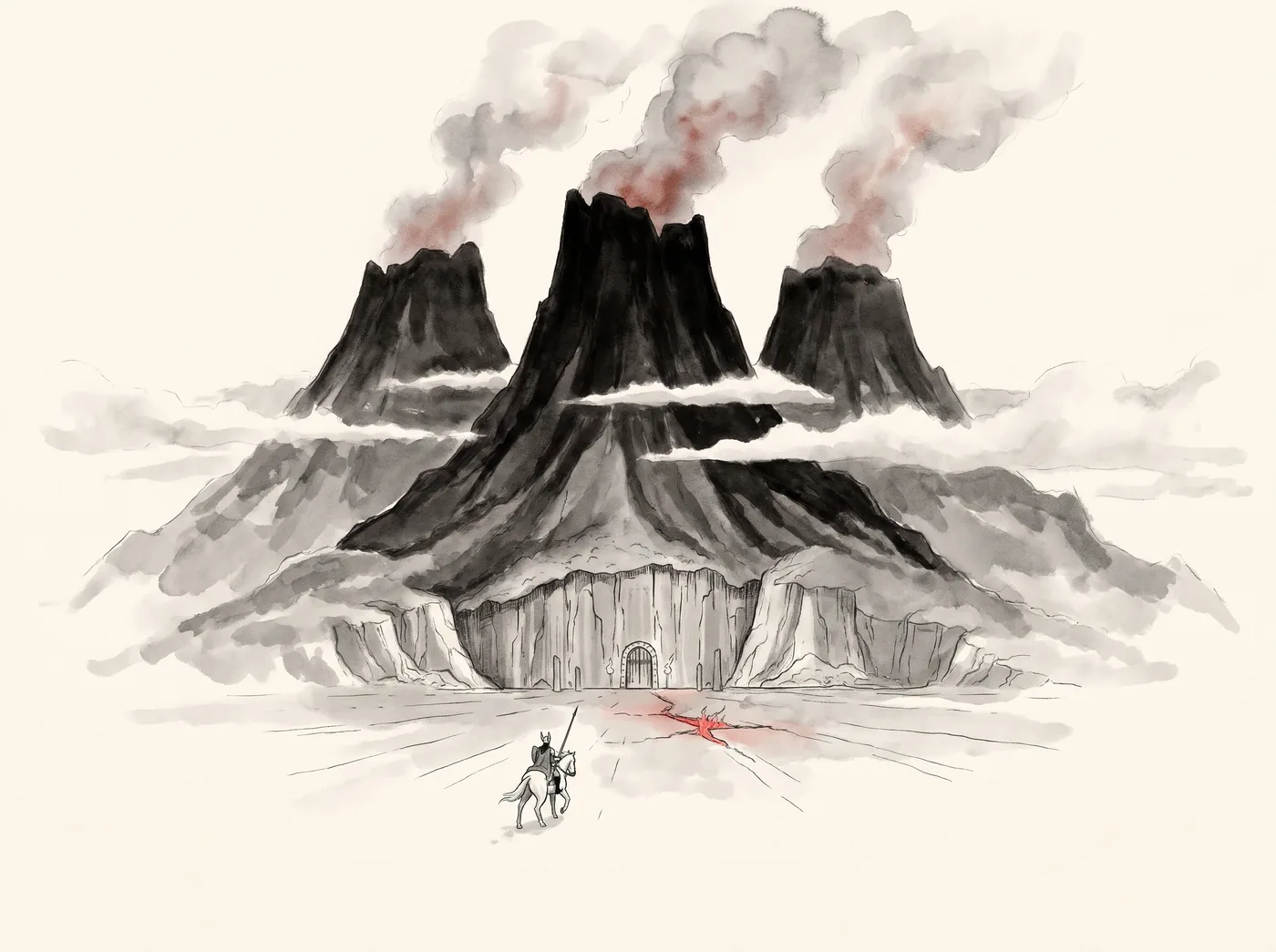
Ink wash: Fingolfin rides to the gate, the gate of Angband
12

Fingolfin rides to the gate

F.A. 455 to 456 from the Annals

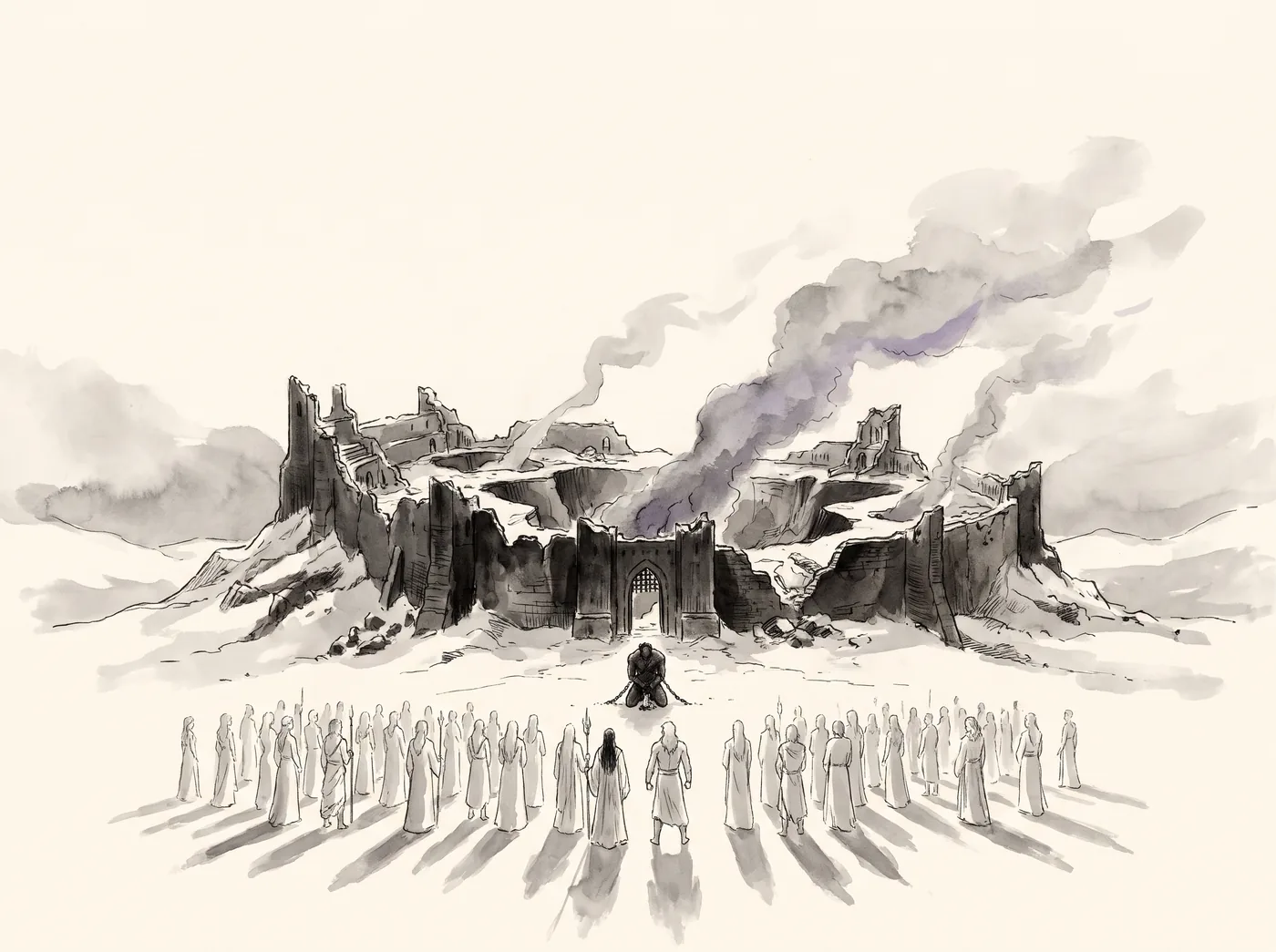
On a winter's night Morgoth sent rivers of fire out of Angband across the grassy plain where the besiegers camped, and the plain became the Anfauglith, the choking dust. The siege ended in a night. Fingolfin, High King of the Noldor, hearing of the ruin, rode alone to the gate of Angband and called Morgoth out to fight. Morgoth came. Fingolfin wounded him seven times before he died under Morgoth's foot, and Morgoth limped ever after.

the gate of Angband

Told in full: The Ring of Barahir →
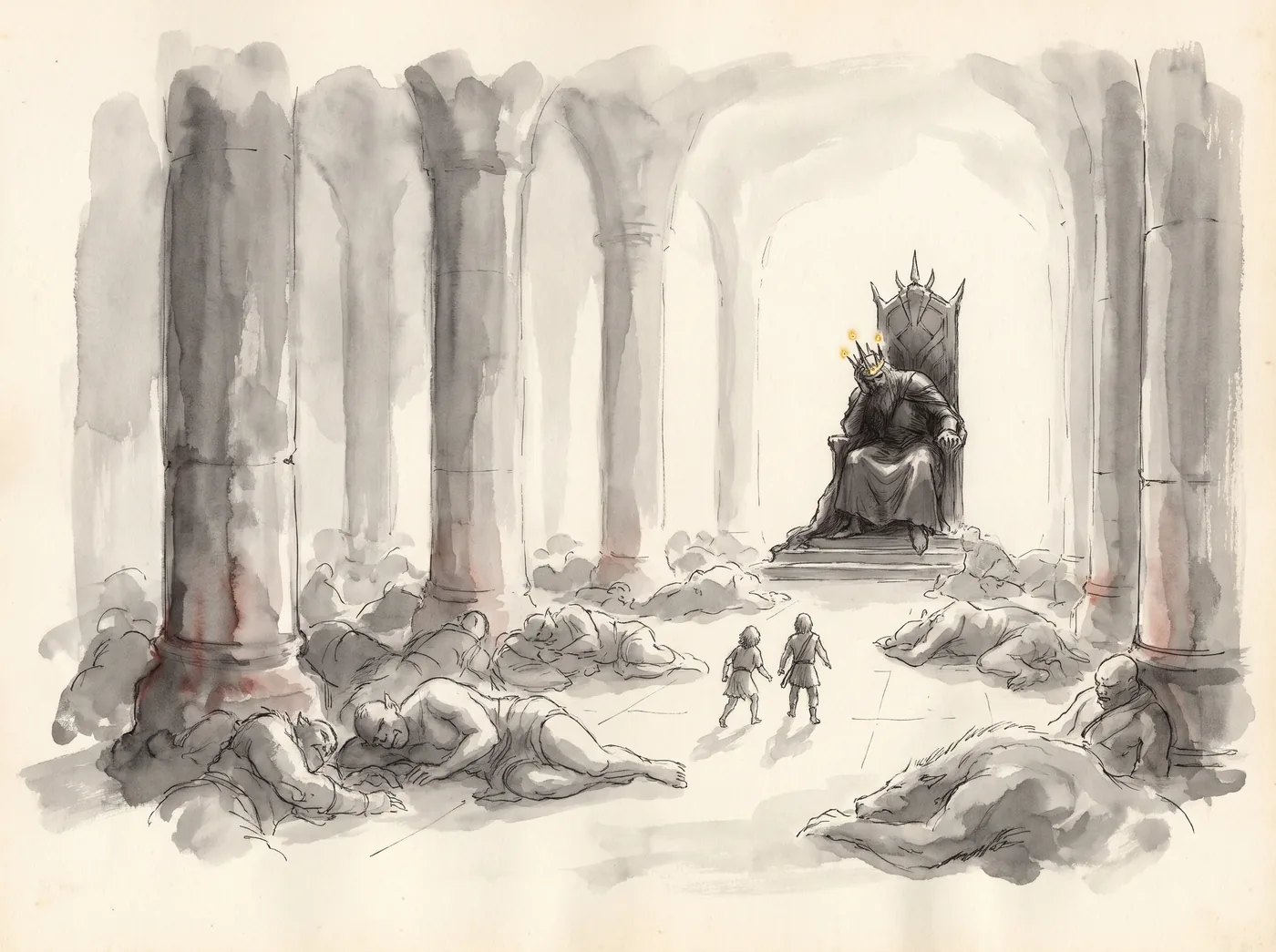
Ink wash: A Silmaril cut from the crown, Angband
13

A Silmaril cut from the crown

F.A. 465 to 466 from the Annals

A mortal man, Beren, asked King Thingol for his daughter's hand, and Thingol, meaning never, set the price at a Silmaril from Morgoth's crown. Lúthien went with him. In the throne room of Angband she sang Morgoth and his whole court to sleep, and Beren cut a Silmaril from the iron crown with a knife. On the way out the wolf Carcharoth bit off his hand with the jewel in it. Thingol got his Silmaril in the end, out of the wolf.

Even now a Silmaril is in my hand.

The Silmarillion, ch. 19

Angband

Told in full: Lúthien, the most powerful being in Middle-earth →
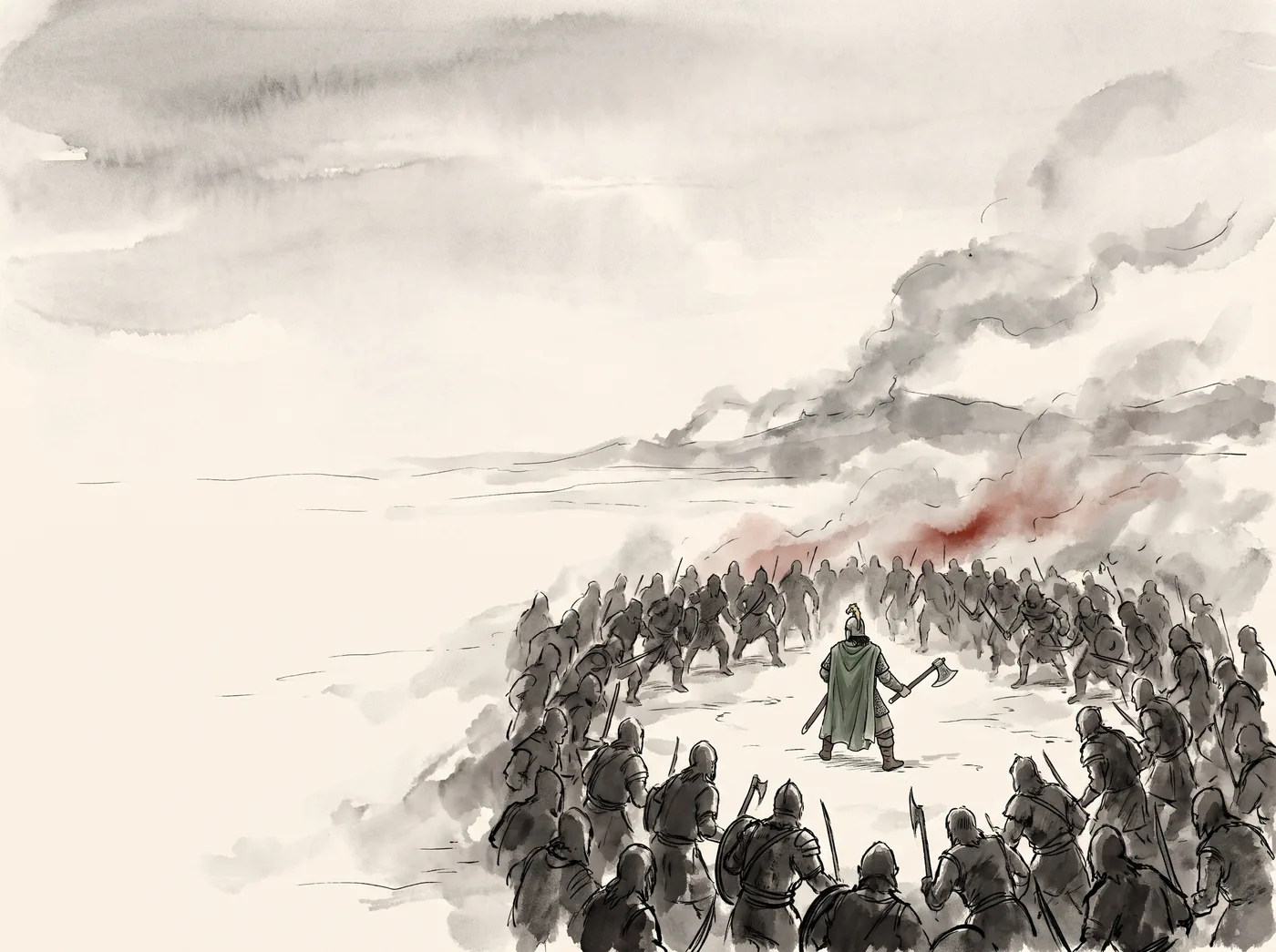
Ink wash: Unnumbered Tears, the Anfauglith
14

Unnumbered Tears

F.A. 472 from the Annals

Fëanor's son Maedhros gathered every Elf, Man and Dwarf who would come and marched on Angband in one great attack. Morgoth had already bought Ulfang the Easterling and his sons, and their treachery turned the battle on the Anfauglith into the worst defeat of the age. Húrin of Dor-lómin and his men held the rearguard so that Turgon could get away, and at the last Húrin stood alone, shouting as he swung his axe, until he was taken alive. Morgoth set him in a chair on a mountain and made him watch what happened to his children.

Aurë entuluva! Day shall come again!

The Silmarillion, ch. 20

the Anfauglith

Told in full: Nirnaeth Arnoediad →
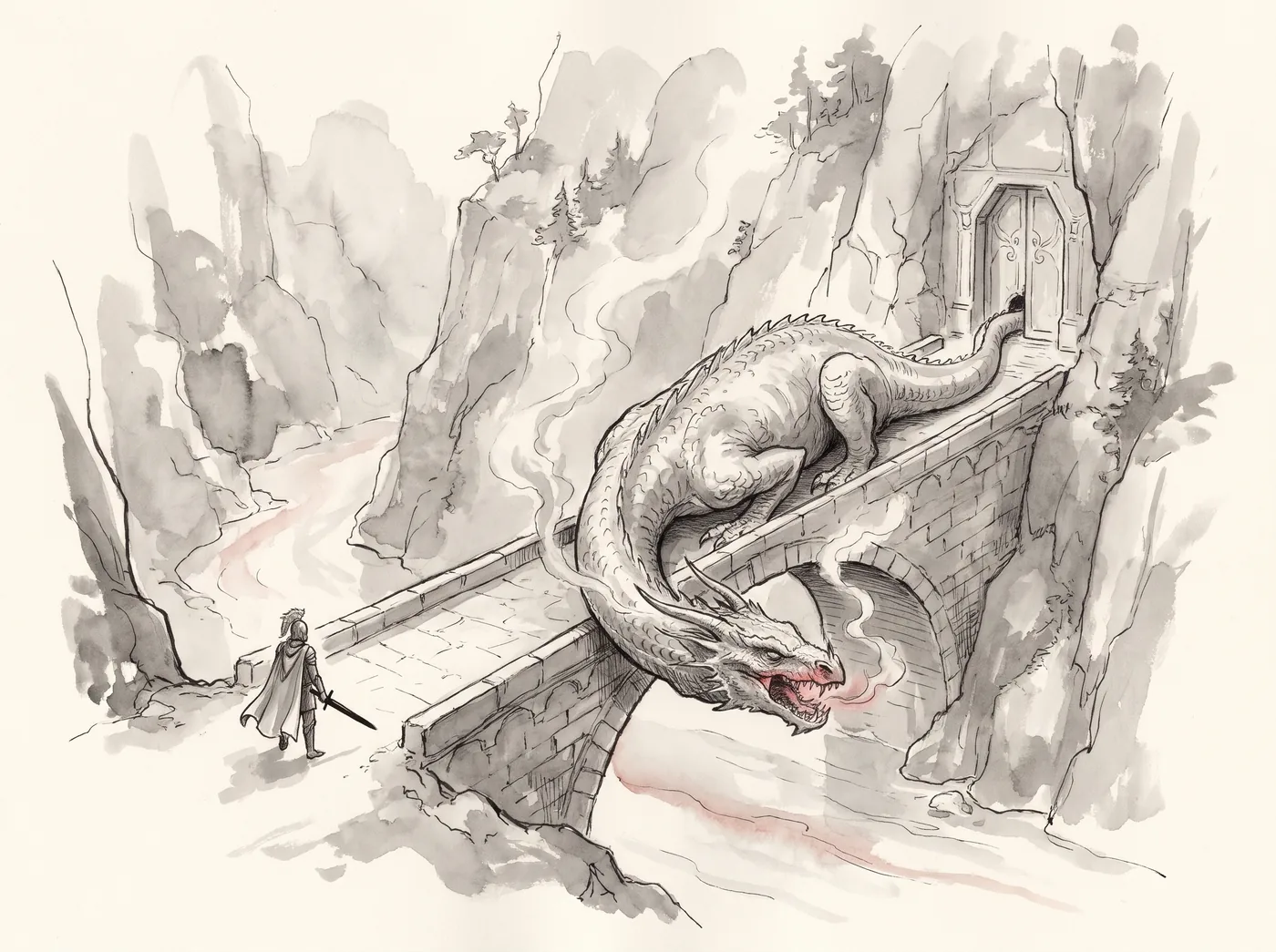
Ink wash: Túrin and the dragon, Nargothrond
15

Túrin and the dragon

F.A. 495 to 499 from the Annals

Húrin's son Túrin spent his life trying to outrun a curse and leading it to everyone he loved. He talked Nargothrond into fighting in the open, and the dragon Glaurung burned the host, sacked the city, and held Túrin with his eyes while the woman who loved him was taken away. Years later, in the forest of Brethil, Túrin climbed a gorge in the dark and put his black sword through the dragon's belly from beneath. When he learned what the dragon's lies had cost him he fell on that sword.

Nargothrond

Told in full: The Children of Húrin →
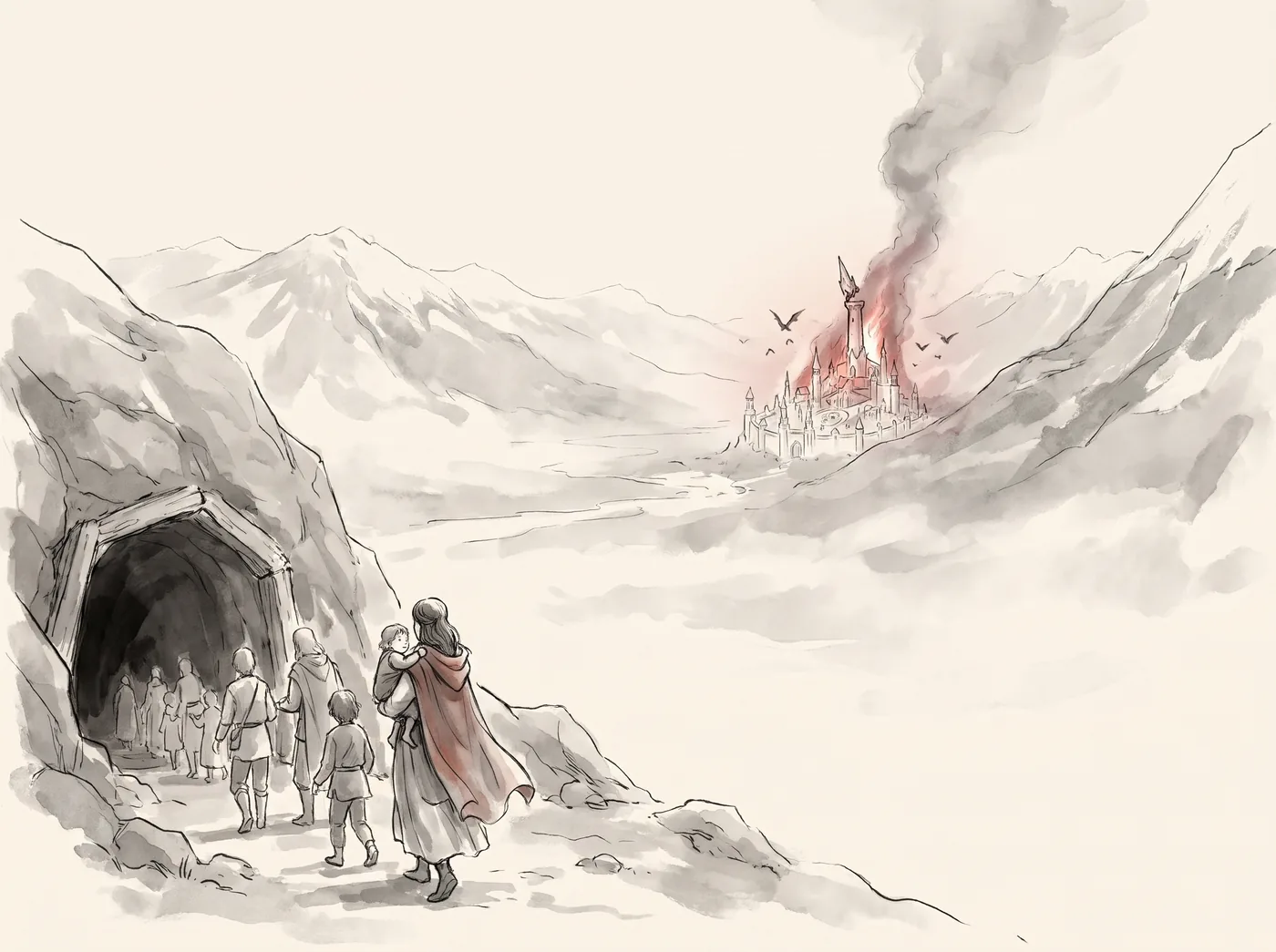
Ink wash: The Fall of Gondolin, Gondolin
16

The Fall of Gondolin

F.A. 510 from the Annals

The hidden city was sold by one of its own. Maeglin, the king's nephew, was caught outside the mountains, taken to Angband, and bought his life with the secret. At midsummer Morgoth sent dragons, Balrogs and orcs over the northern heights. Turgon died in his tower. Tuor, a mortal, and the king's daughter Idril led the survivors out through a tunnel she had dug in secret, and among them was their small son, Eärendil.

Gondolin

Told in full: The Fall of Gondolin →
Ink wash: Eärendil sails into the West, the Mouths of Sirion
17

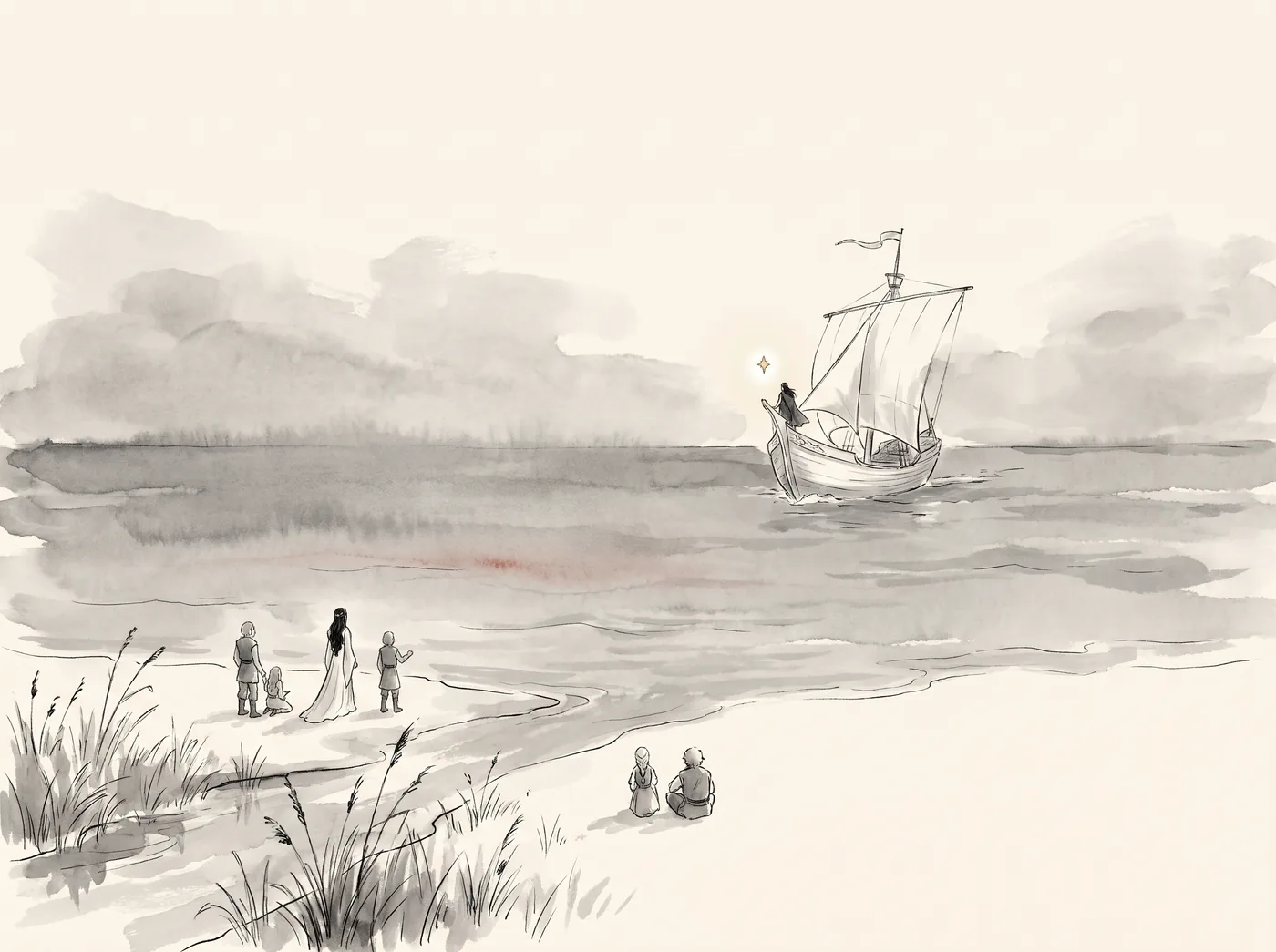
Eärendil sails into the West

F.A. 538 to 542 from the Annals

The refugees of Gondolin and Doriath gathered at the Mouths of Sirion, and Elwing, Beren and Lúthien's granddaughter, kept the Silmaril there. Fëanor's sons attacked for it. Elwing threw herself into the sea with the jewel and came to her husband Eärendil's ship as a white bird. With the Silmaril bound on his brow Eärendil sailed where no mortal was allowed, to Valinor, and asked the Valar to come and finish Morgoth. They said yes. Then they set him in the sky with the jewel, and he is the evening star.

Hail Eärendil, of mariners most renowned, the looked for that cometh at unawares, the longed for that cometh beyond hope!

The Silmarillion, ch. 24

the Mouths of Sirion

Told in full: Eärendil the Mariner →
Ink wash: The War of Wrath, Thangorodrim
18

The War of Wrath

F.A. 545 to 587 from the Annals

The host of the Valar came out of the West and fought Morgoth for over forty years. He sent out the winged dragons, the first anyone had seen, and Eärendil in his flying ship killed the greatest of them. Thangorodrim, the three peaks over Angband, was broken. Morgoth was chained with the chain made for him long ago and thrust out of the world through the Door of Night. The fighting sank Beleriand under the sea. Almost everything on this chart drowned; only a strip in the east and a few hilltops, now islands, stayed above the water.

Thangorodrim

Told in full: The War of Wrath →
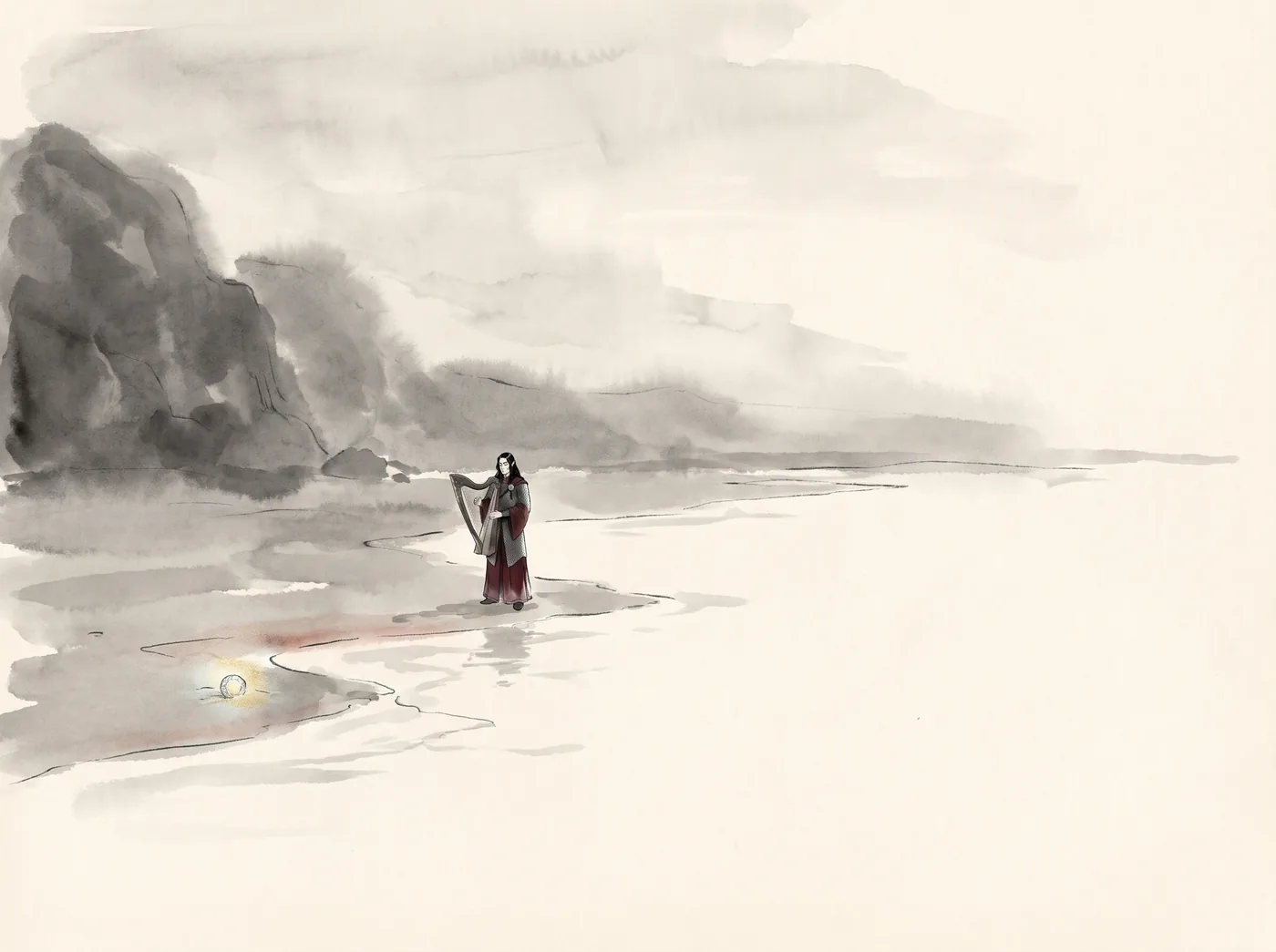
Ink wash: Fire and sea, the shore of a drowning land
19

Fire and sea

F.A. 587 from the Annals

Two Silmarils came out of Morgoth's crown and into the camp of the Valar, and the two surviving sons of Fëanor, still bound by the oath, stole them. The jewels burned their hands. Maedhros threw himself with his into a chasm of fire. Maglor threw his into the sea and walked the shore ever after, singing. One Silmaril in the sky, one in the earth, one in the sea: the oath was done, and so was the First Age.

the shore of a drowning land

The Second Age

Númenor and the Rings

Ink wash: An island for Men, Númenor, in the western sea, west of any chart of Middle-earth
20

An island for Men

S.A. 32

The Men who had fought beside the Elves were given an island in the western sea, raised for them out of the water, within sight of the Undying Lands and forbidden to sail there. Elros, Eärendil's son, chose to be mortal and became its first king; his twin brother Elrond chose otherwise. For two thousand years the Númenóreans grew into the greatest sailors and builders the world had seen, and lived three times as long as other Men.

Númenor, in the western sea, west of any chart of Middle-earth

Ink wash: The Lord of Gifts, Eregion
21

The Lord of Gifts

S.A. c. 1200 to 1590

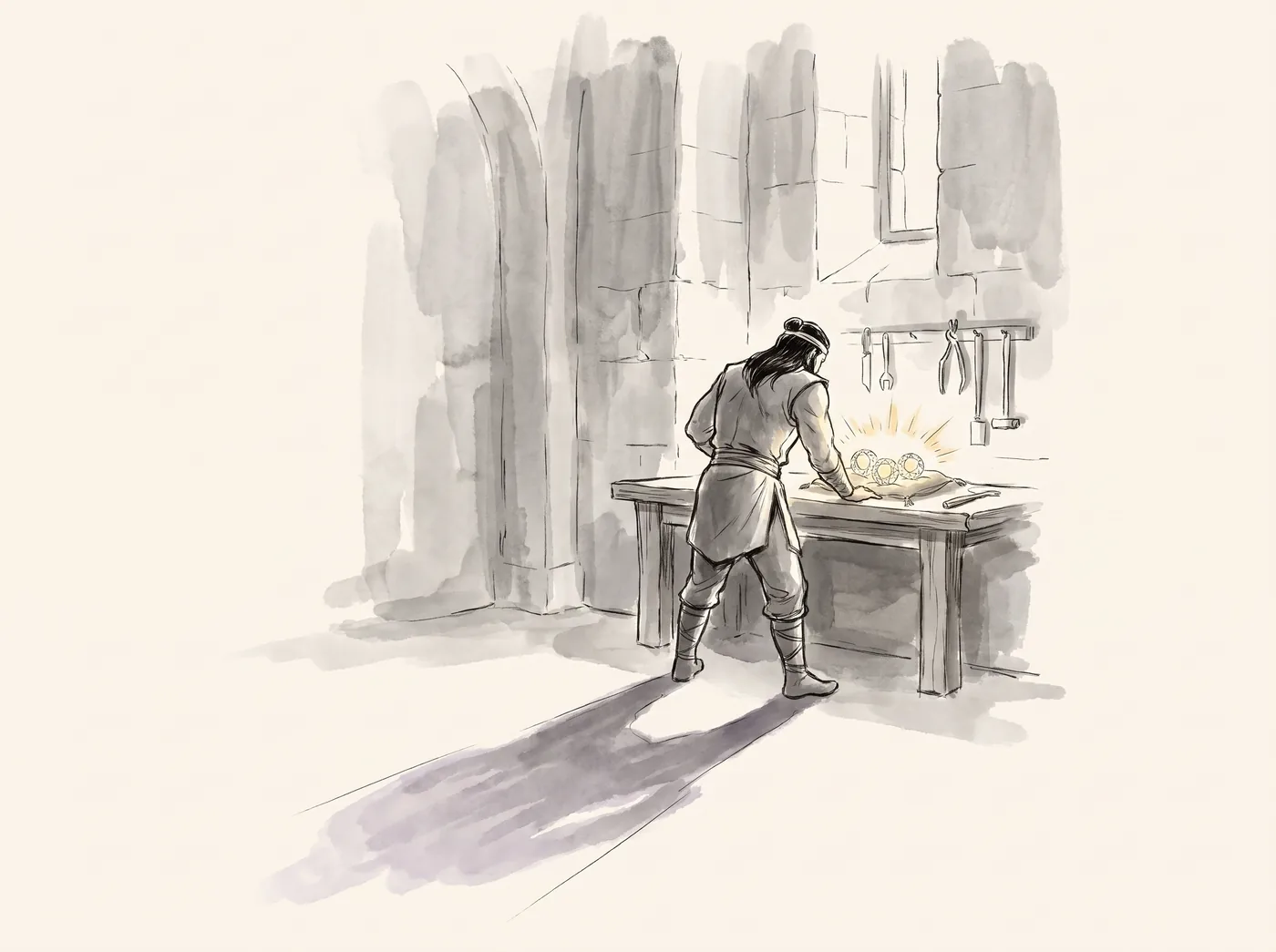
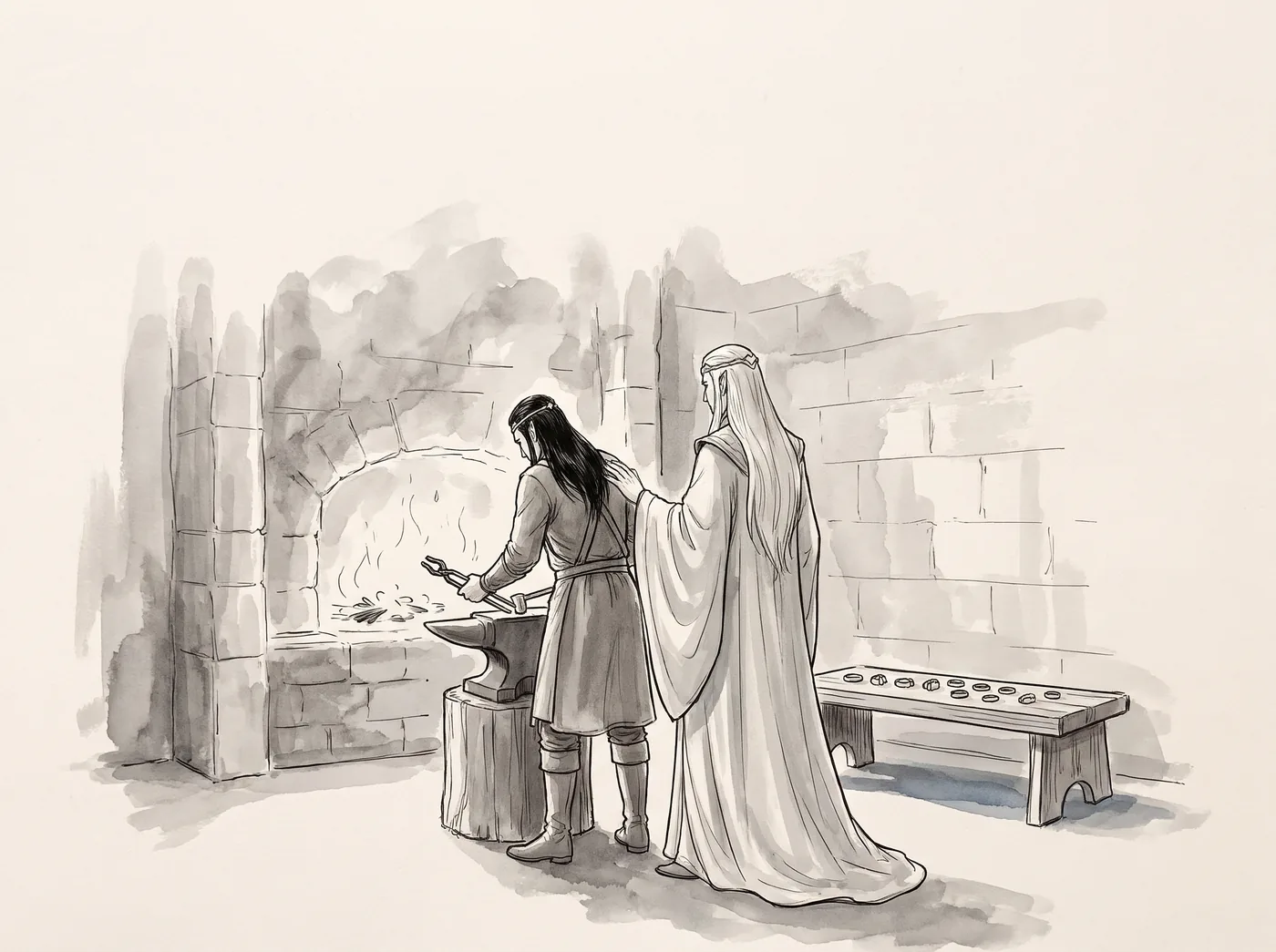
Morgoth's lieutenant Sauron survived the war and, after a long quiet, came to the Elf-smiths of Eregion as a beautiful stranger calling himself Annatar, the Lord of Gifts. He taught them. Together they made the Rings of Power, and the greatest smith, Celebrimbor, Fëanor's grandson, made the three Elven rings last and alone, without Sauron's hand on them.

Eregion

Told in full: Annatar's deception →
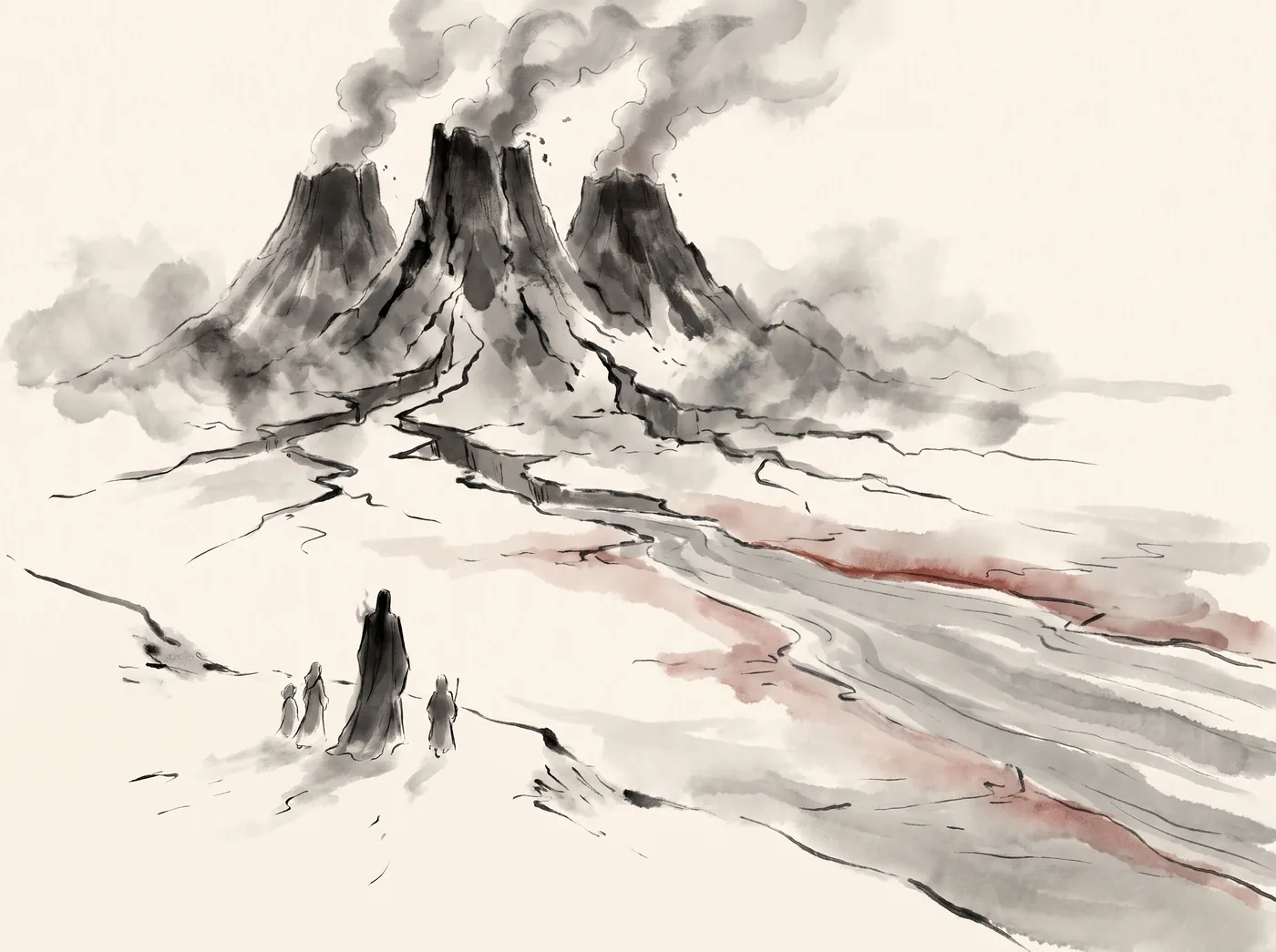
Ink wash: One Ring, in secret, Orodruin
22

One Ring, in secret

S.A. c. 1600 to 1697

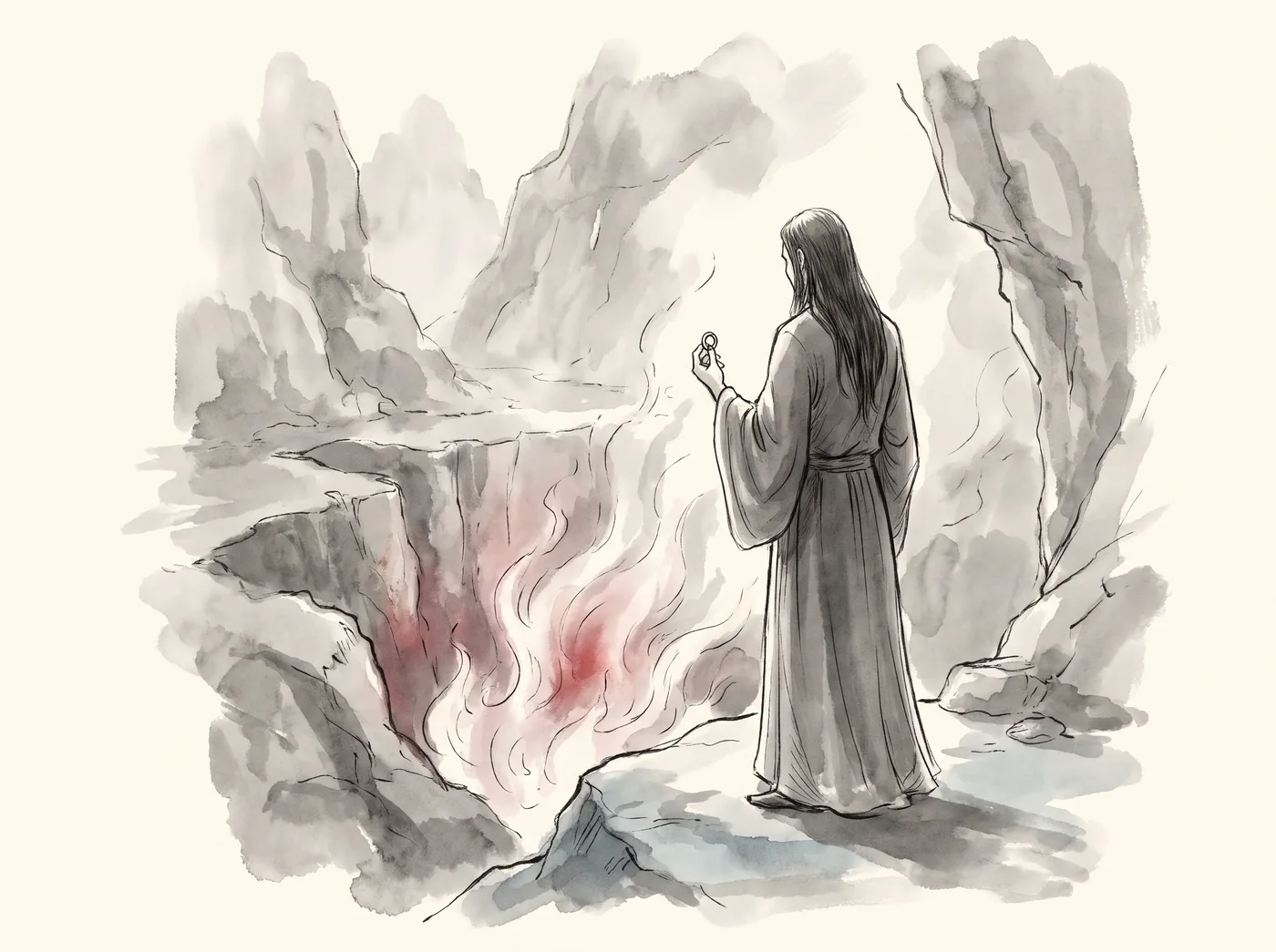
In the fire of Orodruin, in Mordor, Sauron forged a ring to rule the others and poured a great part of his own power into it. The moment he put it on, the Elves wearing theirs felt him and took them off. So he came for the rings in war. Eregion was destroyed, Celebrimbor was killed, and the three Elven rings were hidden, which is why Gandalf, Galadriel and Elrond still have them when the story you know begins.

Orodruin

Told in full: How the Rings of Power were really forged →
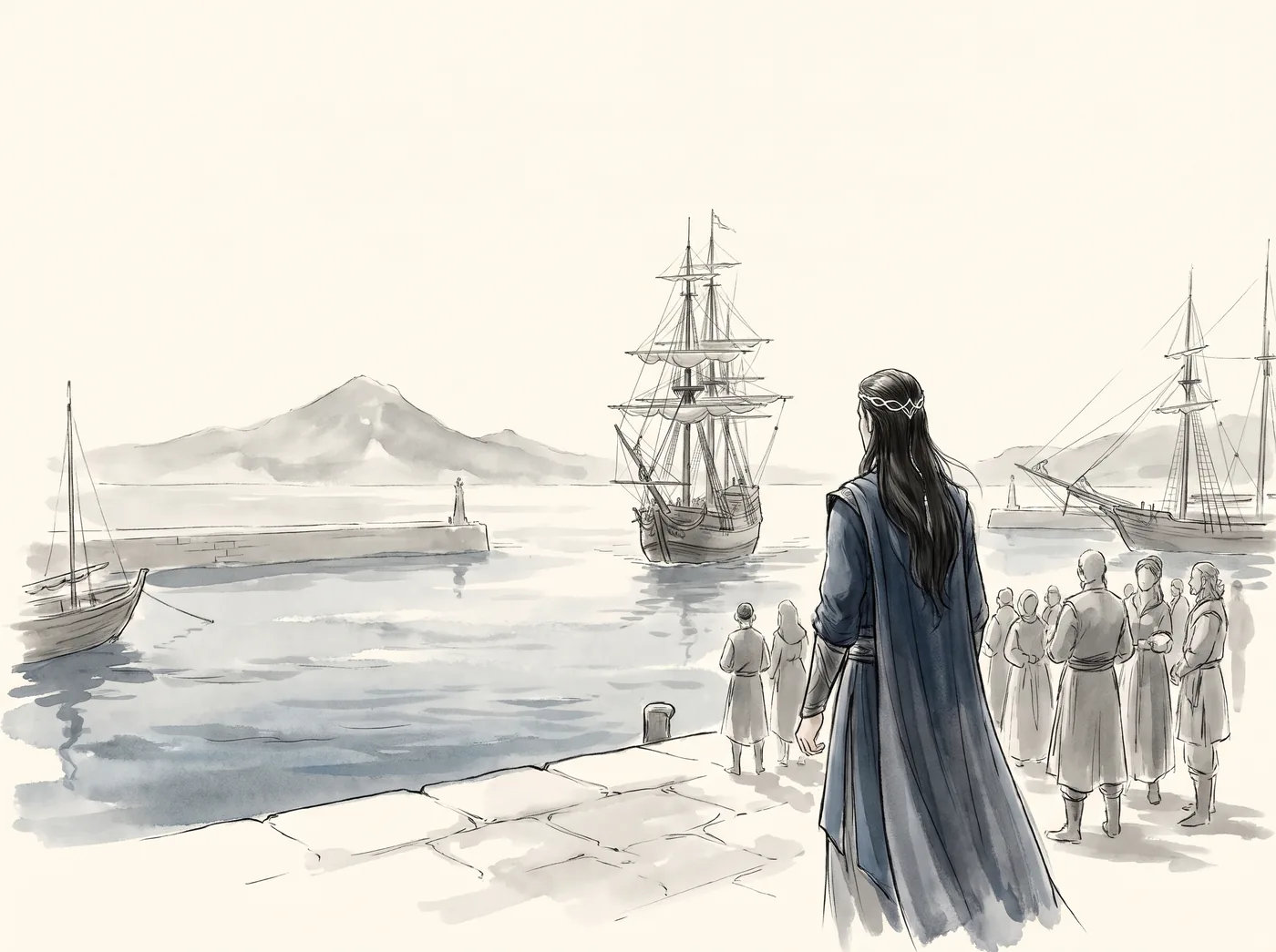
Ink wash: The king who took Sauron prisoner, Umbar
23

The king who took Sauron prisoner

S.A. 3262

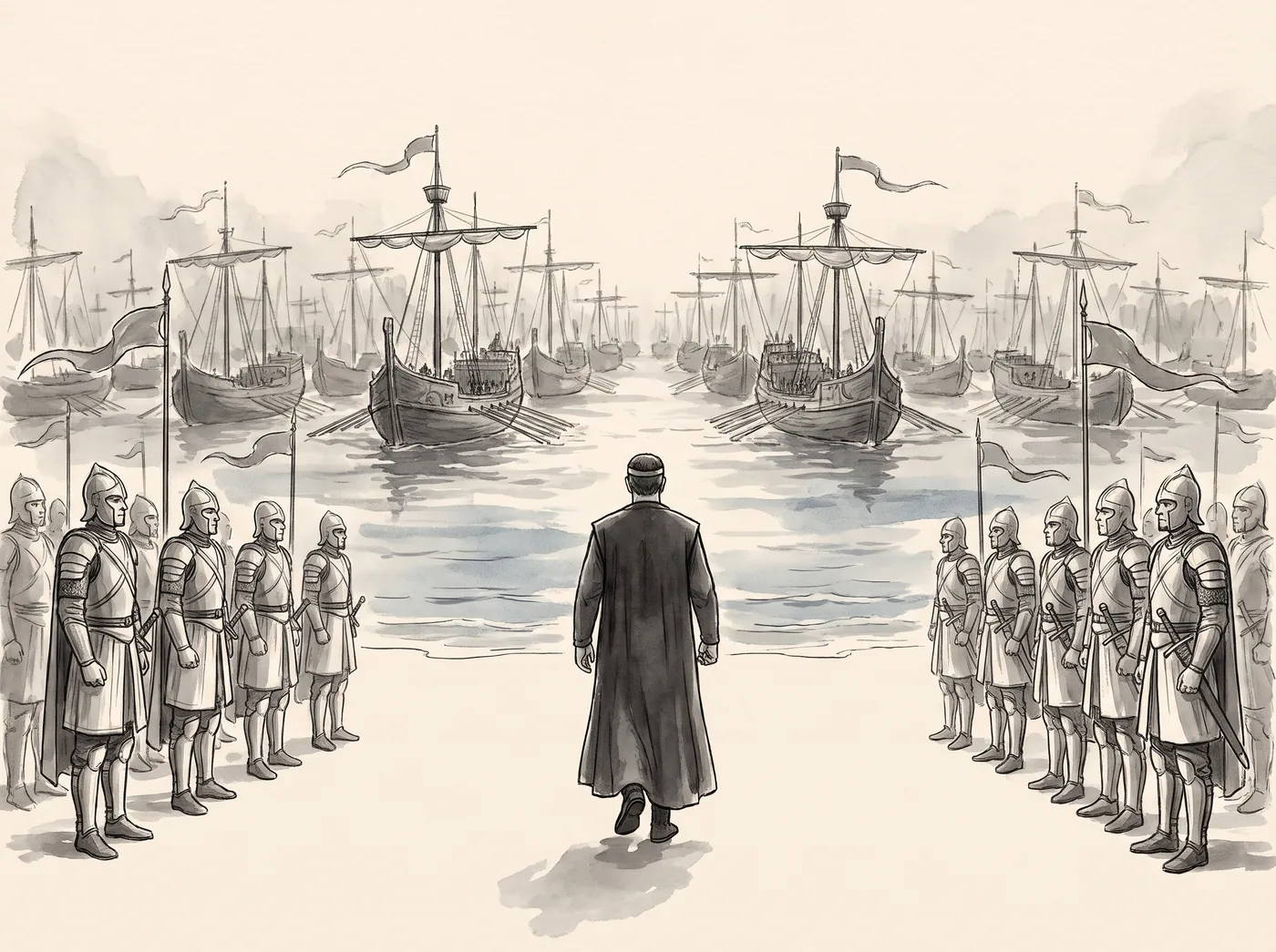
Ar-Pharazôn, the last and proudest king of Númenor, landed at Umbar with a fleet so great that Sauron's own servants deserted him, and Sauron surrendered rather than fight. He was taken back to the island as a prisoner. Within three years the prisoner was the king's closest counsellor. Then the White Tree was cut down, a temple to Morgoth went up with a fire in it, and the king was being told that the only thing standing between him and eternal life was a short voyage west.

Umbar

Told in full: Ar-Pharazôn, the king who chose to invade heaven →
Ink wash: The Downfall, Númenor, drowned; the Undying Lands, removed from the world
24

The Downfall

S.A. 3319

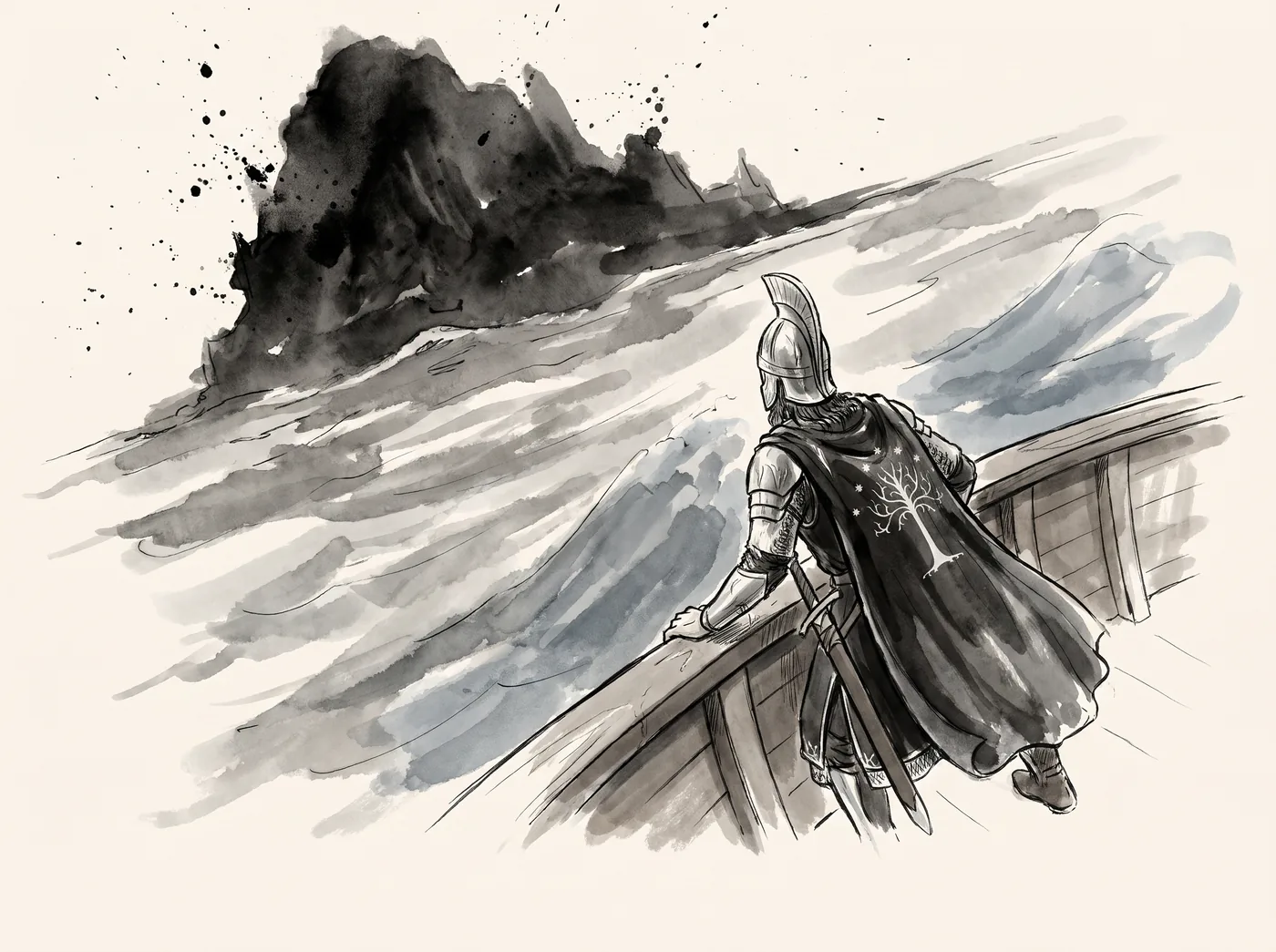
Ar-Pharazôn sailed on Valinor with the greatest fleet ever built and set foot on the forbidden shore. The Valar laid down their guardianship and called on the One, and the world was changed: a chasm opened in the sea and swallowed the fleet, Númenor went down under the water, and the flat world was bent into a round one, with the Undying Lands taken out of it altogether. Nine ships escaped on the storm, led by Elendil and his sons Isildur and Anárion. Sauron's body drowned with the island; his spirit went back to Mordor and never looked fair again.

Númenor, drowned; the Undying Lands, removed from the world

Told in full: How the world changed across five ages →
Ink wash: The realms in exile, Osgiliath
25

The realms in exile

S.A. 3320

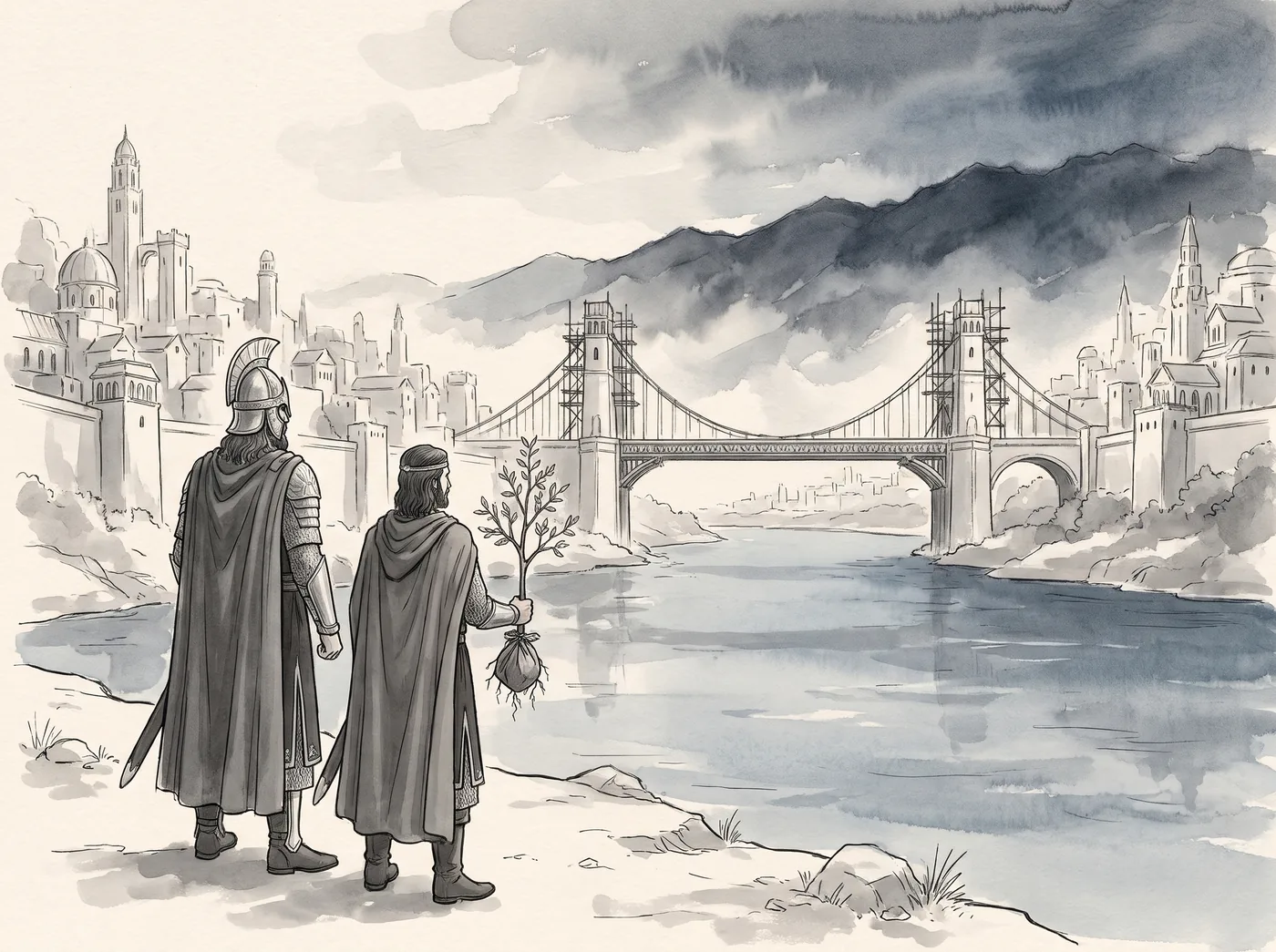
Elendil's ships were thrown onto the coasts of Middle-earth and the survivors founded two kingdoms: Arnor in the north under Elendil, and Gondor in the south under his sons, with its capital at Osgiliath astride the Great River and a seedling of the White Tree planted in Minas Ithil. They brought the seven seeing-stones with them. Across the mountains, in Mordor, Sauron was already rebuilding.

Osgiliath

Told in full: Elendil the Tall →
Ink wash: The Last Alliance, Barad-dûr
26

The Last Alliance

S.A. 3434 to 3441

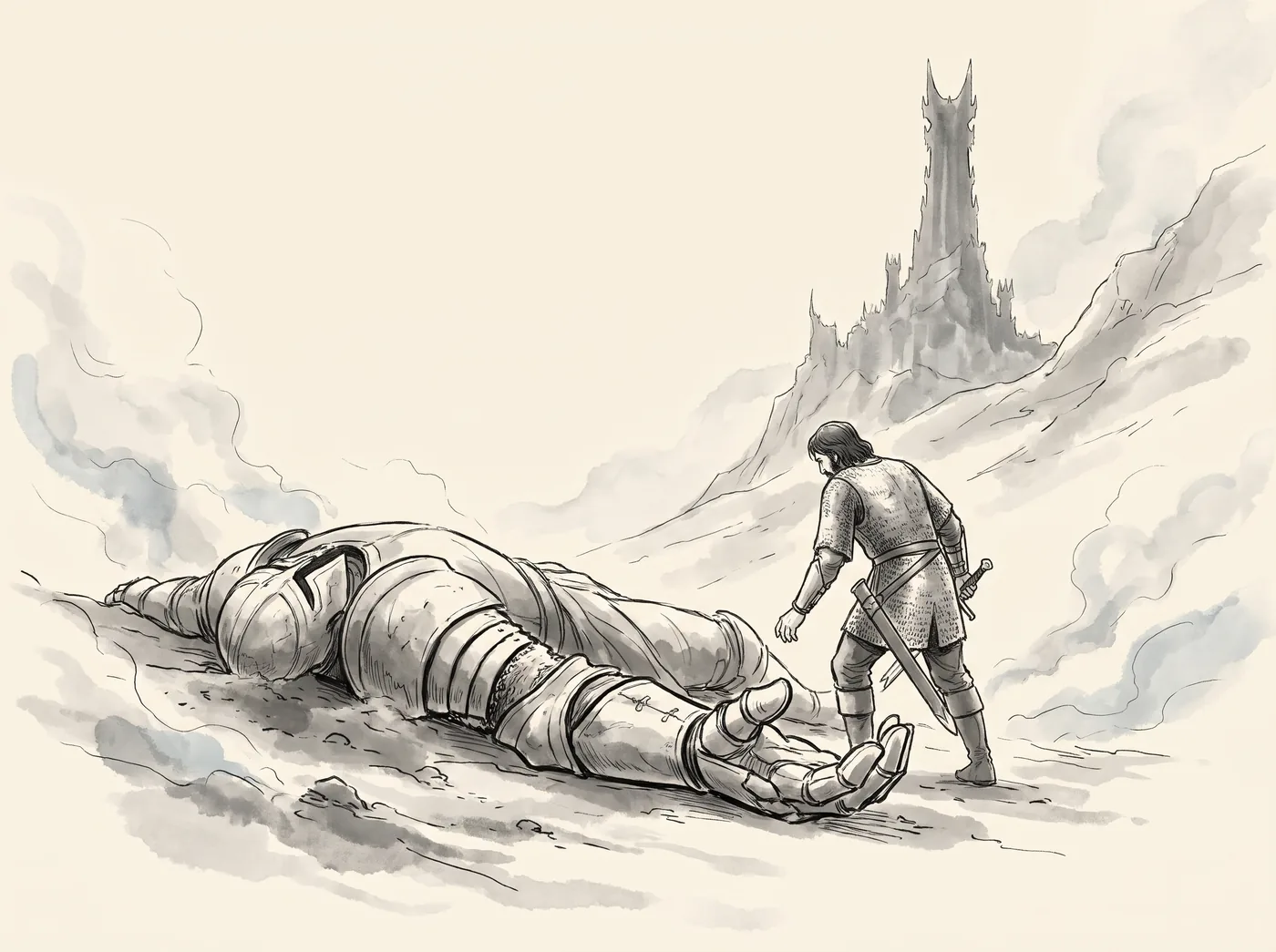
Elendil and Gil-galad, the last High King of the Noldor, made an alliance and marched on Mordor together. They won the battle of Dagorlad on the plain before the Black Gate and then besieged Sauron's tower for seven years. At the end Sauron came out himself and fought both kings on the slopes of Mount Doom. Both died, Elendil's sword broke under him, and his son Isildur picked up the hilt-shard and cut the Ring from Sauron's hand. Sauron's body fell apart. The Ring did not.

Isildur cut the Ring from his hand with the hilt-shard of his father's sword, and took it for his own.

The Fellowship of the Ring, Book II ch. 2, The Council of Elrond

Barad-dûr

Told in full: The Last Alliance of Elves and Men →

The Third Age

the Ring's long road to a hobbit

Ink wash: The Ring goes into the river, the Gladden Fields
27

The Ring goes into the river

T.A. 2

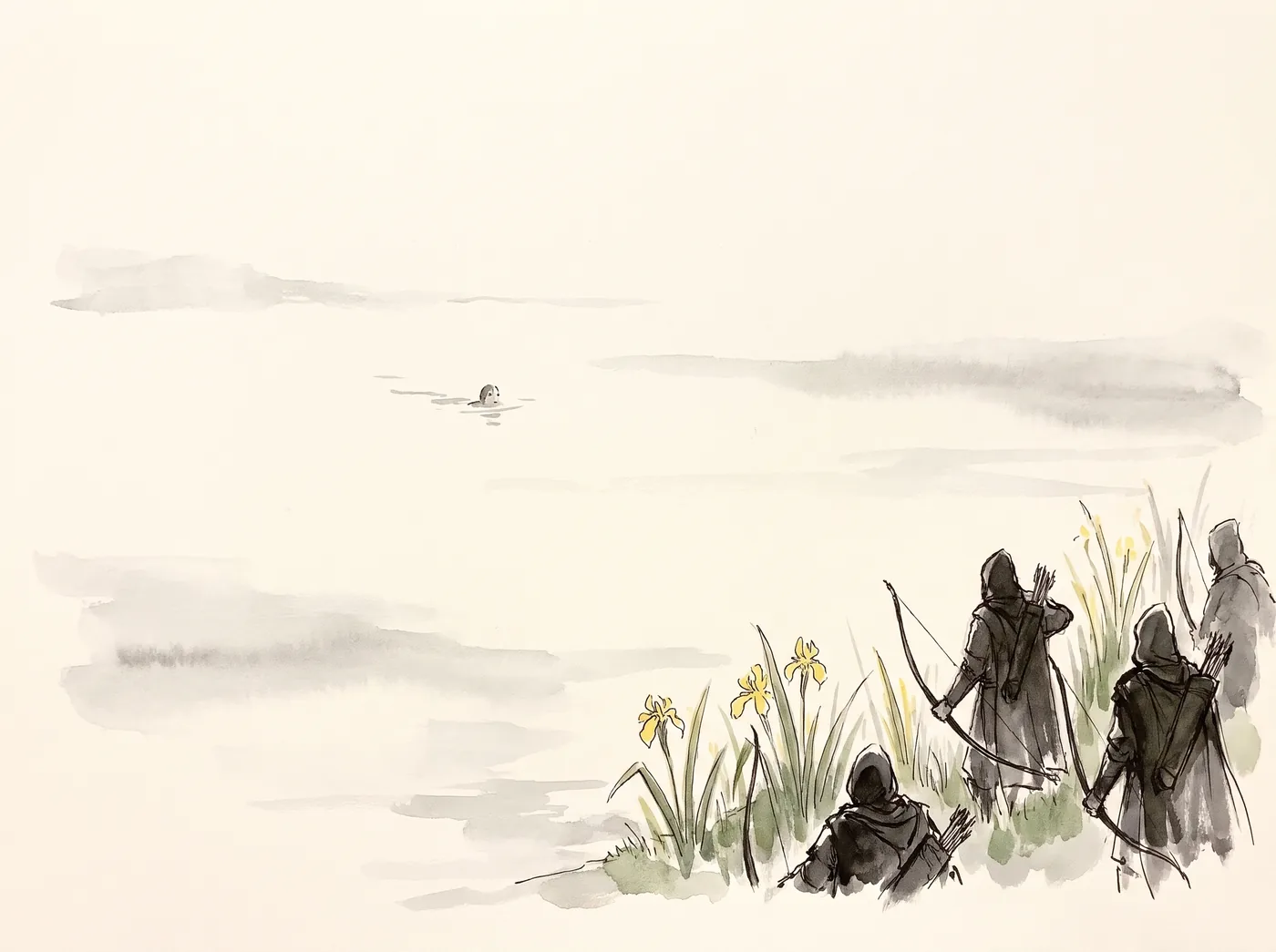
Isildur was told to throw the Ring into the fire of the mountain, close at hand. He kept it, as a weregild for his father and brother, and in the second year of the Third Age rode north with it. Orcs caught his company by the Great River among the gladden-flowers. He put on the Ring to escape, swam, and it slipped from his finger in the water, where the orcs saw him and shot him. The Ring lay in the river mud for nearly two and a half thousand years.

It was hot when I first took it, hot as a glede, and my hand was scorched

The Fellowship of the Ring, The Council of Elrond (Isildur's scroll)

the Gladden Fields

Told in full: Isildur, hero and failure →
Ink wash: A fisherman finds it, the Gladden Fields
28

A fisherman finds it

T.A. c. 2463

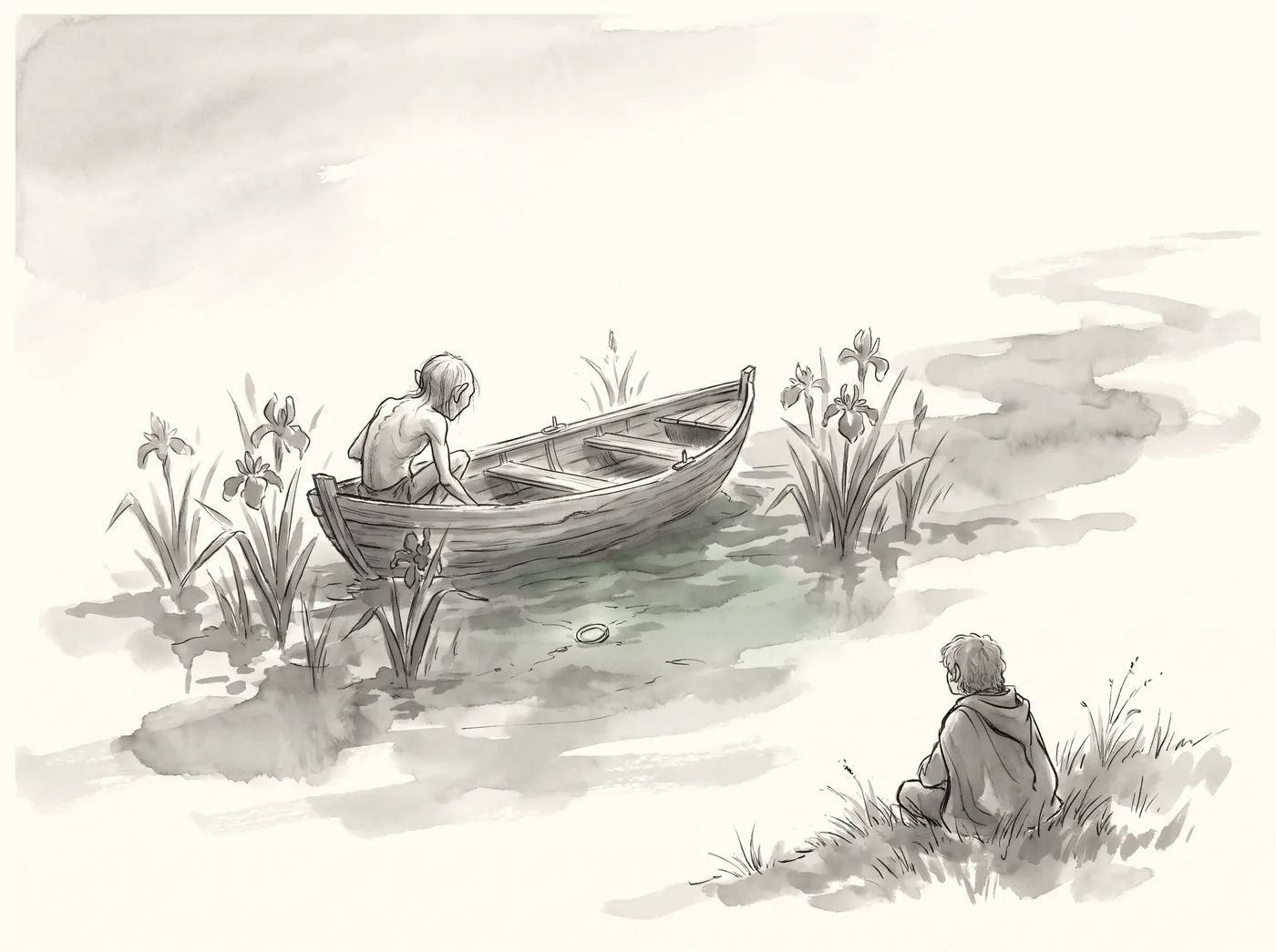
A hobbit of a river-dwelling kind called Déagol was fishing near the Gladden Fields when a fish pulled him in, and on the bottom he saw something gold. His friend Sméagol wanted it for a birthday present and strangled him for it. Sméagol crept with the Ring into the roots of the Misty Mountains and stayed there for nearly five hundred years, and became the creature you know as Gollum.

the Gladden Fields

Told in full: Who are the Stoors? →
Ink wash: A shadow in the south of the wood, Dol Guldur
29

A shadow in the south of the wood

T.A. 2850

A thousand years into the Third Age a power nobody could name took a hill in the south of Greenwood, and the forest became Mirkwood. The Wise called it the Necromancer and argued for centuries about what it was. In 2850 Gandalf walked into Dol Guldur and found out: it was Sauron, taking shape again, and gathering the rings he had lost. The Ring under the mountains was already stirring to go back to him. It just needed a hand to carry it.

Dol Guldur

Told in full: The White Council and the Necromancer →
Ink wash: A hand in the dark, under the Misty Mountains
30

A hand in the dark

T.A. 2941

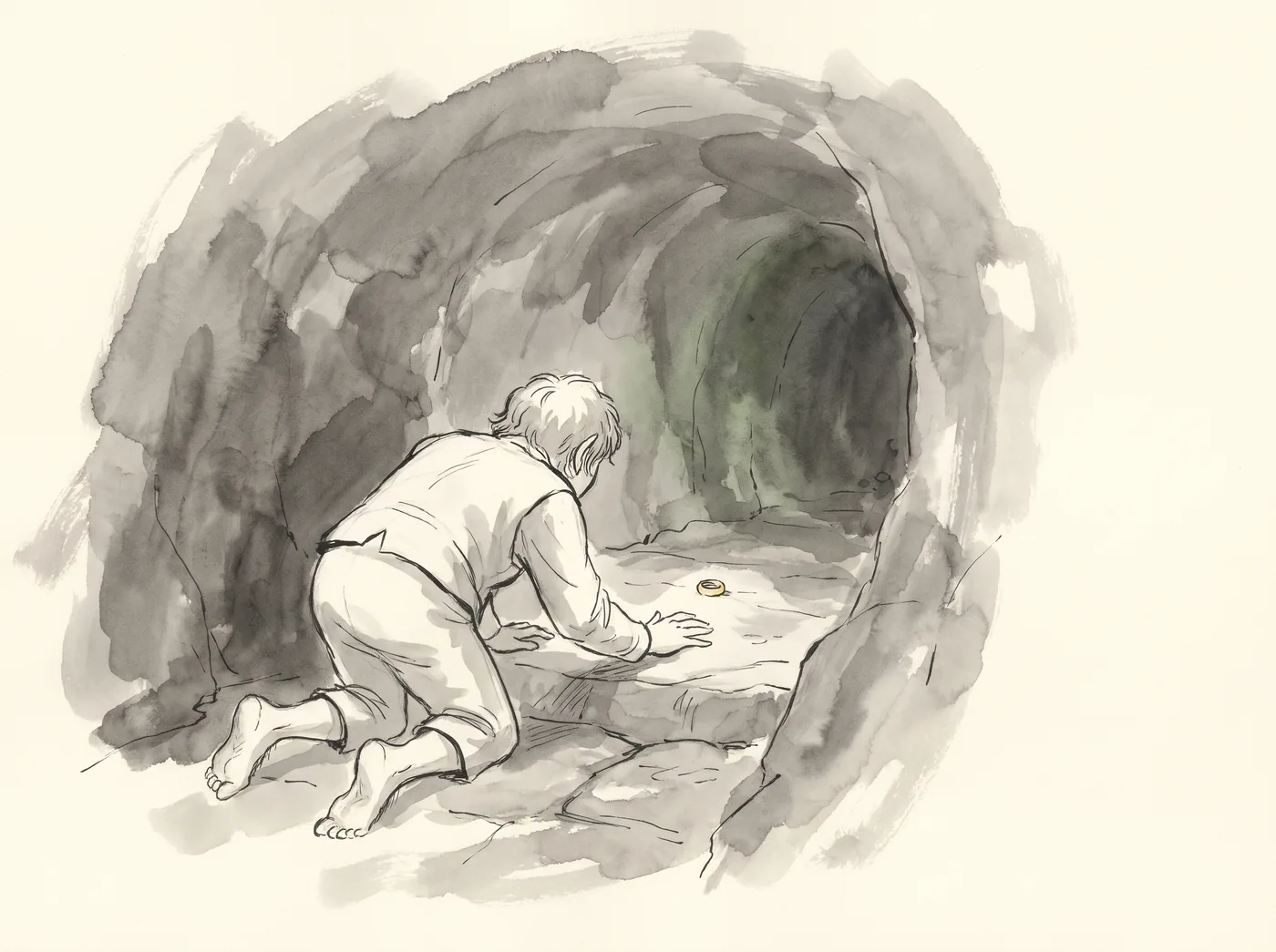
A hobbit of the Shire, out of his depth on somebody else's adventure, was knocked out in a goblin tunnel under the Misty Mountains and woke in the dark alone. Crawling, he put his hand on a small cold ring on the floor and put it in his pocket without thinking about it. It had been lost to its maker for nearly three thousand years, and it had just slipped away from Gollum. Everything you already know starts here.

It was a turning point in his career, but he did not know it.

The Hobbit, Riddles in the Dark

under the Misty Mountains

Everything here is from the books, and in this order. The Second and Third Age dates are Appendix B of The Lord of the Rings, which is exact to the year. The published Silmarillion mostly does not number its years, so where a date is marked from the Annals it comes from Tolkien's own year-by-year chronicles, the Annals of Aman and the Grey Annals, printed in The History of Middle-earth. They are his, but they are not in the book you can buy, and the page says so rather than pretending.

The two charts are the label-free maps the episodes draw on, and they cannot be joined: Beleriand, where the First Age happened, went under the sea at the end of it, and the map of the Third Age begins east of where it was. Valinor, Cuiviénen, Númenor and the Grinding Ice are off every chart in a different direction, and the page points the way rather than inventing a coast. Nothing is moved for tidiness.

Each picture links the episode that tells its scene in full, where there is one.

Read the whole story as text

Before the Sun: the Years of the Lamps and the Trees

1. The Music Before the world, before there was a map. Before there was a world there was a song. Eru, the One, showed the Ainur a theme and bade them make music of it, and the music became a vision of a world, and the vision became the world. Melkor, the mightiest of them, wove his own loud theme against it. Everything that follows, every ruin and every rescue, is that discord played out. Eä! Let these things Be! (The Silmarillion, Ainulindalë) Told in full: What are the Valar?

2. The Lamps fall The Years of the Lamps, a shape of the world that no longer exists. The world was lit first by two lamps on pillars taller than mountains, one in the north and one in the south, and the Valar lived on an island in the middle where the two lights met. Melkor built his fortress of Utumno in the dark of the far north and, when the moment came, threw the pillars down. Seas flooded, lands broke. The Valar left Middle-earth for Aman in the uttermost West and walled their new land with mountains. Told in full: Utumno, the prototype of evil

3. The Two Trees The Years of the Trees, Valinor, in the uttermost West, beyond the Sea. In Valinor, Yavanna sang two trees out of a green mound. Telperion gave a silver light and Laurelin a gold one, and each waxed and waned in seven hours, so that twice in every day the two lights mingled. This is the light the whole legendarium keeps trying to get back. The Silmarils hold it, the Phial of Galadriel holds a thread of it, and the Sun and Moon are its last fruit and flower.

4. The Elves wake under the stars Y.T. 1050 (from the Annals), Cuiviénen, far to the east of any chart of the Third Age. There was no sun yet. Varda made new stars for the coming of the Elves, and by a lake called Cuiviénen, far in the east of Middle-earth, they woke. The first thing they saw was the stars and the first thing they heard was water. Oromë the hunter found them. So did Melkor, and the ones his servants took into the dark are, the wisest guess, where Orcs came from. while they dwelt yet silent by Cuiviénen their eyes beheld first of all things the stars of heaven (The Silmarillion, ch. 3, Of the Coming of the Elves and the Captivity of Melkor) Told in full: The awakening of the Elves

5. The Valar break the north Y.T. 1090 to 1100 (from the Annals), Utumno, in the far north; the land it stood in was broken. To make Middle-earth safe for the Elves, the Valar went to war. They broke Utumno open, chained Melkor and kept him in the halls of Mandos for three ages, and the fighting changed the shape of the world: the sea broke in upon the coasts, a great gulf opened in the south, and many lesser bays were made, of which the Bay of Balar was the chief. Then they brought the Elves west to Valinor, which is why the Elves of the stories are split into those who went and those who stayed. Told in full: The War of the Powers

6. The king who stopped walking Y.T. 1130s (from the Annals), Nan Elmoth. On the great march west one of the Elf-lords, Elwë, walked into a wood called Nan Elmoth and met Melian, a spirit of the Valar's own kind, and stood with her hand in his while the years went by. Most of his people went on without him; those who stayed behind to search for him became his. When he came out he was Thingol, the grey king, and with Melian he made Doriath: the Thousand Caves of Menegroth, and a fence of enchantment round the whole forest that nothing could pass without her leave. Told in full: Doriath, the hidden kingdom

7. Fëanor makes the Silmarils Y.T. 1449 to 1450 (from the Annals), Tirion upon Túna, in Valinor. Fëanor, the greatest craftsman the Elves ever had, caught the mingled light of the Two Trees in three jewels. Even Varda hallowed them, so that no evil hand could hold them and not be burned. He loved them past reason and began to keep them locked away. Half of everything that happens from here to the end of the First Age is somebody trying to get these three stones. Told in full: The Silmarils: why three jewels doomed an age

8. The Darkening of Valinor Y.T. 1495 (from the Annals), Ezellohar, the green mound before the gates of Valmar. Released after three ages and pretending to be reformed, Melkor found an ally in Ungoliant, a spider-shaped hunger who lived in the dark south. Together, at a festival, they came to the Trees. Melkor stabbed them and Ungoliant drank them dry. In the dark that followed he went north, killed Fëanor's father Finwë at his door, and took the Silmarils. From then on the Elves called him Morgoth, the Black Enemy. Told in full: Ungoliant: is she still alive?

9. The Oath, the ships, the Ice Y.T. 1495 to 1500 (from the Annals), the Helcaraxë, the Grinding Ice, north of any chart. Fëanor swore an oath, with his seven sons, to pursue anyone who kept a Silmaril from them, and led most of the Noldor out of Valinor against the Valar's will. To get ships they killed their own kin at the harbour of Alqualondë. Mandos pronounced their doom. Fëanor took the ships, crossed, and burned them. His half-brother Fingolfin, abandoned on the far shore, led his people over the grinding ice of the far north on foot. Tears unnumbered ye shall shed; and the Valar will fence Valinor against you, and shut you out (The Silmarillion, ch. 9)

The First Age: the War of the Jewels

10. The Sun rises for the first time F.A. 1 (from the Annals), Mithrim. Out of the last flower of the dead Trees the Valar made the Moon, and out of the last fruit the Sun. The Moon rose as Fingolfin's people came off the ice, and they blew their trumpets to greet it. When the Sun came up for the very first time, rising in the West, his host was marching into Mithrim with banners unfurled, and Morgoth's creatures fled into Angband. Fëanor was already dead, cut down by Balrogs within sight of Angband. The Years of the Sun are counted from this sunrise.

11. The Siege, and the hidden cities F.A. 60 to 455 (from the Annals), Gondolin. The Noldor beat Morgoth back into Angband and sat down outside it for nearly four hundred years, a siege they could never finish because they could not get in. Behind the siege, two kings built in secret. Finrod dug Nargothrond into a gorge of the river Narog. Turgon, warned in a dream, led his people into a hidden valley ringed by mountains and built Gondolin there, and Morgoth did not learn where it was until almost the end of the age. Told in full: Angband, the Hells of Iron

12. Fingolfin rides to the gate F.A. 455 to 456 (from the Annals), the gate of Angband. On a winter's night Morgoth sent rivers of fire out of Angband across the grassy plain where the besiegers camped, and the plain became the Anfauglith, the choking dust. The siege ended in a night. Fingolfin, High King of the Noldor, hearing of the ruin, rode alone to the gate of Angband and called Morgoth out to fight. Morgoth came. Fingolfin wounded him seven times before he died under Morgoth's foot, and Morgoth limped ever after. Told in full: The Ring of Barahir

13. A Silmaril cut from the crown F.A. 465 to 466 (from the Annals), Angband. A mortal man, Beren, asked King Thingol for his daughter's hand, and Thingol, meaning never, set the price at a Silmaril from Morgoth's crown. Lúthien went with him. In the throne room of Angband she sang Morgoth and his whole court to sleep, and Beren cut a Silmaril from the iron crown with a knife. On the way out the wolf Carcharoth bit off his hand with the jewel in it. Thingol got his Silmaril in the end, out of the wolf. Even now a Silmaril is in my hand. (The Silmarillion, ch. 19) Told in full: Lúthien, the most powerful being in Middle-earth

14. Unnumbered Tears F.A. 472 (from the Annals), the Anfauglith. Fëanor's son Maedhros gathered every Elf, Man and Dwarf who would come and marched on Angband in one great attack. Morgoth had already bought Ulfang the Easterling and his sons, and their treachery turned the battle on the Anfauglith into the worst defeat of the age. Húrin of Dor-lómin and his men held the rearguard so that Turgon could get away, and at the last Húrin stood alone, shouting as he swung his axe, until he was taken alive. Morgoth set him in a chair on a mountain and made him watch what happened to his children. Aurë entuluva! Day shall come again! (The Silmarillion, ch. 20) Told in full: Nirnaeth Arnoediad

15. Túrin and the dragon F.A. 495 to 499 (from the Annals), Nargothrond. Húrin's son Túrin spent his life trying to outrun a curse and leading it to everyone he loved. He talked Nargothrond into fighting in the open, and the dragon Glaurung burned the host, sacked the city, and held Túrin with his eyes while the woman who loved him was taken away. Years later, in the forest of Brethil, Túrin climbed a gorge in the dark and put his black sword through the dragon's belly from beneath. When he learned what the dragon's lies had cost him he fell on that sword. Told in full: The Children of Húrin

16. The Fall of Gondolin F.A. 510 (from the Annals), Gondolin. The hidden city was sold by one of its own. Maeglin, the king's nephew, was caught outside the mountains, taken to Angband, and bought his life with the secret. At midsummer Morgoth sent dragons, Balrogs and orcs over the northern heights. Turgon died in his tower. Tuor, a mortal, and the king's daughter Idril led the survivors out through a tunnel she had dug in secret, and among them was their small son, Eärendil. Told in full: The Fall of Gondolin

17. Eärendil sails into the West F.A. 538 to 542 (from the Annals), the Mouths of Sirion. The refugees of Gondolin and Doriath gathered at the Mouths of Sirion, and Elwing, Beren and Lúthien's granddaughter, kept the Silmaril there. Fëanor's sons attacked for it. Elwing threw herself into the sea with the jewel and came to her husband Eärendil's ship as a white bird. With the Silmaril bound on his brow Eärendil sailed where no mortal was allowed, to Valinor, and asked the Valar to come and finish Morgoth. They said yes. Then they set him in the sky with the jewel, and he is the evening star. Hail Eärendil, of mariners most renowned, the looked for that cometh at unawares, the longed for that cometh beyond hope! (The Silmarillion, ch. 24) Told in full: Eärendil the Mariner

18. The War of Wrath F.A. 545 to 587 (from the Annals), Thangorodrim. The host of the Valar came out of the West and fought Morgoth for over forty years. He sent out the winged dragons, the first anyone had seen, and Eärendil in his flying ship killed the greatest of them. Thangorodrim, the three peaks over Angband, was broken. Morgoth was chained with the chain made for him long ago and thrust out of the world through the Door of Night. The fighting sank Beleriand under the sea. Almost everything on this chart drowned; only a strip in the east and a few hilltops, now islands, stayed above the water. Told in full: The War of Wrath

19. Fire and sea F.A. 587 (from the Annals), the shore of a drowning land. Two Silmarils came out of Morgoth's crown and into the camp of the Valar, and the two surviving sons of Fëanor, still bound by the oath, stole them. The jewels burned their hands. Maedhros threw himself with his into a chasm of fire. Maglor threw his into the sea and walked the shore ever after, singing. One Silmaril in the sky, one in the earth, one in the sea: the oath was done, and so was the First Age.

The Second Age: Númenor and the Rings

20. An island for Men S.A. 32, Númenor, in the western sea, west of any chart of Middle-earth. The Men who had fought beside the Elves were given an island in the western sea, raised for them out of the water, within sight of the Undying Lands and forbidden to sail there. Elros, Eärendil's son, chose to be mortal and became its first king; his twin brother Elrond chose otherwise. For two thousand years the Númenóreans grew into the greatest sailors and builders the world had seen, and lived three times as long as other Men.

21. The Lord of Gifts S.A. c. 1200 to 1590, Eregion. Morgoth's lieutenant Sauron survived the war and, after a long quiet, came to the Elf-smiths of Eregion as a beautiful stranger calling himself Annatar, the Lord of Gifts. He taught them. Together they made the Rings of Power, and the greatest smith, Celebrimbor, Fëanor's grandson, made the three Elven rings last and alone, without Sauron's hand on them. Told in full: Annatar's deception

22. One Ring, in secret S.A. c. 1600 to 1697, Orodruin. In the fire of Orodruin, in Mordor, Sauron forged a ring to rule the others and poured a great part of his own power into it. The moment he put it on, the Elves wearing theirs felt him and took them off. So he came for the rings in war. Eregion was destroyed, Celebrimbor was killed, and the three Elven rings were hidden, which is why Gandalf, Galadriel and Elrond still have them when the story you know begins. Told in full: How the Rings of Power were really forged

23. The king who took Sauron prisoner S.A. 3262, Umbar. Ar-Pharazôn, the last and proudest king of Númenor, landed at Umbar with a fleet so great that Sauron's own servants deserted him, and Sauron surrendered rather than fight. He was taken back to the island as a prisoner. Within three years the prisoner was the king's closest counsellor. Then the White Tree was cut down, a temple to Morgoth went up with a fire in it, and the king was being told that the only thing standing between him and eternal life was a short voyage west. Told in full: Ar-Pharazôn, the king who chose to invade heaven

24. The Downfall S.A. 3319, Númenor, drowned; the Undying Lands, removed from the world. Ar-Pharazôn sailed on Valinor with the greatest fleet ever built and set foot on the forbidden shore. The Valar laid down their guardianship and called on the One, and the world was changed: a chasm opened in the sea and swallowed the fleet, Númenor went down under the water, and the flat world was bent into a round one, with the Undying Lands taken out of it altogether. Nine ships escaped on the storm, led by Elendil and his sons Isildur and Anárion. Sauron's body drowned with the island; his spirit went back to Mordor and never looked fair again. Told in full: How the world changed across five ages

25. The realms in exile S.A. 3320, Osgiliath. Elendil's ships were thrown onto the coasts of Middle-earth and the survivors founded two kingdoms: Arnor in the north under Elendil, and Gondor in the south under his sons, with its capital at Osgiliath astride the Great River and a seedling of the White Tree planted in Minas Ithil. They brought the seven seeing-stones with them. Across the mountains, in Mordor, Sauron was already rebuilding. Told in full: Elendil the Tall

26. The Last Alliance S.A. 3434 to 3441, Barad-dûr. Elendil and Gil-galad, the last High King of the Noldor, made an alliance and marched on Mordor together. They won the battle of Dagorlad on the plain before the Black Gate and then besieged Sauron's tower for seven years. At the end Sauron came out himself and fought both kings on the slopes of Mount Doom. Both died, Elendil's sword broke under him, and his son Isildur picked up the hilt-shard and cut the Ring from Sauron's hand. Sauron's body fell apart. The Ring did not. Isildur cut the Ring from his hand with the hilt-shard of his father's sword, and took it for his own. (The Fellowship of the Ring, Book II ch. 2, The Council of Elrond) Told in full: The Last Alliance of Elves and Men

The Third Age: the Ring's long road to a hobbit

27. The Ring goes into the river T.A. 2, the Gladden Fields. Isildur was told to throw the Ring into the fire of the mountain, close at hand. He kept it, as a weregild for his father and brother, and in the second year of the Third Age rode north with it. Orcs caught his company by the Great River among the gladden-flowers. He put on the Ring to escape, swam, and it slipped from his finger in the water, where the orcs saw him and shot him. The Ring lay in the river mud for nearly two and a half thousand years. It was hot when I first took it, hot as a glede, and my hand was scorched (The Fellowship of the Ring, The Council of Elrond (Isildur's scroll)) Told in full: Isildur, hero and failure

28. A fisherman finds it T.A. c. 2463, the Gladden Fields. A hobbit of a river-dwelling kind called Déagol was fishing near the Gladden Fields when a fish pulled him in, and on the bottom he saw something gold. His friend Sméagol wanted it for a birthday present and strangled him for it. Sméagol crept with the Ring into the roots of the Misty Mountains and stayed there for nearly five hundred years, and became the creature you know as Gollum. Told in full: Who are the Stoors?

29. A shadow in the south of the wood T.A. 2850, Dol Guldur. A thousand years into the Third Age a power nobody could name took a hill in the south of Greenwood, and the forest became Mirkwood. The Wise called it the Necromancer and argued for centuries about what it was. In 2850 Gandalf walked into Dol Guldur and found out: it was Sauron, taking shape again, and gathering the rings he had lost. The Ring under the mountains was already stirring to go back to him. It just needed a hand to carry it. Told in full: The White Council and the Necromancer

30. A hand in the dark T.A. 2941, under the Misty Mountains. A hobbit of the Shire, out of his depth on somebody else's adventure, was knocked out in a goblin tunnel under the Misty Mountains and woke in the dark alone. Crawling, he put his hand on a small cold ring on the floor and put it in his pocket without thinking about it. It had been lost to its maker for nearly three thousand years, and it had just slipped away from Gollum. Everything you already know starts here. It was a turning point in his career, but he did not know it. (The Hobbit, Riddles in the Dark)
Ranger of the RealmsJourney Through Tolkien's Legendarium
Support
© 2026 Dreambytes. All rights reserved.