The promise
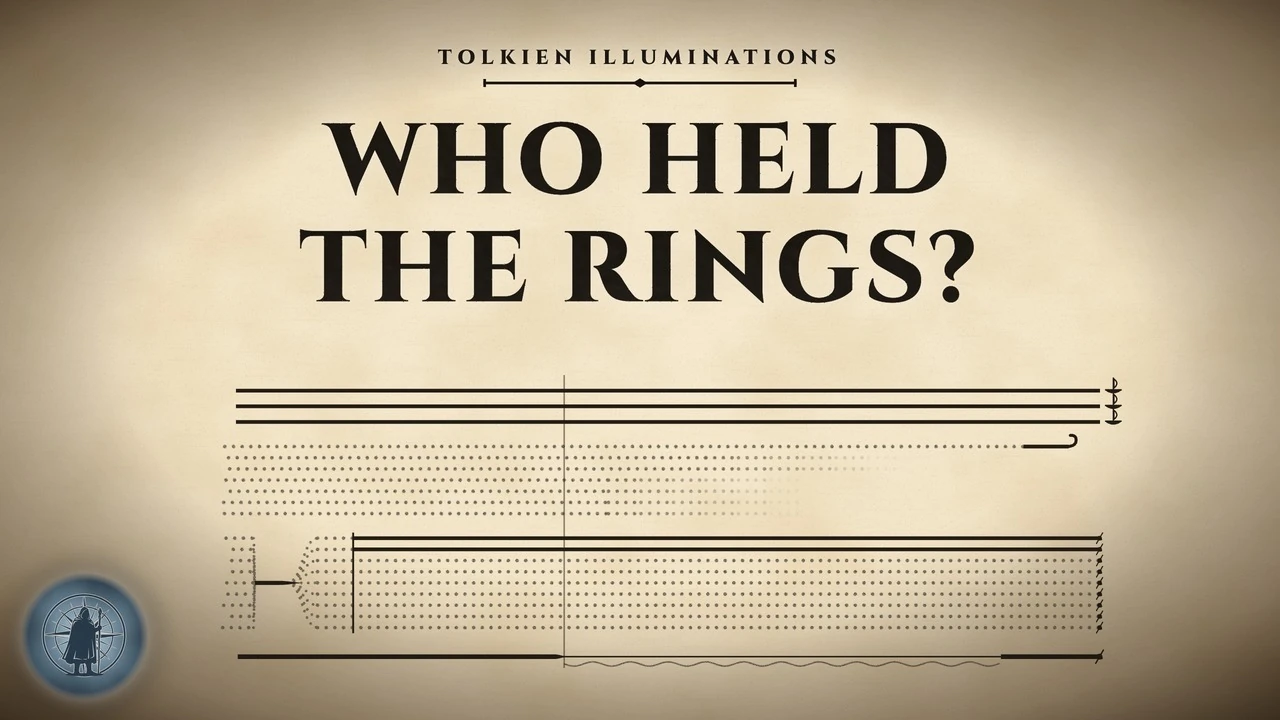
Three jewels, and every hand that ever held one, traced from beginning to end. The family that swore to own them is in it at the beginning, and at the very end. But they are nowhere in between.
Three Jewels and a Law
Fëanor made three jewels and caught in them the light of the Two Trees. These are the Silmarils. Then Varda hallowed them, so that no mortal flesh, no unclean hand, nothing evil could touch them without being scorched. Remember that, because it is the one kind of mark on this page that comes from Tolkien’s text and not from me.
One more thing before the ink starts. The book never tells the three apart. No names, no marks. When I number them one, two and three, those numbers are mine.
The Oath
The first change of hand is a murder. Melkor comes to Formenos, kills Fëanor’s father Finwë at the door, and takes all three. Fëanor names him Morgoth, and the name sticks. Morgoth sets the jewels in an iron crown, and the book says they burned his hands black, and black they stayed.
Then Fëanor and his seven sons swear an oath. It runs against anyone at all, friend or foe, Vala or Elf or Man, who keeps a Silmaril from them, and it ends on a list of offences: whoso hideth or hoardeth, or in hand taketh, finding keepeth or afar casteth a Silmaril. Mandos answers it with a doom. Their Oath, he says, shall drive them, and yet betray them, and ever snatch away the very treasures that they have sworn to pursue.
How to Read the Page
So here is the page. The three threads run together into the crown, and every time a jewel changes hands I tie a knot and stamp it with how. Taken, given, and a few rarer words. Those words are mine, not Tolkien’s. He never sorts them. Where the text says a hand was burned, the knot gets a second stamp. Where it says nothing, I leave it blank, because silence is not evidence. And there are no years. The Silmarillion gives almost none, so this chain just runs in order, not by specific dates.
One Leaves the Crown
For a long time, nothing moves. Then Beren and Lúthien come to Angband, and while Morgoth sleeps Beren cuts one Silmaril out of the crown with the knife Angrist. He reaches for a second and the knife snaps. Two stay where they are. The braid comes apart here, and the first jewel goes on alone.
It does not stay put for long. At the gate, the wolf Carcharoth bites off Beren’s hand, jewel and all, and it burns him from the inside. When the wolf is hunted down, the jewel is recovered from his belly, and Beren brings it to Thingol, the bride-price he was set to pay. Thingol has the Dwarves of Nogrod set it in a necklace, the Nauglamír. They kill him for it in his own halls and carry it off. Then Beren ambushes them at Sarn Athrad and takes it back.
Two Tries
After that the text barely mentions the hand-overs. Lúthien wore it on Tol Galen. Then their son Dior wore it in Doriath. And now the Oath comes for it.
The sons of Fëanor attack Doriath. Dior is killed, and so are three of the sons: Celegorm, Curufin and Caranthir. Dior’s daughter Elwing escapes with the jewel. I stamp that knot orphaned. Later the sons who are left attack her at the mouths of Sirion, and two more of them die there. And with the Silmaril upon her breast she cast herself into the sea. Ulmo carried her up as a white bird, and she flew to her husband, Eärendil. Two Kinslayings over one jewel. But no jewels were won here.
The Sky
Eärendil sailed to Valinor with the jewel on his brow, and his ship was set in the heavens. That is the end of the first thread. By my count it passed through ten hands: Fëanor, Morgoth, Beren, a wolf, a king, a company of Dwarves, Lúthien, Dior, Elwing and Eärendil. Not one of them a son of Fëanor.
The Last Two Hands
Back to the crown, where two jewels have sat this whole time. In the War of Wrath Morgoth is defeated, and the two Silmarils which remained to Morgoth were taken from his crown, and they shone unsullied beneath the sky; and Eönwë took them, and guarded them.
Maedhros and Maglor are the last sons left. They steal the two jewels from Eönwë’s camp and take one each. It is the first time in the whole chain that a son of Fëanor holds a Silmaril. But the jewel burned the hand of Maedhros in pain unbearable; and he perceived that it was as Eönwë had said, and that his right thereto had become void, and that the oath was vain. He threw himself into a chasm of fire, and his jewel went into the earth. Maglor cast his into the sea. The book never says which jewel each brother took, so that part of the split is mine as well. And thus it came to pass that the Silmarils found their long homes: one in the airs of heaven, and one in the fires of the heart of the world, and one in the deep waters.
The Tally
Now count the knots. This is my tally, of a text that never counts. Sixteen times a jewel changes hands. Nine of those are by force: eight taken, and one child left holding it when her father is killed. Thirteen hands in all. Twice the Oath went after a jewel with swords, at Doriath and at Sirion, and both times it came away with nothing. The only two jewels it ever held, it got by robbing a camp.
Afar Casteth
So here is the whole chain again. Three jewels, and every hand that ever held one. Fëanor at the top. Then a thief, a mortal man, a wolf, a king, his killers, a family, a mariner and a herald. And at the very end, two of his sons, one knot each. Remember how the Oath ended, the list of everyone it swore against. Whoso hideth or hoardeth, or in hand taketh, finding keepeth, or afar casteth a Silmaril. The last two hands in the chain belonged to the men who swore it, and they did the last thing on the list.
One jewel into the fire. One into the sea. And the third in the airs of heaven, the one jewel no son of Fëanor, ever held.