The promise
Sixty-three generations on his side. One on hers. The same grandfather.
Some Part in That Kinship
Rivendell, in the year 2951 of the Third Age. Aragorn is twenty. He has just been told his real name, and the next day at sunset he met Arwen in the woods. His mother Gilraen sees it on his face. It is not fit, she tells him, for a mortal to wed with the Elf-kin. He answers her: “Yet we have some part in that kinship, if the tale of my forefathers is true that I have learned.”
Of Lineage Greater Than Yours
Before the fall of that year, Elrond calls him in and gives the other half. Arwen, he says, “is of lineage greater than yours.” Both of them are right. Aragorn and Arwen are family, and Elrond’s daughter really does stand closer to where that family began. I wanted to see how both can be true at once, so I drew the family and counted.
A Maia at the Top
The ink starts with a marriage that should not have been possible. Melian was a Maia, one of the spirits who came into the world before there was a Sun. She married Thingol, king of the Elves of Doriath. Their daughter was Lúthien. Everyone from the twins down, on both sides, descends from her.
The House of Bëor
A second thread comes in from the left. Bëor led the first Men into Beleriand, and his line runs Baran, Boromir, Bregor, Barahir, and then Beren. Beren married Lúthien. Their son Dior was the child of a mortal man and a Maia’s daughter, and Dior’s daughter was Elwing.
The Other Grandparents
On the far side of the page, two more threads. Finwë, king of the Noldor, through his son Fingolfin, then Turgon of Gondolin, then Turgon’s daughter Idril. And the House of Hador: Hador, Galdor, Huor, and Huor’s son Tuor. Tuor married Idril, and their son was Eärendil. One faint line more. Tuor’s mother Rían was Bregor’s great-granddaughter. So when Eärendil married Elwing, the House of Bëor met itself.
The Twins Choose
Eärendil and Elwing had twin sons, Elrond and Elros. When the First Age ended, the Valar let each twin choose the kindred he would be judged among. Elrond chose the Elves. Elros chose to be a king among Men, and to die. From here the page has two threads, and they run at very different speeds.
The Fast Thread
Elros became the first King of Númenor and lived five hundred years. Then his son Vardamir, then Tar-Amandil, then Tar-Elendil, the fourth king. Tar-Elendil’s eldest child was a daughter, Silmariën. The sceptre went to her younger brother, so our thread steps off the throne here. Silmariën’s son Valandil became the first Lord of Andúnië.
The Blank Stretch
Here the record thins. The Lords of Andúnië held that house for over two thousand years, and Tolkien names almost none of them. The last, Amandil, is counted the eighteenth. If each lord was the son of the one before, which the books never quite say, that makes twenty-three generations from Elros to Amandil’s son, Elendil. I draw those lords as blanks.
Thirty-Nine Heirs
Elendil survived the drowning of Númenor and founded Arnor. His son Isildur died on the Gladden Fields. From Isildur the names come back, all of them. The Silmarillion calls Aragorn “the nine and thirtieth heir in the right line from Isildur.” Eight more kings of Arnor. Fifteen kings of Arthedain, ending with Arvedui, who drowned in the ice of Forochel. Then fifteen Chieftains of the Dúnedain with no kingdom at all, and Aragorn, the sixteenth.
The Count
So here is the count. From Elros down to Aragorn is sixty-three generations. From Elrond down to Arwen is one. Both threads left the twins at the same moment. Elros’s took about six thousand four hundred years to reach Aragorn. Elrond’s took about three thousand seven hundred to reach Arwen, and spent all of it on one step. The way genealogists count it, Arwen is Aragorn’s first cousin, sixty-two times removed.
What Greater Means
That is what Elrond meant. Arwen’s grandfather is Eärendil, who sails the sky with a Silmaril on his brow. Aragorn has the same grandfather, with sixty-two greats in front of it. It is the same blood, but on his side it has run through sixty-odd mortal lives. And Elrond watched a good share of those lives himself. After Arnor fell, every Chieftain’s son was fostered in Rivendell. From Arahael to Aragorn, that is fifteen boys, each one his brother’s descendant, raised in his house.
The Token
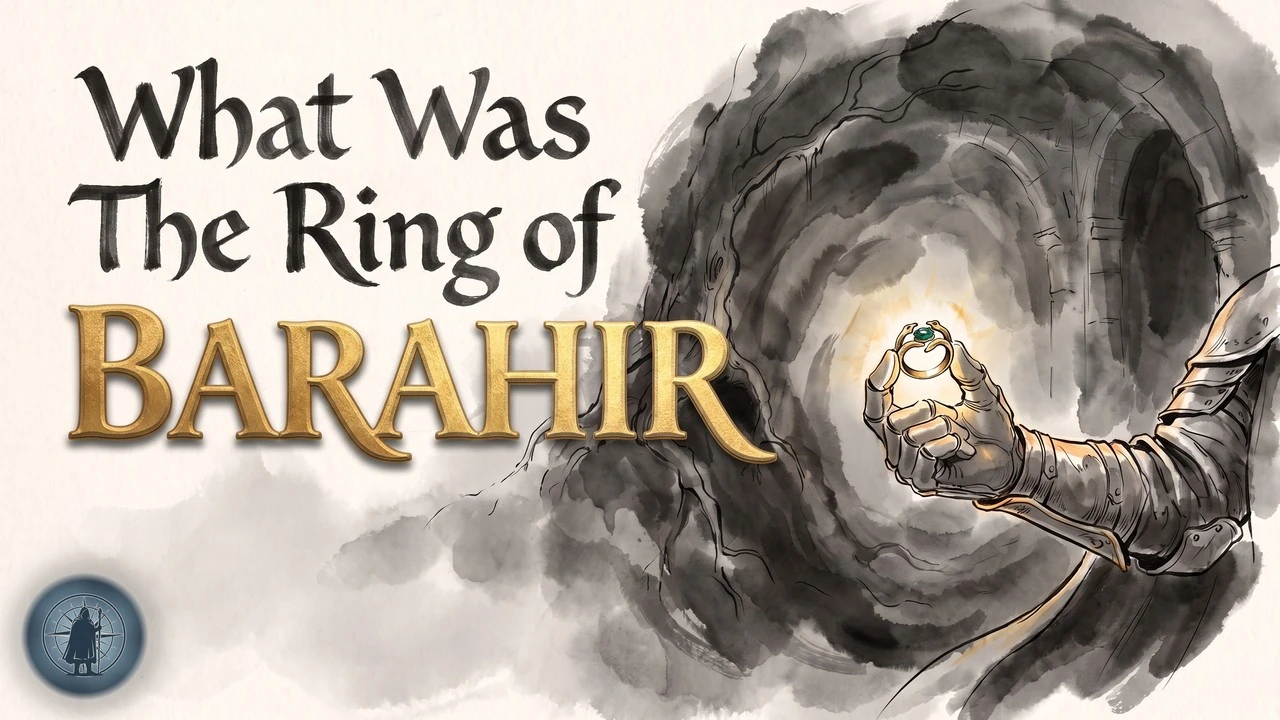
That is why, in 2951, Elrond hands Aragorn the Ring of Barahir and calls it “the token of our kinship from afar.” He means it literally. Barahir was Beren’s father. The ring comes from the place on the page where both threads were still one. In 2980, on the hill of Cerin Amroth, Aragorn gave it to Arwen.
The Choice Again
Arwen then made the choice her uncle made. Like Elros, and like Lúthien before him, she chose a mortal life. They married at Midsummer in 3019, in Minas Tirith.
Eldarion
Here the ink does something it has not done since the twins. Two threads come in from opposite sides of the page and meet in one name: their son, Eldarion. Counted through his mother, he is three steps from Eärendil. Counted through his father, sixty-five. In the year 120 of the Fourth Age, Aragorn gave him the winged crown of Gondor and the sceptre of Arnor. In Rivendell, at twenty, Aragorn had told his mother they had some part in that kinship. This is the part. Sixty-three generations down one side of the page, one down the other, and the two threads that parted at the twins meet again in a single name.