The promise
This line you’re looking at represents every year Tolkien counted, from the first light in the world to the exit of Middle-earth from the Grey Havens. The entire War of the Ring is in it, and you can’t see it.
Half a Year
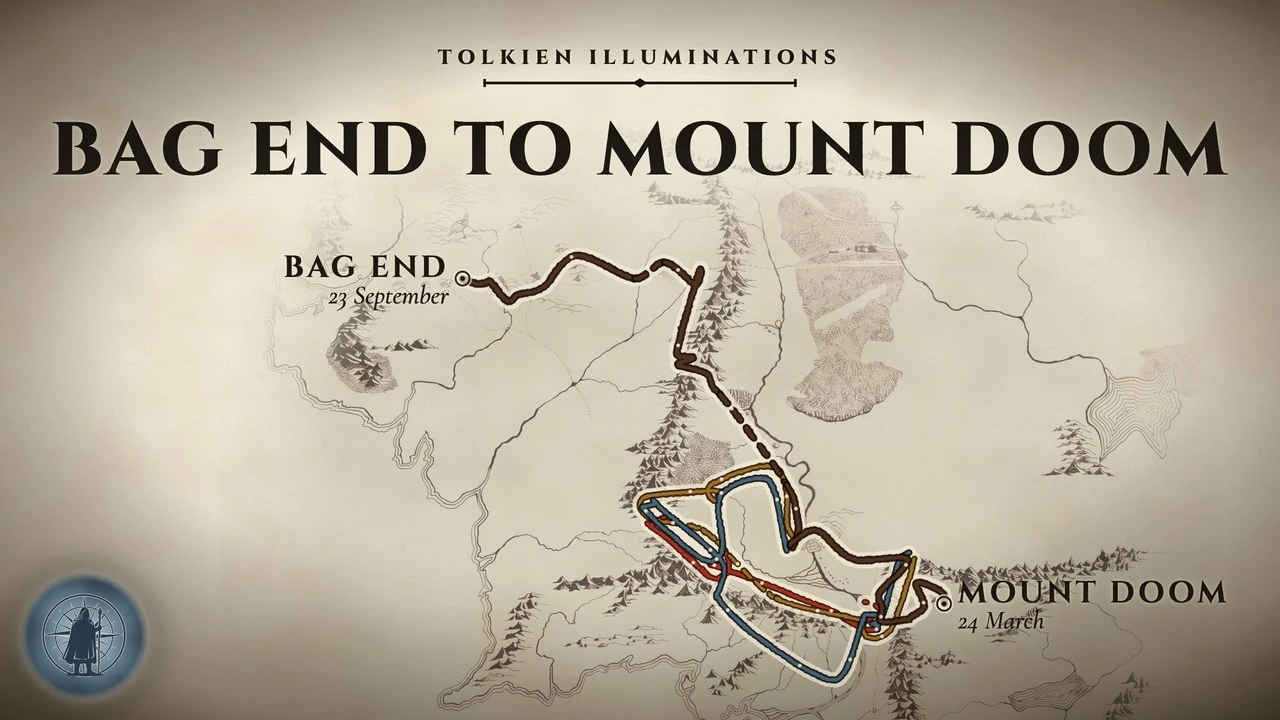
Start where the book is. On the twenty-third of September, 3018, Frodo leaves Bag End. On the twenty-fifth of March, 3019, the Ring goes into the Fire. That’s a hundred and eighty-four days, about half a year. Weathertop, Moria, Helm’s Deep, the Pelennor and Mount Doom all happen inside this bar. At this scale, it fills the page.
The Rules
Here’s how this works. There’s one line of ink, and its right-hand end is pinned where the Third Age ends, the year Frodo sails from the Grey Havens. Every time I pull back, I add the years that came before, on the left. Nothing gets erased. What’s already drawn just gets thinner. The ruler in the corner tells you what one stroke of the pen is worth. Solid ink means Tolkien printed the number himself. Hatched ink means the number comes from his drafts, and I’ll name the drafts when we get there.
Twenty Years
First pull. Bilbo’s birthday party is the twenty-second of September, 3001. Frodo sails in 3021. Twenty years, first page to last. The war that filled the page a moment ago is now a band you could cover with your thumb.
The Third Age
Pull again. Appendix B, the Tale of Years, counts the Third Age at three thousand and twenty-one years. The Battle of Five Armies comes in from the left, in 2941. Then the Fall of Arnor, in 1974. Then the founding of the Shire, in 1601. By the time we reach the first year of the Third Age, the whole book, all twenty years of it, is one stroke at the right-hand end.
The Second Age
The Second Age is longer: three thousand, four hundred and forty-one years. Númenor is founded in the year 32. The One Ring is forged in 1600. Númenor drowns in 3319, and the Last Alliance overthrows Sauron in 3441. The Ring is made in the middle of this age, and nearly all of its life is over before The Lord of the Rings opens. These two ages are the solid ink. Tolkien printed both numbers in Appendix B, and anyone with a copy can check them.
The First Age
Past the Last Alliance, the ink changes. The published Silmarillion has no Tale of Years. For the First Age of the Sun, the dates come from Tolkien’s Grey Annals, printed after his death in The History of Middle-earth, and they give it five hundred and eighty-seven years, give or take a few. Gondolin falls in 510. The War of Wrath ends the age in 587. It’s the shortest age on the line. Beren, Túrin and the fall of Gondolin all fit inside it. Add it up, and the three Ages of the Sun come to about seven thousand years. Before them, there was no Sun.
A Year of the Valar
So how do you count years with no Sun? The Valar counted by the light of the Two Trees. In the Annals of Aman, printed in Morgoth’s Ring, the tenth volume of The History of Middle-earth, Tolkien sets out the rate. A Valian hour is seven of our hours. A Valian year is a thousand Valian days. Work it through, and one Valian year is nine point five eight of ours. The published Silmarillion never tells you this. I’m using the conversion because it’s Tolkien’s own arithmetic, and I’ll show you what the line looks like without it.
The Years of the Trees
The Years of the Trees last fifteen hundred Valian years. That’s a little over fourteen thousand of ours. The Elves wake at Cuiviénen in the year 1050 of the Trees. In 1495, Melkor and Ungoliant destroy the Trees, and Fëanor swears his Oath. Five years later, the Sun rises for the first time. All seven thousand years of the Sun’s three ages are now the short end of the line, and the war is something you have to hunt for.
The Lamps
And before the Trees, the Lamps. The Annals give this stretch, from the coming of the Valar to the making of the Trees, three thousand five hundred Valian years, though the Lamps themselves burned for only part of it. In our years, that’s about thirty-three and a half thousand. It’s the biggest piece of the line, and the least certain: Tolkien’s drafts, read through a conversion he never put into print. The Lamps and the Trees together are eighty-seven of every hundred years on this line.
True Scale
Here’s the whole line. Counted with the conversion, it’s about fifty-five thousand years; read at face value, the way the published Silmarillion leaves you, it’s about twelve thousand. The War of the Ring is at the right-hand end. On the long count, it’s one part in more than a hundred thousand. On the short count, one part in twenty-four thousand. The entire Lord of the Rings book, all twenty years, is one part in about two thousand seven hundred. The ink has no width left to give the war. The flag above it isn’t the war. It’s there so you know where to look.
The Last Sliver
So this line represents every year Tolkien counted, from the first light in the world to Frodo and Bilbo leaving Middle-earth at the Grey Havens. The whole War of the Ring is in it, and you can’t see it. But there’s someone on the last ship out of the Havens who could. Galadriel sails with Frodo, and she was born in Valinor, under the light of the Trees. Her life starts back here, in the hatched ink, before the first sunrise, and runs all the way to the pin. This is Tolkien’s massive imagination. And it is overwhelming to think about the fact that the war most of us read about in three volumes is just a hairline near the end of what the great Galadriel remembers.