The promise
In 1917, Tolkien wrote the first of his Great Tales, The Fall of Gondolin. It didn’t come out as a book of its own until a hundred and one years later.
The Ruler
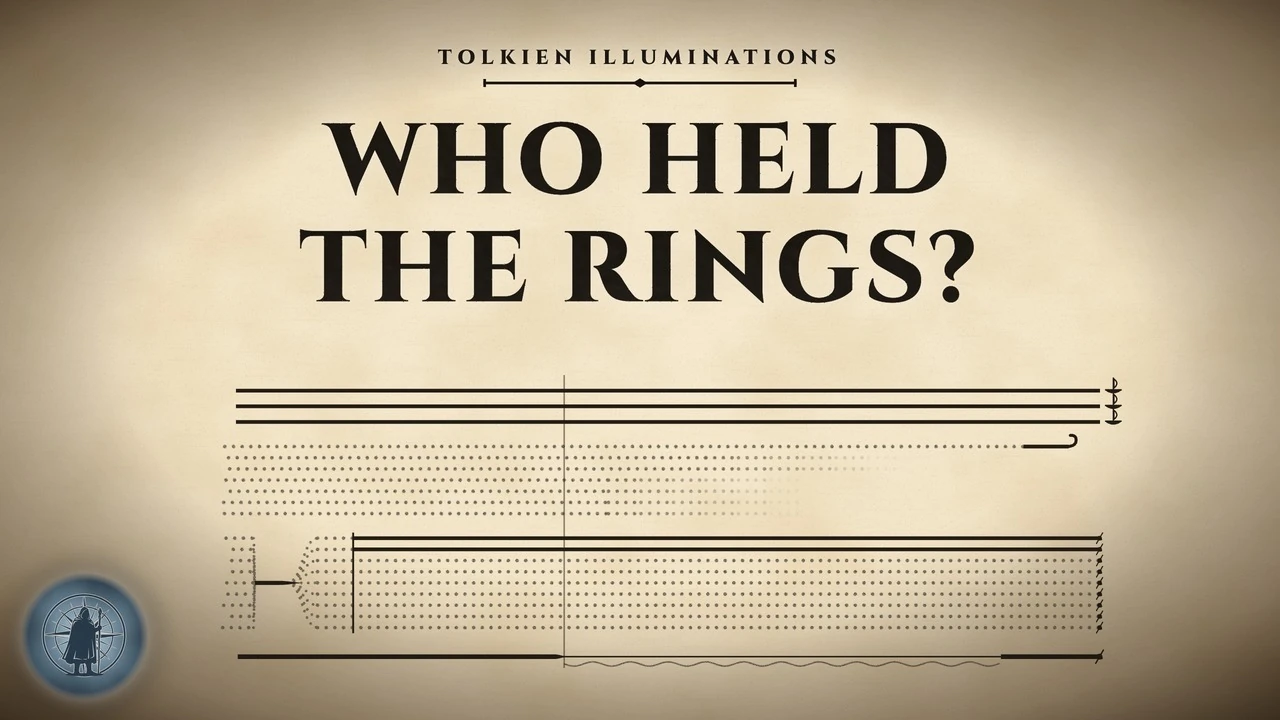
Here’s how this works. This ruler runs from 1914 to 2022. It starts in September 1914, when Tolkien wrote a poem called The Voyage of Earendel the Evening Star. Every book gets one thread of ink. The thread starts the year he began writing it and ends the year it was published. Where the start is firm, the thread begins with a clean dot. Where the sources only give a range, the start is soft, and I’ll give you the range. Keep an eye on the ink of the ruler itself. It changes twice.
What Counts
First, what I’m counting. By his books I mean his Middle-earth prose: the stories, and the drafts and essays behind them. The poems, like The Adventures of Tom Bombadil, the song settings and the letters sit outside that count, and so do Farmer Giles, Smith of Wootton Major and the other books outside Middle-earth. Those are the pencil marks you can barely see. By that rule there are twenty-one books on this ruler.
Two in His Lifetime
Most accounts put the start of The Hobbit between 1928 and 1930, though the sources don’t agree on the year. It was published on the twenty-first of September, 1937. That December he started a sequel. The Lord of the Rings took seventeen years to reach print, in three volumes, in 1954 and 1955. Of the twenty-one, those are the only two he saw published while he was alive.
The Thread Already Running
But look further left. Before either of those threads, there’s one that starts in 1917. That year, recovering after World War One, Tolkien wrote The Fall of Gondolin, and in the same year, the tales of Beren and Lúthien and of Túrin. This is the Silmarillion material, the mythology underneath everything else, and it was more than ten years old when The Hobbit began. He kept working on it for the rest of his life. He died on the second of September, 1973, fifty-six years after he started it, and it was never finished.
Christopher's Hand
From here the ruler is in his son’s hand. Christopher Tolkien became a steward for his father’s work after his death. For The Silmarillion he had a young assistant, Guy Gavriel Kay. In 1975 he resigned from his job at New College, Oxford, to do it full time. The Silmarillion came out on the fifteenth of September, 1977, four years after his father died. Then Unfinished Tales in 1980. Then, from 1983 to 1996, the twelve volumes of The History of Middle-earth, his father’s drafts. Then three of the Great Tales as books of their own: The Children of Húrin in 2007, Beren and Lúthien in 2017, and The Fall of Gondolin in 2018. That’s forty-five years of organization and curation on Tolkien’s works, 1973 to 2018. Of the nineteen books published after Tolkien died, Christopher edited seventeen. If you’ve read The Silmarillion, you’ve read it through Christopher.
Three Printings of One Tale
Now, to be fair to the opening. Gondolin was in print before 2018: a late version is in the 1977 Silmarillion, and the 1917 text was printed inside The Book of Lost Tales, Part Two, in 1984. What 2018 gave it was a book of its own. Christopher was ninety-three. It was the last book he edited, and the first of the Great Tales his father wrote was the last of them to be published.
After Christopher
Christopher died on the sixteenth of January, 2020, aged ninety-five. There’s the second change in the ink. Two more books came after Christopher: The Nature of Middle-earth in 2021, edited by Carl Hostetter, and The Fall of Númenor in 2022, edited by Brian Sibley. So here’s the count. Two books in Tolkien’s lifetime. Nineteen after it. Most of his books came out after he died, and nearly all of those came through his son.
Three Orders
So the same twenty-one threads can be put in three orders, and they don’t agree. Sort them by when he started writing, and the Silmarillion material comes first. Eight threads of it are already running before The Hobbit starts. Sort them by when they reached print, and it flips. The Hobbit and The Lord of the Rings come first, and the three tales he wrote in 1917 are near the very end: 2007, 2017 and 2018. Now sort them by when they happen in the story. This is the line of the Ages from earlier in this series. The 1917 tale lands in the First Age, where Gondolin falls in the year 510. The Hobbit lands near the far end, in the Third Age, in 2941.
A Hundred and One Years
Put them back on the ruler. The book he published first happens near the end of the story. The first of the Great Tales he wrote happens deep in the First Age, and it was the last of them to reach the shelf. One thread starts in 1917, in his hand. It runs past 1973 into Christopher’s, and it stops in 2018. That’s The Fall of Gondolin, a hundred and one years from the page to a book of its own.