Transcript
War of the Elves and Sauron
How Eregion Fell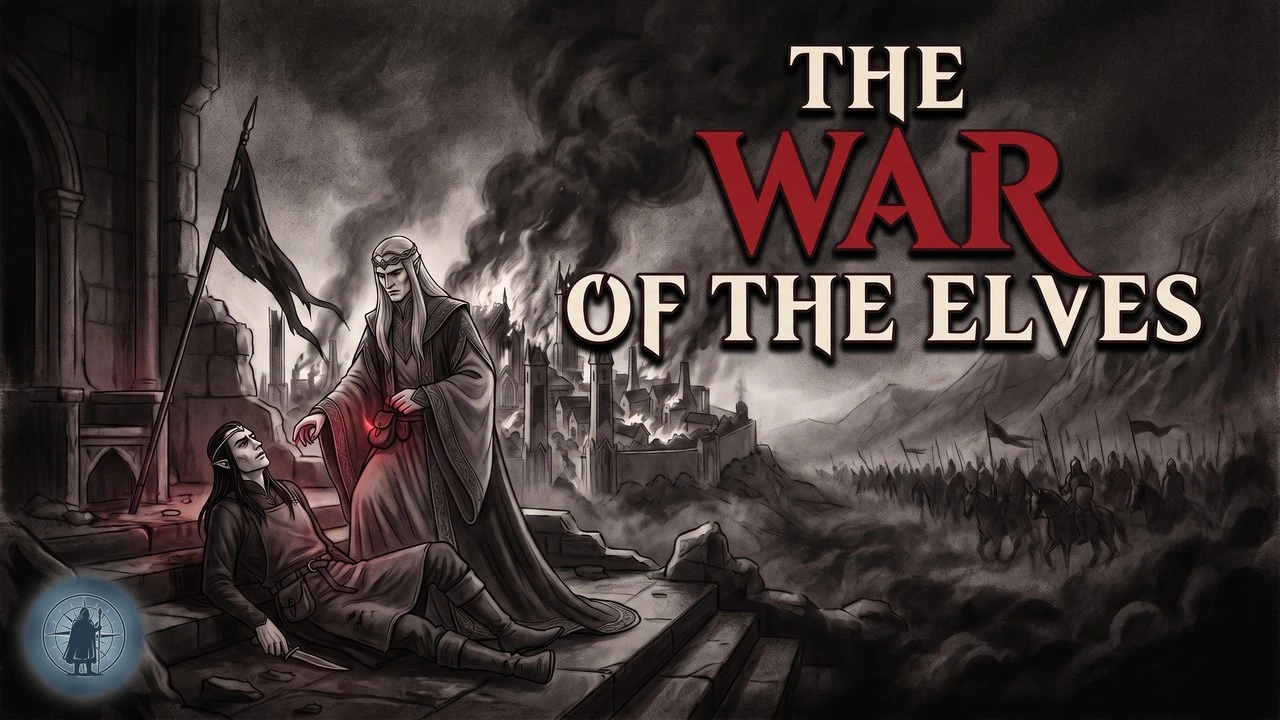 Watch the episode
War of the Elves and Sauron: How Eregion Fell
SECTION: Sauron's Ninety-Year Delay and the Hidden Three Rings
Sauron waited over 90 years to come for the three elven rings. But why wait so long?
Appendix B gives us the year that Sauron revealed himself. The mask came off of Annatar. Around 1600 of the Second Age:
"Sauron forges the One Ring in Orodruin. He completes construction of Barad-dûr. Celebrimbor perceives the designs of Sauron."
That last clause says it all. The Elven-smiths of Eregion had spent three hundred years taking lessons from a beautiful stranger who called himself Annatar, the Lord of Gifts, and the instant Sauron slid the One Ring onto his finger, Celebrimbor felt it and understood exactly what he'd helped build.
Tolkien does tell us how they got there. The entry for the year 1200 in Appendix B reads: "Sauron endeavours to seduce the Eldar. Gil-galad refuses to treat with him; but the smiths of Eregion are won over." Two Elf-lords, one offer, opposite answers. Gil-galad wouldn't let Annatar through the door of Lindon. Eregion gave him a workshop and three centuries of access.
The elves learned and honed their craft for 300 years. Sauron made his one ring a century later. Celebrimbor knew it. And then nothing happens. For ninety-five years.
In 1695 Sauron's armies cross into Eriador. That's a long gap even on an Elvish clock, and for most of his life Tolkien never explained it anywhere. Late in his life, he wrote a short note about the delay, and it finally reached print in 2021 in a collection called The Nature of Middle-earth. The explanation is unglamorous but completely convincing. Sauron "exerted all his time and strength to gathering and training armies, but it took some ninety years before he felt ready to open war."
He was recruiting. He was recruiting heavily, but poorly.
Tolkien's same note says his "success had been much less than his hope, as he had powerful enemies behind his back in the East and in the Southern lands to which he had not yet given sufficient thought." He went after the Haradrim and only partly got them. Something was tying up the manpower he'd counted on, a thousand miles from the theatre he actually cared about.
Tolkien told us what that was too, in a late scrap that never appeared in any book published in his lifetime. Two of the five Wizards went east and south — Morinehtar and Rómestámo, the two we usually call the Blue Wizards — and the whole job they were sent to do was keep those lands in rebellion against Sauron-worship. Tolkien says that without them, the forces of the East would have outnumbered the West in both the Second Age and the Third. It's an isolated note, and the Blue Wizards never appear in The Silmarillion or The Lord of the Rings at all. But if Tolkien meant it, the reason Sauron marched on Eregion with a smaller army than he wanted is two wizards who never once step onto the page in this story.
Gil-galad, meanwhile, had been worried about the East for a very long time. Around the year 882 he sent a warning to Númenor that an evil power was taking shape out there — eight hundred years before the invasion, which has to be some kind of record for a warning nobody acted on and everybody remembered. Númenor took it seriously enough to keep a force stationed in Lindon. That garrison is part of why Lindon holds later.
Then, in 1693, as the war is in its preamble, Celebrimbor does something that matters a lot.
He goes to Galadriel.
In the appendicies Tolkien tells us both of these things happen in the same year. The War of the Elves and Sauron begins, and the Three Rings are hidden. The Three Rings had been finished around 1590. They'd sat in Eregion for roughly a hundred and three years. Now Galadriel tells Celebrimbor to get them as far from the city as he can, and he does it — Nenya stays with her in the east, and Vilya and Narya go west by courier to Gil-galad in Lindon.
So by the time Sauron's army crosses the border two years later, the thing he's coming for is already gone.
Sauron half-knew it. Unfinished Tales says he "guessed the truth, that the Three had been committed to Elvish hands." He just didn't know whose hands, or where. And a guess doesn't give him a location. So now Sauron is about to spend six years and an entire army finding out that the vault was emptied before he arrived on the scene.
SECTION: Sauron Marches Through the Gap of Rohan
How did the war begin? There's one sentence in Unfinished Tales that tells us.
"When Sauron learned of the repentance and revolt of Celebrimbor his disguise fell and his wrath was revealed; and gathering a great force he moved over Calenardhon to the invasion of Eriador in the year 1695."
Calenardhon is the grassland that becomes Rohan more than four thousand years later. So Sauron's road out of Mordor runs west across those plains, through the Gap of Rohan between the Misty Mountains and the White Mountains, and then north up into Eriador.
He doesn't come over the mountains at all. He goes the long way around them.
That's hundreds of miles of open country with an army in it, in plain view of anyone who cared to look, and that single choice is why there's an Elvish army waiting in the field at all. Appendix B's entry for 1695 reads:
"Sauron's forces invade Eriador. Gil-galad sends Elrond to Eregion."
Same year, same line. Lindon is reacting to a march it can see coming.
On the way north Sauron does something small that costs him the war six years later. He detaches a garrison at Tharbad — the fortified ford where the road crosses the Gwathló river, the Greyflood — and the text says that crossing was held only lightly. It's sensible housekeeping. Secure the river, hold the crossing, keep moving. In 1701 that same detachment marches back up to reinforce him, and Tharbad becomes the place his army stops existing.
The Elves got one good hit in before any of the disasters. Celeborn led an attack straight out of the city and threw Sauron's vanguard back off the approaches — the only clean Elvish success of the whole year, and the last one anybody has for two years. It didn't hold. Celeborn's force linked up with Elrond's relief column, and then both of them were outnumbered in the open and cut off from the city they'd come to save, which meant Ost-in-Edhil was on its own from that point onward.
Almost all of this detailed battle information comes from a single source. The dates all make sense — they're in Appendix B, which Tolkien built and rebuilt for decades. The battles aren't in the Appendix though. The garrison, the sortie, the sack, the banner, the trap at the end: all of it sits in a single fast outline Tolkien wrote after finishing The Lord of the Rings, published later in Unfinished Tales. It's the only narrative account of this war that exists anywhere.
Outside of the dates, numbers in these descriptions are hard to come by. There are a few though. In The Fellowship of the Ring, standing on the border of Hollin, Gandalf tells the company that Rivendell lies "five-and-forty leagues as the crow flies" from where they're standing. That's a hundred and thirty-five miles and it's the corridor Elrond has to retreat up in two years' time.
Because there are no other numbers. Tolkien never gives a size of Sauron's army or Elrond's, or the Númenórean fleet. The sources only ever speak in comparisons.
The battle marches and retreats give us the plot. The named fighting, in order, runs straight out and straight back: Eregion in 1697, then the river Lhûn in 1700, then Sarn Ford, then back down to the Gwathló at Tharbad in 1701, then one last action in eastern Calenardhon. Sauron spends five years grinding west along that road and about eighteen months getting driven back down it, and he finishes the war almost exactly where he started it, minus an army.
SECTION: Why the Men of Minhiriath Fought for Sauron
When Sauron's raiders came north through Minhiriath in 1695, the people living there helped them, and nobody had to force them into it. They fed the raiding parties information and guided them through country the Orcs didn't know, and based on the texts, they were happy to do it.
The reason, though, has nothing to do with Sauron.
Minhiriath means "between the rivers" — the land in the wedge between the Baranduin and the Gwathló. Tolkien explained it himself in a letter in 1969 by writing the word "Mesopotamia" after it, which tells us what he thought it was: good river country, the kind of place people settle and farm and stay. And these were ordinary Men, not allies of anybody, living in the woods a long way from the politics of Elf-kingdoms.
Let's go back about nine hundred years, to the mouth of the Gwathló. Somewhere between 750 and 800 of the Second Age, a Númenórean prince named Aldarion — a shipwright and a sailor who spent his whole life at sea and wrecked his marriage doing it — built a harbor there and called it Vinyalondë, the New Haven. It's the first permanent Númenórean settlement in Middle-earth. And it isn't a colony or a fort. It's just a lumber yard.
Númenor needed ship timber in enormous quantities, and the island didn't have enough of it. So the crews went up both banks of the Gwathló and started cutting, and floated the logs downriver to the haven.
They did that for six hundred years.
Tolkien wrote a short appendix about that port. It's one of the least-read things he ever produced about the Second Age. It might also be one of the most uncomfortable. The lumberjacking didn't stay near the river. Great roads were driven north and south into the forests to reach fresh timber. Nobody replanted anything. Over centuries the Númenóreans hollowed out the woodlands of Minhiriath and Enedwaith and left them open. Middle-earth's version of the destruction of the rainforests.
The people who lived in those woods fought back the only way they could. They raided the haven — destroyed it more than once — and burned the wood-stores. And the Númenóreans, being an empire, treated them as enemies and hunted them, and the survivors went into the dark coastal forest of Eryn Vorn and stayed there.
So in 1695 a Dark Lord comes north with an army, and the men in Eryn Vorn look at him, and then look at the Númenórean forts sitting on their river, and they make the obvious choice. Unfinished Tales says they welcomed him, and served his raiders as spies and guides.
Sauron finished what Númenor started. He burned whatever forest was left standing. He'd have liked to take those Númenórean strongholds on the Gwathló as well, but he couldn't — he didn't have the men to spare. Which is the recruiting problem from ninety years earlier coming back to haunt him.
By the Third Age the Gwathló river ran, in Tolkien's words, "through a land that was far and wide on either bank a desert, treeless but untilled." It was a barren wilderness. The aftermath of six centuries of logging.
It is a bit of a tragic story that doesn't quite stop there, either. Around the year 1800 — a century after Númenor's fleet saves Eriador, "the Númenóreans begin to establish dominions on the coasts." The empire that manufactured Sauron's local allies by taking what it wanted out of Middle-earth, wins the war, and then goes right back to taking what it wants out of Middle-earth.
The most famous Tolkien-and-the-environment story is Isengard: Saruman's pits, the burned trees, the Ents coming down the valley. This story though, is older. It feels colder and much harder to feel good about, because the people doing the clear-cutting were supposedly the good guys.
SECTION: Celebrimbor's Last Stand on the Mírdain Steps
Let's zoom in on Eregion.
Eregion held for two years. The invasion crossed the border in 1695, and Appendix B's entry for 1697 is straightforward: "Eregion laid waste. Death of Celebrimbor." The city had stood for close to nine hundred and fifty years, and it came apart in twenty-four months.
Tolkien tells us what happens in the end. The order here matters.
"Celebrimbor, desperate, himself withstood Sauron on the steps of the great door of the Mírdain; but he was grappled and taken captive, and the house was ransacked."
The Mírdain — the Gwaith-i-Mírdain, the People of the Jewel-smiths — were the guild, and that building was their hall. Celebrimbor is the head of it. He's a smith, not a soldier, and he is standing on his own front steps trying to physically stop Sauron. He didn't stand a chance.
Then Sauron begins to rip through the building.
"There Sauron took the Nine Rings and other lesser works of the Mírdain; but the Seven and the Three he could not find."
He found the Nine himself. Nobody handed them over — they were out in the open, and he picked them up out of the wreckage.
Then, Celebrimbor was tortured until Sauron learned from him where the Seven Dwarf rings were.
Celebrimbor broke. Under torture he gave up where the Seven Dwarf-rings had gone, and those were rings he'd personally handed to allies — the greatest of them to Durin the Third, King of Khazad-dûm, a few miles up the road from where he was being tortured. Celebrimbor gave up his friends' rings.
So he gave up some of his friends, but not others. But that allegiance, cost him his life.
"Concerning the Three Rings Sauron could learn nothing from Celebrimbor; and he had him put to death."
That's a man who had already broken once, holding the second time. Which is harder than never breaking at all.
Then Tolkien writes a detail that never made it into The Silmarillion or The Lord of the Rings, which is why plenty of people who know this story well have never run into it.
"In black anger he turned back to battle; and bearing as a banner Celebrimbor's body hung upon a pole, shot through with Orc-arrows, he turned upon the forces of Elrond."
Sauron made Celebrimbor's corpse into a banner. A body on a pole, carried at the head of an army. That's deliberate blasphemy in Tolkien's grammar — a banner is the thing a righteous army carries out in front of it. Sauron took the one man who wouldn't talk and turned him into a flag. And he carried it against Elrond, against the relief column caught in the open a few miles from the wreck of the city, not against Lindon or the Grey Havens.
The saddest thing about Celebrimbor's silence is that it accomplished almost nothing. Sauron figured out the answer anyway — he assumed the Three had gone to Elvish keepers, he assumed Gil-galad and Galadriel were holding them, and he was right on both counts. His refusal to spill the beans didn't hide the Three rings from Sauron. All it denied him was certainty, and it cost him a few years of marching west to check.
So it earned him nothing, and he did it anyway.
There's something else interesting here about Celebrimbor's family. Celebrimbor was the son of Curufin and the grandson of Fëanor, and Unfinished Tales says he "desired in his heart to rival the skill and fame of Fëanor".
Fëanor made three great things and would not give them up, and that refusal burned down two kingdoms and most of his own family.
His grandson made three great things, gave away every one of them inside a century, and then died rather than say where they'd gone.
Same house, same craft, same stated ambition. But here, we see a very different ending.
SECTION: The Dwarves Save Elrond, Then Shut the Gates
Now, where was Elrond in all of this?
Well, Elrond probably should have died outside Eregion.
He isn't the Master of Rivendell yet — Rivendell doesn't exist. In 1695 Elrond is a commander Gil-galad sent east with whatever Lindon could spare at short notice, and Unfinished Tales tells us that his force "was far too weak." He'd have been overwhelmed, and the Noldor of Eriador would have ended in that field.
But something saved him. And what saved him came out of the mountain.
The Dwarves of Khazad-dûm hit Sauron's army from behind, and the Elves of Lórinand under Amroth came down with them. Sauron had to turn around and wage a battle on another front. Sauron beat them. The Dwarves lost the fight and pulled back inside Moria. But turning an army around takes time, and time was the only thing Elrond needed. He got his survivors out and headed north.
Durin's folk came to help because Eregion existed for them in the first place.
Around the year 750 the Dwarves of Khazad-dûm found mithril, and the Noldor came south-east and built Ost-in-Edhil, the Fortress of the Eldar, right up against the mountains a short road from Moria's West-gate. They built it there for one reason: to be next door to the finest metal anyone had ever dug out of the ground, and to the only people who could dig it. A highroad ran from the city straight to that door. It was a mining partnership that turned into a civilization.
The Silmarillion says what grew out of it:
"a friendship arose between Dwarves and Elves, such as has never elsewhere been, to the enrichment of both those peoples."
That's a superlative, but we should pressure test it, because these two peoples had worked together before. Dwarves of the Blue Mountains built Menegroth for Thingol in Doriath, and it was the greatest hall in Beleriand. But The Silmarillion says that relationship "was ever cool," and it ended with Dwarves killing Thingol over a necklace. Doriath was a contract. Eregion was a friendship. So here, the superlative survives the test.
Many of us will be familiar with the best surviving evidence of the friendship: a door. Celebrimbor cut the West-gate inscription himself — Elvish letters in ithildin, on a Dwarf-built gate, signed with his own name. Thousands of years later Gandalf stands in front of that door in the dark, and the lettering still answers.
And now Appendix B gives another entry for 1697:
"Eregion laid waste. Death of Celebrimbor. The gates of Moria are shut. Elrond retreats..."
The door is mentioned third. Tolkien put the closing of a gate in the same breath as the death of a kingdom, and he put it ahead of the retreat.
Durin's folk shut those gates after winning their part of the fight. They came out, they took the pressure off Elrond, they got beaten in the open field, they went home, and they barred the door. There's no betrayal anywhere in it. It sounds like a prudent security decision by people who had just watched what happened to the neighbors and concluded that living next door to a Dark Lord's campaign was a bad position to be in. The greatest friendship between two kindreds in Tolkien's world ends with nobody doing anything wrong.
From here, those gates stay shut for four thousand seven hundred and sixty-three years, until Gandalf says "mellon" and they open for the Fellowship.
And those words are spoken by someone who was never there and never knew them. When the Fellowship walks through Hollin, Gandalf says there's a wholesome air about the place, that "much evil must befall a country before it wholly forgets the Elves." Legolas is a Wood-elf and a stranger to these people, and he hears something else:
"Only I hear the stones lament them: deep they delved us, fair they wrought us, high they builded us; but they are gone."
Every verb in that line is a Dwarf-and-Elf verb. Delving, wrighting, building. The stones remember the partnership, and nothing else in Eriador does.
SECTION: Tar-Minastir's Fleet and the Battle of the Gwathló
By 1699 the Elves had lost.
Sauron had completely overrun Eriador.
Everything between the Misty Mountains and the sea belonged to him except two places — a besieged valley in the foothills where Elrond is bottled up, and the strip of Lindon behind the river Lhûn, where Gil-galad is holding the last defensible line in front of the Grey Havens.
But then, the ships came. Tolkien's succinct one-liner shares with us the hope.
"Tar-Minastir sends a great navy from Númenor to Lindon. Sauron is defeated."
The admiral's name is Ciryatur, which in Quenya looks a lot like "Ship Master" — possibly a job title that somebody wrote down as a name. He might be the best commander in this war, and what he does comes right out of a textbook. He splits the fleet. The bulk of it goes into Lindon and reinforces Gil-galad on the Lhûn. Sauron — who has been grinding west for five years to get at what he thinks are the Three Rings — walks into a fresh army that arrived by sea.
After that it's a rout in slow motion, and it runs back down the road he came up. Beaten on the Lhûn. Beaten again at Sarn Ford, the crossing of the Baranduin that later becomes the southern boundary of the Shire. Falling back on Tharbad, where the garrison he'd left behind in 1695 comes up from the south-east to reinforce him.
And Ciryatur's second force is already ashore behind him.
The other part of the fleet landed at Lond Daer, the great haven at the mouth of the Gwathló. Which is Vinyalondë. The lumber port. The one Aldarion built nine hundred years earlier so Númenor could cut down Minhiriath. The harbor that made Sauron his local allies is the harbor that put an army ashore in his rear.
At the Gwathló in 1701 his host is hit front and back at the same time and comes apart. Unfinished Tales says Sauron "barely escaped." One more action in eastern Calenardhon, on the long road home, strips him down to what the text calls "a tiny bodyguard."
That's the only time Sauron, ruling in his own name as Dark Lord, is beaten in the field and walks away with nothing at all. He came out of it with no fortress, no army and no prisoners, just a Maia and a handful of guards crossing a thousand miles of grass to get home.
There's a bit of a puzzle about who sent that fleet. Appendix B says Tar-Minastir, and Unfinished Tales agrees. But Tolkien's own list of Númenor's rulers has Queen Tar-Telperiën holding the sceptre until 1731 — thirty-one years after the navy sailed. Minastir is two hundred and twenty-six years old in the year 1700 and still three decades away from the throne. Christopher Tolkien noticed the clash and said he couldn't account for it. That late note in The Nature of Middle-earth calls the force "the great host of Minastir," with no royal title on it at all, which is probably the cleanest answer available: the heir sent the fleet, and the chroniclers later handed him the crown he was going to get anyway.
The last thing that happens in this war is a promise. Sauron goes back to Mordor with nothing and swears vengeance on the Númenóreans — on the sea power that beat him, rather than on the Elves he'd just spent eight years failing to destroy.
Númenor drowns in the year thirty-three nineteen.
That is over fifteen-hundred years later. Sauron gets there in the end, and the way he gets there is by surrendering to Ar-Pharazôn and being carried onto the island as a prisoner. This may be the most patient act of spite in the whole legendarium. As they say, revenge is a dish best served, cold.
SECTION: Rivendell Was Founded in a Retreat
Let's go back to Elrond now.
In 1697 Elrond is running. He has what Appendix B calls a "remnant" of the Noldor, he has Sauron's army somewhere behind him, and he's moving north up that hundred-and-thirty-five-mile corridor from Eregion's northern edge toward the headwaters of the Bruinen. He needs ground he can hold, and he needs it this week.
What he finds is a crack in the earth.
Every name that place has ever carried describes the same thing. Imladris is Sindarin for the deep dale of the cleft. The Westron name, Karningul, means the same. Rivendell, the English name Tolkien gave it, is "cloven-dell." A cut in the ground deep enough to hide in — which is exactly what it was picked for.
And that's the military virtue of the site. Rivendell can't be seen until you're in it. An army coming up the Bruinen goes past the top of the gorge without knowing there's a valley underneath, and the path down is a steep zig-zag a handful of archers can hold. It's a bolt-hole chosen under pursuit by a commander who was losing.
Sauron caught up. From 1697 to 1700 there's a siege of Imladris — the first one — and hardly anybody knows it happened, because Appendix B never mentions it. Sauron left what the text calls "a strong detachment" to pin Elrond in the valley, and took the rest of the army west after Gil-galad. So for three years, the whole of Elrond's realm is a gorge with an army around it.
And the valley fills up. Survivors of Eregion get there first, and then, as Sauron ravages Eriador through 1698 and 1699, anyone else who can reach it. Others went the opposite way entirely: the Dwarves granted a column of Elves passage east through Khazad-dûm, and those refugees ended up in the woods beyond the mountains that later became Lothlórien.
The valley only becomes an institution after the war ends. In 1701 there's a Council — Gil-galad, Elrond, whatever is left of the leadership of the Noldor in the west — and they settle three things.
Imladris, in Eregion's place, will be the Elvish stronghold of eastern Eriador.
Elrond is made Gil-galad's vice-regent in Eriador, which is a different office from the heralding he does at the Last Alliance seventeen hundred years later.
And Gil-galad quietly gives him Vilya — the Ring of Air, the one Celebrimbor shipped west in 1693 and then died without naming.
Ost-in-Edhil stood nine hundred and forty-seven years and left so little behind that the Fellowship walked across its country and never saw it. Imladris ran from 1697 to roughly the year 120 of the Fourth Age — about four thousand nine hundred years. The shelter outlasted the realm by a factor of five.
And The Silmarillion's description of what Rivendell became has nothing to do with walls or workshops:
"the house of Elrond was a refuge for the weary and the oppressed, and a treasury of good counsel and wise lore."
Eregion was a forge. Rivendell is a house with the door open.
Which brings us back to that one entry in Appendix B — a single line of chronicle for the year 1697.
"Eregion laid waste. Death of Celebrimbor. The gates of Moria are shut. Elrond retreats..."
Four clauses. A country destroyed, a man killed, a door closed — and then, last, at the tail end of the same breath, a founding.
Tolkien filed the beginning of Rivendell as the fourth item in a list of disasters. It doesn't get its own year, or its own line, or a single word of ceremony. It shows up as a part of a sentence about everything going wrong, and it turns out to be the longest-lasting institution anybody in this story ever builds. The Council of Elrond meets there. The Ring goes south from there. Bilbo finishes his book there.
That's how Tolkien writes the good outcomes in the Second Age. They come in late in the sentence, after the losses, in the same flat chronicle voice as the losses, easy to walk right past.
Eight years of war, and almost everything it was fought over was either already gone or about to be. The one thing that came out of it whole was the place a beaten army founded so they could stop running.