
Research & Sources
War of the Elves and Sauron
How Eregion Fell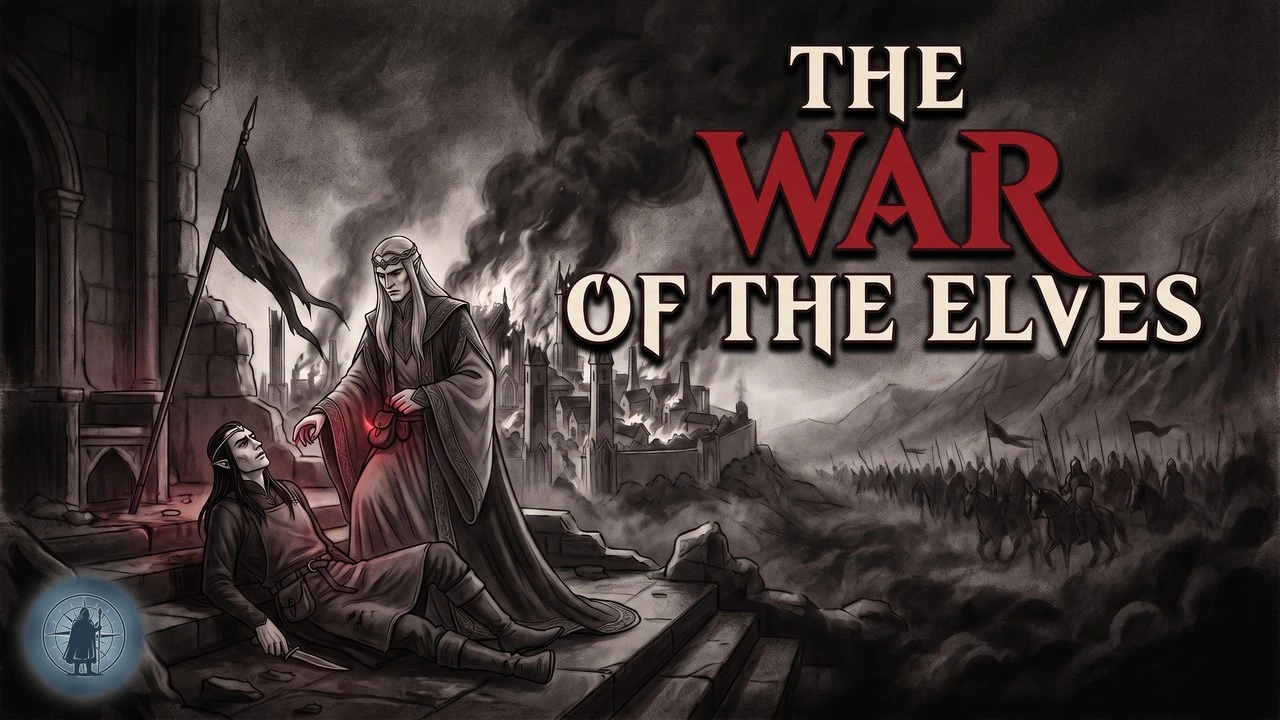 Watch the episode
War of the Elves and Sauron: How Eregion Fell
Research Notes: The War of the Elves and Sauron — How Eregion Fell and Rivendell Was Born
READ THIS FIRST — five things that will break the script if the writer gets them wrong
1. Celebrimbor did NOT give up the Nine under torture. The sequence in Unfinished Tales is precise and it matters: Sauron found the Nine in the ransacked House of the Mírdain. The Seven were extracted under torment. The Three he never got. A script that says "he broke and gave up the Nine and the Seven" inverts the one moral fact the whole episode rests on.
2. The body-as-banner was borne against ELROND, not at the Grey Havens. The verbatim text: "he turned upon the forces of Elrond." (Tolkien Gateway's Celebrimbor article paraphrases this as "when Sauron attacked the Grey Havens" — that is a wiki error. Do not follow it.)
3. "Sauron's first open war" needs one qualifier. Sauron fought — and won battles — in the First Age as Morgoth's lieutenant (Tol-in-Gaurhoth, the Dagor Bragollach). This is his first war in his own name, as Dark Lord. Unfinished Tales ("Aldarion and Erendis") does call it "the first war with Sauron," so the phrase is defensible, but the script should say *first war he fought as his own master*, not "first war he ever fought."
4. Tar-Minastir probably was not King when he sent the fleet. Appendix B and *Unfinished Tales both say "Tar-Minastir." But The Line of Elros* says Queen Tar-Telperiën held the sceptre until S.A. 1731. Christopher Tolkien flagged this and could not account for it. *The Nature of Middle-earth* calls the force "the great host of Minastir" — no royal prefix. Safest script line: "the heir of Númenor, Minastir, sent the fleet" — or name the contradiction, which is more interesting.
5. Nearly everything tactical in this episode comes from ONE hasty text. Christopher Tolkien published "Concerning Galadriel and Celeborn" (the first section of Unfinished Tales, "The History of Galadriel and Celeborn") as what it is: a rapid outline his father wrote after *The Lord of the Rings*, containing elements Tolkien later abandoned. The Appendix B dates are firm. The battle narrative — Celeborn's sortie, the steps of the Mírdain, the banner, the Dwarf sally, the double envelopment on the Gwathló — is all from that single source. Say so once; it makes the episode more honest, not less dramatic.
Numbers to avoid inventing: Tolkien gives no troop counts anywhere in this war. Not for Sauron's host, not for Elrond's force, not for the Númenórean fleet. Michael Martinez's survey of the texts confirms it. If the script wants scale, use the relative language the text uses ("greater," "far smaller," "a tiny bodyguard") — never a figure.
Overview
The War of the Elves and Sauron (S.A. 1693–1701) is the hinge of the Second Age, and almost nobody knows it happened. It is eight years long. It kills the last great Noldorin craftsman in Middle-earth, erases the only lasting Noldorin realm outside Lindon, shuts the gates of the greatest Dwarf-kingdom in the world, depopulates Eriador, brings the armies of Númenor ashore in Middle-earth for the first time as a war-fleet, and — as the by-product of a losing retreat — produces Rivendell, which then stands for four thousand seven hundred years.
Tolkien himself waved at it. In Letter 131 he called the Second Age "a dark age, and not very much of its history is (or need be) told." He then told it anyway, in fragments, across four decades: nine dated lines in Appendix B, a few paragraphs in "Of the Rings of Power and the Third Age," one hasty outline in Unfinished Tales, an appendix about a seaport, and a late note about why the cavalry was late. Assembling it is the work.
What emerges is not a fantasy war. It is a **logistics story with a martyrdom at the centre of it**. Sauron needs ninety years to raise an army and still can't raise enough, because he has enemies behind him in the East. The Elves win in the end only because a sea power four hundred miles offshore decides to intervene. The forest-men of Minhiriath fight for Sauron, not because they love him but because Númenórean logging crews had been clear-cutting their homeland for six hundred years. And the one unambiguous act of heroism in the whole thing is a man refusing to say three names while being tortured to death.
The episode's shape is therefore: a war that everyone loses except the future.
Timeline
Dates from The Lord of the Rings, Appendix B, "The Tale of Years — The Second Age" unless otherwise flagged. Appendix B marks most Second Age Middle-earth dates "c." — Tolkien's own note is that "the dates that concern events in Middle-earth, unlike Númenor, are often uncertain."
| Year (S.A.) | Event | Source | |---|---|---| | c. 750 | Eregion founded; Ost-in-Edhil built. Site chosen for nearness to Khazad-dûm and newly-found mithril. | App. B | | 750–800 | Aldarion of Númenor founds Vinyalondë ("New Haven") at the mouth of the Gwathló — the first permanent Númenórean settlement in Middle-earth. Timber-felling begins. | UT, "Aldarion and Erendis," Chronology | | c. 882 | Gil-galad warns Númenor that an evil power is taking shape in the East. | UT, "Aldarion and Erendis"; App. A | | c. 1000 | Sauron establishes himself in Mordor; Barad-dûr begun. | App. B | | 1200 | "Sauron endeavours to seduce the Eldar. Gil-galad refuses to treat with him; but the smiths of Eregion are won over." | App. B (verbatim) | | 1350–1400 | (Variant material only) The Mírdain seize power in Eregion; Galadriel departs through Khazad-dûm to Lórinand; Celeborn remains, "disregarded by Celebrimbor." | UT, "Concerning Galadriel and Celeborn" | | c. 1500 | "The Elven-smiths instructed by Sauron reach the height of their skill. They begin the forging of the Rings of Power." Annatar leaves Eregion. | App. B (verbatim) | | c. 1590 | "The Three Rings are completed in Eregion." | App. B (verbatim) | | c. 1600 | "Sauron forges the One Ring in Orodruin. He completes the Barad-dûr. Celebrimbor perceives the designs of Sauron." | App. B (verbatim) | | 1600–1693 | The ninety-year interval. Sauron gathers and trains armies; "it took some ninety years before he felt ready to open war." Opposed in the East and South. | NoMe, "Note on the Delay of Gil-galad and the Númenóreans" | | 1693 | "War of the Elves and Sauron begins. The Three Rings are hidden." Celebrimbor takes counsel of Galadriel; Nenya to Galadriel, Vilya and Narya sent to Gil-galad. | App. B (verbatim); UT | | 1695 | "Sauron's forces invade Eriador. Gil-galad sends Elrond to Eregion." Sauron's host crosses Calenardhon, enters through the Gap of Rohan, garrisons Tharbad, turns north. Gil-galad sends to Númenor for aid. | App. B (verbatim); UT | | 1695–97 | Celeborn leads a sortie out of Eregion and throws back Sauron's vanguard; joins Elrond's relief force; both are outnumbered and cut off from the city. | UT, "Concerning Galadriel and Celeborn" | | 1697 | "Eregion laid waste. Death of Celebrimbor. The gates of Moria are shut. Elrond retreats with remnant of the Noldor and founds the refuge of Imladris." | App. B (verbatim) | | 1697 | Dwarves of Khazad-dûm under Durin III and Galadhrim under Amroth strike Sauron's rear; Elrond escapes north. Sauron turns, beats them, and they withdraw into Moria. The Doors are shut. | UT | | 1697–1700 | First Siege of Imladris. Sauron leaves "a strong detachment" to contain Elrond and marches the rest west. | UT | | 1699 | "Sauron overruns Eriador." | App. B (verbatim) | | 1700 | "Tar-Minastir sends a great navy from Númenor to Lindon. Sauron is defeated." Gil-galad is holding the line of the Lhûn. Ciryatur lands; Sauron is beaten at the Lhûn, again at Sarn Ford, falls back to Tharbad. | App. B (verbatim); UT | | 1701 | Battle of the Gwathló. Ciryatur's second force lands at Lond Daer and takes Sauron in the rear; his army is routed; he "barely escaped." A last action in eastern Calenardhon strips him to "a tiny bodyguard." He flees to Mordor. "Sauron is driven out of Eriador. The Westlands have peace for a long while." | App. B (verbatim); UT | | 1701 | A Council is held. Imladris is chosen as the Elvish stronghold of eastern Eriador in Eregion's place. Gil-galad makes Elrond his vice-regent in Eriador and gives him Vilya in secret. | UT | | c. 1800 | "The Númenóreans begin to establish dominions on the coasts." The war's other consequence. | App. B | | 3319 | Downfall of Númenor — 1,618 years after Sauron swore vengeance on the Númenóreans at the Gwathló. | App. B | | T.A. 1980–81 | Durin's Bane; Khazad-dûm abandoned. | App. B | | T.A. 3019, Jan | The Fellowship crosses Hollin and stands at the West-gate — 4,763 years after Eregion fell. (Derived: 3,441 − 1,697 = 1,744, + 3,019.) | FOTR II.3–4 |
Derived spans, all safe to use if presented as arithmetic: - Ost-in-Edhil stood c. 947 years (c. 750 – 1697). - 93 years between the One Ring going on (c. 1600) and the war opening (1693); Tolkien's own figure for Sauron's preparation is "some ninety years." - The war runs 8 years (1693–1701); the actual campaigning, 6 years (1695–1701). - Eregion fell 2 years after the invasion began. - Imladris was besieged c. 3 years (1697–1700). - Rivendell outlived Eregion by a factor of five: founded 1697, effectively empty by Fo.A. 120 — roughly 4,900 years of occupancy.
Primary Sources
The Lord of the Rings — Appendix B, "The Tale of Years"
Nine lines carry the whole war. They are worth reading aloud in the episode exactly as written, because their flatness is the point — this is a chronicle entry, not a lament:
1693 War of the Elves and Sauron begins. The Three Rings are hidden.
1695 Sauron's forces invade Eriador. Gil-galad sends Elrond to Eregion.
1697 Eregion laid waste. Death of Celebrimbor. The gates of Moria are shut. Elrond retreats
with remnant of the Noldor and founds the refuge of Imladris.
1699 Sauron overruns Eriador.
1700 Tar-Minastir sends a great navy from Númenor to Lindon. Sauron is defeated.
1701 Sauron is driven out of Eriador. The Westlands have peace for a long while.
Note the sentence order in 1697. The gates of Moria are shut comes before Elrond's retreat. Tolkien puts the closing of a door in the same breath as the death of a kingdom.
The Lord of the Rings — The Fellowship of the Ring
The only place most readers ever meet Eregion is as a field of grass. "The Ring Goes South" (FOTR II.3), Gandalf:
"We have reached the borders of the country that Men call Hollin; many Elves lived here in
happier days, when Eregion was its name."
And:
"There is a wholesome air about Hollin. Much evil must befall a country before it wholly forgets
the Elves, if once they dwelt there."
Legolas's answer is the single best line in the whole topic, and it should anchor the episode:
"But the Elves of this land were of a race strange to us of the silvan folk, and the trees and
the grass do not now remember them. Only I hear the stones lament them: *deep they delved us,
fair they wrought us, high they builded us; but they are gone.*"
Distance, stated by Gandalf in the same chapter: Eregion's northern border is "five-and-forty leagues as the crow flies" from Rivendell — 135 miles. That is the width of Elrond's retreat. It is also the only hard distance Tolkien gives anywhere in this theatre; do not invent others.
In "A Journey in the Dark" (II.4) the Fellowship walks the Elven-way from Hollin along the Sirannon to the West-gate and never sees Ost-in-Edhil — the road survives, the city does not. Gandalf reads Celebrimbor's ithildin inscription on the Doors of Durin; the lettering still answers a word spoken 4,763 years after the man who wrote it was killed.
The Silmarillion — "Of the Rings of Power and the Third Age"
The governing description of what was destroyed:
"From Ost-in-Edhil, the city of the Elves, the highroad ran to the west gate of Khazad-dûm, for
a friendship arose between Dwarves and Elves, such as has never elsewhere been, to the
enrichment of both those peoples. In Eregion the craftsmen of the Gwaith-i-Mírdain, the People
of the Jewel-smiths, surpassed in cunning all that have ever wrought, save only Fëanor himself;
and indeed greatest in skill among them was Celebrimbor, son of Curufin."
Two load-bearing facts in that sentence: the friendship superlative ("such as has never elsewhere been") and the skill limit ("save only Fëanor himself"). Use both exactly.
The same chapter establishes that Eregion was the only lasting Noldorin realm outside Lindon — a sourced superlative, safe to use.
It also names the era from the Elves' side. The years after Eregion's fall were remembered as the "Days of Flight", when Sauron hunted the Elves and they fled to Lindon and over the Sea. And the general term for the age: the Dark Years / the Black Years.
Unfinished Tales — "The History of Galadriel and Celeborn," §"Concerning Galadriel and Celeborn"
This is the only narrative account of the war that exists. The critical passages, verbatim:
On Sauron's response to Celebrimbor's revolt:
"When Sauron learned of the repentance and revolt of Celebrimbor his disguise fell and his wrath
was revealed; and gathering a great force he moved over Calenardhon to the invasion of Eriador
in the year 1695."
On the last stand:
"Celebrimbor, desperate, himself withstood Sauron on the steps of the great door of the Mírdain;
but he was grappled and taken captive, and the house was ransacked."
On the interrogation — note the ORDER of the three ring-sets:
"There Sauron took the Nine Rings and other lesser works of the Mírdain; but the Seven and the
Three he could not find. Then Celebrimbor was put to torment, and Sauron learned from him where
the Seven were bestowed."
And the line the episode is built on:
"Concerning the Three Rings Sauron could learn nothing from Celebrimbor; and he had him put to
death."
Then the banner:
"In black anger he turned back to battle; and bearing as a banner Celebrimbor's body hung upon a
pole, shot through with Orc-arrows, he turned upon the forces of Elrond."
Also from this text: Sauron guessed the truth anyway — that the Three had been committed to Elvish guardians — and supposed they were with Gil-galad and Galadriel. Which is why he drove west for Lindon rather than consolidating. Celebrimbor's silence did not hide the Three; it only denied Sauron certainty, and certainty was what he needed to move fast.
On the relief and the rescue: Elrond's force "was far too weak" and would have been overwhelmed "but that Sauron's attention was diverted" by an attack in the rear from the Dwarves of Khazad-dûm and Elves of Lórinand under Amroth. Sauron turned, beat them, and they withdrew into Moria. Elrond used the interval to get his survivors north.
On the aftermath and Rivendell's charter: at the Council after the war it was resolved that Imladris, not Eregion, should be the Elvish stronghold of eastern Eriador; Gil-galad gave Elrond Vilya and made him vice-regent in Eriador.
Unfinished Tales — "The History of Galadriel and Celeborn," Appendix D: "The Port of Lond Daer"
The most under-used text in the whole topic, and the source of the episode's best non-obvious theme. It explains why a whole region of Men fought on Sauron's side.
- Aldarion's Númenóreans felled timber on both banks of the Gwathló and floated it down to Vinyalondë from the mid-700s S.A. onward. - Over centuries the cutting became, in Christopher Tolkien's summary of his father's note, devastating — great tracks and roads driven north and south into the forests, and **no replanting**. - The forest-dwellers of Minhiriath and Enedwaith fought back: they destroyed the haven more than once and burned the Númenórean wood-stores in hit-and-run raids. - When Sauron invaded in 1695, those same people **welcomed him and served his raiders as spies and guides.** Sauron burned what forest was left; he could not spare the men to storm the Númenórean forts on the Gwathló. - By the Third Age the Gwathló "flowed through a land that was far and wide on either bank a desert, treeless but untilled."
Tolkien wrote an ecological war crime into the backstory of his own good guys, and then made it strategically decisive. That is not fan inference; it is in the appendix.
The Nature of Middle-earth (2021, ed. Carl F. Hostetter) — "Note on the Delay of Gil-galad and the Númenóreans"
Part Three, ch. XVIII. A late note explaining the two awkward gaps in the chronology: why Sauron took ninety years to attack, and why help was slow.
- After his disguise was pierced, Sauron "exerted all his time and strength to gathering and training armies, but it took some ninety years before he felt ready to open war." - "His gathering of armies had not been unopposed, and his success had been much less than his hope, as he had powerful enemies behind his back in the East and in the Southern lands to which he had not yet given sufficient thought." - He sought to recruit Haradrim and only partly succeeded, because two Wizards had influence among them. - The text names the intervening force as "the great host of Minastir" — without the royal Tar- prefix, which is the strongest textual hint that Minastir was not yet king.
The Peoples of Middle-earth (HoME XII) — "Last Writings," "The Five Wizards"
The Blue Wizards, Morinehtar and Rómestámo, were sent east and south specifically to stir rebellion against Sauron-worship and keep those regions in dissension. Tolkien's stated effect: without them the forces of the East would have outnumbered the West in both the Second and Third Ages. This is the mechanism behind the ninety-year delay — the reason Sauron marched on Eregion with an army smaller than he wanted.
*(Accuracy flag: this is a late, isolated note. Present it as Tolkien's late explanation, not as settled narrative. The Blue Wizards are never named in the published Silmarillion or LOTR.)*
The Letters of J.R.R. Tolkien
- Letter 131 (the Waldman letter, c. 1951): the Second Age is "a dark age, and not very much of its history is (or need be) told." Also the diagnosis of the Elvish motive that built the Rings: "The chief power (of all the rings alike) was the prevention or slowing of decay… the preservation of what is desired or loved, or its semblance — this is more or less an Elvish motive." And: "this frightful evil can and does arise from an apparently good root, the desire to benefit the world and others — speedily and according to the benefactor's own plans." - Letter 153: Sauron "was not 'evil' in origin"; "very slowly, beginning with fair motives, he becomes a reincarnation of Evil, and a thing lusting for Complete Power." - Letter 211 (to Rhona Beare, 1958): the Three were endowed with preservation, not creation or birth.
The Fall of Númenor (2022, ed. Brian Sibley)
Not a new text — a compilation that gathers the Second Age material into chronological order. Useful as a reading recommendation for the audience; adds no new facts to this war. Say so if it comes up; do not cite it as a source of anything the older books do not already contain.
Key Characters
Celebrimbor — Lord of Eregion, greatest of the Gwaith-i-Mírdain, son of Curufin, grandson of Fëanor. *(Genealogy check: father Curufin, grandfather Fëanor. Not "son of Fëanor." The Fëanorian descent was added to Appendix B only in the 1966 Second Edition; the Curufin parentage came later still, in a marginal note.)* He was a smith who spent his life trying to out-make his grandfather and who, at the end, made the opposite choice about what to do with what he had made. Dies 1697 on the steps of the Mírdain's hall. Reigned or led in Eregion from c. 750 to 1697 — 947 years.
Sauron — the war's author, and here at his most conventionally military: he raises an army, marches a long road, invests a city, tortures a prisoner, is outmanoeuvred by sea power, and runs. He escapes with "a tiny bodyguard." This is the only war in the legendarium where Sauron is personally defeated in the field and survives with nothing.
Gil-galad — High King of the Noldor in Lindon; refused Annatar entry in 1200; sends Elrond in 1695 and sends to Númenor for aid in the same year; holds the line of the Lhûn as the war's last defensible position; after the war gives Vilya to Elrond and makes him vice-regent. He is the strategic mind of the Elvish side, and the one who correctly calls in the allies.
Elrond Half-elven — in 1695 he is a commander, not yet a lord of anywhere. *(Title check: he becomes Gil-galad's vice-regent in Eriador after this war; he is Gil-galad's herald at the Last Alliance, 1,700 years later. Two different offices — do not merge them.)* He arrives late, loses, and turns the loss into a place. Founds Imladris in 1697 mid-retreat, is besieged in it for three years, and then holds it for the rest of recorded history.
Celeborn — leads the sortie out of Eregion that throws back Sauron's vanguard, the only Elvish tactical success of 1695. *(Variant flag: his presence in Eregion at all comes solely from "Concerning Galadriel and Celeborn," the version in which the Mírdain have stripped him and Galadriel of authority and he has stayed behind "disregarded by Celebrimbor.")*
Galadriel — not present at the fighting. Her role is 1693: Celebrimbor comes to her for counsel, she tells him to disperse the Three far from Eregion, and she takes Nenya. She is the reason the war's objective was already gone before the first blow fell.
Durin III — King of Khazad-dûm; bearer of the chief of the Seven, which Celebrimbor gave him. Leads the sally that saves Elrond's army. Dwarf dates are vague: born before c. S.A. 1500–1590, died after 1697.
Amroth — leads the Elves of Lórinand in the rear attack. *(Variant flag: in "Concerning Galadriel and Celeborn" Amroth is the son of Galadriel and Celeborn; in the later "Amroth and Nimrodel" he is the son of Amdír. The parentage is unsettled — call him "Amroth of Lórinand" and say nothing about his father.)*
Minastir / Tar-Minastir — b. S.A. 1474, d. 1873 aged 399; reigned 1731–1869 (138 years). Sends the fleet in 1700. *(Chronology contradiction — see Variants. He is 226 years old in 1700 and 31 years from the throne.)* Appendix A notes he loved the Eldar but envied them, and that he was among the last of Númenor's good kings; his son Tar-Ciryatan begins the slide into greed.
Ciryatur — the Númenórean admiral. Name probably means "Ship Master" in Quenya — possibly a title rather than a personal name. He is the one genuinely brilliant commander in the war: he splits his fleet, reinforces Lindon with the bulk of it, and lands a second force at Lond Daer to close the trap at the Gwathló.
Morinehtar and Rómestámo — the Blue Wizards, offstage in the East, holding down the armies that would otherwise have made Sauron's host irresistible.
Geography
Eregion / Hollin — far south-east Eriador, under the Misty Mountains, directly west of Khazad-dûm. Southern border the Glanduin; western borders the Gwathló and Bruinen; eastern border the cliff of the West-gate; northern border a low ridge 135 miles (45 leagues) south of Rivendell. Eregion = Sindarin ereg ("holly") + -ion ("region"): "Holly-region." Hollin is the Westron/Mannish name — an old English form of "holly." Holly grew there in abundance; the Fellowship walks through it still growing in T.A. 3019.
Ost-in-Edhil — "Fortress of the Eldar." On the Sirannon, many miles downstream of Moria's West-gate, out of sight of the road. The highroad ran from the city to the West-gate — the only road of old from the west to Khazad-dûm. It stood 947 years and left so little that the Fellowship walked past it without seeing it.
Khazad-dûm — the reason Eregion existed (mithril), and the reason Elrond survived (the sally). After 1697 its West-gate stays shut for 1,322 years of the Second Age and 3,019 of the Third — until Gandalf says mellon.
Sauron's route — Mordor → Calenardhon (later Rohan) → the Gap of Rohan → north into Eriador → detach a garrison at Tharbad → Eregion. He does not come over the mountains. The long southern flank march is the whole reason Eregion had warning and Gil-galad had time to send anyone at all.
Tharbad — the ford and fortified crossing on the Gwathló, on the Minhiriath/Enedwaith border. Held "only lightly" at the campaign's start; Sauron's fallback and reinforcement point in 1701; the site of his destruction.
Lond Daer / Vinyalondë — the Númenórean timber-port at the Gwathló's mouth, founded by Aldarion 750–800 S.A. The second landing point in 1701. The whole logic of the war's end is that Númenor had already built a harbour on Sauron's flank six hundred years earlier, for lumber.
The line of the Lhûn — Gil-galad's last defensible river, in front of the Grey Havens. By 1699 this and the besieged bowl of Imladris are the only ground in Eriador Sauron does not hold.
Sarn Ford — the crossing of the Baranduin, later the Shire's southern boundary. Sauron is beaten here in 1700 on his retreat.
Imladris — "deep dale of the cleft" (also glossed "flat-floored valley of the Cleft"). Westron Karningul; English Rivendell, "cloven-dell." A narrow gorge of the Bruinen in the Misty Mountains' foothills: pine above, oak and beech below, a steep zig-zag path down. Its military virtue is that you cannot see it until you are in it.
Themes and Symbolism
Defeat as foundation. The episode's spine. Eregion is the Noldor's second attempt at a kingdom of makers — and, like Nargothrond and Gondolin before it, it ends in a sack. But this time the survivors do not build another city. They build a house. Rivendell is defined in the texts not by walls or crafts but by function: "a refuge for the weary and the oppressed, and a treasury of good counsel and wise lore." Tolkien's answer to the fall of the forge-kingdom is the hostel-kingdom.
The thing worth dying for is an absence. Celebrimbor dies protecting the location of three objects that are not in the city and never were, from 1693 onward. His silence is strategically almost useless — Sauron guesses correctly anyway. Its value is entirely moral. Tolkien makes the one heroic act in the war a refusal that changes nothing tactical and everything else.
The maker's inversion. Fëanor made three great things and would not release them, and the refusal destroyed everything. His grandson made three great things, released all of them within a century, and died rather than say where they had gone. Same house, same craft, same stated ambition (UT: Celebrimbor "desired in his heart to rival the skill and fame of Fëanor") — opposite ending.
Empire makes its own enemies. The Númenóreans deforest Minhiriath for six centuries and are repaid with a native population that guides Sauron's raiders. Then the same Númenóreans save Eriador. Then, "c. 1800," they "begin to establish dominions on the coasts" — the very habit that made the collaborators. The war's rescuers and the war's root cause are the same people.
Doors closing. The most quoted single line of Appendix B's 1697 entry is not the death of Celebrimbor but "The gates of Moria are shut." Tolkien's image for the end of an age is not a battle; it is a door that stops being opened. The Elf-Dwarf friendship "such as has never elsewhere been" ends not in betrayal but in a reasonable security decision after a rescue.
Catholic resonance. Celebrimbor's death is structured as a martyrdom: interrogation, torment, refusal to name, execution, and the desecration of the corpse as a standard. The body carried on a pole before an army is deliberately blasphemous — a false standard, a parody of the thing carried before a righteous host. And the good it produces is invisible at the time and enormous later, which is Tolkien's standard grammar for grace.
The long fuse. Sauron is humiliated at the Gwathló in 1701 and swears vengeance on Númenor. Númenor is destroyed in 3319. The distance between the insult and the payoff is 1,618 years, and Sauron gets there by going to Númenor as a prisoner. The war's real consequence takes sixteen centuries to detonate.
Scholarly Perspectives
- On the Second Age as Tolkien's "political" age. Critics broadly read the Second Age as the part of the legendarium where Tolkien writes about power structures rather than fate — rings, treaties, colonies, fleets, occupations. The War of the Elves and Sauron is the clearest example: it is decided by alliance management and shipping, not by any single heroic act. Tolkien's own framing in Letter 131 ("a dark age") sets it up as a period of documented politics rather than legend.
- On the machine-vs-art critique (Shippey's line of argument, from Letter 131). The Rings are tools of domination sold as tools of preservation. The war is what happens when the seller discovers the buyers have read the contract. Shippey's broader reading — that Tolkien's evil is characteristically technological and administrative — fits this war better than any other in the legendarium, because Sauron here loses on administration: he cannot raise enough troops, cannot garrison Tharbad properly, cannot spare men to reduce the Gwathló forts, and is destroyed by an enemy with better sealift.
- On the Elves as "embalmers" (Flieger, Splintered Light, reinforced by Letters 131 and 154). The Three exist because the Elves wanted to stop time inside Middle-earth. The war's outcome hands those Rings their working conditions for the next 4,700 years: Vilya to Imladris, Nenya to Lórien. Rivendell is a pocket of stopped time founded during a rout — the embalming impulse made into a defensive perimeter.
- On the ecological reading. Ecocritical Tolkien scholarship usually goes to Isengard and the Shire. Appendix D of "The History of Galadriel and Celeborn" is stronger material and less used: a six-hundred-year deforestation, a displaced population, insurgency, and then that population allying with the villain. Tolkien wrote it into the Second Age in the 1960s, and it is a remarkably unsentimental account of how an environmentally destructive empire manufactures its own fifth column.
- On the numbers question (Michael Martinez, Middle-earth & J.R.R. Tolkien Blog). Martinez's surveys of this campaign make the point the script must respect: Tolkien gives no troop counts here at all. Martinez's own explanations for the Númenórean victory — Sauron's forces spread thin, an imperfect mastery of the One Ring after only a century, poorer discipline than his Third Age armies — are explicitly speculation, and should be labelled as such if used.
- On adaptation (Amazon's The Rings of Power). Season 2 dramatises the Sack of Eregion, compressing centuries into a single siege, making Adar rather than Sauron the besieging commander, and staging Celebrimbor's death as an intimate confrontation. The show's structural choices — Gil-galad's refusal of Annatar, Galadriel's distrust, Celebrimbor's vulnerability — track Tolkien; its chronology does not. The audience overlap is large; a clean "here's what the books actually say happened" is likely the episode's highest-value beat.
Contradictions and Variants
1. Who ruled Númenor in 1700. Appendix B and UT "Concerning Galadriel and Celeborn" both say Tar-Minastir sent the navy. UT "The Line of Elros" says Tar-Telperiën did not surrender the sceptre until 1731. Christopher Tolkien flagged the discrepancy and could not account for it. The Nature of Middle-earth calls it "the great host of Minastir." Best handling: name the contradiction and note the tidy reconciliation (Minastir sent it as heir or regent; later chroniclers back-applied the royal style).
2. When Eregion was founded. Appendix B: 750. UT: Celeborn and Galadriel went east "about the year 700" and established Eregion. Usually reconciled as 700 = the migration, 750 = the city. Flag it; don't pick silently.
3. Who founded Eregion at all. Appendix B makes it Celebrimbor's people, drawn by mithril. UT "Concerning Galadriel and Celeborn" makes Galadriel and Celeborn the founders and the Lord and Lady of the Eldar in Eriador, with Celebrimbor as a smith who came with them and later took power from them. These are two different political histories of the same realm, and the second is the one Christopher considered least reliable.
4. Where Narya went in 1693. UT (and the standard reading): Celebrimbor sent **Vilya and Narya to Gil-galad and Nenya to Galadriel; Gil-galad later passed Narya to Círdan** and Vilya to Elrond. Some summaries — including Tolkien Gateway's own Eregion article — state that Celebrimbor sent Narya directly to Círdan. Use the Gil-galad version and flag the other as a summary variant, not a Tolkien variant.
5. When Elrond got Vilya. UT is specific: at the Council of 1701, secretly, with the vice-regency. Other summaries put it late in the Second Age, near Gil-galad's death. For this episode the 1701 date is the one that matters and it is the one the text gives.
6. Whether the banner is canon. The body-on-a-pole detail exists only in Unfinished Tales. Tolkien wrote it; Christopher published it; it has no competing version. Treat it as canonical, but note it is not in The Silmarillion or The Lord of the Rings — which is why many readers have never heard it.
7. Amroth's parentage. Son of Galadriel and Celeborn in "Concerning Galadriel and Celeborn"; son of Amdír in "Amroth and Nimrodel." Unsettled. Name him without a father.
8. The Fëanorian descent itself. Celebrimbor was invented in 1939 as a signature on a door ("Celebrimbor of Hollin drew these signs"). The line making him "descended from Fëanor" was added to Appendix B only in the 1966 Second Edition; "son of Curufin" came from a marginal note after that. Across the drafts he is also a Noldo of Gondolin, a Sinda descended from Daeron, and a Teler who came east with Celeborn. The grandson of Fëanor was reverse-engineered from a door.
9. "Christopher Tolkien admitted he was wrong." He did not, about anything here. Do not say it.
Linguistic Notes
- Eregion (S.) — ereg "holly" + -ion "region": "Holly-region," "Land of Holly." - Hollin (Westron/English) — an old, still-local form of "holly." Tolkien's Nomenclature entry treats it as the Mannish translation. - Ost-in-Edhil (S.) — ost "fortress, fortified town" + in (pl. article) + Edhil (pl. of edhel, "Elf"): "Fortress of the Eldar." - Gwaith-i-Mírdain (S.) — "the People of the Jewel-smiths." - Imladris (S.) — "deep dale of the cleft"; Tolkien also glosses it "flat-floored valley of the Cleft" and "Canyon of the Cleft." Quenya form Imbeláris. Westron Karningul. English Rivendell = "cloven-dell." Note that every name for the place means the same thing: a cut in the ground. The refuge is named for the fact that it is a crack you can hide in. - Celebrimbor (S.) — "Silver-fist" / "Hand of Silver"; Quenya Telperinquar. - Gwathló (S.) — "Greyflood," the shadowy river; the Sindarin name is tied to the fens and the darkened land around it. - Lond Daer Enedh (S.) — lond "haven" + daer "great" + enedh "middle": "Great Middle Haven." Its earlier Quenya name Vinyalondë = vinya "new" + londë "haven," "New Haven." - Minhiriath (S.) — min "between" + hiriath (< sîr "river"): "Between the Rivers." Tolkien himself glossed it in a 1969 letter to Paul Bibire by writing "(Mesopotamia)" after it. - Ciryatur (Q.) — probably cirya "ship" + tur "master": "Ship Master." Possibly an office, not a name. - Minastir (Q.) — probably minas "tower" + tir "to watch": "Watch-tower," for the tower he built on the hill of Oromet to look west.
Additional Context
- Why Eregion existed at all: mithril, newly found in Khazad-dûm. The realm is a mining partnership that became a civilisation. It dies in the same decade the partnership does. - What "the gates of Moria are shut" cost: the Dwarves shut them after winning their part of the fight. It is a prudential decision by a victor, and it ends the closest relationship between the two kindreds that ever existed. - Gil-galad had asked for help before. He warned Númenor of a rising evil in the East around S.A. 882 — more than 800 years before the invasion — and a Númenórean force was already stationed in Lindon when the war began, which is why the Lhûn held at all. The 1700 fleet is a reinforcement of an existing commitment, not a bolt from the blue. - The first Númenórean war in Middle-earth. Before 1700, Númenor's presence in Middle-earth is traders, shipwrights and timber crews. After 1701 it is armies. Appendix B's "c. 1800 — the Númenóreans begin to establish dominions on the coasts" is the direct sequel, and the first step toward the Downfall. - Sauron's hatred of Númenor starts here. Not at Umbar, not with Ar-Pharazôn. It starts with being routed on the Gwathló by an admiral he had not accounted for.
Questions for Further Research
1. Is there any text placing a figure — even a relative one — on Sauron's host? (Current answer: no. Every "army of X" online is invention.) 2. Where exactly was Ost-in-Edhil? Tolkien never fixes it; the Sirannon inference is Tolkien Gateway's reconstruction, not canon. Don't state a location. 3. Does any text say what happened to the Gwaith-i-Mírdain as a guild — were there survivors who kept practising at Imladris? (Nothing found; the texts say only that survivors reached Imladris, Lórien via Moria, or the Wild, and that many later sailed West.) 4. What is the complete Appendix B 1699 context? ("Sauron overruns Eriador" is the whole entry; the siege detail is from UT.) 5. Christopher Tolkien's editorial commentary in UT on which parts of "Concerning Galadriel and Celeborn" his father abandoned — worth a direct read if the book is to hand, for precision on the Celeborn-in-Eregion material.
Discrete Analytical Themes
Theme 1: The Ninety-Year Pause — Why the Blow Took So Long to Fall
Core idea: Sauron declared himself in c. 1600 and did not attack until 1695, because he could not raise an army large enough while enemies in the East and South were tying up his recruitment — and that delay is the reason the Elves survived at all. Evidence: - Appendix B puts the One Ring at c. 1600 and the invasion at 1695 — a gap of 95 years in which nothing happens militarily. - The Nature of Middle-earth, "Note on the Delay of Gil-galad and the Númenóreans": he "exerted all his time and strength to gathering and training armies, but it took some ninety years before he felt ready to open war." - Same note: "his success had been much less than his hope, as he had **powerful enemies behind his back in the East and in the Southern lands**." He tried to recruit Haradrim and only partly managed it. - The Peoples of Middle-earth, "The Five Wizards": Morinehtar and Rómestámo were sent to stir rebellion in the East; without them, Tolkien says, the East would have outnumbered the West in both Ages. - Gil-galad had warned Númenor of the eastern shadow as early as c. S.A. 882 and had a Númenórean force stationed in Lindon before the invasion. Distinction: This is about the interval before the war — recruitment, logistics, and offstage attrition. No fighting happens in it. Every other theme starts after the first spear.Theme 2: Asset Denial — The Three Leave Before the War Begins
Core idea: Appendix B dates the outbreak of the war and the hiding of the Three to the *same year*, which means the Elves emptied the vault before the siege — and the entire campaign is therefore fought over something that is no longer there. Evidence: - Appendix B, 1693, verbatim and in this order: "War of the Elves and Sauron begins. **The Three Rings are hidden.**" - UT: Celebrimbor goes to Galadriel in Lórinand for counsel; she tells him to disperse them far from Eregion. Nenya stays with her; Vilya and Narya go to Gil-galad in Lindon. - The Three had been finished c. 1590 — they sat in Eregion for roughly 103 years before being moved. - UT: Sauron "guessed the truth, that the Three had been committed to Elvish hands," and supposed Gil-galad and Galadriel held them — which is why he drove west on Lindon after Eregion fell rather than consolidating Eriador. - Variant to flag: some summaries send Narya straight to Círdan; the text sends it to Gil-galad, who passes it on later. Distinction: This is about the strategic decision two years before the invasion — the evacuation of the objective. Theme 5 covers what Sauron did in the city once he got there.Theme 3: The Long Southern Road — Sauron's Campaign as a Map Problem
Core idea: Sauron did not come over the mountains; he marched his host out of Mordor, across Calenardhon and through the Gap of Rohan, which handed the Elves months of warning and dictated every subsequent move of the war. Evidence: - UT, verbatim: "gathering a great force he moved over Calenardhon to the invasion of Eriador in the year 1695." Entry via the Gap of Rohan, then north. - He detached a garrison at Tharbad on the way — a crossing the texts describe as "only lightly held" — and that detachment is what reinforces him in 1701, and what gets him killed there. - The warning time is real: Appendix B, 1695, has "Gil-galad sends Elrond to Eregion" **in the same year as the invasion** — Lindon is reacting, not anticipating. - The theatre's only stated distance: Eregion's northern border to Rivendell, "**five-and-forty leagues as the crow flies" — 135 miles* (FOTR* II.3). That is the corridor Elrond retreats up. - The war's four named engagements trace the road backwards: Eregion (1697) → the Lhûn (1700) → Sarn Ford (1700) → the Gwathló at Tharbad (1701) → eastern Calenardhon. Distinction: This is the physical campaign — routes, garrisons, distances, sequence. Not motive (Theme 1), not the sack (Theme 5), not the sea intervention (Theme 8).Theme 4: The Collaborators of Minhiriath — Númenor's Six-Hundred-Year Debt Comes Due
Core idea: The Men between the Baranduin and the Gwathló fought for Sauron because Númenor had been clear-cutting their homeland since S.A. 750, and Tolkien makes that grievance militarily decisive. Evidence: - Vinyalondë founded by Aldarion at the Gwathló's mouth between S.A. 750 and 800 — the first permanent Númenórean settlement in Middle-earth — as a timber port. Logs were floated down the Gwathló from both banks. - UT Appendix D, "The Port of Lond Daer": the felling became devastating; roads were driven north and south into the forests; no replanting. The forest-dwellers destroyed the haven more than once and burned the wood-stores in hit-and-run raids; the Númenóreans then treated them as enemies, and survivors fled into the dark woods of Eryn Vorn. - In 1695 those exiles "welcomed Sauron" and served his raiders as spies and guides. Sauron burned what forest remained but could not spare troops to storm the Númenórean forts on the Gwathló. - Result, generations later: the Gwathló "flowed through a land that was far and wide on either bank a desert, treeless but untilled." - The bitter closing bracket: Appendix B, c. 1800 — "the Númenóreans begin to establish dominions on the coasts." The rescuers go straight back to the behaviour that made the collaborators. Distinction: This is about the Men caught between two empires — the war's third party, and its ecological cause. No Elf appears in it.Theme 5: The Steps of the Mírdain — What Celebrimbor Gave Up and What He Didn't
Core idea: The fall of Ost-in-Edhil is a precisely staged interrogation in which Sauron recovers the Nine by search, the Seven by torture, and the Three never — and then desecrates the body as a war standard. Evidence: - UT, verbatim: "Celebrimbor, desperate, himself withstood Sauron **on the steps of the great door of the Mírdain**; but he was grappled and taken captive, and the house was ransacked." - UT, verbatim, and the order matters: "There Sauron took the Nine Rings and other lesser works of the Mírdain; but the Seven and the Three he could not find. Then **Celebrimbor was put to torment, and Sauron learned from him where the Seven were bestowed**." - UT, verbatim: "Concerning the Three Rings Sauron could learn nothing from Celebrimbor; and he had him put to death." - UT, verbatim: "In black anger he turned back to battle; and bearing as a banner **Celebrimbor's body hung upon a pole, shot through with Orc-arrows**, he turned upon the forces of Elrond." - Appendix B, 1697: "Eregion laid waste. Death of Celebrimbor." The city had stood **c. 947 years and fell two years** after the invasion crossed the border. - Before this, Celebrimbor had given the chief of the Seven to Durin III — so what he gave up under torment were rings he had personally placed with allies. Distinction: This is the sack and the death — one day, one building, one man. Theme 6 is what happened outside the city while this was going on.Theme 6: The Sally and the Shut Gate — How the Dwarves Saved Elrond and Then Ended an Age
Core idea: Elrond's army survives only because Durin's folk and the Galadhrim hit Sauron's rear — and the Dwarves' entirely reasonable decision to withdraw and bar the Doors afterwards closes the greatest cross-kindred friendship in Tolkien's world for the rest of recorded history. Evidence: - UT: Elrond's force "was far too weak" and would have been overwhelmed, but Sauron was diverted by an attack in the rear from the Dwarves of Khazad-dûm and the Elves of Lórinand under Amroth. Sauron turned, beat them, and they fell back into Moria — buying Elrond the interval he needed. - Appendix B, 1697, verbatim, and note where it sits in the sentence: "Eregion laid waste. Death of Celebrimbor. The gates of Moria are shut. Elrond retreats…" - The Silmarillion, "Of the Rings of Power," on what is being shut: "a friendship arose between Dwarves and Elves, such as has never elsewhere been, to the enrichment of both those peoples." *(Counterexample the script must acknowledge: Dwarves built Menegroth for Thingol — but "Of the Sindar" says that relationship "was ever cool," and it ended in Thingol's murder. Doriath was a contract; Eregion was a friendship. Name Menegroth, then keep the superlative.)* - The gates stay shut 4,763 years — from S.A. 1697 to T.A. 3019, when Gandalf says mellon. (Derived: 3,441 − 1,697 = 1,744 years of the Second Age remaining, + 3,019 of the Third.) The Elven lettering on them, cut by Celebrimbor, still works. - FOTR II.3, Legolas at Hollin — the epitaph for the whole partnership: "Only I hear the stones lament them: deep they delved us, fair they wrought us, high they builded us; but they are gone." Distinction: This is about the alliance — the rescue and its cost. Theme 5 is inside the city; this is the relief battle and the door.Theme 7: Rivendell Was Not Founded, It Was Fallen Back To
Core idea: Imladris begins as a retreat position chosen under pursuit, is besieged for three years, and is only afterwards converted by decree into the institution that outlasts everything else in the story. Evidence: - Appendix B, 1697, verbatim: "Elrond retreats with remnant of the Noldor and founds the refuge of Imladris." The word is remnant, and refuge — not realm, not city. - The retreat runs north up a 135-mile corridor (FOTR II.3) to the headwaters of the Bruinen. The site's military virtue is invisibility: a narrow cloven gorge you cannot see until you are in it. Every name for it says so — Imladris "deep dale of the cleft," Westron Karningul, English Rivendell "cloven-dell." - First Siege of Imladris, 1697–1700: Sauron detaches "a strong detachment" to contain Elrond and marches the rest west. By 1699 ("Sauron overruns Eriador") the besieged valley and Lindon behind the Lhûn are the only ground in Eriador not in Sauron's hands. - It fills with refugees during the siege: survivors of Eregion, then others driven out of Eriador as Sauron ravages it. *(Other survivors went the opposite way — through Khazad-dûm, granted passage by the Dwarves, to the woods that later became Lothlórien.)* - Only after the war, at the Council of 1701, does it become an institution: Imladris is chosen as the Elvish stronghold of eastern Eriador in Eregion's place, Elrond is made Gil-galad's vice-regent in Eriador, and is given Vilya in secret. *(Title check: vice-regent here; herald at the Last Alliance 1,700 years later. Different offices.)* - It then runs from 1697 to roughly Fo.A. 120 — c. 4,900 years — against Eregion's 947. Distinction: This is about the founding and the siege — how a rout produced a permanent institution. Theme 6 is the escape; this is what the escapees built.Theme 8: The Fleet That Changed a War and Doomed an Island
Core idea: Númenor's first military intervention in Middle-earth wins the war in a single campaigning season by superior sealift and a double envelopment — and plants both Númenor's imperial habit and Sauron's personal hatred of Númenor, which destroy the island 1,618 years later. Evidence: - Appendix B, 1700, verbatim: "Tar-Minastir sends a great navy from Númenor to Lindon. Sauron is defeated." 1701: "Sauron is driven out of Eriador. The Westlands have peace for a long while." - UT: Ciryatur splits his fleet — the bulk to Lindon, a strong force to the harbour at Lond Daer. Sauron is broken on the Lhûn, beaten again at Sarn Ford, falls back on Tharbad, is reinforced from the south-east, and is then taken front and rear at the Gwathló and "barely escaped." A last action in eastern Calenardhon leaves him "a tiny bodyguard"; he flees to Mordor and vows vengeance on the Númenóreans. - No numbers exist. Tolkien gives no figure for the fleet, the host, or the losses — anywhere. Any troop count in circulation is invention. - The chronology contradiction, which is itself good material: Appendix B and UT say Tar-Minastir; UT "The Line of Elros" has Queen Tar-Telperiën holding the sceptre until 1731; The Nature of Middle-earth says "the great host of Minastir." Christopher Tolkien could not resolve it. Minastir was 226 years old in 1700 and 31 years from the throne. - The long fuse: Appendix B, c. 1800 — the Númenóreans "begin to establish dominions on the coasts." Ar-Pharazôn's fleet and the Downfall come in 3319 — 1,618 years after the humiliation at the Gwathló, and Sauron gets there as a prisoner by choice. Distinction: This is about sea power and its two-thousand-year consequence — the intervention that ends the war and starts the next catastrophe. Theme 3 is the land campaign; Theme 4 is the Men on the ground.Ten quotable lines, ranked for the script
1. "Only I hear the stones lament them: deep they delved us, fair they wrought us, high they builded us; but they are gone." — Legolas, FOTR II.3 2. "Concerning the Three Rings Sauron could learn nothing from Celebrimbor; and he had him put to death." — UT, "Concerning Galadriel and Celeborn" 3. "In black anger he turned back to battle; and bearing as a banner Celebrimbor's body hung upon a pole, shot through with Orc-arrows, he turned upon the forces of Elrond." — UT 4. "Celebrimbor, desperate, himself withstood Sauron on the steps of the great door of the Mírdain." — UT 5. "Eregion laid waste. Death of Celebrimbor. The gates of Moria are shut." — App. B, 1697 6. "There is a wholesome air about Hollin. Much evil must befall a country before it wholly forgets the Elves, if once they dwelt there." — Gandalf, FOTR II.3 7. "A friendship arose between Dwarves and Elves, such as has never elsewhere been, to the enrichment of both those peoples." — Silm., "Of the Rings of Power" 8. "It took some ninety years before he felt ready to open war." — NoMe, "Note on the Delay" 9. "The Second Age… is a dark age, and not very much of its history is (or need be) told." — Letter 131 10. "And the house of Elrond was a refuge for the weary and the oppressed, and a treasury of good counsel and wise lore." — Silm., "Of the Rings of Power"
Sources — The War of the Elves and Sauron
Tier 1: Primary Tolkien texts (the load-bearing ones)
| Source | What it supplies | Weight | |---|---|---| | The Lord of the Rings, Appendix B, "The Tale of Years — The Second Age" (pp. 1082–83, 50th Anniv. ed.) | Every firm date: 1200, c.1500, c.1590, c.1600, 1693, 1695, 1697, 1699, 1700, 1701, c.1800. Quoted verbatim in the notes. | Highest. The only fully published, fully authorised chronology. | | Unfinished Tales, "The History of Galadriel and Celeborn," §"Concerning Galadriel and Celeborn" (esp. pp. 236–39) | THE narrative of the war: Celeborn's sortie, the encirclement, the steps of the Mírdain, the Nine/Seven/Three interrogation sequence, the body-as-banner, the Dwarf sally, Elrond's retreat, the siege, Ciryatur's double envelopment, the Council, Vilya and the vice-regency. | Highest for events, with a caveat — Christopher Tolkien published it as a hasty outline containing material his father later abandoned. | | Unfinished Tales, "The History of Galadriel and Celeborn," Appendix D: "The Port of Lond Daer" (pp. 261–65) | The deforestation of Minhiriath/Enedwaith, the native insurgency, and their alliance with Sauron in 1695. Sole source for Theme 4. | High. Most under-used text in the topic. | | Unfinished Tales, "The Line of Elros: Kings of Númenor," entries X (Tar-Telperiën), XI (Tar-Minastir), XII (Tar-Ciryatan), + Note 9 | Minastir's dates (b.1474, r.1731–1869, d.1873) and the ruler contradiction Christopher could not resolve. | High. | | Unfinished Tales, "Aldarion and Erendis: The Mariner's Wife" + its Chronology | Vinyalondë founded S.A. 750–800; Gil-galad's c.882 warning to Númenor; the phrase "the first war with Sauron." | High. | | The Silmarillion, "Of the Rings of Power and the Third Age" | Eregion as the only lasting Noldorin realm outside Lindon; the Elf–Dwarf friendship superlative; the Gwaith-i-Mírdain / "save only Fëanor himself"; the Days of Flight; Rivendell as "a refuge for the weary and the oppressed." | High. | | The Silmarillion, "Of the Sindar" | The Menegroth counterexample ("ever cool") that keeps the friendship superlative honest. | High. | | The Lord of the Rings, FOTR II.3 "The Ring Goes South" (p. 282–83) | Gandalf on Hollin; Legolas's "the stones lament them"; the 45-league / 135-mile distance. | High. | | The Lord of the Rings, FOTR II.4 "A Journey in the Dark" (pp. 300–03) | The Elven-way from Hollin; the Doors of Durin; Celebrimbor's inscription still functioning. | High. | | The Nature of Middle-earth (2021, ed. Carl F. Hostetter), Part Three ch. XVIII, "Note on the Delay of Gil-galad and the Númenóreans" (p. 370) | "Some ninety years"; enemies in the East and South; the Haradrim recruitment failure; "the great host of Minastir." Sole source for Theme 1. | High — but a late, isolated note. | | The Nature of Middle-earth, Part One ch. XVIII, "Elvish Ages & Númenórean," "Examples of application to Narrative" | Uses the phrase "sack of Eregion." | Minor. | | The Peoples of Middle-earth (HoME XII), "XIII. Last Writings," "The Five Wizards" (pp. 384–85) | Morinehtar and Rómestámo; the eastern rebellion that thinned Sauron's recruitment. | Medium — late note, contradicts other Istari material. | | The Letters of J.R.R. Tolkien, nos. 131, 153, 211 | Letter 131: "a dark age, and not very much of its history is (or need be) told"; the preservation/embalming diagnosis; "this frightful evil… from an apparently good root." Letter 153: Sauron "not 'evil' in origin." | High for theme, not for event. | | The Fall of Númenor (2022, ed. Brian Sibley) | Compilation only — reorders the above into chronological Second Age narrative. Adds no new facts. Good audience reading recommendation. | Reference. |
Tier 2: Reference works consulted
- Tolkien Gateway — the most useful secondary source by a distance; every article carries
per-sentence citations back to the primary text, which is what made verification possible. Pages
used (all retrieved 15 Sept 2026; fetched via r.jina.ai text proxy because the site is behind
Cloudflare and refuses direct fetches):
- https://tolkiengateway.net/wiki/War_of_the_Elves_and_Sauron — most useful single page. Full
campaign sequence, combatant list, commanders, references.
- https://tolkiengateway.net/wiki/Sack_of_Eregion — the 1697 engagement in detail.
- https://tolkiengateway.net/wiki/First_Siege_of_Imladris — 1697–1700, the containment
detachment, the relief.
- https://tolkiengateway.net/wiki/Battle_of_the_Gwathló — the 1701 double envelopment.
- https://tolkiengateway.net/wiki/Eregion — geography, borders, founding-date variant (700 vs 750).
- https://tolkiengateway.net/wiki/Ost-in-Edhil — 947-year span, siting, the 1350–1400 lordship
variant.
- https://tolkiengateway.net/wiki/Rivendell — founding, siege, Council, etymology chain.
- https://tolkiengateway.net/wiki/Celebrimbor — lineage, textual instability, and **one error to
ignore** (it says the banner was borne "when Sauron attacked the Grey Havens"; UT says "he
turned upon the forces of Elrond").
- https://tolkiengateway.net/wiki/Vilya — the 1701 Council transfer, page-cited to UT pp. 237, 239.
- https://tolkiengateway.net/wiki/Tar-Minastir — dates and the Tar-Telperiën contradiction note.
- https://tolkiengateway.net/wiki/Ciryatur — the fleet split and the Lond Daer landing.
- https://tolkiengateway.net/wiki/Minhiriath — the fullest secondary account of the deforestation
and the natives' alliance with Sauron.
- https://tolkiengateway.net/wiki/Vinyalondë and https://tolkiengateway.net/wiki/Lond_Daer — the
timber port, its destruction by natives, its role as beachhead in 1700.
- https://tolkiengateway.net/wiki/Durin_III — dates (b. before c.1500–1590, d. after 1697).
- https://tolkiengateway.net/wiki/Elrond — the Second Age section; vice-regent vs. herald.
- https://tolkiengateway.net/wiki/Black_Years — Dark Years / Days of Flight framing.
- https://tolkiengateway.net/wiki/The_Tale_of_Years_of_the_Second_Age — drafting history of the
chronology (T2 dated Rivendell's founding to S.A. 750, not 1697).
- Appendix B verbatim text — https://lotr.bib.bz/appendix-b-the-tale-of-years (used to confirm the exact wording of the 1200–1800 entries).
- Silmarillion Writers' Guild, Celebrimbor character study — https://www.silmarillionwritersguild.org/reference/characterofthemonth/celebrimbor2.php Verbatim death-scene quotations plus commentary on the drafting variants. *(Note: it labels the UT quotations as Silmarillion; they are from Unfinished Tales.)*
- Michael Martinez, Middle-earth & J.R.R. Tolkien Blog: - https://middle-earth.xenite.org/how-could-the-numenoreans-defeat-sauron-in-the-second-age/ — confirms no troop counts exist in any text for this campaign, and offers labelled speculation on why Sauron lost. - https://middle-earth.xenite.org/what-is-the-history-of-tharbad/ — Tharbad's Second Age role; the "only lightly held" crossing; the Gwathló as "a desert, treeless but untilled."
- Encyclopedia of Arda — https://www.encyclopedia-of-arda.com/w/warofelvesandsauron.html (attempted; page returned empty via fetch — not used).
- The One Wiki to Rule Them All (Fandom) — War of the Elves and Sauron, Siege of Eregion. Surfaced in search but not fetchable (HTTP 402). Content cross-checked via search summaries only; nothing in the notes rests on it alone.
Tier 3: Prior in-house research reused (verified, not taken on trust)
These sit in the project and were mined for already-checked citations and accuracy traps:
- production/episodes/celebrimbor-the-smith-who-surpassed-feanor-tolkien-lore-explained/research/notes.md
— the single richest internal file. Source of the 1966-Appendix-B / marginal-note drafting history,
the "save only Fëanor himself" limit, the Menegroth counterexample, the 4,763-year arithmetic, and
the list of citation traps.
- production/episodes/annatars-deception-how-sauron-fooled-the-greatest-elven-smith/research/notes.md
— Letters 131/153/211 quotations; the Shippey and Flieger readings; "secretly anxious to rival the
skill and fame of Fëanor" (NoMe).
- production/episodes/the-three-elven-rings/research/notes.md — the 1693 dispersal (Nenya to
Galadriel, Vilya and Narya to Gil-galad) and the onward transfers.
Scoping note — what sibling episodes already own
The library already covers the setup. This episode owns 1693–1701 and nothing before it.
- Annatar's Deception owns the 300-year con and the Aulëan-mirror psychology. - How the Rings of Power Were Really Forged and The Three Elven Rings own the ring-craft and the Three as objects. - Celebrimbor: The Smith Who Surpassed Fëanor owns the man — lineage, Nargothrond, Narvi, the Doors. - Gil-galad: Last High King owns Lindon and the king. - Rivendell: The Last Homely House owns Imladris in the Third Age. - Khazad-dûm: The Greatest Kingdom of the Dwarves owns Moria.
Leave all of that as one-line setup. The new material is the campaign: the ninety-year pause, the southern road, the collaborators of Minhiriath, the sack and the interrogation, the Dwarf sally, the founding under siege, and the Númenórean fleet.
Coverage assessment
Abundant for the skeleton, thin for the flesh. Dates, sequence, commanders, geography and outcome are all firmly attested and cross-checkable. What does not exist anywhere: troop numbers, casualty figures, the location of Ost-in-Edhil, any account of the fighting from a participant's point of view, and any second narrative version of the battles to check "Concerning Galadriel and Celeborn" against. The episode should lean on the specificity that does exist — the named rivers, the exact interrogation order, the 135 miles, the ninety years, the 1,618-year fuse — and never supply a number Tolkien withheld.