
Transcript
Mithril
The Metal That Saved Middle-earth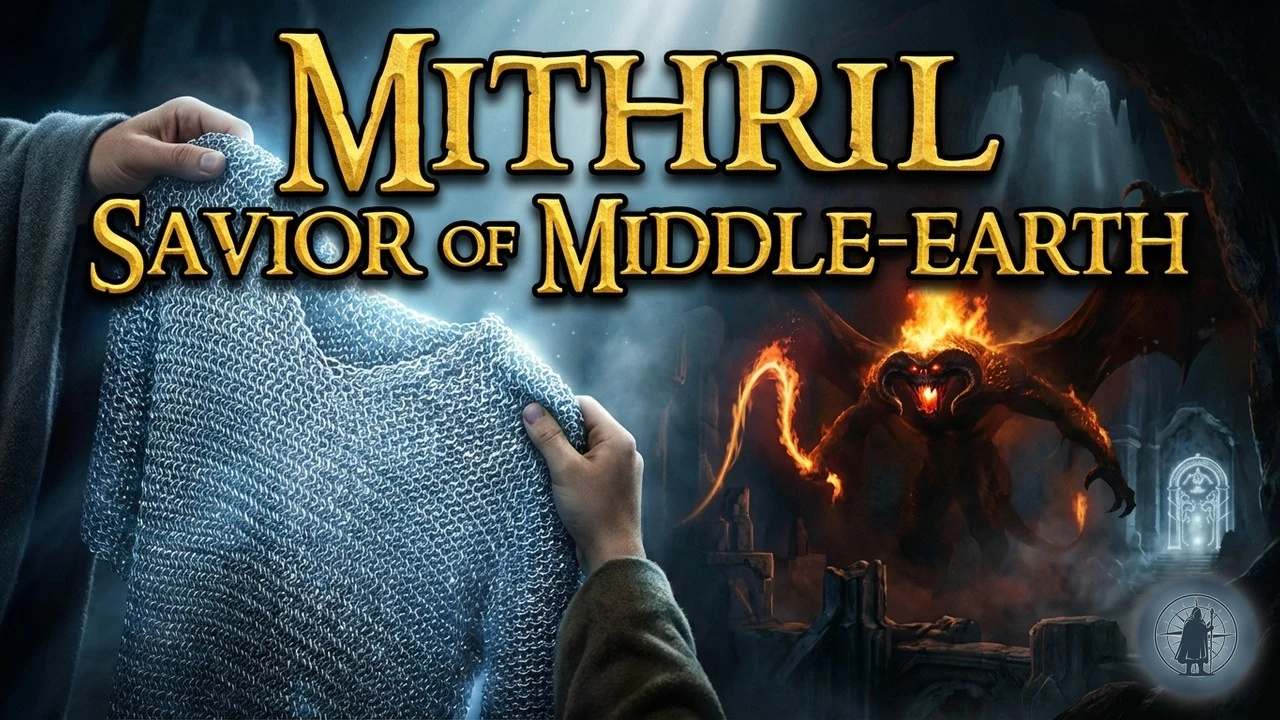 Watch the episode
Mithril: The Metal That Saved Middle-earth | Tolkien Lore Explained
Watch the episode
Mithril: The Metal That Saved Middle-earth | Tolkien Lore Explained
Main Narrative: The Value of Mithril
SECTION: The Only Mineral Tolkien Ever Invented
"It could be beaten like copper, and polished like glass; and the Dwarves could make of it a metal, light and yet harder than tempered steel. Its beauty was like to that of common silver, but the beauty of mithril did not tarnish or grow dim."
Those four lines are doing something remarkable. Tolkien isn't describing a magical substance. He's describing a metallurgical one. There's no mention of enchantment, no invocation of spells. What he gives us instead is a precise catalogue of physical properties: malleability, luster, hardness, weight, corrosion resistance. It reads almost like an entry in a materials science textbook -- if that textbook were written by someone who also happened to be a master of English prose.
Scholar Charles A. Huttar made an observation that I think is underappreciated: mithril is the only mineral Tolkien invented for Middle-earth. Not one of several. The only one. Gold exists in his world. Iron exists. Copper, tin, silver -- all present and accounted for. But when Tolkien needed something to anchor the deepest veins of his mythology, something to embody both the highest aspirations and darkest failures of his peoples, he created something entirely new.
The name itself is a window into that purpose. Mithril -- Sindarin, from mith, meaning grey or light grey, and ril, meaning brilliance or glitter. A grey brilliance. Something luminous that doesn't call attention to itself. It's a quiet name for a substance that would drive wars, shatter friendships, awaken ancient terrors, and ultimately save the world.
The Dwarves, characteristically, had their own name for it -- one they refused to share. In the Common Speech it was called Moria-silver, or true-silver. That second name is worth lingering over. True-silver. Not "better silver" or "magical silver." True silver. As though common silver were merely an approximation of something, and mithril was the real thing all along -- the platonic ideal that ordinary metal only gestured toward.
And then there was ithildin. A derivative substance crafted by Celebrimbor's Gwaith-i-Mirdain, the People of the Jewel-smiths. Ithildin -- "moon-star" in Sindarin -- was visible only by moonlight or starlight, and it was made from mithril. A substance that reveals its splendor only under specific, ancient light. You could walk past the Doors of Durin a thousand times in daylight and see nothing but blank stone. But under the moon, the ithildin blazed to life: the emblems of Durin, the Trees of the High Elves, the star of the House of Feanor. A hidden script written in a hidden metal, waiting for the right conditions to be read.
Metallurgist James Owen has argued that mithril's described properties correspond to real crystallographic possibilities -- an fcc metal like aluminum or nickel, or possibly a bcc structure like titanium. Titanium is the most commonly cited analogue: strong, light, resistant to corrosion, and genuinely beautiful when polished. But titanium tarnishes. Mithril does not. Whatever Tolkien imagined, he imagined it as something that endures unchanged across ages -- a material that time cannot diminish.
That durability matters. Because the story of mithril is, at its heart, a story about what endures and what doesn't. The metal lasts forever. The civilizations that coveted it did not.
SECTION: The Road Between Ost-in-Edhil and Khazad-dum
Around the year 750 of the Second Age, something extraordinary happened in the foothills west of the Misty Mountains. Noldorin Elves, led by Celebrimbor -- grandson of Feanor, greatest smith of the Eldar since his grandfather -- established a settlement called Eregion. The Holly-land.
They didn't choose the location for its scenery, though it was striking. They chose it because of what lay beneath the mountains to the east. In Khazad-dum, the mansions of Durin's Folk, miners had struck veins of a metal unlike anything found elsewhere in the world. And the Noldor, whose craft hunger was as deep as any Dwarven mine-shaft, came running.
What followed was unprecedented. Tolkien calls the friendship that grew between Celebrimbor's smiths and the Dwarves of Khazad-dum "the closest that there has ever been between the two races." Not merely cordial. Not a temporary alliance of convenience. The closest ever. A high road was built connecting the Elven city of Ost-in-Edhil to the western gate of Khazad-dum, and along that road flowed a commerce of materials and ideas that produced some of the most extraordinary artifacts in Middle-earth's history.
Celebrimbor and the Dwarf-smith Narvi built the Doors of Durin together -- the great western gate whose ithildin inscriptions would later gleam for the Fellowship under a cold moon. An Elf and a Dwarf, working side by side, combining their traditions into a single work. The Doors bore symbols of both peoples: Durin's crown and anvil, the star of Feanor's house, the Trees of the High Elves. A collaborative monument, written in a substance that only moonlight could reveal.
And Celebrimbor forged Nenya. The Ring of Adamant. One of the Three Elven Rings, the ring that Galadriel would bear through the long twilight of the Third Age. Its band was mithril. The metal of Dwarven mines, shaped by Elven hands, set to preserve the splendor of Lothlorien against the erosion of time. Mithril protecting what was fair from fading.
But there is a shadow over this golden age that cannot be ignored. The same cooperative spirit that produced the Doors and Nenya also created the conditions for catastrophe. Because it was into this community of open-handed smiths, sharing techniques and materials freely across racial lines, that Sauron walked. Disguised as Annatar, the Lord of Gifts. Offering knowledge. Offering partnership.
The Rings of Power were forged in Eregion. The collaboration that mithril had catalyzed -- Elves and Dwarves working together in unprecedented trust -- became the very channel through which Sauron infiltrated and corrupted the greatest act of craftsmanship since the Silmarils. Mithril brought the peoples together. Sauron used that togetherness against them.
In 1697 of the Second Age, Sauron's armies destroyed Eregion utterly. Celebrimbor was slain. The road between Ost-in-Edhil and Khazad-dum fell silent. And the age of cooperation was over.
SECTION: The Geography of Loss
The Dwarves of Khazad-dum survived the fall of Eregion. They shut their gates and endured, mining their mithril in increasing isolation for another thirteen centuries. But the world around them was contracting in ways they may not have fully understood.
Mithril had never been abundant. At its widest distribution, it could be found in perhaps three locations: Khazad-dum beneath the Misty Mountains, somewhere in the island kingdom of Numenor, and probably -- though the texts are suggestive rather than explicit -- in Aman, the Blessed Realm itself.
Then came the catastrophes.
In the year 3319 of the Second Age, Numenor drowned. Ar-Pharazon, the last king, sailed against the Valar in his madness, and Iluvatar broke the world to stop him. The island sank beneath the waves, and with it went every grain of mithril the Numenoreans had gathered. And in the same cataclysm, Aman was removed from the physical world entirely -- set apart on the Straight Road, unreachable by mortal ships.
Two sources gone in a single day. After the Downfall, when Gandalf later told the Fellowship that mithril was found "here alone in the world," he was speaking literal truth. Khazad-dum was all that remained.
The fifteenth King of Numenor, Tar-Telemmaite, had foreshadowed what mithril does to those who covet it. His very name -- "Silver-handed" in Quenya -- was a monument to his obsession. He directed his servants to seek the metal ceaselessly, pouring royal resources into the pursuit of a substance that would ultimately sink with his kingdom. A king defined by desire for something that would outlast neither him nor his realm. The parallel to the Dwarves is unmistakable, and it is not flattering to either.
After the Downfall, Khazad-dum stood alone as the sole source of mithril in the accessible world. And the Dwarves kept digging.
SECTION: Delved Too Greedily and Too Deep
Gandalf delivers the epitaph with the gravity it deserves:
"The Dwarves tell no tale; but even as mithril was the foundation of their wealth, so also it was their destruction: they delved too greedily and too deep, and disturbed that from which they fled, Durin's Bane."
Foundation and destruction in the same sentence. Tolkien compresses an entire civilizational arc into twenty-eight words. The thing that made you great is the thing that killed you. Not because the thing itself was evil, but because you could not stop reaching for it.
In the year 1980 of the Third Age, the miners of Khazad-dum broke through into something. Not a new vein. Not a deeper chamber. Something that had been sleeping beneath the roots of the mountains since the ruin of the First Age -- a Balrog, a spirit of shadow and flame, a servant of Morgoth who had lain dormant in the deep places when his master fell. Durin VI was slain. His son Nain I was killed the following year. And Khazad-dum, the greatest Dwarven realm in the history of the world, was abandoned.
No more mithril could be mined. What remained above ground was all there would ever be.
Scholar Charles Huttar frames this as "beauty and terror side by side" -- evil "inherent in the mineral treasures hidden in the womb of Earth." The phrasing deliberately echoes older mythological traditions. The dragon sitting on its hoard. The cursed gold of the Nibelungs. Tolkien knew those stories intimately, and he built mithril to participate in the same moral architecture: the earth gives up its treasures, and the treasures consume those who take them.
The parallel to the Silmarils is impossible to miss. Feanor's jewels were the most radiant objects ever crafted -- and the oath to recover them drowned the First Age in blood. Mithril was the most valuable substance ever discovered -- and the drive to extract it woke a demon that ended a civilization. In both cases, the object itself bears no malice. The Silmarils burned evil hands, not good ones. Mithril served whoever worked it. The corruption lived in the desire, not the thing desired.
Tolkien grew up between two worlds: the rural village of Sarehole, with its mill and trees and quiet fields, and industrial Birmingham, with its furnaces and smoke and relentless extraction. "Delved too greedily and too deep" is not only a Dwarven epitaph. It carries the weight of a man who watched the English countryside consumed by an appetite that could never be satisfied. The Dwarves did not need more mithril. Their wealth was already legendary. But they dug anyway, because the vein went deeper, because the metal was there, because stopping felt like leaving something on the table.
And so the foundation became the grave.
SECTION: A Kingly Gift -- The Coat's Journey
But mithril is not only a story about civilizations. It is also a story about a single object -- small enough to fold, light enough for a hobbit to wear, and worth more than the Shire and everything in it.
The mithril shirt enters the legendarium modestly. In the original 1937 edition of The Hobbit, it's described as a "coat of silvered steel." Nothing more. A nice piece of armor. Tolkien didn't change it to mithril until the 1966 revised edition, retroactively binding The Hobbit to the deeper mythology he'd spent decades developing. What had been a narrative prop became a thematic keystone.
The corslet was made "for a young elf-prince long ago." Tolkien never tells us who. Not the House. Not the Age. Not the smith. This deliberate silence creates a kind of resonance -- the armor arrives from a past so deep it has no name, carrying the weight of an identity we can never recover. Somehow it ended up in Smaug's hoard beneath the Lonely Mountain, one priceless treasure buried among mountains of gold.
Thorin Oakenshield gave it to Bilbo Baggins. Gimli, upon seeing it decades later, called it "a kingly gift" and said "it was well given." Those words matter. Not "it was well earned" or "it was well deserved." Well given. The moral quality belongs to the act of giving, not to the recipient's worthiness.
And then Bilbo gave it to Frodo in Rivendell. Gandalf, watching this exchange, knew something neither hobbit fully grasped:
"I never told him, but its worth was greater than the value of the whole Shire and everything in it."
Greater than the Shire. Every hill and farm and mill and garden. Every mathom and market and old stone wall. The entire homeland of an entire people -- and the mail was worth more. Bilbo gave it away as casually as lending a good walking stick. He didn't know, and it wouldn't have changed anything if he had.
Now contrast this journey of gifts with encounters marked by seizure. Smaug hoarded it for nearly two centuries, buried under his belly with ten thousand other treasures, none of them used, none of them appreciated, all of them wasted. The orcs of Cirith Ungol stripped it from Frodo's unconscious body -- and the discovery triggered a brawl so violent that nearly the entire garrison slaughtered each other. Shagrat survived and brought it to Sauron. The Mouth of Sauron displayed it at the Black Gate, wielding an object of protection as an instrument of despair.
Every time the shirt is seized, violence follows. Every time it is given, life is preserved. Tolkien could not have drawn the moral line more clearly.
SECTION: Hidden Armor, Hidden Strength
Bilbo told Frodo to keep the mail secret. Wear it under your clothes. Don't let anyone see.
And so the most valuable object in Middle-earth traveled to Mordor concealed beneath a hobbit's linen shirt. An absurd image, when you stop to think about it. An artifact exceeding the price of an entire country, strapped to the chest of a three-foot-six gardener's employer, walking into the land of shadow.
The shirt saved Frodo's life at least three times. In the Mines of Moria, an orc chieftain drove a spear into his chest with enough force to pin "a wild boar." The Fellowship thought he was dead. He wasn't. The mithril turned the blow. On the Great River, an arrow struck him -- turned again. And in the Shire itself, at the very end of the story, Saruman drew a blade and stabbed downward. The knife snapped against the hidden mail, and the fallen Wizard's face registered pure disbelief. He hadn't known. None of them had known.
That pattern of surprise is the point. The orc expected easy prey. Saruman expected a defenseless hobbit. In each case, the attacker's assumption -- that small means weak, that humble means unprotected -- proved fatally wrong. The armor is a physical manifestation of the theme that runs through every page of Tolkien's work: do not judge strength by appearance. The hobbits look like nothing. They are everything.
At Cirith Ungol, after Shagrat seized the mail and brought it to Barad-dur, Sauron's servants displayed it before the Captains of the West at the Black Gate. The Mouth of Sauron held up the small mithril shirt, Sam's short sword, and a grey elven-cloak. Tokens of a captured spy, he claimed. Evidence that the Ring-bearer had failed.
The shirt that had protected Frodo now served as a weapon against his friends' hope. An object of preservation became an instrument of psychological destruction. Its meaning inverted completely depending on who held it and why. In the hands of those who gave freely, it shielded. In the grasp of those who seized, it wounded.
Gandalf recovered it after the fall of Sauron. We're told it was returned to Frodo. The mail came home, as gifts sometimes do when the story is long enough.
SECTION: The Precious That Protects
There are two objects in The Lord of the Rings that inspire the word "precious." One is the Ring. The other, though it's never called that explicitly, is the mithril coat. And the structural parallels between them illuminate something fundamental about Tolkien's moral architecture.
Both are incomparably rare. Both inspire violent covetousness -- the Ring drives Gollum to murder; the mithril shirt drives the orcs of Cirith Ungol to mutual annihilation. Both "protect" their bearers, though in radically different ways: the Ring grants invisibility, the mail turns blades. Both are associated with a significance that defies ordinary measurement. The Ring contains the power of a demigod. The shirt exceeds the value of an entire country.
But the resemblance fractures at the moral seam.
The Ring can only be taken. Its entire history is a chronicle of seizure, murder, and corruption. Isildur cut it from Sauron's hand. Gollum strangled Deagol for it. Bilbo found it in darkness -- and even that "finding" was an act orchestrated by the Ring's own will. The Ring does not give itself. It moves by manipulation, by violence, by the erosion of its bearer's soul. And it extends life only at the cost of hollowing it out -- Gollum's five centuries of wretched, hissing existence in the roots of the mountains.
The mithril coat moves by generosity. An unknown smith made it for an elf-prince. Thorin gave it to Bilbo. Bilbo gave it to Frodo. Each transfer was free, willing, even joyful. And where the Ring diminishes its bearers, the coat sustains them. It doesn't demand anything in return. It doesn't whisper. It doesn't corrupt. It simply waits, hidden and patient, until the moment its bearer needs saving.
Economist C.J. Lockett has argued that wealth in Middle-earth operates as "transcendent rather than transactional." Mithril embodies this perfectly. Its value cannot be captured by economics. It serves narrative and moral purposes that no ledger could contain. The shirt is not an investment. It is not a status symbol, at least not for those who carry it properly. It is a grace -- an unearned protection, freely given, that shows up precisely when death seems certain.
Galadriel prophesied of Gimli that gold would "have no dominion" over him. That prophecy names the proper relationship a soul can have with beautiful things: appreciation without possession, reverence without avarice. Gimli would later work the Glittering Caves of Aglarond with a craftsman's love -- enhancing what he found rather than extracting it, adorning rather than depleting. Tolkien's concept of sub-creation in action: the right use of the maker's gift.
Mithril endures. It does not tarnish. It does not grow dim. But the question it poses to everyone who encounters it is always the same: will you give, or will you grasp? And the answer to that question determines whether the most precious substance in Middle-earth becomes a foundation or a grave.