Transcript
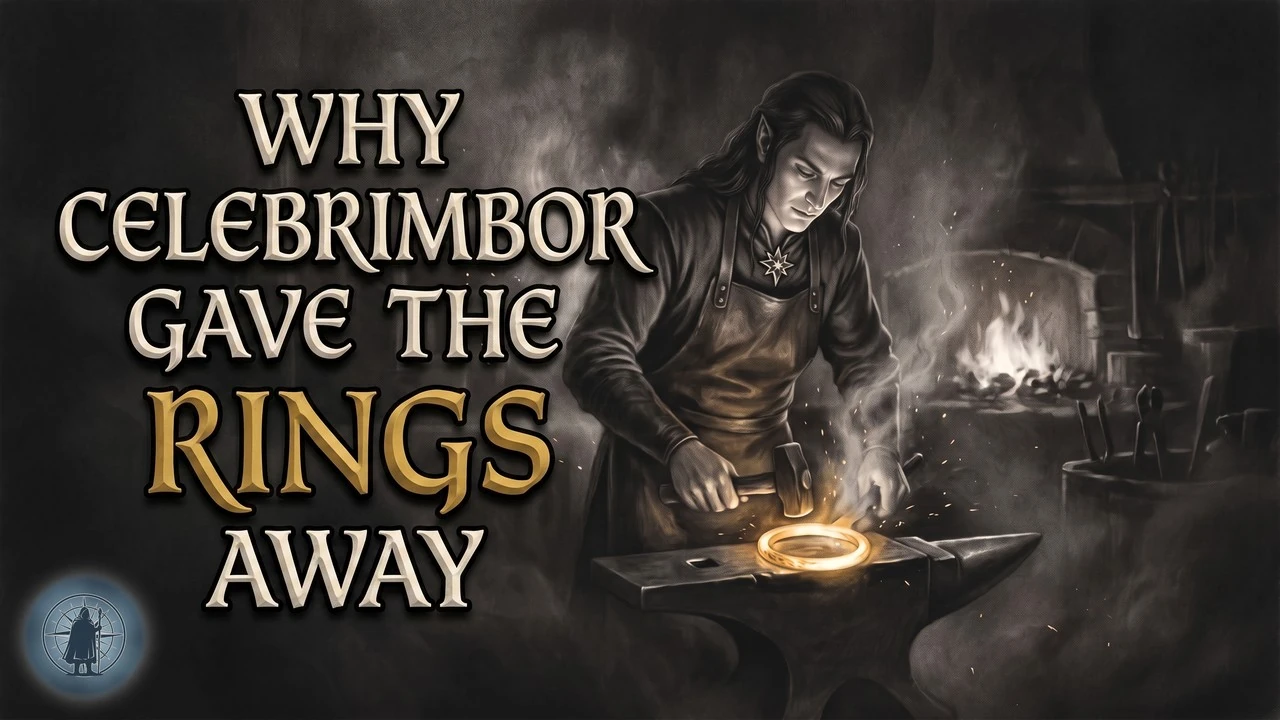
Celebrimbor Gave Away What Fëanor Killed For.
 Watch the episode
Celebrimbor Gave Away What Fëanor Killed For.
SECTION: The Closed Hand of Fëanor
There's a moment in The Silmarillion where almost everything begins to hang on one question, and that question is very simple. Yavanna, one of the Powers who shaped the earth, asks Fëanor for his jewels.
That's the test.
The Two Trees are dead. Morgoth and Ungoliant have drunk them dry, and the light that lit the world is gone, except for the little of it Fëanor caught and sealed inside three stones. Yavanna says she can wake the Trees again if she gets that light back. And before she asks, she says the kindest thing anyone says to Fëanor in the entire book. "Even for those who are mightiest under Ilúvatar there is some work that they may accomplish once, and once only."
She knows what she's asking him to give up. She's telling him she knows.
His answer is worth hearing, because most will remember his refusal but forget the grief that came with it. "It may be that I can unlock my jewels, but never again shall I make their like; and if I must break them, I shall break my heart, and I shall be slain; first of all the Eldar in Aman."
Then, again, he says something important.
"This thing I will not do of free will. But if the Valar will constrain me, then shall I know indeed that Melkor is of their kindred."
Mandos answers him with three words. "Thou hast spoken."
Fëanor doesn't know the Silmarils have already been stolen. Hours earlier Morgoth killed Fëanor's father and stole them. So when Fëanor says he'd sooner die than open his hand, what he's refusing to open it for is already gone. He's defending an empty chest, and of everyone in that room only Mandos seems to know it.
That means his refusal was worthless. It saved nothing and changed nothing. And then Tolkien steps out from behind the story to tell us it mattered anyway, which he almost never does. "Yet had he said yea at the first, before the tidings came from Formenos, it may be that his after deeds would have been other than they were."
If he'd said yes at the start, everything might have gone differently. Tolkien is putting the fork in the road at the grip rather than at the theft.
He'd already told us what that grip was made of. Back in chapter seven, long before any of the darkness: "the heart of Fëanor was fast bound to these things that he himself had made." And then the part that really implicates his character. "He seldom remembered now that the light within them was not his own."
That's the disease.
The maker forgot he wasn't the source. The light inside the Silmarils came out of the Trees, and the Trees came from Yavanna, and Fëanor caught that light the way a man catches rain. He was the finest craftsman his people ever produced, and somewhere along the way he started treating the beauty as property.
His own teacher had faced the identical test and passed it. Aulë made the Dwarves in secret, before Ilúvatar had made anybody. Caught in the act, he raised his hammer over the Seven Fathers to smash them himself, weeping. And that's what saved them. Ilúvatar gave the Dwarves real life because unlike Fëanor, Aulë could open his hand. Tolkien says Aulë's delight is "neither in possession nor in his own mastery."
Fëanor was his best student, and he failed the same exam.
There's a complication though. Fëanor didn't only make things to keep. He made the palantíri, and the Seeing-stones were built to be scattered and used across distance. He could make a gift when he chose to, which makes what he did with the Silmarils harder to excuse, not easier.
The keeping, is a decision he made about three particular stones.
SECTION: Nargothrond, 465: The Son Who Stayed
Celebrimbor's father was, Curufin.
We don't hear that relationship come up much, because in the published Silmarillion Celebrimbor gets one appearance in the entire First Age, and it's a single sentence.
"In that time Celebrimbor the son of Curufin repudiated the deeds of his father, and remained in Nargothrond; yet Huan followed still the horse of Celegorm his master."
One line for an entire youth, and the verb in it is repudiated.
So let's go back to the year 465 of the First Age and look at what he was repudiating. Ten years earlier the Dagor Bragollach had smashed the northern defences, and two of Fëanor's sons, Celegorm and Curufin, had lost their lands and fled south to Nargothrond, where Finrod Felagund took them in.
Then Beren walked in.
He asked Finrod to honour an old debt and help him steal a Silmaril. Finrod said yes, because he'd sworn to. And Celegorm and Curufin stood up in Finrod's own hall and turned Finrod's own people against him. Finrod put down his crown, handed the kingship to Orodreth, and left with Beren and ten men.
Finrod then died in the pits of Tol-in-Gaurhoth, killing a werewolf with his bare hands so Beren could live.
That's what the brothers did to the man who'd taken them in. Then they imprisoned Lúthien, and Curufin later tried to kidnap her. Orodreth drove them both out.
And Celebrimbor didn't go with his father.
Pay attention to the date here. This is 465. The kinslaying at Doriath, where Celegorm and Curufin both die with Elvish blood on their hands, is 506 to 507 - forty-one years later. Celebrimbor didn't break with his father over Doriath. He broke with him over Finrod, four decades earlier, when the crime was ingratitude and a good king sent off to die.
Tolkien fills in the reason in a note in one of his late essays. Celebrimbor "had grown to love Finrod... and was aghast at the behaviour of his father and would not go with him." He chose a dead guy over his living father.
And nothing was forcing him either way. The Oath of Fëanor - the thing that has Maedhros and Maglor committing atrocities for five hundred years because they swore they would - was sworn by Fëanor and his seven sons, named individually. Celebrimbor is a generation below that list. The Oath never touched him. Maedhros could at least plead that he was bound. Celebrimbor had nothing binding him at all, which makes what he did at Nargothrond just a young man deciding he didn't want to be like his father.
Tolkien even offers an explanation for the temper, and he puts it in a parenthesis, in passing, like a footnote rather than the key to a character. Celebrimbor inherited Curufin's skills, but was "an Elf of wholly different temper" - and then the bracket opens: "his mother had refused to take part in the rebellion of Fëanor and remained in Aman with the people of Finarphin."
Celebrimbor's mother is never named. Not in any text, anywhere. All we know about her is that when the House of Fëanor marched out of Valinor, she wouldn't go. Celebrimbor got his hands from his father and his judgement from a woman who stayed home, whose name we're never going to learn.
Before we go into Eregion...
It's tempting to say the curse of Fëanor hung over Celebrimbor for the rest of his life, but it didn't. At the end of the First Age the Noldor were pardoned and, in Tolkien's phrase, "the curse was laid to rest." He confirmed in a letter that the exiles were allowed home "save for a few chief actors in the rebellion," and Celebrimbor isn't on that list. He spent the whole Second Age as a free and forgiven Elf.
We just have no idea where.
Between 465 of the First Age and the founding of Eregion around the year 750 of the Second, Celebrimbor disappears from every text Tolkien wrote. The record is blank.
SECTION: Why Tolkien Kept Rewriting Celebrimbor
Now let's get into some other complications with the story of Celebrimbor.
The grandson of Fëanor - the main character of this episode - is younger than most would assume, and Tolkien changed his mind several times about him.
Celebrimbor turns up in the drafts in 1939 as a signature. Nothing else. Tolkien is writing the Moria chapter, he needs words on a door, and he writes "Celebrimbor of Hollin drew these signs." No family, no house, no biography. And that's how Celebrimbor reaches print in The Fellowship of the Ring in 1954. For twelve years the greatest smith of the Second Age is a name on a gate.
Then in 1966 Tolkien revised The Lord of the Rings for its second edition and added one sentence to the front of the Second Age chronology. "Celebrimbor was Lord of Eregion and the greatest of their craftsmen; he was descended from Fëanor."
That single sentence is where the Fëanorian connection enters the published canon, twelve years after the character did. And it says descended from. It never says son of Curufin.
Son of Curufin exists in Tolkien's lifetime in two places. One is a note he pencilled in the margin of his own copy of The Return of the King. The other is a footnote in a late essay that begins "It seems probable that..." Probably the most quoted genealogy in Second Age lore rests on a margin note and a written hedge. Even the text that establishes it is guessing.
And then Tolkien changed his mind again. Around 1968, in an essay about Elvish hand-counting that's now printed in The Nature of Middle-earth, Tolkien wrote this: "The famous Celebrimbor, heroic defender of Eregion in the Second-age war against Sauron, was a Teler, one of the three Teleri who accompanied Celeborn into exile."
A Teler.
A Telerin silversmith who came east with Celeborn - and the essay explains that Celebrimbor was a common name among the Teleri, because they were famous for silver-work. That's probably the most radical of Tolkien's revisions to the character. It came five years before he died, and it deletes the grandfather completely.
And that isn't the only alternative. Around 1959 Celebrimbor is an Elf of Gondolin, beaten in most things by a colleague named Enerdhil. Around 1969 he's a Sinda claiming descent from Daeron of Doriath. Christopher Tolkien, who had to turn all of this into one book, put it plainly. "Like Gil-galad, Celebrimbor was a figure first appearing in The Lord of the Rings whose origin my father changed again and again."
So Christopher had to make a decision.
He picked the Fëanorian version, and his reasoning wasn't that it made the best story. It was that his father had printed it. Writing about the late Telerin version, he says his father "ignored the addition to Appendix B in the Second Edition... no doubt he had forgotten that that theory had appeared in print, for had he remembered it he would undoubtedly have felt bound by it."
A thing you put into a published book is a promise to the people who bought it. That's defensible, and Christopher never wrote down any regret about it - the decision was made.
So this leaves our deep dive into Celebrimbor a bit murky. The redemption reading depends on a family tree the author was still rewriting the year before he died. We'll proceed with known caveats and caution.
There's one thing we see in every version. In the Telerin text, where the Fëanor connection is gone completely, this is what Tolkien says instead: "there was great friendship between the Dwarves of Moria and Celebrimbor, and they shared their skills and craft-secrets."
Whoever his father was, in whichever draft, the Dwarves are always there. Tolkien changed his lineage four times and never once touched the friendship. Celebrimbor and the Dwarves got along swimmingly.
SECTION: Eregion, Mithril, and the Dwarves of Moria
Most Elvish kingdoms in Tolkien get founded for reasons that sound like poetry. Doriath is built where a Maia and a king fell in love. Gondolin is hidden in a ring of mountains because a Vala whispered the way.
Eregion was founded next to a mine.
Around the year 750 of the Second Age, according to the chronology in the appendices, "Eregion founded by the Noldor." The site is in Eriador, under the west face of the Misty Mountains, in the angle below Caradhras, Celebdil and Fanuidhol - the three peaks the Dwarves had hollowed out into Khazad-dûm. And the reason the Elves picked that patch of holly country is that the Dwarves had just found something underneath it.
Mithril.
As Gandalf tells us thousands of years later: mithril was worth ten times its weight in gold, and it was found nowhere else in the world.
So the greatest guild of Elven-smiths in the history of Middle-earth chose their homeland the way a steel town chooses a river. They moved next to the supply.
There's a contradiction worth mentioning. The chronology credits the Noldor and names nobody; Unfinished Tales says Celeborn and Galadriel went east "about the year 700 of the Second Age" and founded the realm themselves - and Celeborn wasn't a Noldo. So two printed accounts don't quite agree.
Nobody disputes what grew out of that ore deposit, though. The Silmarillion puts it like this: "a friendship arose between Dwarves and Elves, such as has never elsewhere been, to the enrichment of both those peoples." Tolkien is telling us it made money for both sides. A lucrative, symbiotic relationship.
The superlative means more when it's next to Doriath. Dwarves built Menegroth for Thingol and delved Nargothrond for Finrod - older collaborations, grander buildings - and Tolkien's verdict on them is chilly: "the friendship between the Dwarves and the Elves was ever cool, though much profit they had one of the other." That arrangement ended with Thingol murdered in his own halls over a necklace. Doriath was a contract. Eregion was a friendship. The difference had nothing to do with the quality of the stonework.
The Elves of Eregion called themselves the Gwaith-i-Mírdain, the People of the Jewel-smiths - a guild that names itself after its material and its trade instead of after a lord. The Silmarillion says they "surpassed in cunning all that have ever wrought, save only Fëanor himself."
And again we come back to a theme of this episode. Tolkien ranked them second. Meaning...he ranked Celebrimbor, second.
Second place, however, built something Fëanor never managed.
Unfinished Tales says that out of the partnership "Eregion became far stronger, and Khazad-dûm far more beautiful, than either would have done alone." Each city got better at being itself because of the other one. Fëanor made things nobody could match and shared them with nobody. His grandson ran a workshop where the improvements went both ways through a mountain wall.
We can't really make him a saint though. One version of the story has him seizing power. Unfinished Tales preserves an account where the smiths of Eregion, working with a stranger calling himself Annatar, revolt against Galadriel and Celeborn some time between 1350 and 1400 and make Celebrimbor lord in their place. Galadriel leaves through Khazad-dûm for the woods that become Lothlórien. Celeborn, who won't set foot in a Dwarf-mansion, stays behind and is, "disregarded by Celebrimbor." Christopher Tolkien tells us this appears nowhere else in his father's papers. It's a variant. But a lord who came to power in a guild coup and cold-shouldered the husband of the woman he loved is a more interesting man than a saint. There's some scandle there.
Annatar, incidentally, had arrived around the year 1200, and Eregion welcomed him. Gil-galad and Elrond had already refused to let him past their doors.
SECTION: Narvi's Name Comes First on the Doors of Durin
Almost everything Celebrimbor built is gone. Ost-in-Edhil was destroyed so completely that nothing of it is described as standing in the Third Age. His rings left the world. His kingdom is a stretch of dying holly on the road to a haunted mine.
One thing that survives, though, is a door. And it still works.
In the year 3019 of the Third Age, Gandalf puts his hands on a blank cliff face beside a stagnant lake, and silver lines come up through the stone like veins. An arch of Elvish letters at the top. Below that, an anvil and hammer under a crown with seven stars. Below that, two trees carrying crescent moons. And in the middle, shining more clearly than all the rest, a single star with many rays.
Three characters name the three devices, and Tolkien lets each of them say one line. Gimli: "There are the emblems of Durin!" Legolas: "And there is the Tree of the High Elves!" And Gandalf: "And the Star of the House of Fëanor."
Everywhere else in the legendarium, that star is a war badge. It's the device of the house that swore the Oath, burned the ships at Losgar, and killed Elves at Alqualondë and Doriath and Sirion. Celebrimbor took his family's battle emblem and set it on a door he made with a Dwarf, on the same surface as a Dwarf-king's hammer. Tolkien tells us that all the symbols share one door.
Then there's the writing. Gandalf reads the whole inscription out: "The Doors of Durin, Lord of Moria. Speak, friend, and enter. And underneath small and faint is written: I, Narvi, made them. Celebrimbor of Hollin drew these signs."
So there's three things in that sentence.
The Dwarf's name comes first, and the Dwarf gets the verb. I, Narvi, made them. Celebrimbor's own claim on the work is the smaller one - he drew the signs. The greatest craftsman alive in Middle-earth signed the gate as the decorator.
Second, he calls himself Celebrimbor of Hollin - by his town, not by his father and not by his house. On the only object he ever signed that we still have, he identified himself by the place he built rather than the family he came from. Meanwhile the Silmarils get called Fëanor's jewels for two entire ages of the world.
And third, Gandalf tells us the signatures are "small and faint." They're the least visible thing on the door.
The letters themselves are Daeron's runes, the writing system invented in Doriath and taken up by the Dwarves as their own. An Elf and a Dwarf, meeting in a third people's alphabet.
The silver they're written in is ithildin, from ithil and tin, "star-moon." It's an alloy of mithril, so the lettering on that gate is made of the exact metal the two races of people had come together to trade. Gandalf says that it "mirrors only starlight and moonlight, and sleeps until it is touched by one who speaks words now long forgotten in Middle-earth."
This was an entrace for goods. For commerce. Gandalf again: "the West-door was made chiefly for their use in their traffic with the Lords of Moria." Two masters collaborated on the finest thing either would ever make, and its job was moving cargo.
There's sadness in that signature, too. We don't know Narvi's name. The appendices are explicit that Dwarves keep their real Khuzdul names secret from outsiders and won't even carve them on their own tombs. Narvi is an outer name, the kind a Dwarf hands to strangers. Celebrimbor may never have known the real name of his closest friend. And Gimli, standing at that door, might give him the shortest phrase in the book: "Narvi and his craft and all his kindred have vanished from the earth."
Over four thousand years pass between the day Celebrimbor died and the night Gandalf touched that stone. The ithildin still woke up. And Gandalf says: "Those were happier days, when there was still close friendship at times between folk of different race, even between Dwarves and Elves."
SECTION: The Elessar and the Three Rings of Power
Before any of the rings, there was a green stone.
Unfinished Tales has a short piece about it, and it might be the most under-used text in all the Celebrimbor material, because it gave us a peak into his motives centuries before Sauron ever walked into Eregion.
The Elessar was a great green gem with the light of the Sun caught inside it. It healed things. "The hands of one who held it brought to all that they touched healing from hurt," and things seen through it that were withered or burned looked as they had in their youth, or as they might be if made whole again.
Healing, and seeing damaged things unstained.
Those are almost the exact words Elrond uses about the Three Rings, centuries later. The Elessar is a Ring of Power in miniature, made centuries early, by the same smith.
But why did he make it?
Galadriel told him she was grieving for the slow fading of Middle-earth, the way everything she loved kept coming out a little less than it had been. So he made her a stone that made the hurt things look whole. Unfinished Tales adds some context that recolors it all: Celebrimbor "bore great love" for Galadriel, and she didn't return it. He set the gem in a great silver brooch shaped like an eagle rising with its wings spread, and he gave it to her.
There is no version of any text in which Celebrimbor keeps the Elessar.
Tolkien wrote two accounts of that stone but didn't choose between them. In one, Celebrimbor made it, and in the other an Elf of Gondolin named Enerdhil made the first one and Gandalf brought it back from Valinor centuries later. Tolkien says only that the people who could settle it "now are gone." And in the version where Celebrimbor makes it, he isn't a Fëanorian at all. He's an Elf of Gondolin. Even the text that shows us his clearest motive can't agree on who he was.
The stone kept going, though.
Galadriel gave it to her daughter Celebrían, Celebrían to her daughter Arwen, and Arwen to Aragorn, who took his royal name from it and ruled as Elessar, the Elfstone. The Fourth Age opens with a king wearing a jewel an Elf made out of love that was never returned.
Now, the smithcraft most of us know: the rings.
The smiths began forging around the year 1500 of the Second Age. Around 1590 the chronology has seven words for it: "The Three Rings are completed in Eregion."
Celebrimbor forged those three alone, without Sauron's hand on them and without Sauron even knowing they existed.
Ten years later, in 1600, Sauron finished the One in the fire of Orodruin and put it on. And the appendix tells us what happened next in a single verb.
"Celebrimbor perceives the designs of Sauron."
There's no warning, no duel, no rescue. Just one instant of knowing, from hundreds of miles away, that the man he'd worked beside for four hundred years had been building a leash. Unfinished Tales adds the exoneration that matters: "Now Celebrimbor was not corrupted in heart or faith, but had accepted Sauron as what he posed to be; and when at length he discovered the existence of the One Ring he revolted against Sauron."
Celebrimbor was fooled, but he was never bought.
The rings were special. Celebrimbor gave them away.
In 1693, the chronology says: "War of the Elves and Sauron begins. The Three Rings are hidden." Celebrimbor took counsel with Galadriel, and the Three rings left Eregion - to Galadriel, to Gil-galad, and onward. Gil-galad passed Narya to Círdan at the Havens, and Círdan eventually handed it to Gandalf. Vilya found its way to Elrond. Three rings, three keepers. Celebrimbor kept none.
He let the Three go in 1693, and Ost-in-Edhil doesn't fall until 1697. He divested himself four years before the war reached his gates, while he still had every option and nobody was making him do anything. By contrast, Fëanor kept all three of the special objects he made. He locked them in a chamber of iron at Formenos.
The Silmarillion story here stings...
"Therefore the Three remained unsullied, for they were forged by Celebrimbor alone, and the hand of Sauron had never touched them; yet they also were subject to the One."
So even the clean rings were never quite free.
And the Dwarves remembered one more gift on top of all that.
They got rings too. Seven of them.
And by their own tradition, the greatest of the Seven came to Durin the Third from Celebrimbor's own hand rather than Sauron's. That's their account rather than flat fact, but it tells us how they chose to remember it - even among the compromised rings, theirs came from a friend. Which may make it worse.
SECTION: How Celebrimbor Died in Ost-in-Edhil
And now we come to his end.
Celebrimbor's name means "the closed hand".
Celebrin for silver, and paur for a fist. Silver-fist, Hand of Silver. And in that late essay about hand-counting, Tolkien is specific about which kind of closed hand he meant: "the tightly closed hand as in using an implement or a craft-tool rather than to the 'fist' as used in punching." It's the hand closed on the work.
So how does it end?
In 1695 Sauron's army crossed into Eriador and Gil-galad sent Elrond east.
Elrond arrived too late.
In 1697 Ost-in-Edhil was taken, and Celebrimbor made his last stand on the steps of the House of the Mírdain - the guild hall. His own workshop. He lost. He was overpowered and taken alive.
The next part tends to get garbled.
Sauron sacked the guild house. He found the Nine rings of men there himself, along with other lesser works of the smiths. Celebrimbor didn't surrender those; they were just lying around in the building. Then the text says: "but the Seven and the Three he could not find." Under torture, Celebrimbor gave up the Seven. He broke under pressure.
But Tolkien tells us why he broke on the Dwarven rings and held on the others: "neither the Seven nor the Nine did he value as he valued the Three; the Seven and the Nine were made with Sauron's aid, whereas the Three were made by Celebrimbor alone, with a different power and purpose."
He surrendered the rings he'd made with Sauron, and he died over the rings he'd made by himself.
"Concerning the Three Rings Sauron could learn nothing from Celebrimbor; and he had him put to death. But he guessed the truth, that the Three had been committed to Elvish guardians: and that must mean to Galadriel and Gil-galad. In black anger he turned back to battle; and bearing as a banner Celebrimbor's body hung upon a pole, shot through with Orc-arrows, he turned upon the forces of Elrond."
Sauron figured it out anyway. We read it in the next sentence - he reasoned his way to Galadriel and Gil-galad without needing to be told. The silence bought nothing at all, which means the thing Celebrimbor died for was the refusal itself rather than any secret inside it.
Fëanor stood in front of the Powers of the world and said this thing I will not do of free will, to stop three jewels being broken open for everybody's good. Celebrimbor, his grandson, said the same thing to Sauron, to stop three rings being taken for everybody's ruin.
It's the same refusal, but in the opposite direction. That's the case, and I think it's the only argument we could make that Celebrimbor "surpassed" his grandfather.
The published text only gives us three words the end of Celebrimbor.
"Celebrimbor was slain."
Sauron killed him.
Sauron took the body of the greatest maker of the age and turned it into an object - a sign on a pole, carried in front of an army. The last thing anybody does with Celebrimbor is unmake him into material.
Sauron carried that banner against Elrond when the mountain opened behind him. Durin the Third sent a force of Dwarves out of Khazad-dûm into the back of Sauron's army, and Elves of Lórinand came with them under Amroth. Elrond, who'd otherwise have been overwhelmed, got out, went north with the survivors, and founded Imladris - Rivendell - that same year.
Then the gates of Moria shut for nearly five thousand years. But they shut after the exit, and that's why Elrond lived to keep Vilya, raise Aragorn, and host the council that sent the Ring to the fire.
Tolkien named two ways an Elf can fall. In one letter, the Elvish fall is "into possessiveness and, to a less degree, into perversion of their art to power." In another, the Elves of Middle-earth "were 'embalmers'. They wanted to have their cake and eat it," trying to stop change and keep the world as a pleasant garden.
Celebrimbor is guilty of the second one. The Three rings hold time still, and Tolkien thought that was a fault. Elrond, who wore Vilya for three thousand years, says so at his own council: "It would be better if the Three had never been."
But on the family charge, the one his grandfather Fëanor died of, he's acquitted. Tolkien wrote the acquittal himself. The Three Rings, he says, "were 'unsullied', because this object was in a limited way good, it included the healing of the real damages of malice, as well as the mere arrest of change; and the Elves did not desire to dominate other wills, nor to usurp all the world to their particular pleasure."
In a limited way good.
That might be the most exact thing anyone ever said about Celebrimbor.
He didn't out-build Fëanor. He out-chose him, by exactly one of the two available sins.