
Transcript
Why the Valar Stopped Intervening
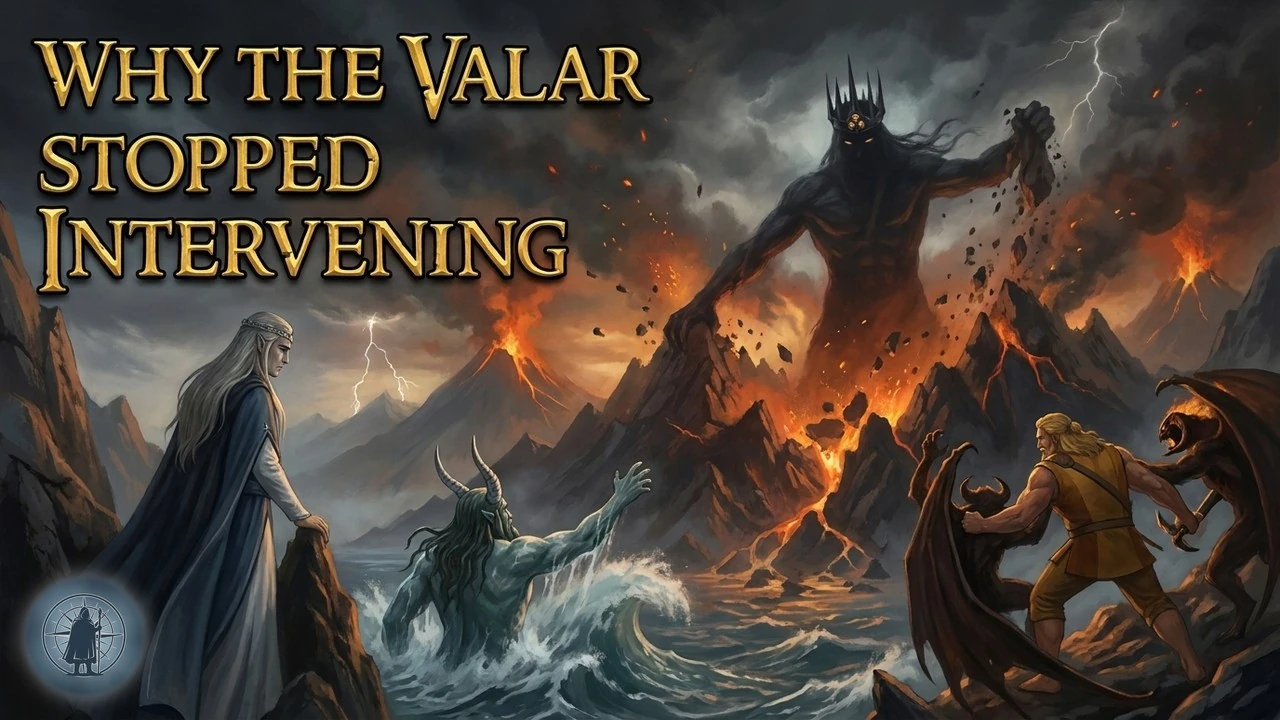 Watch the episode
Why the Valar Stopped Intervening
SECTION: The Lamps, Almaren, and Morgoth's Grip on Arda
"And the shape of Arda and the symmetry of its waters and its lands was marred in that time, so that the first designs of the Valar were never after restored."
That line from the Silmarillion comes from long before the Sun, and it's about a fight the Valar lost.
Before there was any Sun or Moon, the Valar lit Middle-earth with two enormous Lamps, one in the north and one in the south. They made their first home in between, on an island called Almaren. Then Melkor, the rebel among them, the one the Elves would later call Morgoth, came back out of the dark and destroyed the Lamps. Their fire poured out over the earth, and Almaren was destroyed along with them.
The Silmarillion says the Valar "could not at that time overcome him," because most of their strength went into holding the world together, "and afterwards they feared to rend the Earth again." It's the first time the book says the Valar held back for fear of breaking the world. So the Valar left Middle-earth, crossed to Aman in the far west, raised a wall of mountains called the Pelóri along its coast, and built Valinor behind it. From then on, they didn't come to Middle-earth too often.
The question of war came back because of the Elves. Before they woke, Yavanna asked the council, "Shall they walk in darkness while we have light?" Tulkas, the champion of the Valar, answered, "Let us make war swiftly!" But Mandos reminded everybody that the Elves haven't woke yet, so the council held off, and Varda lit new stars for the Elves to wake under.
When Oromë found the Elves by the lake of Cuiviénen, Manwë went to Ilúvatar before deciding anything, and came back with this: "This is the counsel of Ilúvatar in my heart: that we should take up again the mastery of Arda, at whatsoever cost, and deliver the Quendi from the shadow of Melkor." Tulkas was glad. But Aulë the smith was sad, worried about the harm the world would suffer from that fight.
Aulë was right. The Battle of the Powers was fought in the north, around Melkor's fortress of Utumno, and during that battle, the shape of Middle-earth changed. The Great Sea "grew wide and deep," broke in on the coasts, and opened a great gulf to the south and a string of bays to the north, the Bay of Balar the largest of them. The Elves the war was fought for knew only that "the Earth shook and groaned beneath them." Melkor was dragged back to Valinor in chains. But Sauron? They didn't find him...
So the fall of the Lamps cost the Valar their original design for the world, and the Battle of the Powers redrew its coastlines. Late in life, Tolkien explained why fighting Melkor cost so much land, in an essay probably written in the late 1950s. Christopher Tolkien published it as "Notes on motives in the Silmarillion."
In it, Tolkien writes that Morgoth "lost (or exchanged, or transmuted) the greater part of his original 'angelic' powers, of mind and spirit, while gaining a terrible grip upon the physical world." He'd poured himself into the actual stuff of Arda.
"For this reason he had to be fought, mainly by physical force, and enormous material ruin was a probable consequence of any direct combat with him, victorious or otherwise. This is the chief explanation of the constant reluctance of the Valar to come into open battle against Morgoth."
Then Tolkien makes a comparison most of us can follow. Sauron put a great part of his power into one ring, so the Ring could be found, and carried, and destroyed. Morgoth's was spread through everything. As Tolkien put it, "The whole of 'Middle-earth' was Morgoth's Ring."
That left the Valar with a real dilemma: "Arda could only be liberated by a physical battle; but a probable result of such a battle was the irretrievable ruin of Arda." To get Morgoth all the way out of the world, you'd have to take the world apart.
That's Morgoth's half of this story. The more grip he got on the world, the less of the original angel was left in him.
SECTION: Why Did the Valar Summon the Elves to Valinor?
With Melkor in chains, the Valar met in council at the Ring of Doom in Valinor, to decide what to do about the Elves. And they didn't agree.
Ulmo, and some others with him, said that the Quendi should be left free to walk as they would in Middle-earth, and with their gifts of skill to order all the lands and heal their hurts. But most of them were afraid for the Quendi, out in a dangerous world full of tricks and shadows in the starlit dusk; and they were also filled with love for the beauty of the Elves, and wanted their company. So the majority won, and the Elves were summoned west, to live in the Valar's own land. Mandos, who had said nothing until then, broke his silence to say, "So it is doomed." And Tolkien adds, "From this summons came many woes that afterwards befell."
The Elves had their own reasons to hesitate. They had only seen the Valar angry, going off to war, except for Oromë. That filled them with fear. The beings asking them to come and live in the West were the same beings whose war had just shaken the ground under their feet. So Oromë took three of their lords to see Valinor first, Ingwë, Finwë, and Elwë, and those three came back and urged their peoples to go. Many did. Others refused and stayed in the east under the stars, and they became the Avari, "the Unwilling." The Silmarillion calls it "the first sundering of the Elves."
The woes from the Summons fill the rest of the Silmarillion. The Noldor, Finwë's people, settled in Aman. When Melkor was let out of his sentence, he lived among them in Valinor and whispered to them for years, and out of that came Fëanor's rebellion, the theft of the Silmarils, and the flight of the Noldor back across the sea to war.
So was the Summons a mistake? Tolkien never quite settled that question, and we can watch him argue with himself across his later papers.
In the late 1950s, rewriting his annals of Valinor, Tolkien added a sharp line about anyone who blamed the Valar for it: "those who hold that the Valar erred, thinking rather of the bliss of Valinor than of the Earth, and seeking to wrest the will of Ilúvatar to their own pleasure, speak with the tongue of Melkor." Christopher Tolkien pointed out that an earlier and gentler idea, that the Valar had erred but "with good intent," was harshly criticized here.
At about the same time, Tolkien wrote a conversation between Manwë and Eru himself. In it, Eru asks Manwë about the Elves: "have ye not removed great numbers of them to Aman from the Middle-earth in which I set them?" And Manwë answers, "This we have done, for fear of Melcor, and with good intent, though not without misgiving." Earlier in the same conversation, Manwë admits, "For we fear to meddle with Thy Children."
And in a letter drafted in 1958 and never sent, Tolkien says pretty plainly: "Even the 'good' Valar as inhabiting the World could at least err; as the Great Valar did in their dealings with the Elves."
So in one text, calling the Summons an error means speaking with Melkor's tongue. In another, Manwë confesses his misgivings to God. In a third, Tolkien just says the Valar got it wrong with the Elves.
All three texts agree on what the Valar actually did. When they were afraid for the Elves, they reached for their own presence and their own glory as protection, and they brought the Elves to it. Thousands of years later, the Valar would design a whole mission around not doing that again.
SECTION: The Hiding of Valinor: Were the Valar Do-Nothing Gods?
For a while, the Elves in Valinor were safe. Then Melkor destroyed the Two Trees with Ungoliant's help and fled to Middle-earth with the Silmarils. Most of the Noldor rebelled and went after him, and Mandos laid a doom on them: "the Valar will fence Valinor against you, and shut you out, so that not even the echo of your lamentation shall pass over the mountains."
When the Sun first rose, the Valar did exactly that. The Silmarillion says that, "being unwilling to make war upon him in Middle-earth, they remembered nonetheless the ruin of Almaren; and they resolved that the like should not befall Valinor." So they raised giant mountains, the Pelóri "to sheer and dreadful heights," and out in the sea they created the Enchanted Isles, with shadow and confusion on the water around them. Any sailor who landed on those islands was trapped there, and "slept until the Change of the World." The old songs call it Nurtalë Valinóreva, the Hiding of Valinor.
The wall worked, and the cost landed on the Elves in Middle-earth. As the war against Morgoth went badly, Turgon, the king of Gondolin, sent ships west, "to ask for pardon and aid of the Valar." But "Valinor was hidden. Therefore none of the messengers of Turgon came into the West, and many were lost and few returned." Of all the mariners who tried over the following centuries, the Silmarillion says only one ever got through.
Tolkien wasn't easy about any of this. In the late essay, Tolkien called the raising of the Pelóri "the last major effort, of this demiurgic kind, made by the Valar." Demiurgic just means world-shaping. Tolkien wrote that the whole effort could be seen, "if not an actually bad action, at least as a mistaken one." It had a good aim, keeping one part of the world unspoiled, but it "seemed to have a selfish or neglectful (or despairing) motive also." One of the Valar disapproved, and he gets his own chapter in a moment.
Then Tolkien goes further. The Hiding, Tolkien wrote, "came near to countering Morgoth's possessiveness by a rival possessiveness, setting up a private domain of light and bliss against one of darkness and domination: a palace and a pleasaunce (well-fenced) against a fortress and a dungeon."
The accusation that the Valar just sat on their hands is an old one. There's a French word for it, fainéant, which literally means "does nothing." Historians gave it to the last Merovingian kings of the Franks, who kept their thrones while other men ran the kingdom. Christopher Tolkien used that word about his father's earliest version of this story, the Lost Tales, written during and just after the First World War. So this was even before the Silmarillion. In those stories the Valar hid their land too, and Christopher wrote that their action "sprang essentially from indolence mixed with fear. Nowhere does my father's early conception of the fainéant Gods appear more clearly." Christopher added that in those early tales, his father held their failure to fight Melkor to be "a deep error, diminishing themselves."
Some forty years later, in Notes on motives, Tolkien answered the charge himself. "This appearance of selfish fainéance in the Valar in the mythology as told is ... I think only an 'appearance', and one which we are apt to accept as the truth, since we are all in some degree affected by the shadow and lies of their Enemy, the Calumniator." The Calumniator means the slanderer, and that's Morgoth. Inside the story, these tales reach us through Númenor, where the rebels hated the Valar.
Even so, Tolkien never let every one of the Valar off the hook. A few years before that, in a 1954 letter to a Jesuit priest, Tolkien set out the ways his angels could fail, from the outright rebellion of Morgoth and Sauron at one end, to "the fainéance of some of the other higher powers or 'gods'" at the other. So in 1954, at least, Tolkien thought some of the Valar had earned the name.
SECTION: Ulmo, the Vala Who Never Left Middle-earth
The Vala who disapproved of the Hiding was Ulmo, Lord of Waters. That fits a pattern. Ulmo was the chief voice against the Summons. When Melkor came out of his imprisonment pretending to repent, Manwë believed him, but "Ulmo was not deceived." And on the opening pages of the Silmarillion, Tolkien writes that Ulmo has never "forsaken Middle-earth," and that "he has not ceased to take thought for it, and will not until the end of days."
There may be a physical reason Ulmo could keep working in Middle-earth while the others held back, and it goes back to Morgoth's hold on the world. In the same essay that calls Middle-earth Morgoth's Ring, Tolkien adds: "Water is represented as being almost entirely free of Morgoth." Morgoth had sunk himself into the solid stuff of Arda. The seas and the rivers were the part of the world he'd barely touched. So Ulmo could move through Middle-earth without having to break it.
And Ulmo worked through people. When Men woke in the east, "there came no Vala to guide Men, or to summon them to dwell in Valinor," and Men "have feared the Valar, rather than loved them." But Tolkien writes that "Ulmo nonetheless took thought for them, aiding the counsel and will of Manwë; and his messages came often to them by stream and flood." Men mostly couldn't understand the messages. Ulmo sent them anyway.
The clearest picture of Ulmo's method comes near the end of the First Age, around the year 495. A young man named Tuor, Túrin's cousin, came down to the empty halls of Vinyamar on the western coast, and Ulmo rose up out of the sea in a storm to speak to him. What Ulmo tells Tuor is close to a confession.
"In the armour of Fate (as the Children of Earth name it) there is ever a rift, and in the walls of Doom a breach, until the full-making, which ye call the End. So it shall be while I endure, a secret voice that gainsayeth, and a light where darkness was decreed. Therefore, though in the days of this darkness I seem to oppose the will of my brethren, the Lords of the West, that is my part among them, to which I was appointed ere the making of the World."
So by Ulmo's own account, his dissent is part of the design. It's a role he was given before the world began, to be the voice in the council that pushes back. And it was costing him. "Yet Doom is strong, and the shadow of the Enemy lengthens; and I am diminished, until in Middle-earth I am become now no more than a secret whisper." Christopher Tolkien wrote of "his isolation in the counsels of the Valar."
Ulmo's help, when it comes, is one man with a message, sent to a hidden city. "The last hope alone is left, the hope that they have not looked for and have not prepared. And that hope lieth in thee; for so I have chosen."
Ulmo's advice could be refused, and it was. The message Tuor carried told Turgon to leave Gondolin and go down to the sea, and Turgon wouldn't do it. The city fell in the year 510.
But Tuor did go to Gondolin. He married Idril, Turgon's daughter, and their son was Eärendil, the one mariner who would get through the Shadowy Seas. And when Eärendil finally stood in Valinor, and Mandos asked, "Shall mortal Man step living upon the undying lands, and yet live?", it was Ulmo who answered.
"For this he was born into the world."
SECTION: Eärendil's Plea and the Timing of the War of Wrath
Eärendil came to Valinor in the last years of the First Age with a Silmaril bound on his brow, and he came to ask. He brought the message of the two peoples. He asked for forgiveness for the Noldor, pity for their deep sorrows, and mercy on Men and Elves, and help in their need. And his request was granted. Tolkien summed it up in his long 1951 letter to the publisher Milton Waldman: "The gods then move again, and great power comes out of the West."
Morgoth didn't see it coming. He'd assumed the Noldor were cut off from the Valar for good, and that the Valar, comfortable in their own land, would leave his kingdom alone. By this point Morgoth measured everything by domination, and he had no way to plan for an army that came because somebody begged for mercy.
The Valar's army was led by Eönwë, the herald of Manwë, with the Vanyar and the Noldor who had stayed in Valinor marching under its white banners. Worth noting, that as far as I can tell, The Silmarillion never puts the great Valar themselves on the field. Manwë stayed on his mountain, and Tolkien did give a reason: "When Manwë himself goes forth it will be the last battle, and the end of the World."
The war broke Thangorodrim, and it broke the land under it. "The northern regions of the western world were rent asunder, and the sea roared in through many chasms ... and the valleys were upheaved and the hills trod down; and Sirion was no more." Most of Beleriand, the country of Doriath and Nargothrond and Gondolin, went under the sea. And Tolkien calls that a limited loss: "ruin was limited to the small (if beautiful) region of Beleriand." In other words, Tolkien thought it could have been a lot worse.
From the Hiding of Valinor to the army setting out, the Valar waited roughly five and a half centuries. In that time the Noldor lost battle after battle, Turgon's sailors drowned, and Nargothrond and Gondolin both fell.
Tolkien's view was that the timing was deliberate. "The last intervention with physical force by the Valar, ending in the breaking of Thangorodrim, may then be viewed as not in fact reluctant or even unduly delayed, but timed with precision. The intervention came before the annihilation of the Eldar and the Edain." Through those centuries, Tolkien argues, the Noldor were the best possible weapon with which to keep Morgoth at bay, just surrounding him, but not provoking him to a frenzy of destruction. Meanwhile Men, fighting beside the Elves, "were raised to their fullest achievable stature," and through two marriages, Beren and Lúthien, and Tuor and Idril, the noblest Elvish blood passed into Mankind.
Tolkien was defending his gods after the fact but it's a specific argument, and it fits a pattern in the story. The Valar seem to move when somebody asks.
Then there was Sauron. After the war, Sauron came before Eönwë and seemed to repent, and Tolkien says that "this was not at first falsely done." But "it was not within the power of Eönwë to pardon those of his own order," so Eönwë told Sauron to go to Aman for Manwë's judgment. Sauron didn't want to be sentenced and captured, so he pretty much looked the other way and hid in Middle-earth.
For Tolkien, the fall of Morgoth was "in a sense the end of Manwë's prime function and task as Elder King, until the End." Manwë knew about Sauron, and had "left room for repentance and ultimate rehabilitation." But Manwë also knew that before long, "the Dominion of Men must begin" - the world's story was theirs to write.
"Sauron, however, was a problem that Men had to deal with finally."
SECTION: Why the Valar Didn't Stop Ar-Pharazôn Themselves
Sauron drew his own conclusion from all this. Seeing the mess the world had become, Sauron believed the Valar had again forgotten Middle-earth, and that seems like an opportunity...
Sauron was wrong about that. The Valar had changed how they worked. To the Edain who'd fought beside the Elves, they gave an island raised out of the sea in the west, Númenor, and the first settlers sailed there in the year 32 of the Second Age. The Valar gave the Númenóreans long lives and one rule: don't sail west out of sight of your own coast. The Akallabêth explains why: "the design of Manwë was that the Númenóreans should not be tempted to seek for the Blessed Realm." And the one thing the Valar couldn't change was death. "The Valar indeed may not withdraw the gift of death, which comes to Men from Ilúvatar."
When the Númenóreans began to resent their deaths, the Valar sent messengers, in the days of King Tar-Ciryatan and his son Tar-Atanamir, around two thousand years into the Second Age. "'The Doom of the World,' they said, 'One alone can change who made it.'" They said that the Valar couldn't change it either. And they admitted how much they didn't know: "the mind of Ilúvatar concerning you is not known to the Valar."
The warning didn't work. Generations later, the kings turned openly against the Valar and persecuted the Faithful, the Elf-friends among their own people, and the strongest step the Valar allowed themselves was to stop helping. Under King Ar-Gimilzôr, the Valar were fed up with the Kings of Númenor, and gave them counsel and protection no more.
With the Valar silent, Sauron found his opening. Brought to Númenor as a prisoner in the year thirty-two sixty-two, in a captivity Tolkien called "voluntary and a trick," Sauron became the closest adviser of the king, Ar-Pharazôn. And, as Tolkien told Milton Waldman, Sauron taught the Númenóreans that the One was "a mere invention of the jealous Valar of the West." The Valar's restraint had become the evidence against them.
In the year thirty-three nineteen of the Second Age, Ar-Pharazôn, the last king of Númenor, sailed west with a fleet that darkened the sea, broke the Ban, and set foot on the shore of Aman.
This is where the Valar's way of working ran out. Tolkien explained why in a letter in 1954: "The Valar had no real answer to this monstrous rebellion — for the Children of God were not under their ultimate jurisdiction: they were not allowed to destroy them, or coerce them with any 'divine' display of the powers they held over the physical world." Their authority over the world stopped short of Men.
So the Valar did the one thing left to them.
"Then Manwë upon the Mountain called upon Ilúvatar, and for that time the Valar laid down their government of Arda. But Ilúvatar showed forth his power, and he changed the fashion of the world."
Thirty-nine days after the fleets had sailed, Númenor was destroyed...sunk to the bottom of the sea. Valinor and Eressëa were removed from the world, and the world was made round. In the Appendices to The Lord of the Rings, Tolkien put it this way: "the Valar laid down their Guardianship and called upon the One."
Tolkien's tellings of this moment moved in one direction over the years. In the earliest version, from the 1930s, Ilúvatar gave the Valar power and they "bent back the edges of the Middle-earth" themselves. By 1958, Tolkien was calling it "a direct action of God the Creator, changing the fashion of the world, when appealed to by Manwë." Over twenty-odd years, Tolkien took the reshaping of the world out of the Valar's hands and gave it to God.
The Akallabêth says the Valar laid down their government "for that time," so the handover was meant to be temporary, and they went on watching over Middle-earth afterwards. But one thing had changed for good. In Tolkien's words, "Thereafter there is no visible dwelling of the divine or immortal on earth."
SECTION: Gandalf and the Istari: Sent to Advise, Not to Rule
The late essay also describes what the Valar had left, and it's the mirror image of what Tolkien said about Morgoth. The Valar, Tolkien wrote, "fade" as the world becomes "more defined and settled." In one version, Tolkien compared them to "architects working with a plan 'passed' by the Government," who "became less and less important (structurally!) as the plan was more and more nearly achieved." Then Tolkien added, in brackets: "The wiser they became the less power they had to do anything - save by counsel."
Morgoth lost his mind and spirit and gained a terrible grip on the world. The Valar lost their grip on the world and grew wiser. Tolkien wrote both in the same essay, with Morgoth and the Valar moving in opposite directions. That may be why the Valar can look idle. If you judge them by how tightly they hold on to the world, they do less in every age, but that was always Morgoth's way of keeping score. Counsel was about all the Valar had left, so that's what they sent.
About a thousand years into the Third Age, when the first shadow fell on Greenwood the Great, strangers began turning up in the west of Middle-earth, looking like "Men already old in years but hale in body." These were the Istari, the wizards, a name that means "those who know." In Unfinished Tales, Tolkien says what they really were: spirits of the Valar's own order, sent "with the consent of Eru," in "bodies as of Men, real and not feigned," bodies that could "hunger and thirst and be slain."
And Tolkien gives the Valar's reason. They did it "desiring to amend the errors of old, especially that they had attempted to guard and seclude the Eldar by their own might and glory fully revealed." Whatever Tolkien wrote elsewhere about speaking with Melkor's tongue, here the Valar name the Summons as their own mistake, and they design the Istari as its opposite, "forbidden to reveal themselves in forms of majesty."
In Tolkien's rough notes on the council where this was decided, as Christopher Tolkien summarized them, the emissaries "must be mighty, peers of Sauron, but must forgo might, and clothe themselves in flesh." When the council asked who would go, Olórin, the spirit we know as Gandalf, "declared that he was too weak for such a task, and that he feared Sauron. Then Manwë said that that was all the more reason why he should go."
The rules were strict. In the Appendices to The Lord of the Rings, the wizards are sent to oppose Sauron, but they "were forbidden to match his power with power, or to seek to dominate Elves or Men by force and fear." Tolkien also said they were sent to "train, advise, instruct, arouse the hearts and minds of those threatened by Sauron to a resistance with their own strengths; and not just to do the job for them." That's Ulmo's method, one voice working through mortals, made into the policy of a whole order.
The Summons had leaned on the Valar's glory, and the same letter names that danger, a "constant temptation ... to force lesser wills by power: by awe if not by actual fear." Two years later, Tolkien wrote that a wizard's fall would come through "impatience, leading to the desire to force others to their own good ends." Saruman succumbed to this evil. Gandalf didn't.
Saruman went Morgoth's way, toward a fortress, an army, and a will imposed by any means. Gandalf refused the Ring when Frodo offered it to him, because "the way of the Ring to my heart is by pity, pity for weakness and the desire of strength to do good."
And still the plan failed. On the Bridge of Khazad-dûm, Tolkien wrote, Gandalf "was handing over to the Authority that ordained the Rules, and giving up personal hope of success." As Tolkien put it, "The 'wizards', as such, had failed."
The rescue that came next came from higher up. Gandalf "was sent by a mere prudent plan of the angelic Valar or governors; but Authority had taken up this plan and enlarged it, at the moment of its failure." Gandalf was sent back, Tolkien said, "not by the 'gods' whose business is only with this embodied world and its time." And at Mount Doom, when Frodo's will gave out at the edge of the fire, Tolkien wrote: "The Other Power then took over: the Writer of the Story (by which I do not mean myself)."
When Saruman died at Bag End later that year, a grey mist rose from his body and stood over the hill like a shrouded figure. It looked West, but then a cold wind blew it away and it dissolved into nothing.
So even at the end, the Valar never struck Saruman down, but they wouldn't take him back either.