
Research & Sources
Why the Valar Stopped Intervening
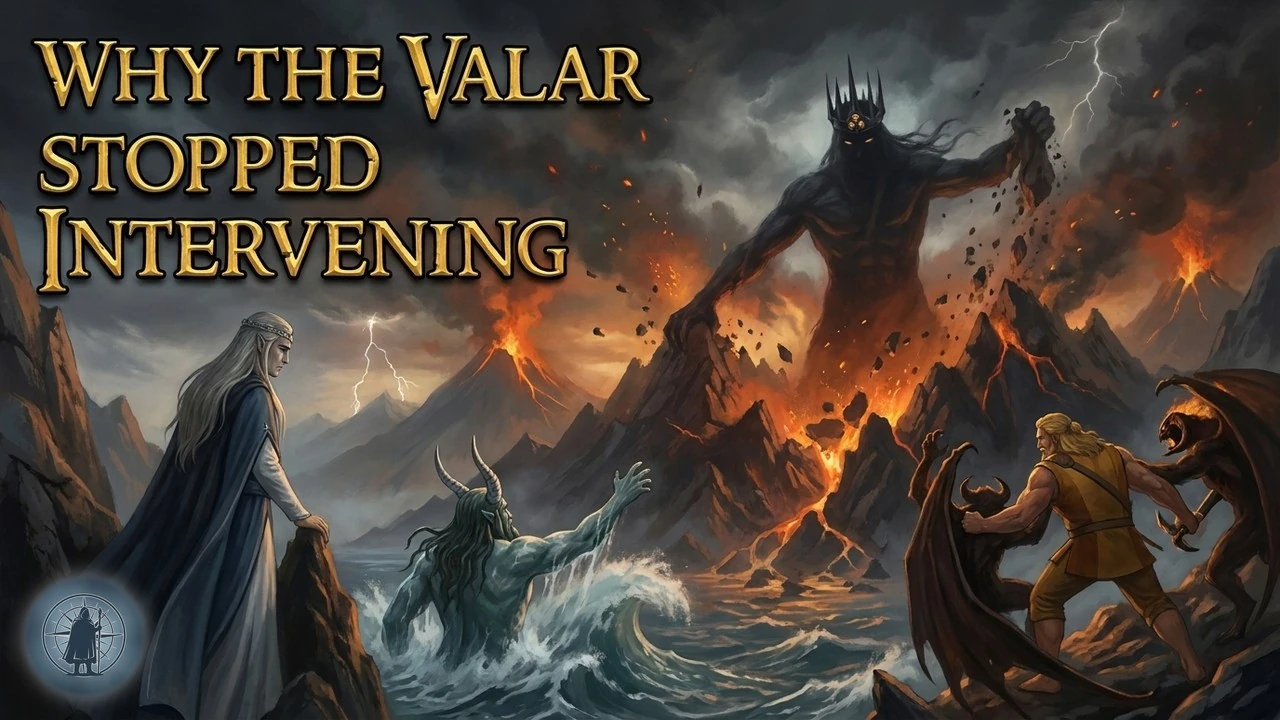 Watch the episode
Why the Valar Stopped Intervening
Research Notes: Why the Valar Stopped Intervening
Band verdict: this topic can fill the 29-36 minute band. It is a document-driven topic and the documents are dense. Eight distinct themes are listed below, each with five or more hard specifics. Almost every key quotation was checked word for word against full-text copies of the primary sources: The Silmarillion, Unfinished Tales, the Akallabêth, the LotR Appendices, Letters (1981), Morgoth's Ring (HoME X), The Lost Road (HoME V) and The Peoples of Middle-earth (HoME XII). The few exceptions are marked "verify wording". The spine document is Tolkien's late essay "Notes on motives in the Silmarillion" (Morgoth's Ring, pp. 394 ff.). Previous research passes did not mine it in full, and it supplies the causal logic the episode needs, almost sentence by sentence.
Five corrections to the brief and hook (read first):
1. "Forbidden to match his power with power" is not from Letter 156. That exact phrase is in the LotR Appendix B headnote to the Third Age Tale of Years. Unfinished Tales quotes it, and the UT Istari essay has its own parallel wording ("forbidden to reveal themselves in forms of majesty..."). Letter 156's own formulation is different: "to limit and hinder their exhibition of 'power' on the physical plane ... and not just to do the job for them." An earlier channel research file also misattributed this to Letter 156.
2. The Valar did not sink Númenor. In the published Akallabêth, Manwë calls upon Ilúvatar and the Valar lay down their government; Ilúvatar changes the fashion of the world. This is the whole point of the turning point. (There is a 1930s variant in which the Valar do it themselves with power lent by Ilúvatar; see Contradictions.)
3. "They sank a continent to stop Morgoth": Beleriand was a region of north-western Middle-earth, not a continent. Its drowning is described as collateral damage ("so great was the fury of those adversaries"), not a deliberate act. Keep the image, but don't call it a continent and don't imply the sinking was the goal.
4. The War of Wrath was not fought by Manwë or (as far as the text says) by the great Valar in person. The published text names "the host of the Valar", led by Eönwë, and marching under it the Vanyar and Finarfin's Noldor. Tolkien says outright that Manwë stays home: "Even to the final war against Morgoth it is Fionwë son of Manwë who leads out the power of the Valar. When we move out Manwë it will be the last battle" (Morgoth's Ring, Notes on motives).
5. "Three thousand years and did almost nothing." The Third Age ran about 3,021 years, but Sauron was shapeless for its first millennium. The Istari arrived around TA 1000 and the shadow fell on Greenwood around TA 1050. "Almost nothing" also leaves out the Istari themselves, Gandalf's return, the Eagles, and the answered invocations of Elbereth. It works as a hook only if the body then shows the "nothing" was a method.
Overview
The Valar's history across the three Ages runs one way, from direct force toward deliberate restraint. Tolkien explains the reasons from inside the myth, in his letters and in late philosophical notes. The arc:
1. Years of the Lamps: Melkor's assault breaks Arda's original symmetry. The Valar cannot overcome him, and they "feared to rend the Earth again". They withdraw to Aman. 2. War of the Powers (Years of the Trees): the first deliberate intervention, "at whatsoever cost", to free the Elves. It reshapes the coasts of Middle-earth and then leads straight into the second error: the Summons, which tries to protect the Elves by bringing them into the Valar's own presence. 3. The Hiding of Valinor (start of the First Age): the last great physical shaping the Valar ever undertake. Tolkien later calls it "if not an actually bad action, at least ... a mistaken one". Ulmo disapproves. 4. War of Wrath (end of the First Age): the "last intervention with physical force by the Valar". It comes only after Eärendil petitions for both kindreds, and Tolkien insists it was "timed with precision". Beleriand is broken. Sauron is left in Middle-earth, and Tolkien says he is "a problem that Men had to deal with finally". 5. Second Age / Númenor: the Valar work by gift, ban, messengers and warnings, never by coercion. When Ar-Pharazôn lands on Aman they "had no real answer ... they were not allowed to destroy them, or coerce them". Manwë calls on Eru. The world is made round, and Valinor leaves the physical world. 6. Third Age: the answer is the Istari. They are Maiar sent in real, weak bodies and forbidden displays of majesty, and the Valar send them, in Tolkien's words, "desiring to amend the errors of old". When even this "prudent plan" fails at Khazad-dûm, "Authority" (Eru) takes it up and enlarges it.
The spine: each direct intervention cost Arda something physical (land, sea, the shape of the world) and something moral (Elvish freedom, Men's trust). The Valar learned, in Tolkien's phrase about the Istari, to "train, advise, instruct, arouse ... and not just to do the job for them." Notes on motives gives the deepest reason. Morgoth had poured himself into the matter of Arda, so "enormous material ruin was a probable consequence of any direct combat with him, victorious or otherwise." It also notes that the Valar "fade ... precisely in proportion as the shape and constitution of things becomes more defined and settled."
Distinctness from earlier channel episodes: The War of the Powers, War of Wrath, Númenor, Istari and Gandalf episodes each told one event. This episode tells the causal chain between them, from documents. It should not retell Tulkas wrestling Melkor; one or two sentences of recap per war is enough. It should also stay textual and causal, not reach a verdict, which keeps it clear of the Red Book governance critique (2026-09-09). Notes on motives conveniently sets up a "was it neglect?" question and then has Tolkien answer it himself.
Primary Sources
The Silmarillion (1977), verified against full text
Ainulindalë / "Of the Beginning of Days": the precedent of Almaren - "...and when the lamps were spilled destroying flame was poured out over the Earth. And the shape of Arda and the symmetry of its waters and its lands was marred in that time, so that the first designs of the Valar were never after restored." (Quenta ch. 1, "Of the Beginning of Days") - "And the Valar could not at that time overcome him, for the greater part of their strength was needed to restrain the tumults of the Earth, and to save from ruin all that could be saved of their labour; and afterwards they feared to rend the Earth again, until they knew where the Children of Ilúvatar were dwelling, who were yet to come in a time that was hidden from the Valar." (ch. 1). This is the first statement in the published text that the Valar hold back for fear of breaking the world. - After the withdrawal to Aman: "From the beauty and bliss of Valinor the Valar came seldom over the mountains to Middle-earth, but gave to the land beyond the Pelori their care and their love." (ch. 1) - On Ulmo: "...to all who were lost in that darkness or wandered far from the light of the Valar the ear of Ulmo was ever open; nor has he ever forsaken Middle-earth, and whatsoever may since have befallen of ruin or of change he has not ceased to take thought for it, and will not until the end of days." (ch. 1) - Men's freedom beyond the Music: Ilúvatar "willed that the hearts of Men should seek beyond the world and should find no rest therein; but they should have a virtue to shape their life, amid the powers and chances of the world, beyond the Music of the Ainur, which is as fate to all things else" (ch. 1). Men sit outside the Valar's foreknowledge.
"Of the Coming of the Elves and the Captivity of Melkor": the first deliberate intervention - Yavanna's challenge: "Shall we then leave the lands of their dwelling desolate and full of evil? Shall they walk in darkness while we have light? Shall they call Melkor lord while Manwë sits upon Taniquetil?" Tulkas: "Nay! Let us make war swiftly!" Mandos: "they come not yet." (ch. 3; this council comes before the Awakening and leads to Varda's star-making, not to war) - After Oromë finds the Elves, Manwë "sought the counsel of Ilúvatar": "This is the counsel of Ilúvatar in my heart: that we should take up again the mastery of Arda, at whatsoever cost, and deliver the Quendi from the shadow of Melkor." Then "Tulkas was glad; but Aulë was grieved, foreboding the hurts of the world that must come of that strife." (ch. 3). The wording is "at whatsoever cost", not "at whatever cost". - The cost to the land: "In that time the shape of Middle-earth was changed, and the Great Sea that sundered it from Aman grew wide and deep; and it broke in upon the coasts and made a deep gulf to the southward. Many lesser bays were made between the Great Gulf and Helcaraxë far in the north ... Of these the Bay of Balar was the chief." (ch. 3) - The Elves "knew nothing of the great Battle of the Powers, save that the Earth shook and groaned beneath them, and the waters were moved, and in the north there were lights as of mighty fires." (ch. 3) - Incomplete victory: "Nonetheless the Valar did not discover all the mighty vaults and caverns hidden with deceit far under the fortresses of Angband and Utumno. Many evil things still lingered there ... and Sauron they did not find." (ch. 3) - The Summons debate: "For some, and of those Ulmo was the chief, held that the Quendi should be left free to walk as they would in Middle-earth, and with their gifts of skill to order all the lands and heal their hurts. But the most part feared for the Quendi in the dangerous world amid the deceits of the starlit dusk; and they were filled moreover with the love of the beauty of the Elves and desired their fellowship. At the last, therefore, the Valar summoned the Quendi to Valinor ... and Mandos broke his silence, saying: 'So it is doomed.' From this summons came many woes that afterwards befell." (ch. 3) - The Elves "had as yet seen the Valar only in their wrath as they went to war, save Oromë alone; and they were filled with dread." (ch. 3) - The result: "Then befell the first sundering of the Elves." The Avari refuse. (ch. 3)
"Of Fëanor and the Unchaining of Melkor": mercy as a second kind of intervention - Melkor sues for pardon; "Nienna aided his prayer; but Mandos was silent." "For Manwë was free from evil and could not comprehend it ... and he saw not to the depths of Melkor's heart, and did not perceive that all love had departed from him for ever. But Ulmo was not deceived, and Tulkas clenched his hands whenever he saw Melkor his foe go by ... But they obeyed the judgement of Manwë; for those who will defend authority against rebellion must not themselves rebel." (ch. 6)
"Of the Flight of the Noldor": the Doom of Mandos - "Tears unnumbered ye shall shed; and the Valar will fence Valinor against you, and shut you out, so that not even the echo of your lamentation shall pass over the mountains." (ch. 9)
"Of the Sun and Moon and the Hiding of Valinor" - On Morgoth's dispersal: "as he grew in malice, and sent forth from himself the evil that he conceived in lies and creatures of wickedness, his might passed into them and was dispersed, and he himself became ever more bound to the earth" (ch. 11) - "Being unwilling to make war upon him in Middle-earth, they remembered nonetheless the ruin of Almaren; and they resolved that the like should not befall Valinor. Therefore at that time they fortified their land anew, and they raised up the mountain-walls of the Pelori to sheer and dreadful heights..." (ch. 11) - The Calacirya is left open "because of the Eldar that were faithful". - "And in that time also, which songs call Nurtalë Valinóreva, the Hiding of Valinor, the Enchanted Isles were set, and all the seas about them were filled with shadows and bewilderment ... all that ever set foot upon the islands were there entrapped, and slept until the Change of the World. Thus it was that as Mandos foretold to them in Araman the Blessed Realm was shut against the Noldor; and of the many messengers that in after days sailed into the West none came ever to Valinor — save one only: the mightiest mariner of song." (ch. 11)
"Of Men" - "To Hildórien there came no Vala to guide Men, or to summon them to dwell in Valinor; and Men have feared the Valar, rather than loved them, and have not understood the purposes of the Powers, being at variance with them, and at strife with the world. Ulmo nonetheless took thought for them, aiding the counsel and will of Manwë; and his messages came often to them by stream and flood." (ch. 12)
"Of the Ruin of Beleriand and the Fall of Fingolfin": the failed petitions - Turgon's ships set out "seeking for Valinor, to ask for pardon and aid of the Valar ... But the seas were wild and wide, and shadow and enchantment lay upon them; and Valinor was hidden. Therefore none of the messengers of Turgon came into the West, and many were lost and few returned" (ch. 18). These messengers are the human cost of the Hiding.
"Of the Voyage of Eärendil and the War of Wrath" - Eärendil "delivered the errand of the Two Kindreds. Pardon he asked for the Noldor and pity for their great sorrows, and mercy upon Men and Elves and succour in their need. And his prayer was granted." (ch. 24) - Ulmo at the hearing: Mandos asks "Shall mortal Man step living upon the undying lands, and yet live?" Ulmo answers: "For this he was born into the world." (ch. 24) - Morgoth's misreading: "he thought that he had for ever estranged the Noldor from the Lords of the West, and that content in their blissful realm the Valar would heed no more his kingdom in the world without; for to him that is pitiless the deeds of pity are ever strange and beyond reckoning." (ch. 24) - "But the host of the Valar prepared for battle; and beneath their white banners marched the Vanyar ... and those also of the Noldor who never departed from Valinor, whose leader was Finarfin" (ch. 24). Teleri sailed the ships but "none of them set foot upon the Hither Lands". - The cost: "For so great was the fury of those adversaries that the northern regions of the western world were rent asunder, and the sea roared in through many chasms, and there was confusion and great noise; and rivers perished or found new paths, and the valleys were upheaved and the hills trod down; and Sirion was no more." (ch. 24)
"Of the Rings of Power and the Third Age" - Sauron "did obeisance to Eönwë ... And some hold that this was not at first falsely done ... But it was not within the power of Eönwë to pardon those of his own order, and he commanded Sauron to return to Aman and there receive the judgement of Manwë. Then Sauron was ashamed, and he was unwilling to return in humiliation and to receive from the Valar a sentence, it might be, of long servitude in proof of his good faith". He hid in Middle-earth. - "In the Great Battle and the tumults of the fall of Thangorodrim there were mighty convulsions in the earth, and Beleriand was broken and laid waste; and northward and westward many lands sank beneath the waters of the Great Sea." Ered Luin broken; Gulf of Lhûn formed. - The enemy reads restraint as absence: "Seeing the desolation of the world, Sauron said in his heart that the Valar, having overthrown Morgoth, had again forgotten Middle-earth; and his pride grew apace." - Annatar's pitch exploits the same vacuum: "wherefore should Middle-earth remain for ever desolate and dark, whereas the Elves could make it as fair as Eressëa, nay even as Valinor?" - Third Age: "Even as the first shadows were felt in Mirkwood there appeared in the west of Middle-earth the Istari ... messengers sent by the Lords of the West to contest the power of Sauron, if he should arise again, and to move Elves and Men and all living things of good will to valiant deeds." "Curunír was the eldest and came first, and after him came Mithrandir and Radagast, and others of the Istari who went into the east of Middle-earth". - The ending: "help came from the hands of the weak when the Wise faltered."
The Akallabêth (in The Silmarillion), verified against full text
- After the War of Wrath: "Then the Valar forsook for a time the Men of Middle-earth who had refused their summons and had taken the friends of Morgoth to be their masters; and Men dwelt in darkness and were troubled by many evil things that Morgoth had devised". - "But Manwë put forth Morgoth and shut him beyond the World in the Void that is without ... Yet the seeds that he had planted still grew and sprouted, bearing evil fruit, if any would tend them." - The Ban: "But the Lords of Valinor forbade them to sail so far westward that the coasts of Númenor could no longer be seen ... But the design of Manwë was that the Númenóreans should not be tempted to seek for the Blessed Realm". - "The Valar indeed may not withdraw the gift of death, which comes to Men from Ilúvatar". - The messengers (persuasion, not force): "Manwë was grieved, seeing a cloud gather on the noontide of Númenor. And he sent messengers to the Dúnedain". Their words: "'The Doom of the World,' they said, 'One alone can change who made it.'" Also: "For it is not the land of Manwë that makes its people deathless, but the Deathless that dwell therein have hallowed the land" and "Nor can the Valar take away the gifts of Ilúvatar." And: "Indeed the mind of Ilúvatar concerning you is not known to the Valar, and he has not revealed all things that are to come ... and to you it will be revealed and not to the Valar." Dated to "the days of Tar-Ciryatan the Shipbuilder, and of Tar-Atanamir his son". - Withdrawal of counsel under Ar-Gimilzôr, the twenty-second king: "all that they did was known to Manwë, and the Valar were wroth with the Kings of Númenor, and gave them counsel and protection no more; and the ships of Eressëa came never again out of the sunset". - The warnings before the end: the eagle-shaped clouds: "'Behold the Eagles of the Lords of the West!' they cried. 'The Eagles of Manwë are come upon Númenor!'" - Amandil's plan: "to try that counsel which our forefather Eärendil took of old, to sail into the West ... and beseech his aid ere all is lost." His charge to Elendil: "To meddle not in the war, and to watch." - The turning point: "Then Manwë upon the Mountain called upon Ilúvatar, and for that time the Valar laid down their government of Arda. But Ilúvatar showed forth his power, and he changed the fashion of the world; and a great chasm opened in the sea between Númenor and the Deathless Lands". Note "for that time": the abdication is framed as temporary. - "And there is not now upon Earth any place abiding where the memory of a time without evil is preserved ... and the world was diminished, for Valinor and Eressëa were taken from it into the realm of hidden things." - Doom fell "on the nine and thirtieth day since the passing of the fleets". - Elendil's escape: "whether or no it were that Amandil came indeed to Valinor and Manwë hearkened to his prayer, by grace of the Valar Elendil and his sons and their people were spared". - "For Sauron himself was filled with great fear at the wrath of the Valar, and the doom that Eru laid upon sea and land."
The Lord of the Rings
- Appendix A, I(i), Númenor (verified): "But when Ar-Pharazôn set foot upon the shores of Aman the Blessed, the Valar laid down their Guardianship and called upon the One, and the world was changed. Númenor was thrown down and swallowed in the Sea, and the Undying Lands were removed for ever from the circles of the world." (This is the source of the brief's word "Guardianship"; note App. A says the Valar called, the Akallabêth says Manwë.) - Appendix B, headnote to the Third Age (verified): "When maybe a thousand years had passed, and the first shadow had fallen on Greenwood the Great, the Istari or Wizards appeared in Middle-earth. It was afterwards said that they came out of the Far West and were messengers sent to contest the power of Sauron, and to unite all those who had the will to resist him; but they were forbidden to match his power with power, or to seek to dominate Elves or Men by force and fear." (UT's quotation of this reads "force or fear"; use the LotR wording "force and fear" and verify against the edition in use.) - Elrond at the Council (FotR II.2): "...those who dwell beyond the Sea would not receive it: for good or ill it belongs to Middle-earth; it is for us who still dwell here to deal with it." (Verify wording; confirmed only through secondary quote sources.) - Gandalf refuses the Ring (FotR I.2): "Do not tempt me! For I do not wish to become like the Dark Lord himself. Yet the way of the Ring to my heart is by pity, pity for weakness and the desire of strength to do good." (Standard text from memory; verify.) This dramatises Letter 156's "constant temptation". - Gandalf to Denethor (RotK V.1): "...the rule of no realm is mine ... But all worthy things that are in peril as the world now stands, those are my care ... For I also am a steward. Did you not know?" (Verify.) - The Last Debate (RotK V.9), Gandalf: "Other evils there are that may come; for Sauron is himself but a servant or emissary. Yet it is not our part to master all the tides of the world, but to do what is in us for the succour of those years wherein we are set, uprooting the evil in the fields that we know, so that those who live after may have clean earth to till. What weather they shall have is not ours to rule." (Confirmed in part via secondary sources.) This is the Valar's Third Age doctrine in Gandalf's own mouth. - Gandalf's return (TT III.5): "Naked I was sent back — for a brief time, until my task is done." - Saruman's death (RotK VI.8): the mist "wavered, looking to the West; but out of the West came a cold wind, and it bent away, and with a sigh dissolved into nothing." (Verify wording.) The only scene in LotR where the West visibly passes judgement, and it does so by refusing rather than striking. - Elbereth: Aragorn after Weathertop: "More deadly to him was the name of Elbereth." (FotR I.12) Letter 153 frames such invocations: "For help they may call on a Vala (as Elbereth), as a Catholic might on a Saint".
Unfinished Tales (1980), verified against full text
Part Four, II "The Istari": the core text - "They first appeared in Middle-earth about the year 1000 of the Third Age, but for long they went about in simple guise, as it were of Men already old in years but hale in body ... revealing to none their powers and purposes." - "Emissaries they were from Lords of the West, the Valar, who still took counsel for the governance of Middle-earth, and when the shadow of Sauron began first to stir again took this means of resisting him. For with the consent of Eru they sent members of their own high order, but clad in bodies as of Men, real and not feigned, but subject to the fears and pains and weariness of earth, able to hunger and thirst and be slain; though because of their noble spirits they did not die, and aged only by the cares and labours of many long years. And this the Valar did, desiring to amend the errors of old, especially that they had attempted to guard and seclude the Eldar by their own might and glory fully revealed; whereas now their emissaries were forbidden to reveal themselves in forms of majesty, or to seek to rule the wills of Men and Elves by open display of power, but coming in shapes weak and humble were bidden to advise and persuade Men and Elves to good, and to seek to unite in love and understanding all those whom Sauron, should he come again, would endeavour to dominate and corrupt." This is the single most important sentence for the episode: the Valar themselves name the Summons as the "error of old" that the Istari are designed to correct. - "Of this Order the number is unknown; but of those that came to the North of Middle-earth ... the chiefs were five." The order "belonged solely to the Third Age and then departed". (Contradicted by a late note; see Contradictions.) - Círdan to Gandalf with Narya: "take this Ring for your aid and comfort ... that may wield it for the kindling of all hearts to courage." - Christopher Tolkien's comment: the essay "contains some incidental remarks of great interest about Valar, their continuing concern for Middle-Earth, and their recognition of ancient error". - The council sketch (CT's summary with embedded quotations from his father's notes): "a council of the Valar, summoned it seems by Manwë ('and maybe he called upon Eru for counsel?'), at which it was resolved to send out three emissaries ... 'Who would go? For they must be mighty, peers of Sauron, but must forgo might, and clothe themselves in flesh so as to treat on equality and win the trust of Elves and Men. But this would imperil them, dimming their wisdom and knowledge, and confusing them with fears, cares, and weariness coming from the flesh.'" Curumo was chosen by Aulë, Alatar sent by Oromë; "Olórin declared that he was too weak for such a task, and that he feared Sauron. Then Manwë said that that was all the more reason why he should go". Varda: "Not as the third;" and Curumo remembered it.
Part One, "Of Tuor and his Coming to Gondolin": Ulmo's dissent - Ulmo to Tuor at Vinyamar: "But behold! in the armour of Fate (as the Children of Earth name it) there is ever a rift, and in the walls of Doom a breach, until the full-making, which ye call the End. So it shall be while I endure, a secret voice that gainsayeth, and a light where darkness was decreed. Therefore, though in the days of this darkness I seem to oppose the will of my brethren, the Lords of the West, that is my part among them, to which I was appointed ere the making of the World. Yet Doom is strong, and the shadow of the Enemy lengthens; and I am diminished, until in Middle-earth I am become now no more than a secret whisper." (UT p. 29 per CT's citation in Morgoth's Ring.) - "The last hope alone is left, the hope that they have not looked for and have not prepared. And that hope lieth in thee; for so I have chosen."
The History of Middle-earth
Vol. X, Morgoth's Ring, "Myths Transformed", text VII: "Notes on motives in the Silmarillion" (pp. 394 ff.; long version B; the demiurgic passage is on p. 401). Verified against full text. The key passages, in order: - The Elder King stays home: "Even to the final war against Morgoth it is Fionwë son of Manwë who leads out the power of the Valar. When we move out Manwë it will be the last battle, and the end of the World (or of 'Arda Marred') as the Eldar would say." - The mechanism: "But in this way Morgoth lost (or exchanged, or transmuted) the greater part of his original 'angelic' powers, of mind and spirit, while gaining a terrible grip upon the physical world. For this reason he had to be fought, mainly by physical force, and enormous material ruin was a probable consequence of any direct combat with him, victorious or otherwise. This is the chief explanation of the constant reluctance of the Valar to come into open battle against Morgoth." - "Manwë's task and problem was much more difficult than Gandalf's. Sauron's, relatively smaller, power was concentrated; Morgoth's vast power was disseminated. The whole of 'Middle-earth' was Morgoth's Ring ... Unless swiftly successful, War against him might well end in reducing all Middle-earth to chaos, possibly even all Arda." - The dilemma: "It is easy to say: 'It was the task and function of the Elder King to govern Arda and make it possible for the Children of Eru to live in it unmolested.' But the dilemma of the Valar was this: Arda could only be liberated by a physical battle; but a probable result of such a battle was the irretrievable ruin of Arda." - "No such eradication of Morgoth was possible, since this required the complete disintegration of the 'matter' of Arda." - "Water is represented as being almost entirely free of Morgoth." (Useful for Ulmo's freedom of action.) - Section (iii), the fading: "The Valar 'fade' and become more impotent, precisely in proportion as the shape and constitution of things becomes more defined and settled. The longer the Past, the more nearly defined the Future, and the less room for important change ... The Past, once 'achieved', has become part of the 'Music in being'. Only Eru may or can alter the 'Music'." - The Pelóri: "The last major effort, of this demiurgic kind, made by the Valar was the lifting up of the range of the Pelori to a great height. It is possible to view this as, if not an actually bad action, at least as a mistaken one. Ulmo disapproved of it." It had "one good, and legitimate, object: the preservation incorrupt of at least a part of Arda. But it seemed to have a selfish or neglectful (or despairing) motive also". "Thus the 'Hiding of Valinor' came near to countering Morgoth's possessiveness by a rival possessiveness, setting up a private domain of light and bliss against one of darkness and domination: a palace and a pleasaunce (well-fenced) against a fortress and a dungeon." - The fainéance charge, and Tolkien's reply: "This appearance of selfish fainéance in the Valar in the mythology as told is (though I have not explained it or commented on it) I think only an 'appearance', and one which we are apt to accept as the truth, since we are all in some degree affected by the shadow and lies of their Enemy, the Calumniator." The mythology is "two stages removed from a true record". Elvish lore reaches us through Númenórean traditions, which "could not altogether escape the darkening of the picture due to the hostility of the rebellious Númenóreans to the Valar." - "The closing of Valinor against the rebel Noldor (who left it voluntarily and after warning) was in itself just." - Manwë "alone of all persons or minds in that time is represented as having the power of direct recourse to and communication with Eru. He must have grasped with great clarity ... that it was the essential mode of the process of 'history' in Arda that evil should constantly arise, and that out of it new good should constantly come." - The Noldor as the besieging force: "the heroic Noldor were the best possible weapon with which to keep Morgoth at bay, virtually besieged, and at any rate fully occupied, on the northern fringe of Middle-earth, without provoking him to a frenzy of nihilistic destruction." "In their association with the warring Eldar Men were raised to their fullest achievable stature, and by the two marriages the transference to them, or infusion into Mankind, of the noblest Elf-strain was accomplished". (The two marriages are Beren and Lúthien, and Tuor and Idril.) - The timing: "The last intervention with physical force by the Valar, ending in the breaking of Thangorodrim, may then be viewed as not in fact reluctant or even unduly delayed, but timed with precision. The intervention came before the annihilation of the Eldar and the Edain." Morgoth by then "had neglected most of Middle-earth during the war" and "had become absorbed in 'kingship'". - "The war was successful, and ruin was limited to the small (if beautiful) region of Beleriand." - The handoff: "Nonetheless the breaking of Thangorodrim and the extrusion of Melkor was the end of 'Morgoth' as such ... It was thus, also, in a sense the end of Manwë's prime function and task as Elder King, until the End. He had been the Adversary of the Enemy. It is very reasonable to suppose that Manwë knew that before long (as he saw 'time') the Dominion of Men must begin, and the making of history would then be committed to them: for their struggle with Evil special arrangements had been made! Manwë knew of Sauron, of course. He had commanded Sauron to come before him for judgement, but had left room for repentance and ultimate rehabilitation ... Sauron, however, was a problem that Men had to deal with finally: the first of the many concentrations of Evil into definite power-points that they would have to combat". - "It may be noted that Sauron's first defeat was achieved by the Númenóreans alone (though Sauron was not in fact overthrown personally: his 'captivity' was voluntary and a trick)." - Version A's shorter conclusion: "The last effort of this sort made by the Valar was the raising up of the Pelóri — but this was not a good act: it came near to countering Morgoth in his own way". "The Valar were like architects working with a plan 'passed' by the Government. They became less and less important (structurally!) as the plan was more and more nearly achieved. ... (The wiser they became the less power they had to do anything - save by counsel.)" "Men will also 'fade', if it proves to be the plan that things shall still go on, when they have completed their function." - CT's note 4 (on the Hiding): in The Book of Lost Tales the Hiding met "overt condemnation, strongly expressed". CT quotes his own earlier commentary (BLT I.223): "It is most curious to observe that the action of the Valar here sprang essentially from indolence mixed with fear. Nowhere does my father's early conception of the fainéant Gods appear more clearly. He held moreover quite explicitly that their failure to make war upon Melko then and there was a deep error, diminishing themselves, and (as it appears) irreparable." In later writing "there is no whisper of its condemnation", but Ulmo's disapproval reappears, "further evidence of his isolation in the counsels of the Valar". - CT's note 8: "the history of Middle-earth in the last centuries of the First Age would not have been possible of achievement had Valinor remained open to the return of the Noldor." - CT dates the essay loosely: the "Fionwë son of Manwë" naming suggests it is relatively early among the late philosophical writings (late 1950s), and he notes its "marked likeness in tone" to the post-LotR letters.
Vol. X, "Annals of Aman" (the late-1950s rewrite of the Valinor annals): the Summons passage adds, against later readers: "For of this summons came many woes that after befell; yet those who hold that the Valar erred, thinking rather of the bliss of Valinor than of the Earth, and seeking to wrest the will of Ilúvatar to their own pleasure, speak with the tongue of Melkor." CT's commentary: "The belief that the Valar erred is not here imputed to them as an error 'with good intent' (QS, V.214), and to this extent is harshly repudiated." It also notes Ulmo "had chiefly spoken against the summons".
Vol. X, "The Converse of Manwë and Eru" (Laws and Customs / reincarnation material, c. 1959): Eru: "As for my First-born, have ye not removed great numbers of them to Aman from the Middle-earth in which I set them?" Manwë: "This we have done, for fear of Melcor, and with good intent, though not without misgiving." Earlier Manwë says: "For we fear to meddle with Thy Children."
Vol. V, The Lost Road, "The Fall of Númenor" (FN I, mid-1930s): "But the Gods were silent. Sorrow and dismay were in the heart of Manwë, and he spoke to Ilúvatar, and took power and counsel from the Lord of All; and the fate and fashion of the world was changed." Then: "But Ilúvatar gave power to the Gods, and they bent back the edges of the Middle-earth, and they made it into a globe". In this earliest version the Valar do the reshaping themselves with delegated power. In a revision, Beleriand's drowning is assigned to the Downfall: "Beleriand fell into the sea in that time, all save ... Lindon". CT: "the words '[the Gods] bent back the edges of the Middle-earth' have disappeared; it is the Great Sea in the West and 'the Barren Land' in the East that are 'cast back' by Ilúvatar."
Vol. XII, The Peoples of Middle-earth, "Last Writings" (c. 1972-73), Glorfindel and the Blue Wizards: - Glorfindel's return: "This must probably have occurred before the end of the Second Age, and the 'Change of the World' and the Drowning of Númenor, after which no living embodied creature ... could return from the Blessed Realm ... This was according to a general ordinance proceeding from Eru Himself; and though, until the end of the Third Age, when Eru decreed that the Dominion of Men must begin, Manwë could be supposed to have received the permission of Eru to make an exception..." Tolkien suggests SA 1200 ("when Sauron came in person to Lindon") or, "perhaps more probably, as late as c.1600, the Year of Dread, when Barad-dûr was completed and the One Ring forged". "No doubt urgent messages and prayers asking for help were received in Númenor (and in Valinor)." - Blue Wizards: "The 'other two' came much earlier, at the same time probably as Glorfindel, when matters became very dangerous in the Second Age. Glorfindel was sent to aid Elrond ... But the other two Istari were sent for a different purpose. Morinehtar and Rómestámo. Darkness-slayer and East-helper. Their task was to circumvent Sauron..." They "must have had very great influence on the history of the Second Age and Third Age in weakening and disarraying the forces of East".
The Letters of J.R.R. Tolkien (1981), verified against full text
- Letter 131 (to Milton Waldman, c. 1951): the Valar "are as we should say angelic powers, whose function is to exercise delegated authority in their spheres (of rule and government, not creation, making or re-making)." On the First Age ending: Eärendil's function is "as ambassador persuade them to take thought again for the Exiles, to pity them, and rescue them from the Enemy ... The gods then move again, and great power comes out of the West". The cost: "In the great battles against the First Enemy the lands were broken and ruined, and the West of Middle-earth became desolate." "The doom or gift of God, of mortality, the gods of course cannot abrogate". On Númenor: "Faced by this rebellion, of appalling folly and blasphemy, and also real peril (since the Númenóreans directed by Sauron could have wrought ruin in Valinor itself) the Valar lay down their delegated power and appeal to God, and receive the power and permission to deal with the situation; the old world is broken and changed." "Thereafter there is no visible dwelling of the divine or immortal on earth." Sauron in Númenor "denies the existence of God, saying that the One is a mere invention of the jealous Valar of the West". - Letter 153 (to Peter Hastings, draft, 1954): the Valar are "reverend, therefore, but not worshipful"; resident on Earth "to which they are bound by love ... they cannot by their own will alter any fundamental provision. They called upon the One in the crisis of the rebellion of Numenor ... which necessitated a catastrophic change in the shape of Earth." Footnote: "For help they may call on a Vala (as Elbereth), as a Catholic might on a Saint, though no doubt knowing in theory as well as he that the power of the Vala was limited and derivative." - Letter 156 (to Robert Murray SJ, draft, 4 Nov 1954; Letters 1981 pp. 200-207): THE ISTARI LETTER. - Gandalf is "an incarnate 'angel' ... with the other Istari, wizards, 'those who know', an emissary from the Lords of the West, sent to Middle-earth, as the great crisis of Sauron loomed on the horizon. By 'incarnate' I mean they were embodied in physical bodies capable of pain, and weariness, and of afflicting the spirit with physical fear, and of being 'killed'". - "At this point in the fabulous history the purpose was precisely to limit and hinder their exhibition of 'power' on the physical plane, and so that they should do what they were primarily sent for: train, advise, instruct, arouse the hearts and minds of those threatened by Sauron to a resistance with their own strengths; and not just to do the job for them." - "But in this 'mythology' all the 'angelic' powers concerned with this world were capable of many degrees of error and failing between the absolute Satanic rebellion and evil of Morgoth and his satellite Sauron, and the fainéance of some of the other higher powers or 'gods'." (Tolkien himself uses fainéance of the gods here, in 1954.) - "The 'wizards' were not exempt, indeed being incarnate were more likely to stray, or err." - On the Bridge: "it was a humbling and abnegation of himself in conformity to 'the Rules' ... He was handing over to the Authority that ordained the Rules, and giving up personal hope of success." - "The 'wizards', as such, had failed; or if you like: the crisis had become too grave and needed an enhancement of power." - After his return "He is still under the obligation of concealing his power and of teaching rather than forcing or dominating wills, but where the physical powers of the Enemy are too great for the good will of the opposers to be effective he can act in emergency as an 'angel' — no more violently than the release of St Peter from prison." The Witch-king at the Gate: "so powerful is the whole train of human resistance, that he himself has kindled and organized, that in fact no battle between the two occurs: it passes to other mortal hands." - "He was sent by a mere prudent plan of the angelic Valar or governors; but Authority had taken up this plan and enlarged it, at the moment of its failure. 'Naked I was sent back — for a brief time, until my task is done'. Sent back by whom, and whence? Not by the 'gods' whose business is only with this embodied world and its time; for he passed 'out of thought and time'." "Naked" = "'unclothed like a child' (not discarnate)". - "None of my 'angelic' persons are represented as knowing the future completely, or indeed at all where other wills are concerned. Hence their constant temptation to do, or try to do, what is for them wrong (and disastrous): to force lesser wills by power: by awe if not by actual fear, or physical constraint." - "the intrusion of Elves and Men into that story was not any part of theirs at all, but reserved: hence Elves and Men were called the Children of God". - On Númenor: "The Valar had no real answer to this monstrous rebellion — for the Children of God were not under their ultimate jurisdiction: they were not allowed to destroy them, or coerce them with any 'divine' display of the powers they held over the physical world. They appealed to God; and a catastrophic 'change of plan' occurred." "At the moment that Arpharazôn set foot on the forbidden shore, a rift appeared ... and the Blessed Realm removed for ever from the circles of the physical world." - Draft ending: the istari "are actually emissaries from the True West, and so mediately from God, sent precisely to strengthen the resistance of the 'good', when the Valar become aware that the shadow of Sauron is taking shape again." - Letter 181 (to Michael Straight, drafts, 1956): the One "remains remote, outside the World, and only directly accessible to the Valar or Rulers" and "reserves the right to intrude the finger of God into the story". Gandalf "is an angelos or messenger from the Valar or Rulers: to assist the rational creatures of Middle-earth to resist Sauron, a power too great for them unaided. But since in the view of this tale & mythology Power — when it dominates or seeks to dominate other wills and minds (except by the assent of their reason) — is evil, these 'wizards' were incarnated in the life-forms of Middle-earth ... The chief form this [fall] would take with them would be impatience, leading to the desire to force others to their own good ends, and so inevitably at last to mere desire to make their own wills effective by any means. To this evil Saruman succumbed. Gandalf did not." - Letter 192 (to Amy Ronald, 27 July 1956), on Mount Doom: "Frodo ... spent every drop of his power of will and body, and that was just sufficient to bring him to the destined point, and no further ... The Other Power then took over: the Writer of the Story (by which I do not mean myself)". - Letter 210 (to Forrest J. Ackerman, June 1958): "The Eagles are a dangerous 'machine'. I have used them sparingly, and that is the absolute limit of their credibility or usefulness." (This is about narrative craft, not cosmology. It shows that Tolkien's restraint as author matches the Valar's restraint in the story. Use with care.) - Letter 211 (to Rhona Beare, 14 Oct 1958): "Sauron was first defeated by a 'miracle': a direct action of God the Creator, changing the fashion of the world, when appealed to by Manwë ... That Sauron was not himself destroyed in the anger of the One is not my fault: the problem of evil, and its apparent toleration, is a permanent one for all who concern themselves with our world. The indestructibility of spirits with free wills, even by the Creator of them, is also an inevitable feature". Also, of the Blue Wizards: "I think they went as emissaries to distant regions, East and South ... What success they had I do not know; but I fear that they failed". - Letter 212 (unsent continuation of 211): Elves and Men were "a private addition to the Design, by the Creator, and one in which the Valar had no part ... their foresight, derived from their pre-knowledge of the Design, was imperfect or failed in the matter of the deeds of the Children." "Even the 'good' Valar as inhabiting the World could at least err; as the Great Valar did in their dealings with the Elves; or as the lesser of their kind (as the Istari or wizards) could in various ways become self-seeking." Aulë's Dwarves: "impatient love". - Letter 246 (to Eileen Elgar, Sept 1963): Gandalf "was an emissary of the Valar, and virtually their plenipotentiary in accomplishing the plan against Sauron." - Letter 297 (drafts to "Mr Rang", Aug 1967): "The Valar listened to the pleading of Eärendil on behalf of Elves and Men (both his kin), and sent a great host to their aid." Also: "We are in a time when the One God, Eru, is known to exist by the wise, but is not approachable save by or through the Valar". - Letter 325 (to Roger Lancelyn Green, 17 July 1971): "The Valar had neither the power nor the right to confer 'immortality' upon them [Frodo and other mortals]."
Timeline
(Valian Years: one Valian Year ≈ 9.582 solar years in the late Annals of Aman reckoning; prior channel research. The precise Y.T. dates below are from the Annals of Aman as summarised in the channel's War of the Powers notes; treat them as Tolkien's late chronology, not as figures in the published Silmarillion.)
Before the Sun - Years of the Lamps: Melkor casts down Illuin and Ormal. "First designs of the Valar were never after restored." Almaren is destroyed; the Valar withdraw to Aman, raise the Pelóri (first time) and found Valinor. They "feared to rend the Earth again". - Y.T. 1050: the Elves awake at Cuiviénen (per Annals of Aman). - c. Y.T. 1085-1090: council at the Ring of Doom; Manwë: "at whatsoever cost". Aulë grieved. - Y.T. 1090-1099: the Battle/War of the Powers and the Siege of Utumno. The coasts reshape; the Bay of Balar and the Great Gulf form. - Y.T. 1099-1100: Tulkas wrestles Melkor down; Angainor; Melkor sentenced to "three ages" in Mandos. Sauron not found. - Shortly after: the Summons; "So it is doomed"; first sundering of the Elves (Eldar vs Avari). - c. Y.T. 1400: Melkor released (Manwë "could not comprehend" evil; Ulmo not deceived). - Y.T. 1495: Darkening of Valinor; Noldor rebel; Doom of Mandos.
First Age (years of the Sun) - c. FA 1: Sun and Moon rise; Hiding of Valinor (Pelóri raised to "sheer and dreadful heights"; Enchanted Isles). Per Notes on motives, "the last major effort, of this demiurgic kind, made by the Valar". - FA 455-472: after the Dagor Bragollach (455) and the Nirnaeth (472), Turgon's messengers sail west; "Valinor was hidden"; none arrive. (Battle dates are standard; the voyages are spread across this period.) - c. FA 495-496: Ulmo speaks to Tuor at Vinyamar; Tuor reaches Gondolin (Gondolin falls FA 510). (Standard chronology; verify against the Tale of Years.) - c. FA 542-545: Eärendil reaches Valinor and pleads; the host of the Valar sets out. (The commonly used dates come from the late Tale of Years and reconstructions; the published Silmarillion gives no years.) - c. FA 545-587: the War of Wrath / Great Battle. Ancalagon falls on Thangorodrim; Morgoth bound with Angainor; Beleriand broken. The 42-year span is a commonly cited chronology; sources vary ("more than forty years"). Flag as approximate. - After the war: Eönwë summons the Elves west; Sauron refuses judgement; Morgoth is put out into the Void.
Second Age - SA 32: the Edain reach Númenor (Land of Gift); the Ban of the Valar. - c. SA 1200: Sauron (Annatar) rebuffed at Lindon; possible return of Glorfindel (PME, Tolkien's first suggestion). - c. SA 1600: the One Ring forged; Barad-dûr completed; "more probably" Glorfindel's return, and the Blue Wizards (late note, PME). - SA 1693-1701: War of the Elves and Sauron; Tar-Minastir's fleet saves the Elves (SA 1700). Help comes from Númenor, not Valinor. - Reigns of Tar-Ciryatan and Tar-Atanamir: Manwë's messengers come to Númenor to explain death and warn. - Ar-Adûnakhôr (19th king) takes a title of the Valar; Ar-Gimilzôr (22nd king) persecutes the Faithful: "the Valar ... gave them counsel and protection no more." - SA 3262: Sauron taken to Númenor (his "captivity was voluntary and a trick"). - Before 3319: eagle-shaped storm-clouds, lightning; Sauron defies lightning on the Temple. Amandil sails west. - SA 3319: Ar-Pharazôn lands on Aman; Manwë calls upon Ilúvatar; "for that time the Valar laid down their government of Arda"; the Downfall happens "on the nine and thirtieth day since the passing of the fleets". The world is made round and Valinor removed. - SA 3434-3441: the Last Alliance; Sauron overthrown by Elves and Men alone.
Third Age - c. TA 1000: the Istari arrive (UT; App. B "when maybe a thousand years had passed"). Saruman first; Gandalf last. Círdan gives Narya to Gandalf. - c. TA 1050: shadow falls on Greenwood; it becomes Mirkwood. - c. TA 1100: the Wise (the Istari and chief Eldar) discover an evil power in Dol Guldur. - TA 2063: Gandalf goes to Dol Guldur; Sauron flees east; the Watchful Peace (to 2460). - TA 2850-2851: Gandalf confirms Sauron in Dol Guldur; the White Council; Saruman overrules an attack. - TA 2941: the White Council drives Sauron from Dol Guldur; Bilbo finds the Ring. - TA 3019, January: Gandalf falls with the Balrog and dies after the fight on Zirakzigil; he is "sent back" (by Authority, not the Valar: Letter 156). - TA 3019, 25 March: the Ring destroyed. "The Other Power then took over" (Letter 192). - TA 3019, November: Saruman's spirit is refused by the West wind. - TA 3021, 29 September: Gandalf sails from the Grey Havens. The Third Age ends. - Fourth Age: "the Dominion of Men" (PME: "Eru decreed that the Dominion of Men must begin").
Useful spans (derived, for narration; mark as derived): - From the Hiding of Valinor (c. FA 1) to the host setting out (c. FA 545): roughly five and a half centuries of the Valar holding back. - From the Istari's arrival (c. TA 1000) to the Ring's destruction (TA 3019): roughly two thousand years of the emissary method. - From the Downfall (SA 3319) to the end of the Third Age (TA 3021): about 3,140 years in which the Valar take no direct physical action against Sauron that the texts record. (Derived: 122 years of the Second Age after the Downfall plus 3,021 of the Third. The Eagles and Gandalf's return do not count as Valar actions, since Letter 156 assigns the return to Authority.)
Key Characters
- Manwë Súlimo: Elder King, chief of the Valar; the only finite mind with "direct recourse to and communication with Eru" (Notes on motives). He "sought the counsel of Ilúvatar" before the War of the Powers, pardoned Melkor ("could not comprehend" evil), stayed on Taniquetil through every war, sent messengers to Númenor, and "upon the Mountain called upon Ilúvatar". Tolkien frames his role after the War of Wrath as finished: "the end of Manwë's prime function and task as Elder King, until the End." - Ulmo: Lord of Waters. Chief voice against the Summons; disapproved of the Hiding; "not deceived" by Melkor; "never forsaken Middle-earth"; sent messages to Men "by stream and flood"; spoke to Tuor; spoke for Eärendil before the council. Self-description: "a secret voice that gainsayeth". Water is "almost entirely free of Morgoth" (Notes on motives), which explains why his element is free to act. CT: "his isolation in the counsels of the Valar". - Aulë: the smith; "grieved, foreboding the hurts of the world". Forged Angainor. His own "fall" was "impatient love" (Letter 212: the Dwarves). He chose Curumo (Saruman), "very notable" per CT. - Mandos (Námo): the Doomsman. "So it is doomed" at the Summons; silent at Melkor's pardon; the Doom of the Noldor; at Eärendil's hearing, "Shall mortal Man step living upon the undying lands, and yet live?" - Yavanna and Oromë: the Valar who pressed hardest for intervention for the Children's sake. Yavanna: "Shall they walk in darkness while we have light?" - Tulkas: the champion; "Nay! Let us make war swiftly!"; wrestled Melkor down at Utumno; "clenched his hands" at Melkor after the pardon. - Varda / Elbereth: kindled the stars instead of making war ("To Varda ever shall they call at need": Mandos). Invoked successfully in the Third Age. At the Istari council: "Not as the third." - Eönwë (Fionwë in older texts): herald of Manwë; commanded the host in the War of Wrath; could not pardon Sauron, "one of his own order". - Eärendil: the petition-bearer "on behalf of the Two Kindreds"; the condition for the War of Wrath. - Sauron: refused the Valar's judgement in FA; read their absence as forgetting ("had again forgotten Middle-earth"); in Númenor called the One "a mere invention of the jealous Valar of the West" (Letter 131). Notes on motives: "a problem that Men had to deal with finally." - Ar-Pharazôn: the last king of Númenor (25th ruler in the App. A list, verify; Letter 131 calls him "the thirteenth" in its 1951 reckoning, which is a variant). His landing triggers the Valar's abdication. - Amandil: last Lord of Andúnië; repeats Eärendil's petition; tells Elendil "To meddle not in the war, and to watch." - The Istari: Curumo/Saruman (chosen by Aulë), Olórin/Gandalf (Manwë and Varda), Aiwendil/Radagast (at Yavanna's begging), Alatar and Pallando (Oromë; in late notes Morinehtar and Rómestámo). "Peers of Sauron, but must forgo might." - Glorfindel: in the late writings, a returned Elf of Gondolin, sent back to Middle-earth probably in the Second Age "in accord with the wishes and designs of Manwé". A Second Age emissary before there were Istari. - Eru Ilúvatar / "Authority" / "the Writer of the Story": the actor who steps in when the Valar step back: at the Downfall, at Gandalf's return, and at Mount Doom (Letter 192).
Geography
- Almaren: the Valar's first home in mid-Middle-earth, destroyed with the Lamps; the original "ruin" the Valar remember when they choose not to fight (Silm ch. 11: "they remembered nonetheless the ruin of Almaren"). - Aman / Valinor / the Pelóri / Taniquetil: the Valar's retreat; the Pelóri raised twice (after the Lamps, and again at the Hiding). Manwë's throne on Taniquetil is where he "called upon Ilúvatar". - Calacirya: the one pass left open "because of the Eldar that were faithful". The Hiding was never total. - The Enchanted Isles / Shadowy Seas: the mechanism of the Hiding; mariners "slept until the Change of the World". Turgon's ships were lost here. - Utumno and the North: the War of the Powers theatre; "all that region was much broken". - The Great Gulf, Bay of Balar, Helcaraxë: coastlines produced or deepened by the War of the Powers. - Beleriand / Thangorodrim / Sirion: the War of Wrath theatre; "rent asunder"; "Sirion was no more"; Ered Luin broken and the Gulf of Lhûn formed. Notes on motives frames the loss as limited: "the small (if beautiful) region of Beleriand". - Númenor (Andor, Elenna): the gift; within sight of Eressëa "but not of Valinor"; the Ban forbids sailing out of sight of its coasts. - The Straight Road: after the Downfall, Valinor is "removed for ever from the circles of the physical world". Only Elves (and mortals by special grace) may take the Straight Road. The Valar's physical withdrawal is geographic and permanent. - Grey Havens: where Círdan alone "saw their landings" and gave Narya to Gandalf; where Gandalf sails home (TA 3021). - Dol Guldur: where the Istari method is tested for nearly two thousand years. - Khazad-dûm / Zirakzigil: where the "prudent plan" fails and Authority takes it up.
Themes and Symbolism
- Force as world-breaking: every battle between Valar and Morgoth reshapes geography (Lamps, Powers, Wrath), because Morgoth is in the matter. The Downfall breaks the world too, but by Eru's hand. - Protection as possession: the Summons, the Hiding and the Three Rings (Letter 181: the Elves "desired some 'power' over things as they are ... to arrest change") share one temptation: to keep the good safe by enclosing it. Notes on motives: "a palace and a pleasaunce (well-fenced) against a fortress and a dungeon." - Petition as trigger: the Valar's great acts follow pleas: Manwë seeking Ilúvatar's counsel; Eärendil "on behalf of the Two Kindreds"; Amandil; Manwë calling on Eru. Each rescue is asked for before it comes. - Delegated authority: the Valar are regents ("delegated authority ... not creation, making or re-making": Letter 131). The Children are "not under their ultimate jurisdiction" (Letter 156). - Calumny: Sauron's slander of the "jealous Valar", the King's Men calling the Eldar "Spies of the Valar", and Tolkien's own warning that the reader's sense of the Valar's "selfish fainéance" is shaped "by the shadow and lies of their Enemy, the Calumniator". - Catholic frame: angels as governors (Letter 131's "angelic powers"); invocation of Varda "as a Catholic might on a Saint" (Letter 153); Gandalf's return as an act of God, not of the angels (Letter 156); Mount Doom as grace (Letter 192); Elendil as "a Noachian figure" (Letter 131); the release of St Peter as the model for Gandalf's limited miracles (Letter 156). A free will that even its Creator does not destroy (Letter 211). - Eucatastrophe at the seam: at each failure point (the Bridge, Mount Doom) a higher Authority acts. Restraint by the Valar does not mean nobody acts; it moves the action to Eru and to mortals.
Scholarly Perspectives
- Christopher Tolkien (BLT I commentary, quoted in Morgoth's Ring, Notes on motives, note 4): the early "fainéant Gods" acted "from indolence mixed with fear"; in the Lost Tales their failure to fight Melko was "a deep error, diminishing themselves". In the later Silmarillion "there is no whisper of its condemnation". This is the strongest documentary evidence that the Valar's restraint evolved from a flaw in the gods into a principle. - Tolkien as his own scholar: Notes on motives anticipates the "incompetent Valar" reading (a staple of fan debate; cf. the forum thread "The Singular Incompetence of the Valar") and answers it with three moves: (1) the physics of Morgoth's dispersal; (2) the timing of the last intervention; (3) the unreliable, Númenórean-filtered transmission of the myth. - Tom Shippey, The Road to Middle-earth (1982/2005, pp. 173-174, 262): a patterning force perceived in events, Providence or the Valar, that "does not affect free will", so heroic effort is still required (via the Wikipedia "Ainur in Middle-earth" summary). This fits the Istari doctrine: help that requires the helped to act. - Paul H. Kocher, Master of Middle-earth (1972, p. 37): providence via the Valar or Eru guides Bilbo's finding and Frodo's bearing of the Ring, but they must choose to cooperate. - Matthew Dickerson, "Valar", J.R.R. Tolkien Encyclopedia (2007, pp. 689-690): the Valar are presented like pagan gods but imagined as angels, "not to be worshipped"; cites Verlyn Flieger that their original role was "to shape and light the world". That role ends with the Pelóri, the "last major effort, of this demiurgic kind". - Ralph C. Wood, The Gospel According to Tolkien (2003, p. 13): Valar and Maiar as angelic intermediaries with free will. - Marjorie Burns, "Norse and Christian Gods" (in Chance, ed., Tolkien and the Invention of Myth, 2004, pp. 163-178): the Valar became "civilized and modernized" and more Christian between the Lost Tales and the Silmarillion. This links to CT's "fainéant Gods". - Michael Martinez (Middle-earth Xenite, "Why Did the Valar 'Abandon' the Elves and Men..."): argues that Tolkien's later thinking binds the Valar to a predetermined progression of time, so they shift from builders to observers and inspirers. He concedes this doesn't fully explain the First Age wait, and suggests free will plus the Eärendil condition. (Fan scholarship; useful as the "obvious objection" voice.) - K. R. Harriman (Substack, "Biblical and Theological Commentary on Tolkien's Letters"): reads Letter 156 alongside Gandalf's sacrifice. - Fan synthesis to treat with caution: the Encyclopedia of Arda's statement that after the War of Wrath, "seeing the destruction that their intervention had caused", the Valar "chose to play a less direct part" is a reasonable inference. No primary text says the Valar decided this because of the War of Wrath's destruction. Tolkien's stated reasons are Morgoth's dispersal (which applies to Morgoth, not Sauron), the handoff to Men, the ban on coercing the Children, and the fading. Don't put the fan sentence in Tolkien's mouth.
Contradictions and Variants
1. Did the Valar err in the Summons? - Annals of Aman (late 1950s): "those who hold that the Valar erred ... speak with the tongue of Melkor." CT: the idea of an error "with good intent" (from the 1930s Quenta, V.214) is "harshly repudiated". - The Converse of Manwë and Eru (c. 1959): Manwë admits the removal was done "for fear of Melcor, and with good intent, though not without misgiving." - UT, The Istari (late essay; date not fixed in UT): the Valar send the Istari "desiring to amend the errors of old, especially that they had attempted to guard and seclude the Eldar by their own might and glory fully revealed." - Letter 212 (1958): "Even the 'good' Valar ... could at least err; as the Great Valar did in their dealings with the Elves." - A genuine contradiction across late texts. The episode can present it as Tolkien arguing with himself: in one text he forbids readers to call it an error, while in the Istari essay the Valar call it one themselves. Present this as a variant, not as settled. 2. Who changed the world at the Downfall? - FN I (1930s, HoME V): "Ilúvatar gave power to the Gods, and they bent back the edges of the Middle-earth". - Letter 131 (1951): the Valar "receive the power and permission to deal with the situation". - Akallabêth (published): "Ilúvatar showed forth his power, and he changed the fashion of the world". - Letter 156 (1954): "They appealed to God; and a catastrophic 'change of plan' occurred." - Letter 211 (1958): "a direct action of God the Creator ... when appealed to by Manwë". - The trajectory moves agency from the Valar toward Eru. The published text is unambiguous; Letter 131 is the outlier among the mature statements. 3. Who called on Eru? In the Akallabêth, "Manwë upon the Mountain". In App. A and Letter 153, "the Valar". A minor variant. 4. Was the abdication permanent? The Akallabêth says "for that time". UT's Istari essay describes the Valar in the Third Age as those "who still took counsel for the governance of Middle-earth". So the "abdication" was a moment, not an end. What became permanent was Valinor's removal from the physical world and the end of Valar force against the Children. 5. Were the Istari only of the Third Age? UT: they "belonged solely to the Third Age". PME Last Writings (c. 1972-73): the Blue Wizards "came much earlier, at the same time probably as Glorfindel, when matters became very dangerous in the Second Age". Letter 211 (1958): Tolkien fears they "failed". In the late note they "must have had very great influence". A real variant, and also a counterexample to "the Valar did nothing in the Second Age". 6. What sank Beleriand? Published Silmarillion: the War of Wrath. A revision of FN in HoME V assigns it to the Downfall. Mention this only if useful; it supports the point that every great intervention broke the land. 7. Who led the War of Wrath? Published text: Eönwë, herald of Manwë. Older texts and Notes on motives: "Fionwë son of Manwë". Manwë himself never "moves out": "When we move out Manwë it will be the last battle." 8. The "fainéant Gods" across drafts: BLT (1910s-20s) condemned the Hiding as "a deep error"; the Silmarillion keeps the Hiding without comment; Notes on motives (late 1950s) calls it "mistaken" but calls the fainéance an "appearance". Letter 156 (1954) still speaks of "the fainéance of some of the other higher powers or 'gods'". So Tolkien never fully withdrew the charge from some of the Valar. 9. "Forbidden to match his power with power": LotR App. B wording. The UT essay's own text uses "forbidden to reveal themselves in forms of majesty, or to seek to rule the wills of Men and Elves by open display of power". Letter 156: "limit and hinder their exhibition of 'power' on the physical plane". Cite each correctly. 10. Counts and numbers: Ar-Pharazôn is the 13th king in Letter 131 (1951) but far later in the published line (App. A; 25th ruler, verify). Istari: "number is unknown", "chiefs ... five" in the North; three in the council sketch (later five with Aiwendil and Pallando).
Linguistic Notes
- Valar (sing. Vala): "the Powers"; from a root meaning "power" / "to have power" (cf. Letter 212, "The Valar or 'powers, rulers'"). Letter 153: "the Valar (the Powers or Authorities)". - Ainur: "Holy Ones"; the Valar are "only those from among them who entered the world after its making" (Letter 212). - Istari (sing. Istar), Sindarin ithron / pl. ithryn: "those who know" (Letter 156; UT). Heren Istarion, "Order of Wizards". PME: the archaic Quenya ingolemo "one with very great knowledge, a 'wizard'" was used only of Valinórean sages such as Rúmil; "The wizards of the Third Age — emissaries from the Valar — were called Istari 'those who know'." - Nurtalë Valinóreva: "the Hiding of Valinor" (nurta-, "hide"). - Mahanaxar: the Ring of Doom, where every great decision here is taken (the war, the Summons, the sentence, Eärendil's hearing). - Angainor: the chain forged by Aulë, used in both the War of the Powers and the War of Wrath. A visual link between the two direct interventions. - Fainéance / fainéant: French fait-néant, "do-nothing" (as in the rois fainéants, the "do-nothing kings" of the late Merovingian dynasty). Tolkien and Christopher both use it of the Valar. It is a good word for the episode to define on air. - Morinehtar / Rómestámo: "Darkness-slayer" and "East-helper" (PME, Tolkien's own glosses). - Akallabêth: Adûnaic, "the Downfallen"; Quenya Atalantë. - Eruhíni: "Children of Eru" (Letter 181). The name itself marks them as outside the Valar's authorship.
Additional Context
- The channel's earlier episodes told the War of the Powers, the War of Wrath, Utumno, Númenor, the Istari, and Gandalf as divine emissary. This episode's job is the connective causal tissue. Keep recaps short (one or two sentences per war) and spend the words on the documents that explain the why: Notes on motives, Letter 156, UT Istari, Letter 131/153/211. - The Red Book governance critique (2026-09-09) judged the Valar as rulers. This episode should stay descriptive and causal. Notes on motives makes that easy, because Tolkien himself raises the "neglect" charge and answers it. Let the documents argue; don't add a channel verdict. - Narrative pattern for the writer: each Age repeats plea, then action, then cost, then a new method. Lamps (no plea; Melkor strikes first) leads to withdrawal. Yavanna's plea plus Manwë's prayer to Ilúvatar leads to war, then the Summons. Rebellion leads to the Hiding. Eärendil's plea leads to the War of Wrath, then the handoff to Men. Númenor's rebellion leads to Manwë's plea to Eru, then the Downfall. Sauron's re-emergence leads to the Istari, then the Bridge, then Authority, then Mount Doom, then the Dominion of Men. - The Eagles in LotR: readers will raise the Eagles. Letter 210 calls them "a dangerous 'machine'" to be used "sparingly". The Silmarillion's Eagles are Manwë's messengers ("The Eagles of Manwë are come upon Númenor!" in the Akallabêth; Thorondor in the War of Wrath). That Gwaihir's interventions in LotR are Manwë's direct acts is a reader inference, not stated in LotR. Flag it if used. - Common audience objections (for the writer to anticipate): "Why not kill Sauron after the War of Wrath?" (Sauron was a Maia under Manwë's judgement, given "room for repentance", and then "a problem that Men had to deal with finally".) "Why wait 500 years in the First Age?" ("timed with precision"; the Noldor as besiegers; Men raised in stature.) "Why not just send a Balrog-slayer army against Sauron in the Third Age?" (The Children "not under their ultimate jurisdiction"; force would mean coercion; Valinor was no longer in the physical world; and the Valar fade as the Music settles.) "Weren't the Istari a failure?" (Letter 156: "The 'wizards', as such, had failed" — at which point Authority takes over.)
Questions for Further Research
- The Nature of Middle-earth (2021, ed. Hostetter) may contain late texts on the Valar's powers and time reckoning that bear on "fading". This pass did not reach its text. It's worth a fact-checker's look if the script leans on fading. - The Fall of Númenor (2022, ed. Sibley) compiles the Second Age material. Nothing new found here; it may give convenient page references. - Exact 1981 page numbers for Letters other than 156 were not captured (the PDF used is reflowed). Cite letters by number and date. - Exact chronology of Eärendil's arrival and the start of the War of Wrath (c. FA 542-545): verify against The War of the Jewels "Tale of Years" before giving a precise year on air. - LotR main-text quotations (Elrond, Gandalf/Denethor, Last Debate, Saruman's death) were confirmed only partly, via secondary quotation sites. Verify against a print edition. - Whether any text states that a Vala in person (not Eönwë and the Maiar) fought in the War of Wrath: none found in the published Silmarillion. Treat "the Valar fought" as unsupported.
Discrete Analytical Themes
Theme 1: Almaren's Lesson: Why Force Breaks the World
Core idea: The Valar's reluctance is first a matter of physics. Morgoth has poured himself into the matter of Arda, so every battle with him is fought in the material of the world, and every victory costs land, sea and the original shape of Creation. Evidence: - The precedent: "the shape of Arda and the symmetry of its waters and its lands was marred in that time, so that the first designs of the Valar were never after restored"; "afterwards they feared to rend the Earth again, until they knew where the Children of Ilúvatar were dwelling" (Silm ch. 1) - Aulë "was grieved, foreboding the hurts of the world that must come of that strife" (Silm ch. 3); then "the shape of Middle-earth was changed, and the Great Sea ... grew wide and deep"; the Great Gulf, the Bay of Balar, Helcaraxë (ch. 3) - Notes on motives (MR pp. 394 ff.): "enormous material ruin was a probable consequence of any direct combat with him, victorious or otherwise. This is the chief explanation of the constant reluctance of the Valar"; "Arda could only be liberated by a physical battle; but a probable result of such a battle was the irretrievable ruin of Arda"; "The whole of 'Middle-earth' was Morgoth's Ring" - "No such eradication of Morgoth was possible, since this required the complete disintegration of the 'matter' of Arda" (MR); Silm ch. 11: "his might passed into them and was dispersed, and he himself became ever more bound to the earth" - War of Wrath: "the northern regions of the western world were rent asunder ... and Sirion was no more" (Silm ch. 24); "Beleriand was broken and laid waste" (Of the Rings of Power); Letter 131: "the lands were broken and ruined, and the West of Middle-earth became desolate" - Before the Hiding they "remembered nonetheless the ruin of Almaren" (Silm ch. 11) Distinction: This is the material cost of intervention: geography and physics. It does not cover the moral cost to the Elves (Theme 2), the timing (Theme 5), or the fading (Theme 7).Theme 2: The Summons: Guarding by Might and Glory
Core idea: The War of the Powers' second, subtler cost is the decision to protect the Elves by gathering them into the Valar's own presence. Tolkien's late texts argue about whether this was a mistake, and the Valar themselves later name it "the errors of old". Evidence: - The debate: Ulmo "held that the Quendi should be left free to walk as they would in Middle-earth"; "the most part feared for the Quendi ... and desired their fellowship"; Mandos: "So it is doomed. From this summons came many woes that afterwards befell" (Silm ch. 3) - The Elves "had as yet seen the Valar only in their wrath as they went to war ... and they were filled with dread"; "Then befell the first sundering of the Elves" (Silm ch. 3) - Annals of Aman (MR): "those who hold that the Valar erred ... speak with the tongue of Melkor"; CT: the "error 'with good intent'" idea is "harshly repudiated" - Converse of Manwë and Eru (MR): "This we have done, for fear of Melcor, and with good intent, though not without misgiving"; "For we fear to meddle with Thy Children" - UT, The Istari: the Valar acted "desiring to amend the errors of old, especially that they had attempted to guard and seclude the Eldar by their own might and glory fully revealed" - Letter 212: "Even the 'good' Valar ... could at least err; as the Great Valar did in their dealings with the Elves" Distinction: This is the relational/moral error of protective control and its long consequence (sundering, the Noldor in Aman, the later rebellion). It is the error the Istari are explicitly designed to correct (Theme 8 pays it off).Theme 3: The Hiding of Valinor and the Charge of Fainéance
Core idea: The Valar's most visible withdrawal, sealing Aman behind the raised Pelóri and the Enchanted Isles, is the act that most invites the charge of "do-nothing gods". Tolkien raised that charge against his own creations and then partly answered it. Evidence: - The act: they "raised up the mountain-walls of the Pelori to sheer and dreadful heights ... Nurtalë Valinóreva, the Hiding of Valinor, the Enchanted Isles were set ... all that ever set foot upon the islands were there entrapped, and slept until the Change of the World" (Silm ch. 11); the Calacirya left open "because of the Eldar that were faithful" - The human cost: Turgon's ships sought "pardon and aid of the Valar ... and Valinor was hidden. Therefore none of the messengers of Turgon came into the West" (Silm ch. 18) - Notes on motives: "The last major effort, of this demiurgic kind ... the lifting up of the range of the Pelori ... if not an actually bad action, at least ... a mistaken one"; "a rival possessiveness ... a palace and a pleasaunce (well-fenced) against a fortress and a dungeon"; version A: "not a good act: it came near to countering Morgoth in his own way" - The defence: "This appearance of selfish fainéance in the Valar ... I think only an 'appearance' ... affected by the shadow and lies of their Enemy, the Calumniator"; the myth is "two stages removed from a true record"; "The closing of Valinor against the rebel Noldor (who left it voluntarily and after warning) was in itself just" - The early version: CT on the Lost Tales: "the action of the Valar here sprang essentially from indolence mixed with fear. Nowhere does my father's early conception of the fainéant Gods appear more clearly ... a deep error, diminishing themselves" (MR n. 4, quoting BLT I.223) - Letter 156 (1954) still names "the fainéance of some of the other higher powers or 'gods'" Distinction: This is about withdrawal as an act, its justification and the critique of it. It is the self-protective counterpart to Theme 2's possessive protection, and it is where the "neglect" question is raised and answered from the documents.Theme 4: Ulmo's Dissent: The Other Model of Help
Core idea: One Vala never accepted withdrawal. Ulmo's indirect, persistent help through waters, dreams and chosen mortals prototypes the method the whole council adopts in the Third Age. Evidence: - "nor has he ever forsaken Middle-earth ... he has not ceased to take thought for it, and will not until the end of days" (Silm ch. 1) - Chief voice against the Summons (Silm ch. 3; Annals of Aman: he "had chiefly spoken against the summons"); disapproved of the Pelóri raising (Notes on motives: "Ulmo disapproved of it"); "Ulmo was not deceived" by Melkor (Silm ch. 6) - "Ulmo nonetheless took thought for them [Men] ... his messages came often to them by stream and flood. But they have not skill in such matters" (Silm ch. 12) - To Tuor: "a secret voice that gainsayeth, and a light where darkness was decreed. Therefore, though in the days of this darkness I seem to oppose the will of my brethren, the Lords of the West, that is my part among them, to which I was appointed ere the making of the World ... I am become now no more than a secret whisper" (UT, Of Tuor) - "The last hope alone is left ... And that hope lieth in thee; for so I have chosen" (UT); at the council: "For this he was born into the world" (Silm ch. 24) - Why water: "Water is represented as being almost entirely free of Morgoth" (Notes on motives); CT on "his isolation in the counsels of the Valar" (MR n. 4) Distinction: This is about a dissenting individual and an alternative method (help through chosen mortals, never by force), not about the council's choices. It sets up Theme 8 without being about the Istari.Theme 5: Timed with Precision: The Last Physical Blow and the Handoff to Men
Core idea: The War of Wrath comes only on petition, at a moment Tolkien insists was calculated. It is the last time the Valar use force, and Tolkien frames it as the end of Manwë's role as Morgoth's adversary and the moment the fight against evil passes to Men. Evidence: - The petition: Eärendil "delivered the errand of the Two Kindreds. Pardon he asked for the Noldor ... and mercy upon Men and Elves and succour in their need. And his prayer was granted" (Silm ch. 24); Letter 131: "as ambassador persuade them to take thought again for the Exiles ... The gods then move again" - Morgoth's misreading: "to him that is pitiless the deeds of pity are ever strange and beyond reckoning" (Silm ch. 24) - "The last intervention with physical force by the Valar, ending in the breaking of Thangorodrim, may then be viewed as not in fact reluctant or even unduly delayed, but timed with precision. The intervention came before the annihilation of the Eldar and the Edain" (Notes on motives); the Noldor "the best possible weapon ... to keep Morgoth at bay"; Men "raised to their fullest achievable stature" through "the two marriages" - Manwë stays home: "it is Fionwë son of Manwë who leads out the power of the Valar. When we move out Manwë it will be the last battle" (MR) - "It was thus, also, in a sense the end of Manwë's prime function and task as Elder King, until the End ... the Dominion of Men must begin, and the making of history would then be committed to them"; "Sauron, however, was a problem that Men had to deal with finally" (MR) - Sauron and Eönwë: "it was not within the power of Eönwë to pardon those of his own order"; Sauron refused "a sentence, it might be, of long servitude" (Silm, Rings of Power); the Valar "forsook for a time the Men of Middle-earth who had refused their summons" (Akallabêth) Distinction: This is about timing, petition, and the transfer of responsibility, not about the physical damage (Theme 1). It explains why Sauron is left alive and why the Second and Third Ages work differently.Theme 6: Counsel Without Compulsion: The Valar and Númenor
Core idea: In the Second Age the Valar act only through gift, ban, messengers and portents. When persuasion fails they withdraw counsel rather than force obedience, while the enemy recasts their restraint as jealousy and neglect. Evidence: - The Ban: "the design of Manwë was that the Númenóreans should not be tempted to seek for the Blessed Realm" (Akallabêth); "The Valar indeed may not withdraw the gift of death" - The messengers (Tar-Ciryatan / Tar-Atanamir): "'The Doom of the World,' they said, 'One alone can change who made it'"; "Nor can the Valar take away the gifts of Ilúvatar"; "the mind of Ilúvatar concerning you is not known to the Valar" (Akallabêth) - Withdrawal under Ar-Gimilzôr, 22nd king: "the Valar were wroth ... and gave them counsel and protection no more; and the ships of Eressëa came never again out of the sunset" (Akallabêth) - Portents only: eagle-shaped clouds; "'The Eagles of Manwë are come upon Númenor!'"; the King: "'The Lords of the West have plotted against us. They strike first'" (Akallabêth) - The calumny: Sauron "said in his heart that the Valar, having overthrown Morgoth, had again forgotten Middle-earth" (Silm, Rings of Power); in Númenor, "the One is a mere invention of the jealous Valar of the West" (Letter 131) - Quiet aid without force: Glorfindel sent back "in accord with the wishes and designs of Manwë", c. SA 1200 or "more probably" c. 1600 (PME); the Blue Wizards "much earlier ... in the Second Age" (PME); yet Sauron's defeat in SA 1700 and SA 3262 is Númenor's doing, "achieved by the Númenóreans alone" (MR) Distinction: This is about the methods of restraint before the break: persuasion, warning, withdrawal of favour. It ends before Ar-Pharazôn lands. Theme 7 is the crisis itself.Theme 7: Laying Down the Guardianship: The Appeal to Eru and the Fading of the Valar
Core idea: At Aman's shore the Valar meet the limit of their delegated authority. They may not destroy or coerce the Children, so they lay down their government and appeal to Eru. Afterwards they are physically removed from the world and "fade" as the Music settles into history. Evidence: - "Then Manwë upon the Mountain called upon Ilúvatar, and for that time the Valar laid down their government of Arda. But Ilúvatar showed forth his power, and he changed the fashion of the world" (Akallabêth); "the Valar laid down their Guardianship and called upon the One" (LotR App. A) - "The Valar had no real answer to this monstrous rebellion — for the Children of God were not under their ultimate jurisdiction: they were not allowed to destroy them, or coerce them with any 'divine' display of the powers they held over the physical world. They appealed to God" (Letter 156) - "they cannot by their own will alter any fundamental provision. They called upon the One" (Letter 153); Valar exercise "delegated authority ... not creation, making or re-making" (Letter 131) - Variant trajectory: FN I "Ilúvatar gave power to the Gods, and they bent back the edges of the Middle-earth" (HoME V) → Letter 131 "receive the power and permission" → Letter 211 "a direct action of God the Creator ... when appealed to by Manwë" - The consequence: "there is not now upon Earth any place abiding where the memory of a time without evil is preserved ... the world was diminished" (Akallabêth); "Thereafter there is no visible dwelling of the divine or immortal on earth" (Letter 131) - Fading: "The Valar 'fade' and become more impotent, precisely in proportion as the shape and constitution of things becomes more defined and settled ... Only Eru may or can alter the 'Music'"; "like architects working with a plan 'passed' by the Government ... (The wiser they became the less power they had to do anything - save by counsel.)" (Notes on motives) Distinction: This is the structural turning point: the jurisdictional limit, the appeal upward, and the permanent change in the Valar's relation to the physical world. It is the hinge between the persuasion of Theme 6 and the emissary design of Theme 8.Theme 8: Emissaries in Flesh: The Istari, and the Authority Behind Them
Core idea: The Third Age answer is restraint built into the body. Maiar of Sauron's own rank are sent weak, aged and mortal-seeming, forbidden majesty and domination. When even this "prudent plan" fails, help comes not from the Valar but from Eru and from mortal hands. Evidence: - The council: "they must be mighty, peers of Sauron, but must forgo might, and clothe themselves in flesh"; Olórin "too weak ... and that he feared Sauron. Then Manwë said that that was all the more reason why he should go" (UT, The Istari) - The rule: "forbidden to match his power with power, or to seek to dominate Elves or Men by force and fear" (LotR App. B); "forbidden to reveal themselves in forms of majesty ... bidden to advise and persuade" (UT); "limit and hinder their exhibition of 'power' on the physical plane ... train, advise, instruct, arouse the hearts and minds of those threatened by Sauron to a resistance with their own strengths; and not just to do the job for them" (Letter 156) - The danger: "Power — when it dominates or seeks to dominate other wills and minds (except by the assent of their reason) — is evil"; the fall "would be impatience, leading to the desire to force others to their own good ends ... To this evil Saruman succumbed. Gandalf did not" (Letter 181); "their constant temptation ... to force lesser wills by power" (Letter 156); Gandalf: "the way of the Ring to my heart is by pity" (FotR I.2, verify) - The method in action: "it is not our part to master all the tides of the world, but to do what is in us for the succour of those years wherein we are set" (RotK V.9); "I also am a steward" (RotK V.1); at the Gate "no battle between the two occurs: it passes to other mortal hands" (Letter 156) - The plan fails and is taken up: "The 'wizards', as such, had failed" (Letter 156); "He was sent by a mere prudent plan of the angelic Valar or governors; but Authority had taken up this plan and enlarged it, at the moment of its failure ... Not by the 'gods' whose business is only with this embodied world and its time" (Letter 156) - The end of the Age: Mount Doom: "The Other Power then took over: the Writer of the Story" (Letter 192); Saruman's spirit "looking to the West; but out of the West came a cold wind" (RotK VI.8, verify); "until the end of the Third Age, when Eru decreed that the Dominion of Men must begin" (PME) Distinction: This is about the designed instrument of restraint and what happens when it reaches its limit. It pays off Theme 2 (the "errors of old" corrected), Theme 4 (Ulmo's method made policy) and Theme 7 (the limit of the Valar's authority, now met by Eru again), without repeating their evidence.Overlap check (for the writer)
- Ulmo's disapproval of the Hiding is assigned to Theme 4 only; Theme 3 mentions only that a dissent existed. - War of Wrath damage goes in Theme 1; War of Wrath timing, petition and handoff go in Theme 5. Don't narrate Ancalagon twice. - Sauron's slander of the "jealous Valar" goes in Theme 6; Tolkien's "Calumniator" defence goes in Theme 3. They answer each other across sections, so let the second call back to the first rather than re-explain it. - Fading and the architects metaphor go in Theme 7; the Istari's eventual failure and enlargement go in Theme 8. The closing should not re-explain fading; it can end on the image of Gandalf sailing home in TA 3021 with the Dominion of Men begun.Sources: Why the Valar Stopped Intervening
How these were checked
Most primary quotations innotes.md were checked word for word against full-text copies (archive.org OCR text, and PDF text extraction for the Letters, the Akallabêth and the LotR Appendices). Where OCR garbled a character (e.g. "Iltvatar", "E6nwé"), the standard spelling was restored. Quotations confirmed only through secondary quote sites are marked "verify wording" in the notes.
Primary sources (most useful first)
1. "Notes on motives in the Silmarillion", in Morgoth's Ring (HoME X, ed. Christopher Tolkien, 1993), "Myths Transformed" text VII, pp. 394 ff. (the demiurgic/Pelóri passage is at p. 401; CT's notes follow). The spine document: the physics of Morgoth's dispersal, the "timed with precision" argument, the handoff to Men, the fading of the Valar, the architects metaphor, the "appearance of selfish fainéance" passage, and CT's note quoting the Lost Tales commentary on the "fainéant Gods". - Full text checked: https://archive.org/details/morgoths-ring-vol-10 (djvu text) - Excerpts: https://fair-use.org/j-r-r-tolkien/notes-on-motives-in-the-silmarillion - Also from MR: "Annals of Aman" (the Summons passage, "speak with the tongue of Melkor"; CT's commentary); "The Converse of Manwë and Eru" ("for fear of Melcor, and with good intent, though not without misgiving"). 2. The Letters of J.R.R. Tolkien, ed. Humphrey Carpenter (1981). Checked against full-text PDF: https://static1.squarespace.com/static/59d68c02c534a5079b390c38/t/5c2d3e3f575d1f37b45d4750/1546468936692/the_letters_of_j.rrtolkien.pdf - No. 131 (to Milton Waldman, c. 1951): delegated authority; "The gods then move again"; the Valar "lay down their delegated power and appeal to God, and receive the power and permission". - No. 153 (to Peter Hastings, draft, 1954): "cannot by their own will alter any fundamental provision"; Elbereth invoked "as a Catholic might on a Saint". - No. 156 (to Robert Murray SJ, draft, 4 Nov 1954; 1981 ed. pp. 200-207): the most useful single letter. "Train, advise, instruct, arouse ... and not just to do the job for them"; "fainéance of some of the other higher powers or 'gods'"; "prudent plan ... Authority had taken up this plan"; "The Valar had no real answer ... not allowed to destroy them, or coerce them". - No. 181 (to Michael Straight, drafts, 1956): "Power — when it dominates or seeks to dominate other wills ... is evil"; the wizards' temptation is "impatience". - No. 192 (to Amy Ronald, 27 July 1956): "The Other Power then took over: the Writer of the Story". - No. 210 (to Forrest J. Ackerman, June 1958): "The Eagles are a dangerous 'machine'". - No. 211 (to Rhona Beare, 14 Oct 1958): Downfall as "a 'miracle': a direct action of God the Creator ... when appealed to by Manwë"; the Blue Wizards probably "failed". - No. 212 (unsent continuation of 211): "the Great Valar did [err] in their dealings with the Elves". - No. 246 (to Eileen Elgar, Sept 1963): Gandalf "virtually their plenipotentiary". - No. 297 (drafts to "Mr Rang", 1967): "The Valar listened to the pleading of Eärendil". - No. 325 (to Roger Lancelyn Green, 17 July 1971): the Valar "had neither the power nor the right to confer 'immortality'". - Catalogue entry for 156: https://tolkienguide.com/guide/letters/404 3. Unfinished Tales (1980), Part Four ch. II "The Istari" (essay, council sketch, CT commentary) and Part One "Of Tuor and his Coming to Gondolin" (Ulmo's speech at Vinyamar). Full text: https://archive.org/details/j.-r.-r.-tolkien-unfinished-tales-the-lost-lore-of-middle-earth 4. The Silmarillion (1977): Quenta ch. 1 (Lamps, Almaren, Ulmo, Men's freedom), ch. 3 (War of the Powers, the Summons), ch. 6 (Melkor's release), ch. 9 (Doom of Mandos), ch. 11 (Hiding of Valinor), ch. 12 (Of Men), ch. 18 (Turgon's messengers), ch. 24 (Eärendil and the War of Wrath); "Of the Rings of Power and the Third Age". Full text: https://archive.org/details/the-silmarillion-tolkien 5. Akallabêth (in The Silmarillion): full text PDF https://westofwest.org/docs/sil/akallabeth.pdf 6. The Lord of the Rings, Appendix A I(i) ("the Valar laid down their Guardianship and called upon the One") and Appendix B Third Age headnote ("forbidden to match his power with power"). Appendices PDF: https://arda.ir/wp-content/downloads/lord-of-the-rings/LOTR%204%20-%20Appendices%20And%20Index.pdf. Main-text quotes (FotR I.2, I.12, II.2; TT III.5; RotK V.1, V.9, VI.8) are from standard text and secondary confirmation; verify against print. 7. The Lost Road and Other Writings (HoME V, 1987), "The Fall of Númenor" FN I and revisions: the Valar "bent back the edges of the Middle-earth" with power given by Ilúvatar; Beleriand's drowning assigned to the Downfall in a revision. Full text: https://archive.org/details/the-lost-road-vol-05 8. The Peoples of Middle-earth (HoME XII, 1996), "Last Writings": Glorfindel's return (SA 1200 or c. 1600), the Blue Wizards Morinehtar and Rómestámo in the Second Age, "when Eru decreed that the Dominion of Men must begin", and the Istari etymology note. Full text: https://archive.org/details/the-peoples-of-middle-earth-vol-12 9. The Book of Lost Tales I (HoME I): not read directly. Its "fainéant Gods" commentary (I.208-9, I.223) is quoted by CT in Morgoth's Ring, Notes on motives, note 4.
Secondary sources
- Wikipedia, "Ainur in Middle-earth" (scholarly summary with citations to Shippey 1982/2005 pp. 173-174, 262; Kocher 1972 p. 37; Dickerson 2007 pp. 689-690; Wood 2003 p. 13; Burns 2004 pp. 163-178; Garth 2003): https://en.wikipedia.org/wiki/Ainur_in_Middle-earth
- Michael Martinez, "Why Did the Valar 'Abandon' the Elves and Men in Middle-Earth in the First Age?" (Middle-earth Xenite): https://middle-earth.xenite.org/?p=4317. The fan-scholar "objection" voice; contains no direct Tolkien quotation.
- K. R. Harriman, "Biblical and Theological Commentary on Tolkien's Letters, Part 5" (Letter 156 commentary): https://krharriman.substack.com/p/biblical-and-theological-commentary-fb4
- Encyclopedia of Arda, "Guardians of the World": https://encyclopedia-of-arda.com/g/guardiansoftheworld.html. Its claim that the Valar withdrew because of the War of Wrath's destruction is fan inference, flagged in the notes.
- SFF Chronicles thread, "The Singular Incompetence of the Valar": https://sffchronicles.com/threads/578340. An example of the popular critique the episode answers.
- Prior channel research (cross-checked, not relied on for quotations): production/episodes/the-war-of-the-powers-when-the-valar-broke-the-world-to-save-the-elves/research/notes.md (Valian-year timeline), the-war-of-wrath/research/notes.md (FA 545-587 span), all-five-istari-ranked-by-true-power/research/notes.md. Note: an earlier file misattributes "forbidden to match his power with power" to Letter 156. The phrase is from LotR Appendix B.