Transcript
What Happens When a Maia Dies?
 Watch the episode
What Happens When a Maia Dies? | Tolkien's Balrogs & Sauron Explained
Watch the episode
What Happens When a Maia Dies? | Tolkien's Balrogs & Sauron Explained
SECTION: A Maia Wears Its Body Like Clothing
When the first Sun was made and somebody had to steer it, the Valar picked a Maia named Arien, a spirit of fire who had watered the golden flowers of Valinor with the dew of Laurelin, back when there were still Trees. And on her way out of Valinor she did something extraordinary, which Tolkien reports in half a sentence, like a change of coat.
She took her body off.
"Leaving Valinor she forsook the form and raiment which like the Valar she had worn there, and she was as a naked flame, terrible in the fullness of her splendour."
There wasn't a wound or violence. Nobody stripped her. She just stopped wearing the shape she'd been wearing, and after that she became just a naked flame, too bright for even the Elves to see.
That's one of the first things we want to understand about a Maia. It's what makes the question we're discussing in this episode so interesting.
A Maia doesn't have a body the way we do. The Valaquenta tells us this, in a passage that reads like a footnote but may actually be the entire rulebook.
"They need it not, save only as we use raiment, and yet we may be naked and suffer no loss of our being. Therefore the Valar may walk, if they will, unclad, and then even the Eldar cannot clearly perceive them."
The word Tolkien picked there is raiment. Clothes. He could have picked shell, or vessel, or avatar, and instead he went with the word for the things you wear on your body because you want to be seen. There's a clause in the middle is that sentence we'll build this episode around.
"We may be naked and suffer no loss of our being."
Tolkien took this concept further than most people ever read. While revising the drafts of the Silmarillion he rewrote the passage about the Balrogs, and put one word in brackets - ëalar - with a footnote hung off it.
"Spirit," the footnote says. "Not incarnate, which was fëa."
He invented a word so he wouldn't have to use the other one.
Elves and Men have a fëa, a soul, and a hröa, a body, and the two are married to each other. Pulling them apart is death, and when an Elf dies the soul is summoned to the Halls of Mandos, where a whole system is waiting for it.
The Ainur don't get a fëa. They get an ëala, which just means "being," built on the same stem that gives us Eä, the name of the universe, the word that means it is. Their nature is to exist, rather than to be housed. And the word he chose for the thing they wear, fana, comes from a root meaning "veil." It's the same word he used for a cloud. Something with a shape, visible, real, and not solid.
So an Elf's soul and body are a marriage. An Ainu's spirit and shape are a wardrobe.
And this leaves us with a problem.
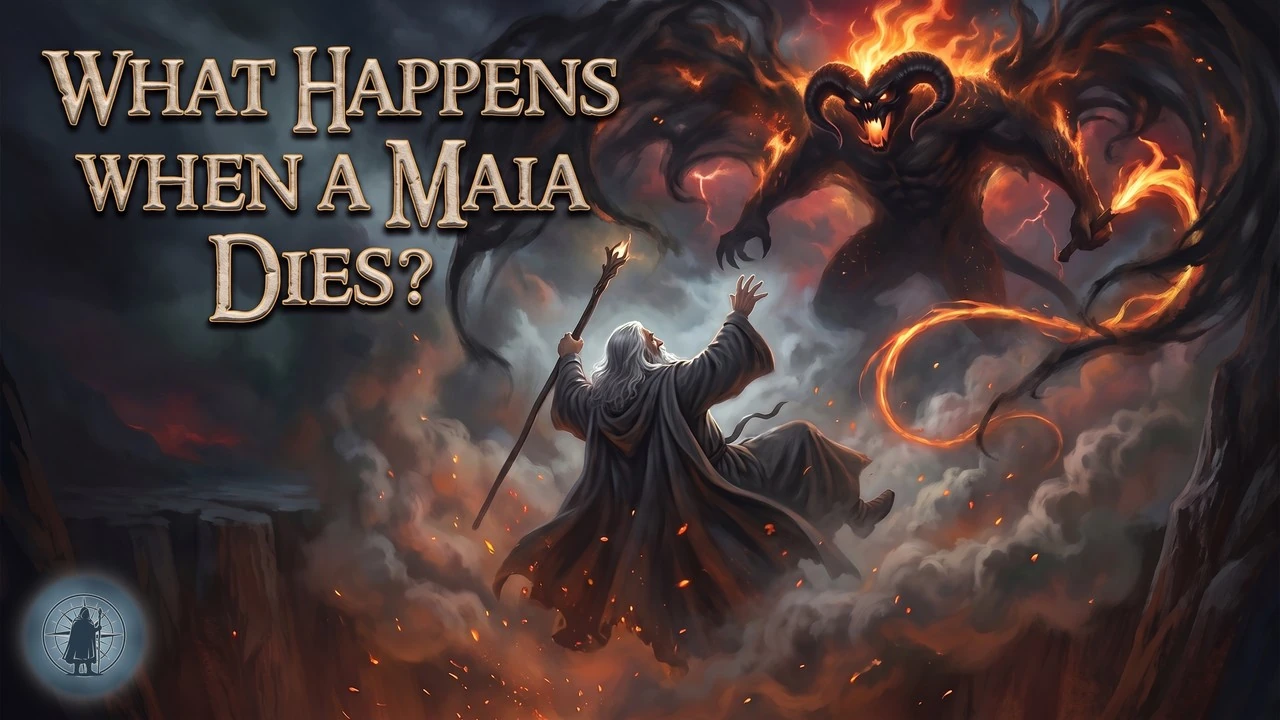
If that rule holds, Gandalf dying in Moria is a costume change, and Tolkien insisted for years that it was a real death. And whatever Gandalf threw off the peak above Moria should have got up and come back too.
Neither of those is what happens though. So something between the rule and the stories is what we have to investigate.
There's another line worth a mention before we begin. It's from the very beginning of the world. When the Ainur went down into Eä, Ilúvatar attached a condition. Their power "should thenceforward be contained and bounded in the World, to be within it for ever."
They can't leave.
Whatever happens to a Maia when its body is destroyed, it happens inside Arda. That rules out the simplest answer before we've started, and forces every death in this episode to be a change of state. Not a change in whether something exists.
SECTION: Morgoth's Wounds: When Raiment Becomes Flesh
So how does clothing turn into flesh?
Tolkien answered that directly, in a late essay about how thought passes between minds. It's an odd place for it, until you notice the essay is really about what the Ainur are. He's discussing Melkor, and he writes this:
"Melkor alone of the Great became at last bound to a bodily form; but that was because of the use that he made of this in his purpose to become Lord of the Incarnate, and of the great evils that he did in the visible body."
Bound to a bodily form, and alone of the Great in being so.
Then he generalises it to everyone who followed Melkor down. Corrupted spirits, he says, "became wedded to the forms of their evil deeds, and if these bodies were taken from them or destroyed, they were nullified, until they had rebuilt a semblance of their former habitations."
"Wedded" is that marriage metaphor again, the exact word for the relationship Elves have with their bodies and Maiar are supposed to be free of. Doing evil in a body marries you to it. And "nullified" means something softer and worse than destroyed - emptied out, left inert, reduced to nothing in particular.
Then we get the important word: until.
Until they had rebuilt.
It's a temporary state, in principle. Nothing promises the rebuild ever actually happens.
Morgoth is the case that shows what this marriage costs, and he's useful to study because he isn't a Maia. He's a Vala, the biggest of them, and he runs the process all the way to the end.
"Melkor incarnated himself, as Morgoth, permanently," Tolkien wrote. "He did this so as to control the hroa, the flesh or physical matter, of Arda." He was pouring himself into the world, into the rock and the soil and the creatures, so that owning the world and being the world would come to the same thing.
It worked. That's the unfortunate part. He gained a terrible grip on physical Arda, and in exchange he "lost, or exchanged, or transmuted, the greater part of his original angelic powers, of mind and spirit."
There's pieces of evidence scattered all over the Silmarillion, and they're easy to read past.
Let's go back to the Years of the Trees, to the night Ungoliant drinks the Two Trees dry. She swells. She grows big enough that Morgoth is frightened of her. And Tolkien tells us why: she grew great, "and he less by the power that had gone out of him." That's the first time anyone in the legendarium gets measurably smaller after something happens.
Then there's the Silmarils. Morgoth sets them in his iron crown and they burn him. The burns never heal. "His hands were burned black by the touch of those hallowed jewels, and black they remained ever after."
Then Fingolfin.
In the year 456 of the First Age, one Elf rides alone to the gates of Angband and challenges the enemy of the world to single combat. He loses. But before he does, he wounds Morgoth seven times, "and seven times Morgoth gave a cry of anguish."
Tolkien gives us something interesting here...
"Morgoth went ever halt of one foot after that day, and the pain of his wounds could not be healed."
An Ainu with a damaged body takes it off and weaves a new one. That's the rule, and Arien is the proof it costs nothing. Morgoth couldn't do it. He limped through the rest of the Age, in front of everybody, because the thing he was wearing had stopped being a garment.
Another strange bit of information sits in a footnote, and it's an odd thing to write about your own villain. Morgoth, Tolkien says, "came to fear death - the destruction of his assumed bodily form - above everything, and sought to avoid any kind of injury to his own form."
A Dark Lord who's afraid of dying.
He started out as a spirit that couldn't be killed, and ended up as something that was frightened by death.
SECTION: Sauron Died Three Times, and Rebuilt Twice
Sauron ran the same experiment on a smaller budget, three separate times across two Ages, which makes him the closest thing the legendarium has to a controlled trial.
Lúthien knew exactly what Sauron was. Pinned by Huan at Tol-in-Gaurhoth, shifting from wolf to serpent to his own shape, Sauron "could not elude the grip of Huan without forsaking his body utterly." He could see the exit but he handed over a fortress instead. Tolkien brackets that episode out of the count himself, so the real tally starts in the Second Age.
Number one is Númenor, in the year 3319, where Sauron has talked an island civilisation into sailing west to make war on the Valar. He's laughing in his temple when Ilúvatar breaks the world open and the sea takes the island out from under him.
"Though he was robbed now of that shape in which he had wrought so great an evil, so that he could never again appear fair to the eyes of Men, yet his spirit arose out of the deep and passed as a shadow and a black wind over the sea."
Robbed.
That's a word, for something taken off you by force. And what got taken went past the body. He can never look beautiful again, ever, and that's not a thing drowning does to you. Tolkien puts the Downfall down to "a direct action of God the Creator," which makes this a sentencing. Handed down and ruled on - it's more than Sauron just being injured.
Despite a part of him being destroyed, Sauron still crossed a thousand miles of ocean as weather, got home to Mordor, picked his Ring back up, and grew himself a new shape.
Example number two is the Last Alliance, in the year 3441. Gil-galad and Elendil die killing Sauron, and Isildur cuts the Ring off his hand with the broken shard of his father's sword. Sauron "forsook his body, and his spirit fled far away and hid in waste places; and he took no visible shape again for many long years."
The recovery times are where we're forced to turn to arithmetic.
After Númenor, it only took about a hundred and ten years to return to a working body that had an army. After the Last Alliance, it took roughly a thousand years before a shadow even falls on Greenwood and men start calling it Mirkwood. That was the dark presence of Sauron slowly returning. And that happened around eleven hundred before the Wise find a stronghold at Dol Guldur, and they don't think it's him. The Tale of Years says "it is thought to be one of the Nazgûl."
So more than two thousand years go by before anybody so much as fears "that it may be Sauron taking shape again," and he doesn't declare himself openly until the year 2951 of the Third Age.
An order of magnitude longer, whichever endpoint you pick. And the text uses the right verb: at Dol Guldur, "slowly he grew and took shape there again." He grew, like a plant, or like a wound closing over.
Tolkien explained why in a letter in 1957. "Sauron took a long while to re-build, longer than he had done after the Downfall of Númenor. I suppose because each building-up used up some of the inherent energy of the spirit."
So every body he uses costs some money out of a reserve that doesn't refill. In the same letter Tolkien sums Sauron's whole career up in six words: "He was always de-bodied when vanquished."
And the damage carries over. The proof comes from Gollum, who has actually seen Sauron in the flesh.
"Yes, He has only four on the Black Hand, but they are enough."
Isildur took that finger in the year 3441. The hand Gollum saw was grown from scratch more than a thousand years later, by a spirit that had been formless in between, and it still came out short a finger. So the wound sits on whatever creates the garment, rather than on the garment - a wound of the spirit.
Number three is Mount Doom, and Gandalf has already told everyone what to expect. In "The Last Debate" - Gandalf in the novel, says that if the Ring goes into the fire, Sauron "will be maimed for ever, becoming a mere spirit of malice that gnaws itself in the shadows, but cannot again grow or take shape."
What the armies at the Black Gate see is "a huge shape of shadow, impenetrable, lightning-crowned, filling all the sky," reaching out "a vast threatening hand, terrible but impotent: for even as it leaned over them, a great wind took it, and it was all blown away."
Terrible but impotent. Both halves are still true, and they've stopped having anything to do with each other.
Early in the first book, Gandalf hands Frodo a rule that had held for six thousand years. "Always after a defeat and a respite, the Shadow takes another shape and grows again." True after Númenor. True after the Last Alliance.
The third time, the reserve was empty.
SECTION: Why a Wizard Can Be Murdered
Everything so far says a Maia can't really be killed. Which leaves us with a problem, because two of them die in the book that many of us read first.
But with the Wizards, Tolkien wrote down the terms of a different arrangement.
Around the year 1000 of the Third Age, five figures came ashore at the Grey Havens. Círdan met the last of them, the grey one, and gave him the Ring of Fire he'd been keeping. Which tells us Círdan knew what he was looking at, even if nobody else did.
The essay Tolkien wrote about them contains an important sentence. The Valar sent members of their own high order, he says, "clad in bodies as of Men, real and not feigned, but subject to the fears and pains and weariness of earth, able to hunger and thirst and be slain."
Real and not feigned.
A fana is something you put on. This is something you're stuck inside, and it gets cold, and it can be hurt, and it can be ended. Tolkien said the same thing to a priest in a letter a few years later, and he put "killed" in quotation marks, like he was slightly uncomfortable with his own arrangement. They were "embodied in physical bodies capable of pain, and weariness, and of afflicting the spirit with physical fear, and of being 'killed'."
So the Istari were handed something that every other Maia in the legendarium can walk away from. It wasn't an oversight, it was probably Tolkien's deliberate intent.
Their instructions on dealing with Sauron forbade them "to match his power with power, or to seek to dominate Elves or Men by force and fear." That's the mission in one line. They weren't sent to win the war, they were sent to persuade a continent to save itself, and a being that can be hurt has to ask for help.
This came with a real cost that Tolkien explains. They were "involved in the peril of the incarnate: the possibility of 'fall', of sin." He even names the specific flavor they were most likely to fall into. "Impatience, leading to the desire to force others to their own good ends."
The likely points of failure were called out in the contract, two thousand years in advance. And at least one of the wizards walked straight into it.
There's a smaller cost, too. Living inside a human body dimmed their memory of where they'd come from, which is why, when Gandalf gives an account of himself, what comes out is a list of names rather than an origin.
"Mithrandir among the Elves, Tharkûn to the Dwarves; Olórin I was in my youth in the West that is forgotten, in the South Incánus, in the North Gandalf; to the East I go not."
Five names for one spirit. He remembers the name he had in Valinor the way most of us remember a childhood address. Readers argue constantly about whether Gandalf even knew what the Balrog was when they met on the bridge, and this is why it's a real argument rather than a silly one. Both were Maiar. Both were older than the Sun. And after two thousand years of wearing something else, neither may have fully recognised the other.
Then, at the end of everything, the arrangement produces its grimmest possible proof.
On the 3rd of November in the year 3019, at the door of a hobbit hole in the Shire, Saruman is killed by Gríma Wormtongue with a knife.
This is the chief of the Order. The head of the White Council. A Maia of Aulë, who studied Sauron's arts until he became a smaller copy of the thing he was sent to oppose. And he's killed by a broken man with a household blade, on a doorstep, in an argument about a garden.
An ordinary man. An ordinary weapon.
That can happen because the Valar handed him a body that could be killed. It's the clause in the contract, executed.
SECTION: Who Sent Gandalf Back from Death?
Gandalf's death is probably the best documented death in Tolkien, because it's the only one where the man himself came back and described it.
The dates are exact. On the 15th of January in the year 3019, the Fellowship crosses the bridge of Khazad-dûm, and Gandalf goes into the dark with a Balrog holding onto him. He tells the story afterwards, and he's clearly having trouble with it.
"Long time I fell. Long I fell, and he fell with me. His fire was about me. I was burned. Then we plunged into the deep water and all was dark. Cold it was as the tide of death: almost it froze my heart."
They fight at the bottom of the world, far below the deepest place the Dwarves ever dug, where, Gandalf says, "the world is gnawed by nameless things. Even Sauron knows them not. They are older than he." He mentions them once and refuses to say another word, which might be the only time in the whole book that Gandalf declines to explain something.
Then the chase goes up, by the Endless Stair, "from the lowest dungeon to the highest peak," to Durin's Tower on the summit of Zirakzigil. They fight there three days, the 23rd to the 25th of January. Then the Tale of Years gives us eight words.
"He casts down the Balrog, and passes away."
What Gandalf says about the next part doesn't really have an equivalent anywhere else in Tolkien.
"Then darkness took me; and I strayed out of thought and time, and I wandered far on roads that I will not tell."
Out of thought and time.
That's a big statement from Tolkien. A reader wrote to him about the resurrection, and his answer gives us more.
"'Naked I was sent back - for a brief time, until my task is done.' Sent back by whom, and whence? Not by the 'gods' whose business is only with this embodied world and its time; for he passed 'out of thought and time'."
The Valar couldn't have done it. Their authority runs inside the world, and Gandalf had gone somewhere outside it. So Tolkien names the one above them, and capitalises it.
"He was sent by a mere prudent plan of the angelic Valar or governors; but Authority had taken up this plan and enlarged it, at the moment of its failure. So Gandalf sacrificed himself, was accepted, and enhanced, and returned."
The Valar's plan was five wizards in limited bodies with no permission to use force. That plan died on the bridge at Khazad-dûm. Somebody upstairs picked it up off the floor and made it bigger.
"Naked" means something specific too.
"Naked I was sent back" doesn't mean he came back as a bare spirit. Tolkien glosses the word himself, in the same letter, and rules that reading out in two words. "It was meant just literally, 'unclothed like a child' - not discarnate - and so ready to receive the white robes of the highest."
He came back with a body. New, bare and helpless, lying on a mountaintop where "each day was as long as a life-age of the earth," until Gwaihir found him and carried him down to Lothlórien to be dressed.
And the death was real. Tolkien was clear about that, and his reason is really a craft argument. "Gandalf really 'died', and was changed: for that seems to me the only real cheating, to represent anything that can be called 'death' as making no difference."
So it made a difference. He comes back with holes in him. "I have forgotten much that I thought I knew, and learned again much that I had forgotten." And he comes back wearing somebody else's job. "Indeed I am Saruman, one might almost say, Saruman as he should have been."
One Maia in six thousand years got sent back, and the reason had nothing to do with what his kind can survive. A task wasn't finished, and someone above the Valar decided to give him a free return trip.
SECTION: Saruman's Cold Wind, Melian's Open Road
Nine months later, the same order of being, in the same kind of body, ends up standing in almost the same position. And gets a different answer.
Saruman's end at Bag End is two sentences long, and people have been arguing about them for seventy years.
"About the body of Saruman a grey mist gathered, and rising very slowly to a great height like smoke from a fire, as a pale shrouded figure it loomed over the Hill. For a moment it wavered, looking to the West; but out of the West came a cold wind, and it bent away, and with a sigh dissolved into nothing."
Rising very slowly. The "very" tends to get dropped when people quote it, and it's the word that makes the moment last as long as it does. The thing hangs over Hobbiton, in no hurry at all.
It waits. It looks West. And the West answers with weather.
As usual, there's something more interesting to think aobut here. The near-universal reading is that Saruman was refused. That the cold wind is Valinor saying no, and a fallen wizard is barred from coming home. It's a beautiful reading and it might be right. But Tolkien never says it. No letter says it, and nothing in his essay on the Wizards says it. So the only way to put it is that readers have long taken it to mean rejection. What Tolkien wrote was a cold wind, and a sigh, and then he stopped.
The wind comes after a hobbit's offer, though.
Minutes before Gríma's knife, Frodo stops the hobbits from killing Saruman. "He was great once, of a noble kind that we should not dare to raise our hands against." And Saruman's answer is one of the most bitter things anybody says in the whole book. "I must go hence in bitterness, in debt to your mercy. I hate it and you!"
Mercy was offered. He took it, and hated it. And then the wind.
For the opposite outcome we go back three Ages, to a Maia who put on a body far more completely than any Wizard ever did, and who walked home anyway.
Melian came to Middle-earth as a spirit out of the gardens of Lórien in Valinor. She met an Elf king in a wood in the dark before the Sun, and married him. Tolkien tells us specifically what that did to her. "In that union she became bound by the chain and trammels of the flesh of Arda."
The chain and trammels of the flesh.
That's what a marriage did to a Maia, and she was never corrupted, and she never attempted to dominate anybody. She was bound by a husband and a daughter. Tolkien even names her, by name, in those late notes, as the worked example: spirits who practice procreation while embodied become "more and more earthbound, unable to return to spirit-state."
By the rulebook, Melian was more stuck in her body than Saruman ever was.
And when Thingol was murdered by the Dwarves of Nogrod, around the year 502 of the First Age, she sat beside him a long while, and then she left. She didn't have to die to do it.
Her leaving does more damage than most deaths in that book. The Girdle of Melian, the enchantment that had kept Doriath hidden and unenterable for centuries, was her. When she withdrew, "Esgalduin the enchanted river spoke with a different voice, and Doriath lay open to its enemies." A kingdom fell because a Maia went home.
And then Tolkien gives her the most final-sounding exit line he ever wrote, for a character who doesn't die. "She vanished out of Middle-earth, and passed to the land of the Valar beyond the western sea... and this tale speaks of her no more."
They were the same order of being. It was the same West.
Melian gets a road. Saruman gets a cold wind.
SECTION: Durin's Bane and the Silence Tolkien Left
And that brings us to the case most people came here for, and the one Tolkien left empty.
The Balrog.
Durin's Bane was a Maia. The same order of being as Gandalf and Sauron and Melian, corrupted by Melkor before the Sun had ever risen. It fought through the wars of Beleriand, and it survived the War of Wrath, the war that broke a continent and dragged Morgoth out of Angband in chains, by hiding in the roots of the earth for an Age and a half.
Then in the year 1980 of the Third Age, the Dwarves of Khazad-dûm dug too deep after mithril and woke it up. It killed Durin the Sixth, which is how it got its name, and his son Náin the next year. And then the Dwarves, who never abandon anything, abandoned Khazad-dûm and stayed out for a thousand years.
There also weren't many Balrogs. The early drafts had a thousand Balrogs, and a late note in Tolkien's margin says "there should not be supposed more than say three or at most seven ever existed." So Ecthelion, Glorfindel and Gandalf between them account for a serious fraction of an entire kind of being.
And what Gandalf does to it happens in two stages. First he drowns it. "His fire was quenched, but now he was a thing of slime, stronger than a strangling snake." A demon of fire, put out. Then, days later, on the summit: "I threw down my enemy, and he fell from the high place and broke the mountain-side where he smote it in his ruin."
Fire taken away first. Then height. Both of the things it was, stripped off one at a time.
And then nothing.
No mist gathers. Nothing rises very slowly like smoke from a fire. Nothing turns West and gets an answer. Tolkien wrote all of that out for Saruman, on a doorstep, in the Shire. For Durin's Bane, on the roof of the world, he wrote a broken mountainside and moved straight on to Gandalf's own death.
And he never came back to it. Not in the book, or a letter or in fifty years of notes.
But we've got the whole rulebook now, though, so let's put it to work on Tolkien's deliberate silence.
What the rules forbid is where people will drift first. The balrog could not have been annihilated. "The indestructibility of spirits with free wills, even by the Creator of them, is also an inevitable feature," Tolkien wrote. Not even Eru unmakes a thing that has a will. And there's no zero in this cosmology for anything to be reduced to. On absolute evil, he said, "I do not think there is such a thing, since that is Zero."
The balrog also couldn't have left. Right back at the beginning, the Ainur accepted that their power would be "contained and bounded in the World, to be within it for ever." That includes the ones who went wrong. So strictly, by Tolkien's own rules, something of the thing Gandalf threw off Zirakzigil is inside Arda right now.
What the rules permit is arguably worse than being dead. In those late notes Tolkien uses a verb for what happens when a corrupted spirit's body is killed. He says it's released. And then he says what it is released into. "Reduced to impotence, infinitely recessive: still hating but unable more and more to make it effective physically."
Released. And the freedom is worthless.
There's no road home for a balrog either, and Gondolin proves it. In the year 510 of the First Age, Glorfindel and a Balrog fought above the burning city and went over the edge together. The same fall, the same second. Glorfindel was an Elf. He had a fëa, and a fëa has somewhere to go: Mandos, a judgment, a waiting, and in this case a new body and a passage back to Middle-earth. The Balrog he killed got none of that. Tolkien never wrote about a Mandos for the Ainur.
Which is just about where Tolkien himself ended up. At some point he was reading back over his own essay, on a page where he'd written that a spirit was "destroyed," and he stopped and wrote a note in the margin arguing with himself.
"Since no fëa can be annihilated, reduced to zero or not-existing, it is not clear what is meant."
He couldn't make his own word work. So he tried to reason out what it might mean instead.
"A 'wicked' spirit becomes fixed in a certain desire or ambition, and if it cannot repent then this desire becomes virtually its whole being. But the desire may be wholly beyond the weakness it has fallen to, and it will then be unable to withdraw its attention from the unobtainable desire. It will then remain for ever in impotent desire, or memory of desire."
So that's what's left on the mountainside above Moria.
It wasn't a corpse, but it wasn't nothing. It was a wanting that can't be satisfied, and can't stop.