
Research & Sources
What Happens When a Maia Dies?
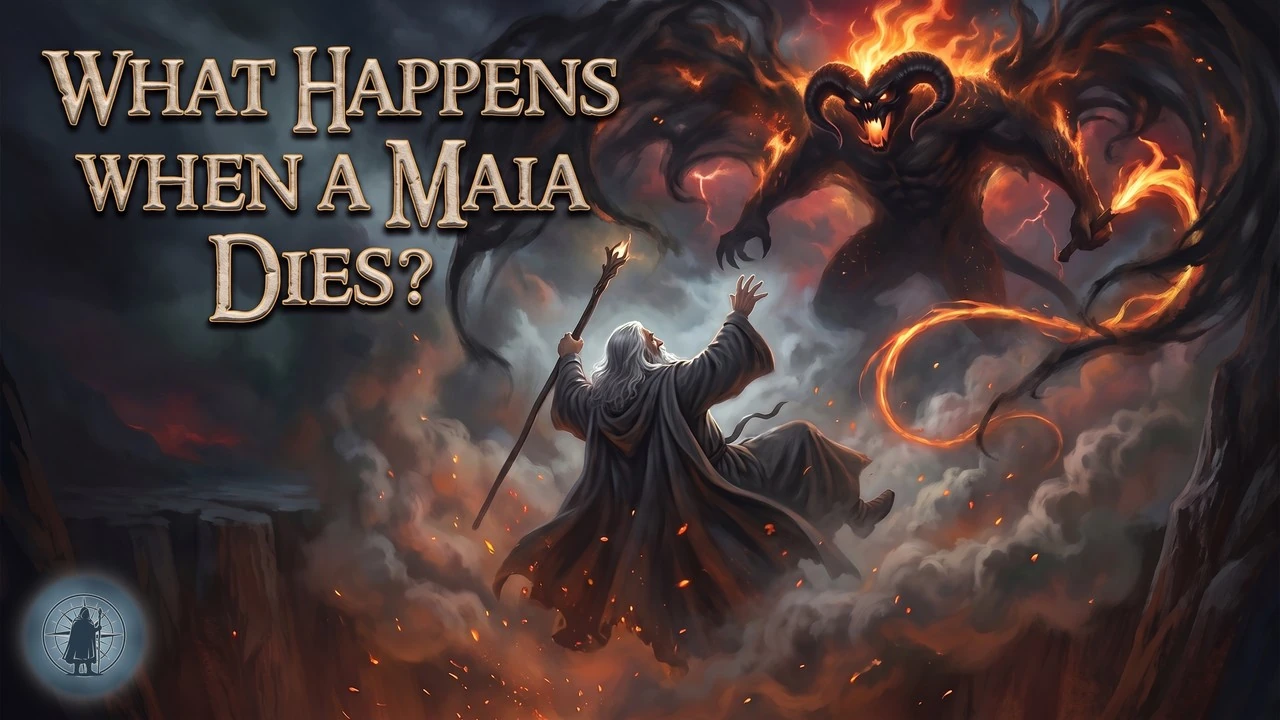 Watch the episode
What Happens When a Maia Dies? | Tolkien's Balrogs & Sauron Explained
Watch the episode
What Happens When a Maia Dies? | Tolkien's Balrogs & Sauron Explained
Research Notes: What Happens When a Maia Dies?
Evidence density assessment (read this first)
Verdict: abundant. Unusually well-supplied for a metaphysics episode, because Tolkien wrote about it directly in three registers:
1. Narrative — six fully-dramatised discorporations in the published books (Sauron at Tol-in-Gaurhoth, at Númenor, at Dagorlad and at Mount Doom; Gandalf on Zirakzigil; Saruman at Bag End), plus Melian's voluntary departure and Arien's. 2. Doctrinal — the late philosophical texts: the Ósanwe-kenta (Vinyar Tengwar 39) and Morgoth's Ring (HoME X), especially "Myths Transformed" texts VII ("Notes on motives in the Silmarillion") and X ("Orcs"), plus the Later Quenta commentary. Tolkien states the rule in his own analytic voice, and names Melian as the worked example. 3. Authorial — Letters 131, 156, 183, 200, 211, 246 answer reader questions about exactly this. Letter 200 is the most important single source for the episode and none of the Balrog-wave channels are quoting it.
Eight distinct analytical themes below, each with 3+ hard specifics. The topic comfortably supports 29-36 minutes.
One honest gap, which is itself the payoff: Tolkien never states what happened to Durin's Bane's spirit. That silence is a fact to deliver, not paper over — and the rulebook lets us say precisely what the silence can and cannot contain.
Five citation traps flagged below. This topic is heavily mis-cited across the internet, including by sources that look authoritative. Read the "Contradictions and Variants" section before writing a single quote card.
Overview
The question in the title is malformed, and that is the episode.
A Maia is an ëala — and Tolkien coined that word specifically so it would not be the word for the spirit of an incarnate being. A Maia does not have a body the way an Elf has a body. It has a fana: self-woven visible raiment, put on and taken off. Destroying the fana does not kill the Maia. It strips it. The correct word is not death but discorporation, and the state it produces is one Tolkien names precisely: houseless, and unanchored.
So the four cases the audience argues about are not four instances of one event. They are four outcomes of one mechanism run under different conditions:
- Gandalf — an Ainu who accepted full incarnation (a real body, not a fana), was genuinely killed, genuinely died, and was sent back by an authority above the Valar. - Sauron — a Maia who spent centuries pouring his native power into matter and into a ring, was de-bodied repeatedly, and rebuilt more slowly each time until he could not rebuild at all. - The Balrog — a Maia corrupted into a form defined by its own violence, drowned, then thrown off a mountain, and then never mentioned again by anyone, including Tolkien. - Saruman — the same order of being as Gandalf, in the same kind of body, killed by an ordinary knife in the hands of a broken man; his spirit rose, looked West, and was blown away.
The mechanism is identical in all four. The differences come down to two variables: **how much of itself the spirit had already spent, and whether anyone above wanted it back.**
And Tolkien himself, in a marginal note he added to his own essay, worked out the answer and found it uncomfortable enough to say so:
"Since no fëa can be annihilated, reduced to zero or not-existing, it is no[t] clear what is
meant... a 'wicked' spirit becomes fixed in a certain desire or ambition, and if it cannot repent
then this desire becomes virtually its whole being. But the desire may be wholly beyond the
weakness it has fallen to... **It will then remain for ever in impotent desire or memory of
desire.**"
— Morgoth's Ring, "Myths Transformed" Text VII, marginal note, pp. 407-408
That is the episode's answer. **A Maia does not die. It becomes a permanent, unsatisfiable wanting.**
The rulebook: six load-bearing terms
| Quenya | Meaning | Applies to | |---|---|---| | fëa (pl. fëar) | spirit, soul — of an incarnate being | Elves and Men | | hröa (pl. hröar) | body, flesh — native and necessary | Elves and Men | | ëala (pl. ëalar) | "being" — a spirit not natively incarnate | Valar and Maiar | | fana (pl. fanar) | "veil, raiment" — the self-woven visible form an Ainu assumes | Valar and Maiar | | Valarauko / Balrog | "demon of might" | the corrupted fire-spirits | | Úmaiar | the corrupted Maiar | Melkor's servants |
The single most important textual find for this episode is Tolkien's own footnote defining
ëala, printed by Christopher Tolkien in Morgoth's Ring, Part Two, *The Later Quenta
Silmarillion*, commentary on ch. 3 §18. Tolkien had revised the Balrog passage to read:
"These were the (ëalar) spirits who first adhered to him in the days of his splendour, and
became most like him in his corruption: their hearts were of fire, but they were cloaked in
darkness, and terror went before them; they had whips of flame. Balrogs they were named by the
Noldor in later days."
and attached to that one bracketed word:
"There is a footnote to the word ëalar in this passage: 'spirit' (not incarnate, which was
fëa, S[indarin] fae). ëala 'being'."
Read what that footnote does. Tolkien is explicitly refusing to call a Maia's spirit a fëa, because a fëa is by definition the spirit of something with a body. He minted a different word. The metaphysical answer to the episode's title is embedded in Tolkien's vocabulary before any story is told — and it is invisible in the published Silmarillion, which drops the "(ëalar)" gloss entirely.
The critical structural distinction: an Elf's fëa and hröa are married — separating them is a wound, and the fëa is summoned to Mandos. An Ainu's ëala and fana are not married — the fana is worn. This is why "a Maia died" is a category error, and why the exceptions (Gandalf, Melian, Morgoth) are the interesting part: in each case, something converted the relationship from clothing into marriage.
Primary Sources
Ainulindalë and Valaquenta (The Silmarillion)
The binding — the ceiling on everything that follows. When the Ainur entered Eä, Ilúvatar's condition was that
"their power should thenceforward be contained and bounded in the World, to be within it for
ever, until it is complete, so that they are its life and it is theirs."
— "Ainulindalë"
A discorporated Maia cannot leave. Whatever happened to Durin's Bane, it did not exit the world. Whatever remains of Sauron is still inside Arda. This sentence forecloses annihilation and forces every "death" to be a change of state, never of existence. Tolkien restates it plainly in Letter 200: the Ainur who helped make the world "then had to remain in it until the Story was finished."
The raiment doctrine — the clearest statement of what a fana is:
"But when they desire to clothe themselves the Valar take upon them forms, some as of male and
some as of female... Their shape comes of their knowledge of the visible World, rather than of
the World itself; and they need it not, save only as we use raiment, and yet we may be naked
and suffer no loss of our being. Therefore the Valar may walk, if they will, unclad, and then
even the Eldar cannot clearly perceive them, though they be present."
— "Valaquenta"
Note the analogy Tolkien chose: raiment. Not shell, not avatar, not vessel — clothes. And the tell in the middle: "we may be naked and suffer no loss of our being." That is the episode's thesis in fourteen of Tolkien's own words.
On the Balrogs — use the published text, not the HoME variant:
"For of the Maiar many were drawn to his splendour in the days of his greatness, and remained
in that allegiance down into his darkness; and others he corrupted afterwards to his service
with lies and treacherous gifts. Dreadful among these spirits were the Valaraukar, the scourges
of fire that in Middle-earth were called the Balrogs, demons of terror."
— "Valaquenta", "Of the Enemies"
Citation trap: the widely-quoted "spirits whose hearts were of fire, but who were cloaked in darkness... they had whips of flame" is the HoME X Later Quenta version, not the published Silmarillion. Both are Tolkien; they are different texts. Attribute correctly.
Also from the Valaquenta: the Maiar are "of the same order as the Valar but of less degree"; and Eönwë is the Maia "whose might in arms is surpassed by none in Arda."
Ósanwe-kenta ("Enquiry into the Communication of Thought"), Vinyar Tengwar 39 (1998), ed. Carl F. Hostetter
Written c. 1959-60 alongside "Quendi and Eldar". Tolkien in pure analytic mode.
On Melkor's binding:
"Melkor alone of the Great became at last bound to a bodily form; but that was because of the
use that he made of this in his purpose to become Lord of the Incarnate, and of the great evils
that he did in the visible body."
— Ósanwe-kenta, Note 5
On what happens to a corrupted Maia when its form is destroyed:
"they became wedded to the forms of their evil deeds, and if these bodies were taken from them
or destroyed, they were nullified, until they had rebuilt a semblance of their former
habitations, with which they could continue the evil courses"
— Ósanwe-kenta, Note 5
This is the closest thing in the corpus to a direct answer to the title question, and it applies specifically to the Úmaiar. Destroy the body: the spirit is nullified — not destroyed; nullified, reduced to inert nothing-in-particular — until it rebuilds. Rebuilding is possible in principle. Nothing guarantees it is possible in a given case.
Provenance caution: this is a late, posthumously published philosophical essay in a linguistic journal, not narrative canon Christopher Tolkien incorporated. Present it as Tolkien's late technical formulation, which it is.
Morgoth's Ring (HoME X) — "Myths Transformed"
Two texts matter, and text X is the bigger find.
#### Text VII, "Notes on motives in the Silmarillion" — the economics
"Sauron was greater, effectively, in the Second Age than Morgoth at the end of the First. Why?
Because, though he was far smaller by natural stature, he had not yet fallen so low. Eventually
he also squandered his power (of being) in the endeavour to gain control of others. But he was
not obliged to expend so much of himself."
"To gain domination over Arda, Morgoth had let most of his being pass into the physical
constituents of the Earth... Morgoth at the time of the War of the Jewels had become permanently
incarnate; for this reason he was afraid, and waged the war almost entirely by means of devices,
or of subordinates and dominated creatures."
"Melkor incarnated himself (as Morgoth) permanently. He did this so as to control the hroa,
the flesh or physical matter, of Arda. He attempted to identify himself with it. A vaster, and
more perilous, procedure, though of similar sort to the operation of Sauron with the Rings."
"But in this way Morgoth lost (or exchanged, or transmuted) the greater part of his original
angelic powers, of mind and spirit, while gaining a terrible grip upon the physical world."
The title thesis:
"Sauron's, relatively smaller, power was concentrated; Morgoth's vast power was disseminated.
The whole of Middle-earth was Morgoth's Ring, though temporarily his attention was mainly upon
the North-west."
The death-of-an-Ainu passage — the closest thing to a statement of the rule:
"though he had disseminated his power (his evil and possessive and rebellious will) far and
wide into the matter of Arda, he had lost direct control of this, and all that he, as a
surviving remnant of integral being, retained as himself and under control was the terribly
shrunken and reduced spirit that inhabited his self-imposed (but now beloved) body. **When that
body was destroyed he was weak and utterly houseless, and for that time at a loss and
unanchored as it were.**"
"In any case, in seeking to absorb or rather to infiltrate himself throughout matter, what was
then left of him was no longer powerful enough to reclothe itself."
And on the asymmetry with Sauron — Melkor's remnant might over ages draw back some dissipated power, and
"It would do this (even if Sauron could not) because of its relative greatness."
And the psychological engine, in a footnote:
"For this reason he himself came to fear death — the destruction of his assumed bodily form —
above everything, and sought to avoid any kind of injury to his own form."
A Dark Lord who is afraid of dying. That is the whole topic in one sentence, and it is Tolkien's.
And the possibility of recovery, which almost nobody quotes (MR p. 404):
"The Elves certainly held and taught that fëar or 'spirits' may grow of their own life
(independently of the body), even as they may be hurt and healed, be diminished and renewed. The
dark spirit of Melkor's 'remainder' might be expected, therefore, eventually and after long ages
to increase again, even (as some held) to draw back into itself some of its formerly dissipated
power. It would do this (even if Sauron could not) because of its relative greatness.... As it
grew again it would become, as it were, a dark shadow, brooding on the confines of Arda, and
yearning towards it."
#### The marginal note at MR pp. 407-408 — the best single answer to the episode's title
This is a note Tolkien added to Text VII after the page was written, and it is the passage the episode should be built on, because in it Tolkien catches his own legendarium using the word "destroyed" and stops to say that cannot be right:
"Since no fëa can be annihilated, reduced to zero or not-existing, it is no[t] clear what is
meant. Thus Sauron was said to have fallen below the point of ever recovering, though he had
previously recovered. What is probably meant is that a 'wicked' spirit becomes fixed in a certain
desire or ambition, and if it cannot repent then this desire becomes virtually its whole being.
But the desire may be wholly beyond the weakness it has fallen to, and it will then be unable to
withdraw its attention from the unobtainable desire, even to attend to itself. **It will then
remain for ever in impotent desire or memory of desire.**"
— Morgoth's Ring, "Myths Transformed" Text VII, marginal note, pp. 407-408
That is the answer, in Tolkien's own hand. A Maia does not die. It becomes a permanent, unsatisfiable wanting. Note also what Tolkien is doing grammatically: he is reasoning aloud, and concluding that the narrative language of destruction is imprecise. This is better than anything in the Ósanwe-kenta because it is Tolkien arguing with himself and losing.
#### The "Orcs" texts (MR p. 410) — the mechanism, with Melian named
Tolkien is arguing about whether lesser Maiar could have become Orcs, and states the rule in passing. *(Text-number caution: sources cite this variously as "Myths Transformed" Text VIII and Text X; the page reference — MR p. 410 — is verified. Cite by page, or say "the Orcs texts.")*
"In any case is it likely or possible that even the least of the Maiar would become Orcs? Yes:
both outside Arda and in it, before the fall of Utumno. Melkor had corrupted many spirits — some
great, as Sauron, or less so, as Balrogs. The least could have been primitive (and much more
powerful and perilous) Orcs; but **by practising when embodied procreation they would (cf. Melian)
[become] more and more earthbound, unable to return to spirit-state (even demon-form), until
released by death (killing), and they would dwindle in force. When released they would, of
course, like Sauron, be 'damned': i.e. reduced to impotence, infinitely recessive: still hating
but unable more and more to make it effective physically** (or would not a very dwindled dead
Orc-state be a poltergeist?)."
Note the verb: "released by death (killing)." Tolkien is explicit that destroying the body frees the spirit rather than ending it — and that the freedom is worthless.
Four rules in one paragraph: 1. Procreation while embodied is what binds a spirit to a body — not merely wearing a form, but begetting. Melian is cited by name, in a parenthesis, as the case. 2. A bound spirit is "unable to return to spirit-state" — it can no longer un-clothe at will. 3. The only release is "death (killing)." 4. On release, a corrupted spirit is "reduced to impotence, infinitely recessive."
Also from the same text, Tolkien's blunt classification note:
"Orcs are beasts and Balrogs corrupted Maiar."
and
"the wills of Orcs and Balrogs etc. are part of Melkor's power 'dispersed'. Their spirit is one
of hate."
#### Laws and Customs among the Eldar — the contrast case
Supplies the Elvish system: a fëa separated from its hröa is summoned to the Halls of Mandos, may refuse the summons, and may in time be re-housed. **This system is for the Children of Ilúvatar. Tolkien never extends it to the Ainur.** Whether a slain Maia's spirit goes to Mandos is exactly what the texts do not settle.
The Silmarillion — the narrative cases
Arien — the control group. Chosen to steer the Sun, she was "from the beginning a spirit of fire, whom nonetheless Melkor had not deceived nor drawn to his service." And:
"Too bright were the eyes of Arien for even the Eldar to look on, and leaving Valinor she
forsook the form and raiment which like the Valar she had worn there, and she was as a naked
flame, terrible in the fullness of her splendour."
— ch. 11, "Of the Sun and Moon and the Hiding of Valinor"
Arien takes the raiment off. No wound, no violence, no consequence — she simply becomes unlookable. This is what discorporation looks like when nobody is fighting. (Tilion, Maia of Oromë, steers the Moon and "loved Arien, but she was a holier spirit of greater power, and wished to be ever virgin and alone." Worth one line: Arien refuses union and stays free of the flesh. Melian does the opposite and gets trapped.)
Sauron vs. Huan and Lúthien, Tol-in-Gaurhoth, F.A. c. 466 — the best dramatised statement of the rule in the whole legendarium, and it is dialogue:
"Now Sauron knew well, as did all in that land, the fate that was decreed for the hound of
Valinor, and it came into his thought that he himself would accomplish it. Therefore he took
upon himself the form of a werewolf, and made himself the mightiest that had yet walked the
world; and he came forth to win the passage of the bridge."
"But no wizardry nor spell, neither fang nor venom, nor devil's art nor beast-strength, could
overthrow Huan of Valinor; and he took his foe by the throat and pinned him down. Then Sauron
shifted shape, from wolf to serpent, and from monster to his own accustomed form; but **he could
not elude the grip of Huan without forsaking his body utterly.**"
"Ere his foul spirit left its dark house, Lúthien came to him, and said that he should be
stripped of his raiment of flesh, and his ghost be sent quaking back to Morgoth; and she
said: 'There everlastingly thy naked self shall endure the torment of his scorn, pierced by
his eyes, unless thou yield to me the mastery of thy tower.' Then Sauron yielded himself, and
Lúthien took the mastery of the isle and all that was there; and Huan released him."
"And immediately he took the form of a vampire, great as a dark cloud across the moon, and he
fled, dripping blood from his throat upon the trees, and came to Tar-nu-Fuin, and dwelt there,
filling it with horror."
— ch. 19, "Of Beren and Lúthien"
Four different metaphors for one idea in two sentences: "his foul spirit," "its dark house," "raiment of flesh," "thy naked self." And note what Sauron chooses. Lúthien does not threaten to kill him — she threatens to unhouse him — and he surrenders a fortress rather than face it. A Maia fears un-bodying more than defeat. That is the thesis, spoken aloud by a character, three thousand years before Moria.
Note also: this is not a death. He is bested and flees in a new shape. The conservative count is three true Sauron discorporations (Númenor, Dagorlad, Mount Doom); Tolkien himself brackets this one — in Morgoth's Ring he writes "In the first overthrow and disembodiment of Sauron in Middle-earth (neglecting the matter of Luthien)…", and the sentence breaks off unfinished.
Melian — the case that is not a death at all, and the one Tolkien uses as his worked example.
"For Melian was of the divine race of the Valar, and she was a Maia of great power and wisdom;
but for love of Elwë Singollo she took upon herself the form of the Elder Children of Ilúvatar,
and in that union she became bound by the chain and trammels of the flesh of Arda."
— ch. 22, "Of the Ruin of Doriath"
"The chain and trammels of the flesh of Arda" is the phrase the episode wants. This is TEXT, not inference: Melian is a Maia who put on a body and then could not simply take it off. And Morgoth's Ring text X names her explicitly as the case that proves procreation is the binding mechanism.
After Thingol's murder by the Dwarves of Nogrod (F.A. 502-503):
"Melian sat long in silence beside Thingol the King, and her thought passed back into the
starlit years and to their first meeting among the nightingales of Nan Elmoth in ages past; and
she knew that her parting from Thingol was the forerunner of a greater parting, and that the
doom of Doriath was drawing nigh."
"Thus it came to pass that her power was withdrawn in that time from the forests of Neldoreth
and Region, and Esgalduin the enchanted river spoke with a different voice, and Doriath lay
open to its enemies."
"Thereafter Melian spoke to none save to Mablung only, bidding him take heed to the Silmaril,
and to send word speedily to Beren and Lúthien in Ossiriand; and **she vanished out of
Middle-earth, and passed to the land of the Valar beyond the western sea, to muse upon her
sorrows in the gardens of Lórien, whence she came, and this tale speaks of her no more.**"
Two beats for the writer. (1) "And this tale speaks of her no more" is Tolkien's most final-sounding exit line — for a character who did not die. (2) **A Maia leaving is more catastrophic than most characters dying**: the Girdle fails with her, and Nogrod's host walks in unopposed. Melian is the "what it looks like when it goes right" case, and the episode needs her as the control against Saruman.
Morgoth's body becomes woundable — the physical receipts. Because Morgoth had spent himself into the world, his form stopped behaving like raiment and started behaving like flesh:
"His hands were burned black by the touch of those hallowed jewels, and black they remained
ever after; nor was he ever free from the pain of the burning." (the Silmarils in the Iron Crown)
"He wounded Morgoth with seven wounds, and seven times Morgoth gave a cry of anguish, whereat
the hosts of Angband fell upon their faces in dismay, and the cries echoed in the Northlands."
"Morgoth went ever halt of one foot after that day, and the pain of his wounds could not be
healed."
— ch. 18, "Of the Ruin of Beleriand and the Fall of Fingolfin" (F.A. 456)
An unhoused Ainu discards a damaged body and weaves a fresh one. Morgoth couldn't. Permanent scars on an angelic being are diagnostic: the fana had hardened into a hröa.
**Of the Rings of Power and the Third Age — Sauron's fair form, still intact at the end of the First Age.* (Location correction: this passage opens "Of the Rings of Power", NOT ch. 24.)*
"When Thangorodrim was broken and Morgoth overthrown, Sauron put on his fair hue again and did
obeisance to Eönwë the herald of Manwë, and abjured all his evil deeds. And some hold that this
was not at first falsely done, but that Sauron in truth repented, if only out of fear, being
dismayed by the fall of Morgoth and the great wrath of the Lords of the West. But it was not
within the power of Eönwë to pardon those of his own order, and he commanded Sauron to return
to Aman and there receive the judgement of Manwë. Then Sauron was ashamed, and he was unwilling
to return in humiliation and to receive from the Valar a sentence... Therefore when Eönwë
departed he hid himself in Middle-earth."
Flag: "fair hue" vs "fair form" — reproductions split. Published text reads "fair hue"; verify against print before narration.
Akallabêth — the first true discorporation, S.A. 3319:
"And Sauron, sitting in his black seat in the midst of the Temple, had laughed when he heard the
trumpets of Ar-Pharazôn sounding for battle; and again he had laughed when he heard the thunder
of the storm; and a third time, even as he laughed at his own thought, thinking what he would do
now in the world, being rid of the Edain for ever, he was taken in the midst of his mirth, and
his seat and his temple fell into the abyss."
"But Sauron was not of mortal flesh, and though he was robbed now of that shape in which he
had wrought so great an evil, so that he could never again appear fair to the eyes of Men, yet
his spirit arose out of the deep and passed as a shadow and a black wind over the sea, and came
back to Middle-earth and to Mordor that was his home. There he took up again his great Ring in
Barad-dûr, and dwelt there, dark and silent, until he wrought himself a new guise, an image of
malice and hatred made visible; and the Eye of Sauron the Terrible few could endure."
Everything is in that paragraph: the form destroyed; a capability permanently confiscated; the spirit surviving and travelling as weather; the rebuild; and the new form being worse — "an image of malice and hatred made visible." And the verb is passive and judicial: robbed. The crime and the confiscation in one clause.
The parallel account in "Of the Rings of Power and the Third Age":
"Sauron indeed was caught in the wreck of Númenor, so that the bodily form in which he long had
walked perished; but he fled back to Middle-earth, a spirit of hatred borne upon a dark wind. He
was unable ever again to assume a form that seemed fair to men, but became black and hideous,
and his power thereafter was through terror alone."
The Last Alliance, S.A. 3441 — same chapter:
"But at the last the siege was so strait that Sauron himself came forth; and he wrestled with
Gil-galad and Elendil, and they both were slain, and the sword of Elendil broke under him as he
fell. But Sauron also was thrown down, and with the hilt-shard of Narsil Isildur cut the Ruling
Ring from the hand of Sauron and took it for his own. **Then Sauron was for that time vanquished,
and he forsook his body, and his spirit fled far away and hid in waste places; and he took no
visible shape again for many long years.**"
The convalescence at Dol Guldur:
"For coming out of the wastes of the East he took up his abode in the south of the forest, and
slowly he grew and took shape there again; in a dark hill he made his dwelling and wrought
there his sorcery, and all folk feared the Sorcerer of Dol Guldur, and yet they knew not at
first how great was their peril."
"Slowly he grew and took shape again." Growth, not instantiation. Re-embodiment has a duration, and the duration is the episode's best data.
Ungoliant — hedged twice, and worth exactly one careful beat:
"The Eldar knew not whence she came; but some have said that in ages long before she descended
from the darkness that lies about Arda, when Melkor first looked down in envy upon the Kingdom
of Manwë, and that in the beginning she was one of those that he corrupted to his service."
"Of the fate of Ungoliant no tale tells. Yet some have said that she ended long ago, when in her
uttermost famine she devoured herself at last."
"Some have said" in both sentences. Tolkien refuses to state her origin or her end. If the rumour is true she is the only being in the legendarium who dies by consuming itself — a spirit that ate its own body. Do not call her a Maia flatly. Present as legend, which is how Tolkien presents it.
The Lord of the Rings
"The Shadow of the Past" (FotR I.2) — Gandalf states the pattern that the whole episode is about to break:
"Always after a defeat and a respite, the Shadow takes another shape and grows again."
"The White Rider" (TT III.5) — the longest first-person account of dying in Tolkien:
"Long time I fell," he said at last, slowly, as if thinking back with difficulty. "Long I fell,
and he fell with me. His fire was about me. I was burned. Then we plunged into the deep water
and all was dark. Cold it was as the tide of death: almost it froze my heart."
"His fire was quenched, but now he was a thing of slime, stronger than a strangling snake."
"We fought far under the living earth, where time is not counted. Ever he clutched me, and ever
I hewed him, till at last he fled into dark tunnels."
"Far, far below the deepest delving of the Dwarves, the world is gnawed by nameless things. Even
Sauron knows them not. They are older than he. Now I have walked there, but I will bring no
report to darken the light of day."
"Ever up now we went, until we came to the Endless Stair... From the lowest dungeon to the
highest peak it climbed, ascending in unbroken spiral in many thousand steps, until it issued at
last in Durin's Tower carved in the living rock of Zirakzigil, the pinnacle of the Silvertine."
"I threw down my enemy, and he fell from the high place and broke the mountain-side where he
smote it in his ruin."
"Then darkness took me; and I strayed out of thought and time, and I wandered far on roads that
I will not tell."
"Naked I was sent back — for a brief time, until my task is done. And naked I lay upon the
mountain-top... I was alone, forgotten, without escape upon the hard horn of the world. There I
lay staring upward, while the stars wheeled over, and each day was as long as a life-age of the
earth."
"And so at the last Gwaihir the Windlord found me again, and he took me up and bore me away."
"Yes, I am white now. Indeed I am Saruman, one might almost say, Saruman as he should have
been." ... "I have forgotten much that I thought I knew, and learned again much that I had
forgotten."
Two writer's notes. (1) "Naked" is doing precise technical work — it is the Valaquenta's "we may be naked and suffer no loss of our being," used literally. Gandalf comes back unclothed in the fana sense and lies on the peak until he is re-clothed. (2) "I strayed out of thought and time" places him outside Eä — where the Valar's writ ends. That is the strongest internal evidence that the decision to return him was not theirs.
"The Voice of Saruman" (TT III.10) — the expulsion:
"Behold, I am not Gandalf the Grey, whom you betrayed. I am Gandalf the White, who has returned
from death. You have no colour now, and I cast you from the order and from the Council."
"Saruman, your staff is broken." There was a crack, and the staff split asunder in Saruman's
hand, and the head of it fell down at Gandalf's feet.
"The Black Gate is Closed" (TT IV.3) — the detail proving damage carries across a rebuild. Gollum, who has seen Sauron in the flesh:
"Yes, He has only four on the Black Hand, but they are enough."
Isildur cut the Ring away in S.A. 3441. Sauron built a wholly new body over the following millennium — and it still has four fingers. The wound is not on the body. It is on the spirit that weaves the body.
"Mount Doom" (RotK VI.3) — the moment before:
"the Power in Barad-dûr was shaken, and the Tower trembled from its foundations to its proud and
bitter crown. The Dark Lord was suddenly aware of him... and the magnitude of his own folly was
revealed to him in a blinding flash... Then his wrath blazed in consuming flame, but his fear
rose like a vast black smoke to choke him."
"The Last Debate" (RotK V.9) — Gandalf's doctrine of what the Ring's destruction will do:
"For he will lose the best part of the strength that was native to him in his beginning, and all
that was made or begun with that power will crumble, and he will be maimed for ever, becoming a
mere spirit of malice that gnaws itself in the shadows, but cannot again grow or take shape."
CITATION TRAP — resolved. This is Gandalf, in the novel, RotK Book V ch. 9. It is routinely mis-cited as Letter 131 and as Letter 200. Verified: the phrase does not appear in the Tolkien Estate's published text of Letter 131. Cite the novel.
"The Field of Cormallen" (RotK VI.4) — the prophecy executed:
"And even as he spoke the earth rocked beneath their feet. Then rising swiftly up, far above
the Towers of the Black Gate, high above the mountains, a vast soaring darkness sprang into the
sky, flickering with fire."
"'The realm of Sauron is ended!' said Gandalf. 'The Ring-bearer has fulfilled his Quest.' And as
the Captains gazed south to the Land of Mordor, it seemed to them that, black against the pall
of cloud, there rose a huge shape of shadow, impenetrable, lightning-crowned, filling all the
sky. Enormous it reared above the world, and stretched out towards them a vast threatening hand,
terrible but impotent: for even as it leaned over them, a great wind took it, and it was all
blown away, and passed; and then a hush fell."
Accuracy note: "a huge shape of shadow" — not "shape of a man," which is the common misquote. "Terrible but impotent" is the load-bearing phrase.
"The Scouring of the Shire" (RotK VI.8) — Saruman, 3 November T.A. 3019:
"To the dismay of those that stood by, about the body of Saruman a grey mist gathered, and
rising very slowly to a great height like smoke from a fire, as a pale shrouded figure it
loomed over the Hill. For a moment it wavered, looking to the West; but out of the West came a
cold wind, and it bent away, and with a sigh dissolved into nothing."
Accuracy note: "rising very slowly." The "very" is frequently dropped. Keep it.
Saruman's last words, moments before:
"You have grown, Halfling," he said. "Yes, you have grown very much. You are wise, and cruel.
You have robbed my revenge of sweetness, and now I must go hence in bitterness, in debt to your
mercy. I hate it and you! Well, I go and I will trouble you no more. But do not expect me to
wish you health and long life. You will have neither. But that is not my doing. I merely
foretell."
And Frodo, refusing to let the hobbits kill him:
"He was great once, of a noble kind that we should not dare to raise our hands against."
Flag: the continuation usually quoted with it — "He is fallen, and his cure is beyond us; but I would still spare him, in the hope that he may find it" — could not be verified verbatim in this research pass. Almost certainly correct; **verify against a print copy before using as a quote card.**
Appendix A, "Durin's Folk" — the Balrog's Third Age career: awakened T.A. 1980 by Durin VI's mithril-miners; slew Durin VI (hence the name); slew Náin I the following year; the Dwarves abandoned Khazad-dûm in 1981.
Unfinished Tales — "The Istari"
"For with the consent of Eru they sent members of their own high order, but **clad in bodies as
of Men, real and not feigned, but subject to the fears and pains and weariness of earth, able to
hunger and thirst and be slain**; though because of their noble spirits they did not die, and
aged only by the cares and labours of many long years."
The hinge of the whole episode. The Istari are not wearing fanar. They are wearing **bodies as of Men, real and not feigned** — a genuine hröa with the full incarnate downside. "Able to hunger and thirst and be slain." A wizard can be murdered in a way that Arien or Ulmo simply cannot.
The same essay on the risk:
the Istari were "involved in the peril of the incarnate: the possibility of 'fall', of sin" —
whose chief form for them "would be impatience, leading to the desire to force others to their
own good ends."
And that they were forbidden "to match his power with power, or to seek to dominate Elves or Men by force and fear." The body is the handicap. Also: memory of Valinor dimmed with the incarnation — which is why Gandalf's account of himself is a list of names:
"Mithrandir among the Elves, Tharkûn to the Dwarves; Olórin I was in my youth in the West that
is forgotten, in the South Incánus, in the North Gandalf; to the East I go not."
— TT IV.5 (Faramir quoting Gandalf), elucidated in UT, "The Istari"
Five names for one ëala. The body and the name are both raiment.
Important negative finding. The Unfinished Tales Istari essay says nothing about the fate of a fallen wizard's spirit. There is no passage anywhere — not in the essay, not in a Letter — stating that a failed Istar is barred from the West. See "Contradictions."
The Letters of J.R.R. Tolkien
Letter 200 (to Major R. Bowen, 25 June 1957; Letters 1981 ed. pp. 259-60) — **the most valuable single source, and the one nobody quotes.**
"He was always de-bodied when vanquished. The theory, if one can dignify the modes of the story
with such a term, is that he was a spirit, a minor one but still an 'angelic' spirit."
"They were thus in the world, but not of a kind whose essential nature is to be physically
incarnate. **They were self-incarnated, if they wished; but their incarnate forms were more
analogous to our clothes than to our bodies, except that they were more than are clothes the
expression of their desires, moods, wills and functions.**"
"It is mythologically supposed that when this shape was 'real', that is a physical actuality in
the physical world and not a vision transferred from mind to mind, **it took some time to build
up. It was then destructible like other physical organisms. But that of course did not destroy
the spirit, nor dismiss it from the world to which it was bound until the end.** After the battle
with Gilgalad and Elendil, Sauron took a long while to re-build, longer than he had done after
the Downfall of Númenor (I suppose because **each building-up used up some of the inherent energy
of the spirit**, which might be called the 'will' or the effective link between the indestructible
mind and being and the realization of its imagination). The impossibility of re-building after
the destruction of the Ring, is sufficiently clear 'mythologically' in the present book."
Tolkien uses the clothes analogy himself, unprompted, in a letter — and then improves on it: the forms "were more than are clothes the expression of their desires, moods, wills and functions." A fana is clothing that tells you what the wearer wants. The companion line is in Letter 212 (the unsent draft continuation of 211): the Ainur "wished to, and could, incarnate themselves in visible physical forms, though these were **comparable to our clothes (in so far as our clothes are a personal expression) not to our bodies**."
Tolkien is describing a ratchet. Each rebuild is paid out of a finite reserve that does not refill. And note the phrase he reaches for: "the effective link between the **indestructible mind and being** and the realization of its imagination." The mind is indestructible. What wears out is the bridge from mind to matter.
Letter 211 (to Rhona Beare, 14 October 1958; Letters p. 280):
"**The indestructibility of spirits with free wills, even by the Creator of them, is also an
inevitable feature, if one either believes in their existence, or feigns it in a story.**"
"Sauron was, of course, 'confounded' by the disaster, and diminished (having expended enormous
energy in the corruption of Númenor). **He needed time for his own bodily rehabilitation, and for
gaining control over his former subjects.**"
"Though reduced to 'a spirit of hatred borne on a dark wind', I do not think one need boggle at
this spirit carrying off the One Ring, upon which his power of dominating minds now largely
depended."
The first line is the theological floor of the episode. **In Tolkien's world nothing with a free will can be annihilated — not even by Eru.** So the answer to the title can never be "it stops existing." The same letter attributes the Downfall of Númenor to "a direct action of God the Creator, changing the fashion of the world, when appealed to by Manwë" — so Sauron's first de-bodying is a sentence, not an injury.
Letter 156 (to Fr Robert Murray SJ, 4 November 1954; Letters p. 202) — the richest single letter on Gandalf, and it corrects a reading almost everyone gets wrong.
"I wd. venture to say that he was an incarnate 'angel' — strictly an ἄγγελος: that is, with the
other Istari, wizards, 'those who know', an emissary from the Lords of the West, sent to
Middle-earth, as the great crisis of Sauron loomed on the horizon. **By 'incarnate' I mean they
were embodied in physical bodies capable of pain, and weariness, and of afflicting the spirit
with physical fear, and of being 'killed', though supported by the angelic spirit they might
endure long, and only show slowly the wearing of care and labour.**"
"Gandalf really 'died', and was changed: for that seems to me the only real cheating, to
represent anything that can be called 'death' as making no difference."
"Gandalf, an incarnate ἄγγελος, an emissary of the Lords of the West, really did pass through
death, and was sent back."
"He was sent by a mere prudent plan of the angelic Valar or governors; but **Authority had taken
up this plan and enlarged it, at the moment of its failure.** The crisis had become too grave and
needed an enhancement of power. So Gandalf sacrificed himself, was accepted, and enhanced,
and returned."
On the Bridge: "He was handing over to the Authority that ordained the Rules, and giving up
personal hope of success."
And the passage that settles both "who sent him back" and what "naked" means:
"'Naked I was sent back — for a brief time, until my task is done.' **Sent back by whom, and
whence? Not by the 'gods' whose business is only with this embodied world and its time; for he
passed 'out of thought and time'.** Naked is alas! unclear. It was meant just literally,
'unclothed like a child' (not discarnate), and so ready to receive the white robes of the
highest."
READING CORRECTION — important. It is tempting (and very common online) to read Gandalf's "naked" as fana-nakedness, i.e. discorporate. Tolkien explicitly rules that out: "not discarnate." He came back with a body, unclothed like a newborn, and was then robed in white. Do not build a beat on "he came back as a bare spirit." He didn't.
Tolkien capitalises Authority to distinguish it from the Valar. The Valar made a plan; the plan failed on the Bridge; someone above them picked it up and enlarged it — and Tolkien states flatly that the Valar could not have done it, because Gandalf had gone somewhere their business does not reach.
And a line built for the closing:
"for of course the Shadow will arise again in a sense (as is clearly foretold by Gandalf), but
**never again (unless it be before the great End) will an evil daemon be incarnate as a physical
enemy.**"
Letter 181 (Letters p. 237) — the incarnation's real cost, and Tolkien pre-empting the obvious comparison:
"these 'wizards' were incarnated in the life-forms of Middle-earth, and so suffered the pains
both of mind and body. They were also, for the same reason, thus **involved in the peril of the
incarnate: the possibility of 'fall', of sin**, if you will... Thus Gandalf faced and suffered
death; and came back or was sent back, as he says, with enhanced power. But though one may be in
this reminded of the Gospels, it is not really the same thing at all."
Letter 153 (Letters pp. 187-196) — why the Valar cannot simply fix any of this:
"The immediate 'authorities' are the Valar (the Powers or Authorities): the 'gods'. But **they are
only created spirits — of high angelic order we should say, with their attendant lesser angels —
reverend, therefore, but not worshipful; and though potently 'subcreative', and resident on
Earth to which they are bound by love, having assisted in its making and ordering, they cannot
by their own will alter any fundamental provision.**"
And Tolkien's own footnote, the metaphysical rule in one sentence:
"**Creation, the act of Will of Eru the One that gives Reality to conceptions, is distinguished
from Making, which is permissive.**"
Letter 183:
Sauron was "of the same kind as Gandalf and Saruman, but of a far higher order."
"In my story I do not deal in Absolute Evil. **I do not think there is such a thing, since that
is Zero.**"
Scholars split on whether "far higher order" registers Sauron's innate stature or the cost the Istari paid for incarnation. Probably both. Either way it is the clearest statement that Maiar are not a flat tier. And the "Zero" line is the doctrinal partner to Letter 211: nothing in this world is annihilated, because absolute nothing is not a thing Tolkien's cosmology contains.
Letter 246 (to Mrs Eileen Elgar, September 1963):
"The form that he took was that of a man of more than human stature, but not gigantic. In his
earlier incarnation he was able to veil his power (as Gandalf did) and could appear as a
commanding figure of great strength of body and supremely royal demeanour and countenance."
And on attrition, in the hypothetical Gandalf-vs-Sauron duel, Gandalf would have the advantage because Sauron "was weakened by long corruption and expenditure of will in dominating inferiors." Domination costs the dominator. Same thesis, stated casually.
Letter 131 (to Milton Waldman, 1951): Sauron "was of course not 'evil' in origin. He was a 'spirit' of the same order as the 'wizards'." Also, on the general principle: "I do not deal in Absolute Evil... I do not think that at any rate any 'rational being' is wholly evil."
Timeline
Before and during the Years of the Trees - Before Eä: the Ainur who enter accept that "their power should thenceforward be contained and bounded in the World, to be within it for ever." (Ainulindalë) - Y.T. 1495: Ungoliant drinks the Two Trees; Morgoth is diminished — she grew great "and he less by the power that had gone out of him." First recorded case of an Ainu measurably losing power by spending it. - After the first rising of the Sun: Arien "forsook the form and raiment... and she was as a naked flame." Voluntary discorporation, zero cost.
First Age - F.A. 456 (after the Dagor Bragollach): Fingolfin gives Morgoth seven wounds; "Morgoth went ever halt of one foot after that day." Morgoth's fana has become woundable flesh. - F.A. c. 466: Sauron duels Huan at Tol-in-Gaurhoth. Full shape-shifting intact. Surrenders the tower rather than be unhoused. - F.A. 502-503: Thingol slain; Melian's power withdraws from Neldoreth and Region; the Girdle fails; she "vanished out of Middle-earth." - F.A. 510: Fall of Gondolin. Ecthelion of the Fountain, disarmed, drives the spike of his helm into Gothmog, Lord of Balrogs; both fall into the King's Fountain and drown. *A Maia drowned.* Separately, Glorfindel kills an unnamed Balrog at Cirith Thoronath and falls with it into the abyss; Thorondor bears his body up. - End of F.A.: War of Wrath. "The Balrogs were destroyed, save some few that fled and hid themselves in caverns inaccessible at the roots of the earth." Morgoth is taken **in physical form**, as a criminal. Sauron repents before Eönwë, then flees rather than face judgment.
Second Age - S.A. c. 1600: The One Ring forged; Sauron transfers a large part of his native power into it. - S.A. 3262-3319: Sauron surrenders to Ar-Pharazôn, is taken to Númenor, and rises to rule it from within — wearing the fair shape. - S.A. 3319: The Downfall. Body destroyed. Loses forever the ability to appear fair. - S.A. 3319 → 3429/3441: Rebuild #1 — roughly 110-122 years to a functioning body and open war on Gondor. Tolkien notes he was attacked "before his new domination was fully established." - S.A. 3441: Last Alliance. Gil-galad and Elendil slain; Isildur cuts the Ring away; Sauron "forsook his body, and his spirit fled far away and hid in waste places."
Third Age - c. T.A. 1000: The Istari arrive at the Grey Havens; Círdan gives Narya to Gandalf. - c. T.A. 1050: "About this time a shadow falls on Greenwood, and men begin to call it Mirkwood." (Standard across reference sources; flag for a print check of Appendix B.) - T.A. 1100: "The Wise (the Istari and the chief Eldar) discover that an evil power has made a stronghold at Dol Guldur. It is thought to be one of the Nazgûl." (Verbatim-confirmed.) - T.A. 1980: "A Balrog appears in Moria, and slays Durin VI." - T.A. 1981: Náin I slain; Durin's Folk abandon Khazad-dûm. - T.A. 2060: "The power of Dol Guldur grows. **The Wise fear that it may be Sauron taking shape again.**" - T.A. 2063: Gandalf goes to Dol Guldur; Sauron retreats east. The Watchful Peace begins. - T.A. 2850: Gandalf enters Dol Guldur again and confirms that its master is Sauron. - T.A. 2951: Sauron declares himself openly and begins to rebuild Barad-dûr.
**How long did rebuild #2 take? The honest answer is a range, and the range is a better segment than a tidy number. From S.A. 3441 it is roughly 1,050 years** to a shadow on Greenwood, ~1,100 to a stronghold the Wise can find (which they misread as a Nazgûl), ~2,400 years before they even suspect Sauron, ~2,850 before Gandalf confirms it, and ~2,950 before he says so out loud. Against ~110-122 years for rebuild #1. Whatever endpoint you pick, the ratio is an order of magnitude or worse — and Tolkien tells us why in Letter 200. **Never state a single precise figure; the Tale of Years does not support one.** - T.A. 3019, 15 January: The Bridge of Khazad-dûm; Gandalf falls with the Balrog. - T.A. 3019, 23 January: Gandalf pursues the Balrog to the peak of Zirakzigil. - T.A. 3019, 25 January: "He casts down the Balrog, and passes away." - T.A. 3019, 14 or 15 February: "Gandalf returns to life, and lies in a trance." *(Date differs by edition — see Contradictions.)* Roughly twenty to twenty-one days dead. - T.A. 3019, 17-23 February: Gwaihir bears him to Lothlórien; re-clothed in white. - T.A. 3019, 25 March: The Ring unmade; "a great wind took it, and it was all blown away." - T.A. 3019, 3 November: Saruman killed at Bag End; his spirit rises, looks West, is refused. - T.A. 3021, 29 September: Gandalf sails from the Grey Havens.
Key Characters (case files)
Olórin / Gandalf / Mithrandir / Tharkûn / Incánus. A Maia of Manwë and Varda; in *Unfinished Tales*, the wisest of the Maiar and a lover of the Children of Ilúvatar. Sent c. T.A. 1000 in a real body. Killed 25 January 3019 after a three-day battle on Zirakzigil. Returned ~20 days later. Sails West 29 September T.A. 3021. **The only Maia explicitly stated to have died and been sent back.**
Curunír / Saruman / Sharkey. Chief of the Istari, head of the White Council; a Maia of Aulë. Corrupted by study of Sauron's arts and by the palantír. Cast from the Order at Orthanc; staff broken. Killed by Gríma Wormtongue with a knife at Bag End, 3 November 3019. **The only Maia in the legendarium killed by ordinary murder, by an ordinary man, with an ordinary weapon.** Fate: "with a sigh dissolved into nothing."
Mairon / Sauron / Annatar / the Necromancer. A Maia of Aulë, "of the same kind as Gandalf and Saruman, but of a far higher order" (L.183). Three true discorporations (Númenor, Dagorlad, Mount Doom), plus the Tol-in-Gaurhoth flight. Fate: "a mere spirit of malice that gnaws itself in the shadows, but cannot again grow or take shape."
Durin's Bane. A Balrog — a Maia corrupted before the Sun; a survivor of the War of Wrath; awoke T.A. 1980; slew two Kings of Durin's Folk; drove out an entire people. Fate: unrecorded. Tolkien never says.
Gothmog. Lord of Balrogs; Morgoth's high-captain. Killed at Gondolin F.A. 510 by Ecthelion, who was disarmed and used his helmet-spike. Fate: unrecorded. Same silence, same year.
Melian. A Maia of Vána and Estë; the only Ainu known to have wed one of the Children and borne a child; consequently "bound by the chain and trammels of the flesh of Arda," and named by Tolkien in Morgoth's Ring as the worked example of embodiment-by-procreation. Fate: put the form down voluntarily and returned to the gardens of Lórien in Valinor.
Melkor / Morgoth. A Vala, not a Maia — but the control case that proves the ratchet by running it to the end. Permanently incarnate by the War of the Jewels; scarred, lamed, burned; afraid of death; captured in the body; and when the body was destroyed, "weak and utterly houseless... and unanchored as it were."
Glorfindel. Not a Maia — the crucial contrast. An Elf who died fighting a Balrog at Gondolin, went to Mandos, was re-housed, and returned to Middle-earth in the Second Age with power "almost an equal of the Maiar" (HoME XII). **He and his Balrog died in the same fall, in the same instant. He came back. It didn't.** An Elf has a defined route home. A corrupted ëala has none.
Arien. Maia of fire, steerer of the Sun. The rule at rest.
Eönwë. Herald of Manwë, "whose might in arms is surpassed by none in Arda." Survives the War of Wrath. Useful for keeping the episode honest about how rare a killed Maia actually is.
Geography
- Zirakzigil / Celebdil / Silvertine — the peak above Moria, crowned by Durin's Tower, reached by the Endless Stair, which climbed "from the lowest dungeon to the highest peak... in unbroken spiral in many thousand steps." Gandalf calls it "the hard horn of the world." A Maia dies here and a Maia is sent back here. The most vertical location in the legendarium and the most vertical event. - The deep water beneath Khazad-dûm — where the Balrog's fire is quenched and it becomes "a thing of slime," and where "the world is gnawed by nameless things." The one place Gandalf refuses to describe. - Tol-in-Gaurhoth (formerly Minas Tirith of Finrod, on Tol Sirion) — where Sauron surrenders a fortress rather than be stripped of flesh. - Númenor and the sea between it and Middle-earth — Sauron's spirit crosses roughly a thousand miles of open ocean as weather. The best evidence for how a houseless Maia travels. - Dol Guldur, southern Mirkwood — the convalescent ward, where Sauron spends a millennium "slowly growing and taking shape again." - Bag End, Hobbiton — where the second-greatest Maia in Middle-earth ends, on a doorstep, by a household knife. The bathos is deliberate. - The gardens of Lórien in Valinor — Melian's origin and destination; the only recorded case of a Maia going home.
Themes and Symbolism
Clothes, not skin. Tolkien's governing metaphor is domestic: raiment, veil, cloak, weaving, "his dark house." He deliberately refuses the language of possession or avatar. It keeps the Ainur from becoming ghosts and their bodies from becoming costumes: a fana is real, wearable, losable. And a body in this legendarium can be worn by someone else after its owner is done with it — Sauron wears Draugluin's skin; Lúthien wears Thuringwethil's.
Wind as verdict. Four times a spirit ends or flees and Tolkien reaches for wind. Sauron crossing the sea "as a shadow and a black wind" — wind as escape. "A spirit of hatred borne upon a dark wind" — wind as conveyance. Sauron's shadow at Cormallen: "a great wind took it, and it was all blown away" — wind as dispersal. Saruman: "out of the West came a cold wind, and it bent away" — wind as refusal. Same image, different verdicts. And the direction matters: the wind that disperses Saruman comes from the West, from Valinor. That is not weather.
The economics of self-expenditure. Tolkien's most original theological move. Power here is not a renewable stat; it is a substance, and spending it into the world — into a ring, into an army, into the soil of Arda — permanently removes it from the spender. Morgoth ends up lame and afraid of dying; Sauron ends up unable to grow a body. Both got exactly what they asked for. The Catholic frame is precise: the sin is the punishment, and nobody imposes it.
Death that means something. Letter 156 is blunt: to represent "anything that can be called 'death' as making no difference" would be "the only real cheating." So Gandalf comes back with holes in him — "I have forgotten much that I thought I knew." Resurrection in Tolkien is never a reset. Compare the four-fingered Black Hand: even the villains carry their deaths forward.
Mercy as the thing offered before judgment. Frodo spares Saruman; Saruman dies minutes later by his own servant's hand, in explicit debt to that mercy — "I must go hence in bitterness, in debt to your mercy. I hate it and you!" The mercy does not save him. But it is the last thing offered to him, and the cold wind comes after a hobbit's offer. The sequencing is not accidental.
Angelology, not mythology. Tolkien insisted the Valar and Maiar were "angelic" spirits, not gods (L.200, L.131, L.156's ἄγγελος). The Thomistic frame explains the strangeness: angels are pure intelligences; embodiment for them is a choice and therefore a risk; and a fallen angel is not destroyed but fixed in its fall. Ralph C. Wood describes the Valar and Maiar as what "Christians would call angels"; Matthew Dickerson (J.R.R. Tolkien Encyclopedia) calls them the "Powers of Middle-earth" and stresses they were "not to be worshipped"; Judith Kollmann (Mythlore) argues they are at once "the gods of Scandinavia, Greece, and Rome" and "the angels and archangels of Judeo-Christianity."
Rarity. Across the whole legendarium, the complete list of Maiar whose bodies are destroyed on the page is: Gothmog; one unnamed Balrog (Glorfindel's); Durin's Bane; Saruman; Sauron (three times); and possibly Ungoliant, if she is a Maia and if the rumour of her end is true. **Fewer than eight bodies, across three Ages, out of an order of spirits present since before the world.** The rarity is itself the story.
Scholarly Perspectives
- Grant C. Sterling (cited in the standard survey literature on the Ainur): the Maiar differ from the Valar "in being able to choose to incarnate fully in forms such as men's bodies," so they can be killed when embodied — but the fate of killed Maiar "remains unclear." Sterling suggests Sauron's final inability to re-form follows from having given his power to the Ring, rather than from the killing as such. - Tom Shippey, The Road to Middle-earth, in the section headed "Views of evil: Boethian and Manichaean" (pp. 128-129, Grafton/HarperCollins pagination; roughly pp. 140-143 in the 2003 revised edition — that second pagination is unverified). Verbatim:
"A good way to understand The Lord of the Rings in its full complexity is to see it as an
attempt to reconcile two views of evil, both old, both authoritative, both living, each
seemingly contradicted by the other. One of these is in essence the orthodox Christian one...
**This says that there is no such thing as evil: 'evil is nothing', is the absence of good...
Corollaries of this belief are, that evil cannot itself create, that it was not in itself
created... that it will in the long run be annulled or eliminated.**"
"The danger of this opinion is that it tends towards Manichaeanism, the heresy which says that
Good and Evil are equal and opposite and the universe is a battlefield."
The Maia-death question sits exactly on that fault line: a "nullified" spirit is a Boethian object; a spirit crossing the sea as a black wind is a Manichaean one. On Saruman specifically, Shippey reads the death as "wraithing" — his term for a modern conception of evil in which a person is "eaten up inside" by devotion to an abstraction — and notes simply that the spirit "dissolved into nothing." - Jonathan S. McIntosh, *The Flame Imperishable: Tolkien, St. Thomas, and the Metaphysics of Faërie (Angelico Press, 2017), on what a fana is* in Thomistic terms: because Ainurin embodiment "is not natural but voluntary and therefore provisional or conditional... **the angelic body is, for the angelic spirits, ultimately a kind of 'machine,' a form of technology and therefore a mere tool to be used** rather than part of their fundamental nature and identity." And on the arc: "the more they invest themselves into the material shaping and making of the world, the more power or influence they wield over it, and yet the less power they retain in and for themselves." - **The Aquinas contrast (an original reading — no published scholar found making it; present it as the episode's own).* Summa Theologiae* I, q.51, a.2, ad 3:
"Although air as long as it is in a state of rarefaction has neither shape nor color, yet when
condensed it can both be shaped and colored as appears in the clouds. **Even so the angels
assume bodies of air, condensing it by the Divine power in so far as is needful for forming the
assumed body.**"
And I, q.51, a.3, ad 4: "**Properly speaking, the angels do not talk through their assumed bodies**; yet there is a semblance of speech, in so far as they fashion sounds in the air like to human voices."
The divergence writes itself. Aquinas's angel wears a puppet of condensed air and cannot really speak through it. Tolkien's Maia wears a body that can bleed, breed, get tired, and close over it like a trap: Melian bore a child through hers and was "bound by the chain and trammels of the flesh of Arda" for it. That is precisely why "what happens when a Maia dies" is a real question in Middle-earth and a category error in the Summa. (Note the pleasing accident that Aquinas reaches for clouds and Tolkien's word fana also means "cloud.") - Paul Kocher reads Saruman's end as an instance of Tolkien's recurring theme of **nothingness as the fate of evil**. - The Catholic reading: Letter 211's "indestructibility of spirits with free wills, even by the Creator of them" imports directly the doctrine that a created rational soul cannot be annihilated. This is why there is no death for a Maia in the human sense — the theology does not permit one. - On Saruman's rejection: the near-universal reading is that the West refused him. **Neither Shippey nor Kocher claims this, and Tolkien never states it.** See Contradictions. - The "Gandalf's memory is degraded" reading — a live argument on r/tolkienfans as of August 2026 (196 upvotes, 130 comments, "The Balrog and Gandalf recognising each other"): the Istari essay makes incarnation dim the wizards' memory of Valinor, which is why Gandalf plausibly did not know which Balrog he was fighting. One commenter's framing is usefully sharp: "Gandalf was probably intellectually aware he was a Maia, but only from deduction."
Contradictions and Variants
1. CITATION TRAP — "a mere spirit of malice that gnaws itself in the shadows." This is Gandalf, RotK Book V ch. 9, "The Last Debate." It is very widely mis-attributed to Letter 131 and to Letter 200, including by otherwise reliable sources. Verified: the phrase does not appear in the Tolkien Estate's text of Letter 131. 2. CITATION TRAP — the Balrog description. "Spirits whose hearts were of fire, but who were cloaked in darkness... whips of flame" is the HoME X Later Quenta text. The published Silmarillion Valaquenta reads "the Valaraukar, the scourges of fire... demons of terror." Different texts; both Tolkien. 3. CITATION TRAP — the Eönwë/repentance passage. It opens "Of the Rings of Power and the Third Age," not ch. 24 "Of the Voyage of Eärendil." Also: published text reads "fair hue," not "fair form." 4. CITATION TRAP — "a huge shape of shadow," not "a shape of a man." Check before quoting. 5. CITATION TRAP — there is no Unfinished Tales account of Sauron's form-loss at the Downfall. The alternative telling is HoME IX, Sauron Defeated, "The Drowning of Anadûnê" (where he is Zigûr). Do not cite UT for this. 6. Gandalf's return date: 14 vs 15 February T.A. 3019. Earlier editions of Appendix B read "February 14 — The Mirror of Galadriel. Gandalf returns to life, and lies in a trance." Hammond and Scull's revised text moves this to 15 February to close a one-day gap before the Company leaves Lórien on the 16th. Both are "correct" depending on edition. Safe on-air phrasing: "roughly three weeks" / "the middle of February." 7. Saruman's rejection by the West is INFERENCE, not text. No Letter and no passage in the Istari essay says a fallen Istar is barred from returning. Searched for specifically; not found. The reading is excellent — the figure looks West, the wind comes from the West, it bends away — but say "readers have long taken this to mean," never "Tolkien tells us." The nearest supporting text is Morgoth's Ring text X on released corrupted spirits being "reduced to impotence, infinitely recessive." 8. How many Balrogs. The 1937 Quenta Silmarillion has "Balrogs one thousand." Tolkien's late marginal note in Morgoth's Ring (notes to The Annals of Aman, §50) reads: "**There should not be supposed more than say 3 or at most 7 ever existed.**" A gap of 1,000 → 7. This matters here: the smaller the number, the more a Balrog's destruction is a genuine metaphysical event rather than attrition. *(The channel already has a research page on this — reuse, don't re-derive.)* 9. Whether Maiar go to Mandos. No text says they do. No text says they don't. The Halls of Mandos are consistently the house of the Children of Ilúvatar. Fans assert the Maiarin case with confidence the texts do not support. 10. How many times Sauron died. Some counts say four (including Tol-in-Gaurhoth), some three. The conservative and defensible position is three true discorporations. Tolkien himself brackets the Lúthien episode ("neglecting the matter of Luthien"). 11. Ungoliant's nature and end. Tolkien hedges both with "some have said." Do not call her a Maia flatly; do not state that she devoured herself as fact. 12. Draugluin and Thuringwethil as Maiar — fan speculation resting on shape-shifting, not on any statement by Tolkien. Draugluin is explicitly bred and then inhabited by an evil spirit, which is a different metaphysics. Flag or cut. 13. The Saruman death scene may have been a late addition. One secondary source (Wikipedia's Saruman article) states the shrivelling body and the pale shrouded figure were **added while Tolkien reviewed the page proofs** — i.e. the most famous depiction of a Maia's death in all of Tolkien was an afterthought at the printer. Unverified against a primary source (likely Hammond & Scull's Reader's Companion or HoME IX). If it checks out it is a superb cold-open or closing beat. Ten minutes with a print copy would settle it. 14. Superlative trap — "the only Maia who ever came back." Gandalf is the only Maia stated to have died and been sent back. But Sauron rebuilt twice, and Glorfindel (an Elf) is the legendarium's headline resurrection. Frame Gandalf as "the only one sent back **by authority, with a task**," never as the only being who ever returned from death. 15. Provenance of the Ósanwe-kenta. Late (c. 1959-60), posthumously published in a linguistic journal, not incorporated into the Silmarillion. Best available statement of the rule; flag it as Tolkien's late technical thinking. 16. Frodo's "his cure is beyond us" continuation — unverified verbatim in this pass. Verify before quote-carding. 17. READING CORRECTION — Gandalf's "naked" does NOT mean discorporate. Letter 156 glosses it himself: "It was meant just literally, 'unclothed like a child' (not discarnate)." He came back with a body, bare, and was then robed in white. The widespread online reading that he returned as a bare spirit is wrong, and Tolkien says so in as many words. 18. Letter 246's "reduced to impotence" is about the WITCH-KING, not Sauron. The footnote reads "The Witch-king had been reduced to impotence." Do not repurpose it for Sauron. 19. The Akallabêth says Sauron could never again appear fair "to the eyes of MEN." The variant "to elvish eyes" circulates widely and is wrong.
Phrases circulating online that we could NOT find in any Tolkien text — do not use
- "He had become 'the Dark Lord', and could not now be otherwise." Searched twice, in Morgoth's Ring and the Letters. Not found. The real phrasings are MR p. 403's "his self-imposed (but now beloved) body" and MR p. 410's "reduced to impotence, infinitely recessive." - "Reduced to a self-imprisonment." Not found. Same replacements. - Any Letter or Istari-essay statement that a fallen wizard is barred from the West. Searched specifically. Does not appear to exist. - "Sauron shifted shape from wolf to serpent" is genuine (Silmarillion ch. 19) — but the frequently-appended detail that he became "his own accustomed form" and then a vampire in an unbroken sequence compresses the text. Quote the two attested passages, not a paraphrase chain.
Still unverified after three research passes (flag if the script leans on them)
Exact Vinyar Tengwar 39 page for Ósanwe-kenta Note 5 (the essay runs pp. 21-34); *Parma Eldalamberon 17 page numbers for the individual PHAN- citations; Letters* page numbers for 200 and 246; Shippey's 2003 revised-edition pagination; the "added at page proofs" claim about Saruman's death scene; Frodo's "his cure is beyond us."
Linguistic Notes
- ëala (pl. ëalar) — "being." Tolkien's footnote: "'spirit' (not incarnate, which was fëa, S. fae)." Built on the same stem family as Eä, "It is" / "Let it be," the name of the created universe. **The word Tolkien chose for the Ainur's kind of existence is essentially the word for is-ness* — their nature is to exist, not to be housed. (Root caution: the popular citation √EYA appears unreliable; Eldamo gives √EÑ. If the script names a root at all, say "the same stem that gives Eä," not a bare √-form.)* - fana (pl. fanar), from root PHAN-, "veil, cover" — cognate with fana "cloud," with Fanuilos (Varda's title, "Ever-white"), and with Vanyar, the Fair. **The word Tolkien picked for a Maia's body is the same word he used for a cloud**: something that has a shape, is visible, is real, and is not solid. - fëa — spirit/soul of an Incarnate. hröa — body, flesh. Both from the vocabulary developed in "Laws and Customs among the Eldar." - Maia (pl. Maiar) — "the Beautiful" / "the Excellent," from root MAY-. - Balrog (Sindarin) — bal- "power, divine" (cf. Balan / Belain, the Valar) + raug "demon." Quenya Valarauko, "Demon of Might." **The Sindarin word for the thing Gandalf killed contains the same element as the word for the gods.** - Úmaiar — the corrupted Maiar; ú- is the Quenya privative prefix. - Ósanwe — "thought-communication" (ó- "together" + sanwe "thought"). Ósanwe-kenta = "enquiry into the communication of thought." - Olórin — from olos/olor, "dream, vision"; the UT gloss connects it to clear mental vision, not sleep. - Curumo / Curunír — "man of skill / cunning device," from curu "skill, craft." Sharkey is glossed in LOTR as probably Orkish sharkû, "old man."
Additional Context
**Competitive landscape (verified 22 Aug 2026 — channel RSS sweep, 25 peer channels, 352 recent uploads).** The Balrog wave is real and current: - In Deep Geek (1.0M) — "Can Balrogs Talk?" (8 Aug 2026) - Nerd of the Rings (1.3M) — Balrog discussion (10 Aug 2026) - Men of the West (386k) — "Does Tolkien Contradict Himself About the Balrog?" (28 Jul 2026) - Men of the West (386k) — "Can Balrogs Actually Speak in the Lore?" (26 Jul 2026) - Fellowship Updates (317k) — "Why didn't the Balrog in Moria serve Sauron?" (30 Jul 2026) - The Broken Sword (282k) — "Why Didn't Sauron Use the Balrog?" (24 May 2026)
**Five Balrog videos in roughly thirty days across the peer set, and not one of them is about the mechanics of Maiar death.** The angle is unoccupied.
Live audience demand. r/tolkienfans, 11 August 2026: "The Balrog and Gandalf recognising each other" — 196 upvotes, 130 comments, arguing over whether two Ainur would know one another through their incarnate forms. The whole thread is about fana, ósanwe, and memory-loss under incarnation. This episode answers the question that thread is circling.
Internal catalogue adjacency (differentiate deliberately). Already published: *The Maiar Power Tier List, Gandalf: The God Pretending to Be a Wizard, Glorfindel: The Elf Who Came Back*, The Balrog Number Debate, Death as Gift: Why Tolkien's Elves Envy Mortal Men, *Saruman the White, Sauron Before the Ring*. This episode must not re-litigate power rankings, Gandalf's identity, Balrog counts, or Elvish mortality. Its distinct territory is **the mechanism of discorporation and the four different endings it produces* — the how, not the who's strongest*.
Questions for Further Research
1. Where does a killed Maia's spirit go? Tolkien never answers directly. The full evidence is: the Ósanwe-kenta's "nullified... until they had rebuilt"; Morgoth's Ring's "houseless... at a loss and unanchored"; text X's "reduced to impotence, infinitely recessive"; and the Ainulindalë's rule that none of them can leave the World. 2. Did Durin's Bane's spirit survive its body's ruin? No text addresses it. Under the rules it cannot have been annihilated and cannot have left Arda — so strictly, something of it is still in the world. Strongest closing beat available; must be delivered as inference from the rules. 3. Was Saruman's refusal permanent? Unresolved. The text gives only the cold wind and the sigh. 4. Does "nullified" apply to the uncorrupted? Ósanwe-kenta Note 5 and Morgoth's Ring text X are both explicitly about Melkor's servants. Arien's costless un-clothing suggests the uncorrupted work differently. 5. Why could Sauron not appear fair after Númenor specifically? The Akallabêth states the fact without a mechanism, and uses a judicial verb — "robbed." Two readings compete: (a) the drowning destroyed something irrecoverable; (b) it is a sentence, and thereafter the fana can only render what the spirit now is. (b) fits Ósanwe-kenta Note 5 and Letter 211's "miracle" framing better. 6. Why is Gandalf's returned body still recognisably Gandalf? He returns "naked" and is re-clothed, yet Aragorn, Legolas and Gimli know him. Whether the new form was patterned on the old body or on the ëala underneath is never addressed. 7. Verify the page-proofs claim about Saruman's death scene (item 13 above).
Compelling quotes for narration (shortlist)
1. "they need it not, save only as we use raiment, and yet we may be naked and suffer no loss of our being." (Valaquenta) 2. "'spirit' (not incarnate, which was fëa)... ëala 'being'." (Tolkien's footnote, HoME X) 3. "he could not elude the grip of Huan without forsaking his body utterly." (Of Beren and Lúthien) 4. "thy naked self shall endure the torment of his scorn." (Lúthien to Sauron) 5. "she became bound by the chain and trammels of the flesh of Arda." (Of the Ruin of Doriath) 6. "she was as a naked flame, terrible in the fullness of her splendour." (Of the Sun and Moon) 7. "He was always de-bodied when vanquished." (Letter 200) 8. "each building-up used up some of the inherent energy of the spirit." (Letter 200) 9. "When that body was destroyed he was weak and utterly houseless, and for that time at a loss and unanchored as it were." (Morgoth's Ring) 10. "he himself came to fear death — the destruction of his assumed bodily form — above everything." (Morgoth's Ring) 11. "reduced to impotence, infinitely recessive: still hating but unable more and more to make it effective physically." (Morgoth's Ring, "Orcs") 12. "Always after a defeat and a respite, the Shadow takes another shape and grows again." (Gandalf, FotR) 13. "Then darkness took me; and I strayed out of thought and time." (The White Rider) 14. "Gandalf really 'died', and was changed." (Letter 156) 15. "Authority had taken up this plan and enlarged it, at the moment of its failure." (Letter 156) 16. "out of the West came a cold wind, and it bent away, and with a sigh dissolved into nothing." (The Scouring of the Shire) 17. "terrible but impotent: for even as it leaned over them, a great wind took it, and it was all blown away." (The Field of Cormallen) 18. "Yes, He has only four on the Black Hand, but they are enough." (The Black Gate is Closed) 19. "The indestructibility of spirits with free wills, even by the Creator of them, is also an inevitable feature." (Letter 211) 20. "and this tale speaks of her no more." (Of the Ruin of Doriath, on Melian) 21. "their incarnate forms were more analogous to our clothes than to our bodies." (Letter 200) 22. "It was then destructible like other physical organisms. But that of course did not destroy the spirit, nor dismiss it from the world to which it was bound until the end." (Letter 200) 23. "Since no fëa can be annihilated, reduced to zero or not-existing, it is no[t] clear what is meant." (Morgoth's Ring, marginal note, pp. 407-408) 24. "It will then remain for ever in impotent desire or memory of desire." (same note) — **the closing line of the episode, if you want one** 25. "Sent back by whom, and whence? Not by the 'gods' whose business is only with this embodied world and its time; for he passed 'out of thought and time'." (Letter 156) 26. "unclothed like a child (not discarnate)." (Letter 156, glossing "naked") 27. "never again (unless it be before the great End) will an evil daemon be incarnate as a physical enemy." (Letter 156) 28. "I do not think there is such a thing, since that is Zero." (Letter 183, on Absolute Evil)
Discrete Analytical Themes
Theme 1: The Raiment Rule — A Maia's Body Is Worn, Not Owned
Core idea: A Maia has no native body; it weaves a fana — visible raiment — and can take it off without harm, which makes "death" the wrong word for what happens when one is destroyed. Evidence: - "they need it not, save only as we use raiment, and yet we may be naked and suffer no loss of our being. Therefore the Valar may walk, if they will, unclad" (Silmarillion, Valaquenta) - Tolkien reaches for the same analogy himself, unprompted, in Letter 200: they "were self-incarnated, if they wished; but their incarnate forms were **more analogous to our clothes than to our bodies**, except that they were more than are clothes the expression of their desires, moods, wills and functions." (Cf. Letter 212: "comparable to our clothes... not to our bodies.") A fana is clothing that tells you what the wearer wants - Tolkien coined a separate word to keep the categories apart. His footnote to ëalar in Morgoth's Ring (Later Quenta commentary, ch. 3 §18): "'spirit' (not incarnate, which was fëa, S[indarin] fae). ëala 'being'." **This gloss is absent from the published Silmarillion** — the metaphysical key is invisible unless you read HoME - fana derives from root PHAN-, "veil / cover," the same root as fana "cloud" and Fanuilos; Tolkien's word for a Maia's body is his word for a cloud - Arien "forsook the form and raiment which like the Valar she had worn there, and she was as a naked flame, terrible in the fullness of her splendour" (Silmarillion ch. 11) — voluntary discorporation at zero cost, the control group for everything that follows - Structural contrast: an Elf's fëa and hröa are married; an Ainu's ëala and fana are not Distinction: This theme is the DEFINITION — what a Maia's body is. It contains no deaths, no consequences, no cases. Everything after it is what happens when this rule meets violence.Theme 2: The Ratchet — Every Rebuild Is Paid Out of a Finite Reserve
Core idea: Re-embodiment isn't free; each one draws down a non-renewing reserve of native power, which is why a Maia's deaths get progressively harder to come back from. Evidence: - Letter 200: "After the battle with Gilgalad and Elendil, Sauron took a long while to re-build, longer than he had done after the Downfall of Númenor (I suppose because **each building-up used up some of the inherent energy of the spirit**, which might be called the 'will' or the effective link between the indestructible mind and being and the realization of its imagination)" - The arithmetic: rebuild #1 after S.A. 3319 ran roughly 110-122 years (to open war on Gondor, S.A. 3429). Rebuild #2 after S.A. 3441 ran roughly 1,050-1,100 years (shadow on Greenwood c. T.A. 1050; the Wise identify a stronghold at Dol Guldur T.A. 1100) — and ~2,850 years before Gandalf confirmed the Necromancer was Sauron himself (T.A. 2063). *Endpoints are approximate in the Tale of Years — present as an order of magnitude, never as a precise figure.* - "slowly he grew and took shape there again" (Of the Rings of Power and the Third Age) - Letter 200: "The impossibility of re-building after the destruction of the Ring, is sufficiently clear 'mythologically' in the present book." - Letter 246, on the same principle applied to Sauron's overall strength: he "was weakened by long corruption and expenditure of will in dominating inferiors" Distinction: This is the ECONOMICS — the cost curve of re-embodiment, measured in years. It is not about why a spirit hardens (Theme 3) or the moral meaning of any one death.Theme 3: Wedded to the Deed — How Evil Turns Raiment Into Flesh
Core idea: A spirit that pours itself into physical dominion stops wearing its body and starts being it — and once that happens, the injuries stick and the door out closes. Evidence: - Ósanwe-kenta, Note 5: "Melkor alone of the Great became at last bound to a bodily form; but that was because of the use that he made of this in his purpose to become Lord of the Incarnate, and of the great evils that he did in the visible body" - Ósanwe-kenta, Note 5, the operative rule: "they became wedded to the forms of their evil deeds, and if these bodies were taken from them or destroyed, they were nullified, until they had rebuilt a semblance of their former habitations" - Morgoth's Ring text VII: "Melkor incarnated himself (as Morgoth) permanently. He did this so as to control the hroa... A vaster, and more perilous, procedure, though of similar sort to the operation of Sauron with the Rings"; "Morgoth lost (or exchanged, or transmuted) the greater part of his original angelic powers" - The physical receipts: Morgoth's hands "burned black by the touch of those hallowed jewels, and black they remained ever after"; Fingolfin's seven wounds, F.A. 456, after which "Morgoth went ever halt of one foot after that day, and the pain of his wounds could not be healed" - The tell that the fana had become flesh: "he himself came to fear death — the destruction of his assumed bodily form — above everything" (Morgoth's Ring, footnote). **A Dark Lord afraid of dying.** - The Sauron receipt, one whole new body and three thousand years later: "Yes, He has only four on the Black Hand, but they are enough" — Isildur's cut of S.A. 3441 survives into a body built centuries afterward. The wound is on the weaver, not the garment - What the hardening finally produces, in Tolkien's marginal note (MR pp. 407-408): a spirit "becomes fixed in a certain desire or ambition, and if it cannot repent then this desire becomes virtually its whole being" — the fana narrows until the wearer is the wanting Distinction: This is the MORAL MECHANISM — why a spirit loses the ability to shed a body. Theme 2 measures the bill in years; this explains the physics behind it, and it is the only theme carrying the wounds-that-persist evidence.Theme 4: Sauron's Three Deaths — The Case File
Core idea: Sauron is the legendarium's controlled experiment — the same being de-bodied across three Ages, with the outcome degrading each time until the last one takes. Evidence: - F.A. c. 466, Tol-in-Gaurhoth (a flight, not a death — Tolkien himself brackets it): full shape-shifting intact, "from wolf to serpent, and from monster to his own accustomed form; but he could not elude the grip of Huan without forsaking his body utterly." Lúthien threatens to strip him of his "raiment of flesh" and send "thy naked self" back to Morgoth — **and he surrenders a fortress rather than face it.** A Maia fears un-bodying more than defeat - S.A. 3319, Númenor: "though he was robbed now of that shape in which he had wrought so great an evil, so that he could never again appear fair to the eyes of Men, yet his spirit arose out of the deep and passed as a shadow and a black wind over the sea" (Akallabêth). A capability confiscated, permanently, in a way losing a body alone doesn't explain — and Letter 211 attributes the Downfall to "a direct action of God the Creator." A sentence, not an injury - S.A. 3441, Dagorlad: "Then Sauron was for that time vanquished, and he forsook his body, and his spirit fled far away and hid in waste places; and he took no visible shape again for many long years" (Of the Rings of Power) - T.A. 3019, Mount Doom: "there rose a huge shape of shadow, impenetrable, lightning-crowned, filling all the sky... stretched out towards them a vast threatening hand, **terrible but impotent**: for even as it leaned over them, a great wind took it, and it was all blown away" - The verdict, spoken in advance by Gandalf in "The Last Debate": "he will be maimed for ever, becoming a mere spirit of malice that gnaws itself in the shadows, but cannot again grow or take shape." This is the novel, NOT a Letter — very widely mis-cited - Tolkien's own summary (L.200): "He was always de-bodied when vanquished" - The pattern Gandalf names in FotR — "Always after a defeat and a respite, the Shadow takes another shape and grows again" — is true three times and then, exactly once, false Distinction: This is the CASE DATA — one being, four events, in order, with what changed each time. Themes 2 and 3 supply the rules; this is the worked example that proves them.Theme 5: The Istari Clause — A Body You Cannot Take Off
Core idea: The Wizards were not given fanar. They were given real human bodies, deliberately, which is why a wizard's death is a genuine death rather than a change of clothes. Evidence: - Unfinished Tales, "The Istari": sent "clad in bodies as of Men, real and not feigned, but subject to the fears and pains and weariness of earth, able to hunger and thirst and be slain; though because of their noble spirits they did not die, and aged only by the cares and labours of many long years" - Letter 156: "By 'incarnate' I mean they were embodied in physical bodies capable of pain, and weariness, and of afflicting the spirit with physical fear, and of being 'killed'" - The constraint that made it necessary: forbidden "to match his power with power, or to seek to dominate Elves or Men by force and fear" — the body is the handicap — and they were "involved in the peril of the incarnate: the possibility of 'fall', of sin," whose chief form for them "would be impatience, leading to the desire to force others to their own good ends" - The side-effect: memory of Valinor dimmed, which is why Gandalf's account of himself is a list of five names — "Olórin I was in my youth in the West that is forgotten" — and why Zirakzigil may have been a fight between two Ainur who no longer recognised each other - Arrival c. T.A. 1000 at the Grey Havens, received by Círdan, who gives Narya to Gandalf; ~2,000 years of wear before Moria - The proof of concept, grim: Saruman is killed at Bag End by Gríma Wormtongue with a knife. **The only Maia in the legendarium ended by ordinary murder, by an ordinary man, with an ordinary weapon** — because the Valar gave him a body that could be Distinction: This is the SPECIAL CASE — a category of Maia that opted out of the raiment rule by contract. It explains why Gandalf and Saruman can die at all, which Themes 1-4 would otherwise make impossible.Theme 6: Sent Back — The One Time the Rules Were Overridden
Core idea: Gandalf's return is not the raiment rule operating; it is an intervention from above the Valar, and Tolkien insisted it cost him something real. Evidence: - The death: 25 January T.A. 3019 — "He casts down the Balrog, and passes away" (Tale of Years) — after a three-day battle, 23 to 25 January, on Zirakzigil. Roughly twenty days dead, returning 14 or 15 February depending on edition - The gap: "Then darkness took me; and I strayed out of thought and time, and I wandered far on roads that I will not tell" — outside Eä, therefore outside the Valar's jurisdiction - Letter 156, the authorisation, in Tolkien's own capitalisation: "He was sent by a mere prudent plan of the angelic Valar or governors; but **Authority had taken up this plan and enlarged it, at the moment of its failure.** The crisis had become too grave and needed an enhancement of power. So Gandalf sacrificed himself, was accepted, and enhanced, and returned" - Letter 156 on the reality of the death: "Gandalf really 'died', and was changed: for that seems to me the only real cheating, to represent anything that can be called 'death' as making no difference." And: "Gandalf, an incarnate ἄγγελος, an emissary of the Lords of the West, really did pass through death, and was sent back" - The return itself: "Naked I was sent back — for a brief time, until my task is done. And naked I lay upon the mountain-top... alone, forgotten, without escape upon the hard horn of the world." And Tolkien glosses the word himself, in the same letter, ruling out the popular reading: "Naked is alas! unclear. It was meant just literally, 'unclothed like a child' (**not discarnate*), and so ready to receive the white robes of the highest." He came back with a body*, bare, and Gwaihir bore him to Lothlórien to be robed - Tolkien pre-empting the obvious comparison, Letter 181: "Gandalf faced and suffered death; and came back or was sent back, as he says, with enhanced power. But though one may be in this reminded of the Gospels, it is not really the same thing at all" - The damage that came back with him: "I have forgotten much that I thought I knew, and learned again much that I had forgotten" — and he returns holding someone else's office: "Indeed I am Saruman, one might almost say, Saruman as he should have been" - Letter 211's floor under all of it: "The indestructibility of spirits with free wills, even by the Creator of them, is also an inevitable feature" Distinction: This is the EXCEPTION and its authorisation — who sent him back, from where, and at what cost. Theme 5 explains why he could die; this explains why he didn't stay dead.Theme 7: The Cold Wind From the West — Refusal, and the Case That Went Right
Core idea: Saruman's end is Gandalf's in reverse — same order of being, same kind of body, same moment standing houseless — and the answer from the West is no; while Melian, who was never asked, walked home. Evidence: - 3 November T.A. 3019, Bag End: "about the body of Saruman a grey mist gathered, and rising very slowly to a great height like smoke from a fire, as a pale shrouded figure it loomed over the Hill. For a moment it wavered, looking to the West; but out of the West came a cold wind, and it bent away, and with a sigh dissolved into nothing" - The mercy that preceded it, and his own account of it: Frodo — "He was great once, of a noble kind that we should not dare to raise our hands against"; Saruman — "I must go hence in bitterness, **in debt to your mercy. I hate it and you!**" - The expulsion that foreshadowed it, at Orthanc: "You have no colour now, and I cast you from the order and from the Council... Saruman, your staff is broken" - The contrast case, in full: Melian "became bound by the chain and trammels of the flesh of Arda" by wedding Thingol and bearing Lúthien — and Tolkien names her in Morgoth's Ring text X as the example of spirits who "by practising when embodied procreation... [become] more and more earthbound, unable to return to spirit-state." Yet when Thingol died she "vanished out of Middle-earth, and passed to the land of the Valar beyond the western sea... and this tale speaks of her no more." Same order of being, opposite verdict. And her leaving destroys a kingdom — the Girdle fails, "and Doriath lay open to its enemies" - Honest caveat, and it matters: that the wind is a rejection is the near-universal reading, but Tolkien never states it, and there is no Letter or Istari-essay passage barring a fallen wizard from the West. Shippey reads the death as "wraithing"; Kocher as nothingness-as-the-fate- of-evil. Neither claims rejection. Say "readers have long taken this to mean," not "Tolkien tells us" Distinction: This is JUDGMENT — what happens to a houseless spirit depending on whether anyone wants it back. Theme 6 is the yes; this is the no, plus the one case where the question never had to be asked. Shares no evidence with Theme 6.Theme 8: The Silence Over Durin's Bane
Core idea: The case the audience most wants settled is the one Tolkien deliberately left blank — and the rulebook lets us say exactly what that blank can and cannot contain. Evidence: - The kill is described in detail and the aftermath is not: "His fire was quenched, but now he was a thing of slime, stronger than a strangling snake"; then "he fell from the high place and broke the mountain-side where he smote it in his ruin." Then nothing. No spirit rises. No wind takes it. Tolkien simply stops — and moves straight to Gandalf's own death - Note the manner: the fire-demon is drowned first (fire quenched, reduced to slime) and thrown from a height second. Both defining attributes stripped, one at a time, before it dies - The Balrog's own history is long and consequential: awoke T.A. 1980 and slew Durin VI; slew Náin I in 1981; drove Durin's Folk out of Khazad-dûm for over a thousand years; survived the War of Wrath that broke Beleriand. And per Tolkien's late note there were only ever "3 or at most 7" of its kind — so Ecthelion, Glorfindel and Gandalf between them killed a meaningful fraction of a species - What the rules forbid: it cannot have been annihilated (L.211, "the indestructibility of spirits with free wills, even by the Creator of them"), and it cannot have left the world — the Ainur's "power should thenceforward be contained and bounded in the World, to be within it for ever" (Ainulindalë) - What the rules permit: Ósanwe-kenta Note 5 on corrupted Maiar — "nullified, until they had rebuilt a semblance of their former habitations" — and the Morgoth's Ring Orcs texts (p. 410), where killing the body "releases" the spirit into being "reduced to impotence, infinitely recessive: still hating but unable more and more to make it effective physically." Both are inference when applied to Durin's Bane; flag as such - And the sentence that closes the episode — Tolkien's own marginal note at MR pp. 407-408, where he catches the legendarium using the word "destroyed" and refuses it: "*Since no fëa* can be annihilated, reduced to zero or not-existing, it is no[t] clear what is meant**... a 'wicked' spirit becomes fixed in a certain desire or ambition, and if it cannot repent then this desire becomes virtually its whole being... **It will then remain for ever in impotent desire or memory of desire.**" That is what is left on the mountainside: not a corpse, and not nothing — a wanting that cannot be satisfied and cannot stop - The contrast that makes the silence sting: **Glorfindel and his Balrog died in the same fall, in the same instant, at Gondolin in F.A. 510. Glorfindel was re-housed in Aman and sent back to Middle-earth. The Balrog was not.* An Elf — a Child of Ilúvatar with a fëa* — has a documented route home through Mandos. A corrupted ëala has none, and Tolkien never built one - Gothmog, Lord of Balrogs, killed by Ecthelion in the same city in the same year: same silence Distinction: This is the UNANSWERED QUESTION and the episode's landing. It is the only theme built on absence rather than text, and it is where the previous seven get spent — the rulebook is used to bound a silence, not to fill it.Sources — What Happens When a Maia Dies?
Research pass: 22 August 2026. Four parallel research streams plus direct verification.
Tier 1 — Primary Tolkien texts actually used (ranked by value to this episode)
1. The Letters of J.R.R. Tolkien — the highest-value source, and the least-used by peers
| Letter | Recipient / date | Why it matters | |---|---|---| | 200 | Major R. Bowen, 25 June 1957 (Letters ~pp. 259-60) | The single most important source. "He was always de-bodied when vanquished"; the clothes analogy in Tolkien's own words; "each building-up used up some of the inherent energy of the spirit"; "did not destroy the spirit, nor dismiss it from the world" | | 156 | Fr Robert Murray SJ, 4 Nov 1954 (p. 202) | "Gandalf really 'died', and was changed"; the ἄγγελος/incarnate definition; "Authority had taken up this plan and enlarged it"; the "naked = unclothed like a child (not discarnate)" gloss; "never again... will an evil daemon be incarnate as a physical enemy" | | 211 | Rhona Beare, 14 Oct 1958 (p. 280) | "The indestructibility of spirits with free wills, even by the Creator of them"; "He needed time for his own bodily rehabilitation"; the Downfall as a "miracle," a direct act of Eru | | 181 | (p. 237) | The Istari "involved in the peril of the incarnate: the possibility of 'fall', of sin"; "though one may be in this reminded of the Gospels, it is not really the same thing at all" | | 153 | (pp. 187-196) | The Valar are "only created spirits — of high angelic order"; "they cannot by their own will alter any fundamental provision"; Creation vs. Making | | 183 | | Sauron "of the same kind as Gandalf and Saruman, but of a far higher order"; "I do not think there is such a thing [as Absolute Evil], since that is Zero" | | 212 | unsent draft continuation of 211 | Ainurin forms "comparable to our clothes... not to our bodies" | | 246 | Eileen Elgar, Sept 1963 | Sauron's stature and veiling; "weakened by long corruption and expenditure of will in dominating inferiors". Caution: its "reduced to impotence" line is about the Witch-king | | 131 | Milton Waldman, 1951 | Sauron "not 'evil' in origin... a 'spirit' of the same order as the 'wizards'". Does NOT contain the "gnaws itself in the shadows" line — verified against the Tolkien Estate's published text |Full text of Letter 246 read at the Tolkien Estate: https://www.tolkienestate.com/letters/letter-to-eileen-elgar-september-1963/ Letter 131 full text (used to disprove a common mis-citation): https://www.tolkienestate.com/letters/letter-to-milton-waldman/ Catalogue entries with recipients, dates and pagination: https://www.tolkienguide.com/guide/letters/562 (L.200) · https://www.tolkienguide.com/guide/letters/L156 · https://www.tolkienguide.com/guide/letters/L131
2. Morgoth's Ring (HoME X) — the doctrinal spine
One research stream obtained and text-searched a full copy; those citations carry page numbers and are the strongest in the notes. - pp. 403-404, "Myths Transformed" Text VII — "his self-imposed (but now beloved) body"; "**when that body was destroyed he was weak and utterly 'houseless', and for that time at a loss and 'unanchored' as it were**"; "no longer powerful enough to reclothe itself"; and the recovery passage, "It would do this (even if Sauron could not) because of its relative greatness" - pp. 407-408, marginal note to Text VII — *"Since no fëa* can be annihilated, reduced to zero or not-existing"... "It will then remain for ever in impotent desire or memory of desire."** The best single answer to the episode's title question - p. 410, the Orcs texts — the Melian rule: "by practising when embodied procreation they would (cf. Melian) [become] more and more earthbound... released by death (killing)... reduced to impotence, infinitely recessive". *(Cited variously as Text VIII and Text X; the page ref is verified, the text number is not.)* - Later Quenta Silmarillion commentary, ch. 3 §18 — Tolkien's footnote defining ëala: "'spirit' (not incarnate, which was fëa, S. fae)". Absent from the published Silmarillion - Notes to The Annals of Aman, §50 (p. 80) — "There should not be supposed more than say 3 or at most 7 [Balrogs] ever existed" - "Laws and Customs among the Eldar" — the Elvish fëa/hröa/Mandos system, used only as the contrast - Text VII online (used for cross-checking): http://fair-use.org/j-r-r-tolkien/notes-on-motives-in-the-silmarillion/3. Ósanwe-kenta, Vinyar Tengwar 39 (July 1998), ed. Carl F. Hostetter
- Note 5 — "Melkor alone of the Great became at last bound to a bodily form"; and "they became wedded to the forms of their evil deeds, and if these bodies were taken from them or destroyed, they were nullified, until they had rebuilt a semblance of their former habitations" - Essay runs VT39 pp. 21-34. Exact page for Note 5 unverified. - A PDF of the essay circulates (afkimel.wordpress.com) but returned 403 to automated fetching; quotations were obtained via indexed excerpts and cross-checked across three independent sources.4. The Silmarillion
- Ainulindalë — "their power should thenceforward be contained and bounded in the World" - Valaquenta — the raiment doctrine ("save only as we use raiment"); the Valaraukar passage; Eönwë's might; Maiar "of less degree" - ch. 11, "Of the Sun and Moon" — Arien forsakes form and raiment - ch. 18 — Fingolfin's seven wounds; "Morgoth went ever halt of one foot" - ch. 19, "Of Beren and Lúthien" — the Huan duel; "raiment of flesh"; "thy naked self" - ch. 22, "Of the Ruin of Doriath" — "bound by the chain and trammels of the flesh of Arda"; the Girdle failing; "this tale speaks of her no more" - "Akallabêth" — "robbed now of that shape in which he had wrought so great an evil" - "Of the Rings of Power and the Third Age" — the Eönwë repentance; the Last Alliance ("he forsook his body"); "slowly he grew and took shape there again" - Chapter texts used for direct extraction: https://westofwest.org/docs/sil/akallabeth.pdf · http://images.pcmac.org/SiSFiles/Schools/AL/HooverCity/SpainParkHigh/Uploads/DocumentsCategories/Documents/Beren%20and%20Luthien.pdf - Chapter summaries used for cross-checking: http://www.silmarillionwritersguild.org/reference/silmsummaries/ · https://www.teawithtolkien.com/blog/quentasilm225. The Lord of the Rings
- FotR I.2, "The Shadow of the Past" — "Always after a defeat and a respite, the Shadow takes another shape and grows again" - FotR II.2, "The Council of Elrond" — Elrond's account of Dagorlad - TT III.5, "The White Rider" — the whole Balrog account and Gandalf's death and return - TT III.10, "The Voice of Saruman" — the expulsion; "Saruman, your staff is broken" - TT IV.3, "The Black Gate is Closed" — "only four on the Black Hand" - TT IV.5 — "Olórin I was in my youth in the West that is forgotten" - RotK V.9, "The Last Debate" — "a mere spirit of malice that gnaws itself in the shadows" (the most mis-cited passage in this topic — it is the novel, not a Letter) - RotK VI.3-4 — Mount Doom; "a huge shape of shadow... terrible but impotent" - RotK VI.8, "The Scouring of the Shire" — Saruman's death; Frodo's mercy - Appendix A ("Durin's Folk"; Númenor) and Appendix B (the Tale of Years) - Full texts used: https://ae-lib.org.ua/texts-c/tolkien__the_lord_of_the_rings_1__en.htm · https://ae-lib.org.ua/texts-c/tolkien__the_lord_of_the_rings_3__en.htm6. Unfinished Tales — "The Istari"
- "clad in bodies as of Men, real and not feigned... able to hunger and thirst and be slain" - The Istari's prohibitions; the arrival c. T.A. 1000; Círdan and Narya; Gandalf's names - https://laurelinarchives.org/node/47891 (partial text)7. Other HoME
- HoME XII, The Peoples of Middle-earth, "Last Writings" — the Glorfindel essay (re-embodiment and return; power "almost an equal of the Maiar") - HoME IX, Sauron Defeated, "The Drowning of Anadûnê" — the alternative Downfall telling (Sauron as Zigûr). Noted as the correct citation for a claim widely mis-attributed to Unfinished Tales - The 1937 Quenta Silmarillion — "Balrogs one thousand" (the number-debate baseline)Tier 2 — Scholarly and academic
- Tom Shippey, The Road to Middle-earth — "Views of evil: Boethian and Manichaean," pp. 128-129 (Grafton/HarperCollins). Quoted verbatim in the notes. Also his "wraithing" reading of Saruman's death. (2003 revised-edition pagination unverified.) - *Jonathan S. McIntosh, The Flame Imperishable: Tolkien, St. Thomas, and the Metaphysics of Faërie* (Angelico Press, 2017) — the angelic body as "a kind of 'machine,' a form of technology and therefore a mere tool"; the arc from spirit toward Thomistic governing-angel - Thomas Aquinas, Summa Theologiae I, q.51, a.2 ad 3 and a.3 ad 4 — angels assume bodies of condensed air; angels "do not talk through their assumed bodies." **The Tolkien/Aquinas contrast drawn in the notes is our own; no published scholar was found making it.** - Paul Kocher — Saruman's end as nothingness-as-the-fate-of-evil - Grant C. Sterling — the Maiar can incarnate fully and so can be killed; the fate of killed Maiar "remains unclear" - Ralph C. Wood, Matthew Dickerson (J.R.R. Tolkien Encyclopedia), Judith Kollmann (Mythlore) — the angelology framing; cited via the survey literature - Mythlore (SWOSU digital commons) — consulted; the "Gift of Death" article returned 403 and was not read directly. Do not cite it. - Wikipedia, "Ainur in Middle-earth" — useful only as a citation index to the scholars above: https://en.wikipedia.org/wiki/Ainur_in_Middle-earth
Tier 3 — Reference and cross-checking (used, with caution)
- Tolkien Gateway (tolkiengateway.net) — the best reference wiki, but it **returns HTTP 403 to automated fetching**. Everything from it in these notes came via indexed search excerpts and was cross-checked against a second source. Pages leaned on: Fana, Ósanwe-kenta, Letter 200, Durin's Bane, Battle of the Peak, Melian, Myths Transformed, The Tale of Years. - The Encyclopedia of Arda (glyphweb.com) — consulted; article bodies did not extract cleanly. - Middle-earth & J.R.R. Tolkien Blog (middle-earth.xenite.org) — Michael Martinez. Genuinely useful: his posts quote Letters and HoME at length with sources. Pages used: "Did Sauron Die When the One Ring was Destroyed?", "Could Weakened Ainur Regain Their Former Strength?", "How Does Death Work in Middle-earth?", "Why Was Post-Downfall Sauron Unable To Take A Fair Form Again?" - Fenopaedia / elfenomeno.com — the Fana article, used for the fana/hröa distinction: https://www.elfenomeno.com/en/info/ver/27295/fana - The Silmarillion Writers' Guild — character biographies (Ecthelion, Thuringwethil, Melian, Huan) and chapter summaries. - lotrscrapbook.bookloaf.net/ref/letters_evil.html — a useful compilation of Letters passages on evil, but it gives no letter numbers; every quote taken from it was re-sourced. - Wikipedia, Saruman — source of the (unverified) claim that the death scene was added at page proofs.
Tier 4 — Audience and market signal
- Channel RSS saturation sweep (utilities/research/competitor_sweep.py), run 22 Aug 2026:
25 channels, 352 recent uploads. **Nine hits on Balrog/Maiar terms; five Balrog videos in the last
~30 days (In Deep Geek, Nerd of the Rings, Men of the West ×2, Fellowship Updates). Zero on
the mechanics of Maiar death.** The angle is unoccupied.
- r/tolkienfans via utilities/research/reddit_scan.py, top-of-month, 22 Aug 2026:
"The Balrog and Gandalf recognising each other" (196↑, 130 comments, 11 days old) — a live
argument about fana, ósanwe, and incarnation-induced memory loss.
https://www.reddit.com/r/tolkienfans/comments/1vlpiye
- Internal: production/episodes//research/notes.md for The Maiar Power Tier List*,
Glorfindel: The Elf Who Came Back, The Balrog Number Debate, *Gandalf: The God Pretending to
Be a Wizard — mined for already-verified citations and, more importantly, for *what this episode
must not repeat**.
- Internal: production/guides/canon/ entries for Melian, Balrog, Gothmog, Eönwë, Ungoliant —
visual canon constraints, not lore citations.
Most useful sources, ranked
1. Letter 200 — nothing else states the mechanism as plainly, and no competitor is using it. 2. Morgoth's Ring pp. 403-410 — the houseless/unanchored passage, the Melian rule, and the marginal note ("impotent desire or memory of desire") that answers the title. 3. Letter 156 — Gandalf's death and return, plus the "naked ≠ discarnate" gloss that corrects a near-universal misreading. 4. The Ósanwe-kenta — Note 5's "nullified" ruling on corrupted Maiar. 5. "The White Rider" — the only first-person account of dying in Tolkien.
Known gaps in the source base
- No direct access to a print Vinyar Tengwar 39 (Note 5 page unverified). - No direct access to print Letters (pagination for 200 and 246 unverified). - Tolkien Gateway and several Tolkien fan-scholarship sites block automated fetching; those citations rest on indexed excerpts cross-checked across sources. - The "Saruman's death scene added at page proofs" claim rests on a single secondary source. - No published scholar found drawing the Aquinas Summa I q.51 comparison — presented as our own.