Transcript
Utumno
Morgoth's First Hell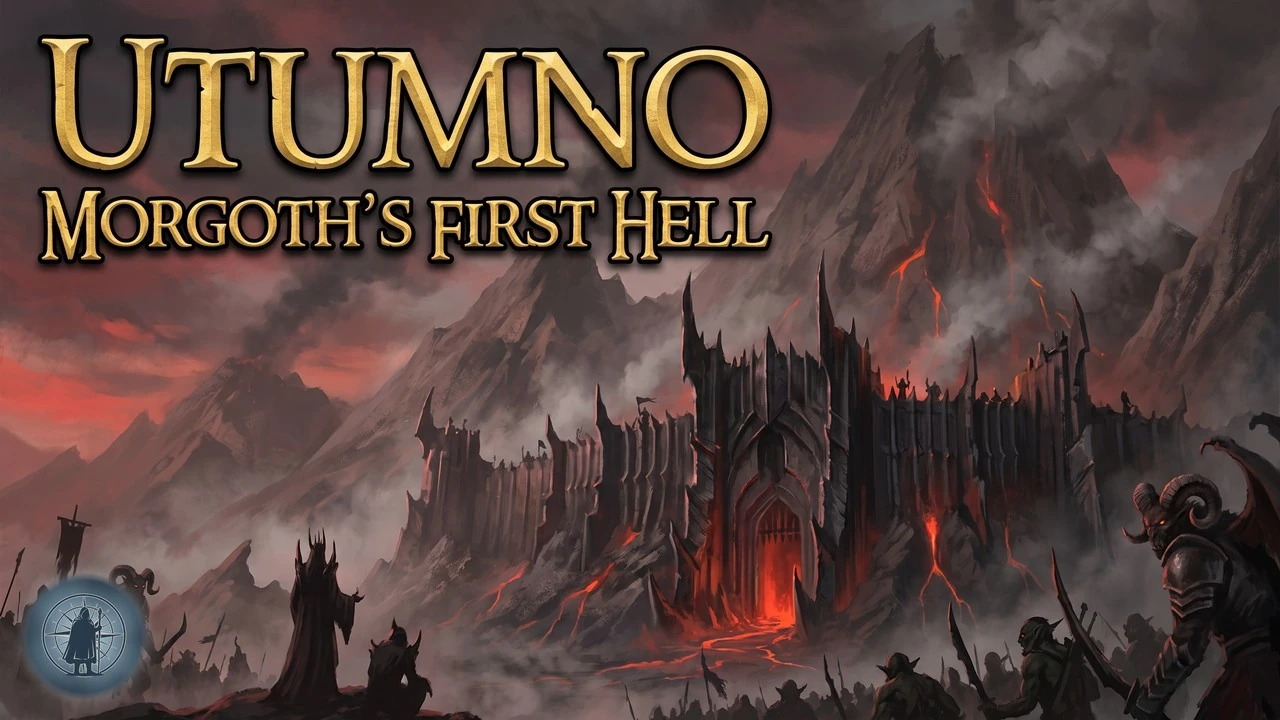 Watch the episode
Utumno: Morgoth's First Hell | Tolkien's Original Evil Explained
Watch the episode
Utumno: Morgoth's First Hell | Tolkien's Original Evil Explained
SECTION: The Deep-Hidden
On the Bridge of Khazad-dûm, with a creature of shadow and flame advancing toward him, Gandalf names his enemy. "I am a servant of the Secret Fire," he says, "wielder of the flame of Anor." And then he names what the Balrog carries: "the dark fire will not avail you, flame of Udûn."
Flame of Udûn. Most readers hear it as poetry — an old, terrible word for an old, terrible thing. It is more than that. Udûn is a real place. It is the Sindarin name of the first fortress evil ever built in the world. In the High-elven tongue it was called Utumno, and when the loremasters of Aman fixed its name forever, they chose a word built from a root meaning to cover over, to hide. They called it Utumno the Deep-hidden.
That is the entire character of the place in a single word. Not the high tower. Not the bright citadel. The buried one. The under-place. The hole delved so far beneath the mountains that light never reached its floor.
The Silmarillion gives us its founding in one quiet, ruinous line. After the first war of the gods, after Melkor — the mightiest of the Valar, the one who would later be named Morgoth — had fled from the wrath of Tulkas, he came back to Middle-earth in secret. And then: "Melkor delved, in secret, the fortress of Utumno beneath the mountains in the north."
Every word of that sentence matters. Delved — he dug downward, he did not build upward. In secret — concealment is the method from the first stroke. Beneath the mountains — under the Iron Mountains of the far north, the great range he had raised himself. This was not a castle. It was a wound driven down into the body of the world.
Think of the geometry of it. In Tolkien's cosmos, light comes from above and from outside — the Lamps on their pillars, the Trees in Valinor, the stars Varda kindled in the deep heavens. Goodness is high and open. But Melkor's power runs the other way. It goes down. It goes inward. The interior of Utumno was a kind of cathedral turned upside down — not a vault of light rising toward heaven, but a descending shaft of fire-pits and black galleries and terraces of darkness, each level deeper and more concealed than the last. The text says the deepest of these vaults were "hidden with deceit." Even Utumno's own architecture was built to deceive anyone who came to search it.
This is where the whole history of organized evil in Middle-earth begins. Before there was an Angband, before there was a Mordor, before any of the dark towers that dominate the later legends, there was a hole in the ground in the north, and inside it a fallen god learned that the surest way to do harm was to do it where no one could see.
It is the first time evil ever had an address.
SECTION: The Confidence of a Fortress
A fortress is usually understood as a defensive thing — a place to hide when you are weak, a wall to stand behind. Utumno was the opposite. It made Melkor bold. And what it emboldened him to do was the first great catastrophe in the history of the world.
When the Valar had withdrawn to Aman and raised the Two Lamps to light Middle-earth — Illuin in the north, Ormal in the south — the world entered what Tolkien calls the Spring of Arda. Things grew. The first forests rose. It was the closest the unfallen world ever came to the paradise it was meant to be. And Melkor, watching from his buried redoubt, decided to end it.
The text is precise about why he dared. He came forth, it says, "trusting the unassailable strength of Utumno and his servants." Note the order of cause. He did not destroy the Lamps because he was strong. He destroyed them because he had somewhere strong to retreat to. The stronghold came first. The atrocity came second, and the place to retreat to was its precondition.
He cast down both Lamps. And the result was apocalyptic. "In the overthrow of the mighty pillars lands were broken and seas arose in tumult; and when the lamps were spilled destroying flame was poured out over the Earth." The symmetry of the continents was shattered. The shape of the world was lost. And then the verdict, four words long: "Thus ended the Spring of Arda."
But the deepest line in this whole sequence is not about the Lamps at all. It is about the place itself. Of Utumno the Silmarillion says: "the blight of his hatred flowed out thence, and the Spring of Arda was marred."
Flowed out thence. From there. From the place. The corruption of the world is described not as an idea Melkor had, or a deed he did, but as something that radiated out of a location — like a poison leaching from a buried source into the groundwater of creation. The under-place is the spring of corruption that poisons the Spring of Arda. Evil, in Tolkien, is not abstract. It has a where.
So before Utumno is anything else, it is a lesson in how catastrophe works. The great wound to the world was not the act of a being who felt invincible in himself, but the act of a being who had built a place to be invincible in. The stronghold did not protect him from doing harm. It freed him to do it.
SECTION: The Laboratory of Mockery
If the first thing Utumno enabled was destruction, the second thing it enabled was manufacture. Because the buried hold was not only a refuge and a launching point. It was a workshop. The first workshop of corruption in the history of Arda — and almost everything that would later crawl through Middle-earth's nightmares was first made there.
Inside its pits, Melkor gathered his demons. "In Utumno he gathered his demons about him," says the Silmarillion, "those spirits who first adhered to him in the days of his splendour, and became most like him in his corruption: their hearts were of fire, but they were cloaked in darkness, and terror went before them; they had whips of flame. Balrogs they were named in Middle-earth in later days."
Hearts of fire, cloaked in darkness, whips of flame. The Balrogs were not created by Melkor — he could create nothing. They were Maiar, lesser angelic spirits, seduced and twisted into something that mocked what they had been. Spirits of holy flame remade into spirits of cruel flame. Utumno was their first home, the place where the host of them first ringed their master's throne.
And then there is the deeper horror, the one Tolkien handles with deliberate, merciful vagueness. The Orcs. "All those of the Quendi who came into the hands of Melkor, ere Utumno was broken, were put there in prison, and by slow arts of cruelty were corrupted and enslaved; and thus did Melkor breed the hideous race of the Orcs in envy and mockery of the Elves, of whom they were afterwards the bitterest foes."
By slow arts of cruelty. He does not tell us the method. He tells us it was slow, and that it was an art, and that it was cruel, and then he lets the silence do the work — which is far worse than any description could be. Somewhere in the buried galleries of Utumno, captured Elves were unmade into the first Orcs. Not built from nothing. Taken, and ruined, and turned against their own kind.
This is the signature of evil in Tolkien's whole legendarium, and Utumno is where it is first practiced. Melkor cannot make. He can only mar. The Orcs are a parody of the Elves. Later the Trolls would be raised "in mockery of" the Ents. Every monster in the workshop is a counterfeit of something good that already existed. This is Tolkien's deep, Augustinian conviction — that wickedness has no creative power of its own, that it is parasitic, a corruption of the good and never an original thing.
And it is important that the counterfeits were bred, plural, in quantity, in cells. Utumno is not the lair of a single monster. It is a factory for them. The under-place gives its master what he most wants and most lacks — not power, which Melkor already had, but the patient, hidden, industrial space in which to make more of itself.
SECTION: The Question Tolkien Could Not Answer
There is a problem buried inside that account of the Orcs, and it is worth stopping on — because it is one of the rare places where the canon we read and the mind of the man who wrote it openly part ways.
The version just told — Orcs bred from captured Elves in the pits of Utumno — is the version printed in The Silmarillion. For most readers it is simply the answer. But the published Silmarillion was assembled and edited after Tolkien's death by his son Christopher, out of decades of competing, unfinished drafts. And the Elf-origin of the Orcs is not Tolkien's final word on the subject. It is Christopher's editorial choice among several his father left behind, unresolved, at the end of his life.
In the volume Morgoth's Ring, in a late section of essays Christopher titled "Myths Transformed," we can watch Tolkien argue with himself about this exact question. And the thing that troubled him was theological. If Orcs were made from Elves — immortal beings, with souls, with fëar given by Eru himself — then Melkor would have had the power to take immortal souls and damn them, permanently, into an irredeemable evil race. And Tolkien did not believe his Enemy should have that power. Only the One creates souls. A corrupted angel, however mighty, should not be able to forge a whole species of the damned out of someone else's children.
So in those late essays he reaches for other answers. Perhaps Orcs were corrupted Men, not Elves — which at least pushes the horror to a later age. Perhaps they were beasts, animals given the crude power of speech, more like talking machines than fallen souls. Perhaps they were mostly mindless, puppeted directly by Melkor's will, falling slack when his attention turned away. Perhaps some were even bred from "the subterranean heat and slime" of the earth itself. He never settled it. He died with the question open.
This matters for how we read Utumno. The most terrible thing the place is famous for — the breeding of the Orcs from captured Elves — is the one thing about it Tolkien himself was least sure had happened that way. The pits are real in the text. What was done in them, and to whom, is a wound the author kept reopening to the end of his life, never able to make it heal into a single answer.
And there is something fitting in that. Utumno is the Deep-hidden. Even now, even to its own creator, its deepest secret stayed hidden. The text shows us the prison and the slow arts of cruelty, and then refuses — the way Tolkien himself refused — to fully tell us what they were.
SECTION: The Gates Broken, the Pit Unsearched
Eventually the reckoning came. When the Elves awoke at last by the waters of Cuiviénen, and the Valar learned that the Children of Eru had entered a world Melkor had already poisoned, they resolved on war. They crossed the sea, marched east, and laid siege to the north.
This is the War of the Powers, and it is its own enormous story — the gods at war, the land broken a second time, a siege that lasted seven years of the Trees. For the purposes of Utumno, what matters is the ending. The gates were broken. The halls were unroofed and laid open to the sky. Melkor fled to the uttermost pit, the deepest hole in his own deep-hidden hold, and there Tulkas wrestled him down to the black stone and bound him with Angainor, the chain that Aulë had forged. He was led away captive to Valinor and shut in the Halls of Mandos for three ages. The text gives the verdict plainly: "the world had peace for a long age."
It reads like a clean victory. The gates are broken. The enemy is chained. And it is a real victory — that should not be diminished.
But there is one more sentence. And it is the most important sentence in the entire history of Utumno, because everything that comes after the First Age hangs from it.
"Nonetheless the Valar did not discover all the mighty vaults and caverns hidden with deceit far under the fortresses of Angband and Utumno. Many evil things still lingered there, and others were dispersed and fled into the dark and roamed in the waste places of the world, awaiting a more evil hour; and Sauron they did not find."
And Sauron they did not find.
Read what actually happened here. The gods won the war. They broke the gates, unroofed the halls, chained the master. And then they stopped. They did not go all the way down. The vaults that had been "hidden with deceit" — the deepest galleries, built from the first to defeat any searcher — those they never searched. And in those unsearched depths, the seed of all later evil was quietly left alive.
This is the lesson Utumno teaches that no other stronghold in the legendarium teaches so cleanly. Victory over evil's expression is not victory over its seed. You can break the gates of darkness and chain its lord and unroof its halls — and still leave, far below, in the part you could not be bothered or could not bear to search, the thing that will rebuild it all.
SECTION: The Things That Crawled Out
So what was left alive down there? The text names two kinds of survivor, and both would shape every age that followed.
The first is named outright: Sauron. He was Melkor's chief lieutenant, set to command the western outpost at Angband, and when the war ended he was simply not found. He slipped the reckoning entirely. Sit with the scale of that. Every catastrophe of the Second and Third Ages — the forging of the Rings, the deception of the Elven-smiths, the drowning of Númenor, the long shadow of Mordor, the War of the Ring itself — all of it descends from a servant the Valar failed to dig out of a hole at the end of the world's first war. The entire later history of evil is the bill for one unsearched vault.
The second kind of survivor is the one the text leaves deliberately open. "Many evil things still lingered there," it says — lingered in the depths, or fled into the dark and the waste places, "awaiting a more evil hour." Among the things first gathered in Utumno were the Balrogs. Some of them died in the wars of the First Age. But not all. At least one went down into the deep and the dark and waited.
We meet that one again thousands of years later, when the Dwarves of Khazad-dûm delve too greedily and too deep, and wake something that had been sleeping in the roots of the mountains since the Elder Days. Durin's Bane. The Balrog of Moria. Tolkien never draws the line explicitly from Utumno's unsearched vaults to the thing under Moria — but the logic of that one sentence makes the connection almost unavoidable. The Balrogs were first gathered in Utumno. Some fled into the dark, awaiting a more evil hour. And one of them was still waiting, in the dark, in the roots of a mountain, when Gandalf met it on a narrow bridge over a chasm.
Which closes a circle we opened at the beginning. The thing on the bridge — the surviving demon of Morgoth's first hold — and the word Gandalf throws at it. Flame of Udûn. Flame of Utumno. The wizard names the Balrog by the place it came from, the deep-hidden pit the Valar broke but never emptied. Across all the ages between, the creature still carries, in the only name that can touch it, the memory of the hole it crawled out of.
The unsearched pit did not stay empty. It exhaled its contents slowly, across thousands of years, one catastrophe at a time.
SECTION: The Template Inherited
Here is the final thing Utumno was, and the thing that makes it more than a single ruin in the north. It was a design. And every dark power that came after copied it.
Look at the pattern the fortress established. An underground stronghold, not a tower in the sun. Hidden depths built to defeat searchers. A workshop for breeding corrupted servants in quantity. And a lieutenant left in command of an outpost — a buried second-in-command who could carry the work forward if the master fell. Utumno wrote that blueprint, and the blueprint never changed.
Angband was the first copy — built, the loremasters say, as Utumno's western outpost, an armory and forward defense, with Sauron set to command it. And like its prototype, it kept hidden depths the Valar failed to fully search. When Morgoth returned in the First Age, he did not rebuild Utumno. He raised Angband higher, crowned it with the smoking peaks of Thangorodrim, and ran the same machine — bred Orcs, gathered Balrogs, sent corruption flowing out into Beleriand. A second citadel running the first one's program.
Then Sauron, the survivor, the heir to Morgoth's evil, built his own dark holds on the same model. Dol Guldur, hidden in the south of Mirkwood, where he gathered strength in secret under a false name. And Barad-dûr, the great dark tower of Mordor, raised on the power of the One Ring — the same logic of the buried stronghold and the bred slave-armies, scaled up to threaten the world. Different name, different age, same design. The first draft was delved beneath the Iron Mountains before the Elves had even opened their eyes.
And Sauron knew exactly whose blueprint he was working from. Because in the northwest of Mordor, behind the Black Gate, there is a valley where he mustered his armies. He gave it a name. He called it Udûn. The Sindarin name of Utumno. Morgoth's first hell, deliberately re-invoked at the heart of the last great dark realm — as if Sauron were signing the inheritance, naming the place after the original he was copying.
So the word travels the whole length of the legendarium. Utumno, the deep-hidden pit where evil first had an address. Udûn, the valley in Mordor where its heir gathered his last great host. Flame of Udûn, the name a wizard speaks to a demon on a bridge in the dark, both of them descended from the same buried beginning.
That is what Utumno truly is. Not the first base of the first Dark Lord. The original form. The first draft of every hell that followed. Evil in Tolkien's world cannot create — and so even its fortresses are copies, age after age, of one hole delved in secret beneath the mountains in the north, broken open once by the gods, and never, ever emptied.