Research & Sources
Utumno
Morgoth's First Hell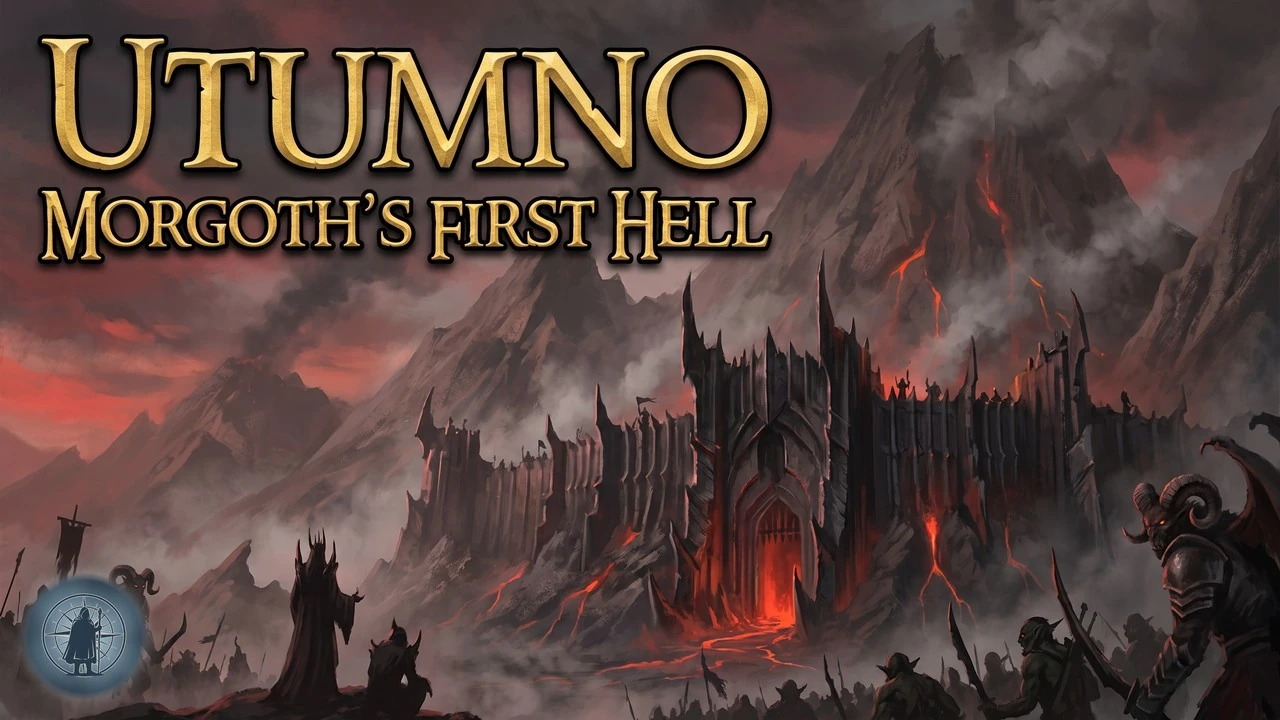 Watch the episode
Utumno: Morgoth's First Hell | Tolkien's Original Evil Explained
Watch the episode
Utumno: Morgoth's First Hell | Tolkien's Original Evil Explained
Research Notes: Utumno — The Prototype of Evil
Overview
Utumno (Quenya: "the Deep-hidden," "Underworld") was the first and greatest fortress raised by Melkor in Arda — delved deep beneath the Iron Mountains in the far north of Middle-earth during the primordial age before the Sun and Moon. It predates Angband, predates the First Age, predates the very awakening of the Elves. It is the place where, for the first time in the history of the world, a Vala set himself to unmake and mock creation behind walls of his own devising. Everything that later haunts Middle-earth — the Balrogs, the Orcs, the bred monsters, the strategy of the buried lieutenant and the hidden vault — was first invented in Utumno's pits.
The episode's thesis: Utumno is not merely Morgoth's first base. It is the template of organized evil in Tolkien's legendarium. Angband copies it. Dol Guldur and Barad-dûr inherit its logic. And critically, when the Valar broke Utumno open in the War of the Powers, they did not — could not — empty it. The deepest vaults were never searched. Sauron was never found. The fortress was the prototype not only of dark architecture but of evil's persistence: it taught that you can break the gates of darkness and still leave its seed alive underground.
This is a topic with abundant primary support (two full Silmarillion chapters touch it directly) and rich secondary/HoME material (especially Morgoth's Ring), though several key questions — the exact location, the precise nature of Orc-breeding, the number of Balrogs — were never fully resolved by Tolkien.
Primary Sources
The Silmarillion — "Of the Beginning of Days" (Ch. 1)
The founding account. After the First War and his flight from Tulkas, Melkor returns secretly to Middle-earth:
- "Melkor delved, in secret, the fortress of Utumno beneath the mountains in the north." (Of the Beginning of Days) - Utumno was "delved exceedingly deep," with pits filled with fire and great hosts of servants, and caverns and vaults "hidden with deceit." - The corruption radiates outward from the fortress itself: "the blight of his hatred flowed out thence, and the Spring of Arda was marred." (Of the Beginning of Days) — This is the key thematic line: the place is the source of the marring. - Trusting "the unassailable strength of Utumno and his servants," Melkor came forth and cast down the Two Lamps (Illuin in the north, Ormal in the south). "In the overthrow of the mighty pillars lands were broken and seas arose in tumult; and when the lamps were spilled destroying flame was poured out over the Earth." "Thus ended the Spring of Arda."
The narrative logic to stress: Utumno gave Melkor the confidence to destroy the Lamps. The fortress is the precondition of the first great catastrophe.
The Silmarillion — "Of the Coming of the Elves and the Captivity of Melkor" (Ch. 3)
The chapter where Utumno reaches its full horror and meets its end. Three load-bearing passages:
The Balrogs gathered: - "In Utumno he gathered his demons about him, those spirits who first adhered to him in the days of his splendour, and became most like him in his corruption: their hearts were of fire, but they were cloaked in darkness, and terror went before them; they had whips of flame. Balrogs they were named in Middle-earth in later days."
The breeding of Orcs: - "Yet this is held true by the wise of Eressëa, that all those of the Quendi who came into the hands of Melkor, ere Utumno was broken, were put there in prison, and by slow arts of cruelty were corrupted and enslaved; and thus did Melkor breed the hideous race of the Orcs in envy and mockery of the Elves, of whom they were afterwards the bitterest foes."
The unsearched vaults (the single most important quote for the episode's hook): - "Nonetheless the Valar did not discover all the mighty vaults and caverns hidden with deceit far under the fortresses of Angband and Utumno. Many evil things still lingered there, and others were dispersed and fled into the dark and roamed in the waste places of the world, awaiting a more evil hour; and Sauron they did not find."
The fall of Utumno (the War / Battle of the Powers): - The siege "was long and grievous." After seven years of the Trees the gates were broken and the halls unroofed; Melkor took refuge in the uttermost pit. - Tulkas stood forth as champion, wrestled Melkor to the ground, and "he was bound with the chain Angainor that Aulë had wrought, and led captive; and the world had peace for a long age." - Melkor was brought to Valinor and consigned to the Halls of Mandos for three ages.
The History of Middle-earth — Morgoth's Ring (Vol. 10)
- Annals of Aman: provides the etymology gloss — "Utupnŭ" from the root √TUP ("cover over; hide"), so "that stronghold was ever after called Utumno the Deep-hidden." This is where the "Deep-hidden" translation comes from. - "Myths Transformed" (final section of the volume): Tolkien's late, unresolved wrestling with the origin of the Orcs. He found the "corrupted Elves" account theologically troubling (it implies Melkor could create/pervert immortal fëar at will) and explored alternatives: Orcs from corrupted Men, Orcs as beasts given speech, Orcs as Maia-puppets, Orcs from "subterranean heat and slime." Christopher Tolkien dates these texts to the mid–late 1950s and notes they propose inconsistent solutions; his father never settled the question. Critical context: the published Silmarillion's "corrupted Elves" version is itself an editorial choice by Christopher among competing drafts.
The Etymologies (in The Lost Road / HoME Vol. 5)
- Root TUB; original form of the name given as Utubnu. Older name-form Utumna, linked to Quenya tumna ("low-lying, deep, profound").
Lord of the Rings — appendix to the legend (the echo)
- The Sindarin name of Utumno is Udûn ("dark pit, Underworld, Hell"). This is the same word Gandalf invokes on the Bridge of Khazad-dûm: "flame of Udûn." And it is the name Sauron gave to the volcanic valley in northwest Mordor (Udûn, behind the Black Gate). The naming is deliberate continuity — Sauron and the Balrog both carry the linguistic memory of Morgoth's first hell.
Key Facts & Timeline
(Valian Years per the Annals of Aman; 1 Valian Year ≈ 9.582 solar years)
- Years of the Lamps (after the First War): Melkor returns to Arda in secret and delves Utumno beneath the northern mountains; gathers corrupted Maiar (future Balrogs) and breeds monsters. (Of the Beginning of Days) - Years of the Lamps: Melkor, secure in Utumno, casts down the Two Lamps. The Spring of Arda ends; the Valar withdraw to Aman. Melkor reigns in the north largely unopposed. (Of the Beginning of Days) - Years of the Trees: Melkor builds Angband at the western end of the Ered Engrin (~1,000 miles west of Utumno) as an armory and first line of defense against Aman; Sauron is set as its commander. (Of the Beginning of Days / Tolkien Gateway) - V.Y. ~1050: The Elves awaken at Cuiviénen. Melkor sets a shadow (the Rider / rumor of Oromë) to capture them; the breeding of Orcs from captured Quendi begins. (Of the Coming of the Elves) - V.Y. 1090–1099: The War / Battle of the Powers. Oromë discovers the Elves; the Valar resolve to make war for the sake of the Children. The siege of Utumno lasts seven years of the Trees. - V.Y. 1099: The gates of Utumno are broken; the fortress is unroofed. Tulkas wrestles Melkor down. (Battle of the Powers) - V.Y. 1100: Melkor is bound with Angainor and taken to Valinor; sentenced to the Halls of Mandos for three ages. The deep vaults of Utumno and Angband remain unsearched; Sauron and many Balrogs escape. (Of the Coming of the Elves)
Significant Characters
- Melkor / Morgoth: Architect and master of Utumno. The fortress is the physical expression of his turn from creation to domination and mockery. His confidence in it precipitates the destruction of the Lamps. - Sauron (Mairon): Melkor's chief lieutenant, set to command Angband. He is the one the Valar "did not find" — the prototype of the surviving servant who will rebuild. The whole later history of the Second and Third Ages is seeded by his escape from this war. - The Balrogs (Valaraukar, sing. Valarauko, "Demon of Power"): Maiar of fire corrupted by Melkor "in the days of his splendour." Utumno was their first dwelling. Some hid in the deep vaults and survived the fall — including the one that would sleep beneath Moria until the Third Age. - Tulkas: The Vala-champion who physically overthrows Melkor. His wrestling of Morgoth is the climactic image of the assault. - Aulë: Smith of the Valar; forged the chain Angainor that bound Melkor (and crafted the Two Lamps that Melkor destroyed — a neat irony). - Oromë: Discovers the awakened Elves; his report drives the Valar to war. - Yavanna & Varda: Yavanna and Oromë urge the war; Varda kindles the great stars to light the Elves' awakening and warn against Melkor — a counter-light to Utumno's spreading dark.
Geographic Locations
- Utumno: Far north of Middle-earth, delved beneath the Iron Mountains (Ered Engrin), toward the western/north portion of the range per the Ambarkanta sketch-maps. "Exceedingly deep," a vertical fortress of descending pits, fires, caverns and concealed vaults. Largely destroyed in V.Y. 1099 — but never fully emptied. - Angband ("Iron Prison"): Western outpost ~1,000 miles from Utumno, at the western end of the Ered Engrin near the shores of the Great Sea. Built as forward armory/defense against Aman; commanded by Sauron. Like Utumno it had hidden depths the Valar failed to search. Morgoth's primary base after his return in the First Age (rebuilt and crowned with Thangorodrim). - The Iron Mountains (Ered Engrin): Immense range across the far north, raised/shaped by Melkor; sheltered both strongholds. - Udûn (Mordor): The volcanic valley behind the Black Gate that Sauron named after Utumno's Sindarin name — geographic proof of the inherited template. - Maps caveat: Two pre-LotR maps (the Ambarkanta material) show approximate positions of Utumno and Angband, but Tolkien never produced a published, canon-consistent map; locations are approximate.
Themes & Symbolism
- The fortress as the source of marring: Evil is not abstract — it flows from a place. "The blight of his hatred flowed out thence, and the Spring of Arda was marred." Utumno is the spring of corruption that poisons the spring of the world. - Mockery as the signature of evil: Melkor cannot create; he can only pervert. Orcs are bred "in envy and mockery of the Elves." Trolls mock Ents. This is Tolkien's Augustinian theology of evil — evil is parasitic, a corruption of the good, never original. - Depth and concealment: Utumno = "the Deep-hidden." Evil burrows, hides, descends. The vertical descent into pits is a moral geography (cf. Udûn / Hell). Light comes from above (stars, Lamps, Trees); Melkor's power goes down and inward. - Confidence/pride precipitating catastrophe: Trusting Utumno's strength, Melkor destroys the Lamps — overreach enabled by the fortress. - Evil's persistence / the unemptied pit: The hook theme. The Valar win the war but leave the deepest vaults unsearched. Victory over evil's expression is not victory over its seed. This single editorial fact is the engine of all later history. - The template inherited: Utumno → Angband → Dol Guldur → Barad-dûr. The dark underground stronghold housing corrupted servants and bred slaves is a repeating form. Sauron is "the heir to Morgoth's evil," and even names his Mordor valley Udûn. - Catholic resonance: The "deep-hidden" pit, the demons with whips of flame, the bound-and-fallen archangel figure (Melkor as a Lucifer/Satan analogue) — Utumno is Tolkien's Hell, the first Pandæmonium.
Scholarly Interpretations & Theories
- The Orc-origins problem (Myths Transformed, Morgoth's Ring): The dominant scholarly debate. Tolkien gave at minimum five-to-eight different answers across his life and never resolved it. The "corrupted Elves bred in Utumno" account is canonical only because Christopher Tolkien selected it for the published Silmarillion; the late essays show his father actively rejecting it on theological grounds (a created being shouldn't be able to make irredeemable evil races from immortal souls). Good material for a "what the text says vs. what Tolkien came to believe" segment. - Utumno as prototype of dark architecture: Secondary writers (storytellingdb, Tolkien Gateway) consistently read Angband as the "prototype" copy of Utumno and the whole line of dark towers as inheriting the model. Worth framing as: Tolkien wrote the first fortress to be the pattern — later evil is derivative even in its real estate. - The "incomplete victory" reading: Scholars note the Valar's failure to fully cleanse Utumno/Angband is presented almost as a moral/strategic error with cosmic consequences (it directly enables Sauron and the surviving Balrogs). Some read it as Tolkien making the point that even divine intervention in history is partial — the world must be redeemed by its inhabitants over time, not cleansed in one stroke. - Number of Balrogs: Tolkien's late note caps them at "no more than three, or at most seven." Early conceptions imagined hundreds. Relevant because Utumno is where they were first gathered — the count affects how we picture that first host.
Contradictions & Different Versions
- Orc origin (above): the headline contradiction. Published Silmarillion = corrupted Elves; later Tolkien = corrupted Men / beasts / Maia-puppets / unresolved. - The name's form and root: Utumna / Utumno / Utubnu / Utupnŭ; roots TUB vs. √TUP across The Etymologies and the Annals of Aman. The gloss settles on "Deep-hidden / cover-over." - Location: never fixed. Ambarkanta maps place it in the north under the Iron Mountains; the published text only says "the north." Distance to Angband ("~1,000 miles") is a secondary-source estimate, not a Tolkien figure. - Balrog numbers: hundreds (early) vs. "three to seven" (late). - Was Angband part of Utumno or separate?: Texts treat Angband as a distinct, lesser western fortress/outpost subordinate to Utumno — not a wing of it. But because both fall in the same war and both keep unsearched depths, they are often discussed together.
Cultural & Linguistic Context
- Utumno — Quenya, "the Deep-hidden / Underworld." Roots: TUB / √TUP ("cover over, hide"); related to tumna ("deep, low-lying, profound"). Earlier forms Utumna, Utubnu, Utupnŭ. - Udûn — Sindarin equivalent, "dark pit, Underworld, Hell." Reused twice in LotR: Gandalf's "flame of Udûn" (the Balrog) and the valley of Udûn in Mordor. Deliberate thematic linkage of Morgoth's first hell to its later echoes. - Angband — Sindarin, "Iron Prison / Iron Hell." - Valaraukar (sing. Valarauko) — Quenya "Demons of Power" = Balrogs (Sindarin balrog = "demon of might / cruel demon"). - Angainor — the chain forged by Aulë to bind Melkor. - Real-world resonance: Utumno is Tolkien's mythic Hell — the bottomless pit, Tartarus, Pandæmonium. Melkor descending and hiding in the "uttermost pit" before capture echoes the fallen-angel cosmology Tolkien drew from Christian tradition.
Questions & Mysteries
- Where exactly was Utumno? Never pinpointed; only "the north," under the Iron Mountains. - What truly survived in the deep vaults? The text names Sauron and Balrogs but speaks vaguely of "many evil things" — the open door for the episode's hook. Did the Moria Balrog crawl out of Utumno's unsearched depths? - Were Orcs really first bred there, and how? Canon says yes (corrupted Elves); Tolkien himself doubted it. The mechanism ("slow arts of cruelty") is left deliberately, horrifyingly vague. - Why did the Valar not finish the job? The text presents the incomplete search almost without comment — was it haste, deceit ("hidden with deceit"), or a deeper statement about the limits of even Valar power? - What happened to Utumno physically afterward? It is "broken" and "unroofed" but apparently never reoccupied; Morgoth chose Angband on his return. Utumno simply fades from the record — a broken, abandoned, but never-cleansed wound in the north.
Compelling Quotes for Narration
1. "Melkor delved, in secret, the fortress of Utumno beneath the mountains in the north." — The Silmarillion, Of the Beginning of Days 2. "The blight of his hatred flowed out thence, and the Spring of Arda was marred." — Of the Beginning of Days 3. "In Utumno he gathered his demons about him... their hearts were of fire, but they were cloaked in darkness, and terror went before them; they had whips of flame. Balrogs they were named." — Of the Coming of the Elves and the Captivity of Melkor 4. "By slow arts of cruelty [they] were corrupted and enslaved; and thus did Melkor breed the hideous race of the Orcs in envy and mockery of the Elves." — Of the Coming of the Elves 5. "Nonetheless the Valar did not discover all the mighty vaults and caverns hidden with deceit far under the fortresses of Angband and Utumno... and Sauron they did not find." — Of the Coming of the Elves (THE HOOK QUOTE) 6. "He was bound with the chain Angainor that Aulë had wrought, and led captive; and the world had peace for a long age." — Of the Coming of the Elves 7. "That stronghold was ever after called Utumno the Deep-hidden." — Annals of Aman (Morgoth's Ring)
Visual Elements to Highlight
1. Melkor alone, delving a black shaft beneath snow-capped northern mountains while the Two Lamps glow far off — secrecy and descent. 2. The interior of Utumno: a vertical abyss of descending galleries, pits of fire, terraces of darkness — a cathedral inverted, going down. 3. The first gathering of the Balrogs — fire-hearted shapes cloaked in shadow with whips of flame, ringed around Melkor's throne. 4. The breeding-pits: captured Elves in chains in the deep dark (handled with restraint — implication over gore). 5. The destruction of the Two Lamps — flame poured over the earth, seas rising, the end of the Spring of Arda. 6. The War of the Powers: Tulkas wrestling Melkor to the ground amid the broken, unroofed gates. 7. The aftermath: the broken fortress on the surface — and, far below, an unsearched vault where two eyes (Sauron) and a smoldering shape (a Balrog) wait in the dark. The hook image. 8. A "family tree of fortresses" graphic: Utumno → Angband → Dol Guldur → Barad-dûr.
Discrete Analytical Themes
Theme 1: The Architecture of Concealment ("the Deep-hidden")
Core idea: Utumno's defining trait is downward concealment — evil that burrows, hides, and descends, encoded even in its name. Evidence: - "Melkor delved, in secret, the fortress of Utumno beneath the mountains in the north." (Of the Beginning of Days) - Name etymology: Utumno / Udûn = "the Deep-hidden, Underworld, Hell"; root √TUP "cover over, hide" (Annals of Aman). - "Delved exceedingly deep," vaults "hidden with deceit." Distinction: This is about the physical and symbolic form of the fortress (depth, secrecy, the inverted cathedral) — NOT about what was made inside it (Theme 2) or its survival (Theme 5).Theme 2: The Laboratory of Mockery (breeding evil)
Core idea: Utumno is the first workshop where Melkor perverts existing creation into mocking counterfeits — Balrogs, Orcs, monsters. Evidence: - Balrogs: "their hearts were of fire, but they were cloaked in darkness... they had whips of flame." (Of the Coming of the Elves) - Orcs: bred "by slow arts of cruelty... in envy and mockery of the Elves." (Of the Coming of the Elves) - Trolls bred in mockery of Ents; the Augustinian principle that evil only corrupts, never creates. Distinction: This is about creation-by-corruption as Melkor's signature method — NOT the theological debate over whether Orcs really came from Elves (Theme 6), and NOT the fortress's form (Theme 1).Theme 3: The Fortress That Emboldened the First Catastrophe
Core idea: Utumno's strength gave Melkor the confidence to overthrow the Two Lamps and end the Spring of Arda — the fortress is the precondition of the first great marring. Evidence: - Melkor, "trusting the unassailable strength of Utumno and his servants," casts down the Lamps. - "The blight of his hatred flowed out thence, and the Spring of Arda was marred." (Of the Beginning of Days) - "Thus ended the Spring of Arda" — the world's first disaster traced to a secure base. Distinction: This is about Utumno as the enabling cause of a specific cosmic event (the fall of the Lamps) — NOT its general role as a corruption-source, and NOT its eventual destruction.Theme 4: The War for the Sake of the Elves (the assault and chaining)
Core idea: The Valar's overwhelming military assault breaks Utumno's gates and ends Melkor's first reign — a decisive but contained victory. Evidence: - Siege "long and grievous"; after seven years of the Trees the gates were broken and halls unroofed (V.Y. ~1090–1099). - Tulkas wrestles Melkor down; "bound with the chain Angainor that Aulë had wrought." - Melkor consigned to Mandos for three ages; "the world had peace for a long age." Distinction: This is about the successful military event and Melkor's personal defeat — distinct from what the victory failed to accomplish (Theme 5).Theme 5: The Unemptied Pit (evil's survival)
Core idea: The Valar broke Utumno but never searched its deepest vaults, so its evil — Sauron, surviving Balrogs, lingering monsters — outlived the war. Evidence: - "The Valar did not discover all the mighty vaults and caverns hidden with deceit... and Sauron they did not find." (Of the Coming of the Elves) - "Many evil things still lingered there... awaiting a more evil hour." - The Moria Balrog and Sauron's entire later career are seeded by this single failure. Distinction: This is about the incompleteness of victory and evil's persistence — the hook of the episode — distinct from the victory itself (Theme 4).Theme 6: The Unresolved Origin of the Orcs (canon vs. Tolkien's doubts)
Core idea: The "Orcs bred from captured Elves in Utumno" account is published canon but a question Tolkien himself never settled, revising it for decades. Evidence: - Published canon: corrupted Quendi, "the hideous race of the Orcs." - Morgoth's Ring, "Myths Transformed": Tolkien proposed corrupted Men, talking beasts, Maia-puppets, and others — inconsistent, unresolved at his death. - Christopher Tolkien's editorial choice made the Elf-origin canonical; it was not his father's final view. Distinction: This is the textual/scholarly meta-debate about a specific claim — distinct from Theme 2's treatment of mockery-as-method (which takes the breeding as given for narrative purposes).Theme 7: The Template Inherited (Utumno → Angband → Dol Guldur → Barad-dûr)
Core idea: Utumno is the prototype every later dark stronghold copies — the underground fortress with hidden depths, bred servants, and a buried lieutenant. Evidence: - Angband built as Utumno's western outpost, commanded by Sauron; "like its prototype Utumno" it kept hidden depths the Valar couldn't find. - Sauron, "heir to Morgoth's evil," raises Dol Guldur and Barad-dûr on the same model. - He names the Mordor valley Udûn — Utumno's Sindarin name — making the lineage explicit; Gandalf's "flame of Udûn" carries the same memory. Distinction: This is about Utumno's legacy as a reusable pattern across the Ages — distinct from its own construction (Theme 1) and its own fall (Themes 4–5).Sources Consulted: Utumno — The Prototype of Evil
Primary Sources (Tolkien texts)
- The Silmarillion, "Of the Beginning of Days" (Ch. 1) — Melkor delves Utumno beneath the northern mountains; "the blight of his hatred flowed out thence, and the Spring of Arda was marred"; destruction of the Two Lamps; end of the Spring of Arda. Most important primary source for construction + the marring theme. - The Silmarillion, "Of the Coming of the Elves and the Captivity of Melkor" (Ch. 3) — gathering of the Balrogs; breeding of Orcs from captured Quendi; the War/Battle of the Powers; siege of Utumno; Tulkas + chain Angainor; the unsearched-vaults passage and Sauron's escape (the episode's hook quote). Single most important chapter. - The History of Middle-earth, Vol. 10 — Morgoth's Ring: - Annals of Aman — timeline (Elves awaken V.Y. ~1050; Utumno broken 1099; Melkor bound 1100); etymology "Utupnŭ √TUP cover over; hide" / "Utumno the Deep-hidden." - "Myths Transformed" — Tolkien's late, unresolved reworking of the origin of the Orcs (corrupted Men, beasts, Maia-puppets). Key for the contradictions/scholarly section. - The History of Middle-earth, Vol. 5 — The Lost Road / The Etymologies — name roots TUB, forms Utumna / Utubnu. - The History of Middle-earth, Vol. 4 — The Shaping of Middle-earth (Ambarkanta) — the only sketch-maps approximating Utumno/Angband locations. - The Lord of the Rings — "flame of Udûn" (Bridge of Khazad-dûm) and the valley of Udûn in Mordor; Sindarin reuse of Utumno's name.
Secondary Sources (web)
- Utumno — Tolkien Gateway — most comprehensive single overview; construction, etymology, location, fall. (Note: blocks automated fetch; accessed via search excerpts.) - Battle of the Powers — Tolkien Gateway — siege details, seven years, breaking of gates, chaining. - Of the Coming of the Elves and the Captivity of Melkor — Tolkien Gateway — chapter summary + quotes. - Angband — Tolkien Gateway — Angband as Utumno's prototype/outpost, Sauron's command, hidden depths. - Myths Transformed — Tolkien Gateway — Orc-origin debate. - Orcs/Origin — Tolkien Gateway — catalog of Tolkien's competing Orc-origin theories. - Balrogs — Tolkien Gateway — Valaraukar, first dwelling in Utumno, numbers. - Morgoth's Ring — Wikipedia — volume contents, dating of Myths Transformed. - Of the Coming of the Elves (Silmarillion Writers' Guild summary) — reliable chapter summary. Useful, fetchable. - Of the Beginning of Days (Silmarillion Writers' Guild summary) — chapter summary. Useful, fetchable. - Chronology of the Silmarillion (Silmarillion Writers' Guild) — Valian Year dates. - Blind Read Through: Of the Coming of the Elves — Sean McBride — confirms direct quotes (Orcs, Balrogs, Angainor). Useful, fetchable. - Morgoth's Strongholds: Utumno & Angband — StorytellingDB — best secondary synthesis of the "template of evil" theme (Utumno → Angband → Dol Guldur → Barad-dûr). Most useful for Theme 7. - Do any Maps Show where Angband and Utumno Lay? — Xenite/Middle-earth Blog — on the unfixed/approximate location. - Ered Engrin — Encyclopedia of Arda — Iron Mountains geography. - Utumno — Parf Edhellen (elvish dictionary) — etymology, name-forms. - Valian Years — Tolkien Gateway — Valian Year ≈ 9.582 solar years conversion.
Most Useful Sources
1. The two Silmarillion chapters (Beginning of Days; Coming of the Elves) — all load-bearing quotes. 2. Tolkien Gateway (Utumno, Battle of the Powers, Myths Transformed) — best scaffolding. 3. StorytellingDB "Morgoth's Strongholds" — the prototype/template synthesis. 4. Morgoth's Ring (Annals of Aman + Myths Transformed) — etymology and the Orc-origin contradictions.
Access Notes
- Tolkien Gateway and lotr.fandom.com return HTTP 403 to automated WebFetch; their content was captured via WebSearch result excerpts (which surface the relevant passages directly). - silmarillionwritersguild.org and seanmmcbride.com are fully fetchable and were used to verify exact quote wording.