Transcript
Ungoliant
Is She Still Alive?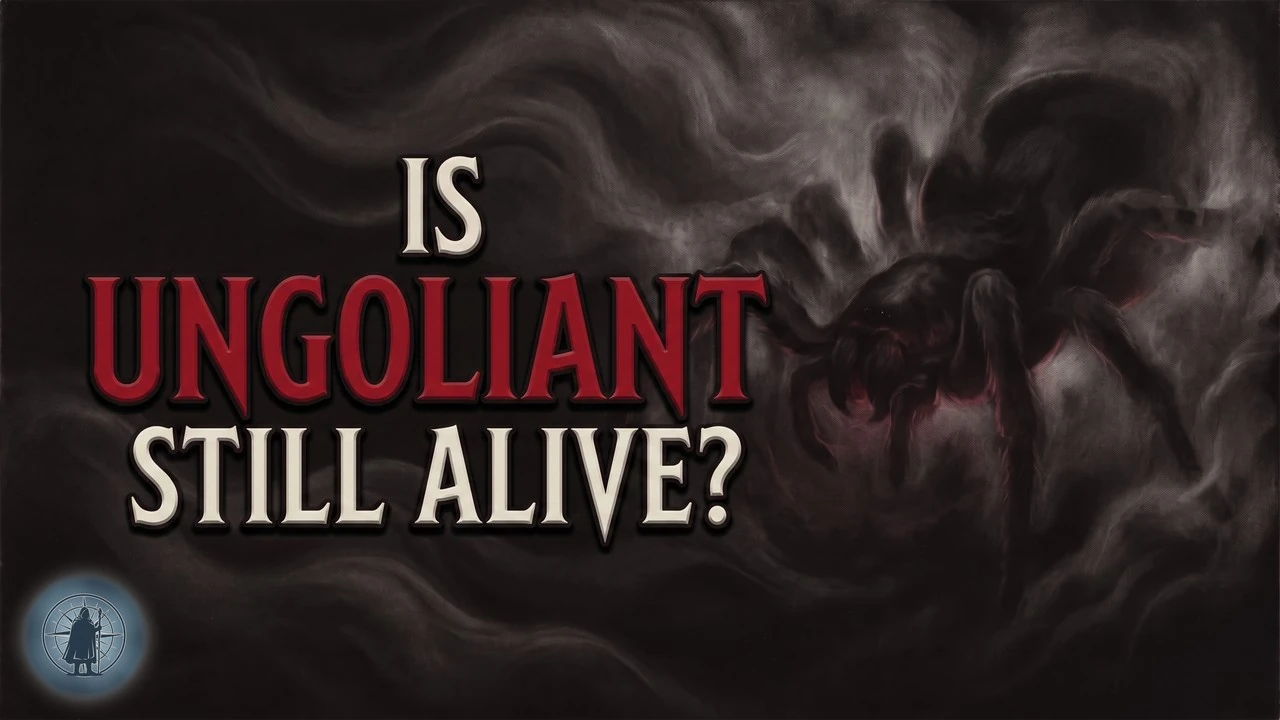 Watch the episode
Ungoliant: Is She Still Alive? | Tolkien's Four Endings Explained
Watch the episode
Ungoliant: Is She Still Alive? | Tolkien's Four Endings Explained
Main Narrative: Ungoliant — Is She Still Alive?
SECTION: What the Book Actually Says
"Of the fate of Ungoliant no tale tells. Yet some have said that she ended long ago, when in her uttermost famine she devoured herself at last."
That's the whole answer.
One sentence, chapter nine of The Silmarillion, about the creature who drank the light out of the Two Trees and left Valinor in the dark. The sentence in itself is curious. Seemingly two halves that don't quite get along.
The first half is a flat refusal.
"No tale tells. "
It doesn't say she died, and it doesn't say she lived - the record just doesn't cover it. Then the second half turns around and hands us something anyway, in the weakest grammar Tolkien had available. He could have written "it is known." He could have written "the Eldar set it down." What he wrote was "some have said."
Before we go any further, there's a line worth clearing up, because a lot of the argument about Ungoliant is built on it. It gets repeated everywhere that The Silmarillion says she fled south and perhaps still lives. That sentence isn't in the book. It isn't a loose paraphrase of the book either. The published text says she went into the forgotten south of the world, and then, some lines later, that some have said she ate herself. The "perhaps lives still" half comes from somewhere else entirely - and where it comes from is more interesting than the sentence people think they're quoting.
So what the book does is stranger than a contradiction. It reports her death as a rumour. A rumor without endorsement.
There's also a detail that makes that look deliberate rather than sloppy. Tolkien uses the identical hedge at the other end of her life. Chapter eight, on where she came from:
"The Eldar knew not whence she came; but some have said that in ages long before she descended from the darkness that lies about Arda."
"Some have said."
The same three words, doing the same job.
Her origin is hearsay, and her ending is hearsay. She's one of the very few figures in the legendarium whose beginning and whose end are both left unsourced. Everything in between gets reported flatly, as fact - the ravine in Avathar, the Unlight, the Trees, the quarrel with Morgoth over the Silmarils. It's only the beginning and the end that go soft.
There's another small wrinkle. And this will take us into the rest of the episode. That self-devouring line exists in an earlier version too, in the manuscript Christopher Tolkien was working from when he assembled the book. But the earlier version reads "It is said that she ended long ago." The published version reads "Yet some have said that she ended long ago."
"It is said", against "yet some have said".
That feels like a demotion.
"It is said" is received tradition, the way you'd introduce something everybody in Valinor grew up hearing. "Yet some have said" is a minority report, and that little "yet" at the front is pushing back against the sentence in front of it. Somewhere between the manuscript and the printed page, the strongest claim about Ungoliant's death got quietly weaker.
Who weakened it is up for debate. It might have been Tolkien himself, in a later pass of revision. It might have been Christopher, smoothing out his father's works. He told us in his own foreword that complete consistency in this material "is not to be looked for, and could only be achieved, if at all, at heavy and needless cost." What's certain is that the printed sentence is more cautious than the drafted one, and that caution is the thing we have to explain.
SECTION: Four Endings in Fifty Years
The reason the sentence hedges is that Tolkien changed his mind about Ungoliant at least three times over roughly fifty years. And every one of those changes of mind got written down, published, and dated. Most loose ends in the legendarium are loose because he never wrote them down. Ungoliant's is loose because he wrote it down four different ways.
A note before the dates, because these sources are drafts rather than finished books. Most of what we'll discuss comes from manuscripts Tolkien's son Christopher published after his death, in a twelve-volume series called The History of Middle-earth - versions of the same story, written decades apart. The point of reading them side by side is that they're dated.
So let's start with the earliest layer. The Book of Lost Tales, written around 1917 to 1920, when Tolkien was in his twenties and the mythology barely existed. She isn't called Ungoliant there. She's Móru, a primeval spirit of night, and also Wirilómë, Gloomweaver, and Gwerlum, the Black. And even then Tolkien couldn't decide what she was. Maybe she was bred of mists and darkness on the confines of the Shadowy Seas. Maybe she's simply always been. Christopher, going through those notebooks decades later, points out that the essentials were there from the start - the doubt about her origin, and her home in desolate southern regions.
Before the Silmarils existed, before Beren and Lúthien, before almost anything had settled into its final shape, two things about her were fixed. Nobody knows where she came from, and she lives in the south. Fifty years later both are still true. But everything else moved.
Ending number one:
she gets killed.
In the Sketch of the Mythology, written in 1926, and again in the Quenta Noldorinwa around 1930, Eärendil hunts her down - the mariner, the one who eventually sails to Valinor with a Silmaril on his brow. The line reads: "most of how he fought and slew Ungoliant in the South and her darkness perished, and light came to many places which had yet long been hid."
That version gives us a hero, a voyage, and a killing. And then the darkness that she made actually lifts, and light comes back to regions buried under it for an age. It's clean, it's satisfying, and it's the kind of ending a mythology is supposed to have.
And Tolkien threw it away.
Ending number two comes around 1951, in the Annals of Aman.
She survives.
She went back into the south of the world, and there, the text says, she abides yet for all that the Eldar have heard.
That wording carries its own limit inside it. He wrote that she abides yet for all that the Eldar have heard, rather than simply that she lives - a claim about the reach of Elvish information more than a claim about Ungoliant. That difference comes back later, when we ask who was doing the reporting.
Ending number three, late in the 1950s, in his own late rewrite of the whole Silmarillion.
She eats herself.
"It is said that she ended long ago, when in her uttermost famine she devoured herself at last." That's the version Christopher chose for the 1977 book, with the hedge strengthened on its way to print.
So let's line those dates up, because the order is the argument. Nineteen twenty-six: killed by a hero. Nineteen fifty-one: alive in the south. Late nineteen fifties: dead by her own appetite.
The popular version of Ungoliant has this backwards. The assumption running through most seems to be that "she might still be out there" is Tolkien's final, mysterious, deliberately open word on her - the last thing he decided, left hanging on purpose. But that's his penultimate word, not his last one. He wrote "she abides yet," and then, some years later, he sat down and wrote her ending. The direction of travel over fifty years is toward closure, not away from it.
So if he kept moving toward an ending, why does the printed sentence sound so unwilling to state it?
Part of the answer is that something happened in between. In May of 1944, in the years between the version where a hero kills her and the version where she abides yet, Tolkien spent a few weeks writing a chapter in which Ungoliant wasn't a legend at all. She was a live monster in a tunnel above Mordor, with two hobbits climbing up into it.
SECTION: The Weeks When Shelob Was Ungoliant
Tolkien had been working through the Cirith Ungol chapters for a couple of years. In the 1942 drafts, the pass above Minas Morgul holds a nest - many great spiders, the notes say, greater than those of Mirkwood. Plural. And noteably, he was describing a hazard rather than a character.
By May of 1944 the many spiders had become one. And in the manuscript, that one has a name, and the name is Ungoliant. Sometimes spelled Ungoliante. He's wrote the First Age monster straight into the Third Age. No descendant or intermediary. No gap. Frodo and Sam are walking into the tunnel of the monster that killed the Trees.
The drafts even catch him mid-decision. He was still writing "Ungoliant" in the chapter while already labelling his own drawings of those tunnels "Shelob's Lair." The new name arrived before the old one left.
Then, on the twenty-first of May, 1944, Tolkien wrote to his son Christopher and asked what he thought of a name he'd just invented. Shelob, he explained, is "of course only 'she + lob'" - lob being an old English word for spider. There's no Elvish in the name at all. The mother's name is Sindarin and cosmological. The daughter's is plain English and slightly comic. That drop in register is the demotion in miniature: the mother is a power out of the dark before the world, the daughter is an enormous spider with an English nickname.
Within days the split was permanent. By the end of that month the Cirith Ungol chapters were basically done, and the creature in the tunnel was Shelob - daughter of Ungoliant, a leftover from an older age rather than the thing itself.
For a few weeks in 1944, though, the answer to our question was sitting on Tolkien's own desk, in his own hand.
Yes, she's still alive. And Sam Gamgee got her with an Elvish knife.
The decision to split the daughter off instead of carrying the mother forward - is what creates the ambiguity we're still arguing about. It puts a living, dateable piece of Ungoliant in the Third Age without putting Ungoliant there. Everything the descendant argument rests on comes out of that week.
It's a fair argument - the strongest physical evidence anybody has. In 1954 Tolkien wrote to Naomi Mitchison and said it outright: "The Balrog is a survivor from the Silmarillion and the legends of the First Age. So is Shelob." He traces her back to the giant spiders of the glens of Nandungorthin, which come into the tale of Beren and Lúthien - confirmation that the line runs unbroken from the Mountains of Terror to the pass above Mordor.
The Two Towers calls Shelob "last child of Ungoliant to trouble the unhappy world." She was at Torech Ungol before Sauron came to Mordor. This puts her in that pass by roughly the year one thousand of the Second Age. Sam wounds her with Sting and the Phial of Galadriel on the twelfth of March, 3019, in the Third Age. The math puts her in the tunnel for something like five and a half thousand years. Tolkien never gives that number himself; it's just what the dates imply.
But a living line only proves the line lived on, which is a smaller claim than it sounds. And there are two pieces of counterevidence that usually get skipped.
First, the spiders of Ered Gorgoroth were already living there when she arrived. The Silmarillion says other foul creatures of spider form had dwelt in that valley since the days of the delving of Angband. She mated with them, and devoured them. So the line that outlasted her is a hybrid - her stock crossed with a population that predates her by a long way.
Second, "last child" doesn't mean last of the line. Shelob's own lesser broods spread from the Ephel Dúath to the eastern hills, to Dol Guldur and the fastnesses of Mirkwood. The spiders Bilbo fights in 2941 of the Third Age are of that stock. She was the last of Ungoliant's children, not the end of Ungoliant's descendants - and a family tree that keeps going is no evidence that its root is still standing.
Beren makes the point better than anyone. He crosses Nan Dungortheb around the year 464 or 465 of the First Age, and the brood is still there, still lethal:
"spiders of the fell race of Ungoliant abode, spinning their unseen webs in which all living things were snared."
The phrasing there is careful - the fell race of Ungoliant, rather than the children of Ungoliant. That's roughly four hundred and sixty-five sun-years after she walked out of that valley. The offspring were thriving. The mother had already gone.
SECTION: The Arithmetic of Appetite
We've done an episode in the past that went deep on what Ungoliant is - the Unlight, the hunger, the ravine in Avathar, the theological headache she creates just by existing. So I've covered the basics. The question in this episode is narrower. Does the way Tolkien understood evil actually predict how she ends?
If we take him at his word, it does.
Writing to the poet W.H. Auden, he laid the rule out plainly:
"In my story I do not deal in Absolute Evil. I do not think there is such a thing, since that is Zero."
That's the rule the whole moral world of his fiction runs on. Evil in Middle-earth is a subtraction from something that was good, not a substance with its own supply - and subtraction has a floor.
He worked the same idea out at length in a set of notes on motives, published in Morgoth's Ring. It is pretty bleak. Morgoth's drive, he writes, is sheer nihilism, with negation as its one ultimate object. What Morgoth actually wants is the destruction and reduction to zero of a world he only ever had a share in. And the punchline of those notes is Morgoth's impotence. He could only have gone raging on until everything was levelled again into a formless chaos. Evil in his world doesn't get beaten so much as it runs out of things to take.
So I think we can now apply that thinking to a creature whose entire motive is eating. Ungoliant doesn't want a throne, or worship, or an ordered kingdom with her name on it. Sauron wants those things. Morgoth wants them. Ungoliant wants to consume, and consuming doesn't fill her. The text says she hungered for light and hated it, which is about as neat a description of an appetite that can't be satisfied as anyone has managed.
An appetite that grows by feeding, inside a world where evil is a subtraction with a floor, has really only one destination. Eventually the only thing left that looks tasty is...itself.
The story shows Ungoliant getting there before she ever leaves the map. In that valley beneath the Mountains of Terror she mated with the spiders already living there, and devoured them. She was eating her own line while she was making it. So self-consumption isn't a twist at the end of her story so much as the mechanism she'd already been running for years.
Then there's the piece of evidence that sits outside the text altogether, in what Tolkien took out.
Nobody kills Ungoliant. No Vala goes after her. Manwë doesn't send anyone. The Balrogs drive her off Morgoth in Lammoth, but they don't finish her, and nobody comes back to finish the job later. And the one hero who did kill her, in the 1926 and 1930 versions, got removed from the role. Eärendil's name comes out, and nothing goes in to replace it.
So this non-ending is a bit unique. The other two great evils of the legendarium both get endings somebody administers. Morgoth is taken at the end of the War of Wrath, bound again with the chain Angainor that he'd worn before, his iron crown beaten into a collar for his neck, and thrust out through the Door of Night into the Timeless Void with a guard set on those walls for ever.
Sauron's end has a date on it - the Ring goes into the Fire on the twenty-fifth of March, 3019 - and Tolkien described what was left of him afterwards as a spirit of malice that gnaws itself in the shadows, but cannot again grow or take shape. Both of those are sentences carried out. Somebody was standing there when it happened, and the text can tell you when.
Ungoliant gets none of that. And the missing killer is a strange decision until we ask what a killer would have meant. If a hero ends Ungoliant, then evil in Middle-earth needs a hero to end it - it needs an outside agent, a sword, a rescue. Cut the hero, and what's left is an evil that ran out on its own. No arrow, no arriving Vala, just an appetite that finally reached the end of the available world and turned inward.
For a Catholic writer describing what sin does to the sinner, that's the doctrine told as a story, with the theology buried so deep it reads as a rumour about a spider.
SECTION: The Creature the Doctrine Can't Reach
The evil-as-subraction idea makes sense, but it has a problem. The problem has a name, a journal, and a date.
Let's get academic for a moment.
In 2024, the scholar Perry Neil Harrison published an article in Mythlore on Tolkien, Augustinian theodicy, and what he calls "Lovecraftian" evil. He argues that in this model, evil is just a subtraction, a thing running down toward zero. And that model governs the legendarium nearly everywhere.
Nearly.
Ungoliant is the exception, and she's the exception precisely because we don't really know where she came from.
That uncertainty is fatal to the argument in the last section, because the subtraction model needs something to subtract from. Melkor was an Ainu who fell. Sauron was a Maia of Aulë who defected. Saruman was sent, and turned. Every one of those is a good thing gone wrong, which is what the doctrine says evil has to be. Trace the line back far enough and it always lands on something Eru made.
That can't be done with Ungoliant. Tolkien never tells us where she came from. She's never called a Maia - not in The Silmarillion, not in the letters, not anywhere in fifty years of published drafts. And she has no entry in the Valaquenta, the catalogue of the Ainur that comes early in the book and names the powers of the world. Ulmo is in there. Melian is in there. Ossë and Uinen and Sauron are in there. The creature who killed the Two Trees and nearly killed Morgoth is not on the list.
Then there's the Unlight. Tolkien describes the darkness she makes as not a lack but a thing with being of its own - a substance rather than an absence. That's a startling sentence from a writer who insisted absolute evil is Zero, because it's the exact opposite claim, in the same legendarium, about the same creature.
Scholars have been pointing out for decades that Tolkien holds two incompatible theories of evil in tension and never resolves them - evil as privation on one side, evil as an independent opposing power on the other. Harrison's move is to say Ungoliant is where that tension stops being a background hum and becomes a specific creature in the middle of the story. On his reading she resembles the monsters of Tolkien's contemporary H.P. Lovecraft more than anything else in Middle-earth - beings beyond the scope of understanding, to which limited mortal minds imperfectly apply the label "evil." If that's what she is, then the mystery of what happened to her is less a gap in the record than a feature of who she is.
So that's quite a claim. And it's also answerable. The answer is sitting in the same chapter Harrison was reading.
Chapter eight doesn't only say the Eldar knew not whence she came. It goes on to say that some have said that she descended from the darkness that lies about Arda, when Melkor first looked down in envy upon the Kingdom of Manwë, and that in the beginning she was one of those that he corrupted to his service. That's a created-order reading, offered by the text. Hedged, certainly - but it's there, and it's the only positive account of her origin we have.
The chapter adds something that's hard to fit into the Lovecraft frame at all. She had disowned her Master. You can't disown a master you never had. That sentence assumes a prior relationship, a service, and a defection - which is the standard shape of a fall.
One more detail that's awkward for the outsider reading. In a later revision Tolkien wrote that she feared the eyes of Manwë and Varda, and wouldn't dare come into Aman at all without a great reward promised for the risk. A creature that seems to be outside the created order has no particular reason to fear two of its officers. Fear that specific is the reaction of something that knows the hierarchy from the inside.
So the evil-by-subtraction doctrine might reach her after all. Or it might not. Both readings hold up against the text, which is what keeps happening every time we press on this enigma.
SECTION: Into a Country Nobody Mapped
Regardless of where Ungoliant ended up, we do know which way she was walking. The Silmarillion plainly says she went into the forgotten south of the world.
"Forgotten" is a strange word to use about a place. It implies somebody once knew. And the destination isn't random. Avathar, where she was living before Morgoth recruited her, was itself a southern shadow-land, a narrow strip of country between the mountains and the sea below Valinor, where the shadows were deepest and thickest in the world. She starts in the south, and she goes back to the south. Across fifty years of revision, where her journey ended is something that never changed.
There's almost nothing down south on the map, and that seems to be on purpose. The Ambarkanta maps from the mid-1930s show a large southern landmass with a label on it - Dark Land, or South Land. That's the entire entry. Tolkien's own Elvish name for the region is Hyarmenor, which just means south-land. Far Harad runs down toward the equator, where the stars are strange, and past that, the description stops. No rivers, no realms, no people, no names.
When an interviewer asked Tolkien about this part of the world in 1967, he joked a bit:
"And south of Harad is Africa, the hot countries."
He basically didn't want to just invent something, on the record.
So Ungoliant walked off the edge of the map into the one large region of Arda that Tolkien deliberately never filled in. Which brings up another question. A gap in the geography has become a gap in the record.
The Silmarillion isn't narrated by Tolkien. The tales are presented as a compilation of Elvish lore, passed down over thousands of years. Other Tolkien texts are meant to be documents assembled by ancient writers, historians of Middle-earth. They have sources, and their sources have a range. Rúmil is a loremaster of Tirion, in Aman. Pengolodh worked in Gondolin and afterwards in the isle of Eressëa. None of these annalists had a single informant anywhere south of Harad.
Which is why that survival line is phrased the way it is. Not that she lives, but that she abides yet for all that the Eldar have heard. That's somebody marking the boundary of his own information. And "of the fate of Ungoliant no tale tells" is the same tradition, later, admitting the boundary got crossed and nobody followed.
The Eldar lost track of Ungoliant because she went somewhere they'd never been, had no informants in, and never mapped.
There's anotherpair of hands on this. Christopher Tolkien had a file of contradictory versions and had to print one of them. He picked the self-devouring version. He warned in his foreword that everything may not be consistent. And years afterward he said publicly that he thought he could have done the job with less editorial intrusion. So the answer most readers have, the one printed in the book on the shelf, is an editor's selection from a contested file - made by a son who later wondered aloud whether he'd selected too freely.
SECTION: What an Empty Space Is For
The longer we think about it, the Ungoliant question looks less like an accident, because the same basic information that ends her story shows up again. And again.
"Of the fate of Ungoliant no tale tells." That's The Silmarillion, chapter nine.
"How Shelob came there, flying from ruin, no tale tells, for out of the Dark Years few tales have come." That's The Two Towers, in Shelob's Lair, about the daughter.
And then, after Sam drives her back into the dark, Tolkien asks whether she lay long in her lair nursing her malice, healing herself from within over slow years and rebuilding her clustered eyes - and answers, "this tale does not tell."
Three monsters, three refusals, in the same grammar. The mother's ending. The daughter's arrival. The daughter's ending. Once is a gap. But three times seems to be a method.
And it isn't only the spiders. Tolkien said as much directly. Writing to Naomi Mitchison in 1954, in the same letter where he confirmed Shelob's descent, he wrote: "Even in a mythical Age there must be some enigmas, as there always are. Tom Bombadil is one (intentionally)." He put the word "intentionally" parethesis. I think that parenthesis is him telling us the unanswered thing was left unanswered on purpose.
The pattern holds in other places. The two Wizards who went east: in 1958 he wrote, "I really do not know anything clearly about the other two," and then, "I fear that they failed, as Saruman did, though doubtless in different ways." The Silmarillion says only that they do not come into these tales. The Entwives: even privately he hedges - "I think that in fact the Entwives had disappeared for good, being destroyed with their gardens in the War of the Last Alliance."
Tolkien's private guess never made it into the published story, where Treebeard is still out there looking. Then Gandalf, on what lives under Moria: "Far, far below the deepest delving of the dwarves, the world is gnawed by nameless things. Even Sauron knows them not. They are older than he."
Older than Sauron, unnamed, and left that way on purpose.
Most of us go wrong with these blanks in the same way, and it isn't really our fault - it's about a century of training. We came up inside a different tradition. Post-Lovecraft, post-franchise, an unresolved cosmic monster reads as a promise. Something left alive at the end of the reel is a sequel hook. The empty space is a door, the door points forward, and the correct response is to ask when she's coming back.
Tolkien's empty spaces are different. They don't point forward, at a return. They point backward, at a record that ran out. The world he built is older than the documents describing it and wider than the people who wrote them could travel. The gaps are where we're meant to feel that. Ungoliant isn't crouched in the south waiting for a third act - she's evidence that the Elves' archive has its limits, and that things went over it and were never heard of again.
Tolkien said this outright. Part of the attraction of The Lord of the Rings, he wrote, is the glimpse of a large history in the background - "an attraction like that of viewing far off an unvisited island, or seeing the towers of a distant city gleaming in a sunlit mist. To go there is to destroy the magic, unless new unattainable vistas are again revealed."
To go there is to destroy the magic.
Answering "did Ungoliant die?" is going there.
Four endings across fifty years, all of them in his own hand, one of them cut back out. A version where she's alive that turns out to be a statement about Elvish record-keeping. A death version demoted to a rumour on its way to the printer. A daughter who was briefly the mother, split off over a single week in 1944 while her author was writing letters to a son. And a destination he declined to draw, in a dark place he never charted.
The evidence doesn't converge. And I don't think it was ever trying to.