Transcript
Ring of Barahir
The Ring With No Power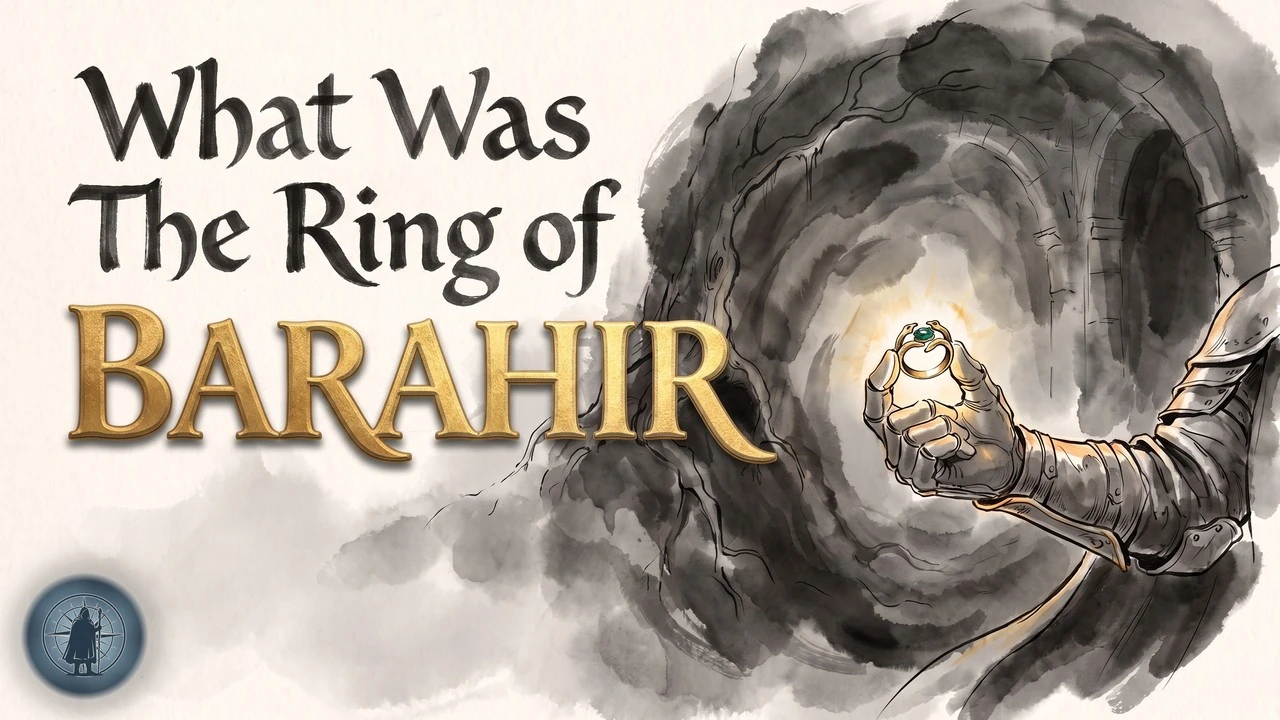 Watch the episode
Ring of Barahir: The Ring With No Power | Silmarillion Explained
Watch the episode
Ring of Barahir: The Ring With No Power | Silmarillion Explained
Main Narrative: The Ring of Barahir - The Artifact That Outlived Three Ages
SECTION: A Ring That Does Nothing
On the ice of Forochel, in the winter of the year 1975 of the Third Age, the last king of Arthedain handed a gold ring to a man whose language he barely spoke, and told him exactly what it was worth.
"This is a thing of worth beyond your reckoning. For its ancientry alone. It has no power, save the esteem in which those hold it who love my house."
That's Arvedui, and he's being precise. He's lost Fornost. He's lost his kingdom. He's living in a snow-hut among a people called the Lossoth, and the object he's giving away is the oldest thing his family owns. He doesn't oversell it. He says it's beyond reckoning, and in the very next breath he says it can't do anything. Then he adds the part that matters: "It will not help you, but if ever you are in need, my kin will ransom it with great store of all that you desire."
So what he's handing over amounts to a promissory note. Its value sits entirely in other people - in whether somebody, somewhere, still cares about the House of Isildur enough to buy it back.
That's a strange thing to build a story around, and Tolkien built two of them.
Most of us know the other one. A gold band that turns you invisible, stretches your life thin, eats your will, and has to be destroyed because it can't safely be owned by anybody. Tolkien explained in Letter 131 what makes a thing like that evil - "the desire for Power, for making the will more quickly effective," what he called the Machine, "the use of these talents with the corrupted motive of dominating: bulldozing the real world, or coercing other wills."
The Ring of Barahir coerces nothing. There isn't a single property attributed to it anywhere in the legendarium. No invisibility. No long life. No sight, no dominion, no protection, no luck. In a story where rings are the most dangerous technology anybody ever built, this one's inert.
And it's very old. It was made by the Noldor in Valinor, under the light of the Two Trees, before the Sun first rose - though Tolkien never tells us who made it, or when. For an object whose whole value is its age, the maker is a blank.
We do know where it came from, though. Finrod Felagund "had brought more treasure out of Tirion than any other of the princes of the Noldor," and two great things came out of that hoard. This ring, and the gems the Dwarves later set into the Nauglamír. The necklace was kept, and it drew the death of Thingol and the ruin of Doriath behind it. The ring was given away.
We should be a little careful here, because the discourse seems to overclaim this ring constantly. Fëanor made the palantíri in Aman during those same Years of the Trees, and four Seeing Stones still worked in the Third Age. Tolkien's one comparable superlative goes to the Sceptre of Annúminas - "perhaps the most ancient work of Men's hands preserved in Middle-earth" - hedged with "perhaps," and restricted to Men. He never writes an equivalent line about the ring. What's safe to say is it's among the oldest crafted things left in Middle-earth, alongside the Stones — and unlike them, it was a gift.
The word Tolkien keeps using for it is, "token". In token of his vow. As a token for Sauron. The token of our kinship from afar. It's a word for evidence - the thing you produce to prove that something happened.
So the big question we're thinking through in this episode is, what's an object worth when its only power is being believed?
SECTION: The Wall of Spears at Serech
In the year 455 of the First Age, Morgoth broke out.
The Dagor Bragollach - the Battle of Sudden Flame - started when rivers of fire came down off Thangorodrim and burned the grasslands of Ard-galen to ash in a night. Finrod Felagund, King of Nargothrond, was riding up from the south with a small company when the retreat collapsed around him, and he was cut off in the Fen of Serech. He should have died there. Two of his brothers, Angrod and Aegnor, did die in that battle.
What happened instead may have shaped the course of the next seven thousand years.
"There King Finrod Felagund... was cut off from his people and surrounded with small company in the Fen of Serech; and he would have been slain or taken, but Barahir came up with the bravest of his men and rescued him, and made a wall of spears about him... Thus Felagund escaped; but he swore an oath of abiding friendship and aid in every need to Barahir and all his kin, and in token of his vow he gave to Barahir his ring."
Barahir was a mortal man. Lord of Ladros in the highlands of Dorthonion, born in F.A. 400, and he'd only just inherited the lordship of the House of Bëor, when his older brother Bregolas was killed in the same fighting. He wasn't Finrod's subject. He didn't owe him anything.
The Grey Annals tell it with one extra clause that matters a whole lot. "Then Inglor gave to Barahir his ring, an heirloom of his house, in token of the oath that he swore unto Barahir to render whatsoever service was asked in hour of need to him or to any of his kin." So Inglor is actually Finrod - Tolkien swapped a set of names late in life, and we'll get to that.
An heirloom of his house. So that's his father's family crest, handed to a mortal on a burning battlefield, and the promise attached reads almost like a contract. The published Silmarillion drops that clause, and in dropping it, understates what Finrod did.
The shape of this scene feels stranger than it looks, too. Tolkien's day job was Old English heroic verse, where the king is a sincgyfa, a treasure-giver - beaga brytta, distributor of rings. Maxims II says flatly that a king must share out rings in the hall. Kingship and ring-giving are the same word, and the direction is fixed: gift first, service after.
At Serech it runs backwards. The retainer saves the lord, unasked, and the lord pays afterwards - to a man of another race who was never his to command, with his own family's badge.
Leslie Stratyner argued in Mythlore back in 1989 that Sauron is the perverted ring-giver, handing out rings to create bondage instead of acknowledging service. What nobody seems to have said out loud is the other half of it, so let's say it: Finrod is the real one. The thing Sauron's Nine and Seven are a corruption of is standing in a marsh in First Age 455, settling a debt. And the device is older than Tolkien - in the Icelandic material he taught, men swore legal oaths on a ring kept on a temple altar, with the gods as witness.
One last thing, because it's easy to read this gift as the start of a friendship. Finrod was the first elf to ever meet men, in 310 of the First Age. He came across the people of Bëor asleep in Ossiriand, picked up Bëor's harp, and played. They called him Nóm, which in their language meant Wisdom. And Barahir's own aunt, Andreth, had loved Finrod's brother Aegnor - who died in the Bragollach, the same battle where his brother put a ring in the hand of Andreth's nephew.
The gift just wrote down a friendship that was already old.
SECTION: Five Years, and a Severed Hand
Barahir wore the ring for five years. That's the shortest tenure of any named holder, and it's why the thing has carried his name for the seven thousand since.
Dorthonion burned in the Bragollach and became Taur-nu-Fuin, Forest under Nightshade. Almost everyone who could leave, left. But Barahir wouldn't. And what happened to the men who stayed gets one grim sentence.
"For these were slain one by one, until at last only twelve men remained to Barahir: Beren his son, and Baragund and Belegund his nephews, the sons of Bregolas, and nine faithful servants of his house whose names were long remembered in the songs of the Noldor: Radhruin and Dairuin they were, Dagnir and Ragnor, Gildor and Gorlim the unhappy, Arthad and Urthel, and Hathaldir the young."
That count gets misreported. The twelve include his son Beren, which makes Barahir the thirteenth. Thirteen men, holding a province.
Somebody had to get the civilians out first, and that was Barahir's wife. Emeldir the Manhearted "gathered together all the women and children that were left, and gave arms to those that would bear them; and she led them into the mountains that lay behind." The Index adds a detail the narrative doesn't: her own father was named Beren, and her son was named for him. The only reason this object has an heir at all is that got her household out of there alive.
The outlaws camped at Tarn Aeluin, a lake in the high moors, blessed by Melian long before anybody needed to hide beside it. They lasted until 460 of the First Age, and what destroyed them was one man's grief. Gorlim - the one the list calls "the unhappy" - had a wife, Eilinel, and he didn't know whether she was dead or a prisoner. So he kept going back to their empty house.
"On a time of autumn he came in the dusk of evening... and coming warily he looked within. There he saw Eilinel, and her face was worn with grief and hunger, and it seemed to him that he heard her voice lamenting that he had forsaken her. But even as he cried aloud the light was blown out in the wind; wolves howled, and on his shoulders he felt suddenly the heavy hands of Sauron's hunters."
It was a trap, and the bait was a hallucination. Gorlim traded the location of the camp for his wife - and once Sauron had what he wanted, he told him Eilinel had been dead the whole time. Then, word for word: "'Nonetheless I will grant thy prayer,' said Sauron; 'and thou shalt go to Eilinel, and be set free of my service.' Then he put him cruelly to death."
The Orcs came before dawn and killed every man in the camp. Beren was away. He came back to find his father's body robbed, buried what was left under a cairn of boulders, and swore vengeance on it. Then he went hunting, found the raiders at Rivil's Well, and got close enough to hear the captain bragging.
"There their captain made boast of his deeds, and he held up the hand of Barahir that he had cut off as a token for Sauron that their mission was fulfilled; and the ring of Felagund was on that hand. Then Beren sprang from behind a rock, and slew the captain, and taking the hand and the ring he escaped, being defended by fate."
Rivil's Well sits directly above the Fen of Serech. So the ring is given in that marsh in 455 and taken back off a dead hand above the same marsh in 460 - same ground, five years apart. And the severed hand is being carried "as a token for Sauron," proof of a completed job. Everyone in this story is carrying evidence to somebody.
SECTION: Held Aloft
Beren spent four more years alone in that dead country, and then in F.A. 464 he crossed the mountains south into Doriath. The ring started doing the only thing it does.
It gets held up in front of people. That's its whole active career - three moments where somebody raises it and the room changes. The first of them belonged to the enemy, an Orc-captain holding a dead man's hand in the air to prove he'd earned his pay.
The second is Menegroth. Beren gets into Thingol's hall and asks for his daughter. Thingol calls him a spy and a slave of Morgoth's. Beren answers with proof rather than words.
"By the ring of Felagund, that he gave to Barahir my father on the battlefield of the North, my house has not earned such names from any Elf, be he king or no."
Tolkien named this ring before but he never described it. The description doesn't show up for another nine story-years. When it comes, it comes in this exact sentence, where a filthy mortal is holding it over his head in a hostile hall.
"His words were proud, and all eyes looked upon the ring; for he held it now aloft, and the green jewels gleamed there that the Noldor had devised in Valinor. For this ring was like to twin serpents, whose eyes were emeralds, and their heads met beneath a crown of golden flowers, that the one upheld and the other devoured; that was the badge of Finarfin and his house."
The ring is painted in our minds at the exact moment it becomes an argument.
And now every face in the hall is turned toward a small piece of unresolved philosophy. Two serpents, identical, under a crown of golden flowers. One is holding the crown up. The other is eating it. The design doesn't tell you which serpent wins. And the ring is handed to a family that will spend three ages upholding kingship. And...being devoured by it.
And now, the third production. The strangest. Beren walks toward Nargothrond in F.A. 465 with the ring held up the entire way, calling out: "I am Beren son of Barahir, friend of Felagund. Take me to the King!" And the text tells us how that went. "When the ring was seen / they bowed before him, though his plight / was poor and beggarly." He's starving and ragged, and the green archers of Narog bow to him.
So Beren gets inside and Tokien lays a joke on us. "Thus Beren came before King Finrod Felagund; and Felagund knew him, needing no ring to remind him of the kin of Bëor and of Barahir."
The king didn't need to see the ring. Everybody else in the building needed to see it. And that's the pattern. It never forces anybody's hand, it just gives the holder a platform to be heard, and then the hearer decides. Thingol hears it and names a price. Finrod hears it and pays. Nargothrond hears it and refuses.
SECTION: The Debt Called In
That promise, the one we've been discussing, gets cashed in exactly once.
Finrod listened to what Beren wanted - a Silmaril out of Morgoth's iron crown, as a bride-price - and didn't look for a way out. The promise covered it. Aid in every need, to Barahir and all his kin. Beren is his kin.
So he stood up in front of his own people and told them. Tolkien doesn't quote that speech, even though plenty of retellings seem to invent one. What the text gives is narration: "Then King Felagund spoke before his people, recalling the deeds of Barahir, and his vow; and he declared that it was laid upon him to aid the son of Barahir in his need."
And then two sons of Fëanor stood up. Celegorm went first, and he didn't argue about Barahir at all. He argued about Silmarils. "Neither law, nor love, nor league of hell, nor might of the Valar, nor any power of wizardry, shall defend him from the pursuing hate of Fëanor's sons, if he take or find a Silmaril and keep it."
Curufin followed him, quieter. Tolkien says he spoke "more softly but with no less power, conjuring in the minds of the Elves a vision of war and the ruin of Nargothrond."
Two oaths in one hall, both freely made. One promised help to a family of mortals. The other promised murder to anyone who touched a jewel. Threat of murder won the room's attention easily. The other promise only came with a debt.
Finrod saw what had happened to him. He said so privately to Beren: "I fear that they will show neither love nor mercy to you, if your quest be told. Yet my own oath holds; and thus we are all ensnared."
Trapped. Everyone in that building is caught in something they said out loud years ago.
Then, he took off his crown. "And Felagund seeing that he was forsaken took from his head the silver crown of Nargothrond and cast it at his feet, saying: 'Your oaths of faith to me you may break, but I must hold my bond.'"
Ten people moved. Their leader's name was Edrahil, and he picked the crown up off the floor and asked somebody to keep it until the king came back. "For you remain my king, and theirs," he said, "whatever betide." Finrod gave it to his brother Orodreth. Celegorm and Curufin said nothing. They smiled, and walked out.
He went north with ten men and Beren, and was caught on Tol-in-Gaurhoth, the Isle of Werewolves - which used to be Tol Sirion. The tower there was Minas Tirith, and Finrod had built it himself. Sauron took it in F.A. 457. So the king walked into his own fortress as a prisoner. He battled. He lost. And he was chained in the dark while wolves came one by one and ate his companions. When a wolf finally came for Beren, Finrod broke his chains and killed it with his bare hands. Not without consequence though...he died of the wounds.
The promise cost him a silver crown, a kingdom, ten men and his own life - ten years after a rescue in a marsh that probably took about four minutes.
And Tolkien built a rhyme into it. At Serech, Barahir assembled men into a wall of spears around Finrod. At Tol-in-Gaurhoth, Finrod put his own body between a wolf and Barahir's son. Both times somebody physically gets in the way. The text doesn't have to explain that the ring does this. It just does it twice.
There are arguments among Tolkien scholars about whether that's admirable. Alexander Bruce, in Mythlore in 2023, argues that Tolkien deliberately challenged absolute adherence to a sworn word, and points at Rivendell - Gimli says "sworn word may strengthen quaking heart," and Elrond answers, "Or break it." Matthew McKenna answered him the next year, reading Fëanor's oath through Chesterton's idea of the liberty to bind oneself.
Finrod's vow is the test case neither of them uses. Freely made, fully paid, fatal - and productive, because Beren survives to father Dior. And the man who says "Or break it" in Rivendell is Beren's descendant. Elrond, ironically, inherits both halves of the argument.
SECTION: It Started as Fëanor's Ring
Everything so far is the story as Tolkien finally left it. The drafts though, tell a different tale, and it might be better.
Let's go back to 1917. Tolkien is recovering from trench fever and writing "The Tale of Tinúviel," the first version of Beren and Lúthien. Christopher Tolkien's summary of what's missing from it is blunt: "Beren has no ring of Felagund, he has no companions on his northward journey." Beren isn't even mortal there - he's an Elf - and his father isn't Barahir. His father is Egnor bo-Rimion, a forester. Christopher notes the change was made casually and late: "Beren's father was still Egnor in 1925."
So where does the ring come from?
Jump ahead to the summer of 1925. Tolkien starts the Lay of Leithian, the long verse version, and in Canto II of the earliest manuscript where the ring finally shows up. It's a gift to Beren's father in return for a deed of service. And the person who gave it isn't Finrod.
Christopher Tolkien wrote: "According to the earlier story seen in A the ring given to Barahir was made by Fëanor, Celegorm's father. In B the later story is present, and the badge of the entwined serpents is that of Felagund's father Finrod - who now first appears." A and B were just different versions of manuscripts labeled by Christopher Tolkien.
The most famous sign of a kept vow in the entire legendarium entered the story as a gift from the house of Fëanor. Made by Fëanor. Given by Celegorm - the same Celegorm who, in the finished book, stands up in Nargothrond and wrecks the honouring of it.
Tolkien moved it around 1928. In the B-text the giver becomes Felagund, and the twin serpents arrive at the same moment, because they're the badge of a house that didn't exist in the story yet. The serpents and Finarfin are born together, in one revision, to replace Fëanor. By the Quenta Noldorinwa, around 1930, the scene is basically finished - "an oath of undying friendship and aid in time of need to Barahir and all his kin and seed, and in token of his vow he gave to Barahir his ring" - and that formula barely moved again for forty years.
The ring's entire Third Age career - Rivendell, Elrond, Aragorn, Arwen, all of it - was written in by Tolkien at the last possible moment. Three pre-publication texts show it. In "The Heirs of Elendil," Tolkien lists what Elrond keeps for the Chieftains: "the chief remaining heirlooms of their house, especially the shards of Elendil's sword, Narsil." No ring. In the earliest draft of the Tale of Aragorn and Arwen, Elrond has "the heirlooms of the Dúnedain, chief of which were the shards of the sword of Elendil." No ring again. And the draft Tale of Years for 2980 reads simply, "They plight their troth on Cerin Amroth."
All three gained the ring at the final Appendix typescript stage. Published Appendix A lists four objects and names the ring first; published Appendix B inserts one clause, "Aragorn gives her the ring of Barahir." One of the oldest objects in Middle-earth is, in writing terms, one of the last things Tolkien put into it.
And he lost track of it. On a copy of the Lay manuscript, beside Finrod's death scene, Tolkien pencilled a note to himself. "He should give ring back to Beren."
Christopher's comment on that note: "But in fact it is nowhere said that Beren had returned the ring to Felagund." Tolkien had spotted that he'd left the ring unaccounted for somewhere between Nargothrond and Doriath - possibly on a corpse in Sauron's dungeon - and the fix never made it into any text. The published Silmarillion just steps around the problem. Finrod hands over the crown before he leaves, the ring isn't mentioned, and it doesn't turn up again until it surfaces in Númenor thousands of years later.
SECTION: Seven Thousand Years, and One Footnote
The Silmarillion mentions the ring for the last time in F.A. 465. After that, nothing - not at the ruin of Doriath, not with Dior or Elwing, not in the Akallabêth. Which leaves a hole three and a half thousand years wide, filled by one footnote in Unfinished Tales.
"The King's sword was indeed Aranrúth, the sword of Elu Thingol... Other heirlooms there were beside: the Ring of Barahir; the great Axe of Tuor; and the Bow of Bregor. Only the Ring of Barahir survived the Downfall; for it was given by Tar-Elendil to his daughter Silmariën and was preserved in the House of the Lords of Andúnië."
Four royal treasures. Three went down with the island in S.A. 3319. The one that lived is the one that was given away.
Silmariën was born in S.A. 521, and the sceptre went to her brother instead. So the ring left the royal line and travelled sideways, into the house of the Lords of Andúnië - the Faithful. Which is why it was on a ship in 3319 and the other three were on a drowning island.
The paperwork is thin. No text names the ring among what Elendil carried out of Númenor, and it isn't on the inventory at the Gladden Fields either. The likeliest reason it still exists is that it wasn't on that riverbank.
Eventually it would sit in a strongroom at Rivendell with the shards of Narsil, the star of Elendil and the sceptre of Annúminas - and in Tolkien's only inventory of Arnor's regalia, the ring is listed first.
Which is where Forochel comes back around. Arvedui handed it to a stranger on the ice, then boarded the ship against that stranger's advice, and the ice crushed the hull that night. "So perished Arvedui Last-king, and with him the palantíri were buried in the sea." Two Seeing Stones sank. The powerless thing on the shore lived.
T.A. 2951. Elrond gives it to a twenty-year-old, on the day he tells him who his father was. "Here is the ring of Barahir, the token of our kinship from afar... The Sceptre of Annúminas I withhold, for you have yet to earn it."
The kinship is literal - Elrond descends from Beren, through Dior and Elwing. And the split is deliberate. The family object goes free at twenty, because you're born into a family. The sceptre waits sixty-eight more years, because nobody is born into a throne.
There's something else in that scene Tolkien never points at. Until that morning the boy had been called Estel - the word Finrod himself defined, in the Athrabeth, arguing with Barahir's aunt about hope. "Estel we call it, that is 'trust'... it does not come from experience, but from our nature and first being." Seven thousand years on, Finrod's ring goes into the hand of the boy who was named it.
Aragorn kept it twenty-nine years, then gave it away too - on Cerin Amroth, in T.A. 2980, to Arwen.
And then it goes quiet. Aragorn dies in the year 120 of the Fourth Age and hands Eldarion "the winged crown of Gondor and the sceptre of Arnor." No ring. Arwen dies on Cerin Amroth the next year, and nothing is recorded of what she wore.
Which brings us back to that Appendix A footnote, and a hedge sitting inside it. "It is said that it was none other than the ring which Felagund of Nargothrond gave to Barahir, and Beren recovered at great peril."
It is said that it was none other than.
That's Tolkien, writing as the chronicler, declining to confirm it. Not "this was the ring." It is said. So inside the story, nobody can prove the gold on Aragorn's finger in 2951 is the gold that came off a dead man's hand above the Fen of Serech. There's no chain of receipts. There's a tradition, and people believe it.
Arvedui said the thing had no power except the esteem of the people who loved his house. That probably runs further than he meant. Its identity works the same way its power does. Both of them are real because somebody kept choosing to say so.