Research & Sources
Ring of Barahir
The Ring With No Power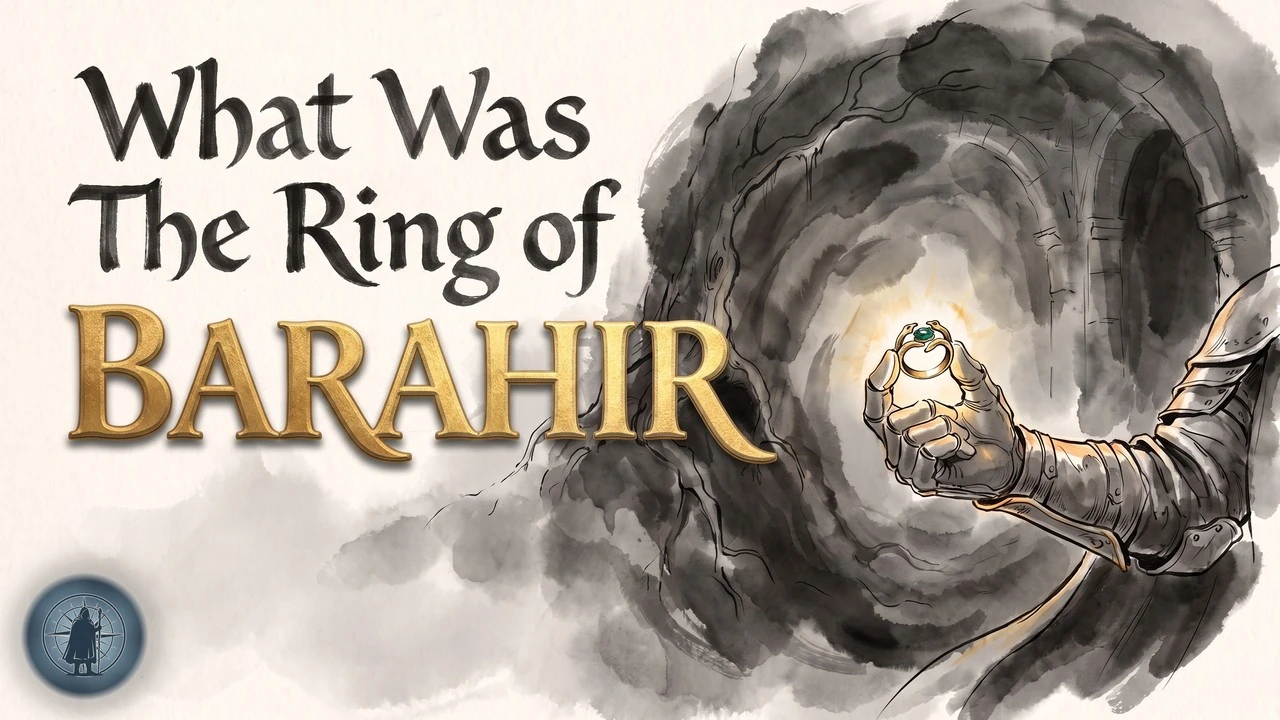 Watch the episode
Ring of Barahir: The Ring With No Power | Silmarillion Explained
Watch the episode
Ring of Barahir: The Ring With No Power | Silmarillion Explained
Research Notes: The Ring of Barahir — The Artifact That Outlived Three Ages
VIABILITY NOTE (read first)
This topic comfortably carries the 29–36 minute band, and it has a genuine scoop.
The ring appears in five dramatic scenes (Serech, Rivil's Well, Menegroth, Nargothrond, Forochel), two hand-overs (Elrond→Aragorn, Aragorn→Arwen), a verse tradition (two versions of the Lay of Leithian), a dated annal tradition (Grey Annals §§146, 168, 189), and a single author's footnote carrying its entire Second Age. Eight distinct analytical themes are below, each with 3+ hard specifics.
The scoop: the Ring of Barahir began life as a Fëanorian ring. In the earliest verse text (Lay of Leithian A-text, summer 1925) Beren's father received it from Celegorm, and Christopher Tolkien states it was made by Fëanor. Tolkien reassigned it to Felagund around 1928. The most famous token of a kept oath in the legendarium started as a gift from the house whose oath destroyed everything — and Tolkien's decision to move it is the theme, enacted in the drafting. No popular treatment of this ring uses that fact.
Three cautions:
1. The catalogue already has finrod-felagund-king-of-nargothrond, beren-and-lthien,
narsil-and-andril, aragorn-the-ranger-the-lost-years, aragorn-the-kings-return,
the-fall-of-arnor, isildur-hero-and-failure, elendil-the-tall,
the-palantri-fanors-lost-technology, elwing-the-white. Every person here has been done.
Stay on the object. The people are custodians.
2. The Second Age rests on one footnote. ~3,400 years of the ring's life are covered by a single
~70-word author's note in Unfinished Tales. Theme 7 makes the gap itself the subject.
3. There is no peer-reviewed scholarship on this ring at all. Searches of Mythlore, *Journal of
Tolkien Research, Tolkien Studies* and academia.edu returned zero articles on it. The
authoritative survey of Tolkien's ring-sources (Honegger 2021) traces the One Ring to Gyges,
Charlemagne and Wagner and never mentions Barahir's. That absence is the episode's licence —
and it means several arguments below are ours, labelled as such.
Overview
The Ring of Barahir — called equally in the texts the Ring of Felagund, and once "**the ring of Inglor**" — is the longest-lived named object in the legendarium whose individual owners Tolkien troubles to list. Made by the Noldor in Valinor during the Years of the Trees, carried into exile, given away on a battlefield in F.A. 455, and placed on Aragorn's hand in T.A. 2951: roughly seven thousand years of Sun-reckoning, before which it already existed in the Blessed Realm.
What makes it worth an episode is not its age but its emptiness of power. It is the one significant ring in Tolkien that does nothing, and its owner says so out loud: *"It has no power, save the esteem in which those hold it who love my house."* In a legendarium whose central object is a ring that enslaves, Tolkien built a second ring, older by an age and a half, whose entire function is to be believed.
Its history is therefore a sequence of moments in which somebody holds it up and the room changes — and a longer sequence of centuries in which nobody mentions it at all.
Primary Sources
The Silmarillion
Ch. 17, "Of the Coming of Men into the West" — the relationship the ring seals begins ~145 years earlier. Finrod is the first Elf to find Men, in Ossiriand; he watches the people of Bëor by their fires, takes up Bëor's harp while they sleep, and plays. They name him Nóm, "Wisdom," in their own tongue and take him as lord. The Elves call him Edennil, "Friend of Men." (F.A. 310.)
Ch. 18, "Of the Ruin of Beleriand and the Fall of Fingolfin" — the giving. *(Verified across three independent sources.)*
"There King Finrod Felagund, hastening from the south, was cut off from his people and surrounded
with small company in the Fen of Serech; and he would have been slain or taken, but Barahir came
up with the bravest of his men and rescued him, and made a wall of spears about him; and they cut
their way out of the battle with great loss. **Thus Felagund escaped, and returned to his deep
fortress of Nargothrond; but he swore an oath of abiding friendship and aid in every need to
Barahir and all his kin, and in token of his vow he gave to Barahir his ring.**"
Context: the Dagor Bragollach, F.A. 455. The Fen of Serech lies at the confluence of Sirion and its tributary Rivil. Finrod's brothers Angrod and Aegnor died in that same battle. (Aggregators sometimes print "aid en every need" — OCR artefact, not a variant.)
The twelve who stayed (verified verbatim, 3 sources):
"For these were slain one by one, until at last only twelve men remained to Barahir: Beren his
son, and Baragund and Belegund his nephews, the sons of Bregolas, and nine faithful servants of
his house whose names were long remembered in the songs of the Noldor: Radhruin and Dairuin they
were, Dagnir and Ragnor, Gildor and Gorlim the unhappy, Arthad and Urthel, and Hathaldir the
young."
Count precisely: the twelve include Beren. Barahir is the thirteenth man. Say "Barahir and twelve men."
"They became outlaws without hope, a desperate band that could not escape and would not yield…
and they retreated to the barren highland above the forest, and wandered among the tarns and rocky
moors of that region, furthest from the spies and spells of Morgoth."
Emeldir the Manhearted *(verified, 2 sources; running text spells it as one word — "Man-hearted" is the Index form)*:
"At last so desperate was the case of Barahir that Emeldir the Manhearted his wife (whose mind was
rather to fight beside her son and her husband than to flee) gathered together all the women and
children that were left, and gave arms to those that would bear them; and she led them into the
mountains that lay behind, and so by perilous paths, until they came at last with loss and misery
to Brethil."
The Silmarillion Index adds a detail not in the narrative: Emeldir was herself descended from Bëor the Old, and her father's name was Beren — i.e. Beren was named for his mother's father.
Ch. 19, "Of Beren and Lúthien" — the ring's three great scenes.
(a) Gorlim and the massacre (F.A. 460). Gorlim son of Angrim lost his wife Eilinel and did not know whether she was dead or captive.
"On a time of autumn he came in the dusk of evening, and drawing near he saw as he thought a light
at the window; and coming warily he looked within. There he saw Eilinel, and her face was worn
with grief and hunger, and it seemed to him that he heard her voice lamenting that he had forsaken
her. But even as he cried aloud the light was blown out in the wind; wolves howled, and on his
shoulders he felt suddenly the heavy hands of Sauron's hunters."
Sauron's bargain (verified verbatim, 2 sources):
"And Gorlim answered that he should find Eilinel again, and with her be set free… Then Sauron
smiled, saying: 'That is a small price for so great a treachery. So shall it surely be. Say on!' …
Then Sauron laughed; and he mocked Gorlim, and revealed to him that he had seen only a phantom
devised by wizardry to entrap him; for Eilinel was dead. **'Nonetheless I will grant thy prayer,'
said Sauron; 'and thou shalt go to Eilinel, and be set free of my service.'** Then he put him
cruelly to death."
"In this way the hiding of Barahir was revealed, and Morgoth drew his net about it; and the Orcs
coming in the still hours before dawn surprised the men of Dorthonion and slew them all, save one."
Beren, absent, is warned too late by Gorlim's wraith — "a form that came to him across the water" — and: *"There Beren buried his father's bones, and raised a cairn of boulders above him, and swore upon it an oath of vengeance."*
Rivil's Well (verified verbatim, 2 sources — the ring's most cinematic passage):
"Therefore he pursued the Orcs that had slain his father and his kinsmen, and he found their camp
by night at Rivil's Well above the Fen of Serech… There their captain made boast of his deeds, and
he held up the hand of Barahir that he had cut off as a token for Sauron that their mission was
fulfilled; and the ring of Felagund was on that hand. Then Beren sprang from behind a rock, and
slew the captain, and taking the hand and the ring he escaped, being defended by fate; for the
Orcs were dismayed, and their arrows wild."
Two things. Geography: the ring is given at the Fen of Serech in 455 and recovered above the Fen of Serech in 460 — the same marsh, five years apart. Vocabulary: the severed hand is carried *"as a token for Sauron." The same noun Tolkien uses for the ring — "in token of his vow", "the token of our kinship from afar."* Everyone in this story is carrying evidence to somebody.
⚠ The Silmarillion never says what Beren did with the recovered hand. It cuts to *"Thereafter for four years more Beren wandered still upon Dorthonion, a solitary outlaw."* The burial-of-the-hand detail is from the Lay of Leithian. Attribute it or drop it.
(b) The ring produced before Thingol (Menegroth, F.A. 464–465). Thingol calls Beren baseborn, spy, thrall. Beren answers:
"By the ring of Felagund, that he gave to Barahir my father on the battlefield of the North, my
house has not earned such names from any Elf, be he king or no."
And immediately — **exact wording verified against two independent transcriptions, one citing the printed page (Sil. p. 195)**:
"His words were proud, and all eyes looked upon the ring; for he held it now aloft, and the green
jewels gleamed there that the Noldor had devised in Valinor. **For this ring was like to twin
serpents, whose eyes were emeralds, and their heads met beneath a crown of golden flowers, that the
one upheld and the other devoured; that was the badge of Finarfin and his house.**"
⚠ WORDING CORRECTION. The text is "For this ring was like to twin serpents" — not "was made like to," a paraphrase circulating on wikis and jewellery sites.
Placement is the argument: Tolkien names the ring in ch. 18 and never describes it. The description arrives nine story-years later, in the sentence where Beren holds it aloft in a hostile hall — "and all eyes looked upon the ring." The object becomes visible only in use.
(c) The ring produced before Finrod (Nargothrond, F.A. 465).
"But knowing his danger he held ever aloft the ring of Felagund; and though he saw no living thing…
he felt that he was watched, and cried often aloud: '**I am Beren son of Barahir, friend of
Felagund. Take me to the King!**'"
"Thus Beren came before King Finrod Felagund; and Felagund knew him, **needing no ring to remind
him** of the kin of Bëor and of Barahir."
The one man the token was addressed to did not need it. Everyone else in the hall did.
Finrod, privately, to Beren:
"They have shown friendship to me in every need, but I fear that they will show neither love nor
mercy to you, if your quest be told. Yet my own oath holds; and thus we are all ensnared."
⚠ There is no quoted "an oath I swore" speech. Finrod's address to his people is narrated: *"Then King Felagund spoke before his people, recalling the deeds of Barahir, and his vow; and he declared that it was laid upon him to aid the son of Barahir in his need."*
Celegorm (verified verbatim, 2 sources):
"Be he friend or foe, whether demon of Morgoth, or Elf, or child of Men, or any other living thing
in Arda, neither law, nor love, nor league of hell, nor might of the Valar, nor any power of
wizardry, shall defend him from the pursuing hate of Fëanor's sons, if he take or find a Silmaril
and keep it. For the Silmarils we alone claim, until the world ends."
Curufin follows *"more softly but with no less power, conjuring in the minds of the Elves a vision of war and the ruin of Nargothrond."*
The crown cast down (verified verbatim, 2 sources — the line the episode can hang on):
"And Felagund seeing that he was forsaken took from his head the silver crown of Nargothrond and
cast it at his feet, saying: 'Your oaths of faith to me you may break, but I must hold my bond.
Yet if there be any on whom the shadow of our curse has not yet fallen, I should find at least a
few to follow me, and should not go hence as a beggar that is thrust from the gates.'"
Edrahil and Orodreth (verified verbatim, 2 sources):
"There were ten that stood by him; and the chief of them, who was named Edrahil, stooping lifted the
crown and asked that it be given to a steward until Felagund's return. '**For you remain my king,
and theirs**,' he said, 'whatever betide.' Then Felagund gave the crown of Nargothrond to Orodreth
his brother to govern in his stead; and Celegorm and Curufin said nothing, but they smiled and went
from the halls."
[Do NOT use "Brother mine, till I return this crown is thine" — that is the Lay of Leithian.]
They are taken by Sauron on Tol-in-Gaurhoth, the isle whose tower Finrod himself had built. Finrod loses the contest of songs, is chained, and kills a werewolf with his bare hands and teeth to save Beren.
"I go now to my long rest in the timeless halls beyond the seas and the Mountains of Aman. It will
be long ere I am seen among the Noldor again; and it may be that we shall not meet a second time in
death or life, for the fates of our kindreds are apart."
AND THEN THE SILMARILLION STOPS. Checked directly by enumerating every occurrence of "ring" in ch. 19: the last is "needing no ring to remind him." **The Ring of Barahir is never mentioned again anywhere in The Silmarillion** — not at the Ruin of Doriath, not with Dior or Elwing, not in the Akallabêth, not in "Of the Rings of Power." **No Silmarillion sentence says the ring was preserved, or passed to Dior, or reached Númenor.* (Firm negative finding, high confidence.)*
Ch. 13, "Of the Return of the Noldor" — the fact behind Theme 6: Finrod *"had brought more treasure out of Tirion than any other of the princes of the Noldor."* Two great objects came out of that hoard: this ring, and the gems the Dwarves of Nogrod and Belegost set into the Nauglamír.
The Lord of the Rings
The ring is named four times in LOTR, and every one is in the appendices. It does not appear in the narrative of the novel at all — and that is explicable (Theme 8).
Appendix A I(iii) — Arvedui, driven north T.A. 1974–75 to the Lossoth. Their chief warns him not to board Círdan's rescue ship. Arvedui refuses, and at parting gives him the ring:
"**This is a thing of worth beyond your reckoning. For its ancientry alone. It has no power, save
the esteem in which those hold it who love my house.** It will not help you, but if ever you are in
need, my kin will ransom it with great store of all that you desire."
The ice crushes the hull that night: "So perished Arvedui Last-king, and with him the palantíri *were buried in the sea."*
The footnote — and note the hedge, which nobody quotes:
"In this way the ring of the House of Isildur was saved; for it was afterwards ransomed by the
Dúnedain. It is said that it was none other than the ring which Felagund of Nargothrond gave to
Barahir, and Beren recovered at great peril."
"It is said that it was none other than" — Tolkien leaves the identification as **tradition, not fact**. Even inside the story, nobody can prove the ring on Aragorn's finger is the ring from Serech.
The heirloom-set after the North-kingdom ends:
"…the line of the kings was continued by the Chieftains of the Dúnedain, of whom Aranarth son of
Arvedui was the first. Arahael his son was fostered in Rivendell, and so were all the sons of the
chieftains after him; and there also were kept the heirlooms of their house: **the ring of Barahir,
the shards of Narsil, the star of Elendil, and the sceptre of Annúminas.**"
Appendix A I(v) — Elrond, T.A. 2951, to Estel at twenty:
"Here is the ring of Barahir, the token of our kinship from afar; and here also are the shards
of Narsil. With these you may yet do great deeds; for I foretell that the span of your life shall
be greater than the measure of Men, unless evil befalls you or you fail at the test. But the test
will be hard and long. The Sceptre of Annúminas I withhold, for you have yet to earn it."
Elrond is a descendant of Beren through Dior and Elwing: "the token of our kinship from afar" is literal. And the ring is given freely at twenty; the sceptre is withheld until earned.
Appendix B, T.A. 2980:
"Aragorn enters Lórien and there meets again Arwen Undómiel. **Aragorn gives her the ring of
Barahir**, and they plight their troth upon the hill of Cerin Amroth."
⚠ The narrative of the Tale of Aragorn and Arwen describes Cerin Amroth in full — the unshod feet, the elanor and niphredil, "they plighted their troth and were glad" — **and never mentions the ring.** Only the annal records it.
Appendix A footnote on the Sceptre of Annúminas (the comparison Tolkien does make): the sceptre was "the silver rod of the Lords of Andúnië, and is now perhaps the most ancient work of *Men's hands** preserved in Middle-earth. It was already more than five thousand years old when Elrond surrendered it to Aragorn." *Tolkien reserves the superlative for the sceptre, restricts it to Men's work, and hedges it with "perhaps." He never gives the ring an equivalent.**
Unfinished Tales — the single most important Second-Age text
"Aldarion and Erendis," Note 2 (UT p. 171), an [Author's note]. This ~70-word note carries the entire Second Age of the ring:
"The King's sword was indeed Aranrúth, the sword of Elu Thingol of Doriath in Beleriand, **that
had descended to Elros from Elwing his mother. Other heirlooms there were beside: the Ring of
Barahir; the great Axe of Tuor, father of Eärendil; and the Bow of Bregor** of the House of
Bëor. **Only the Ring of Barahir father of Beren One-hand survived the Downfall; for it was given
by Tar-Elendil to his daughter Silmariën and was preserved in the House of the Lords of Andúnië**,
of whom the last was Elendil the Faithful who fled from the wrack of Númenor to Middle-earth."
Everything about this note is usable: - Four Númenórean heirlooms are named. One survived. The one that was given away down a side branch. Aranrúth, the Axe of Tuor, the Bow of Bregor — all drowned. - It partly closes the Elwing gap: Aranrúth "descended to Elros from Elwing his mother", so Elwing demonstrably did pass heirlooms to Elros. The ring is not named in that clause, but the mechanism is established. - It explains the survival: the ring went to Tar-Elendil's daughter Silmariën (b. S.A. 521) — out of the sceptre-line, which passed to her brother Tar-Meneldur — and into the **Lords of Andúnië**, the Faithful. That is why it was on a ship in S.A. 3319 and not on the drowned island.
Also in Unfinished Tales: - "The Disaster of the Gladden Fields" (T.A. 2) — Isildur carried the Elendilmir and the One Ring; the shards of Narsil were borne away by his esquire Ohtar. **The Ring of Barahir is not on the list.** Its absence from that riverbank is probably why it still exists. - "The Palantíri" — the Stones were made by Fëanor himself in Aman during the Years of the Trees. The essential counter-example to any "oldest Elvish object" claim.
The History of Middle-earth — the drafting history is the story
HoME II, The Book of Lost Tales 2, "The Tale of Tinúviel" (1917). Christopher Tolkien, verbatim:
"Most notably, what may be referred to as 'the Nargothrond Element' is entirely absent… **Beren has
no ring of Felagund**, he has no companions on his northward journey…"
He adds that "all the complex background of legend, of battles and rivalries, oaths and alliances" is largely absent. In this earliest layer Beren is a Gnome (Elf), and his father is **Egnor bo-Rimion*, a forester — not Barahir. Christopher's note on the typescript: "Egnor changed to Barahir. This however was a much later and as it were casual change; **Beren's father was still Egnor in 1925.*"
HoME III, The Lays of Beleriand, "The Lay of Leithian" — THE SCOOP.
The ring first appears in the A-text, Canto II, summer 1925 — and it is Fëanorian. Christopher Tolkien, verbatim:
"**According to the earlier story seen in A the ring given to Barahir was made by Fëanor,
Celegorm's father.** In B the later story is present, and the badge of the entwined serpents is
that of Felagund's father Finrod (Finarfin in The Silmarillion) who now first appears."
And on the sequence:
"…there is a reference to the 'deed of service' done by Egnor Beren's father to Celegorm, and
the gift of the ring… **The rather surprising conclusion must be that the association of
Egnor/Barahir with Celegorm and the gift of the ring preceded the emergence of the story of Beren's
going to Celegorm for aid.**"
Evolution table:
| Stage | Date | The ring | |---|---|---| | Tale of Tinúviel | 1917 | No ring. Father = Egnor, a Gnome; Beren a Gnome | | Lay of Leithian A-text, Canto II | summer 1925 | Ring appears — given by CELEGORM, and made by Fëanor | | Sketch of the Mythology | early 1926 | Barahir replaces Egnor; both Ilkorin Elves; Barahir "a friend of Celegorm" — no ring | | Lay B-text, Canto IV | c. early 1928 | Giver becomes Felagund; badge becomes Finrod's (= later Finarfin), "who now first appears" | | Quenta Noldorinwa | c. 1930 | Full oath + ring; Men, not Elves. Wording essentially final |
The verse itself. Canto II, A/B text (1925), the Orc-captain's boast, lines ~295–310:
"And one there laughed, and showed a ring / he took from Barahir's dead hand. / 'This ring in far
Beleriand, / now mark ye, mates,' he said, 'was wrought. / … for this same Barahir I slew, / this
robber fool, they say, did do / a deed of service long ago / for Felagund… / and I am minded to
declare / the hand of Barahir was bare!'"
The Lay of Leithian Recommenced (post-LotR, 1950s), lines 445–460 — the same scene, rewritten with Sauron in Morgoth's place, and a much better joke:
"One a ring / held up, and laughed… / '**For I 'twas wrenched it from the hand / of that same
Barahir I slew**, / the robber-knave. If tales be true, / he had it of some elvish lord, / for the
rogue-service of his sword. / No help it gave to him—he's dead. / **They're parlous, elvish rings,
'tis said**; / still for the gold I'll keep it…'"
**"They're parlous, elvish rings, 'tis said" is the single best line in the entire corpus for this episode.** An Orc looking at the one Elvish ring in Middle-earth that is completely harmless, and being nervous about it.
⚠ Variant that matters: in the Lay the ring is wrenched from the hand. The severed-hand-as- proof detail is later — it belongs to the Grey Annals and the published Silmarillion.
Canto IV (1928) — the heraldic passage in verse, at Menegroth, lines ~1084–1102:
"'…Twist not thy oaths, O elvish king, / like faithless Morgoth! **By this ring— / the token of a
lasting bond / that Felagund of Nargothrond / once swore in love to Barahir, / who sheltered him
with shield and spear / and saved him from pursuing foe / on Northern battlefields long ago—** /
death thou canst give unearned to me, / but names I will not take from thee / of baseborn, spy, or
Morgoth's thrall!' / **Proud are the words, and all there turned / to see the jewels green that
burned / in Beren's ring. These Gnomes had set / as eyes of serpents twined that met / beneath a
golden crown of flowers, / that one upholds and one devours: / the badge that Finrod made of yore /
and Felagund his son now bore.**"
⚠ CORRECTION to a widely circulated text. Search results and one fan-completed edition render line 1098 as "These Noldor set" and 1102 as "the badge that Finarfin made of yore." **That is not Tolkien. He wrote "These Gnomes had set" and "the badge that Finrod made of yore"** — where "Finrod" is the father (later renamed Finarfin). Quote it as written and explain the name-shift.
And at Nargothrond, lines ~1751–1761:
"Yet now he thrusts into that land / bearing the gleaming ring on hand / of Felagund… / So ere
he reached the eastward shore / of Narog… those archers green / came round him. **When the ring was
seen / they bowed before him**, though his plight / was poor and beggarly."
★ THE LOOSE END TOLKIEN NEVER CLOSED. On a copy of the D-text, beside Felagund's dying words in Canto IX, Tolkien pencilled:
"He should give ring back to Beren."
Christopher's comment: "*But in fact it is nowhere said that Beren had returned the ring to Felagund.*" So Tolkien himself spotted that he had lost track of the ring's custody between Nargothrond and Doriath — worried it might be stuck on a corpse in Tol-in-Gaurhoth — and **the fix never made it into any text*. The published Silmarillion dodges it: Felagund hands over the crown* before leaving, and the ring is simply never mentioned again until it surfaces in Númenor.
HoME XI, The War of the Jewels — the Grey Annals. §146 (WJ p. 52):
"There King Inglor Felagund, hastening from the south, was defeated and was surrounded with
small company in the Fen of Serech. But Barahir came thither with the doughtiest of his men, and
broke the leaguer of the Orcs and saved the Elven-king. **Then Inglor gave to Barahir his ring, an
heirloom of his house, in token of the oath that he swore unto Barahir to render whatsoever service
was asked in hour of need to him or to any of his kin.**"
Three things: (i) "Inglor," not "Finrod" — pre-name-shift; (ii) "an heirloom of his house" — a phrase not in the published Silmarillion, and it settles the "personal token vs. dynastic property" question; (iii) "whatsoever service was asked in hour of need" — broader and more contractual than the published wording. Nearly a legal instrument.
§168 (WJ p. 59) — the recovery, and the first appearance of the severed hand:
"Then Beren pursued the Orcs that had slain his father, and coming upon their camp, at Rivil's Well
above Serech, he entered it and slew the captain even as he boasted that he was the slayer of
Barahir; and **he snatched from him the hand of Barahir that had been cut off as a token for Sauron.
Thus he regained the Ring of Felagund that his father had worn.**"
§189 (WJ p. 65) — at Menegroth, and the only place the object is called by this name:
"…and Beren showed to him the ring of Inglor his kinsman. But Thingol spoke in anger scorning
mortal Men, saying that the service of Beren's father to another prince gave the son no claim to
walk in Doriath, still less to lift his eyes to Lúthien."
Later Quenta Silmarillion (WJ p. 242) — a discarded curiosity: Christopher records an addition made after "he gave to Barahir his ring", introducing Felagund's wife Meril and their son Gil-galad. For a while, the Elf who gave away the ring was Gil-galad's father.
Quenta Noldorinwa, c. 1930 (HoME IV) — earliest full prose, near-final:
"There Felagund **swore an oath of undying friendship and aid in time of need to Barahir and all his
kin and seed, and in token of his vow he gave to Barahir his ring.**"
So the formula was fixed by ~1930 and barely moved for forty years. The Grey Annals version is the outlier — and the richer text.
HoME XII, The Peoples of Middle-earth — the ring's Third Age role is a LATE addition. No positive statement about the ring exists in PoME (no index entry; "Barahir" appears only as the 8th Ruling Steward and as Beren's father). But three negative findings, each verified verbatim:
1. "The Heirs of Elendil" (PoME p. 195–6) — the Rivendell heirloom list is shorter:
"The sons of their chieftains are usually fostered in Imladris by Elrond, to whose keeping arePublished Appendix A lists four objects. The ring is not in the draft. 2. Earliest "Tale of Aragorn and Arwen" (PoME ch. IX(ii)):
given the chief remaining heirlooms of their house, **especially the shards of Elendil's sword,
Narsil**."
"…and Elrond had in his keeping **the heirlooms of the Dúnedain, chief of which were the shardsNo ring. Published Appendix A instead gives Elrond's speech naming the ring first. 3. Draft Tale of Years, entry 2980 (PoME ch. VIII, text T4):
of the sword of Elendil**…"
"…passes through Lórien, and there again meets Arwen Undómiel… **They plight their troth on thePublished Appendix B inserts: "Aragorn gives her the ring of Barahir, and they plight their troth…"
hill of Cerin Amroth in Lórien.**"
**Conclusion: the entire Third-Age life of the ring was written in at the final Appendix typescript stage.** It is absent from three separate pre-publication texts.
Also: the draft Downfall annal (PoME text T3, S.A. 3319) lists what Elendil carried — *"the Seven Stones or Palantíri… and Isildur brings also a seedling of the White Tree"* — same inventory as the Akallabêth. **No text at any stage, draft or published, names the Ring of Barahir among what left Númenor on the ships.**
And on Forochel, Christopher in "The Making of Appendix A": the Arvedui/Lossoth story *"'wrote itself in precisely the form in which it was printed'. But this is scarcely credible."* He searched for drafts of the ransom episode and found none, while doubting that none existed. **There is no variant of the ring's ransom.**
[The Nature of Middle-earth (2021) contains nothing on the ring. The Fall of Númenor (2022) adds
nothing: "Barahir" occurs twice, once in a Silmarillion quotation and once in Sibley's endnote
pointing back to UT pp. 171–2 note 2.]
HoME X, Morgoth's Ring, "Athrabeth Finrod ah Andreth" — the friendship behind the oath:
"His chief love was given to the people of Bëor the Old, for it was these that he had first
found in the woods of eastern Beleriand. **Andreth was a woman of the House of Bëor, the sister of
Bregor father of Barahir** (whose son was Beren One-hand the renowned)."
So Andreth is Barahir's aunt, and the Athrabeth is Finrod debating mortality with Beren's great-aunt — who loved Finrod's brother Aegnor, and whom he met (per the commentary) one morning in the hills of Dorthonion. Aegnor died in the Dagor Bragollach: **the same battle in which his brother gave the ring to Andreth's nephew.**
And the theological engine of the whole legendarium, from the same dialogue:
"'That is one thing that Men call "hope",' said Finrod. 'Amdir we call it, "looking up". But
there is another which is founded deeper. Estel we call it, that is "trust". It is not
defeated by the ways of the world, for it does not come from experience, but from our nature and
first being."
**Aragorn's childhood name is Estel — and he receives the Ring of Barahir on the day he stops being Estel and learns he is Isildur's Heir.** Finrod defined the word. Finrod's ring is handed to the boy who bore it. Tolkien never draws the line; it is there.
The Letters of J.R.R. Tolkien
⚠ NO LETTER OF TOLKIEN'S MENTIONS THE RING OF BARAHIR. The full text was searched directly. If a script line implies "Tolkien wrote about this ring," it is wrong. He wrote about the story constantly; never about the object. *(Numbers follow the 1981 Carpenter/C. Tolkien edition; the 2023 Revised & Expanded edition restores cut passages and quotes may run longer there.)*
Letter 131 (to Milton Waldman, c. late 1951) — both passages verified verbatim:
"**The chief of the stories of the Silmarillion, and the one most fully treated is the Story of
Beren and Lúthien the Elfmaiden.** Here we meet, among other things, the first example of the motive
(to become dominant in Hobbits) that **the great policies of world history, 'the wheels of the
world', are often turned not by the Lords and Governors, even gods, but by the seemingly unknown and
weak**… It is Beren the outlawed mortal who succeeds… where all the armies and warriors have failed."
⚠ Commonly mangled to "the chief story of the Silmarillion." The phrase is "the chief **of the stories." The letter contains nothing** on Finrod, Barahir or the ring.
And Tolkien's own definition of what makes a ring evil:
"…the desire for Power, for making the will more quickly effective, — and so to **the Machine (or
Magic)**… the use of these talents with the corrupted motive of dominating: bulldozing the real
world, or coercing other wills."
Letter 195 (to Amy Ronald, 15 December 1956) — verified verbatim:
"Actually I am a Christian, and indeed a Roman Catholic, so that I do not expect 'history' to be
anything but a 'long defeat' — though it contains… some samples or glimpses of final victory."
Letter 165 / 257 — the origin of the Beren and Lúthien story. ⚠ Tolkien's own dates disagree: Letter 165 says 1918; Letters 257 and 340 say 1917. Say "1917 — though Tolkien once misremembered it as 1918," or give no year.
Letter 340 (to Christopher Tolkien, 11 July 1972) — verified verbatim; the closer:
"**I never called Edith Lúthien — but she was the source of the story that in time became the chief
part of the Silmarillion.**… In those days her hair was raven, her skin clear, her eyes brighter
than you have seen them, and she could sing — and dance. **But the story has gone crooked, & I am
left, and I cannot plead before the inexorable Mandos.**"
Tolkien died 2 September 1973 and was buried in the same grave, Beren added beneath his name (Wolvercote Cemetery, Oxford).
Also useful: Letter 191 — Frodo was honoured "because he had accepted the burden voluntarily." Letter 246 — Frodo "needed time… before he could control the Ring **or (which in such a case is the same)** before it could control him." ⚠ Letter 180 does NOT pay off (subject: sub-creation and the rejection of The Silmarillion); drop it. Letters 153, 156, 211 checked and empty. ⚠ Commonest misattribution in this area: "The Lord of the Rings is of course a fundamentally religious and Catholic work" is Letter 142, to Fr. Robert Murray SJ, 2 December 1953 — regularly mis-cited to 165 or 180.
Key Facts & Timeline
First-Age dates follow clotho123's Chronology of the Silmarillion (SWG), compiled from the **Annals of Aman, the Grey Annals and the Tale of Years**. Christopher's caveat applies: working chronologies his father might have revised.
Years of the Trees
- Undated: the ring is made in Valinor by the Noldor. **Tolkien never names the maker or the date** — for an object whose entire value is its ancientry, its maker is a blank. - Y.T. 1495–1500: Flight of the Noldor. Finrod carries it into exile with more treasure out of Tirion than any other prince of the Noldor.First Age (Years of the Sun)
| Year | Event | |---|---| | 52–102 | Finrod builds and completes Nargothrond | | 310 | Finrod is the first Elf to meet Men — the people of Bëor. They name him Nóm | | 400 | Birth of Barahir | | 410 | Boromir of the House of Bëor becomes Lord of Ladros in Dorthonion | | 432 | Birth of Beren | | 455 | Dagor Bragollach. Finrod cut off at the Fen of Serech; Barahir's wall of spears; the ring is given. Angrod and Aegnor die | | 456 | Death of Fingolfin | | 457 | Sauron takes Tol Sirion; it becomes Tol-in-Gaurhoth | | 460 | Death of Barahir at Tarn Aeluin, betrayed by Gorlim. Beren recovers hand and ring at Rivil's Well | | 464 | Beren enters Doriath after four more years alone. Confronts Thingol; shows the ring | | 465 | Beren comes to Nargothrond; shows the ring; Finrod abdicates and departs with ten. Death of Finrod | | 466 | Beren and Lúthien take the Silmaril | | 467 | First deaths of Beren and Lúthien | | 470 | Birth of Dior Eluchíl | | 503 | Death of Thingol; birth of Elwing; the Nauglamír affair; final passing of Beren and Lúthien (approx.) | | 504 | Dior becomes King of Doriath | | 506 | Second Kinslaying; death of Dior; Elwing escapes to the Havens of Sirion | | 510 | Fall of Gondolin | | 532 | Birth of Elros and Elrond | | 538 | Third Kinslaying; sack of the Havens; Elwing casts herself into the sea | | 587–590 | Destruction of Angband; Morgoth thrust into the Void. End of the First Age |Second Age
| Year | Event | |---|---| | 32 | Elros Tar-Minyatur becomes first King of Númenor | | 442 | Death of Elros, aged 500 | | 521 | Birth of Silmariën, elder child of Tar-Elendil | | c. 600+ | Silmariën's son Valandil, first Lord of Andúnië. The ring leaves the sceptre-line | | 3319 | Downfall of Númenor. Elendil escapes with nine ships. Three of the four royal heirlooms are lost | | 3441 | Fall of Sauron; deaths of Elendil and Gil-galad. End of the Second Age |Third Age
| Year | Event | |---|---| | 2 | Gladden Fields. Isildur slain; Elendilmir lost; Ohtar bears the shards of Narsil to Rivendell. The ring is not on the inventory | | 861 | Arnor divides; Amlaith of Fornost first King of Arthedain | | 1974–75 | Fall of Fornost. Arvedui flees to Forochel, gives the ring to the chief of the Lossoth, drowns with the two northern palantíri | | after 1975 | Ransomed back by the Dúnedain — no date given — and kept at Rivendell with the shards of Narsil, the star of Elendil and the sceptre of Annúminas | | 2931 | Birth of Aragorn | | 2933 | Arathorn II slain; Aragorn taken to Rivendell as "Estel" | | 2951 | Elrond delivers the ring and the shards to Aragorn at twenty. Withholds the sceptre | | 2980 | Aragorn gives the ring to Arwen on Cerin Amroth | | 3019 | War of the Ring; Elrond surrenders the Sceptre of Annúminas; Aragorn weds Arwen at Midsummer | | 3021 | End of the Third Age |Fourth Age
| Year | Event | |---|---| | 120 | Death of Aragorn. He gives Eldarion "the winged crown of Gondor and the sceptre of Arnor." The ring is not mentioned | | 121 | Arwen dies on Cerin Amroth. The ring's fate is never recorded |Derived spans (our arithmetic from Tolkien's dates — flag as derived, never stated)
- Barahir held it 5 years (455–460): the shortest tenure of any named holder. - Beren held it roughly 43 years (460 – c. 503). - Aragorn held it 29 years (2951–2980). - Serech to Elrond's hand-over: 135 (rest of F.A.) + 3,441 (S.A.) + 2,951 = 6,527 years. - Plus Finrod's tenure from the rising of the Sun: ≈ 6,982 Sun-years by T.A. 2951 — and it was already old when the Sun first rose. - Tolkien's own only comparable figure is "more than five thousand years", and it is about the sceptre. Do not put a number in his mouth.Significant Characters
Finrod Felagund — King of Nargothrond, eldest son of Finarfin, brother of Galadriel. First Elf to find Men (F.A. 310); called Nóm ("Wisdom") by Men and Edennil ("Friend of Men") by Elves. LOTR Appendix B glosses him: *"Finrod Felagund, Friend-of-Men, once king of Nargothrond, who gave his life to save Beren son of Barahir."* Brought more treasure out of Tirion than any other Noldorin prince. The ring-giver. (In HoME texts he is "Inglor" — see Linguistic Notes.)
Barahir — b. F.A. 400, d. F.A. 460. Lord of Ladros in Dorthonion; younger son of Bregor; inherited the lordship of the House of Bëor when his elder brother Bregolas fell in the Bragollach. Saved Finrod at Serech; refused to abandon Dorthonion; held it as an outlaw for five years. Killed at Tarn Aeluin; his hand cut off with the ring on it as a trophy. **He wore the ring five years and it has borne his name for seven thousand.**
Emeldir the Manhearted — Barahir's wife, Beren's mother; armed the women of Dorthonion and led the non-combatants out. Her own father was named Beren (Silmarillion Index) — her son was named for him. She never appears in the ring's story again, and the reason the ring had an heir at all is that she got him born and got the household out alive.
Gorlim the Unhappy — one of the twelve. Sauron used a phantom of his wife Eilinel to draw him in, extracted the camp's location, and killed him. The most consequential act of treachery in the ring's history: without it, the ring never changes hands.
Beren Erchamion — b. F.A. 432. Recovered the ring at Rivil's Well; used it twice as an instrument (against Thingol's contempt, and to call in Finrod's oath). The only person who ever cashed it.
Thingol — audience for the ring's first great presentation. He calls Beren baseborn; the ring is Beren's answer.
Celegorm and Curufin — sons of Fëanor. In the earliest draft, Celegorm was the ring's giver. In the final text he is the man whose speech turns a kingdom against a king trying to honour it. Two oaths collide in one hall.
Edrahil — leader of the ten of Nargothrond who followed Finrod anyway. Named, so the writer can name him.
Arvedui — last King of Arthedain, d. T.A. 1975. Gives the ring away and thereby saves it.
Elrond — descendant of Beren via Dior and Elwing. Keeper of the ring for centuries; hands it back to the Mannish branch of his own family in T.A. 2951. Also the man who says, of oaths, *"Or break it."*
Aragorn / Arwen — last recorded holders. He held it 29 years, then gave it to a descendant of Beren and Lúthien — the line it started in.
Andreth — Barahir's aunt; the mortal woman of the Athrabeth, who loved Finrod's brother Aegnor. The Elf–Man bond that produced the ring had a failed love at its root; the ring's last journey ends as the betrothal token of a successful one.
Geographic Locations
Valinor / Tirion — where the ring was made; never described in connection with it. The ring carries Aman into every later scene, which is why "for its ancientry alone" lands.
Dorthonion ("Land of Pines") — highland north of Doriath, granted to the House of Bëor; Ladros in its north-east was Barahir's fief. Burned in the Bragollach and thereafter Taur-nu-Fuin, "Forest under Nightshade."
Tarn Aeluin — the upland lake where Barahir's outlaws camped; said to have been **hallowed by Melian** long before, its waters blue by day and starlit by night. Where they were slaughtered. *(Wiki sources also place the meeting of Aegnor and Andreth at Aeluin; the Athrabeth commentary says only "in the hills of Dorthonion." Flag if used.)*
Fen of Serech — the marsh at the confluence of Sirion and Rivil, guarding the **Pass of Sirion. The ring is given here in 455 and recovered here in 460.* (Fonstad's* Atlas of Middle-earth estimates it ~20 miles across — an atlas reconstruction, not Tolkien.)
Rivil's Well — the spring where the Rivil rises. Beren's ambush site.
Menegroth / Nargothrond / Tol-in-Gaurhoth — the three halls of the ring's First-Age career: shown to a hostile king, shown to a sworn one, and the tower where the oath is paid. Tol-in-Gaurhoth was Minas Tirith on Tol Sirion — built by Finrod himself, taken by Sauron in F.A. 457. He dies in his own fortress.
Númenor / Andúnië — the ring's home for most of the Second Age, in the house of the Faithful.
Rivendell — its longest single Third-Age resting-place; the strongroom of the North-kingdom's four heirlooms.
Forochel — where the chain of royal custody breaks and is repaired.
Cerin Amroth — where the ring leaves the record. Arwen dies on that hill; nothing is said of what she wore.
Themes & Symbolism
1. A ring that is only evidence. Every other significant ring in Tolkien does something. This one is a signifier with no power, and the text says so in Arvedui's mouth. The binding force is not in the metal; the metal is only proof that the promise was made.
2. Ring-giving as the lord-bond — and its corruption. Tolkien's professional subject was Old English heroic verse, where a king is sincgyfa (treasure-giver), sinces brytta, *beaga brytta (distributor of rings), goldgyfa. Maxims II*: "a king must share out rings in the hall." Finrod at Serech performs this — inverted: the retainer saves the lord first, and the lord pays a debt he owes, to a man of another race who was never his subject. Sauron's Rings of Power are the same custom run backwards: rings given to create bondage rather than acknowledge service.
3. The twin serpents. One devours the crown of golden flowers; the other upholds it. The emblem of Finarfin's house is the same act performed with opposite intent — handed to a family that spends three ages both upholding and being devoured by kingship. Two serpents, one crown, permanently unresolved.
4. Survival by surrender. Its near-death moments are all moments of clutching: Barahir dies wearing it; Isildur's other heirlooms die with him; the palantíri sink in Arvedui's hull; three of the four Númenórean heirlooms drown. It survives at every point where somebody lets it go — Finrod gives it, Tar-Elendil gives it, Arvedui gives it, Elrond gives it, Aragorn gives it.
5. The long defeat, made portable. Letter 195: history as "a long defeat." Galadriel measures her life against "the fall of Nargothrond or Gondolin" — her own brother's kingdom. **The ring outlasts the defeat by which she measures her life.**
6. Kinship vs. kingship. Elrond gives the ring at twenty and withholds the sceptre for sixty-eight more years. You are born into a family; you are not born into a throne. Two objects in one strongbox, meaning opposite things.
7. Covenant, not idol. The ring is a physical sign of a promise, valid only by good faith, and effective when produced. It is the anti-idol of the legendarium: where the One Ring is an object into which its maker poured himself and which must be destroyed, this is an object emptied of power that can safely be loved. Both are made to bind; only one binds by consent. *(The sacramental reading is ours — see Scholarly Interpretations.)*
Scholarly Interpretations & Theories
★ There is no peer-reviewed scholarship on the Ring of Barahir. Searches across Mythlore (SWOSU), Journal of Tolkien Research (Valparaiso), Tolkien Studies and academia.edu returned zero articles on it. The most authoritative published survey of Tolkien's ring-sources deliberately excludes it:
- **Honegger, Thomas. "'What have I got in my pocket?' – Tolkien and the Tradition of the Rings of Power." Journal of Tolkien Research 13.1 (2021), Art. 1.** https://scholar.valpo.edu/journaloftolkienresearch/vol13/iss1/1/ Proposes three models for the One Ring — the Ring of Gyges, the Ring of Charlemagne, and Wagner's Ring — arguing Tolkien "developed his One Ring in opposition to and as a critical rewrite of Wagner's Ring of Power." The abstract **does not mention the Ring of Barahir, oath-rings, or Germanic ring-gift traditions at all.**
The live scholarly debate that IS on-theme — oaths:
- *Bruce, Alexander M. "'Or Break It': The Cost of Silmarils and Sworn Oaths." Mythlore* 42.1 (2023), Art. 4.** https://dc.swosu.edu/mythlore/vol42/iss1/4/ Abstract, verbatim: "As much as J. R. R. Tolkien valued the heroism expressed in 'The Battle of Maldon'… he challenged the notion of utter adherence to a sworn oath in The Silmarillion… the bitter regret that can come from seeking to fulfill an oath that, the more it is pursued, the more harm is done… Elrond observes that efforts not to break an oath can break one's heart instead." The title is from Rivendell — Gimli: "Yet sworn word may strengthen quaking heart." Elrond: "**Or break it.**" - *McKenna, Matthew. "The Liberty to Bind Oneself: Chesterton and The Oath of Fëanor." Mythlore* 43.2 (2024), Art. 6.** https://dc.swosu.edu/mythlore/vol43/iss2/6/ Reads Fëanor's oath through Chesterton's philosophy of vows: the oath "compels the oath-taker," highlighting "the diminished freedom of the sons of Fëanor." Explicitly responds to Bruce.
**This is a live disagreement in the same journal, 2023 → 2024, on exactly this question: does a freely-sworn oath enlarge freedom or destroy it?** Chesterton's paradox — "the liberty to bind oneself" — is the philosophical name for what Finrod's ring embodies. Naming the debate on air is the honest, strong move. And note: **Elrond, who says "Or break it," is a direct descendant of the man Finrod died for. He inherits both oaths.**
The ring-giver argument — the citation that gets you halfway:
- **Stratyner, Leslie. "Ðe us ðas beagas geaf (He Who Gave Us These Rings): Sauron and the Perversion
of Anglo-Saxon Ethos." Mythlore 16.1 (59), Autumn 1989, pp. 5–8.**
https://dc.swosu.edu/mythlore/vol16/iss1/2/
Premise: "a central concept of Anglo-Saxon culture is the lord as ring-giver," and Sauron is a
perversion of that ideal. It is about Sauron; it never discusses the Ring of Barahir. But it
establishes the half of the argument that needs a citation. *Nobody has said Finrod is the true*
ring-giver.** Label that as our inference and make it.
- **Culver, Jennifer. "Extending the Reach of the Invisible Hand: A Gift Looks for Gain in the Gifting
Economy of Middle-earth."* In Vaccaro (ed.), The Body in Tolkien's Legendarium* (McFarland, 2013),
ch. 9. Builds Tolkien's gifting economy on the Germanic tradition and reads **Sauron's rings to the
Nine as a corrupted gift**. The Maussian frame — "the objects are never completely separated from
the men who exchange them" — gives the sharp version: **both rings carry the giver's will. The
difference is consent.** [Bibliographic details confirmed via indexing, not by reading the book.]
- The unmade connection worth making, clearly labelled as ours: the Norse oath-ring (eiðbaugr),
attested in the exact material Tolkien taught. Eyrbyggja saga and Víga-Glúms saga describe
temple altar-rings (one ~500g) on which men swore, sometimes reddened with sacrificial blood;
Úlfljót's Law prescribes a two-ounce ring on the altar of every main temple for legal oaths,
sworn "by the ring" with the gods as witness; Atlakviða refers to oaths sworn on "Ullr's ring."
**A ring given as the physical instrument of a sworn oath, binding the giver's house to the
receiver's kin, is not a symbol Tolkien invented — it is a legal instrument out of the Icelandic
sagas, dropped into the First Age.**
Material memory — and the gap:
- *Sabo, Deborah. "Archaeology and the Sense of History in J.R.R. Tolkien's Middle-Earth." Mythlore* 26.1/2 (2007), Art. 7.** https://dc.swosu.edu/mythlore/vol26/iss1/7/ The canonical "Tolkien and material memory" citation — and it is entirely about immovable places (Lake-town, the Barrow-downs, Weathertop). Nothing on portable heirlooms. A ruin is history you stumble into; an heirloom is history somebody chose to carry. That distinction is unwritten. It is the essay. - Bernthal, Craig. Tolkien's Sacramental Vision: Discerning the Holy in Middle Earth (Angelico, 2014) — argues Middle-earth is sacramental, matter as conduit to unseen reality. ⚠ **Unconfirmed whether Bernthal discusses this ring.** The covenant-token reading is ours; it is strengthened by the fact that the ring's final canonical use is a betrothal. - Higgens, Deborah A. Anglo-Saxon Community in J.R.R. Tolkien's The Lord of the Rings (Crickhollow, 2014), ch. 3 — mead-hall culture, the comitatus oath, gift-giving as its ritual reinforcement. Corpus is LotR and the Rohirrim, not the First Age. - Narrative Epicure, "Concerning Oaths in Middle-earth," TheOneRing.net, 20 Sept 2024 — https://www.theonering.net/torwp/2024/09/20/119457-concerning-oaths-in-middle-earth/ Sets voluntary bonds built on trust against Sauron's rings as forced control; the rings "mock authentic oath-binding by creating involuntary subjugation rather than consensual commitment." Mentions Finrod but not the object. Informed fan criticism; cite as such.
The Narsil parallel and its limit. Narsil's shards are re-forged — the object is repaired to signal the realm's repair. The Ring of Barahir is never repaired, never re-made, never even cleaned in the text. It just persists, unaltered. Two very different models of what an heirloom is for.
Contradictions & Different Versions
1. The ring does not exist in the earliest legendarium. BoLT II (1917): no ring, no oath, no Nargothrond element; Beren's father is Egnor, and Beren is a Gnome. Christopher: *"Beren has no ring of Felagund."* 2. ★ It was originally a Fëanorian ring. Lay of Leithian A-text (summer 1925): the giver is Celegorm, and per Christopher the ring was made by Fëanor. Reassigned to Felagund in the B-text c. 1928, when Finarfin's serpent badge "now first appears." 3. Its entire Third-Age role was added at the final Appendix stage. Absent from PoME's "Heirs of Elendil" heirloom list, from the earliest "Tale of Aragorn and Arwen," and from the draft Tale of Years entry for 2980. 4. Inglor / Finrod. In HoME III–XI, "Finrod" = Finarfin, and "Inglor" = Finrod Felagund. Tolkien swapped the names before the 1966 second edition of LOTR. So the Lay's *"the badge that Finrod made of yore / and Felagund his son now bore" and the Silmarillion's "the badge of Finarfin and his house" are the same statement. Grey Annals §189 calls it "the ring of Inglor"* — the only occurrence of that form. A fossil of the old scheme survives uncorrected in published LOTR: Gildor Inglorion. 5. Personal token or heirloom of the House? Silmarillion and Quenta Noldorinwa: "his ring." Grey Annals §146: "his ring, an heirloom of his house." The Lay: made by the father, worn by the son. The weight of evidence is heirloom — which makes the gift far more serious. The published Silmarillion dropped the clause and thereby understated the act. 6. The oath's wording. Published: "abiding friendship and aid in every need." Grey Annals §146: "whatsoever service was asked in hour of need to him or to any of his kin." Quenta Noldorinwa (c. 1930): "undying friendship and aid in time of need… and all his kin and seed." 7. ★ The custody gap Tolkien noticed and never closed. Pencilled on a Lay manuscript: *"He should give ring back to Beren." Christopher: "But in fact it is nowhere said that Beren had returned the ring to Felagund."* Never fixed in any text. 8. The severed hand is a later detail. In the Lay the ring is "wrenched… from the hand." The cut-off-hand-as-token first appears in Grey Annals §168. 9. Tolkien hedges the identification in his own voice. Appendix A: *"It is said that it was none other than the ring which Felagund… gave to Barahir."* 10. The Silmarillion never says what Beren did with the recovered hand. The cairn-burial is from the Lay of Leithian. 11. The Elwing→Elros step is unnarrated. Elwing leapt into the sea in F.A. 538 with the Silmaril; her sons were captives of Maglor. UT Note 2 does establish the mechanism — Aranrúth *"descended to Elros from Elwing his mother"* — but never names the ring in that clause. And it never explains why the heirlooms went to the younger twin rather than to Elrond, who ended up keeping them anyway. 12. The ring is not on any Downfall inventory. No text, draft or published, names it among what Elendil carried on the nine ships. Its survival is asserted, never staged. 13. No draft of the Lossoth ransom survives. Christopher, in "The Making of Appendix A," notes the story *"'wrote itself in precisely the form in which it was printed'. But this is scarcely credible."* He looked and found nothing. 14. The ring is not on the Gladden Fields inventory either. Whether Isildur left it at Rivendell or Tolkien never considered the question is unstated. 15. 2951 vs 2952. Appendix A says Estel was "only twenty" and Aragorn was born 2931; Appendix B places the reveal in 2951. Several secondary sources say 2952. Use 2951, and note the discrepancy if pressed. 16. Appendix A vs Appendix B on Cerin Amroth. The narrative omits the ring; the annal records it. 17. Number of the outlaws. The Silmarillion names twelve companions including Beren; Barahir is the thirteenth man. Secondary sources variously say "twelve" or "ten or eleven besides Beren." 18. A discarded genealogy. Later Quenta Silmarillion (WJ 242): an addition after *"he gave to Barahir his ring"* introduced Felagund's wife Meril and their son Gil-galad. Abandoned.
Cultural & Linguistic Context
Reliability tiers matter more than the glosses.
| Tier | Names | Phrasing | |---|---|---| | Tolkien's own gloss | Beren, Felagund, Dorthonion, Nargothrond, Lossoth, Erchamion, Camlost, "Manhearted" | "Tolkien tells us…" | | Elements attested, gloss reconstructed | Barahir, Inglor, Tarn Aeluin, Forochel, Finrod, Finarfin | "The elements are X and Y, which give…" | | ★ NO Tolkien gloss exists — circulating meanings are fan work | Serech, Gorlim, Eilinel | "Tolkien never told us." | | Actively wrong but widespread | Barahir "Lord of the Tower"; Finrod "Copper-haired Prince"; Gorlim "many woes"; Serech ← sereg "blood" | Correct on air if raised |
- Barahir — Sindarin. bara "fiery, eager" (√BARÁS) + hîr "master, lord" (√KHER) = "**Fiery
Lord." Verified in The Etymologies (HoME V): "EN bara* fiery, also eager*; frequent in
masculine names as Baragund, Barahir."
⚠ "Lord of the Tower" is wrong — it confuses bara "fiery" with barad "tower."
- Beren — Sindarin adjective beren "bold," √BER "valiant." Etymologies, s.v. BER-:
"cf. proper name Beren."
- Felagund — three etymologies across Tolkien's life, and the sequence is the story:
1. 1930s, Elvish, "Lord of Caves": fela "cave" + †cund "prince" (Etymologies, KUNDŪ-:
"especially in names as Felagund, Baragund").
2. 1959, Dwarvish, "cave-hewer" — the definitive text, PoME p. 352, from notes dated December
1959: *"Felagund: Dwarvish √felek hew rock, felak a tool like a broad-bladed chisel…
√gunud… gundu underground hall. **felakgundu, felaggundu 'cave-hewer'. This name was given
because of Finrod's skill in lighter stone-carving. He cut many of the adornments of the pillars
and walls in Nargothrond. He was proud of the name.*"
[The hyphenated form felak-gundu is Christopher's index spelling; Tolkien wrote
     felakgundu/felaggundu.]
3. 1969, "den-dweller" (Nature of Middle-earth p. 304) — isolated late note; the word "also
used for badgers."
The arc: an Elvish compound → a Khuzdul loanword → folk-etymologised back into Elvish by
the Elves. Which is why the published Silmarillion carries both glosses ("Lord of Caves" and
"Hewer of Caves") — not an error, but the residue of an in-world re-analysis.
- Nóm — the Bëorian (Mannish) word for "wisdom," the name Men gave Finrod first. Edennil,
"Friend of Men," is the Elves' name. **Note the pattern: the Elves called the object "the ring of
Felagund"; Men called it "the ring of Barahir."** Each race names it for its own end of the promise.
- Finrod — Sindarin fîn "hair" + -rod < raud "noble, eminent," Sindarising Quenya
Findaráto, which Tolkien glosses "[Golden-]Hair Champion." Finarfin = Quenya
Arafinwë, "Noble Finwë." Inglor = ind "inner thought, heart" + glaur "gold" →
"\Heart of Gold" ⚠ (reconstruction; Tolkien never translates it)*.
- Nargothrond — Narog + othrond (ost "fortress" + rond "vaulted cavern"). Dwarvish name
Nulukkhizdîn.
- Dorthonion — dôr "land" + thôn "pine" = "Land of Pines" (Tolkien's own gloss). Renamed
Taur-nu-Fuin, "Forest under Nightshade."
- Tarn Aeluin — mixed, and lovely. Tarn is not Elvish: it is the northern-English word
(< ON tjǫrn) for a small mountain lake — Tolkien using the translation-convention inside a
Sindarin name. Aeluin = ael "lake, pool" + luin "blue" → "\Blue Lake." So: "the mountain-tarn
Blue-lake."* ⚠ Gloss reconstructed.
- ★ Serech — ⚠ no meaning given, anywhere. No Etymologies entry, no PE, no VT. **The popular
link to sereg "blood" is fan speculation** — thematically irresistible (Fingolfin's host died
there; Húrin made his last stand there; Barahir saved Finrod there) and phonologically awkward.
Do not state it as an etymology.
- ★ Gorlim — ⚠ no Tolkien gloss, only the epithet "the Unhappy." The circulating "many woes"
is from an unofficial fan dictionary. Attractive because it fits — which is why it should be
flagged, not repeated.
- ★ Eilinel — ⚠ no Tolkien gloss. The Index gives only "The wife of Gorlim the Unhappy."
- Emeldir "the Manhearted" — "Manhearted" is Tolkien's own English, in the narrative. The
morphological parse emel "mother" + dîr "man" ("\manly-mother") is *Patrick Wynne's editorial
suggestion, Vinyar Tengwar 48, pp. 17–18 n. 14 — not Tolkien's**.
- Erchamion / Camlost — Beren's hand-epithets, both Tolkien-glossed. Erchamion = er "one" +
cam "hand" = "One-handed." Camlost = cam + lost "empty" = "Empty-handed."
Etymologies, KAB-: "cf. Camlost 'Emptyhand'… Erchamui 'One-handed'."
The pair is the point: Erchamion names the maiming; Camlost names his return to Thingol
having lost the Silmaril inside Carcharoth — he comes back "empty-handed" having succeeded.
And that is the third hand in this story defined by what it carried: Barahir's hand with the
ring on it, cut off as a trophy; Beren's hand with the Silmaril in it, bitten off by a wolf; and
Aragorn's hand, wearing the ring, seven thousand years later.
- Lossoth — loss "snow" + hoth "host, horde." The Silmarillion Appendix specifies hoth is
"nearly always in a bad sense" (cf. Glamhoth, Tol-in-Gaurhoth). Tolkien translates it
"Snowmen." The nastiness of -hoth, applied to the people who saved the ring, is worth a beat.
- Forochel — forod "north" + -chel < √KHEL "ice" → "\Northern Ice" ⚠ (reconstruction)*.
- Old English background (Tolkien's day job): sincgyfa "treasure-giver," sinces brytta
"distributor of treasure," beaga brytta "distributor of rings," goldgyfa. Kennings in
which kingship and ring-giving are the same word.
Questions & Mysteries
1. Who made it? Never stated in the final text — and in the earliest text the answer was Fëanor. For an object whose whole value is its ancientry, its maker is a blank Tolkien deliberately emptied. 2. Did Beren ever give it back? Tolkien pencilled "He should give ring back to Beren" and never resolved it. The author lost track of the ring for a chapter. 3. How did it get past Elwing? Unnarrated. UT establishes that Aranrúth reached Elros from Elwing; the ring is never placed in that sentence. 4. How did it leave Númenor? No inventory of Elendil's ships, in any draft, includes it. 5. When was it ransomed from the Lossoth? No date. And no draft of the episode survives. 6. Where was it during the War of the Ring? With Arwen since 2980. **The most famous heirloom of the House of Isildur is not present at the restoration of the House of Isildur.** 7. Did Arwen give it back? Never stated. Nothing at the Midsummer wedding in 3019 mentions it. 8. What happened to it after Arwen? Aragorn's death-bed handover to Eldarion lists the crown of Gondor and the sceptre of Arnor. No ring. **Tolkien lets the oldest object in the story leave the record without a word.** Almost certainly deliberate — and it is the episode's ending. 9. Was the oath ever formally discharged? Finrod died fulfilling it in 465. The ring outlives its own contract by six and a half thousand years, and everybody keeps treating it as binding.
Compelling Quotes for Narration
1. "Thus Felagund escaped… but he swore an oath of abiding friendship and aid in every need to Barahir and all his kin, and in token of his vow he gave to Barahir his ring." — Silmarillion 18 2. "…Barahir came up with the bravest of his men and rescued him, and made a wall of spears about him; and they cut their way out of the battle with great loss." — Silmarillion 18 3. "Then Inglor gave to Barahir his ring, an heirloom of his house, in token of the oath that he swore unto Barahir to render whatsoever service was asked in hour of need to him or to any of his kin." — Grey Annals §146 (HoME XI, WJ p. 52) 4. "'Nonetheless I will grant thy prayer,' said Sauron; 'and thou shalt go to Eilinel, and be set free of my service.' Then he put him cruelly to death." — Silmarillion 19 5. "There their captain made boast of his deeds, and he held up the hand of Barahir that he had cut off as a token for Sauron… and the ring of Felagund was on that hand." — Silmarillion 19 6. "They're parlous, elvish rings, 'tis said; still for the gold I'll keep it…" — the Orc-captain, Lay of Leithian Recommenced, l. 456 (HoME III) 7. "By the ring of Felagund, that he gave to Barahir my father on the battlefield of the North, my house has not earned such names from any Elf, be he king or no." — Beren to Thingol, Silm. 19 8. "His words were proud, and all eyes looked upon the ring… For this ring was like to twin serpents, whose eyes were emeralds, and their heads met beneath a crown of golden flowers, that the one upheld and the other devoured; that was the badge of Finarfin and his house." — Silmarillion 19 9. "…the badge that Finrod made of yore / and Felagund his son now bore." — Lay of Leithian, l. 1102 10. "I am Beren son of Barahir, friend of Felagund. Take me to the King!" — Silmarillion 19 11. "When the ring was seen / they bowed before him, though his plight / was poor and beggarly." — Lay of Leithian, ll. 1760–61 12. "Thus Beren came before King Finrod Felagund; and Felagund knew him, **needing no ring to remind him* of the kin of Bëor and of Barahir." — Silmarillion* 19 13. "Yet my own oath holds; and thus we are all ensnared." — Finrod, Silmarillion 19 14. "Your oaths of faith to me you may break, but I must hold my bond." — Finrod, casting down the crown of Nargothrond, Silmarillion 19 15. "For you remain my king, and theirs… whatever betide." — Edrahil, Silmarillion 19 16. "I go now to my long rest in the timeless halls beyond the seas and the Mountains of Aman." — Finrod's last words, Silmarillion 19 17. "Only the Ring of Barahir father of Beren One-hand survived the Downfall; for it was given by Tar-Elendil to his daughter Silmariën and was preserved in the House of the Lords of Andúnië." — Unfinished Tales, "Aldarion and Erendis," Note 2 (p. 171) 18. "**This is a thing of worth beyond your reckoning. For its ancientry alone. It has no power, save the esteem in which those hold it who love my house.**" — Arvedui, LOTR Appendix A 19. "So perished Arvedui Last-king, and with him the palantíri were buried in the sea." — Appendix A 20. "It is said that it was none other than the ring which Felagund of Nargothrond gave to Barahir, and Beren recovered at great peril." — LOTR Appendix A, footnote 21. "…there also were kept the heirlooms of their house: the ring of Barahir, the shards of Narsil, the star of Elendil, and the sceptre of Annúminas." — Appendix A 22. "Here is the ring of Barahir, the token of our kinship from afar… **The Sceptre of Annúminas I withhold, for you have yet to earn it.**" — Elrond, Appendix A 23. "Aragorn gives her the ring of Barahir, and they plight their troth upon the hill of Cerin Amroth." — LOTR Appendix B, T.A. 2980 24. "Estel we call it, that is 'trust'. It is not defeated by the ways of the world, for it does not come from experience, but from our nature and first being." — Finrod, Athrabeth (HoME X) 25. "…the use of these talents with the corrupted motive of dominating… or coercing other wills." — Tolkien, Letter 131 26. "I do not expect 'history' to be anything but a 'long defeat'…" — Tolkien, Letter 195 27. "…she was the source of the story that in time became the chief part of the Silmarillion… **But the story has gone crooked, & I am left, and I cannot plead before the inexorable Mandos.**" — Tolkien, Letter 340, on Edith's gravestone
Visual Elements to Highlight
1. The Fen of Serech under a burning sky: a ring of Mannish spears closed around a Noldorin king, Ard-galen aflame behind them. 2. The ring in close detail — twin serpents, emerald eyes, a crown of golden flowers between their heads, one mouth open to devour and one head raised to uphold. 3. Tarn Aeluin at night: a still blue lake under stars, a dead camp on its shore. 4. Gorlim at a lit window, seeing a wife who is not there. 5. Rivil's Well: an Orc-captain holding a severed hand aloft to boast, the ring catching firelight. 6. The hall of Menegroth: one ragged mortal holding a ring above his head against a seated king's contempt — and every face in the hall turned toward the green stones. 7. Nargothrond: a silver crown lying on stone where a king cast it down; ten figures walking out. 8. The green archers of Narog bowing to a beggar because of what is on his hand. 9. The ice of Forochel: a king in a snow-hut pressing a ring into a fur-clad chief's palm, a ship trapped offshore. 10. The Rivendell strongroom: four objects together — ring, shards, star, sceptre. 11. Elrond's hand opening over a young man's palm; and thirty years later, the same ring going to a woman on a hill of green grass and golden flowers.
Adaptations (brief, and useful)
Peter Jackson's trilogy. Aragorn wears it throughout, on his left index finger, visible in hand close-ups across all three films — but it is never a plot device. **It is named in dialogue exactly once, and only in the Extended Edition: The Two Towers SEE, Gríma Wormtongue** describing it to Saruman — *"Two serpents with emerald eyes; one devouring the other, crowned with golden flowers"* — after which Saruman recognises the Heir of Isildur and dismisses the line as long broken.
**The line writes itself: the films put the oldest object in Middle-earth on their hero's hand and
explained it once, in a deleted scene, through the mouth of a spy, to a traitor who didn't believe
him.**
Structural change: in the book the ring is Aragorn's betrothal token to Arwen. Jackson gives that function to the Evenstar pendant, a film invention. The films kept the object and gave its meaning to a different prop. And Aragorn cannot canonically be wearing it during the War of the Ring at all.
Making: designed and hand-made at Wētā Workshop by master jeweller Jasmine Watson (who also made Nenya, the Evenstar, and Galadriel's and Arwen's crowns). ⚠ Do not confuse with the One Ring, made by Jens Hansen — Gold & Silversmith of Nelson, NZ. ⚠ **No Viggo Mortensen anecdote about this ring exists — the well-known prop story is about Andúril*, which he kept and reused in The Dead Don't Hurt* (2024). Do not transfer a sword anecdote to the ring.
The Rings of Power. The ring does not appear — not in S1, no evidence in S2. Finrod appears in the opening scene of S1E1, already dead; the show has **Sauron kill him and carve a sigil into his flesh. ⚠ Canon divergence worth stating plainly:** in Tolkien, Finrod dies wrestling a werewolf bare-handed to save Beren, fulfilling the oath he swore when he gave away the ring. The show removes the single most important fact about his death: why he died.
And the substitution is a gift to the essay. The token Galadriel carries is Finrod's dagger — an invented heirloom — and in the **S1 finale it is melted down and its metal used to forge the Three Rings. So: in Tolkien, Finrod's heirloom is given away** to a mortal and outlives every kingdom. In the show, Finrod's heirloom is kept by his sister and destroyed to make Rings of Power. Same character, inverted meaning.
Games — thin, and worth saying so. LotR: The Card Game (FFG), "Ring of Barahir," First Age expansion, card #60: a Leadership attachment — *"Attach to an Edain hero. Action: Discard Ring of Barahir to put a unique Noldor ally into play from your hand." *Somebody at that design table understood exactly what the ring is for.** LOTRO has lore text only. ⚠ Do not claim it appears in Shadow of Mordor/War, The Third Age, or MTG without verification.
ACCURACY WATCH-LIST (for the fact-checker and the writer)
- Do NOT call it "the oldest surviving artefact in Middle-earth" or "the oldest work of the Elves." The palantíri were made by Fëanor in Aman during the Years of the Trees and four survived into the Third Age. Tolkien's only comparable superlative is for the Sceptre of Annúminas, is about Men's work, and is hedged with "perhaps." Safe formulations: *"one of the two oldest surviving crafted objects in Middle-earth, alongside the palantíri — and the only one that was ever a gift"; "the longest documented chain of custody in Middle-earth"; "older than any weapon Aragorn carried."* - Do NOT say Aragorn wore it during the War of the Ring. He gave it away in 2980. That is the films. - Do NOT give the ring an age in years as if Tolkien stated one. ~6,982 Sun-years at 2951 is our arithmetic. Tolkien's only figure in this family is "more than five thousand years," about the sceptre. - "Outlived three ages" is conservative and safe — it was made before the First Age and survives into the Fourth. A bigger honest claim: "made before the Sun first rose." - Quote the description as "For this ring was like to twin serpents…" — not "was made like to." - Quote the Lay as "These Gnomes had set" and "the badge that Finrod made of yore." The "Noldor/Finarfin" version online is a fan edition's silent modernisation. - The cairn-burial of Barahir's hand is Lay of Leithian, not Silmarillion. - There is no quoted Finrod speech "an oath I swore…" at Nargothrond; the address is narrated. - The Silmarillion does not track the ring past F.A. 465. The Second Age rests on UT Note 2. - No letter of Tolkien's mentions the ring. Never say "Tolkien wrote about this ring." - Never gloss Serech, Gorlim or Eilinel. Tolkien gave meanings for none of the three. - Genealogy: Barahir was Bregor's son, Bregolas's younger brother; Beren his son; Dior Beren's son; Elwing Dior's daughter; Elrond and Elros Elwing's sons. **Andreth was Barahir's aunt (Bregor's sister), not his sister. Elrond is Aragorn's kinsman through Beren** — "our kinship from afar" is literal. - Titles: Finrod is King of Nargothrond; Barahir Lord of Ladros and lord of the House of Bëor; Arvedui King of Arthedain (Arnor split in T.A. 861); Aranarth and successors **Chieftains of the Dúnedain**, not kings. - Two hands, not one: Barahir's hand was cut off by an Orc after death; Beren's was bitten off by Carcharoth, holding the Silmaril. - Emeldir: running text spells the epithet "Manhearted." - Letter numbers follow the 1981 edition; the 2023 Revised & Expanded may run longer. "A fundamentally religious and Catholic work" is Letter 142, not 165 or 180.
Discrete Analytical Themes
Theme 1: The Token With No Power
Core idea: Tolkien built a ring whose entire function is evidentiary — it proves a promise was made and does nothing else — and had a king say so explicitly. Evidence: - Arvedui, handing it to a stranger: *"This is a thing of worth beyond your reckoning. For its ancientry alone. It has no power, save the esteem in which those hold it who love my house."* (LOTR Appendix A I(iii)) - Its worth is relational ("the esteem in which those hold it who love my house") and conditional ("It will not help you, but if ever you are in need, my kin will ransom it"). What he hands over is not a weapon but a promissory note. - No text anywhere attributes to it a single property — no invisibility, no preservation, no sight, no dominion. Set against Letter 131, where Tolkien defines the corrupted motive as *"bulldozing the real world, or coercing other wills."* This ring coerces nothing; it can only be honoured. - Even the Orcs are unsure: "They're parlous, elvish rings, 'tis said" (*Lay of Leithian Recommenced*, l. 456) — an enemy nervous about the one Elvish ring in Middle-earth that is entirely harmless. - The word Tolkien uses is always token: "in token of his vow", "as a token for Sauron", *"the token of our kinship from afar."* Distinction: The ontology of the object — what kind of thing it is — not who owned it or what happened to it.Theme 2: It Began as a Fëanorian Ring
Core idea: The ring's meaning was manufactured in the drafting — it entered the legendarium as a gift from the house of Fëanor and was reassigned to Finrod, and its entire Third-Age role was written in at the last possible moment. Evidence: - 1917, BoLT II, "The Tale of Tinúviel" — Christopher Tolkien, verbatim: "*Beren has no ring of Felagund*, he has no companions on his northward journey." Beren is a Gnome; his father is Egnor bo-Rimion. Christopher: "Beren's father was still Egnor in 1925." - Summer 1925, Lay of Leithian A-text, Canto II — the ring appears, given by Celegorm. Christopher: "*According to the earlier story seen in A the ring given to Barahir was made by Fëanor, Celegorm's father.** In B the later story is present, and the badge of the entwined serpents is that of Felagund's father Finrod… who now first appears."* - c. 1928, B-text: the giver becomes Felagund; the serpent badge and the House of Finarfin arrive together. c. 1930, Quenta Noldorinwa: the oath formula reaches near-final form and barely moves for forty years. - HoME XII: the Third Age role is a late addition, absent from three separate pre-publication texts — "The Heirs of Elendil" ("especially the shards of Elendil's sword, Narsil", no ring); the earliest "Tale of Aragorn and Arwen" ("chief of which were the shards of the sword of Elendil", no ring); and the draft Tale of Years for 2980 ("They plight their troth on the hill of Cerin Amroth", no ring-gift). - Tolkien lost track of it himself: pencilled on a Lay manuscript, "*He should give ring back to Beren*" — a continuity worry he never fixed. Christopher: *"But in fact it is nowhere said that Beren had returned the ring to Felagund."* Distinction: The compositional history — how the object was invented and reassigned. Nothing else in this brief looks at the drafts.Theme 3: The Ring-Giver's Bond, and Its Inversion
Core idea: The Serech scene reproduces the Germanic lord-and-retainer gift-bond that was Tolkien's professional subject — performed backwards, and later perverted by Sauron. Evidence: - Old English kings are sincgyfa "treasure-giver," sinces brytta, beaga brytta "distributor of rings," goldgyfa; Maxims II: "a king must share out rings in the hall." Kennings in which kingship and ring-giving are the same word. - The normal direction is lord→retainer, gift first, service after. At Serech it runs backwards: "Barahir came up with the bravest of his men and rescued him, and made a wall of spears about him" — and the ring is given in settlement of a debt, to a man of another race who was never Finrod's subject. - The Grey Annals make it heavier still: *"his ring, an heirloom of his house, in token of the oath that he swore… to render whatsoever service was asked in hour of need."* (§146) He hands a mortal outlaw the armorial identity of his father's house. - The bond is 145 years old already: Finrod found the people of Bëor in F.A. 310; they named him Nóm, "Wisdom," and took him as lord. Athrabeth: "*His chief love was given to the people of Bëor the Old.*" The ring formalises a friendship, it does not create one. - Stratyner (Mythlore 16.1, 1989) established that Sauron is the perverted ring-giver — rings given to create bondage rather than acknowledge service. **Nobody has said Finrod is the true one. (Our inference; label it.) Cf. also the Norse oath-ring* (eiðbaugr) of Eyrbyggja saga* and Úlfljót's Law — a ring on a temple altar, sworn on with the gods as witness. Distinction: The cultural machinery behind the gift, and its historical sources — not the oath's contents (Theme 6) or the ring's design (Theme 4).Theme 4: The Twin Serpents — an Argument in Metal
Core idea: The design encodes an unresolved moral proposition about power, and Tolkien withholds the description until the exact moment it functions as an argument. Evidence: - *"His words were proud, and all eyes looked upon the ring; for he held it now aloft, and the green jewels gleamed there that the Noldor had devised in Valinor. For this ring was like to twin serpents, whose eyes were emeralds, and their heads met beneath a crown of golden flowers, **that the one upheld and the other devoured*; that was the badge of Finarfin and his house." (Sil. 19) - Two identical creatures, one crown, opposite intents, frozen mid-act. Nothing resolves which serpent wins — and the ring is handed to a family that spends three ages both upholding and being eaten by kingship. - The verse version, 1928: *"as eyes of serpents twined that met / beneath a golden crown of flowers, / that one upholds and one devours: / the badge that Finrod made of yore / and Felagund his son now bore." (Lay of Leithian, ll. 1099–1102) — *made by the father who never left Valinor, worn by the son who did.** - Placement is the argument: named in ch. 18, never described; described nine story-years later in the sentence where it is held aloft in a hostile hall. The object is visible only in use. - ⚠ Tolkien drew a heraldic device for Finarfin (c. 1960–61; published as Plate 47 "Heraldic Devices" in Pictures by J.R.R. Tolkien, 1979) — an eight-rayed lozenge, in the family's fiery idiom but calmer. **It does not depict twin serpents, and no Tolkien statement connects the drawing to the ring.** Say: "He drew a device for Finarfin, and separately described a serpent badge — readers have long wanted them to be the same object; he never says so." Distinction: The iconography and how the text stages it — not the promise it stands for, not the history it survives.Theme 5: Producing the Ring in Evidence
Core idea: The ring's active career is four moments in which someone holds it up in front of an audience — it is a speech-act, and each production does different work. Evidence: - Rivil's Well, F.A. 460 — an Orc-captain holds it up as proof of a kill: *"he held up the hand of Barahir that he had cut off as a token for Sauron… and the ring of Felagund was on that hand."* The ring's first recorded use is as an enemy's trophy, and it is the reason Beren finds the right band of Orcs. - Menegroth, F.A. 464/465 — produced against a king's contempt. Not a claim on Thingol, who owes him nothing: a rebuttal of an insult. *"By the ring of Felagund… my house has not earned such names from any Elf, be he king or no." Tolkien reports the room, not the argument: "all eyes looked upon the ring."* - The road to Nargothrond, F.A. 465 — *"he held ever aloft the ring of Felagund… and cried often aloud: 'I am Beren son of Barahir, friend of Felagund. Take me to the King!'"* The Lay adds the result: *"When the ring was seen / they bowed before him, though his plight / was poor and beggarly."* - Inside Nargothrond — and the joke at the centre of the whole thing: *"Felagund knew him, needing no ring to remind him of the kin of Bëor and of Barahir." *The one man the token was addressed to did not require it.** The ring exists for the audience, not the debtor. - The pattern: it never compels. It gives the holder standing to be heard, and then the hearer decides. Thingol hears and relents (via Melian); Finrod hears and pays; Nargothrond hears and refuses. Distinction: The ring in action, scene by scene — the mechanics of deployment — against Theme 1's question of what it is.Theme 6: The Debt Called In
Core idea: The oath was cashed exactly once, and it cost a king his crown, his city, his ten companions and his life — the only measurement of the ring's real value the texts give. Evidence: - The published oath: "abiding friendship and aid in every need to Barahir and all his kin." The Grey Annals version is harder: *"whatsoever service was asked in hour of need to him or to any of his kin."* Either way, Beren is "his kin" — the oath was written to cover exactly this. - The cost, itemised: Finrod casts down the silver crown of Nargothrond — "*Your oaths of faith to me you may break, but I must hold my bond" — gives the rule to Orodreth, leaves with ten* men under Edrahil ("For you remain my king, and theirs, whatever betide"), loses a contest of songs to Sauron on Tol-in-Gaurhoth, the tower he built himself, and dies killing a werewolf bare-handed. F.A. 465. - Two oaths collide in one hall. Celegorm: *"neither law, nor love, nor league of hell, nor might of the Valar… shall defend him from the pursuing hate of Fëanor's sons." Curufin follows "more softly but with no less power."* The Oath of Fëanor wins the room; Finrod keeps his alone, knowing the trap: "Yet my own oath holds; and thus we are all ensnared." - The structural rhyme Tolkien built: Barahir made a wall of spears around Finrod with his bare men; Finrod dies with his bare hands around a wolf's throat for Barahir's son. Both times a body is interposed. That is what the ring means. - This is a live scholarly argument. Bruce (Mythlore 42.1, 2023): Tolkien "challenged the notion of utter adherence to a sworn oath," and Elrond's "Or break it" shows that "efforts not to break an oath can break one's heart instead." McKenna (Mythlore 43.2, 2024) answers with Chesterton's "liberty to bind oneself" — the oath compels, diminishing freedom. Finrod's oath is the test case neither uses: freely sworn, fully paid, fatal, and productive of the entire later line of the Half-elven. And Elrond, who says "Or break it," descends from the man Finrod died for. Distinction: The single occasion of redemption and its price — the one time the receipt was presented at the counter.Theme 7: Custody, Gaps, and the One Heirloom That Survived
Core idea: The ring's transmission is a chain of caretakers, not owners — and the honest version admits that its longest stretch rests on one footnote, with holes Tolkien never filled. Evidence: - The one text that carries the Second Age — Unfinished Tales, "Aldarion and Erendis," Note 2 (p. 171), an [Author's note]: *"The King's sword was indeed Aranrúth… Other heirlooms there were beside: the Ring of Barahir; the great Axe of Tuor…; and the Bow of Bregor… **Only the Ring of Barahir… survived the Downfall; for it was given by Tar-Elendil to his daughter Silmariën and was preserved in the House of the Lords of Andúnië.*" **Four royal heirlooms are named. One survived — the one given away, down a side branch, out of the sceptre-line. Silmariën was born S.A. 521**; the sceptre went to her brother; the ring went to the Faithful, which is why it was on a ship in S.A. 3319 and not on the drowned island. - The gaps are real and named. The Silmarillion mentions the ring for the last time in F.A. 465 and never returns to it. The Elwing→Elros step is unnarrated (though UT establishes the mechanism: Aranrúth "descended to Elros from Elwing his mother"). **No inventory of Elendil's ships, in any draft, includes the ring. No date is given** for the ransom from the Lossoth, and Christopher found no draft of that episode at all. - The Gladden Fields test. "The Disaster of the Gladden Fields" lists what Isildur had in T.A. 2 — the Elendilmir, the One Ring, and the shards of Narsil carried off by Ohtar. **The Ring of Barahir is not on the list.** The likeliest reason it exists today is that it was not on that riverbank. - The heirloom-set at Rivendell — *"the ring of Barahir, the shards of Narsil, the star of Elendil, and the sceptre of Annúminas"* — is the only place Tolkien inventories the North-kingdom's regalia, and the ring is listed first. Every Chieftain's son from Arahael onward was fostered where it was kept. - Even the identification is hedged. Appendix A: *"It is said that it was none other than the ring which Felagund of Nargothrond gave to Barahir."* Inside the story, nobody can prove the ring on Aragorn's finger is the ring from Serech. Distinction: The transmission mechanism and its documentary gaps — the archival theme, covering the stretch no other theme touches.Theme 8: Survival by Surrender — and the Silence After
Core idea: The ring lives whenever it is let go, and the record ends with it being given away one last time, never mentioned again. Evidence: - Forochel, T.A. 1975. Arvedui gives the ring to the chief of the Lossoth and boards the ship against his advice. The ice crushes the hull: "So perished Arvedui Last-king, and with him the palantíri were buried in the sea." **The two Seeing Stones of the North sink; the ring lives, because it was in a stranger's hand on the shore.* (The name "Lossoth" contains -hoth, an element Tolkien says is "nearly always in a bad sense" — applied here to the people who saved it.)* - Rivendell, T.A. 2951. Elrond gives the ring and the shards to a twenty-year-old and **withholds the sceptre*: "The Sceptre of Annúminas I withhold, for you have yet to earn it."* Kinship is handed over; kingship is not. Aragorn will not receive the sceptre until 3019, sixty-eight years later. And the boy he hands it to has, until that day, been called Estel — the word **Finrod himself defined* in the Athrabeth: "Estel we call it, that is 'trust'… it does not come from experience, but from our nature and first being."* - Cerin Amroth, T.A. 2980. "Aragorn gives her the ring of Barahir, and they plight their troth." He held it 29 years, then gave it to a descendant of Beren and Lúthien — the line it started in. **Given by an Elf-king to a mortal to seal an oath; returned, seven thousand years later, by a mortal to an Elf-maiden to seal a betrothal.** - Which is why the ring is absent from the entire War of the Ring. The most famous heirloom of the House of Isildur is not present at the restoration of the House of Isildur. *(Jackson's films put it on Aragorn's hand throughout, name it once in a deleted scene through Gríma's mouth, and give its meaning to the invented Evenstar pendant.)* - The silence. Aragorn dies in F.A. 120 and gives Eldarion *"the winged crown of Gondor and the sceptre of Arnor." No ring. Arwen dies on Cerin Amroth the next year. *Tolkien lets the oldest named object in Middle-earth walk out of the record without a sentence** — which is exactly what a token of a promise should do once the promise has been kept. Compare Letter 340, where the man who never wrote a word about this ring put Beren and Lúthien on a real gravestone and chose to be buried inside the story it came from. Distinction: The endgame — the ring's exit from history and the pattern that explains it — against Theme 7's account of how it got that far.Additional Context / Connective Tissue
- Two treasures out of Tirion. Finrod *"had brought more treasure out of Tirion than any other of the princes of the Noldor."* Two great objects came from that hoard: the ring, and the gems the Dwarves set into the Nauglamír. The Nauglamír was kept — and drew the death of Thingol, the sack of Menegroth, and (with the Silmaril in it) the Second Kinslaying and the death of Dior in F.A. 506. The ring was given away — and survives everything. **Both passed through the same two men**: Beren recovered the Nauglamír at Sarn Athrad and wore the ring; Dior wore the Nauglamír and was killed for it, and the ring went on. *(Tolkien never draws this contrast; it is visible in the arithmetic. Use it as colour inside Theme 1 or 7 rather than as a ninth section.)* - The Andreth layer. Andreth — Barahir's aunt — loved Finrod's brother Aegnor, who died in the Dagor Bragollach: the same battle in which Finrod gave the ring to Andreth's nephew. The Elf–Man friendship that produced the ring already contained a love that was not allowed to happen. Seven thousand years later the same ring becomes the betrothal token of the Elf–Man love that finally does. - Rhyme of place. Given at the Fen of Serech; recovered at **Rivil's Well, above the Fen of Serech**, five years apart. - Rhyme of hands. Barahir's hand cut off after death to steal the ring; Beren's hand bitten off by Carcharoth holding the Silmaril, earning him Erchamion and Camlost; Aragorn's hand wearing the ring seven thousand years later. Three hands defined by what they carried. - Rhyme of names. The Elves called it "the ring of Felagund"; Men call it "the ring of Barahir." Each side names it for its own end of the promise. - Rhyme of oaths. Fëanor's (unfulfillable, damning), the Oathbreakers of Dunharrow's (broken, punished three thousand years), and Finrod's (kept, fatal, fruitful). **Only Finrod's has a physical token, and only Finrod's ends well.** - The channel's existing episodes cover Finrod, Beren and Lúthien, Narsil, Aragorn (twice), the fall of Arnor, Elendil, Isildur and the palantíri. Treat all of them as **custodians in an object's biography** and resist becoming any of those episodes again.
Sources Consulted — The Ring of Barahir
Primary Texts (used directly)
The Lord of the Rings — Appendices (full text obtained and searched)
- Full appendices PDF, extracted and grepped locally. Source:https://arda.ir/wp-content/downloads/lord-of-the-rings/LOTR%204%20-%20Appendices%20And%20Index.pdf
- Appendix A I(i) "Númenor" — Silmariën / Lords of Andúnië descent; the Númenórean king-list.
- Appendix A I(ii) "The Realms in Exile" — the Northern Line: Arnor kings, Arthedain kings (Amlaith of Fornost → Arvedui †1975), Chieftains of the Dúnedain (Aranarth → Aragorn II, F.A. 120).
- Appendix A I(iii) "Eriador, Arnor, and the Heirs of Isildur" — Arvedui's flight to Forochel; the Lossoth episode; the ring-gift speech ("This is a thing of worth beyond your reckoning…"); the shipwreck; the heirlooms kept at Rivendell ("the ring of Barahir, the shards of Narsil, the star of Elendil, and the sceptre of Annúminas").
- Appendix A I(v) "Here Follows a Part of the Tale of Aragorn and Arwen" — Elrond's delivery of the heirlooms to Estel at twenty ("Here is the ring of Barahir…"); the Cerin Amroth troth-plighting (note: the ring is not mentioned in this narrative); Aragorn's death-bed handover to Eldarion (crown + sceptre, no ring).
- Appendix B, The Third Age, year 2980 — "Aragorn enters Lórien and there meets again Arwen Undómiel. Aragorn gives her the ring of Barahir, and they plight their troth upon the hill of Cerin Amroth."
- Appendix B, The Second Age — birth of Silmariën; Elros Tar-Minyatur's death (S.A. 442).
- MOST USEFUL SINGLE SOURCE. Everything quoted from LOTR in the notes was verified against this extraction. (OCR artefacts noted where relevant.)
The Silmarillion
- Ch. 17 "Of the Coming of Men into the West" — Finrod finds the people of Bëor; the name Nóm. - Ch. 18 "Of the Ruin of Beleriand and the Fall of Fingolfin" — Dagor Bragollach; Barahir's rescue of Finrod at the Fen of Serech; the oath and the ring-gift; Barahir's outlaw band; Emeldir the Man-hearted. - Ch. 19 "Of Beren and Lúthien" — the ring's design; Gorlim's betrayal; Barahir's death; Beren's recovery of the hand and ring at Rivil's Well; Beren at Nargothrond; Finrod's abdication and death. - Ch. 22 "Of the Ruin of Doriath", Ch. 24 "Of the Voyage of Eärendil" — the onward line (Dior, Elwing, Elros). - A full transcript of ch. 19 was obtained as a school-district PDF and extracted locally:http://images.pcmac.org/SiSFiles/Schools/AL/HooverCity/SpainParkHigh/Uploads/DocumentsCategories/Documents/Beren%20and%20Luthien.pdf
It is a re-typed copy with scattered typos ("Than Sauron smiled", "out curse", dropped
articles), so every quotation taken from it was cross-checked against independent sources
before use. Ch. 18 has no equivalent full text online; those quotations are assembled from
multiple corroborating sources quoting the printed page.
- Corroborating transcription/quote sources used for verification:
- https://lurkerinthemirk.wordpress.com/2014/12/16/reader-the-silmarillion-quenta-18/ (ch. 18)
- https://lurkerinthemirk.wordpress.com/2014/12/19/reader-the-silmarillion-quenta-19/ (ch. 19)
- https://silmarillionquotes.tumblr.com/ (Gorlim/Sauron dialogue; Finrod's last words)
- https://beyonddarkness.blog/2023/01/12/chapter-2-what-happened-to-finrod/ (Nargothrond scene)
- https://askmiddlearth.tumblr.com/post/111859476040/the-ring-of-barahir (Serech passage)
- http://www.henneth-annun.net/events_view.cfm?evid=1531 (Serech)
- https://middle-earth.xenite.org/why-did-elwing-give-the-ring-of-barahir-to-elros-and-not-to-elrond-the-older-brother/
(Michael Martinez — confirms the Silmarillion's silence after Beren and the Elwing→Elros gap)
Unfinished Tales
- Part Two II "Aldarion and Erendis", NOTE 2 (p. 171) —[Author's note]. **The single most
important Second-Age text.** Names four Númenórean heirlooms (Aranrúth, the Ring of Barahir, the
Axe of Tuor, the Bow of Bregor) and states that only the ring survived the Downfall, "for it was
given by Tar-Elendil to his daughter Silmariën and was preserved in the House of the Lords of
Andúnië." Verified verbatim. *(N.B. an earlier working assumption placed this in "The Line of
Elros"; it is Note 2 to "Aldarion and Erendis." Sibley's endnote in The Fall of Númenor (2022)
points back to "UT, pp. 171–2 note 2".)*
- Part Two III "The Line of Elros: Kings of Númenor" — Silmariën (b. S.A. 521), Tar-Elendil, the
Lords of Andúnië.
- Part Three I "The Disaster of the Gladden Fields" — which heirlooms Isildur carried (Elendilmir,
the One Ring; the shards of Narsil borne away by Ohtar). The ring is not on the list.
- Part Four III "The Palantíri" — the Stones made by Fëanor in Aman (the counter-example to "oldest
surviving Elvish work").
The History of Middle-earth (obtained in machine-readable form and grepped)
- HoME II The Book of Lost Tales 2, "The Tale of Tinúviel" + Christopher's commentary (~p. 52) — "Beren has no ring of Felagund"; Egnor bo-Rimion; Beren a Gnome; "Beren's father was still Egnor in 1925." - HoME III The Lays of Beleriand, "The Lay of Leithian": Canto II ll. ~295–320 (A/B text, summer 1925 — the ring given by Celegorm, and per Christopher made by Fëanor); the Lay of Leithian Recommenced ll. 413–472 (the rewritten boast, "They're parlous, elvish rings, 'tis said"); Canto IV ll. ~1084–1102 (the heraldic passage at Menegroth); **ll. ~1751–1766 (the archers of Narog bow); and Tolkien's pencilled note on the D-text, "He should give ring back to Beren."** - HoME IV The Shaping of Middle-earth — the Sketch of the Mythology (Barahir replaces Egnor, both Ilkorin Elves, "a friend of Celegorm", no ring) and the Quenta Noldorinwa oath wording. - HoME V The Lost Road — The Etymologies, roots BARÁS-, KHER-, BER-, KUNDŪ-, KAB-, PHOR-, ID/LÁWAR (Barahir, Beren, Felagund, Camlost/Erchamion, Forochel, Inglor). - HoME X Morgoth's Ring — "Athrabeth Finrod ah Andreth" (Andreth as Bregor's sister; Finrod's "chief love… the people of Bëor the Old"; the amdir/estel passage). - HoME XI The War of the Jewels — Grey Annals §146 (WJ p. 52, "an heirloom of his house… whatsoever service was asked in hour of need"), §168 (WJ p. 59, the severed hand's first appearance), §189 (WJ p. 65, "the ring of Inglor his kinsman"); §159 (Emeldir); WJ p. 179 (the superseded Dwarvish-name note); WJ p. 242 (the discarded Meril/Gil-galad addition); WJ p. 217 (Nóm); WJ p. 414 (Nargothrond/Nulukkhizdîn). - HoME XII The Peoples of Middle-earth — "The Heirs of Elendil" pp. 195–6 (draft heirloom list: shards of Narsil only, no ring); ch. IX(ii) (earliest Tale of Aragorn and Arwen, no ring); ch. VIII text T4 (draft Tale of Years 2980, no ring-gift); ch. VI text T3 (draft Downfall annal, no ring on the ships); "The Making of Appendix A" (Christopher: the Lossoth story "'wrote itself in precisely the form in which it was printed'. But this is scarcely credible."); "The Shibboleth of Fëanor" p. 352 (the December 1959 felakgundu etymology) and pp. 344–46, 360 (Findaráto/Arafinwë; the Finrod/Inglor name-shift). - The Nature of Middle-earth (2021), p. 304 — the late "den-dweller" gloss of Felagund. Otherwise nothing on the ring. - The Fall of Númenor (2022) — adds nothing; "Barahir" occurs twice, once in a Silmarillion quotation and once in Sibley's endnote. Uses S.A. 521 for Silmariën.The Letters of J.R.R. Tolkien (1981 Carpenter/C. Tolkien edition; full text searched)
- ★ NO letter mentions the Ring of Barahir. Firm negative finding. - Letter 131 (Milton Waldman, c. late 1951) — "the chief of the stories of the Silmarillion"; the Machine/"coercing other wills" passage. - Letter 142 (Fr. Robert Murray SJ, 2 Dec 1953) — "fundamentally religious and Catholic work" (the commonest misattribution in this area — it is not 165 or 180). - Letter 165 / 257 / 340 — the Roos origin of the Beren and Lúthien story. **165 says 1918; 257 and 340 say 1917.** Tolkien contradicted himself. - Letter 195 (Amy Ronald, 15 Dec 1956) — the "long defeat." - Letter 191, Letter 246, Letter 183 — voluntary burden; controlling/being controlled by the Ring; Auden on Sauron's imagination. - Letter 340 (Christopher Tolkien, 11 July 1972) — the Wolvercote gravestone. - Letters 153, 156, 180, 211 checked and empty on this topic. Drop 180.Reference & Scholarly Web Sources
| Source | URL | Use | Value | |---|---|---|---| | Tolkien Gateway — Ring of Barahir | https://tolkiengateway.net/wiki/Ring_of_Barahir | Core article (WebFetch blocked 403; used via search snippets) | High | | Tolkien Gateway — Barahir, Barahir's outlaws, Massacre at Tarn Aeluin, Tarn Aeluin, Dorthonion, Fen of Serech, Andreth, Aegnor, Bregor, Sceptre of Annúminas, Timeline/First Age | tolkiengateway.net | Cross-checks on names, dates, geography | High | | The One Wiki to Rule Them All | https://lotr.fandom.com/wiki/Ring_of_Barahir | Cross-check (WebFetch blocked 402; used via search snippets) | Medium | | Valar Guild Encyclopedia — "Ring of Barahir" | https://valarguild.org/tolkien/encyc/papers/ringBarahir.htm | Full ownership chain (23 named holders) with page cites to Silmarillion p.195, LOTR pp.1018, 1032 | Very high | | Encyclopedia of Arda — Ring of Barahir / Sceptre of Annúminas | https://encyclopedia-of-arda.com/r/ringofbarahir.html · https://www.glyphweb.com/arda/s/sceptreofannuminas.php | Dates, sceptre footnote wording | High | | Silmarillion Writers' Guild — "Character Biography: Barahir" (Oshun) | https://www.silmarillionwritersguild.org/reference/characterofthemonth/barahir.php | Scholarly bio; HoME-sourced variant wording of the oath; Emeldir; birth/death years 400–460 | Very high | | Silmarillion Writers' Guild — "Chronology of the Silmarillion" (clotho123), PDF | https://www.silmarillionwritersguild.org/reference/references/pdf/chronology-of-the-silmarillion.pdf | The dated First-Age spine, compiled from Annals of Aman + Grey Annals + Tale of Years, with source attribution and caveats | Very high | | Silmarillion Writers' Guild — Edrahil, Finrod, Celegorm biographies | silmarillionwritersguild.org | Nargothrond abdication scene detail | High | | Thijs Porck, "The Medieval in Middle-earth: Rings of Power" | https://thijsporck.com/2015/12/24/the-medieval-in-middle-earth-rings-of-power/ | Anglo-Saxon ring-giving (sincgyfa, beaga brytta), Kingmoor Ring, weregild. Explicitly does not discuss the Ring of Barahir — the medieval frame is my application | High | | Wikipedia — "Beowulf and Middle-earth", "Tolkien and the medieval" | en.wikipedia.org | Comitatus / heirloom-weapon background | Medium | | "Spirituality, Lineage, and Deeds in Beowulf and The Lord of the Rings" (WKU honours thesis) | https://digitalcommons.wku.edu/cgi/viewcontent.cgi?article=1743&context=stu_hon_theses | Heirloom-as-lineage scholarship | Medium | | "Oath-Breakers and Keepers in Tolkien's Middle-earth" (Leiden MA thesis) | https://studenttheses.universiteitleiden.nl/access/item:2630571/view | Oath framework (page body did not render; cited by title only) | Low — unverified |
Peer-reviewed scholarship (the on-theme journal literature)
★ There is NO peer-reviewed article on the Ring of Barahir. Mythlore (SWOSU Digital Commons), Journal of Tolkien Research (Valparaiso), Tolkien Studies and academia.edu all returned zero. The articles below are the closest adjacent work, and each is used for a specific job:
| Source | URL | Job it does |
|---|---|---|
| Honegger, Thomas. "'What have I got in my pocket?' – Tolkien and the Tradition of the Rings of Power." Journal of Tolkien Research 13.1 (2021), Art. 1 | https://scholar.valpo.edu/journaloftolkienresearch/vol13/iss1/1/ | The authoritative ring-source survey (Gyges / Charlemagne / Wagner) — and it never mentions the Ring of Barahir. Establishes the gap the episode fills |
| Bruce, Alexander M. "'Or Break It': The Cost of Silmarils and Sworn Oaths." Mythlore 42.1 (2023), Art. 4 | https://dc.swosu.edu/mythlore/vol42/iss1/4/ | Tolkien "challenged the notion of utter adherence to a sworn oath"; Elrond's "Or break it" |
| McKenna, Matthew. "The Liberty to Bind Oneself: Chesterton and The Oath of Fëanor." Mythlore 43.2 (2024), Art. 6 | https://dc.swosu.edu/mythlore/vol43/iss2/6/ | The reply to Bruce, via Chesterton's philosophy of vows. A live 2023→2024 disagreement on exactly this theme |
| Stratyner, Leslie. "Ðe us ðas beagas geaf (He Who Gave Us These Rings): Sauron and the Perversion of Anglo-Saxon Ethos." Mythlore 16.1 (59), Autumn 1989, pp. 5–8 | https://dc.swosu.edu/mythlore/vol16/iss1/2/ (JSTOR 26812097; full PDF paywalled) | Establishes "the lord as ring-giver" and Sauron as its perversion. Half the argument, citable. Nobody has said Finrod is the true ring-giver |
| Sabo, Deborah. "Archaeology and the Sense of History in J.R.R. Tolkien's Middle-Earth." Mythlore 26.1/2 (2007), Art. 7 | https://dc.swosu.edu/mythlore/vol26/iss1/7/ | The canonical "Tolkien and material memory" citation — entirely about immovable places. The portable-heirloom distinction is unwritten |
| Culver, Jennifer. "Extending the Reach of the Invisible Hand: A Gift Looks for Gain in the Gifting Economy of Middle-earth." In Vaccaro (ed.), The Body in Tolkien's Legendarium (McFarland, 2013), ch. 9 | — | Maussian gift-economy frame; Sauron's rings to the Nine as corrupted gift. [Details via indexing, not read] |
| Higgens, Deborah A. Anglo-Saxon Community in J.R.R. Tolkien's The Lord of the Rings (Crickhollow, 2014), ch. 3 | — | Mead-hall culture, comitatus oath, gift-giving. Corpus is LOTR/Rohirrim, not the First Age |
| Bernthal, Craig. Tolkien's Sacramental Vision (Angelico, 2014) | — | Sacramental reading of Middle-earth. ⚠ Unconfirmed whether it treats this ring |
| Narrative Epicure, "Concerning Oaths in Middle-earth," TheOneRing.net, 20 Sept 2024 | https://www.theonering.net/torwp/2024/09/20/119457-concerning-oaths-in-middle-earth/ | Best fan-criticism on voluntary bonds vs. Sauron's forced binding. Mentions Finrod, not the object |
| Henneth Annûn — Tarn Aeluin, Sceptre of Arnor | henneth-annun.net | Place/object cross-checks | Medium |
| Council of Elrond encyclopedia — Barahir, Tarn Aeluin | councilofelrond.com | Cross-check | Medium |
| CBR — "The Importance of Aragorn's Ring of Barahir, Explained" | https://www.cbr.com/lord-of-rings-aragorn-ring-of-barahir-explained/ | Popular framing; adaptation notes | Low |
| GameRant — "LOTR: The Ring of Barahir, Explained" | https://gamerant.com/lotr-ring-of-barahir-explained/ | Popular framing | Low |
| Weta Workshop — Ring of Aragorn | https://www.wetanz.com/us/ring-of-aragorn | Film prop design (Jasmine Watson) | Medium |
| Jens Hansen — "Our Ring for Aragorn" | https://www.jenshansen.com/products/our-ring-for-aragorn-18ct | Film prop / merchandise design detail | Low |
| Fenopaedia (elfenomeno.com) — Aeluin, Fen of Serech, Vales of Sirion | elfenomeno.com | Geography | Medium |
| rec.arts.books.tolkien, "The mystery of the Ring of Finrod" | https://rec.arts.books.tolkien.narkive.com/oTgQmyCt/the-mystery-of-the-ring-of-finrod | Textual-variant discussion (503 on fetch; surfaced in search only) | Unverified |
Access Notes / Limitations
- tolkiengateway.net returns HTTP 403 and lotr.fandom.com returns HTTP 402 to automated fetching. Both were used through search-result snippets and corroborated elsewhere; nothing rests on them alone. - No bulk text of The Silmarillion, Unfinished Tales, or HoME was obtainable. Silmarillion quotations in the notes are short excerpts verified across at least two independent web sources; where a quotation could only be confirmed once it is marked[single-source].
- The Atlas of Middle-earth (Karen Wynn Fonstad) is a secondary reconstruction, not Tolkien — its distance figures are flagged as such in the notes.
Related Episodes Already in the Catalogue (overlap risk)
finrod-felagund-king-of-nargothrond · beren-and-lthien · narsil-and-andril ·
aragorn-the-ranger-the-lost-years · aragorn-the-kings-return · the-fall-of-arnor ·
elendil-the-tall · isildur-hero-and-failure · the-palantri-fanors-lost-technology ·
elwing-the-white · the-three-elven-rings · the-one-ring-saurons-masterwork
Implication for the writer: the biographies are already covered. This episode must stay on the object — the ring as a physical thing with a custody chain — and treat Finrod, Beren, Arvedui and Aragorn only as successive holders, not as subjects.