Transcript
Mouth of Sauron
The Man Who Forgot His Name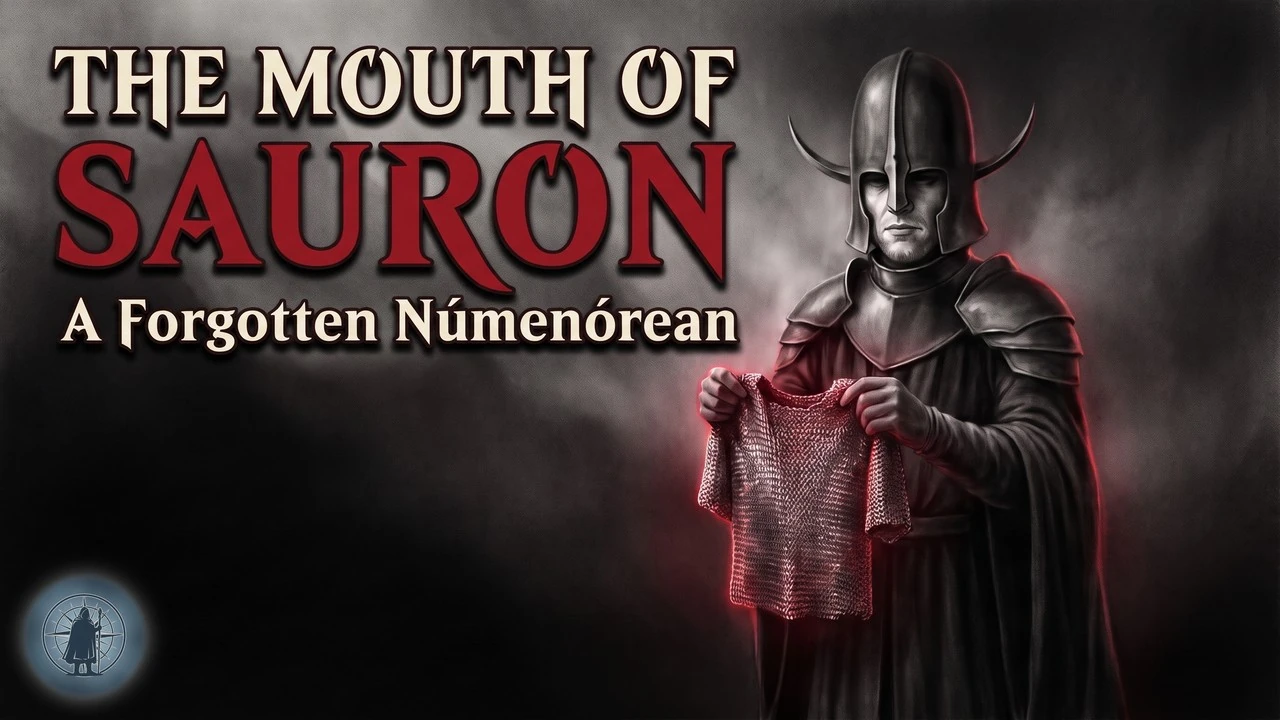 Watch the episode
Mouth of Sauron: The Man Who Forgot His Name | Tolkien Explained
SECTION: The Rider Who Came Out of the Black Gate
The army of the West marched out of Minas Tirith on the eighteenth of March, in the year thirty nineteen of the Third Age. Seven thousand men set out. The captains knew that was a small army to throw at Mordor. The point was to distract. To make Sauron look at them, and away from his own country, where Frodo and Sam, if they were still alive, were somewhere out on the plain heading for Mount Doom.
It took them a week to reach the Black Gate. Along the way, Aragorn let the men who couldn't face it turn back, and sent them off to retake the island of Cair Andros instead. Fewer than six thousand were left by the end. They set up on two low hills made of slag and ash, with a stretch of mud and stinking pools between them and the Gate.
Then a small party rode forward to call Sauron out. Gandalf went, and Aragorn, and Elladan and Elrohir, the sons of Elrond. Prince Imrahil of Dol Amroth went, and Éomer of Rohan, and Legolas and Gimli, and Pippin, who'd marched all that way as a soldier of Gondor. Merry was still back in the city, hurt in the Battle of the Pelennor Fields. Between them, almost every group of people standing against Mordor was represented there. Their heralds blew their trumpets and called for the Lord of the Black Land to come out and face justice.
For a long time, nothing answered.
Then the drums started, a long roll like thunder in the mountains, and then the horns. The door of the Black Gate opened with a great clang. A small group rode out under a single black banner with the red Eye on it. At its head was a tall rider on a huge black horse. The horse's face looked more like a skull than a living head, with fire burning in the sockets of its eyes and in its nostrils.
Tolkien described the rider. "The rider was robed all in black, and black was his lofty helm; yet this was no Ringwraith but a living man."
Then comes his title. This was the Lieutenant of the Tower of Barad-dûr. Right after that, Tolkien writes, "his name is remembered in no tale; for he himself had forgotten it, and he said: 'I am the Mouth of Sauron.'"
The rest of what Tolkien tells us about him fits in one paragraph. This man was a renegade, from "the race of those that are named the Black Númenóreans." His people had settled in Middle-earth while Sauron ruled there. They worshipped Sauron, "being enamoured of evil knowledge." This man "entered the service of the Dark Tower when it first rose again." He was cunning, so he rose higher and higher in his master's favor. He learned "great sorcery" and knew a great deal of what went on in Sauron's mind. He was crueler than any orc.
That's the entire biography. Tolkien never tells us his age or where he was born, or what became of him after that day. In the entire The Lord of the Rings, this man appears on just a handful of pages.
But almost every phrase in that paragraph points somewhere else. "Black Númenóreans" points back across the sea, to the island kingdom of Númenor that drowned at the end of the Second Age, more than three thousand years before the parley. "When it first rose again" points to a date Tolkien doesn't give us. "A living man" points at the Nine Ringwraiths, who weren't living anymore, and who'd been Men once too.
So the story of the Mouth of Sauron is mostly the story of his people. That story begins on an island in the middle of the sea, with an argument about death, and about where a Númenórean was allowed to sail.
SECTION: Who Were the King's Men of Númenor?
Númenor was the island the Valar, the angelic Powers of the world, raised out of the sea at the start of the Second Age. It was a gift for the Men who'd fought beside the Elves against Morgoth. The first Númenóreans lived three times as long as other Men. They were given one rule, which Tolkien calls the Ban of the Valar. They weren't supposed to sail so far west that they lost sight of their own island's coast. Out there were the Undying Lands, which weren't for mortals.
For a long time, they kept to it. Their ships sailed east instead, to Middle-earth, where the Men remembered them as teachers. The Númenóreans brought grain and wine, and showed the people of the coasts how to plant crops and work stone.
Then the mood on the island turned. The Númenóreans began to resent dying. The Elves who sailed over to visit them never died. The longer the Númenóreans lived, the less they wanted to stop. By the time of King Tar-Atanamir and his son Tar-Ancalimon, the island had split into two camps. One side stayed loyal to the Valar and friendly with the Elves. They were called the Faithful, or the Elf-friends. The other side backed the kings in resenting the Ban. They became the King's Men.
Appendix B dates the start of the rebellion and division of the Númenóreans to the year twenty-two fifty-one of the Second Age. The same entry says the Ringwraiths first appeared around this time.
The King's Men spent their lives trying not to die. The Silmarillion says they tried to delay death "by all means that they could." Their wise men worked without rest to find a way to call the dead back, or at least to make the living last longer. The one thing they actually managed was keeping dead bodies from decaying. And they filled their island with silent tombs.
They wanted more of everything else, too. So they went to Middle-earth to get it. According to Unfinished Tales, Tar-Ciryatan, Atanamir's father, was greedy for wealth and squeezed heavy tribute out of the Men on the coasts. Appendix B says that from about the year eighteen hundred, the Númenóreans began claiming territory along the shores of Middle-earth. The ships that used to carry teachers came home loaded with metals and jewels.
The split even showed up on the map. In twenty-two eighty, Umbar, a great natural harbor far down the southern coast, was made into a fortress of Númenor. It became the King's Men's stronghold. In twenty-three fifty the Faithful built Pelargir, up the great river Anduin, as their main harbor. Thousands of years later, in the Third Age, those two harbors would end up on opposite sides of a long war.
The King's Men also changed what their kings were called. In twenty-eight ninety-nine, a king took the throne under a title in Adûnaic, the Númenóreans' own language, instead of the Elvish their kings had always used. He called himself Ar-Adûnakhôr, which means Lord of the West. The Faithful thought that title belonged only to the Valar. Later kings banned the Elvish languages outright.
So the Mouth of Sauron came from a people whose kings had already given up their old Elvish names once, and whose stronghold in Middle-earth was Umbar.
Umbar is also where the last King of Númenor came ashore. Ar-Pharazôn seized the throne in thirty-two fifty-five. In thirty-two sixty-one he landed at Umbar with an enormous fleet, marched inland for seven days, and sent soldiers to command Sauron to come and swear loyalty to him.
Sauron came. He came out of Barad-dûr. He came out of Barad-dûr and knelt in front of a Númenórean king.
And then, Ar-Pharazôn took him home to Númenor as a hostage.
SECTION: Umbar and the Black Númenóreans After the Downfall
Sauron landed on Númenor as a prisoner in thirty-two sixty-two. Within a few years he was Ar-Pharazôn's closest adviser. Appendix B's entry for the next half-century says that Sauron seduces the King and corrupts the Númenóreans.
This is probably where the "evil knowledge" in the Mouth's biography comes from. Sauron brought the King's Men to worship Melkor, which was Morgoth's original name. Morgoth was the first Dark Lord, and Sauron's own old master. A temple went up in the capital, Armenelos. People were burned on its altar, most often men of the Faithful. The White Tree of Númenor, descended from the trees of the Undying Lands, was cut down and burned too. In those years, the King's Men sailed east and built forts on the coasts. They carried that teaching with them. The Silmarillion says many of them were already bent to Sauron's will.
In thirty-three nineteen, Ar-Pharazôn sailed against the Undying Lands, and as a result, Númenor was destroyed...sunk to the bottom of the sea.
Elendil and his sons escaped with nine ships of the Faithful. But the King's Men who happened to be in Middle-earth, survived too. They were in their forts along the southern coasts, a long way from the wave that ended Numenor. The Silmarillion names two of them, Herumor and Fuinur, lords who rose to power among the Haradrim, the great peoples south of Mordor.
Sauron survived as well. In thirty-three twenty he was back in Mordor. Before long he went to war against Elendil's new kingdoms. He attacked Gondor in thirty-four twenty-nine. The Last Alliance of Elves and Men beat his army on the plain of Dagorlad in thirty-four thirty-four, not far from where Aragorn's army would stand thousands of years later. After a seven-year siege of Barad-dûr, Sauron was overthrown in thirty-four forty-one.
The name, Black Númenóreans, is explained in a footnote in Appendix A, in the history of Gondor. It says Umbar was a stronghold of "the King's Men, who were afterwards called the Black Númenóreans." Sauron had poisoned their minds. Above everybody else, they hated the followers of Elendil. The footnote says that after Sauron fell, their race faded quickly, or blended into the other Men of Middle-earth. But that loathing of Gondor was handed down to their descendants undiminished.
That grudge turned into a long war over Umbar. In 933 of the Third Age, King Eärnil the First of Gondor laid siege to Umbar by land and sea, took it, and drove out its lords. The footnote says the harbor was only taken at great cost. Three years later, in 936, Eärnil was lost in a storm off Umbar with many of his ships and men. Then in ten fifteen, the lords of Umbar came back with the Haradrim behind them and besieged the city. Eärnil's son, King Ciryandil, was killed fighting them.
That's eighty-two years after those lords were driven out. Tolkien doesn't say they were the same men, but a long life would fit men with Númenor in their blood.
Gondor held on to Umbar anyway, and put up a monument there. On the highest hill above the harbor, the men of Gondor raised a great white pillar. They crowned it with a globe of crystal that caught the light of the sun and the moon. On a clear day it shone like a star that could be seen from the coasts of Gondor and far out to sea. It was a memorial to the day Ar-Pharazôn landed there and Sauron humbled himself. When Sauron rose again, his followers took Umbar and tore the pillar down.
By then Umbar had changed hands. In fourteen forty-eight, after a civil war in Gondor called the Kin-strife, the sons of Castamir, the usurper who'd lost that war, sailed to Umbar with everyone who'd follow them. They made it a refuge for every enemy of the king. The Corsairs of Umbar came from them. They were Gondorian rebels, a different people from the King's Men. After that, the old lords of Umbar mostly drop out of Gondor's history.
So when a Black Númenórean rides out of the Black Gate in thirty nineteen, he belongs to a people who'd mostly faded out of the histories more than fifteen hundred years earlier. And that certainly raises the question of how old he could possibly be.
SECTION: How Old Was the Mouth of Sauron?
Tolkien's only clue is one phrase in the biography. The Mouth "entered the service of the Dark Tower when it first rose again."
Barad-dûr has a long history of rising and falling. Sauron started building it around the year one thousand of the Second Age, and finished it around sixteen hundred, when he forged the One Ring. After the Last Alliance overthrew him in thirty-four forty-one, the tower was torn down. Its foundations survived, but it lay in ruins for nearly three thousand years.
Then, in twenty-nine fifty-one of the Third Age, Appendix B says Sauron declared himself openly, gathered his power in Mordor, and began rebuilding Barad-dûr. That seems like the natural place for "when it first rose again." On that reading, the Mouth of Sauron had been working for Sauron for sixty-eight years by the time we're introduced to him at the Black Gate. Sixty-eight years is plenty of time for a clever man to climb all the way to Lieutenant of the Tower.
That would make him old, but it's not impossible. If he walked into Mordor as a young man in twenty-nine fifty-one, he'd be nearly ninety at the Black Gate. That spring, Aragorn was eighty-eight years old. And he was riding to war in his prime. He was born on the first of March, twenty-nine thirty-one. The blood of Númenor still lengthened lives in the Third Age, at least among the Dúnedain, the descendants of the Faithful. A Black Númenórean with enough of that blood left in him could plausibly have been tall and strong at ninety. It's a little strange to think about, but the two men facing each other at the Gate might have been about the same age.
There's another way to take the phrase, though. Sauron's first return to Mordor came straight after the Downfall. In thirty-three twenty of the Second Age he was back in Barad-dûr, which hadn't been destroyed yet, with the One Ring in his hand again. You could interpret that as the rising Tolkien meant. That would make the Mouth an original King's Man, one of the Númenóreans who were living in Middle-earth when the island sank. if that's the case, he'd been at Sauron's side for more than three thousand years, kept alive by his great sorcery.
There's an issue with that though. The Mouth's own people spent centuries trying to stretch out their lives and failed. The King's Men's wise men had the entire learning of Númenor behind them. The best they ever did was keep their dead from decaying. In Tolkien's world, when a mortal lasts for centuries past his time, there's usually a Ring of Power involved. Even then, as Gandalf tells Frodo, a mortal who keeps one of the Great Rings doesn't get more life. He "merely continues, until at last every minute is a weariness." Nothing in the book puts a Ring on the Mouth of Sauron.
There's a footnote that tells us more of what happened to the Black Númenóreans: they "dwindled." That might mean their numbers dropped. It might mean their lifespans shrank, the way the lifespans of Gondor's own Dúnedain shrank over the Third Age. Tolkien doesn't say which.
So both readings stay on the table. The Third Age reading asks for an old man with good blood. The Second Age reading asks for something no King of Númenor ever managed. When we look at the dates, I lean toward twenty-nine fifty-one. But Tolkien left the phrase open. A man who couldn't tell you his own name might not have been able to tell you his age either.
SECTION: No Ringwraith: Why Sauron Sent a Living Man
At first glance, everything about the rider's arrival says Ringwraith. The black robes, the tall black helm, the horse with a skull for a face and fire in its eyes. The Nine had been riding in black since the first chapters of the book. That's probably why Tolkien stops, in the middle of the description, to cut off the obvious guess.
If Tolkien had wanted a Númenórean wraith, he had three of them ready. The Silmarillion says the Men who took the Nine Rings "became mighty in their day, kings, sorcerers, and warriors of old." Three of them were "great lords of Númenórean race." They got glory and wealth and what seemed like endless life, until that life became unbearable to them. Then they faded into the shadow and became the Ringwraiths. Appendix B puts their first appearance around twenty-two fifty-one, right beside the split in Númenor.
So three of the Nine and the Mouth come out of the same world. They're Númenórean lords and sorcerers, sworn to the same master. The difference is the Ring. The Nine fell under the power of the One long ago. Their will isn't really their own anymore. According to the book, the Mouth of Sauron wears no ring. Nothing is holding him in that Tower.
Tolkien's drafts show the character becoming freer, and more to blame, with each version. In the early drafts of this chapter, which Christopher Tolkien published decades later, the messenger was at one point a living man who'd been captured as a youth. In a later draft, he was the son of a wise and noble house of Gondor who desired evil knowledge and went over to the Dark Tower. Only in the published book is he a Black Númenórean.
Across those drafts, the messenger goes from a victim, to a man who was seduced, to a man born into Sauron's side who still went looking for the worst of it. A boy taken by force would have been somebody to pity, a little. Tolkien moved him, draft by draft, to a man nobody has to feel sorry for.
One thing from the Gondor draft survived, though. The desire for evil knowledge made it into the final version. The published book also calls him a "renegade." A renegade is somebody who abandons his own side. Kind of a strange word for a man whose people had followed Sauron for generations. It might be a leftover from the version where he was a man of Gondor. Or it might mean the side he abandoned was Númenor itself, the old Númenor that was friends with the Elves.
Either way, Tolkien left him without an excuse. Nothing was forcing him. Even his sorcery was something he'd studied. He rose in Sauron's favor because he was cunning, which tells us he wanted to rise. He was also crueler than any orc. In Tolkien's world, the orcs were twisted into what they are by Morgoth, long ago. But this man is one of the Children of Ilúvatar, which is Tolkien's name for God. Like every Man, he has a free will of his own. With that freedom, he went further than the orcs did.
I think that's why Tolkien made him a Man. For Tolkien, a devout Catholic, evil is something good that's been spoiled from the inside. The Ringwraiths were spoiled by their Rings, but the Mouth of Sauron did it to himself, one choice at a time.
Being alive also gives him the ordinary protections of Men, which a wraith would never need. When the situation at the Black Gate starts to go wrong, the first thing he reaches for is a law made by Men.
SECTION: Gandalf's Parley with the Mouth of Sauron
The Mouth of Sauron stopped a few paces in front of the Captains of the West, looked them up and down, and laughed. He asked whether anybody in this crowd had the authority to deal with him, or the wit to understand him. Then he turned on Aragorn. It takes more than a piece of Elvish glass to make a king, he said, and any brigand in the hills could show as good a following. The glass is probably the green Elfstone that Galadriel gave Aragorn in Lórien.
Aragorn didn't answer. He stared down the Mouth. For a moment the two of them fought it out like that, eye to eye. Then the Mouth flinched and backed away, as if someone had swung at him, though Aragorn hadn't moved a hand.
"I am a herald and an ambassador, and may not be assailed!" the Mouth cried.
"Where such laws hold," Gandalf said, "it is also the custom for ambassadors to use less insolence." Nobody had threatened him, Gandalf told him, and he had nothing to fear until his errand was done.
So the Mouth turned on Gandalf, mocked him as an old greybeard, and had a guard bring forward a bundle wrapped in black cloth. Out of it he held up Sam's short sword. Then a grey cloak with an Elven brooch. Last of all came the coat of mithril mail Frodo had worn, wrapped in his ragged clothes.
A blackness came over the Captains' eyes. Pippin sprang forward with a cry of grief, and Gandalf pushed him back. The Mouth laughed out loud. Gandalf said he knew every one of these things and all their history. The Mouth named the tokens himself: "Dwarf-coat, elf-cloak, blade of the downfallen West, and spy from the little rat-land of the Shire."
Gandalf was right about the history. Sam's sword was one of the blades Tom Bombadil gave the hobbits on the Barrow-downs, forged long ago by Men of Westernesse in the North, who fought the kingdom of Angmar. Men of Númenor's blood made that sword, and now a man of Númenor's blood was holding it up to mock the West.
Then came the threat. The spy, the Mouth said, would "endure the slow torment of years, as long and slow as our arts in the Great Tower can contrive," and never be released, unless they accepted his Lord's terms.
Gandalf asked to hear them. To the men standing near him, he suddenly looked like an old, withered man, crushed and defeated at last.
The terms were total. The army of the West would withdraw over the Anduin and swear never to attack Sauron again. Everything east of the Anduin would be Sauron's, forever. Everything west of it, as far as the Misty Mountains and the Gap of Rohan, would pay tribute to Mordor. The men there could carry no weapons. They'd also rebuild Isengard for Sauron, as a home for his lieutenant, "not Saruman, but one more worthy of trust." The Captains looked in the Mouth's eyes and could tell who he meant. He meant himself, as the tyrant of the West, with all of them as his slaves.
But Gandalf wasn't finished. What guarantee did they have that Sauron would keep his side of it? Where was this prisoner? Let him be brought out and handed over first.
For a quick moment, the Mouth of Sauron didn't know what to say.
Then he laughed again. "Surety you crave! Sauron gives none."
That hesitation gives the game away. The Mouth had Frodo's things, and nothing else. That same day, Frodo and Sam were climbing Mount Doom. In all his gloating, the Mouth never once said his master has the Ring.
Gandalf threw back his cloak, and a white light shone out of him like a sword. He took the tokens out of the Mouth's hands. "These we will take in memory of our friend," he said. Gandalf rejected the terms completely. He told the Mouth his mission was over and death was near him, and that they hadn't come to bargain with Sauron, "still less with one of his slaves."
So Gandalf calls him a slave, even though, as far as we know, no Ring was holding him.
The Mouth fled back toward the Gate. As he went, his soldiers blew their horns, a signal arranged long before. The army of Mordor poured out of the Gate, with more coming down from the hills on either side, ten times the West's number and more. It was a trap all along.
SECTION: Mordu, Estel and the Mouth of Sauron's Lost Name
Here's the line about the Mouth's name again, from the moment he rode out. It comes in two halves, joined by the word "for,": "his name is remembered in no tale; for he himself had forgotten it."
The first half sounds like ordinary history. Plenty of people in Middle-earth's past are remembered in no tale, usually because too much time has gone by. The second half puts the loss back on him. No tale remembers his name because he'd let go of it himself, long before any storyteller had the chance.
So history didn't lose his name. He did.
Tolkien did give him a name once. In an outline for this part of the book, Sauron's messenger is called Mordu. Scholars of Tolkien's languages think it probably meant "Black Night" in an early form of Elvish. By the time the book was finished, Tolkien had taken it away.
Instead, the Mouth calls himself by what he does: "I am the Mouth of Sauron." His title is the part of the body that speaks, followed by his master's name. He says Sauron's name freely, too. Earlier in the book, Aragorn mentions that Sauron doesn't use his right name, and won't allow it to be written or spoken. But his own Lieutenant says "Sauron the Great" to the Captains' faces. So the only name this man still says out loud is his master's.
The Mouth isn't the only servant of Sauron without a name. Tolkien never tells us the Witch-king's name either, but Tolkien never says the Witch-king had lost track of it. Sméagol is a closer match. His family started calling him Gollum after the horrible swallowing noise he made in his throat. When Frodo called him Sméagol again, something of the old hobbit came back, at least for a while. At the Black Gate, nobody could do that for the Mouth of Sauron. Nobody there knew his name.
Now let's go back to twenty-nine fifty-one. Appendix B has a single entry for that year. Sauron declares himself, and begins rebuilding Barad-dûr. In the same entry, Elrond reveals to "Estel" his true name and ancestry.
Aragorn grew up in Rivendell as Estel, which means Hope. Elrond kept Aragorn's real name and family a secret, because Sauron was hunting for the heir of Isildur. In twenty-nine fifty-one, at twenty years old, Aragorn was given his name back, along with the shards of Narsil.
If "when it first rose again" means twenty-nine fifty-one, then the Mouth's years in the Tower began that same year. In one entry of Tolkien's timeline, Aragorn is told who he is, and Sauron starts rebuilding the tower where another man would lose his name. The two of them met at the Black Gate sixty-eight years later. Aragorn rode there under his own name, as the heir of Elendil, but the Lieutenant came out under his master's.
Back in thirty-two sixty-one, a King of Númenor brought Sauron to his knees at Umbar. Now Sauron sent a Númenórean out of his Gate to bring the West to its knees. Aragorn beat him in a staring match without saying a word.
When Gandalf refused him, the Mouth of Sauron lost his words too. Tolkien writes that the Mouth's face twisted like a wild animal's, one that's crouching on its prey and gets struck across the muzzle with a stinging rod. Rage took him over. He was foaming at the mouth, and "shapeless sounds of fury came strangling from his throat." For once, the Mouth of Sauron had nothing to say.
Then he galloped back through the Gate. That's the last we see of him. Before that day was over, the Ring went into the fire, Barad-dûr fell, and Sauron was destroyed. We never know what happens to his Lieutenant. When Aragorn was crowned, he pardoned the Easterlings who had surrendered and made peace with the peoples of Harad. So the men who fought for Sauron were shown mercy. Whether the Mouth of Sauron lived long enough to be offered mercy himself, we'll never know.