
Research & Sources
Mouth of Sauron
The Man Who Forgot His Name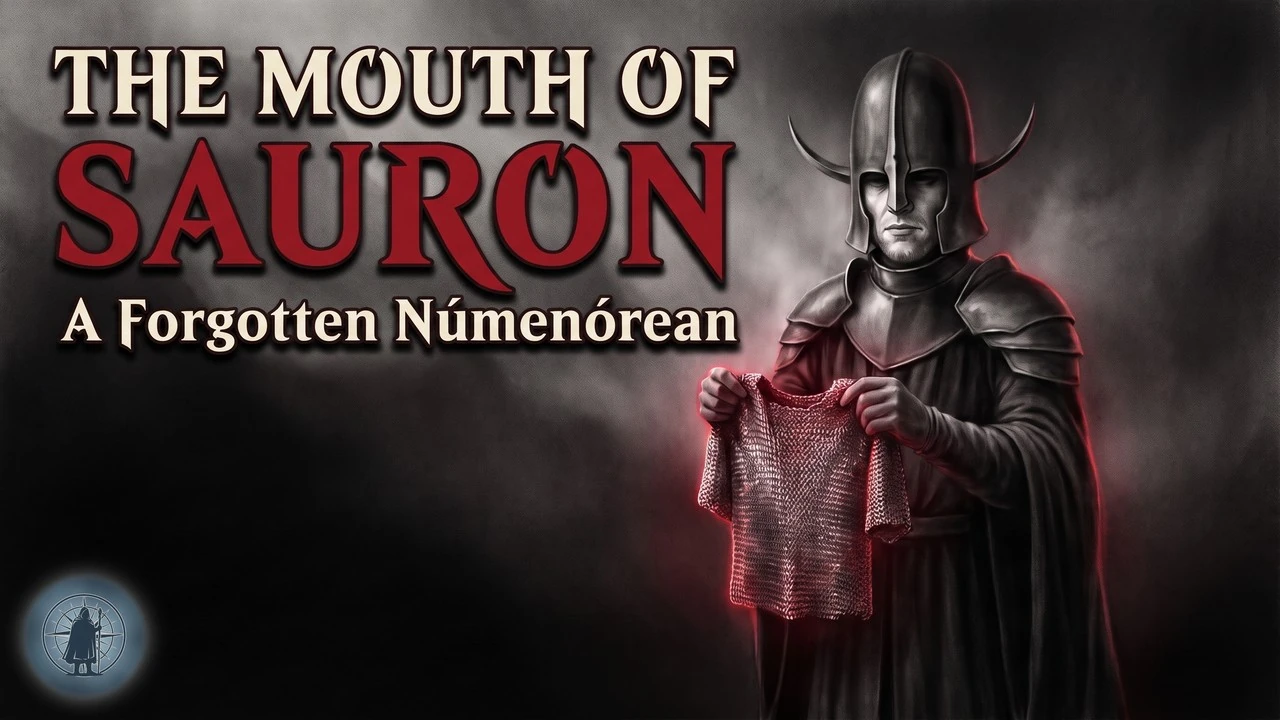 Watch the episode
Mouth of Sauron: The Man Who Forgot His Name | Tolkien Explained
Research Notes: The Mouth of Sauron, the Númenórean Who Forgot His Name
Read this first (honest depth statement)
The topic supports 8 distinct themes, but its evidence has a shape the writer must respect:
- The Mouth himself is thin. Everything Tolkien wrote about him on the page is one scene (RotK V.10, "The Black Gate Opens", about pp. 888-892) plus a one-paragraph biography inside it. Add one draft note (HoME VIII) and an incidental title in the Guide to the Names. The rest of the episode has to be built from the world around him: the King's Men, the Black Númenóreans, Umbar, the Downfall, Appendix A/B. That is a strength (the episode is "the end of the Númenor corridor") but means the Mouth sections must not be inflated with invention. - Fan inference is rife. Names ("Ûrzahil of Umbar"), his age, "Gúrzyul", "Dulgabêth", his fate, his torturing Gollum are all from games or adaptations (MERP, LOTRO, 1981 radio), NOT Tolkien. Do not use them as canon. Flagged below. - Verbatim-quote status. Sandbox/robots limits meant I could not read a clean full text of RotK. Quotes marked [V] were confirmed in a fetched secondary page that quoted the book. Quotes marked [VERIFY] are from my recall of the text and must be checked against print before the script uses them in quotation marks. The Anduin site turned out to be a manuscript-scan index, not a verbatim transcription (the house note about it is out of date for this purpose). - Pagination. Tolkien Gateway cites the whole scene as RotK "The Black Gate Opens", pp. 888-892 (their edition; the Mouth's description/biography is p. 888). Treat page numbers as edition-specific.
Overview
Chapter RotK V.10, "The Black Gate Opens", is the Host of the West's last stand at the Morannon on 25 March T.A. 3019. Before the fight, the Black Gate opens and a single rider comes out. Tolkien introduces him in a few lines: tall, robed in black, in a lofty black helm; "no Ringwraith but a living man"; of the race of the Black Númenóreans; in Sauron's service since the Dark Tower "first rose again"; master of "great sorcery"; and so long a servant that "his name is remembered in no tale; for he himself had forgotten it." He calls himself "the Mouth of Sauron". He lays Frodo's and Sam's belongings before Gandalf, offers terms that amount to the surrender of the West, and is dismissed by Gandalf; he flees to the Gate and the doors open on the army of Mordor.
What makes the scene work for a lore episode is where the man comes from. The Black Númenóreans are the last living branch of the story Tolkien told in the Akallabêth: the Númenóreans who sided with the Kings against the Valar, were corrupted by Sauron on the island and on the coasts of Middle-earth, and survived the Downfall because they were abroad. The Mouth of Sauron is therefore, in Tolkien's own scheme, the last visible fruit of the Ar-Pharazôn corruption, standing in front of the last visible fruit of the Faithful (Aragorn, Heir of Isildur, last Númenórean-line king of the Dúnedain) on the last day of Sauron's power. About 3,141 years separate the Downfall from the Morannon (S.A. 3319 to the end of the Second Age at 3441 is 122 years; plus T.A. 3019 = 3,141. Derived number, not stated by Tolkien.)
Tolkien's chosen shape for this man: a Man, not a Wraith. That choice, plus the forgotten name, is the moral spine of the episode.
Primary Sources
The Return of the King, V.10 "The Black Gate Opens"
Quotes (status in brackets):
- "The rider was robed all in black, and black was his lofty helm; yet this was no Ringwraith but a living man." [V, quoted on visionofthepalantir.com blog] - "...his name is remembered in no tale; for he himself had forgotten it, and he said: 'I am the Mouth of Sauron.'" [V, same source; fandomentals confirms the "forgotten it" clause] - Origin, as reported by Tolkien Gateway from p. 888 (paraphrase of Tolkien's phrases): he "entered the service of the Dark Tower when it first rose again"; "learned great sorcery" and "knew many of the Dark Lord's plans"; rose in "favour" through cunning; "more cruel than an Orc". [Phrase "entered the service of the Dark Tower when it first rose again" is a direct quotation repeated in two Tolkien Gateway articles. The "more cruel than an Orc" and "enamoured of evil knowledge" fragments are likewise quoted there. VERIFY exact surrounding sentence against print.] - The Black Númenórean clause, to be checked: "He was a renegade, who came of the race of those that are named the Black Númenóreans, ... worshipped Sauron, being enamoured of evil knowledge." [VERIFY; Tolkien Gateway quotes "enamoured of evil knowledge" and "the race of those that are named the Black Númenóreans" (xenite.org quote)] - On the tokens: "dwarf-coat, elf-cloak, blade of the downfallen West, and spy from the little rat-land of the Shire" [V, fandomentals]. Gateway's scene page: the tokens are Sam's short sword, a grey cloak with an elven brooch, and the mithril coat. [Items per Tolkien Gateway; the line is repeated by multiple sources.] - "Surety you crave! Sauron gives none. If you sue for his clemency you must first do his bidding." [V] - On Frodo's fate, the Mouth's threat: he "shall endure the slow torment of years, as long and slow as our arts in the Great Tower can contrive" and will not be released "unless maybe when he is changed and broken, so that he may come to you, and you shall see what you have done." [V, fragments] - The herald-law exchange (reproduced on Tolkien Gateway from the book): the Mouth cries "I am a herald and an ambassador, and may not be assailed!" and Gandalf answers "Where such laws hold, ... it is also the custom for ambassadors to use less insolence. But no one has threatened you. You have naught to fear from us ..." [V via Tolkien Gateway; the scene is "Book V, Chapter 10"] - The terms (recalled; [VERIFY]): all lands east of Anduin Sauron's forever; lands west of Anduin to the Misty Mountains and the Gap of Rohan tributary to Mordor, the Men there to bear no weapons but govern their own affairs; the West to rebuild Isengard, "and that shall be Sauron's, and there his lieutenant shall dwell: not Saruman, but one more worthy of trust." Gandalf then reads the meaning: the Mouth meant himself to be that lieutenant, "and gather all that was left in the West under his sway, and be their tyrant and they his slaves." [VERIFY the exact wording. The gist is well attested; Gateway's own summary says the demands included the restoration of Isengard, "from which he believed he would rule over the lands west of the Anduin under Sauron".] - The insult to Aragorn (recalled; [VERIFY]): "It needs more to make a king than a scrap of elf-glass, or a rabble such as this. Why, any brigand of the hills can show as good a following!" Interpretive note: "elf-glass" most likely the green Elessar brooch Galadriel gave Aragorn; Tolkien does not say. [Interpretation, flag as such] - Gandalf's dismissal (recalled; [VERIFY]): he takes the tokens "in memory of our friend", rejects the terms utterly, and tells the Mouth that his embassy is over and that death is near him. The Mouth, "amazed and afraid", flees; Gateway: he "rode back to the Black Gate, let it be opened, and the forces of Sauron marched out." Pippin's grief at the sight of Frodo's things and Gandalf's "Peace!"-style restraint are also in the scene. [VERIFY] - Frodo's real state at the time: not captured by Sauron's lieutenants at all in the sense claimed; the tokens came from the Tower of Cirith Ungol where orcs stripped Frodo; Sam rescued him. Sauron's forces had the items, not the Ring-bearer. (Cross-check against RotK VI.1 "The Tower of Cirith Ungol" and VI.2 "The Land of Shadow" when drafting.)
The Silmarillion, Akallabêth and "Of the Rings of Power and the Third Age"
- The party split: the King's Men vs the Faithful. The King's Men take their name from supporting the Kings' policy of defiance of the Ban of the Valar. Gateway cites Silm. Akallabêth (paragraphs ~15-24) and Unfinished Tales, "The Line of Elros", for Tar-Ciryatan and Tar-Atanamir. - After Tar-Atanamir "the King's Men ... had the support of most of the Kings." They are "quick to anger" and "drank and they feasted and they clad themselves in silver and gold" while fearing death. [Quotations as given in Tolkien Gateway King's Men article; VERIFY wording in Akallabêth] - Under Sauron's influence they "cursed themselves in their agony" (the sickness-and-madness passage). [Gateway quotation; VERIFY] - Sauron as the man who walks "setting man against man". [Gateway; VERIFY] - "Of the Rings of Power": three of the Nine were "great lords of Númenórean race" [Gateway quotation; Silm. p. 288 or thereabouts in most editions, VERIFY]. Sauron "gathered great strength of his servants from the south, including many Black Númenóreans" is Gateway's gloss (it cites the same chapter for Herumor and Fuinur). The Silmarillion itself names two Númenórean lords in the South: Herumor and Fuinur, who "rose to great power among the Haradrim". [Names and their summary are widely attested; VERIFY phrasing.] - Elendil's pursuit/"Of the Rings of Power": Sauron attacks Gondor in S.A. 3429; the Last Alliance; Dagorlad S.A. 3434; siege seven years; Sauron's defeat S.A. 3441 (Appendix B).
The Lord of the Rings, Appendix A (I.iv, "Gondor and the Heirs of Anárion") — the footnote that names them
The only place Tolkien defines the term "Black Númenóreans" in the published LotR is the footnote on Umbar attached to King Eärnil I (about pp. 1044-5 in the Gateway edition citations). Content (paraphrase, verify wording): Umbar had been a stronghold of the Men of Númenor, held by the "King's Men", Númenóreans corrupted by Sauron who hated the followers of Elendil; after the Downfall they were called the Black Númenóreans; after Sauron's fall in the War of the Last Alliance their race "dwindled" swiftly or "became merged with the Men of Middle-earth", yet their descendants kept hold of Umbar and "inherited their hatred of Gondor". [Gateway quotes "dwindled" and "became merged"; the rest is Gateway's reading of the footnote.]
Appendix A Gondor entries relevant here: Eärnil I took Umbar in T.A. 933; was lost at sea off Umbar with many ships in 936 (aged 200); his son Ciryandil was slain in 1015 when the Haradrim, led by "the lords of Umbar" driven out in 933, besieged Umbar. The lords of Umbar were still active 82 years later, which implies longevity (Gateway's inference; Tolkien does not say they were Black Númenóreans specifically).
The Lord of the Rings, Appendix B, "The Third Age" / "The Second Age"
Anchor dates (Gateway cites these entries; most are well known; verify day/month): - S.A. 2251: Tar-Atanamir takes the sceptre; "about this time the Ringwraiths first appear". [As I recall; VERIFY the exact sentence. Gateway cites entry 2251 for tribute and oppression.] - S.A. 3261: Ar-Pharazôn lands at Umbar. S.A. 3262: Sauron taken to Númenor. S.A. 3319: Downfall. S.A. 3429: Sauron attacks Gondor. S.A. 3434: Dagorlad. S.A. 3441: Sauron overthrown, Isildur takes the Ring; Second Age ends. - T.A. 933 / 936 / 1015: Umbar taken by Gondor, Eärnil lost, Ciryandil slain at the siege. - T.A. 2941: White Council drives Sauron from Dol Guldur. T.A. 2951: Sauron openly declares himself; Barad-dûr rebuilt. T.A. 3018-3019: War of the Ring. 25 March 3019: Morannon; Ring destroyed.
The Dark Tower "first rose again" problem lives in this gap (see Theme 4).
Unfinished Tales
- "The Line of Elros: Kings of Númenor": Tar-Ciryatan and Tar-Atanamir "oppressed" Middle-earth Men and "levied heavy tribute"; the colonies from which the Black Númenóreans would descend. - "The Istari", note about the earlier days of Gandalf's journeys to Harad: Gateway cites this for the idea that the South held centres of Sauron-influenced Númenórean settlement; not directly about the Mouth.
The Peoples of Middle-earth (HoME XII)
- "The Tale of Years of the Second Age" (manuscript T4, entries 2000-3000): King's Men settle south of Middle-earth; background for Umbar.
The Letters
- Letter 156 (4 Nov 1954, draft to Robert Murray, unsent) is cited by Tolkien Gateway for the Black Númenóreans ("Sauronians"). Weak link: the Gateway Letter 156 article does not mention them in its summary. Do not use Letter 156 for the Mouth until the specific passage is located in print. What Letter 156 does carry that is relevant: its summary of Númenórean theology (monotheism, the Ban, the rebellion "influenced by Sauron"). - Letter 131 / 183 (Sauron's psychology; "the only measure that he knows is desire, desire for power") are the better pegs for why a servant like the Mouth is useful to him; these are in the Gollum/Sauron research and are not re-verified here.
The War of the Ring (HoME VIII)
- "Part Three: Minas Tirith", III "Minas Tirith", p. 256: an outline of Book V in which the name of Sauron's messenger at Dagorlad is "Mordu"; Christopher Tolkien notes the last two letters could be read "du" (p. 267, note 32). Eldamo: Mordu = "*Black Night" (morn + dû), a Noldorin-form name; Mark Fisher (Encyclopedia of Arda) suggested the same. - XIII "The Black Gate Opens", p. 431: an earlier draft made the messenger "a living man ... captured as a youth"; a later draft made him "the son of a house of wise and noble men in Gondor who desired evil knowledge and entered the service of the Dark Tower" (Gateway's summary). [Secondary summary only; VERIFY phrasing in HoME VIII.] Significance: in the draft he was a Gondorian seduced by Sauron; in the published text he is of the Black Númenórean race, which makes him a different kind of fall (inherited rather than recruited).
Tolkien's "Guide to the Names in The Lord of the Rings"
- In a note on the Witch-king, Tolkien refers to "the Lieutenant of Barad-dûr" (Gateway cites this). VERIFY that this phrase there refers to the Mouth and not the Witch-king; Gateway says it refers to the Mouth. Nomenclature entries are in Hammond & Scull's Reader's Companion. The published LotR title is "Lieutenant of the Tower of Barad-dûr" (Gateway infobox).
Timeline
| Date | Event | Source / status | |---|---|---| | S.A. c. 1000 | Sauron begins Barad-dûr in Mordor | Gateway/EoA; Appendix B lists it | | S.A. 1700 | Sauron defeated by Númenór + Lindon (Tar-Minastir's aid) | Appendix B | | S.A. 2251 | Tar-Atanamir takes the sceptre; the Ringwraiths first appear; oppression of Middle-earth Men increases | Appendix B (as cited in Gateway); VERIFY | | S.A. 2280 | Umbar first fortified by Númenóreans | Gateway Umbar infobox ("First fortified in S.A. 2280"; they cite Appendix B/UT) | | S.A. 3261 | Ar-Pharazôn lands at Umbar, marches 7 days, demands fealty | Silm./Appendix B; Gateway | | S.A. 3262 | Sauron taken hostage to Númenor; becomes Zigûr, adviser | Appendix B | | S.A. 3262-3319 | 57 years of Sauron at court; Temple; sacrifices | Silm. (derived span) | | S.A. 3319 | Downfall; King's Men in Middle-earth survive | Silm. | | S.A. 3320 | Elendil lands; Gondor/Arnor founded; Sauron returns to Mordor in a new, fearful shape | Silm./Appendix B | | S.A. 3429-3441 | Sauron attacks; Last Alliance; Dagorlad 3434; siege 7 yrs; Sauron overthrown | Appendix B | | T.A. 933 | Eärnil I takes Umbar; its lords driven out | Appendix A/B | | T.A. 936 | Eärnil lost at sea off Umbar | Appendix A | | T.A. 1015 | Ciryandil slain in the siege of Umbar | Appendix A/B | | T.A. 2941 | Sauron driven from Dol Guldur | Appendix B | | T.A. 2951 | Sauron declares himself; Barad-dûr rebuilt ("the Dark Tower first rose again" per the usual reading) | Appendix B | | T.A. 3017 | Gollum captured by Sauron's agents; "Baggins" and "Shire" revealed | Appendix B (verify year) | | T.A. 3018 | Messenger from Mordor to Dáin Ironfoot asks after a hobbit | Appendix A (Durin's Folk); Gateway dates it 3017, a conflict; use text, not the Gateway date, and note that Tolkien never names the messenger. | | T.A. 3019, 10-25 March | Host of the West leaves Minas Tirith 10 March (verify), arrives at the Morannon 25 March; parley; battle; Ring unmade | Appendix B / RotK | | T.A. 3019 | Mouth's fate unrecorded | "nowhere recorded" (Gateway) |
Derived intervals (mark as derived in the script): 2951 to 3019 = 68 years of the rebuilt tower. Sauron's captivity-adviser stretch 3262-3319 = 57 years. Eärnil 933 to Ciryandil 1015 = 82 years.
Key Characters
The Mouth of Sauron
- Titles: "the Mouth of Sauron" (his own); "Lieutenant of the Tower of Barad-dûr"; "the Messenger" (Gateway infobox). Name: forgotten, "remembered in no tale". Draft name "Mordu" (WR 256). Race: Man, of Black Númenórean descent. Look: tall, robed in black, lofty black helm, black horse (Gateway; in the book the helm shadows the face). Arts: "great sorcery." Fate: not recorded. - Counterexamples to avoid: "Ûrzahil of Umbar" (MERP, Iron Crown Enterprises, 1987/1990), "Gúrzyul", "Dulgabêth the Black Word" (LOTRO 2017), Peter Jackson's "Lammen Gorthaur" helm and death by Aragorn (2003 extended edition) are NOT Tolkien. Gateway notes the film beheading is "criticized by purist"; in the book Gandalf accepts the herald's immunity and lets him run. - Was he the messenger to Dáin? Unknown. Gateway: "It is not known if..." Michael Martinez prefers a Nazgûl.Sauron
- In the scene he never appears; the Mouth is his voice. Sauron "did not allow the name Sauron to be written or spoken" (Gateway paraphrases Aragorn, TT "The Departure of Boromir", p. 416; VERIFY, I suspect Gateway's citation is off) yet his own servant uses "Sauron" freely: a real Tolkien inconsistency that fans explain as the Mouth using the name only to outsiders.Aragorn / Gandalf / Imrahil / Elrond's sons
- Aragorn says nothing for most of the scene ("did not stir nor move hand to weapon") and the Mouth recoils; Gandalf does the talking; Elladan, Elrohir and Imrahil are present (the film omits them).The wider Black Númenórean cast (all "canon-light")
- Herumor and Fuinur: Númenórean lords of the Haradrim "rose to power", Silm. Names: Herumor Quenya "Black Lord"? (heru + morë; Eldamo/Strack), Fuinur Sindarin fuin "gloom" + unclear suffix (Christopher Tolkien in the Silm. appendix). - Berúthiel: Gateway files her under Black Númenóreans, citing Unfinished Tales/Festival in the Shire (Daphne Castell) and Carpenter's The Inklings. Tolkien's own note: wife of Tarannon Falastur, "nefarious, solitary and loveless", cats and spies, name struck from the records; the "Black Númenórean" label is the Gateway's inference. Flag as inference; she is T.A. 830-913 and therefore a Third Age woman with possible Umbar links, which supports the point that the label stretched. - Ar-Pharazôn / Sauron's Númenor court: the episode opened by the 2026-10-06 Ar-Pharazôn episode. The Mouth is its "afterlife". - The three Númenórean Nazgûl (Silm.): "great lords of Númenórean race" who fell to Rings. Contrast: they are the ring-bound Númenóreans; the Mouth is the ring-free one.Geography
- Black Gate / Morannon / Cirith Gorgor at the northwest of Mordor; the Toothed Towers (Narchost, Carchost) either side. The Host of the West stands on two ash-and-slag hills on the Dagorlad side, with "mire of mud and stinking pools" before them (Gateway Battle article). - Barad-dûr: "the Dark Tower", begun c. S.A. 1000, thrown down S.A. 3441 (not utterly: its foundations remained, says Gateway/EoA); rebuilt after 2951. - Umbar: great natural haven south of the mouth of Anduin at the Bay of Belfalas; the Gateway describes a peninsula bending to almost close the harbour. First fortified S.A. 2280; Ar-Pharazôn's landing site (3261); a great white pillar with crystal globe built after Eärnil's conquest as a monument to Sauron's submission; Sauron's servants threw it down after 2951 (Gateway on Umbar, citing Appendix A). A neat image for the Mouth's world: the submission monument thrown down, Sauron's heirs pulled it down. - Harad: where Herumor and Fuinur rose; Sauron's southern man-power source. - Mordor's seat for the Mouth: Barad-dûr, which in the 68 years since 2951 became the pivot of administration for Sauron.
Themes and Symbolism
- Name as soul: in Tolkien's world names carry weight (Elvish names of power; the Nazgûl nameless; the Mouth nameless). The servant who forgot his name has become his office. Consistent with Tolkien's idea that the Enemy's service is a reduction of the self. - Domination of wills (Letters 131/183): the Mouth is not compelled by a Ring; he chose and the choice eroded him. This is a deliberately Catholic moral shape: evil as privation. - Chosen mortality: the King's Men feared death; the Mouth shows what an artificially extended life looks like once it has been given to evil. Tolkien's core Númenór theme (Gift of Men) read backward. (Gateway's age note: sorcery plausibly prolonged his life.) - Parley as test of mercy and truth: the Mouth is a liar who tells half-truths: the tokens are true; the claim that Frodo is a captive is false (or at least Frodo's fate unknown to him). Gandalf, who knows the Quest is alive, reads the offer as proof of his failure to find the Ring; this is also, as in Letter 156's thread, the Istari's refusal to dominate. - Mirror: Ar-Pharazôn demanded Sauron's fealty at Umbar in 3261, and Sauron "humbled himself" and came. In 3019 Sauron sends a Númenórean to demand the West's fealty. The humbling comes full circle (interpretation, but strongly supported by the texts).
Scholarly Perspectives
Honest note: I found no peer-reviewed essay devoted to the Mouth of Sauron. Open-web material is reference-wiki, fan essays and study-guide commentary.
- Michael Martinez (Xenite), "How Old Was the Mouth of Sauron?": argues the Mouth need not be thousands of years old; the "first rose again" phrase is best read as the T.A. 2951 rebuilding, giving 68 years of service and making him a Third-Age Black Númenórean of Umbar or Harad. Gateway calls this "more feasible". [Secondary, fan-scholarship, flagged as interpretation.] - Robert Foster, Complete Guide to Middle-earth (p. 274): the other reading: if the Tower first rose in the Second Age (after S.A. 3320), he would be an original King's Man who prolonged his life by sorcery. - Encyclopedia of Arda (Mark Fisher): estimates he entered service c. T.A. 2951; even a young recruit would have been 80+ in 3019; Númenórean blood may have slowed aging; ties "Mordu" to "Black Night". - Shmoop/popular reading: his lost name = total identification with function. Popular, not scholarly; label accordingly. - Reader's Companion (Hammond & Scull), p. 20 and Guide to Names: cited by Gateway for the "Lieutenant of Barad-dûr" title note. - The "name taboo" puzzle: reasoned fan resolutions: he uses "Sauron" only for outsiders; or Aragorn's remark is loose. No scholar confirmation found.
Contradictions and Variants
1. Origin variants in HoME VIII: earlier "living man captured as a youth" vs later "son of a house of wise and noble men in Gondor" vs published "Black Númenórean ... renegade". Three different falls: abducted, seduced Gondorian, hereditary. 2. "First rose again" ambiguity: Second Age (after S.A. 3320: Sauron's return and the Dark Tower rising again after the Downfall) vs Third Age (T.A. 2951). Gateway's footnote lays out both. A third possibility: the Tower "first rose" under Sauron c. S.A. 1000-1600 and the Mouth's service dates "when it first rose again" after the Last Alliance's razing: i.e. Tolkien's wording is simply open. 3. Black Númenórean chronology puzzle (EoA): Appendix A footnote says the Black Númenóreans came from the King's Men; but the King's Men as a party only appear c. S.A. 2251+ ("more than four centuries" after Sauron's earlier mischief per EoA). Appendix B puts the "Black Númenórean" lords in the late Second Age. Not contradictory, but the terms drift: Silm. uses "King's Men"; "Black Númenóreans" appears first in the LotR appendix. 4. Corsairs ≠ Black Númenóreans: the Corsairs of Umbar from T.A. 1448 are descendants of Castamir's rebel Gondorians (Kin-strife). Gateway's Umbar page lumps "Black Númenóreans, Gondorians, Corsairs". Keep these distinct. [Cross-check Appendix A, Castamir.] 5. Messenger to Dáin: 3017 per Gateway vs 3018 per Appendix; identity unknown. 6. Troop numbers: Gateway's infobox has "60,000+" for Sauron's army in the battle; Tolkien gives no number. Text gives about 6,000 for the West (7,000 leaving Minas Tirith; ~1,000 sent to Cair Andros) and the enemy as outnumbering them "ten times and more". "60,000" is a fan inference; do not use as canon. 7. Film vs book: Jackson (extended) has Aragorn decapitate the Mouth; in the book Gandalf upholds the herald's law and the Mouth flees. Film also moves the "tokens" focus to the mithril coat only (the book has sword, cloak, mithril). The brief's "Frodo's mithril coat" is accurate but incomplete.
Linguistic Notes
- Mouth of Sauron: Sindarin/rendering in the film, "Lammen Gorthaur" = "Tongue of Sauron" (Gateway calls it "Voice of (Sauron) the Abominable"); not Tolkien's text. Tolkien never gave a Sindarin form as far as I found. - Sauron: Quenya Sauron "Abhorred" (Gateway cites Q.; Tolkien's Silm. appendix gives Q. saura "foul, putrid"). - Black Númenóreans (Appendix A) uses the English "Black"; the Adûnaic "Zigûr" (Sauron's Númenórean title, "Wizard") applies to the Sauron they served. - Mordu: Noldorin-form "*Black Night": morn "black" + dû "night/late evening" (Eldamo, after Mark Fisher; WR 256, 267 n.32). - Herumor: heru + morë "Black Lord"; Fuinur: fuin "night, gloom" (Silm. appendix, per Gateway). - Lieutenant: English title; "Lieutenant of the Tower" is a place-bound office (the Witch-king is Sauron's lieutenant in the field). The two offices are distinct: Tolkien gives the Mouth a residence-office and the Witch-king a command-office.
Additional Context
- Relation to the 2026-10-06 Ar-Pharazôn episode: the corridor runs Zigûr's 57 years at Ar-Pharazôn's court, Downfall, Umbar and the southern lords, Herumor/Fuinur, the 933-1015 Umbar contest, and the Mouth in 3019. - The Mouth is also, structurally, the mirror of Saruman's offers: both ask the West to treat. Saruman asks "a parley". The Mouth is the same device, but in Sauron's voice. Gandalf's reply ("the herald's law, then less insolence") shows the code of Tolkien's old heroic literature (herald immunity). - Film note (for audience expectations): the extended edition puts the scene in the RotK film; many viewers know the beheading and the large disfigured mouth; the book describes neither. A cold-open hook could use that gap: "In the film he loses his head. In the book, he runs." - Adaptations/fan canon to avoid listed above.
Questions for Further Research
1. Print-verify the three [VERIFY] clusters: the terms speech (including "not Saruman, but one more worthy of trust"), the "elf-glass" insult, and the biography paragraph's exact wording. 2. Locate the actual "Lieutenant of Barad-dûr" line in Nomenclature (Reader's Companion p. 20 region). 3. Confirm that Appendix A's footnote on Eärnil uses "Black Númenóreans" as a term for Umbar only or more broadly. 4. Confirm the Appendix B wording for 2251 (Ringwraiths first appear) and 2951 (Sauron declares himself). 5. Check HoME VIII p. 431 and p. 256/267 directly (Gateway gives only paraphrase). 6. Look for Tolkien letters on "Black Númenóreans" (Letter 156 attribution unresolved). 7. Whether Tolkien anywhere confirms the Mouth is the "Lieutenant" who appears as "the messenger to Dáin".
Discrete Analytical Themes
(8 themes; the weaker ones are flagged so the writer can fold them if the band demands.)
Theme 1: The King's Men: How a Political Party Became a Bloodline
Core idea: The Black Númenóreans were not a separate people but the continuation of a Númenórean faction (the King's Men) that chose power over the Ban and later chose Sauron. Evidence: - Party split under Tar-Ciryatan and Tar-Atanamir; the King's Men "had the support of most of the Kings" after Atanamir (Silm. Akallabêth; UT "Line of Elros", XII-XIV). - They colonised Umbar, Harad and the southern coasts and "levied heavy tribute" (UT; Gateway on the Peoples of Middle-earth "Tale of Years" entry 2000-3000); Umbar first fortified S.A. 2280. - Appendix A footnote: "King's Men ... afterwards called the Black Númenóreans"; their hatred of "the followers of Elendil". - Fear of death as the root: they "sought to delay it by all means that they could" and filled the land with tombs (Silm.). Distinction: This is the origin of the label: faction to bloodline. It does not cover what Sauron did to them (Theme 2) or what survived the flood (Theme 3).Theme 2: Zigûr's School: Fifty-Seven Years of Corruption at Armenelos
Core idea: Sauron used his captivity at the Númenórean court to finish the King's Men's conversion into worshippers of Morgoth, making the later Black Númenórean mindset what it is. Evidence: - Ar-Pharazôn lands at Umbar S.A. 3261, Sauron submits and is carried off S.A. 3262; the Downfall is S.A. 3319 (a 57-year stay, derived). - The Temple, the human sacrifices, the felling of the White Tree (Silm.). - The King's Men "cursed themselves in their agony" (Silm. quote per Gateway, verify); Sauron "setting man against man". - Corruption of minds not only creeds: "quick to anger", hated those more fortunate than themselves. Distinction: The Ar-Pharazôn episode already covers the court politics; this theme is only about what that corruption left in the survivors abroad: the evil knowledge the Mouth is later "enamoured" of. Keep to a bridge section, not a retelling.Theme 3: What Survived the Flood: Umbar, the Southern Lords, and the Long Dwindling
Core idea: The King's Men who were away from Númenor in 3319 formed the realms of the South, which Gondor spent a thousand years fighting and which slowly dwindled. Evidence: - Herumor and Fuinur "rose to power among the Haradrim"; Sauron gathered southern servants in S.A. 3429 (Silm. "Rings of Power"). - Umbar held by the King's Men "who hated the Faithful survivors" (Appendix A). - T.A. 933 Eärnil I takes Umbar; the lords driven out; T.A. 936 Eärnil lost off Umbar; T.A. 1015 Ciryandil slain when the same lords besiege Umbar (82 years of persistence: the Gateway inference of longevity). - Footnote verdict: the race "dwindled" or "became merged with the Men of Middle-earth"; but the hatred stayed. Also the Gateway note: settlements "beyond Umbar" "absorbed" c. T.A. 1050. Distinction: The political and military history of the southern lords. Not the Mouth himself; it explains why a Black Númenórean could exist in 3019.Theme 4: How Can a Living Man Still Claim That Lineage? The Age Problem
Core idea: Tolkien gives two incompatible-looking facts (a "race" dwindled to nothing; a Black Númenórean in 3019) and the phrase "first rose again" leaves his age genuinely open. Evidence: - Two readings: Second-Age service (so about 3,000+ years; Foster, sorcery-prolonged life) vs Third-Age service from T.A. 2951 (68 years; Martinez; Gateway "more feasible"). - 2951 to 3019 = 68 years (derived); Encyclopedia of Arda: a recruit then would be 80+ in 3019; Númenórean blood slows ageing. - HoME VIII p. 431: earlier drafts give three different origins (youth captured; Gondorian noble son; published: renegade Black Númenórean). - Appendix A: "dwindled" and "merged" implies bloodline survives in thinned form; Faramir's speech (TT IV.5): many Númenóreans in the Middle-earth shores became "enamoured of the Darkness and of black arts" (Gateway cites it as perhaps referring to them; VERIFY). Distinction: A genealogical and chronological puzzle. Explicitly flag unresolved. Theme 3 is group history; this is one man's biology.Theme 5: The Forgotten Name and the Office That Ate the Man
Core idea: The Mouth's name vanishes because his identity is wholly his job; Tolkien's chosen device for showing evil as erasure. Evidence: - "his name is remembered in no tale; for he himself had forgotten it" (RotK V.10) [V]. - Title as person: "Mouth of Sauron", "Lieutenant of the Tower of Barad-dûr", "the Messenger" (Gateway infobox). - The drafts did name him: "Mordu" "Black Night" (WR 256; Eldamo); Tolkien removed* the name from the final scene. - Inconsistency: a title containing "Sauron" in a realm where the name is not spoken (Gateway "Other names"). - Parallel erasures: the Nazgûl (names lost), Gollum/Sméagol, versus Elvish names of power. Distinction: About identity and naming, not lineage (Themes 1-4) or the scene (Theme 6).Theme 6: The Parley as Performance: Tokens, Terms and the Lie That Failed
Core idea: The scene as a piece of diplomacy: what he shows, what he asks, what he is hoping Gandalf will do, and how Gandalf reads it. Evidence: - The tokens "dwarf-coat, elf-cloak, blade of the downfallen West" (Sam's sword; the mithril; the grey cloak with elven brooch) [V + Gateway]. - The terms: east of the Anduin ceded; west to the Misty Mountains tributary; Isengard rebuilt "not Saruman, but one more worthy of trust" [VERIFY]; Gandalf reads him as the intended lieutenant. - "Surety you crave! Sauron gives none" and the "slow torment of years" threat to Frodo [V]. - The herald exchange: "I am a herald and an ambassador, and may not be assailed!" / "Where such laws hold ... less insolence" [V]; Aragorn's silence; the Mouth's recoil. - Result: the Gate opens; the sortie follows; Sauron "had taken the proffered bait in jaws of steel" (Gateway quoting Tolkien) [VERIFY]: the parley itself is a bait stage of the Host's feint. Distinction: The tactical and rhetorical event. Keep out of the lineage material.Theme 7: Why a Man and Not a Wraith? The Moral Logic of the Choice
Core idea: Tolkien puts a mortal Man in the spokesman's chair; unlike the Nazgûl he has no Ring forcing his will, so his evil is chosen and his lostness is the cost. Evidence: - "this was no Ringwraith but a living man" [V]: the narrator explicitly rules out the obvious alternative. - Three of the Nazgûl are Númenórean lords (Silm.); the Witch-king is Númenórean (Appendix A/B); so Tolkien already had a Númenórean wraith: the Mouth is the free-range version. - "More cruel than an Orc" (p. 888): the human exceeding the creature that Morgoth bred. - Tolkien's Sauron "judges all hearts" by desire for power (Letter 131 phrase: verify): Sauron can use only people who want something he can give; the Mouth is the sample. - The 1980s-2000s adaptations all change him (wraith, immortal "Gúrzyul"), which shows how counter-intuitive Tolkien's choice is. Distinction: The authorial/moral decision. Theme 5 is his psychology; Theme 3/4 his genealogy; this is why Tolkien wrote him as a Man.Theme 8: Faithful Heir Meets Faithless Heir: The Closing of the Númenor Corridor
Core idea: At the Black Gate the two surviving halves of Númenor face each other: Aragorn (Heir of Isildur, line of the Faithful) and the Mouth (line of the King's Men), with Sauron humbling the Faithful by proxy the way he once submitted to a Númenórean King. Evidence: - 3261: Sauron kneels to Ar-Pharazôn at Umbar; 3019: Sauron sends a Númenórean to demand the West's fealty. The Gondorians' white pillar at Umbar (a monument of Sauron's submission) was thrown down after 2951. - The insult "It needs more to make a king than a scrap of elf-glass" [VERIFY] aimed at the Heir of Elendil; Aragorn's silence and the Mouth's flinch. - The Black Númenórean's 3,141-year-old inheritance of hatred (122 years from Downfall to Age's end plus T.A. 3019; derived) against Aragorn's inherited hope; Aragorn's crown being the "return of the king" of the chapter's frame. - Tolkien's own reading of Númenórean destiny (Letter 156): the faithful to renew worship of the True God under Aragorn; the Black Númenóreans are the unrepented opposite. - Fate: Mouth's death unrecorded (the Black Númenórean story simply stops) vs. Aragorn crowned: the corridor closes with no epilogue for the King's Men. Distinction: Synthesis and payoff. Avoid re-explaining Themes 1-4; this is the mirror image and the ending of the line.Overlap warnings: Themes 3 and 4 touch the same facts about Umbar (keep Umbar's wars in 3, the Mouth's age in 4). Themes 5 and 7 both discuss the phrase "no Ringwraith"; put the name-loss in 5 and the Wraith/Man contrast in 7. Theme 2 risks duplicating the Ar-Pharazôn episode; keep it a short bridge.
Evidence-density honesty: Themes 1, 3, 6 and 8 are the strongest. Themes 2 and 4 are real but lean on Gateway paraphrase and on Tolkien's own ambiguity. Theme 5 and 7 are mostly interpretation of one sentence, supported by the draft name and the three-Númenórean-Nazgûl fact. A 7-section script at ~640 words/section is feasible only if the writer leans on Themes 1-4 for the Númenor backstory and treats 6 as the dramatic centre. If the band is tight, merge 5 into 7.
Sources: The Mouth of Sauron
Read in full (via Wayback archive; fetched with curl, needs allowed_domains: web.archive.org, tolkiengateway.net)
- Tolkien Gateway: Mouth of Sauron; Black Númenóreans; King's Men; Umbar; Herumor; Fuinur; Eärnil I; Akallabêth; Battle of the Morannon; Nazgûl; Letter 156; The Mouth of Sauron (scene). Most useful: Mouth of Sauron, Black Númenóreans, Umbar, King's Men. https://tolkiengateway.net/wiki/Mouth_of_Sauron etc. (archive: https://web.archive.org/web/2026/https://tolkiengateway.net/wiki/...)
Fetched (summarised only; fetch tool returns summaries, not verbatim)
- Eldamo, Mordu: https://www.eldamo.org/content/words/word-2485707341.html (WR/256, WR/267 n.32; morn + dû) - Encyclopedia of Arda, Mouth of Sauron: https://www.encyclopedia-of-arda.com/m/mouthofsauron.html (age estimate, Mordu) - thefandomentals.com reread: https://thefandomentals.com/mouth-sauron-black-gate-lotr-reread (verbatim fragments of RotK confirmed) - visionofthepalantir.com: https://visionofthepalantir.com/2025/05/31/the-black-gate-opens/ (block quote of the description) - Xenite (Michael Martinez) "How Old Was the Mouth of Sauron?": https://middle-earth.xenite.org/?p=885 (search summary only) - The Road to Arda Healed substack "Twelve Days of Sauron" (minor)Primary works cited (page numbers via Tolkien Gateway citations; verify against print)
RotK V.10 (pp. 888-892); Appendix A pp. 1044-5; Appendix B (entries 933, 1015, 1050, 2251, 3262...); Silmarillion "Akallabêth" and "Of the Rings of Power"; Unfinished Tales ("Line of Elros", "The Istari"); Peoples of Middle-earth (Tale of Years of the Second Age); War of the Ring pp. 256, 267, 431; Letters 156; Hammond & Scull Reader's Companion p. 20; Foster Complete Guide p. 274.Access notes (additions to house list)
- Tolkien Gateway via web.archive.org works in this sandbox only when the Bash call listsallowed_domains ["web.archive.org","tolkiengateway.net"]; default sandbox denies it. Zsh needs parentheses in URLs quoted.
- Anduin (anduin.marquette.edu) is a manuscript-scan index (on-site viewing only), NOT a verbatim transcription. Do not rely on it for LotR wording.
- WebFetch returns model summaries and declines to reproduce long copyrighted passages; full RotK text was not obtainable. Use print for the [VERIFY] quotes.
- No peer-reviewed essay on the Mouth found; Mythlore/Project MUSE not reached.