Research & Sources
The Last Alliance of Elves and Men
The Victory That Doomed Middle-earth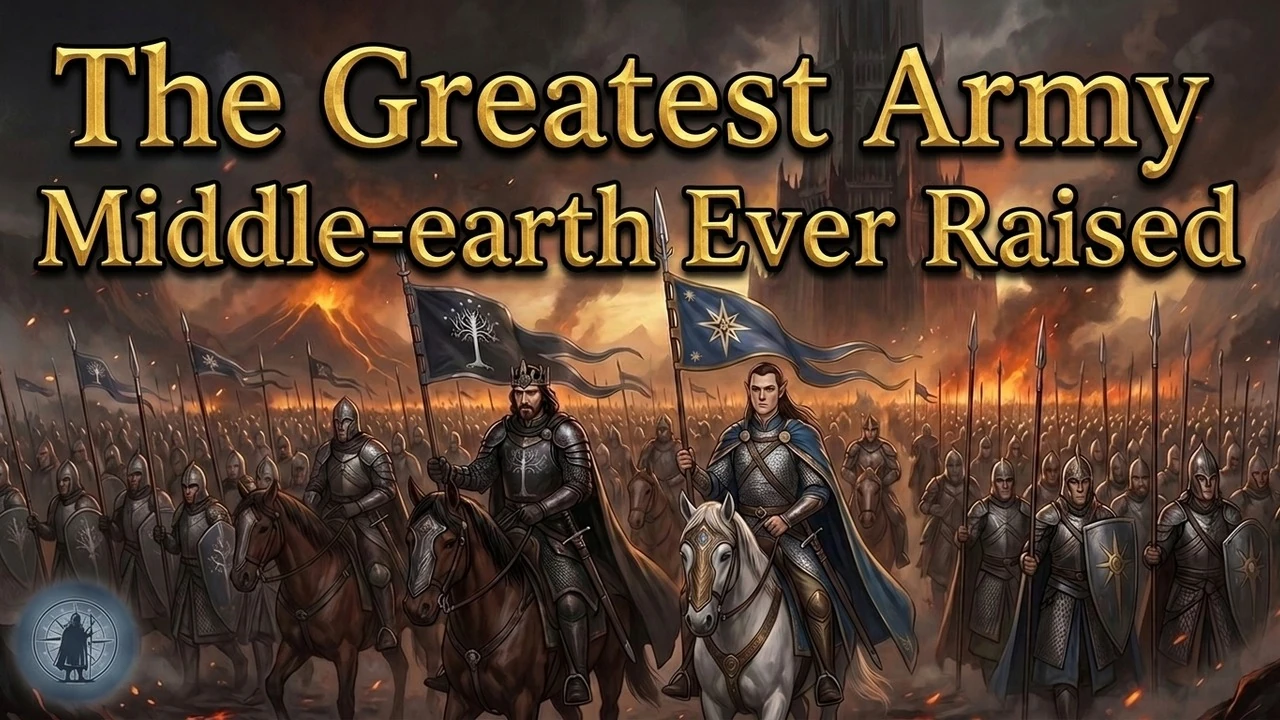 Watch the episode
The Last Alliance of Elves and Men: The Victory That Doomed Middle-earth
Watch the episode
The Last Alliance of Elves and Men: The Victory That Doomed Middle-earth
Research Notes: The Last Alliance of Elves and Men
Overview
The Last Alliance of Elves and Men was the great military coalition forged at the close of the Second Age (c. S.A. 3430) between Gil-galad, the last High King of the Noldor in Middle-earth, and Elendil the Tall, High King of the Dúnedain realms-in-exile of Arnor and Gondor. Its purpose was to overthrow Sauron, who had re-armed after the Downfall of Númenor and seized Minas Ithil. The resulting War of the Last Alliance (c. S.A. 3434–3441) culminated in the seven-year Siege of Barad-dûr and a final duel on the slopes of Orodruin in which Sauron was physically overthrown and the One Ring cut from his hand by Isildur.
It is one of the pivotal hinge-points of the legendarium: the last time Elves and Men marched together as equals against a common enemy, and simultaneously the moment that doomed the next three thousand years. Because Isildur refused to destroy the Ring, the "victory" was, in Elrond's own word, fruitless — a triumph that merely deferred the war the Fellowship would later have to finish. The episode hook ("the greatest alliance and the victory that failed") captures exactly this paradox.
Primary Sources
The Silmarillion — "Of the Rings of Power and the Third Age"
This is the principal continuous narrative of the war.- Quote: "Then Gil-galad and Elendil passed into Mordor and encompassed the stronghold of Sauron; and they laid siege to it for seven years, and suffered grievous loss by fire and by the darts and bolts of the Enemy, and Sauron sent many sorties against them." (Of the Rings of Power and the Third Age) - Quote: "There in the valley of Gorgoroth Anárion son of Elendil was slain, and many others." (Of the Rings of Power and the Third Age) - Quote: "But at the last the siege was so strait that Sauron himself came forth; and he wrestled with Gil-galad and Elendil, and they both were slain, and the sword of Elendil broke under him as he fell. But Sauron also was thrown down, and with the hilt-shard of Narsil Isildur cut the Ruling Ring from the hand of Sauron and took it for his own." (Of the Rings of Power and the Third Age) - Summary: Sauron's spirit fled but his bodily form was destroyed; he could not assume a fair shape again. The text also records the famous warning of Elrond and Círdan that the Ring should be cast into Orodruin, and Isildur's refusal.
The Lord of the Rings — "The Council of Elrond" (FotR, Book II, Ch. 2)
Elrond gives the only eyewitness account in the published canon.- Quote: "I have seen three ages in the West of the world, and many defeats, and many fruitless victories." (Elrond, The Council of Elrond) - Quote: "I was the herald of Gil-galad and marched with his host. I was at the Battle of Dagorlad before the Black Gate of Mordor, where we had the mastery: for the Spear of Gil-galad and the Sword of Elendil, Aiglos and Narsil, none could withstand." (Elrond, The Council of Elrond) - Quote: "I beheld the last combat on the slopes of Orodruin, where Gil-galad died, and Elendil fell, and Narsil broke beneath him; but Sauron himself was overthrown, and Isildur cut the Ring from his hand with the hilt-shard of his father's sword, and took it for his own." (Elrond, The Council of Elrond) - Quote: Isildur's refusal — counselled to destroy the Ring, "he would not listen to our counsel," and kept it (in the Silmarillion phrasing) "as weregild for my father, and my brother." Elrond adds the assessment that the alliance achieved only a "fruitless" victory because the Ring was not unmade.
The Lord of the Rings — Appendix A & B ("The Tale of Years")
The Tale of Years supplies the chronology (see Timeline below). Appendix A's "Númenórean Kings" and "Durin's Folk" sections note who fought and who survived (Elrond, Círdan, Isildur, Thranduil).Unfinished Tales — "The History of Galadriel and Celeborn" (Appendix B, "The Sindarin Princes of the Silvan Elves")
This is the source for the Silvan Elven contribution and its catastrophe.- Summary: Oropher (King of the Woodland Realm, Thranduil's father) and Amdír/Malgalad (King of Lórien) led great hosts of Silvan Elves to the Alliance. They were poorly armoured compared with the Noldor. - Quote/paraphrase: Oropher had "the pride to take his men into battle when Gil-galad had not yet given the command." Out of unwillingness to submit to Noldorin supreme command, the Silvan Elves charged rashly and suffered ruinous losses. - Summary: Oropher was slain in the first assault of the Battle of Dagorlad. Amdír/Malgalad and over half his folk were cut off and driven into the Dead Marshes. Roughly two-thirds of the Silvan host perished over the course of the war. Thranduil inherited a greatly diminished people.
The Letters of J.R.R. Tolkien
- Tolkien repeatedly frames Middle-earth's history as "the long defeat" (Letter 195; Galadriel uses the phrase in LotR). The Last Alliance is the archetypal "fruitless victory" within that pattern — apparent triumph that does not finally resolve the underlying evil because the Ring endures.Key Facts & Timeline (Second Age, from the Tale of Years)
- S.A. 3429: Sauron attacks Gondor, takes Minas Ithil, and burns the White Tree. Isildur escapes down the Anduin to his father Elendil in the North; Anárion defends Minas Anor and Osgiliath. (Source: LotR Appendix B) - S.A. 3430: The Last Alliance of Elves and Men is formed. (Appendix B) - S.A. 3431: Gil-galad and Elendil march east to Imladris (Rivendell), where the host musters. (Appendix B) - S.A. 3434: The host of the Alliance crosses the Misty Mountains (via the passes of Imladris and Caradhras), descends the Vale of Anduin gathering Silvan Elves and a host of Durin's Folk from Khazad-dûm, and wins the Battle of Dagorlad. The Alliance breaks into Mordor through the Black Gate / Cirith Gorgor and the Siege of Barad-dûr begins. (Appendix B; Silmarillion) - S.A. c. 3440: Anárion is slain at the siege (struck by a hurled stone that crushed his helm), in the valley of Gorgoroth. (Silmarillion; fan-wiki dating) - S.A. 3441: After seven years, Sauron comes forth. In single combat he slays Gil-galad and Elendil, but is himself overthrown. Isildur cuts the One Ring from Sauron's hand with the hilt-shard of Narsil. Sauron's spirit flees; the Ringwraiths pass into shadow. The Second Age ends. (Appendix B; Silmarillion) - T.A. 2 (early Third Age): Isildur is ambushed and killed at the Disaster of the Gladden Fields; the Ring slips from his finger and is lost in the Anduin (Unfinished Tales, "The Disaster of the Gladden Fields"). This is the direct consequence of the refusal at Orodruin.
Significant Characters
- Gil-galad (Ereinion): Last High King of the Noldor in Middle-earth, joint commander. Bearer of Vilya (one of the Three) and the spear Aiglos/Aeglos. Slain by Sauron at Orodruin — "the heat of his hand" destroyed him. His line of High Kings ends with him. - Elendil the Tall: High King of the Dúnedain (Arnor and Gondor), joint commander, bearer of the sword Narsil. Slain by Sauron; Narsil shatters as he falls. Father of Isildur and Anárion. - Isildur: Elder son of Elendil. Cuts the Ring from Sauron's hand with the hilt-shard of Narsil. Refuses to destroy it, claiming it as weregild for father and brother — the fateful choice. Later slain at the Gladden Fields; the Ring becomes "Isildur's Bane." - Anárion: Younger son of Elendil, co-ruler of Gondor. Slain at the siege in Gorgoroth by a thrown stone. Ancestor of the later line of Gondor's kings. - Elrond: Herald of Gil-galad; eyewitness and chief in-universe narrator of the war (Council of Elrond). Survives; advises Isildur (in vain) to destroy the Ring. - Círdan the Shipwright: Lord of the Grey Havens; also counsels Isildur to unmake the Ring. Survives. - Oropher: King of the Woodland Realm (northern Mirkwood), father of Thranduil. Slain in the first assault at Dagorlad after a rash, premature charge; refused to subordinate himself to Gil-galad. (Unfinished Tales) - Amdír / Malgalad: King of Lórien. Slain at Dagorlad; his folk driven into the Dead Marshes. Father of Amroth. (Unfinished Tales) - Thranduil: Oropher's son; survives and inherits a diminished Silvan realm — the future Elvenking of The Hobbit. - Sauron: The Dark Lord, defeated in body. Loses the Ring but not annihilated; reduced to a spirit unable to take fair form, he endures to rise again in the Third Age.
Geographic Locations
- Dagorlad ("Battle Plain"): Great treeless plain north of the Black Gate, between the Dead Marshes and Cirith Gorgor — site of the decisive open battle. The dead were buried here, later swallowed by the spreading Dead Marshes (an explicit thematic link in The Two Towers). - The Black Gate (Morannon) / Cirith Gorgor: The fortified northern entrance to Mordor, breached by the Alliance. - Gorgoroth: The blasted plateau of inner Mordor where the army encamped; site of Anárion's death. - Barad-dûr ("Dark Tower"): Sauron's fortress, besieged for seven years. Built with the power of the One Ring, which is why it could not be wholly thrown down while the Ring endured. - Orodruin / Mount Doom (Amon Amarth): The volcano on whose slopes the final duel occurred and where the Ring should have been destroyed. - Imladris (Rivendell): Muster-point for the host before crossing the mountains. - Vale of Anduin / Khazad-dûm / Greenwood / Lórien: Recruiting grounds where Durin's Folk and the Silvan Elves joined the march south.
Themes & Symbolism
- The Fruitless Victory / The Long Defeat: Elrond's "many defeats, and many fruitless victories" is the thesis statement. Total tactical success (Sauron overthrown) yields strategic failure because the root of the evil — the Ring — survives. This anticipates and frames the entire War of the Ring. - The Refusal at Orodruin: The hinge of the whole legendarium. Isildur's weregild-claim dramatizes how even the noblest hero, in his moment of triumph, is overmastered by the Ring. It is the "original sin" the Third Age must atone for. - Pride vs. Unity / Cost of Disunity: The Silvan Elves' refusal to accept Gil-galad's supreme command (Oropher's pride) directly causes their slaughter. The Alliance succeeds where it is unified and bleeds where it is not — a quiet counterpoint to the "alliance" theme. - The Passing of an Age: This is the last time the Elder Kindreds (Noldor under Gil-galad) and Men march as co-equal powers. With Gil-galad's death the High Kingship of the Noldor ends; the Elves begin their irreversible fading. The Last Alliance is "last" in a double sense — final and valedictory. - Memory and Witness: The war reaches the reader almost entirely through Elrond's first-person memory, making it a story about the burden of remembering across ages. - Catholic/Providential reading: The failure at Orodruin sets up the later eucatastrophe — what strength and victory could not finish, mercy, pity, and providence ultimately accomplish through Frodo, Gollum, and the unmaking of the Ring. The Last Alliance is the "works" that fail; the Quest is the "grace" that succeeds.
Scholarly Interpretations & Theories
- Why did Sauron come forth? A common scholarly/fan reading (e.g., Michael Martin, Middle-earth & J.R.R. Tolkien Blog): after seven years the siege had become unbearable, and Sauron, still the mightiest single combatant, gambled on personal intervention. Some argue his confidence reflected the Ring's power; others that the siege had ground down his armies and he had little choice. - Why did Elrond/Círdan not force the issue? Discussed by Tolkien commentators (xenite.org): they counselled but did not (could not) compel a king; Isildur was the rightful heir and overlord of the surviving Dúnedain, and the moment of the Ring's seizure was exactly when its corrupting will was strongest. - The Silvan losses as a "deleted" canon layer: The Oropher/Amdír material exists only in Unfinished Tales drafts, not the published Silmarillion, so its canonicity is "soft." Christopher Tolkien presents it as authorial intent rather than finished narrative. - The Dead Marshes connection: Scholars note Tolkien's deliberate echo of WWI's Western Front (Tolkien served at the Somme); the corpse-faces in the marshes are the literal dead of Dagorlad, fusing his mythology with his trench experience.
Contradictions & Different Versions
- Oropher and Amdír: Absent from The Silmarillion's account entirely. Their leadership, rashness, and deaths appear only in Unfinished Tales. The two named Lórien kings (Amdír vs. the variant Malgalad) reflect Tolkien's unresolved drafting — they may be the same figure under two names. - Manner of Gil-galad's death: The Silmarillion says he and Elendil "wrestled with" Sauron and were slain; a separate note (quoted via Isildur's scroll) attributes Gil-galad's death specifically to the burning heat of Sauron's hand. The two are reconcilable but emphasize different details. - Did Sauron "die"? The text is careful: his body was destroyed and his spirit fled; he was not annihilated. Loose summaries that say Sauron "was killed" misstate the canon — the whole point is that he was not ended because the Ring survived. - Aiglos vs. Aeglos: Spelling of Gil-galad's spear changed between editions; pre-2005 texts read "Aiglos," later corrected toward the more regular Sindarin "Aeglos." - Exact siege casualties/dates within the seven years (e.g., the precise year of Anárion's death) are not fixed in primary text; the c. 3440 dating is a reasonable inference, not a stated date.
Cultural & Linguistic Context
- Dagorlad: Sindarin, "Battle Plain" (dagor "battle" + lad "plain, low flat land"). - Barad-dûr: Sindarin, "Dark Tower" (barad "tower" + dûr "dark"). - Aiglos / Aeglos: Sindarin "Snow-point" / "Icicle" (aeg "sharp, pointed" + los "snow"). Gil-galad's spear. - Narsil: From the Quenya/Elvish roots nar- "fire" and thil/sil "white light" — sun and moon, i.e., "red-and-white flame." It is later reforged as Andúril, "Flame of the West." - Gil-galad: Sindarin "Star of Radiance / Bright Star" (gil "star" + galad "radiance, bright light"); his true name was Ereinion, "Scion of Kings." - Orodruin: Sindarin "Mountain of Red Flame / Fiery Mountain"; also Amon Amarth, "Mount Doom." - Weregild: Tolkien's deliberate use of the Old English/Germanic legal concept — the "man-price" owed in compensation for a slain kinsman. Isildur frames his theft of the Ring in archaic Northern-heroic legal terms, lending tragic irony: a lawful-sounding claim that is in truth the Ring's seduction. - Real-world parallel: Tolkien's Somme/Western Front experience underlies the imagery of mass graves and the Dead Marshes.
Questions & Mysteries
- Could the Ring have been destroyed in 3441 if Elrond or Círdan had taken it instead? (Tolkien implies no one near the Fire could willingly cast it in — the same failure Frodo suffers — making the refusal almost foreordained.) - How large were the hosts? No reliable numbers exist; only that they were vast enough that Mordor's orcs hid rather than harry the crossing. - What exactly killed Sauron's body — the combined assault of both kings, or did he overreach? The text leaves the mechanics ambiguous. - How did the Silvan disaster reshape Wood-elf/Noldor relations for the rest of the legendarium (Thranduil's later isolationism)?
Compelling Quotes for Narration
1. "I have seen three ages in the West of the world, and many defeats, and many fruitless victories." — Elrond, The Council of Elrond (FotR) 2. "I was the herald of Gil-galad and marched with his host. I was at the Battle of Dagorlad before the Black Gate of Mordor, where we had the mastery: for the Spear of Gil-galad and the Sword of Elendil, Aiglos and Narsil, none could withstand." — Elrond 3. "I beheld the last combat on the slopes of Orodruin, where Gil-galad died, and Elendil fell, and Narsil broke beneath him; but Sauron himself was overthrown, and Isildur cut the Ring from his hand with the hilt-shard of his father's sword, and took it for his own." — Elrond 4. "They laid siege to it for seven years, and suffered grievous loss by fire and by the darts and bolts of the Enemy." — Of the Rings of Power and the Third Age (Silmarillion) 5. "But at the last the siege was so strait that Sauron himself came forth; and he wrestled with Gil-galad and Elendil, and they both were slain." — Silmarillion 6. Isildur (paraphrase of the weregild claim): he would keep the Ring "as weregild for my father, and my brother." — Silmarillion / Council of Elrond
Visual Elements to Highlight
1. The host of the Alliance cresting the Misty Mountains — banners of Gil-galad and Elendil, so vast the orcs hide. 2. The Battle of Dagorlad: the spear Aiglos and the sword Narsil shining at the front of the line before the Black Gate. 3. The rash charge of the Silvan Elves and Oropher's fall into ruin — color contrast of green-clad woodland elves against the black legions. 4. The seven-year siege of Barad-dûr under a sky of fire-darts; the encampment on the ashen plateau of Gorgoroth. 5. Anárion's death beneath a hurled stone. 6. The climactic duel on Orodruin's slopes: Sauron towering, Narsil shattering, Elendil and Gil-galad falling. 7. Isildur kneeling, hilt-shard in hand, cutting the Ring free — and the close-up of the Ring on his finger, the refusal. 8. The Dead Marshes "after-image": pale faces beneath the water, the buried dead of Dagorlad — the cost made literal.
Discrete Analytical Themes
Theme 1: The Architecture of the Alliance Itself
Core idea: The Last Alliance was an unprecedented and never-repeated union of the great surviving powers of Elves and Men under two co-equal High Kings. Evidence: - Joint command of Gil-galad (last Noldorin High King) and Elendil (High King of Arnor and Gondor), formed S.A. 3430 (Appendix B). - Contributing peoples: Noldor of Lindon, Dúnedain of the two realms, Silvan Elves of Greenwood and Lórien, and Durin's Folk of Khazad-dûm (Silmarillion; Unfinished Tales). - "I was the herald of Gil-galad and marched with his host." (Elrond, Council of Elrond). Distinction: This covers WHO united and the scale/structure of the coalition — not the battles or the outcome.Theme 2: Dagorlad and the Seven-Year Siege (The Grinding War)
Core idea: Open victory at Dagorlad gave way to a brutal, attritional seven-year siege that bled the Alliance white. Evidence: - "where we had the mastery: for the Spear of Gil-galad and the Sword of Elendil... none could withstand." (Elrond). - "they laid siege to it for seven years, and suffered grievous loss by fire and by the darts and bolts of the Enemy." (Silmarillion). - Anárion slain in Gorgoroth by a thrown stone (Silmarillion). Distinction: This is the MILITARY CAMPAIGN — its duration, attrition, and cost — distinct from the alliance's formation (T1) and the final duel (T4).Theme 3: Pride and Disunity — The Silvan Catastrophe
Core idea: The Alliance's hidden flaw — the refusal of the Silvan kings to submit to a single command — turned valor into slaughter. Evidence: - Oropher and Amdír "unwilling to submit to the supreme command of Gil-galad" (Unfinished Tales). - The Silvan Elves charged before the order was given; Oropher fell in the first assault, Amdír's folk were driven into the marshes; ~two-thirds of the host perished. - Poorly armoured compared to the Noldor (Unfinished Tales). Distinction: This is about INTERNAL DISUNITY as a cause of loss — the dark underside of "alliance" — found only in Unfinished Tales, not in T2's main campaign.Theme 4: The Duel on Orodruin and the Death of Kings
Core idea: The war was decided not by armies but by a single combat in which both High Kings died to overthrow Sauron's body. Evidence: - "the siege was so strait that Sauron himself came forth; and he wrestled with Gil-galad and Elendil, and they both were slain, and the sword of Elendil broke under him as he fell." (Silmarillion). - Gil-galad destroyed by "the heat of his hand"; Narsil shatters beneath Elendil. - Sauron's body thrown down but his spirit not destroyed — he endures. Distinction: This is the specific CLIMACTIC EVENT and the price (two kings dead, a dynasty ended), distinct from the broader campaign (T2).Theme 5: The Refusal — Isildur and the Weregild
Core idea: At the instant of total victory, Isildur claimed the Ring rather than destroy it, the single choice that doomed the next age. Evidence: - "Isildur cut the Ring from his hand with the hilt-shard of his father's sword, and took it for his own." (Elrond). - Counselled by Elrond and Círdan to cast it into Orodruin, he refused, keeping it "as weregild for my father, and my brother." - Directly leads to the Gladden Fields disaster and "Isildur's Bane." Distinction: This is the moral/decisive DECISION and its corrupting context — distinct from the duel that immediately preceded it (T4).Theme 6: The Fruitless Victory — Why It Failed
Core idea: Because the Ring survived, the greatest military triumph in the legendarium resolved nothing and merely deferred the war. Evidence: - "many defeats, and many fruitless victories." (Elrond). - Sauron's body destroyed but spirit endures; Barad-dûr's foundations remain while the Ring exists. - The whole War of the Ring exists to finish what the Last Alliance left undone. Distinction: This is the STRATEGIC/THEMATIC verdict on the outcome — the "victory that failed" thesis — distinct from the specific refusal (T5), which is its cause; this theme is its consequence across ages.Theme 7: The End of an Age and the Fading of the Elves
Core idea: The Last Alliance is "last" because it marks the final co-equal partnership of Elves and Men and the end of the Noldorin High Kingship. Evidence: - Gil-galad's death ends the line of High Kings of the Noldor in Middle-earth. - Thranduil inherits a diminished Silvan realm; the Elves' irreversible fading accelerates into the Third Age. - The Second Age literally ends with the duel (S.A. 3441) (Appendix B). Distinction: This is the EPOCHAL/ELEGIAC significance — what the war ended forever — distinct from the tactical (T2) and decisional (T5) themes.Sources: The Last Alliance of Elves and Men
Primary Sources (Tolkien texts)
- The Silmarillion — "Of the Rings of Power and the Third Age." The principal continuous narrative of the war, the siege, the duel, and Isildur's refusal. MOST IMPORTANT primary source. - The Lord of the Rings, The Fellowship of the Ring, Book II, Ch. 2 — "The Council of Elrond." Elrond's first-person eyewitness account ("fruitless victories"; Dagorlad; the last combat on Orodruin). MOST QUOTABLE source. - The Lord of the Rings, Appendix A ("The Númenórean Kings," "Durin's Folk") and Appendix B ("The Tale of Years") — chronology S.A. 3429–3441 and who survived. - Unfinished Tales, "The History of Galadriel and Celeborn," Appendix B ("The Sindarin Princes of the Silvan Elves") — Oropher, Amdír/Malgalad, Silvan rashness and heavy losses. ONLY source for the Silvan disaster. - Unfinished Tales, "The Disaster of the Gladden Fields" — Isildur's death, the consequence of the refusal. - The Letters of J.R.R. Tolkien — Letter 195 and related; the "long defeat" framing.
Web Sources Consulted
- Tolkien Gateway — Last Alliance of Elves and Men: https://tolkiengateway.net/wiki/Last_Alliance_of_Elves_and_Men (overview; surfaced via search snippet, page blocks direct fetch) - Tolkien Gateway — War of the Last Alliance: https://tolkiengateway.net/wiki/War_of_the_Last_Alliance - Tolkien Gateway — Battle of Dagorlad: https://tolkiengateway.net/wiki/Battle_of_Dagorlad (location, 3434 dating, allied composition) - Tolkien Gateway — Siege of Barad-dûr: https://tolkiengateway.net/wiki/Siege_of_Barad-d%C3%BBr (seven-year siege, Anárion's death) - Tolkien Gateway — Oropher / Amdír: https://tolkiengateway.net/wiki/Oropher (Silvan command dispute and losses) - Tolkien Gateway — Aeglos (spear): https://tolkiengateway.net/wiki/Aeglos_(spear) (Aiglos/Aeglos etymology and spelling variant) - Wikipedia — Last Alliance of Elves and Men: https://en.wikipedia.org/wiki/Last_Alliance_of_Elves_and_Men (FETCHED; formation, duel, weregild) - Wikipedia — Isildur: https://en.wikipedia.org/wiki/Isildur (refusal, Gladden Fields) - Wikipedia — Gil-galad: https://en.wikipedia.org/wiki/Gil-galad (name etymology, death) - Middle-earth & J.R.R. Tolkien Blog (xenite.org) — "How Did Gil-galad and Elendil Stand against Sauron?": https://middle-earth.xenite.org/how-did-gil-galad-and-elendil-stand-against-sauron/ (FETCHED; verbatim Elrond + Silmarillion quotes, strategic analysis). VERY USEFUL. - xenite.org — "Why and How Did Sauron Attack Gil-galad and Elendil on Orodruin?" and "Why Did Elrond Let Isildur Take the One Ring?" (scholarly fan analysis of the duel and the refusal). - LotR Tale of Years (Appendix B) transcript: https://lotr.bib.bz/appendix-b-the-tale-of-years (chronology; page blocks direct fetch, used via search snippets) - Elrond Quotes archive: http://elrond.leavesofgold.co.uk/text/elrondquotes4.php (Council of Elrond passage) - LOTR Fandom Wiki — War of the Last Alliance / Siege of Barad-dûr (casualty summary, weregild line, burials on Dagorlad).
Notes on Source Availability
- Abundant: This is a well-documented event. The Silmarillion gives a clean narrative spine and the Council of Elrond gives ringing first-person quotes. Chronology is fixed by Appendix B. - Tolkien Gateway blocks WebFetch (HTTP 403); content was captured via WebSearch result summaries instead — reliable for facts but verbatim Gateway prose was not extractable. Wikipedia and xenite.org were fetchable and supplied verbatim primary quotes. - Soft-canon caveat: The Oropher/Amdír Silvan material is Unfinished Tales draft-level, not in the published Silmarillion — flag as "later authorial intent" rather than settled canon. - Exact verbatim wording of Isildur's weregild line and some siege dates should be confirmed against a physical copy of The Silmarillion before final scripting.