Transcript
Khazad-dûm
How the Greatest Dwarf Kingdom Became Moria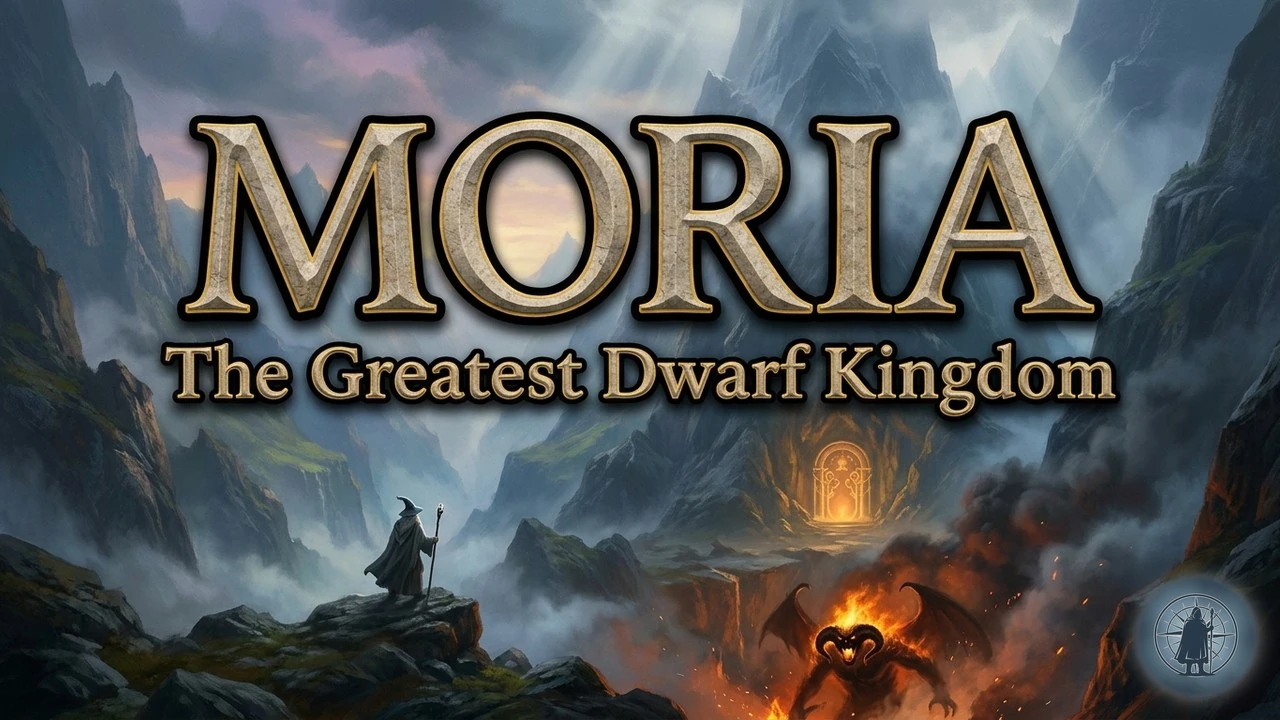 Watch the episode
Khazad-dûm: How the Greatest Dwarf Kingdom Became Moria | Tolkien
Watch the episode
Khazad-dûm: How the Greatest Dwarf Kingdom Became Moria | Tolkien
SECTION: Durin Woke and Walked Alone
Before it was a tomb, it was the wonder of the world.
Long before the Sun first rose, before the Moon climbed the sky, in the ages when the only light in the heavens was the light of the stars, one of the Seven Fathers of the Dwarves opened his eyes in the dark. His name was Durin, and the makers of legend would come to call him Durin the Deathless. He was the eldest of his kind, shaped by Aulë the Smith — Mahal, the Maker, as the Dwarves themselves named him — and laid to sleep beneath the mountains until the appointed hour.
When he woke, he woke alone. And he walked.
Gimli sings of it in the dark halls of Moria, in lines that carry the whole spirit of his people. The world was young, the mountains green, no stain yet on the Moon was seen — because there was as yet no Moon at all. Durin wandered south through a clean and nameless country, and he came at last to a still mountain lake cupped in a high valley between three peaks. He stooped, and looked into the water.
What he saw there set the course of everything that followed. Reflected above the shadow of his own head, in the dark surface of that lake, a crown of stars appeared — gems upon a silver thread, a diadem of light resting on the brow of a king who had not yet built a single hall. The Dwarves would name that water Kheled-zâram, the Mirrormere, and it became sacred to them forever after. To gaze into it was to remember the moment their people first understood what they were.
This is the founding image, and it tells us something we are apt to forget once the drums begin to sound. Khazad-dûm did not begin as a mine. It began as a vision — a binding of Dwarven kingship to the heavens themselves, a sign that the work of Aulë's children, however far it ran underground, was answerable to the stars.
And the name they gave their home declared exactly that pride. Khazad-dûm. In the secret tongue of the Dwarves, Khazâd is the name they call themselves, and dûm their great halls and excavations — the place of the delving of the Dwarves. In the old Westron it comes down to us as Dwarrowdelf, an archaic English plural of "dwarf" folded around the act of digging. It is a name a people give a home they love and mean to keep. Hold onto that word, delving. It is going to matter more than any other in this story — because the same act it names will both crown this kingdom and bury it.
For now, though, there is only the founder under the stars, the lake, and the crown of light. The mountains were green. No stain yet on the Moon was seen. And the greatest of all the mansions of the Dwarves was about to be born.
SECTION: Speak, Friend, and Enter
The kingdom grew. Through long ages Durin's Folk drove their halls farther and wider beneath the three peaks — Caradhras the Redhorn, Celebdil the Silvertine, and Fanuidhol the Cloudyhead — until Khazad-dûm pierced the entire spine of the Misty Mountains, opening on the west toward the green country of Eregion and on the east above the valley of the Mirrormere. When the Dwarf-cities of the Blue Mountains, Nogrod and Belegost, were broken at the end of the First Age, their survivors came east in great numbers, and the population of Khazad-dûm swelled. It became the largest, richest, and most populous Dwarf-realm that ever was.
But the realm reached its true height not by anything it dug out of the rock. It reached its height through a friendship.
Around the year 750 of the Second Age, a people of the Noldor founded a realm in the green land west of the mountains. They called it Eregion; Men later called it Hollin, for the holly trees that grew there. These were the greatest craftsmen among the Elves still left in Middle-earth, and their lord in the work of the forge was Celebrimbor — grandson of Fëanor himself, heir to the most dangerous and most brilliant hands in the history of the Elves.
And here something happened that had never happened before and would never happen again. The Elves of Eregion and the Dwarves of Khazad-dûm did not merely trade. They became friends.
The Silmarillion is plain about how rare this was. Of all the Elves, it says, the Dwarves of Moria had most dealings with the smiths of Eregion, and the friendship of Durin's Folk with the Elves of Eregion was the closest that there has ever been between the two races. Set that against the long, bitter history between Elf and Dwarf — the killing of Thingol over a necklace, the sack of Doriath, centuries of cold suspicion — and you begin to see what an astonishing thing was made here. Two sundered peoples, each guarding secrets the other would never be told, chose to build side by side.
You can still read the proof of it, carved into stone. On the western threshold of the kingdom stood the Doors of Durin, the great gate between Eregion and the Dwarf-realm. They were made by two hands working as one: Narvi, the Dwarf master-craftsman, and Celebrimbor, the Elf-lord. Across the doors, in letters of ithildin — a silver alloy that drinks the light and shows itself only under star or moon — ran the maker's signature. I, Narvi, made them. Celebrimbor of Hollin drew these signs. Between the emblems of the House of Durin and the Tree and the Star, the doors carried a single welcoming line, and it has become one of the most beloved sentences Tolkien ever wrote.
Speak, friend, and enter.
For all their dark and secret nature, the Dwarves had built a front door that opened on a word — and the word was friend. That is what the golden age of Khazad-dûm looked like. Not a fortress sealed against the world, but a kingdom confident enough in its glory to inscribe an invitation across its gate. The splendour of Moria, at its very peak, was a splendour of open doors.
SECTION: True-Silver
So we come to the substance of that splendour. To the thing that made Khazad-dûm not merely the greatest Dwarf-realm but, in plain terms, the richest place in the entire world.
It was not gold. Gandalf himself is careful to say so, standing in the dark of those very halls, telling the Fellowship what this place had been. The wealth of Moria, he says, was not in gold and jewels, the toys of the Dwarves; nor in iron, their servant. It was in something rarer than all of these together. For here alone in all the world was found Moria-silver — true-silver, some called it — and the Elves had a name for it that the world now knows. They called it mithril.
What this metal could do bordered on the impossible. It could be beaten like copper and polished like glass, yet it would not tarnish or grow dim. It was light as a feather in the hand and harder than tempered steel. From it the Elves made ithildin, the moon-silver that lit the Doors of Durin, and the bright mail that no blade could pierce. It was beautiful and it was nearly indestructible — the two qualities a smith dreams of and almost never gets in the same material.
And it was found in one place only. Gandalf again: its worth was ten times that of gold, and now it is beyond price, for little is left above ground. There were rumours of it elsewhere — in drowned Númenor, perhaps, or in the unreachable West — but in the lands where people actually lived and fought and died, every scrap of true-silver in existence had come out of the rock beneath Caradhras. The Dwarves of Moria did not merely have a rich mine. They had a monopoly on a miracle.
We are given one unforgettable measure of its value, and it reaches across two books to touch the whole War of the Ring. When Thorin Oakenshield gave Bilbo a small coat of that bright mail in the Lonely Mountain, neither of them grasped what it was worth. Years later Gandalf would tell Frodo the truth: that little shirt of rings was worth more than the entire Shire — every field, every hole, every Hobbit and all they owned, put together. And it was that same coat, drawn from Moria's signature metal, that turned the cave-troll's spear in the Chamber of Mazarbul and kept Frodo alive to carry the Ring out of the dark.
That is the wonder of the world, made literal. A single thread of bright metal in black stone, found nowhere else, precious beyond reckoning, beautiful and unbreakable at once. It built the greatest kingdom the Dwarves ever raised. It was the foundation of everything they were.
And it was lying at the bottom of the mine.
SECTION: Too Greedy, Too Deep
Here is the turn the entire story has been building toward, and it is best stated as plainly as Tolkien states it. The thing that made Khazad-dûm the wonder of the world was the thing that destroyed it. Not a rival kingdom. Not a war. Not a betrayal from outside. The very same true-silver that was the foundation of their greatness was also the instrument of their ruin — because to get more of it, they had to dig deeper, and there was something waiting far below.
Gandalf puts the two halves of the truth into a single breath, and it is one of the most important sentences in all of The Lord of the Rings. Even as mithril was the foundation of their wealth, he says, so also it was their destruction. They delved too greedily and too deep, and disturbed that from which they fled — Durin's Bane.
Hold those two facts side by side, because the whole tragedy lives in the gap between them. The foundation of their wealth. The cause of their destruction. The same metal. The same act. To delve for glory and to delve toward doom were not two different things the Dwarves did at two different times. They were one motion, carried a little too far. Every shaft they sank for treasure was also a shaft sunk toward death; they simply could not see the bottom of it until they reached the bottom.
It happened in the year 1980 of the Third Age. Mining ever further down beneath Caradhras, hungry for the bright veins that had made them rich, the Dwarves of King Durin the Sixth broke through into something far older than any treasure. Fire rose out of the dark. The king who had sent his people downward was the first to die, and so the thing that killed him took, forever, the name of the man it slew. Durin's Bane. The very next year it killed his son, Náin the First, and that was the end. The Dwarves abandoned the halls their fathers had carved for thousands of years. They fled their own home.
And they renamed it. This is the moment Khazad-dûm dies, in language before it dies in fact. The proud Khuzdul name — the Dwarrowdelf, the place of the delving of the Dwarves — was set aside, and the realm took a Sindarin name instead. Moria. The Black Pit. The Black Chasm. Mor, dark; iâ, the void, the abyss. A people who had named their home for the joy of building it now named it for the horror of what building it had let loose.
Scholars have long read the Balrog as more than a monster in this story. Jane Chance sees in it the monstrous projection of the Dwarves' own vice — their avarice given fire and shadow and sent up out of the abyss to destroy them. And the pattern repeats too neatly to ignore. Durin's Folk fell through digging too greedily for wealth in 1980. And when, a thousand years later, another Dwarf-lord tried to take the kingdom back, his people would fall the same way — digging, grasping, reaching too far down. The thing in the dark below was woken by avarice and, it seems, could only ever be reached by it.
The wonder of the world and the Black Pit are the same place. The crowning glory and the killing wound are the same metal. That is not a story of a kingdom that rose and then, separately, fell. It is a story of a kingdom whose rise was its fall, seen from the other end — a people who dug straight down through their own splendour into their own grave, and never knew, until the fire came up to meet them, that the two had been the same hole all along.
SECTION: The Thing They Fled
But what, exactly, did they wake?
This is where the tragedy turns stranger and, in a way, more terrible — because the destroyer of Khazad-dûm was not a Dwarvish creation at all. The Dwarves did not make their doom by digging. They found it. The thing in the dark was already ancient beyond their reckoning when Durin first looked into the Mirrormere, and it had been waiting in the dark long before there was a kingdom to threaten.
Durin's Bane was a Balrog — a Valarauko, in the old tongue, one of the spirits of fire that Melkor, the first Dark Lord, corrupted in the very dawn of the world. These were Maiar, beings of the same order as Gandalf himself, bent to evil in the Elder Days and made into demons of flame and shadow. In the great wars of the First Age they were Morgoth's most feared servants. And when Morgoth was at last thrown down and his fortress unroofed in the War of Wrath, most of his creatures perished with him.
But not all. A few of the Balrogs fled. They went into the hidden roots of the earth and hid, and one of them ran east, and burrowed down beneath the roots of the Misty Mountains, and there it lay. The number matters. By the end of Tolkien's long reworking, the Balrogs were no horde but a tiny remnant — at most seven in all the world. Durin's Bane was one of these few survivors of the ruin of the Elder Days, a living piece of the first war against the dark, asleep under the mountain.
And asleep it stayed. Through the entire Second Age — through the founding of Eregion, the forging of the Rings, the rise and fall of Sauron's first dominion — it never stirred. Through most of the Third Age, the same. For something on the order of five thousand years, this First-Age terror slept beneath Khazad-dûm while the Dwarves built their kingdom of light directly above its head, and it did nothing, because nothing reached down far enough to trouble it. It was territorial, not hungry. It did not come for them. They came for it.
And there were older things still. Gandalf, who would meet this demon face to face, gives us one of the most haunting lines in the whole legendarium about what lies beneath. Far, far below the deepest delving of the Dwarves, he says, the world is gnawed by nameless things — older even than Sauron, things that the Balrog itself, for all its fire, did not know. The abyss that the Dwarves dug into was not merely dark. It was old, layered with horror beneath horror, and the further down it went the more ancient and the less knowable it became. They had reached, at the very bottom of their mines, into the foundations of the world.
When the demon finally faced something that could stand against it, the encounter became one of Tolkien's defining scenes. On the narrow Bridge of Khazad-dûm, Gandalf turned and named himself: a servant of the Secret Fire, wielder of the flame of Anor. You cannot pass, he told the thing of shadow. The dark fire will not avail you, flame of Udûn. Anor against Udûn — the Sun's own fire against the fire of Morgoth's deepest pit. That is the true scale of what the Dwarves disturbed. They had gone digging for jewellery, and they had broken into a war that began before the Sun.
SECTION: Drums in the Deep
For a thousand years after the fire rose, Durin's Folk were exiles. And the cruelest part of their exile was that home was still there — empty, vast, full of their fathers' bones and their fathers' treasure — and they could never reach it.
The pull never let them go. Driven from Moria, the Dwarves wandered, founded other realms, dwindled, endured. Thráin the First fled to the Lonely Mountain and there found the Arkenstone, and his line became kings under that mountain instead. But always the old home tugged at them. And in time, the empty halls filled with a new tenant: Sauron, returning to power, stocked Moria with Orcs and trolls and worse, until the Dwarrowdelf became a den of the very things its builders had despised.
The attempts to return are a litany of grief. In the year 2790, King Thrór — old, half-broken, drawn back to the East-gate as if by a wound that would not close — walked into Moria almost alone, and was murdered there by the great Orc Azog, who branded his own name into the dead king's brow and flung the body back in pieces. That single atrocity lit the War of the Dwarves and Orcs, a war fought through every mountain stronghold from end to end of the range, and it climaxed in the year 2799 in the valley of the Mirrormere itself — Azanulbizar, the Dimrill Dale.
It was a slaughter on both sides, and the Dwarves won it, after a fashion. Young Dáin Ironfoot cut down Azog before the East-gate and avenged his people. But victory turned to ash in his mouth, because in that moment Dáin did something none of the others had dared. He looked through the open Gate, into the dark of Moria, and he felt what waited there. His warning has the weight of prophecy. Only I have looked through the shadow of the Gate, he told them, and beyond the shadow it waits for you still — Durin's Bane. The world must change, he said, and some other power than ours must come, before Durin's Folk walk again in Moria. They had won the field and could not enter the door. The home was un-reclaimable by any strength that mortals had.
But hope, in the Dwarves, dies harder than that. Almost two hundred years later, in 2989, a Dwarf the listeners of this tale will know well — Balin, companion of Thorin and of Bilbo, kindly old Balin of The Hobbit — could not let the dream go. He led a colony back into Moria to take it for the Dwarves once more. And for five years, against all the warnings, it seemed he might. They drove out Orcs; they reached the lower halls; Balin was named Lord of Moria and took his seat in the Chamber of Mazarbul, the Hall of Records, and there his chronicler Ori kept a book.
We know exactly how it ended, because the Fellowship found that book. Balin, Lord of Moria, went down to gaze into the Mirrormere — the founder's sacred lake, the place of the crown of stars — and an Orc shot him there, dead, beside the holiest water of his people. Within days the colony was overwhelmed. And the last legible words Ori ever wrote, scrawled and failing, are among the most frightening Tolkien ever set on a page. The pool is up to the wall at Westgate. The Watcher in the Water took Óin. We cannot get out. The end comes, and then, twice, the words that have echoed through every retelling since: drums, drums in the deep. They are coming. And the book stops.
Five years of hope, ending in a hall of the dead, sealed under the mountain, waiting to be read by strangers a generation later. That is what reclamation cost. Dáin had been right. Some other power than theirs would have to come.
SECTION: The World Is Grey
And one did come — though not to rule, and not to stay.
When the Fellowship passed through Moria in the last days of the Third Age, they passed Balin's tomb, and read Ori's book, and heard the drums. And on the Bridge of Khazad-dûm, Gandalf the Grey met Durin's Bane and would not let it pass. Both of them fell into the abyss. The wizard chased the demon down through water and up through fire to the very peak of Celebdil, the Silvertine, and there, after days of battle no mortal eye saw, he cast it down and broke it — and died himself in the breaking. Some other power than ours. A Maia had been woken by greed; it took a Maia to end it. Gandalf was sent back, returned greater than before, and Durin's Bane was no more.
So the great wound was finally closed. But the kingdom was not restored, and the elegy stands. Gimli's song, which opened in green mountains under a stainless Moon, ends in grey. The world is grey, the mountains old, the forge's fire is ashen-cold; no harp is wrung, no hammer falls; the darkness dwells in Durin's halls; the shadow lies upon his tomb, in Moria, in Khazad-dûm. That is the true sound of Tolkien's legendarium — not triumph, but the long, clear note of beauty remembered after it is gone. Moria is the grandest ruin in all his work precisely because it was the grandest thing, and it endured the longest, and it fell the hardest.
And yet Tolkien, who could not bear to leave his Dwarves only with grief, built a thread of return into the very bones of their history. Say the two names aloud, one after the other — Khazad-dûm, the wonder of the world; Moria, the Black Pit. They are the same halls. The Dwarves believed that Durin himself returned the same way: that their founder was reborn again and again down the ages, six more times, each a true king and each again named Durin, the same spirit walking the same halls in a new body. Death, for them, was never quite the end. It was a turning of the wheel.
There is even a coda. In notes Tolkien set down late in his life, there is a seventh Durin still to come — Durin the Last — descended from the line that survived, who would one day lead the Dwarves home into Khazad-dûm and light the forges again, and the kingdom would live once more, far into the Fourth Age, until the world itself grew old and the days of Durin's race were ended at last. The deep that held the grave, in the end, also held the promise. The same downward dark that swallowed the kingdom was the dark that the founder kept being reborn into, and the dark that a future Durin would one day reclaim.
That is the strange shape of this story, and it is worth seeing whole. The same delving that crowned them buried them. The same metal that was their glory was their ruin. The same lake that showed a founder his crown of stars saw a lord shot dead beside it. And the same deep, black halls that became the legendarium's greatest tomb were, in the Dwarves' own faith, the cradle their king would wake in again. Light glimpsed in darkness, at the founding — and light promised in darkness, at the end. Between them lies the wonder of the world, and the Black Pit, which were never two places at all.