Research & Sources
Khazad-dûm
How the Greatest Dwarf Kingdom Became Moria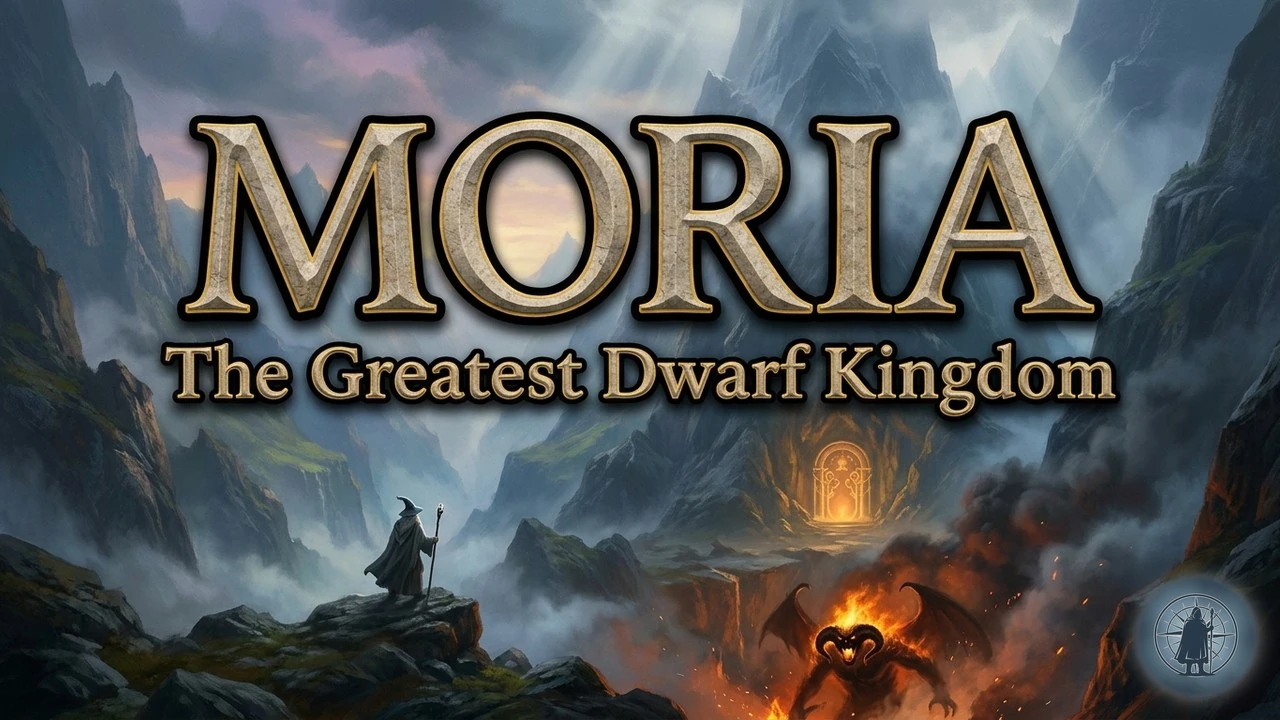 Watch the episode
Khazad-dûm: How the Greatest Dwarf Kingdom Became Moria | Tolkien
Watch the episode
Khazad-dûm: How the Greatest Dwarf Kingdom Became Moria | Tolkien
Research Notes: Khazad-dûm — The Greatest Kingdom of the Dwarves
Overview
Khazad-dûm — later called Moria — was the oldest, deepest, richest, and most renowned of all the Dwarf-mansions of Middle-earth. It was the seat of Durin's Folk (the Longbeards), the eldest of the Seven Houses of the Dwarves, and the only Dwarf-kingdom continuously inhabited from the Years of the Trees (before the rising of the Sun and Moon) into the late Third Age. Carved through the living rock of the Misty Mountains, it spanned the range from the Hollin Gate in the west to the Dimrill Gate in the east, beneath the three peaks of Caradhras, Celebdil, and Fanuidhol.
The arc the episode tracks is one of the great rise-and-fall stories of the legendarium: founded by Durin the Deathless under the stars; raised to its peak in the Second Age through the unique alliance with the Elves of Eregion and the discovery of mithril; doomed in T.A. 1980 when the Dwarves "delved too greedily and too deep" and woke a Balrog that had hidden there since the First Age; abandoned and renamed Moria, "the Black Pit"; the failed reclamation attempts that culminated in the Battle of Azanulbizar (T.A. 2799); Balin's doomed recolonization (T.A. 2989–2994), recorded in the Book of Mazarbul; and finally the Fellowship's passage and Gandalf's duel with Durin's Bane (T.A. 3019). Tolkien even left a Fourth Age coda in which Durin VII leads the Dwarves home again.
The hook — "Before it was a tomb, it was the wonder of the world" — is exactly right: Moria's tragedy is that its very glory (mithril) was also the instrument of its destruction.
Primary Sources
The Lord of the Rings — "A Journey in the Dark" & "The Bridge of Khazad-dûm" (FotR, Book II)
The richest single source. Gandalf's exposition on mithril and the fall:
- On mithril and the cause of the fall: "the wealth of Moria was not in gold and jewels, the toys of the Dwarves; nor in iron, their servant... For here alone in the world was found Moria-silver, or true-silver as some have called it: mithril is the Elvish name. The Dwarves have a name which they do not tell... Its worth was ten times that of gold, and now it is beyond price; for little is left above ground." (FotR, "A Journey in the Dark") - "even as mithril was the foundation of their wealth, so also it was their destruction: they delved too greedily and too deep, and disturbed that from which they fled, Durin's Bane." (FotR, "A Journey in the Dark") - On the mithril-coat: Gandalf to Frodo — "I never told him, but its worth was greater than the value of the whole Shire and everything in it." (FotR, "A Journey in the Dark") - The Book of Mazarbul's last legible entry, read by Gandalf: "...The pool is up to the wall at Westgate. The Watcher in the Water took Óin. We cannot get out. The end comes... drums, drums in the deep... they are coming." (FotR, "The Bridge of Khazad-dûm") - Gandalf at the bridge: "You cannot pass... I am a servant of the Secret Fire, wielder of the flame of Anor. You cannot pass. The dark fire will not avail you, flame of Udûn." And his fall: "Fly, you fools!"
The Doors of Durin / West-gate inscription (FotR)
Gandalf's translation: "The Doors of Durin, Lord of Moria. Speak, friend, and enter." and "I, Narvi, made them. Celebrimbor of Hollin drew these signs." The signs were traced in ithildin (a mithril alloy visible only by starlight or moonlight), depicting the emblems of Durin, the Two Trees, and the Star of the House of Fëanor.
Gimli's "Song of Durin" (FotR, "A Journey in the Dark")
The elegiac hymn of Dwarvish glory and loss. Opening (excerpt): "The world was young, the mountains green, / No stain yet on the Moon was seen... / When Durin woke and walked alone. / ...He stooped and looked in Mirrormere, / And saw a crown of stars appear, / As gems upon a silver thread, / Above the shadow of his head."
The middle stanzas describe the kingdom at its height ("the mighty halls of Khazad-dûm"), with mithril, beryl, pearl, and opal, hammer on anvil, harps and trumpets. The closing turn (excerpt): "The world is grey, the mountains old, / The forge's fire is ashen-cold; / No harp is wrung, no hammer falls: / The darkness dwells in Durin's halls; / The shadow lies upon his tomb / In Moria, in Khazad-dûm."
LOTR Appendix A, "Durin's Folk" & Appendix B (The Tale of Years)
Source for nearly all dates and the War of the Dwarves and Orcs. Key passage — Dáin Ironfoot's warning after Azanulbizar: "Only I have looked through the shadow of the Gate. Beyond the shadow it waits for you still: Durin's Bane. The world must change and some other power than ours must come before Durin's Folk walk again in Moria." (Appendix A)
The Silmarillion — "Of the Sindar" & "Of the Rings of Power and the Third Age"
- Founding: the Dwarves of Khazad-dûm called themselves Khazâd; the Sindar named their realm Hadhodrond (later Moria). The Naugrim/Dwarves of the Blue Mountains (Nogrod, Belegost) had dealings with Khazad-dûm; after the ruin of the Blue Mountain cities at the end of the First Age, many Dwarves migrated to Khazad-dûm, swelling its population. - Eregion alliance: "Of all the Elves the Dwarves of Moria had most dealings with the smiths of Eregion (Celebrimbor)... and the friendship of Durin's folk with the Elves of Eregion was the closest that there has ever been between the two races."
The Hobbit
Origin of Bilbo's mithril-coat: Thorin gives Bilbo "a small coat of mail... of silvered steel, which the dwarves call mithril," wrought for a young elf-prince. (This becomes the coat that saves Frodo in Moria — a direct narrative thread linking the two books to Moria's signature metal.)
Unfinished Tales
- "The History of Galadriel and Celeborn" gives the founding of Eregion (S.A. 750) and details the Elf-Dwarf traffic through the mountains; Galadriel and Celeborn's relationship to Moria; the importance of the direct road under the mountains.
The History of Middle-earth
- HoME XII (The Peoples of Middle-earth), "Of Dwarves and Men" and the appendix materials: contains the Dwarvish reincarnation belief, the canon of the Kings of Khazad-dûm, and the Fourth Age coda. The note that Durin VII ("Durin the Last") would return and that the Dwarves would dwell again in Khazad-dûm "until the world grew old and the Dwarves failed and the days of Durin's race were ended" derives from here (HoME XII, p. 278 region). Also records the rejected river-name Zigil-nâd vs. final Kibil-nâla. - HoME VII (The Treason of Isengard): drafts of the Moria chapters, including the evolution of the Doors of Durin inscription and the "Speak, friend, and enter" riddle.
Key Facts & Timeline
- Years of the Trees / Ages of the Stars: Durin (eldest of the Seven Fathers) awakes — by tradition near Mount Gundabad — wanders south, looks into the lake later called Kheled-zâram (Mirrormere) and sees a crown of stars above his reflection; he founds Khazad-dûm in Azanulbizar. (FotR "Council of Elrond"; Appendix A) - First Age: The kingdom grows under Durin; mithril discovered. Durin's Bridge, the Second Hall, the Endless Stair, and Durin's Tower on Celebdil built during his reign. Durin I dies before the end of the First Age. (Thain's Book; Appendix A) - c. S.A. 40: After the destruction of Nogrod and Belegost, Dwarves migrate to Khazad-dûm; wealth and population swell. (Appendix A) - S.A. 750: Elves found Eregion (Hollin) west of the mountains; daily traffic and the great friendship of Narvi and Celebrimbor begins. (Silmarillion; UT) - c. S.A. 1500: Rings of Power forged. Celebrimbor gives Durin III one of the Seven Dwarf-rings (Tolkien's later view; Appendix A says the Dwarves held it was given by the Elves). The Doors of Durin built by Narvi and Celebrimbor. - S.A. 1697: Sauron destroys Eregion and slays Celebrimbor. The Dwarves of Khazad-dûm sally out, then "shut fast the Doors of Durin"; Moria becomes a sealed refuge. End of the golden age of the alliance. - S.A. 3434–3441: Durin's Folk fight in the War of the Last Alliance. - T.A. 1980: Mining ever deeper for mithril beneath Barazinbar (Caradhras), the Dwarves wake a Balrog of Morgoth. It slays King Durin VI — hence Durin's Bane. (Appendix A) - T.A. 1981: The Balrog slays Náin I. The Dwarves flee; Khazad-dûm is abandoned and becomes Moria, "the Black Pit." (Appendix A) - T.A. 1999: Thráin I, having fled, founds Erebor (the Lonely Mountain) and finds the Arkenstone. Durin's Folk become wanderers and exiles. - c. T.A. 2480: Sauron begins stocking Moria with Orcs, Trolls, and evil things. (Tale of Years) - T.A. 2790: King Thrór, returning to the East-gate, is murdered by Azog, who brands his name on Thrór's severed brow and sends back his maimed companion Nár — igniting the War of the Dwarves and Orcs. - T.A. 2793–2799: The War of the Dwarves and Orcs, fought through every mountain stronghold. - T.A. 2799 — Battle of Azanulbizar (Sindarin: Nanduhirion): The climactic battle before the East-gate. Náin (son of Grór) slain by Azog; Azog slain by Dáin Ironfoot, who then peers through the Gate and feels the Balrog. He warns Thráin that none can reclaim Moria. Pyrrhic victory. - T.A. 2989: Balin leads a colony from Erebor to retake Moria (companions include Óin, Ori, Flói, Frár, Lóni, Náli). Initial success; Balin named Lord of Moria, seat in the Chamber of Mazarbul. Ori keeps the Book of Mazarbul. - T.A. 2994 (Nov. 10): Balin shot by an Orc while gazing into Mirrormere. Within days the colony is overwhelmed: Óin taken by the Watcher at the West-gate; Frár, Lóni, Náli fall at the Bridge. The colony is annihilated. Moria reverts to the Orcs. - T.A. 3018 (August): Gollum enters Moria via the East-gate and becomes lost. - T.A. 3019 (Jan. 13–15): The Fellowship enters via the West-gate (Frodo seized by the Watcher in the Water), reaches the Twenty-first Hall, finds Balin's tomb and the Book of Mazarbul. Gandalf falls with the Balrog at the Bridge of Khazad-dûm (Jan. 15). - T.A. 3019 (Jan. 23–25): Battle of the Peak atop Zirakzigil (Celebdil); Gandalf casts down the Balrog; Durin's Tower destroyed. Gandalf "dies," is sent back (returns Feb. 14), borne by Gwaihir to Lórien (Feb. 17). - Fourth Age: Per HoME XII, Durin VII ("the Last"), descended from Dáin's line, leads the Dwarves back; Khazad-dûm's halls are restored "until the world grew old and the Dwarves failed."
Significant Characters
- Durin I, "the Deathless": Founder; eldest of the Seven Fathers, made by Aulë (Mahal). Awoke at Gundabad, founded Khazad-dûm. Believed to be reborn six more times across the Ages (Durin II–VI, and Durin VII the Last). - Durin III: King during the height of the Eregion alliance; received one of the Seven Rings (the Ring of Durin's folk, later taken by Sauron from Thráin II). - Durin VI: Slain by the Balrog in T.A. 1980; his death gives the demon its name, Durin's Bane. - Náin I: Son of Durin VI; slain by the Balrog T.A. 1981; the abandonment follows. - Narvi: Dwarf master-craftsman who made the Doors of Durin ("I, Narvi, made them"); friend of Celebrimbor. - Celebrimbor: Elf-lord of Eregion, grandson of Fëanor, greatest smith of the Second Age; co-created the Doors and the Rings of Power; betrayed and slain by Sauron. - Durin's Bane (the Balrog): A Maia of fire, one of the Valaraukar corrupted by Melkor in the Elder Days. Survived the War of Wrath, fled east, hid beneath the Misty Mountains for millennia. Woken in 1980. Killed by Gandalf in 3019. - Thrór: King murdered by Azog at the East-gate (2790), triggering the War of the Dwarves and Orcs. - Azog: Orc-chieftain of Moria; killer of Thrór; slain at Azanulbizar by Dáin. - Dáin II Ironfoot: Slew Azog as a young Dwarf; felt the Balrog's terror at the Gate and counseled against reclamation. Later King under the Mountain; died at the Battle of Dale (3019). - Balin: Companion of Thorin in The Hobbit; led the doomed recolonization; entombed in the Chamber of Mazarbul. - Ori: Chronicler of the colony; author of the Book of Mazarbul's final, desperate entries. - Gandalf: Slayer of Durin's Bane; "died" and returned as Gandalf the White. - Durin VII, "the Last": Restores Khazad-dûm in the Fourth Age (HoME XII).
Geographic Locations
- Khazad-dûm / Moria itself: Spans the Misty Mountains beneath three peaks; West-gate (Hollin/Elven Door) to East-gate (Dimrill Gate). Contains the Great Hall of the Twenty-first Hall, the Endless Stair, Durin's Bridge, the Bridge of Khazad-dûm, the Chamber of Mazarbul, the First Deep down to unfathomed depths. - The Three Peaks (Khuzdul / Sindarin / Westron): - Barazinbar / Caradhras / Redhorn ("red horn") - Zirakzigil / Celebdil / Silvertine ("tine of silver") — site of Durin's Tower and the Battle of the Peak - Bundushathûr / Fanuidhol / Cloudyhead ("cloudy head") - Azanulbizar / Nanduhirion / Dimrill Dale: The valley below the East-gate; site of the great battle. - Kheled-zâram / Mirrormere: The lake where Durin saw the crown of stars; sacred to Durin's Folk. ("glass-lake/pool.") - Kibil-nâla / Celebrant / Silverlode: The river flowing from the mountains past Lórien. - Eregion / Hollin: The Elf-realm west of the West-gate; partner in Moria's golden age.
Themes & Symbolism
- Glory carrying the seed of its own ruin (mithril): The metal that made Moria the wonder of the world is the literal cause of its fall. "Even as mithril was the foundation of their wealth, so also it was their destruction." This is the central irony. - Avarice as the internal vice projected outward: Scholar Jane Chance reads the Balrog as the monstrous projection of the Dwarves' own greed — both Durin's folk (1980) and Balin's folk (2994) fall through digging too deep for treasure. The demon is, symbolically, what greed wakes. - The Long Defeat / elegy: The Song of Durin embodies Tolkien's recurring mood — beauty remembered, glory faded, "the world is grey." Moria is the legendarium's grandest ruin: a civilization that endured longer than any other and fell hardest. - Industrialism vs. nature: In Tolkien's moral geography, deep delving and machinery shade toward corruption (cf. Mordor, Isengard). Moria's bottomless mines stand at the boundary — noble craft turned to fatal extraction. - Friendship across sundered peoples: The Narvi–Celebrimbor friendship and the Doors of Durin ("Speak, friend, and enter") are Tolkien's most hopeful image of Elf-Dwarf concord — and its loss with Eregion's fall prefigures Moria's own. - Death, memory, and resurrection: The Dwarvish belief that Durin returns seven times sets Moria's history as a cycle of fall and renewal; the Fourth Age coda (Durin VII restoring the halls) redeems the tragedy. Gandalf's own death-and-return in Moria mirrors this. - Reflection and the crown of stars: The founding image — Durin seeing stars crowning his shadowed head in Mirrormere — links Dwarven kingship to the heavens (Aulë's making) and frames the whole arc as light glimpsed in darkness.
Scholarly Interpretations & Theories
- Jane Chance: The fall of the Dwarves (Durin's folk, then Balin's) is "brought about through avarice"; the Balrog "monstrously projects" their internal vice. Moria is read as a moral parable of possessiveness. (cited via Wikipedia, "Moria, Middle-earth") - Environmental / industrial reading: Wikipedia's "Environmentalism in The Lord of the Rings" and related scholarship note that industrial-scale production marks corrupt places; Moria's deep mining sits at the edge of this critique — craft that overreached. - The Balrog wings debate: Long-running fan/scholarly argument over whether Tolkien's "wings" are literal or metaphorical ("the shadow about it reached out like two vast wings"). Worth flagging as a contradiction/ambiguity; the channel's own visual canon (ram-style horns on Balrogs) is a deliberate house choice that departs from Tolkien's hornless text-description. - Durin's reincarnation as "the Beautiful Dwarvish Long Defeat" (The Blog of Mazarbul): reads the seven-fold return of Durin and the Fourth Age restoration as Tolkien's gift of hope to the Dwarves — a people otherwise outside the Elvish fate of Aman, gathered by Mahal in separate halls of Mandos. - Council of Elrond literary analysis: the Song of Durin functions as a Dwarvish "set piece" composed for outsiders, showcasing the sophistication (harps, minstrels, trumpets) of the lost civilization and structuring the narrative as glory-then-ruin.
Contradictions & Different Versions
- Who gave Durin III the Ring? Appendix A relays the Dwarves' own tradition that the Ring was given by the Elven-smiths (Celebrimbor), while a strand of "Of the Rings of Power" implies Sauron's involvement in distributing the Seven. Tolkien's view shifted; The Rings of Power (RoP) dramatizes the Celebrimbor gift. - Date/era of founding: Sources variously say "Ages of the Stars," "Years of the Trees," or simply "the First Age / very ancient days." Tolkien is deliberately vague; the founding predates the Sun and Moon. - Balrog's "wings" and number of Balrogs: The famous textual ambiguity (simile vs. literal wings). Also, Tolkien's Balrog population shrank dramatically over drafts (from hundreds to "at most seven") — Durin's Bane is one of these few survivors. - River name: Zigil-nâd (early Appendix A drafts) was replaced by Kibil-nâla for the Silverlode (HoME XII / Eldamo). - Fourth Age restoration: The Durin VII coda appears only in HoME XII as a late note; it is not in the published LOTR proper, making it semi-canonical — useful but worth flagging as drawn from Christopher Tolkien's edited material. - Christopher Tolkien's editorial role: Much Moria back-history (the War of the Dwarves and Orcs detail, the Kings list, "Of Dwarves and Men") was shaped/published posthumously in UT and HoME, not finalized by Tolkien himself.
Cultural & Linguistic Context
- Khazad-dûm = "Dwarrowdelf," from Khazâd ("Dwarves," plural of Khuzd) + dûm ("halls / mansions / excavations," likely a plural or collective). The Westron/English rendering "Dwarrowdelf" preserves an archaic plural of "dwarf." - Moria = Sindarin "the Black Chasm / Black Pit," from mor ("dark, black") + iâ ("void, abyss / chasm"). A name of dread given after its fall — the contrast with the proud Khuzdul name is itself a story beat. - Hadhodrond = Sindarin name for the realm (Hadhod = Sindarin for Dwarf, from Khazâd; rond = vaulted hall). Casarrondo is the Quenya equivalent. - Kheled-zâram = "glass-lake/pool" (Mirrormere); Kibil-nâla = "silver-watercourse" (Silverlode). - The three peaks: Barazinbar "red horn," Zirakzigil "silver tine," Bundushathûr "cloudy head" (zigil = silver; zirak = tine; baraz = red; inbar = horn). - Mazarbul = "of records" (the Book/Chamber of Records). - Khuzdul itself was a secret tongue, taught to no outsiders; Dwarves used Mannish names in public and never revealed their inner-names or their own word for mithril ("the Dwarves have a name which they do not tell"). Real-world inspiration: Tolkien modeled Khuzdul's consonantal, triconsonantal-root structure loosely on Semitic languages (especially Hebrew), and the Dwarves themselves on a Jewish-diaspora analogy (a people with their own private language, dispossessed of their homeland, dwelling among others) — a parallel Tolkien stated in Letter 176 and a 1971 BBC interview.
Questions & Mysteries
- How deep did Moria actually go? Tolkien implies depths the Dwarves themselves did not fathom — and that older, "nameless things" gnaw the world far below the Balrog (Gandalf: "Far, far below the deepest delving of the Dwarves, the world is gnawed by nameless things"). Useful tie-in to the existing Nameless Things episode without overlapping. - Why did the Balrog never leave Moria for thousands of years? It seems territorial/dormant — woken only by intrusion. - Did Durin VI know what lay below, or was the deep mithril vein simply too tempting? (Greed vs. ignorance.) - What exactly is the relationship between the seven reborn Durins — same fëa (spirit) in restored body, or symbolic dynastic continuity? Tolkien left it deliberately mythic.
Compelling Quotes for Narration
1. "they delved too greedily and too deep, and disturbed that from which they fled, Durin's Bane." — Gandalf, FotR 2. "Its worth was ten times that of gold, and now it is beyond price." — Gandalf on mithril, FotR 3. "We cannot get out. The end comes... drums, drums in the deep... they are coming." — Book of Mazarbul, FotR 4. "Only I have looked through the shadow of the Gate. Beyond the shadow it waits for you still: Durin's Bane." — Dáin Ironfoot, Appendix A 5. "The world is grey, the mountains old, / The forge's fire is ashen-cold... / The shadow lies upon his tomb / In Moria, in Khazad-dûm." — Song of Durin, FotR 6. "He stooped and looked in Mirrormere, / And saw a crown of stars appear." — Song of Durin (the founding image), FotR 7. "Speak, friend, and enter." — The Doors of Durin 8. "until the world grew old and the Dwarves failed and the days of Durin's race were ended." — Fourth Age restoration, HoME XII
Visual Elements to Highlight
1. Durin alone under the stars, looking into Mirrormere, the crown of stars over his shadowed head (the founding image). 2. The Twenty-first Hall — vast pillared darkness pierced by a single shaft of daylight (Tolkien's own imagined cathedral-of-stone). 3. The Doors of Durin glowing in ithildin moonlight — the holly trees, the star, the anvil. 4. Narvi and Celebrimbor at work — Dwarf and Elf craft side by side, the high-water mark of the alliance. 5. Mithril veins in black rock; a Dwarf delving too deep toward a glow of fire below. 6. Durin VI facing the rising Balrog — shadow and flame in the deep. 7. The Battle of Azanulbizar before the East-gate, snow and Orc-host, Dáin standing over Azog. 8. Balin's tomb in the Chamber of Mazarbul, the broken Book lying open. 9. Gandalf on the Bridge of Khazad-dûm, staff raised against the Balrog. 10. Fourth Age coda: lights and hammer-song returning to the halls.