Transcript
Nineteen Rings and One Lie
How the Rings of Power Were Made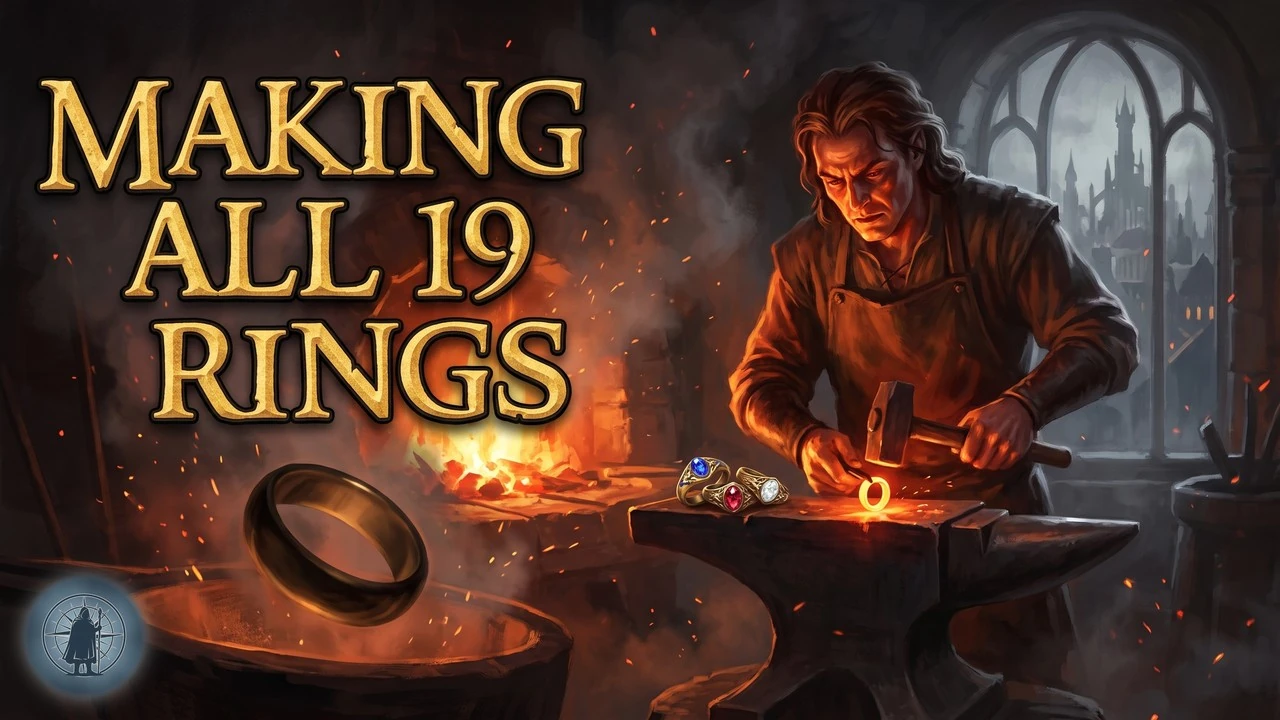 Watch the episode
Nineteen Rings and One Lie: How the Rings of Power Were Made
Watch the episode
Nineteen Rings and One Lie: How the Rings of Power Were Made
SECTION: Why Eregion Said Yes and Lindon Said No
In the year twelve hundred of the Second Age, a stranger came west with an offer, and two Elven realms gave him two different answers.
Tolkien's Tale of Years tells the story in a single line.
"Sauron endeavours to seduce the Eldar. Gil-galad refuses to treat with him; but the smiths of Eregion are won over."
That's the whole entry. Sauron pitched his services twice. He got two different answers - and the answer Eregion gave is the reason there are twenty rings in this story instead of none.
The Silmarillion fills in what the annal leaves out.
"Only to Lindon he did not come, for Gil-galad and Elrond doubted him and his fair-seeming, and though they knew not who in truth he was they would not admit him to that land. But elsewhere the Elves received him gladly, and few among them hearkened to the messengers from Lindon bidding them beware; for Sauron took to himself the name of Annatar, the Lord of Gifts, and they had at first much profit from his friendship."
So Lindon sent messengers. Eregion got the warning, and went ahead let Annatar in anyway.
In this episode we'll explore how the twenty rings actually got made - in what order, by whose hands, over how long. And it starts with the Elves, not Sauron. What did the smiths of Eregion want badly enough that a warning from the High King was worth ignoring?
Tolkien answered that himself, more than once, and he didn't go easy on his own Elves.
Writing to Naomi Mitchison in nineteen fifty-four, Tolkien said this.
"But the Elves are not wholly good or in the right. Not so much because they had flirted with Sauron; as because with or without his assistance they were 'embalmers.' They wanted to have their cake and eat it: to live in the mortal historical Middle-earth because they had become fond of it... and so tried to stop its change and history, stop its growth, keep it as a pleasaunce."
So he called them embalmers - people working very hard to keep something fresh that's already started to fade away.
A couple of years later, Tolkien put it more gently. The Elvish weakness is "naturally to regret the past, and to become unwilling to face change: as if a man were to hate a very long book still going on, and wished to settle down in a favorite chapter."
And that's their calling. To make things, and keep things, beautiful.
Annatar showed up with a compelling offer. Here's Tolkien's own summary of it:
"Sauron found their weak point in suggesting that, helping one another, they could make Western Middle-earth as beautiful as Valinor. It was really a veiled attack on the gods, an incitement to try and make a separate independent paradise."
Make the West as lovely as the Blessed Realm. Right here, without sailing, without giving anything up. To the Elves, whose grief was that the world kept moving on without them, that sounds a lot like a perfect solution, not a temptation.
And that pitch was delivered to the right audience. Tolkien described this particular branch of the High-Elves as "always on the side of 'science and technology', as we should call it: they wanted to have the knowledge that Sauron genuinely had."
Another important fact about who the Elves of Eregion were. The guild at Ost-in-Edhil was the Gwaith-i-Mírdain - the People of the Jewel-smiths. They were named for jewel-work, which is what they'd built their reputation on. Rings were a departure from the trade. The guild dated back to about the year seven fifty, so when the stranger arrived they'd been at it for four and a half centuries and were recognized as the finest craftsmen since Fëanor. Their lord, Celebrimbor, "desired in his heart to rival the skill and fame of Fëanor."
So Sauron was recruiting the best smiths in the world, at the exact moment when being the best had stopped feeling like enough.
As you may know, Sauron didn't even go by one name. Unfinished Tales has him coming among the Noldor in a fair shape under a fair name - Artano, "high-smith," or Aulendil, one devoted to the service of the Vala Aulë. The Silmarillion gives the name a lot of us remember.
Annatar. The Lord of Gifts.
SECTION: Three Hundred Years of Lesser Rings
We could jump from that first meeting straight to the rings. But Tolkien doesn't do that.
The next entry in the Tale of Years that matters is dated about fifteen hundred of the Second Age.
"The Elven-smiths instructed by Sauron reach the height of their skill. They begin the forging of the Rings of Power."
So that's about three hundred years between Annatar, the teacher, walking in and the first Great Ring coming off the anvil.
So what were they doing for three centuries?
The only real description we get of this from Gandalf, in "The Shadow of the Past."
"In Eregion long ago many Elven-rings were made, magic rings as you call them, and they were, of course, of various kinds: some more potent and some less. The lesser rings were only essays in the craft before it was full-grown, and to the Elven-smiths they were but trifles - yet still to my mind dangerous for mortals."
Gandalf was basically calling the lesser rings "coursework". Three hundred years of a workshop learning a new discipline from a visiting master, and what came out of it was a quantity of working magic rings that the people who made them thought of as scrap.
They were plain things, too. When Isildur later writes his description of the One, he's not impressed. He said it looked like one of the lesser rings - round, ungemmed, nothing on it. That detail will come back.
There's a problem with the tidy inventory, though. Tolkien never says how many lesser rings there were.
Not in The Lord of the Rings. Not in The Hobbit. Not in the Silmarillion, not in Unfinished Tales, not in the Letters, not across the twelve volumes of the History of Middle-earth. The word he uses is "many." Gandalf says many. The Silmarillion says "Now the Elves made many rings." When Sauron finally sacks the workshop, Unfinished Tales describes him carrying off the Nine "and other lesser works of the Mírdain" - an unweighed heap, never counted.
We know there were nineteen Great Rings and one Ruling Ring. Twenty - a very tidy number. And it sits on top of a pile of unnumbered magic rings that nobody ever inventoried and Tolkien never detailed for us.
There are hints they stayed in circulation. The Shire has folk tales about rings that turn people invisible, which is exactly why Bilbo, holding the most dangerous object in the world, files it under "useful trinket" and goes home. And Saruman, in his tower at Orthanc, wears a ring and styles himself Saruman Ring-maker. Tolkien never tells us whether that's one of Eregion's leftovers or something Saruman made himself.
Gandalf's line was "still to my mind dangerous for mortals," and then Tolkien just drops it. No more discussion of it.
It's also worth understanding what other things that workshop was doing. This is the same guild, and the same lord, that made the West-gate of Moria with Narvi of Khazad-dûm - the doors with Celebrimbor's own signature written across them, built to open at a spoken word from either side. Open work. Joint work. Made for a friend, and made to be read.
But three hundred years is what we want to think about here. Ring-craft in Middle-earth was a taught skill. It had a curriculum, and it was practiced for three centuries by masters who were being retrained.
Sauron only made one ring himself. One. But he taught the making of nineteen.
SECTION: Who Were the Sixteen Rings Made For?
If you ask most people what the Rings of Power were, they'd probably answer with the verse. Three for the Elves, seven for the Dwarves, nine for Men. That might be the most quoted piece of Tolkien there is.
The trouble is that the sixteen rings made at Ost-in-Edhil were made by Elves, in an Elven city, for Elves. Nobody standing at that anvil was thinking about Dwarves. Nobody was thinking about Men.
So let's start with what the Silmarillion says the program was actually for.
"In those days the smiths of Ost-in-Edhil surpassed all that they had contrived before; and they took thought, and they made Rings of Power. But Sauron guided their labors, and he was aware of all that they did; for his desire was to set a bond upon the Elves and to bring them under his vigilance."
This was trickery at its finest. Sauron wanted to control the Elves. He needed to control them because the Elves were the only people in Middle-earth strong enough to stop him. And they just invited him into their workshop.
The evidence doesn't stop there. We also have to track down where the objects physically were.
In the year sixteen ninety-seven, Sauron takes Ost-in-Edhil by storm. Unfinished Tales tells us what he took out of that victory. He took the Nine Rings, along with other lesser works of the Mírdain.
The Nine rings were still there.
So the timeline that implies is strange. The One Ring had existed for ninety-seven years by then. Celebrimbor had known he'd been played for almost a century. And nine Great Rings were still sitting in the guild-hall at Eregion, unclaimed, because there was nobody they had ever been meant to go to. Nine Great Rings, just sitting in storage.
And it seems like they stayed dormant for quite a while. The Tale of Years says the Nazgûl "first appear" about the year twenty-two fifty-one. That's five hundred and fifty-four years after Eregion fell, and six hundred and fifty-one years after the One Ring came into the world. Sauron held those nine rings for more than five hundred years before he found nine Men to put them on.
Then there's how the Silmarillion talks about the results. The Dwarves, it says, "proved tough and hard to tame." Men "proved easier to ensnare." Again, this sounds like somebody reading the results of an experiment, not a designer collecting the results of a well defined plan. Sauron tried it on Dwarves and found out the Dwarves were tough to crack.
And the sequence in "Of the Rings of Power" is clear about the order. Sauron gathers the surviving rings in the ruin of Eregion, and then he deals them out. Distribution follows capture, and capture follows a war he only fought because his original plan collapsed. We'll go deeper into that original plan, in a moment.
Scholars who go deep into the stories reach the same conclusion here - that the seven and the nine were a fallback improvised after the first plan failed, and that the allocation lines written by Tolkien are history written afterwards.
As per usual, there are some complications in the story, though.
This time it comes from Tolkien's own published text rather than an editor's. Appendix A preserves what Durin's Folk believed about their own ring - that it was the first of the Seven ever made, and, in Tolkien's careful wording, "they say that it was given to the King of Khazad-dûm, Durin III, by the Elven-smiths themselves and not by Sauron, though doubtless his evil power was on it."
Tolkien sets this up as tradition, which is to say: this is what the Dwarves said, and he isn't ruling on it. Remember, a lot of what we know about the lore is meant to come from what the characters themselves write down. And those records are never clean.
Tolkien's son Christopher wrote that Unfinished Tales never actually says how the Seven came into Dwarvish hands at all. There's a gap in the record, and Durin's Folk filled it with a gift.
If they're right, at least one of the sixteen really was meant for a Dwarf. Both versions of the tale sit in the books. Tolkien left the truth open to our discussion.
SECTION: The Three Rings Were Made Last, Not First
What about the Elven rings? The Three. Where in the order were they made?
The Tale of Years tells us that about the year fifteen ninety: "The Three Rings are completed in Eregion."
So this would be after the sixteen. After Annatar, the teacher, had gone. The Three are the last rings ever made in Eregion. They are the closing act of a program that had already been running for a century.
But, unsurprisingly, there's a gap in the dating. Appendix B has no entry at all for Annatar leaving. The date usually given, around fifteen hundred, is a reconstruction from Unfinished Tales plus the plain requirement that the Three came after Annatar had left town. Tolkien never specifies his exit.
But we know the exit happened. Celebrimbor made these three alone, and he made them for something completely different from what the sixteen were for. Elrond describes the intent at the Council, and it's worth hearing what he lists and what he leaves out.
"They were not made as weapons of war or conquest: that is not their power. Those who made them did not desire strength or domination or hoarded wealth, but understanding, making, and healing, to preserve all things unstained."
Understanding, making, healing.
That's the brief. And Tolkien confirms in his letters that these three didn't do the one thing popular imagination assigns to all of these rings - the Three, he wrote, were "directed to the preservation of beauty: they did not confer invisibility."
Even the names are a departure. Narya, from the word for fire. Nenya, from water. Vilya, air. In a letter to Hugh Brogan, describing a dust-jacket he'd designed himself, Tolkien gave their colors: "Narya (red), Vilya (blue), Nenya (white)." Celebrimbor named his last work after the elements of the world, rather than after a house or a deed or himself.
And Nenya was made of mithril, which is a quiet reminder of what this whole program had been standing on. The one metal that made Eregion's work possible came out of Khazad-dûm, and the Dwarves were in this story from the beginning, whether anyone had told them so or not.
So this is the clean production run - an independent commission, the best smith of the age working unsupervised, on the best intention anywhere in the program.
And then the Silmarillion gives a little fact we often forget.
"Therefore the Three remained unsullied, for they were forged by Celebrimbor alone, and the hand of Sauron had never touched them; yet they also were subject to the One."
The last part of that sentence is pretty important. The Three rings were still controlled by The One.
Tolkien tells us how this works in a letter to Naomi Mitchison in nineteen fifty-four.
"Though unsullied, because they were not made by Sauron nor touched by him, they were nonetheless partly products of his instruction, and ultimately under the control of the One."
Celebrimbor kept Sauron's hands off the metal. What he couldn't do was get Sauron's methods out of his own head. He had been taught to make rings by the person who invented ring-craft for this purpose, and there was no other version of the skill to use. You can throw the teacher out of the workshop. You can't unlearn the lesson.
And so the three rings made with the cleanest motive turned out to be the ones the Enemy wanted most. "Of all the Elven-rings," the Silmarillion says, "Sauron most desired to possess them, for those who had them in their keeping could ward off the decays of time and postpone the weariness of the world."
And of the nineteen, they are the only three he never got his hands on.
SECTION: Orodruin, and the Ring With No Gem
About ten years later, in the year sixteen hundred, the Tale of Years gives one entry with three things in it.
"Sauron forges the One Ring in Orodruin. He completes the Barad-dûr. Celebrimbor perceives the designs of Sauron."
A ring, a fortress, and a discovery, all in one line. The tower and the ring were the same construction project, finished in the same season, and the Elves found out about it at the same time.
Every other ring came out of Eregion. The One came out of Orodruin. Sauron left the workshop he'd spent three hundred years cultivating, went to Mordor, and built the master key in a completely different fire, on his own, with nobody watching. He needed to be somewhere else.
Tolkien gave us his own account of it, in a long letter:
"But secretly in the subterranean Fire, in his own Black Land, Sauron made One Ring, the Ruling Ring that contained the powers of all the others, and controlled them, so that its wearer could see the thoughts of all those that used the lesser rings, could govern all that they did, and in the end could utterly enslave them."
And the price, which Tolkien flags as an old motif in myth and fairy-story: "to achieve this he had been obliged to let a great part of his own inherent power pass into the One Ring."
He put a piece of himself into the One Ring to make it work.
This plan collapsed almost immediately, and it collapsed for a reason that has nothing to do with magic.
"But the Elves were not so lightly to be caught. As soon as Sauron set the One Ring upon his finger they were aware of him; and they knew him, and perceived that he would be master of them, and of all that they wrought. Then in anger and fear they took off their rings."
Nobody sees anything. Celebrimbor, far off in Eregion, hears him - the binding formula had to be said out loud, and the system was built so that the sixteen rings were listening. Sauron made a surveillance network and then broadcast on it.
Four hundred years of patient work, and it ended the moment Sauron opened his mouth.
The binding words matter.
The words on the Ring are Black Speech, and Gandalf gives them in English at the Council of Elrond.
One Ring to rule them all, one Ring to find them, one Ring to bring them all, and in the darkness bind them.
That's the ruling couplet, and that's all that's on the Ring. That inscription is the part that does the work - a command.
It's also where his greatest servants got their name. Nazgûl is Black Speech: nazg, "ring," plus gûl, "wraith." The name of the Nine is assembled out of the first two words of the spell that made them.
The physical design of the ring is unremarkable too. Isildur wrote a description of the Ring, and Gandalf reads it out at the Council.
"The Nine, the Seven, and the Three, had each their proper gem. Not so the One. It was round and unadorned, as it were one of the lesser rings; but its maker set marks upon it that the skilled, maybe, could still see and read."
In a collection where nineteen rings announce their worth with a gemstone, the most powerful object ever made in Middle-earth is shaped to look like a first-year practice piece - the same coursework the Mírdain had been turning out and shrugging at for three centuries.
And that boring disguise pays off. Bilbo picks it up in the dark and reads it as an ordinary invisibility ring out of Shire folklore. Thousands of years later, Sauron's own herald stands at the gate of Erebor and calls it "a little ring, the least of rings, that once he stole" - underselling his master's masterwork exactly as designed.
Back in Eregion there was a window, and it closed. Unfinished Tales says Celebrimbor took counsel with Galadriel, and that they should have destroyed all the Rings of Power right then - "but they failed to find the strength."
Nobody in this story ever chooses to destroy a ring. Celebrimbor couldn't, Isildur wouldn't, and even Frodo failed at the end when it mattered.
SECTION: Ninety-Three Years, Then Eregion Fell
So in Sixteen hundred of the Second Age is when Celebrimbor figures it out. The war starts in sixteen ninety-three.
That's ninety-three years of nothing.
This is one of the strangest gaps in the Second Age. Tolkien never explains it either. Then, in January of nineteen seventy, Tolkien wrote a short piece asking exactly that - why didn't Gil-galad and Númenor just hit Sauron the moment his cover was blown? That paper Tolkien wrote sat unpublished until twenty twenty-one.
Tolkien's answer is that they couldn't have known, because Sauron hid his weakness well.
"It was one of the successes of his cunning and deceits that they were unaware of his actual weakness, and his need for a long time in which to gather armies."
And the reason he needed that time is almost funny.
"Until sixteen hundred he was still using the disguise of beneficent friend, and often journeyed at will in Eriador with few attendants, and so could not risk any rumour that he was gathering armies."
The con had a cost. For four centuries Sauron had been traveling Eriador as a helpful visitor, which meant he couldn't be seen raising troops. The day the mask came off was the first day he could start, and he was starting from almost nothing.
"It took some ninety years before he felt ready to open war. And he misjudged this... His gathering of armies had not been unopposed, and his success had been much less than his hope. He had powerful enemies behind his back, the East."
Who were these enemies in the East?
Very late in his life Tolkien wrote about who those were - two of the wizards, called there Morinehtar, "Darkness-slayer," and Rómestámo, "East-helper," sent to stir up rebellion among the peoples Sauron was recruiting from. In that late scheme they arrive around sixteen hundred, the same year as the One Ring, alongside Glorfindel. If you're familiar with the text, there's a loose end worth pointing out here: the essay on the wizards in Unfinished Tales has all five arriving thousands of years later, and Christopher Tolkien printed both and let them stand.
Either way, Sauron got ninety-three years and used them to build an army and finish a tower. The Elves got the same ninety-three years, and used them to hide the rings.
The War of the Elves and Sauron beings. Nenya had gone to Galadriel, Vilya to Gil-galad, and Narya to Círdan at the Havens. The assets Sauron wanted the most were out of the building before his army reached the border.
The campaign was quick. Sixteen ninety-five, his forces come up through the Gap of Rohan into Eriador, leaving a garrison at Tharbad. Sixteen ninety-seven, Ost-in-Edhil falls, nine hundred and forty-seven years after it was founded.
What did Sauron actually recover from the city he spent five centuries setting up?
"There Sauron took the Nine Rings and other lesser works of the Mírdain; but the Seven and the Three he could not find."
Nine. Out of nineteen.
Celebrimbor was taken alive on the steps of the guild-hall, and torchered, and under it he gave up where the Seven had been sent. About the Three he said nothing at all, and Sauron killed him for it - "but he guessed the truth," Unfinished Tales says, "that the Three had been committed to Elvish guardians: and that must mean to Galadriel and Gil-galad."
Celebrimbor died protecting a secret his enemy figured out anyway.
The war continued for four more years. In sixteen ninety-nine, Eriador is overrun, with only Lindon and the new refuge at Imladris holding out. By seventeen hundred, a Númenórean fleet lands. Sauron is beaten at the Lhûn, then at Sarn Ford, and in seventeen-oh-one he's caught surrounded at the Gwathló and gets out with a bodyguard.
The aftermath of the war gave birth to new things. Imladris, founded in sixteen ninety-seven out of the Eregion remnant. Lothlórien, settled by refugees the Dwarves passed through Khazad-dûm and out the eastern side. The Doors of Durin shut, ending the closest friendship Elves and Dwarves ever had - closed by the rings that both peoples' craftsmanship had made possible. And Númenórean soldiers on the mainland for the first time, who eventually stopped going home.
Both of the great Elven refuges of the Third Age are refugee camps from this one war.
SECTION: Why the Ring-Verse Isn't the Build Order
So Sauron is standing in the ruins of Eregion holding nine rings he took off a shelf, the whereabouts of seven more extracted under torture, and three he'll never see. Sixteen out of nineteen - on a plan meant to deliver all nineteen quietly, from inside, without a battle.
And then we get the distribution.
"But Sauron gathered into his hands all the remaining Rings of Power; and he dealt them out to the other peoples of Middle-earth... Seven rings he gave to the Dwarves; but to Men he gave nine, for Men proved in this matter as in others the readiest to his will."
That's the moment three-seven-nine comes into existence: in a burnt city in sixteen ninety-seven, sorting through what he'd managed to grab.
The famous architecture isn't a design specification. It's a salvage inventory.
And you can see it was salvage from the results, which are all over the place. Same craft, same workshop, same century, wildly different outcomes. This feels like an expected result when you hand equipment that was built for one people, the Elves, to two others, Dwarves and Men.
The Dwarves broke it.
"The Dwarves indeed proved tough and hard to tame; they ill endure the domination of others, and the thoughts of their hearts are hard to fathom, nor can they be turned to shadows. They used their rings only for the getting of wealth."
Zero wraiths out of seven rings.
Except the Seven still paid Sauron. They built the seven great hoards - a golden ring at the foundation of each - and the hoards drew the dragons, and out of that, the Silmarillion says, came "evil enough after... to the profit of Sauron." Thrór, Erebor, Smaug: that whole chain is the result of a ring program that failed at its actual job.
Men went the other way entirely. Nine for nine. They "obtained glory and great wealth, yet it turned to their undoing. They became the Nazgul. They had, as it seemed, unending life, yet life became unendurable to them." Three of them were lords of Númenor, one was Khamûl the Easterling, and the other five Tolkien never names.
Same rings, near enough, and completely different people. What a Great Ring seems to do is amplify whoever wears it, which means the Seven and the Nine may have differed in nothing but the hands they landed in.
So the verse we all know is really just a list. Nineteen items in three lines, sorted by holder, then one owner, then the ruling couplet. It's a beautiful piece of writing, and it records the end state of a failure.
Tolkien himself didn't fix that order until very late.
In the drafts of the Tale of Years, the sequence of events went the other way. Christopher Tolkien tells us:
"In this text, by either dating, the Three Rings were not achieved for a further ninety years after the forging of the One Ring, whereas in the final chronology (by adopting in this one case the revised date, 1590) the One Ring was made ten years after the Three."
In the drafts, Sauron's ring came first - by ninety years. Which makes the Elves of Eregion people responding to something already loose in the world, instead of innocents who got infiltrated. The published order, the one this episode has been walking through, exists because Tolkien adopted one revised number in one place.
And the conditions Tolkien chose it under weren't calm. Christopher Tolkien describes the papers as "a confused collection of typescript pages... made very evidently under stress: the deadline for the publication of The Return of the King was fast approaching... and this work must be done against time."
The words moved frequently, while Tolkien was working it out. One early complete version reads "Nine for the Elven-kings under moon and star... Three for Mortal Men that wander far" - the Elves with nine, Men with three, backwards from what we know. Another opens "Twelve for Mortal Men doomed to die, Nine for the Dwarf-lords in their halls of stone."
The numbers we recite as though they were carved into the world were arithmetic Tolkien was still adjusting, with the printers waiting.
Which leaves the four words at the end of the Silmarillion's sentence about the Three, the ones that fall off when people quote it. Sauron's hand never touched them - "yet they also were subject to the One."
That's the whole system in a clause. It didn't matter who held what, or whether the Enemy was standing in the room. Celebrimbor worked in secret and it made no difference, because the thing carrying the evil was the craft itself.
On the twenty-fifth of March in the year three thousand and nineteen of the Third Age, one ring goes into the fire at Orodruin, and Narya, Nenya and Vilya go quiet along with it. Four thousand eight hundred and seventy years after Celebrimbor made them alone, with his own hands, for the best reason anybody in this story ever had.