Transcript
Why Sauron Never Conquered Gil-galad
 Watch the episode
Why Sauron Never Conquered Gil-galad
Watch the episode
Why Sauron Never Conquered Gil-galad
SECTION: Who Was Gil-galad's Father?
Let's go back to the year 455 of the First Age.
Fingolfin is dead.
He rode alone to the gates of Angband, challenged Morgoth to single combat, and lost. Up in Hithlum his son Fingon takes the crown, and The Silmarillion gives us one sentence:
"Great was the lamentation in Hithlum when the fall of Fingolfin became known, and Fingon in sorrow took the lordship of the house of Fingolfin and the kingdom of the Noldor; but his young son Ereinion, who was after named Gil-galad, he sent to the Havens."
That's the first time we meet him in the published works, and his introduction is pretty uneventful. A boy moved out of range, a few words long, inside a sentence that's really about somebody else's grief.
And this is the challenge. He barely exists on the page. The question we're thinking about in this episode is how a king that important ended up this thin.
It starts with his father. Tolkien wrote that clause about Fingon in the margin, in pencil, and then he changed his mind. Here's how many fathers Gil-galad has, in the order Tolkien invented them.
Tolkien first wrote in Gil-galad around nineteen thirty-seven, in a draft called The Fall of Númenor, a story that eventually made its way into the Silmarillion. Tolkien wrote: Elendil "made a league with Gil-galad the Elf-king who was descended from Fëanor." So for a moment Gil-galad was a descendant of Fëanor. Then Tolkien revised the draft, and Gil-galad became the son of Felagund - the Elf we usually call Finrod. That version of Gil-galad was still standing when The Lord of the Rings was finished.
Then Tolkien wrote the Grey Annals in nineteen fifty-one, and what he puts in there, changes things again. Finrod swears that nothing of all his realm will endure for a son to inherit, and the woman he loved wasn't permitted to leave Valinor with him. Finrod has no children in exile, so Gil-galad can't be his son.
Now we were left with a hole, and in the margin of those same annals Tolkien pencils in a patch: the young son sent to the Havens is Fingon's. One note. That is the entire basis of the sentence in the published Silmarillion.
So we must be done, right?
Wrong.
In August of nineteen sixty-five, Tolkien wrote it out differently again! This time the boy is the son of Orodreth, grandson of Angrod, great-grandson of Finarfin, and his mother is a Sindarin lady of the north who names him Gil-galad herself.
Christopher Tolkien's verdict on all that is worth reciting.
"There can be no doubt that this was my father's last word on the subject; but nothing of this late and radically altered conception ever touched the existing narratives... It would nonetheless have been very much better to have left Gil-galad's parentage obscure."
So Tolkien's son wishes we just left the story of Gil-galad's parents out of the discussion all together. And Christopher goes further. The Fingon idea, he says, was ephemeral. In the published book, at the sentence where Lindon gets founded, "Fingon is an editorial alteration of Felagund." The escape from the Havens is an insertion too - the records narrate that whole disaster without Gil-galad anywhere in it.
These aren't small stakes. Under Fingon, the crown of the exiles stays in the House of Fingolfin. Under Orodreth it belongs to the House of Finarfin, and Finduilas becomes his sister. Tolkien also struck Fingon's wife and children out of the family tables in that late material, with a note that Fingon had no child or wife. So the Silmarillion contradicts what Tolkien last wanted, twice over.
Parents aside, what isn't in doubt is what happened to the boy. The Havens of the Falas were sacked in 473, and some of Círdan's people escaped by ship to the Isle of Balar. And in 510, when word reached that island that Turgon was dead and Gondolin had fallen, Gil-galad was named High King of the Noldor in Middle-earth.
Named king. On a rock in the sea, by refugees.
SECTION: Lindon: The Kingdom Made of Leftovers
The First Age doesn't end quietly. The host of the Valar comes over the sea, Morgoth is defeated, and the war that does it, completely wrecks the continent it's fought on.
"In the Great Battle and the tumults of the fall of Thangorodrim there were mighty convulsions in the earth, and Beleriand was broken and laid waste... the walls of Ered Luin were broken, and a great gap was made in them towards the south, and a gulf of the sea flowed in."
Everything Gil-galad grew up with ends up at the bottom of the ocean. Hithlum, the Falas, Nargothrond, Doriath, the plain where Fingolfin died. What's left is a strip of land along the western edge of the Blue Mountains, and the Elves who stay there get described in a way that tells us most of what we need to know about them.
"Many of the Eldar still dwelt there, lingering, unwilling yet to forsake Beleriand where they had fought and laboured long."
That's the founding condition of the kingdom. And the Tale of Years puts it in the Second Age's first entry, year one: "Foundation of the Grey Havens, and of Lindon." This realm's birthday is the year after the world was broken.
Now the strange part.
At the end of that war, Eönwë summoned the Elves to come back over the sea. The exiles were pardoned. The road home was open, and it led to Valinor. Gil-galad didn't take it. Neither did Círdan, neither did Celeborn and Galadriel. So the kingdom of the Noldor in Middle-earth is founded by people who turned down paradise and stayed in the ruins.
Its capital makes the same point. Mithlond, the Grey Havens, sits on the shore of the new gulf, and Tolkien tells us exactly what it's for:
"From the Grey Havens the Eldar ever and anon set sail, fleeing from the darkness of the days of Earth."
The central institution of Gil-galad's state is a departure gate. Every year that it works as intended, he has fewer subjects. There's no version of Lindon that grows.
The name belongs to someone else too. Lindon was the Noldorin name for Ossiriand, the country of the Green-elves, from a root meaning "sing." Land of song. The final Noldorin kingdom is named after another people's music.
Now, the title he holds there is bigger than we usually say. The Appendices go past High King of the Noldor:
"In Lindon north of the Lune dwelt Gil-galad, last heir of the kings of the Noldor in exile. He was acknowledged as High King of the Elves of the West."
High King of the Elves of the West. That's a claim over everybody.
And it comes with a problem buried in the geography. Tolkien slips in one line that undercuts Gil-galad's title:
"Only in Eregion... did Elves of Noldorin race establish a lasting realm beyond the Ered Luin."
One Noldorin realm exists outside his mountains. Just one. And that's the one where the Rings of Power get made. We'll certainly come back to that.
Gil-galad's reach did run a long way. When Sauron returns from the drowning of Númenor he finds that Gil-galad's power "had passed beyond the Misty Mountains and the Great River even to the borders of Greenwood the Great." That is real authority. But authority is one thing and settlement is another, and nobody was building new Elvish cities out in Eriador.
Tolkien described the situation, writing to his publisher in nineteen fifty-one. "We hear of a lingering kingdom, in the extreme North-west," he says, "under Gil-galad," and it "is maintained precariously on the extreme west-shores, where are the havens of the Ships."
A lingering kingdom is how he described it. It "lingered" for three thousand years.
SECTION: The Letter to Tar-Meneldur
For six hundred years, nothing comes from the west.
The Edain who survived the First Age were given an island in the sea, and once they'd sailed to it the traffic stopped. Then, in the year 600 of the Second Age, a ship captained by a man named Véantur comes up the Gulf of Lhûn:
"Its captain and mariners were welcomed by Gil-galad; and thus was begun the friendship and alliance of Númenor with the Eldar of Lindon."
A century later Véantur brings his grandson Aldarion, who "made the friendship of Círdan and Gil-galad" and spends the rest of his life sailing back. Tolkien ends up calling him "the friend and counsellor of Gil-galad."
And that brings us to an important letter.
In the year 882, Aldarion carries home a sealed parchment - white stars on a blue field, Gil-galad's own symbol, to be handed to the High King at Armenelos in person. This is the only time in the whole legendarium that Gil-galad speaks for himself. It opens formally, "Ereinion Gil-galad son of Fingon to Tar-Meneldur of the line of Eärendil, greeting," and then gets to the point.
"A new shadow arises in the East. It is no tyranny of evil Men, as your son believes; but a servant of Morgoth is stirring, and evil things wake again. Each year it gains in strength, for most Men are ripe to its purpose. Not far off is the day, I judge, when it will become too great for the Eldar unaided to withstand. If you have any strength of Men to spare, lend it to me, I beg."
And then he signs off.
"The memories of the First Age are dim, and all things in Middle-earth grow colder. Let not the ancient friendship of Eldar and Dúnedain wane also. Behold! The darkness that is to come is filled with hatred for us, but it hates you no less. The Great Sea will not be too wide for its wings."
That letter is dated 882 of the Second Age. Sauron doesn't reach Eregion wearing the name Annatar until somewhere around twelve hundred. Gil-galad names Sauron - correctly, as a servant of Morgoth who's going to outgrow the Elves - three centuries before anyone else notices.
So what does the King of Númenor do with this?
"Meneldur let the parchment fall into his lap. Great clouds borne upon a wind out of the East brought darkness early." And he cries out: "May Eru call me before such a time comes!"
The following year Meneldur resigns the Sceptre, in troubles that arose "owing to the disquiet of Gil-galad in Lindon." He reads the warning and abdicates the throne rather than answering the call.
His successor is Aldarion, so finally there's a king in Númenor who takes it seriously. Then Aldarion dies, his daughter Tar-Ancalimë takes the sceptre, and "after Aldarion's death she neglected all his policies and gave no further aid to Gil-galad." There's no mention anywhere of the aid Gil-galad asked for ever being sent.
Nothing. Eight hundred years of correspondence, one desperate letter, and the answer is nothing.Tolkien sums up the whole effort in seven words. "Aldarion was too late, or too early."
Then, in sixteen ninety-five, Sauron invades Eriador for real, and Gil-galad calls on Númenor again.
Númenor's fleet arrives in seventeen hundred.
It took five years.
By then, "Sauron had mastered all Eriador, save only besieged Imladris, and had reached the line of the River Lhûn." One river left. "Gil-galad and the Númenóreans were holding the Lhûn in desperate defence of the Grey Havens, when in the very nick of time the great armament of Tar-Minastir came in."
What follows is probably the worst beating Sauron takes in the entire Second Age. Slaughter at the Sarn Ford, then the Gwathló, where "Sauron was routed utterly and he himself only narrowly escaped." Sauron goes home "broken and humiliated," and vows vengeance on Númenor - a grudge he collects on personally sixteen hundred years later.
But the friendship holds long past the point where it should have. When Númenor splits and the King's Men turn against the Elves, one group is still making the northern crossing:
"They alone came now ever to the north and the land of Gil-galad."
And when the island goes under, one of them washes up alive on his shore. "Elendil was cast up by the waves in the land of Lindon, and he was befriended by Gil-galad."
Gil-galad built him towers, later, on the hills west of the Shire, and set a seeing-stone in the tallest one. It looked west, over the sea. Gil-galad raised a tower so a mortal man could look at the country Gil-galad himself had declined to sail to.
SECTION: The Door That Stayed Shut to Annatar
Around the year twelve hundred of the Second Age, somebody very beautiful starts knocking on Elvish doors.
Tolkien tells this twice and not quite the same way. In The Silmarillion the stranger takes the name Annatar, the Lord of Gifts. In material Christopher published later, he presents himself as an emissary of the Valar - an angel sent from the west. Two versions of the story, and they don't merge.
Either way, it works. It works on nearly everyone. But there's exactly one place it doesn't.
"Only to Lindon he did not come, for Gil-galad and Elrond doubted him and his fair-seeming, and though they knew not who in truth he was they would not admit him to that land."
The Tale of Years reduces it to one line in the records, and the two halves of that line are the whole Second Age in miniature: "Gil-galad refuses to treat with him; but the smiths of Eregion are won over."
Tolkien is careful about what he says here. Nobody knew who he was. There's no scene where Gil-galad sees through the disguise and names Sauron out loud. He looks at a stranger who's too good to be true and decides the answer is no. That's the one act of judgment the record gives him, and it's a refusal.
But Gil-galad doesn't stop at his own border. He sends riders. "Few among them hearkened to the messengers from Lindon bidding them beware." Tolkien said the same in a letter in nineteen fifty-four: those of Eregion "refused the warnings of Gil-galad and Elrond." He got it right, he told everybody, and everybody ignored him.
We even get the enemy's frustration on the record. Sauron, working the smiths, complains about Gil-galad out loud:
"Alas, for the weakness of the great! For a mighty king is Gil-galad, and wise in all lore is Master Elrond, and yet they will not aid me in my labours."
That's Sauron paying Gil-galad a compliment in the middle of a con.
So why did being right change nothing? Because Eregion was not Gil-galad's realm.
Eregion is a separate realm on the far side of the Misty Mountains, run by Celebrimbor and his smiths. Gil-galad has no jurisdiction there and no way to police a border he doesn't own. Every Ring of Power except Sauron's own gets forged in the one Noldorin kingdom he can't close. He could warn them, but he couldn't stop them.
And when he's finally proved right, it shows up as a delivery. In sixteen ninety-three Celebrimbor figures out what he's done and sends two of his greatest rings north for safekeeping - Vilya, the ring of air, and Narya, the ring of fire. They go to Gil-galad.
Then Eregion burns, and Celebrimbor is tortured, and tells Sauron nothing about the Three elvish rings. But Sauron figures it out anyway:
"he guessed the truth, that the Three had been committed to Elvish guardians: and that must mean to Galadriel and Gil-galad."
So the invasion of seventeen hundred - the one that pushes all the way to the Lhûn - is a ring-hunt. Sauron marches on Lindon "where he believed that he had most chance of seizing one, or more, of the Three Rings." The whole weight of that war lands on Gil-galad because Gil-galad is holding the prize.
Gil-galad doesn't keep them, though. He gives Narya to Círdan. He gives Vilya to Elrond, along with the job of vice-regent over Eriador. The king who was right about Sauron ends up as the only major Noldorin figure of the Age who owns no Ring at all.
Tolkien never explains why. No scene, no speech, no reason. And the texts can't agree on when. One account has Vilya passing to Elrond at the first Council, around seventeen-oh-one. The Appendices say "Gil-galad before he died gave his ring to Elrond," which is thirty-four forty-one - two dates seventeen hundred and forty years apart. Narya's the same story: handed to Círdan the moment it arrived, in three separate sources, except for one note in the margin of a fourth saying he carried it himself and gave it up on the day he marched to war.
Many versions of the truth. None are right, none are wrong.
SECTION: Aeglos and the Battle of Dagorlad
Now let's talk about Gil-galad's famous spear.
Its name is Aeglos, and the Silmarillion index glosses it: "Snow-point, the spear of Gil-galad." There's a second gloss elsewhere, where Tolkien mentions a plant of the same name - "snowthorn," he says, "like furze, but larger, and with white flowers." So the king's weapon is named after a thorn bush.
And Aeglos is named three times in the entire published legendarium. Once at the Council of Elrond, once in the account of the Last Alliance, once in an index entry. There's no scene where it's forged or described, nobody ever watches it being used, and not one word anywhere about what became of it.
Three mentions and a thorn bush, for what's probably the best-known Elvish weapon of the Age after the sword we know as Narsil.
We do get a description of the man himself, and it's the source of his name.
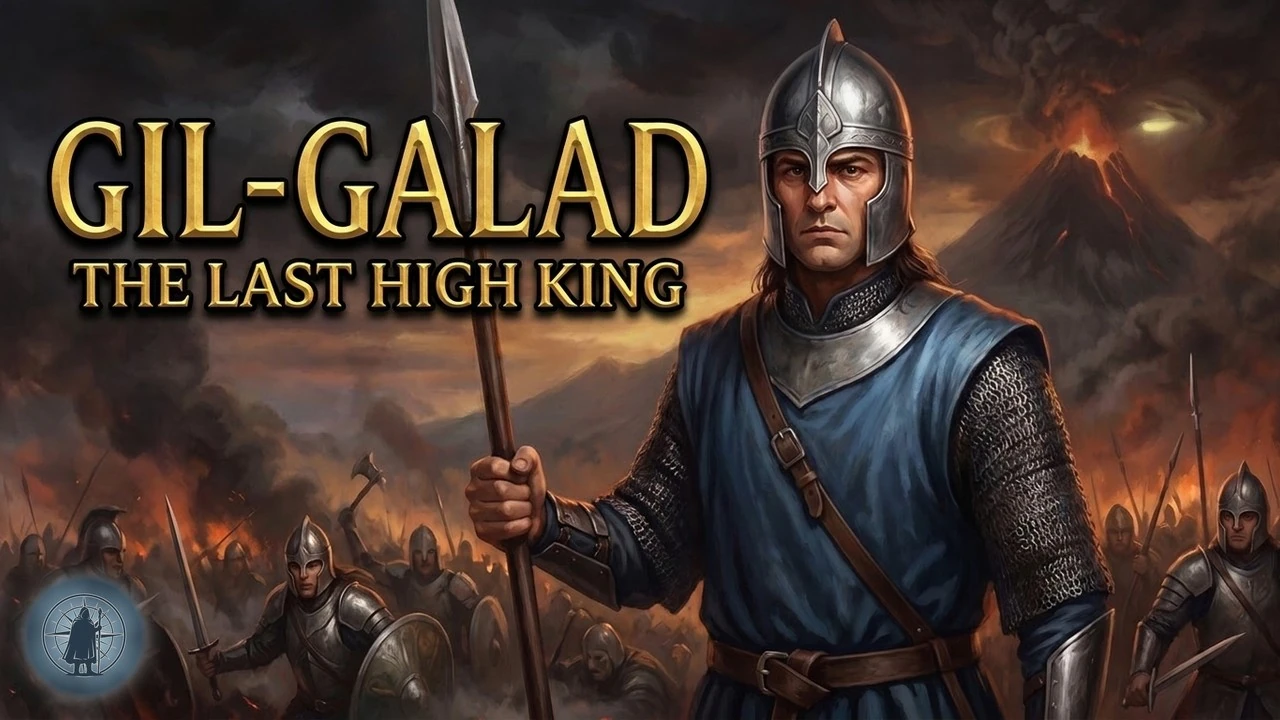
"His helm and mail, and his shield overlaid with silver and set with a device of white stars, shone from afar like a star in sunlight or moonlight, and could be seen by Elvish eyes at a great distance if they stood upon a height."
That's why he's Gil-galad. Star of radiance. The name is a description of what an army could see from miles off - white stars on blue, the same symbol that sealed the letter to Númenor.
The Last Alliance of Elves and Men forms in thirty-four thirty to battle Sauron. The next year Elendil and Gil-galad march east to Imladris. And then there's a gap nobody explains: they don't cross the Misty Mountains until thirty-four thirty-four. Three years of gathering and waiting. Then the passes, the march down Anduin, and the plain in front of the Black Gate.
Dagorlad. And the sentence Tolkien writes about that day is a curious one:
"All living things were divided in that day, and some of every kind, even of beasts and birds, were found in either host, save the Elves only. They alone were undivided and followed Gil-galad."
Every people on earth split, and one kindred didn't. And the reason Tolkien gives isn't a treaty or a cause but a man.
"Against Aeglos the spear of Gil-galad none could stand." Elrond, who was there, puts it as a pair: "the Spear of Gil-galad and the Sword of Elendil, Aiglos and Narsil, none could withstand." They won. It's the last open-field victory a Noldorin host ever wins under its own king.
Though even at the summit, Gil-galad's command was resented. The Silvan Elves who came down from the Greenwood and from Lórien were, Tolkien says, "independent, and not disposed to place themselves under the supreme command of Gil-galad." It cost them horribly. Oropher, Thranduil's father, was killed in the first assault, "rushing forward at the head of his most doughty warriors before Gil-galad had given the signal for the advance." The king of Lórien and more than half his people were driven into the Dead Marshes, and Thranduil "led back home barely a third of the army that had marched to war."
Then the siege. The war runs eleven years, thirty-four thirty to thirty-four forty-one, and the siege of Barad-dûr is seven of them. Anárion is killed in thirty-four forty by a stone from the tower. Gil-galad spends the final decade of a three-and-a-half-thousand-year life in a camp outside the same black wall.
And then Sauron comes out.
Tolkien wrote the death of the High King of the Noldor three separate times, and no two of them agree.
The Silmarillion says "he wrestled with Gil-galad and Elendil, and they both were slain." Elrond, telling it at the Council thousands of years later, says: "I beheld the last combat on the slopes of Orodruin, where Gil-galad died, and Elendil fell." Different verbs for the two of them, and no cause of death for either.
The third account comes from the least likely place - Isildur's private scroll about the Ring. He's writing about how it burned his hand and then cooled, and he reasons his way backwards to something he watched:
"The Ring misseth, maybe, the heat of Sauron's hand, which was black and yet burned like fire, and so Gil-galad was destroyed."
So the killing blow, in Isildur's reading, is a touch - Sauron's bare hand. And what we're reading there is a witness guessing, from his own scorched fingers, at what he'd seen happen to somebody else. The most physically specific thing anybody ever wrote about Gil-galad is an aside in a memo about a ring.
Elrond also tells us who was standing with him at the end, and it's the smallest number in the story. "By Gil-galad only Círdan stood, and I."
Two Elves.
SECTION: The End of the Noldorin High Kingship
Let's do the arithmetic on that reign, because nobody in the books ever does it.
Gil-galad is named High King on Balar in 510 of the First Age. He dies on the slopes of Orodruin in thirty-four forty-one of the Second. That comes to roughly three thousand five hundred and twenty years on the throne. That's longer than the entire Third Age, which runs three thousand and twenty-one - and longer than every previous High King of the Noldor in Middle-earth put together.
Tolkien never writes that total anywhere. It falls out of his own dates when you add them up: one Elf holds an office for longer than the whole age of the world most of us know best.
And his rule was shaky at both ends.
On the way in: Fingolfin, then Fingon in 456, then Turgon in 472, with the House of Fëanor cut out of the succession. But the Silmarillion index never once calls Turgon High King. He's "the Hidden King," he's "the Wise" - the office attaches to him mainly in the sentence that ends it. And Gil-galad doesn't inherit kingship during a ceremony in a hall. Tolkien uses the word is named. Refugees on an island heard Gondolin had burned, and named a young man king of a country that was three years from sinking.
On the way out, there's no joint venture at all. Gil-galad never married. He had no children. There's no heir in the record, no claimant. Galadriel is alive, and she's the other surviving royal of the Noldor, but she doesn't take the title. So it just stops.
In his late writings, Tolkien does tell us what this means. Gil-galad was "the last king of the Eldar in Middle-earth, and the last male descendant of Finwë except Elrond the Half-elven."
Finwë was the first king of the Noldor, back in the starlight before the sun, and his house produced Fëanor, Fingolfin, Turgon, Finrod, Galadriel. When Gil-galad falls, what's left of that house on this side of the sea is Elrond, one half-elven loremaster in a river valley.
There's a specific point that's an easy one to overstate. He's the final High King of the Noldor in Middle-earth. Over the sea, Finarfin went back and ruled the Noldor who never left, and he outlives everybody in this story. So the kingship of the Noldor carries on in Aman. What ends on Orodruin is the kingship in exile - the crown carried out of Valinor and never carried back.
The Appendices are careful in the same way, say that "after the fall of Gil-galad the lineage of the High-elven Kings was also in Middle-earth only represented by their descendants." Tolkien's own summary of the Age, in that same letter to his publisher, is blunter: "So ends the Second Age... with the passing of the last kingship of the High Elves."
So what exactly replaces a crown? Three lords and no country.
Galadriel in Lórien. Círdan at the Havens. And in Imladris, someone Tolkien is careful to call Master Elrond - never king, not once - who "preserved through many lives of Men the memory of all that had been fair."
That's an archive, not a kingdom. The Elves of Middle-earth stop being a nation the day Gil-galad dies, and the three enclaves outlive him by three thousand years without ever trying to reunite.
Elrond tells us himself, at the Council:
"Fruitless did I call the victory of the Last Alliance? Not wholly so, yet it did not achieve its end. Sauron was diminished, but not destroyed. His Ring was lost but not unmade. The Dark Tower was broken, but its foundations were not removed; for they were made with the power of the Ring, and while it remains they will endure."
Gil-galad spent thirty-five centuries holding a line, eleven years fighting the war, and died winning it - and Elrond, who carried his banner, calls the result fruitless.
Tolkien said once that being a Catholic, he didn't expect history to be anything but a long defeat, with glimpses of final victory in it.
Gil-galad is what that sentence looks like when you give it a face and a spear.
SECTION: Sam's Song and the Dead Marshes
Three thousand years later, four hobbits and a Ranger are climbing down into a valley under a hill called Weathertop, and the Ranger mentions in passing that a king once stood up there watching the west.
"It is told that Elendil stood there watching for the coming of Gil-galad out of the West, in the days of the Last Alliance."
Merry asked the obvious question. "Who was Gil-galad?"
But Strider didn't answer, he was lost in thought.
We know Strider as Aragorn. Aragorn is Elendil's heir. Elendil died beside Gil-galad. Aragorn was raised in Rivendell by Elrond, who stood on that mountain and watched Gil-galad die.
And Aragorn has nothing to say.
The answer to Merry's question comes from a gardener. Sam Gamgee recites part of a song - Gil-galad was an Elven-king, of him the harpers sadly sing - then stops, and says that's all he knows. He learned it from Mr. Bilbo when he was a lad. Aragorn corrects the credit, and then admits something.
"He did not make it up. It is part of the lay that is called The Fall of Gil-galad, which is in an ancient tongue. Bilbo must have translated it. I never knew that."
The heir of Elendil is learning about his own inheritance here...from Sam. And Sam has one more thing to add: "There was a lot more, all about Mordor. I didn't learn that part, it gave me the shivers."
So this is what survives of the High King of the Noldor. Twelve lines of a song, written in the rhythm of English folk song, not epic poetry. Its own second line tells you it's a genre piece: of him the harpers sadly sing. And it ends on his disappearance rather than his death: "for into darkness fell his star, in Mordor where the shadows are."
Aragorn promises they might hear the rest of it at Rivendell. They never do. Scholars who've gone looking say there is no rest of it - the longer song doesn't exist, and the bit of it we get looks like something Tolkien wrote while he was drafting that chapter. That's the deliberate technique though. Tolkien said that, part of the attraction of the book is the "glimpses of a large history in the background: an attraction like that of viewing far off an unvisited island, or seeing the towers of a distant city gleaming in a sunlit mist."
So that brings us back to the silence we started with.
Gil-galad has no dialogue anywhere in The Silmarillion. None. Fëanor speaks a lot in that book. Finwë, Fingolfin, Turgon, Thingol, Beren, Húrin, Morgoth - they all speak. Gil-galad never does. He has one first-person document in the entire corpus, that letter, and even that has been edited, because the salutation in the printed book names a father his author had abandoned. Everything vivid about him comes out of somebody else's mouth. Elrond's memory. Sauron's propaganda. Isildur's scroll. His editor's footnotes.
And the memorial he ended up with is a bog.
Because the plain where he won is still there. Three thousand years later, Frodo and Sam are picking their way across it, and they look down into the water.
"Grim faces and evil, and noble faces and sad. Many faces proud and fair, and weeds in their silver hair. But all foul, all rotting, all dead."
Those are Elves in the water - on the plain reading, some of them the Lórien contingent driven into the marshes on the day of the battle. Gollum explains: "the Marshes have grown since then, swallowed up the graves; always creeping, creeping." And Tolkien told a correspondent in nineteen sixty where the image came from: "The Dead Marshes and the approaches to the Morannon owe something to Northern France after the Battle of the Somme."
So the field of Gil-galad's victory is Tolkien's own war, and the Ring-bearer walks over the top of it without knowing whose army is under his feet.
Everybody else in this story got a monument. Fingolfin got a cairn on a mountain no Orc dared cross. Elendil, who died on the same slope on the same day, got a tomb on a hill and later a green mound Tolkien calls the memorial of a memorial. Gil-galad has no recorded grave, and Aeglos is never mentioned again.
Gil-galad did leave one physical thing and it happens to make its way to the Shire. Aldarion once gave Gil-galad mallorn-nuts. They wouldn't grow in Lindon, so Gil-galad passed them to Galadriel - and one ends up as the tree in Sam Gamgee's Party Field.
The placement of the campfire that our hobbit friends chose inspires some awe. Sam recites those twelve lines in a valley below Amon Sûl, where Elendil watched for Gil-galad's coming and where the hosts of the Alliance mustered in thirty-four thirty. He sings the song of the king who beat Sauron, on the ground where that king raised his army. Minutes later Sauron's Nazgul come down the hill and stab the Ring-bearer, Mr. Frodo Baggins.