Research & Sources
Why Sauron Never Conquered Gil-galad
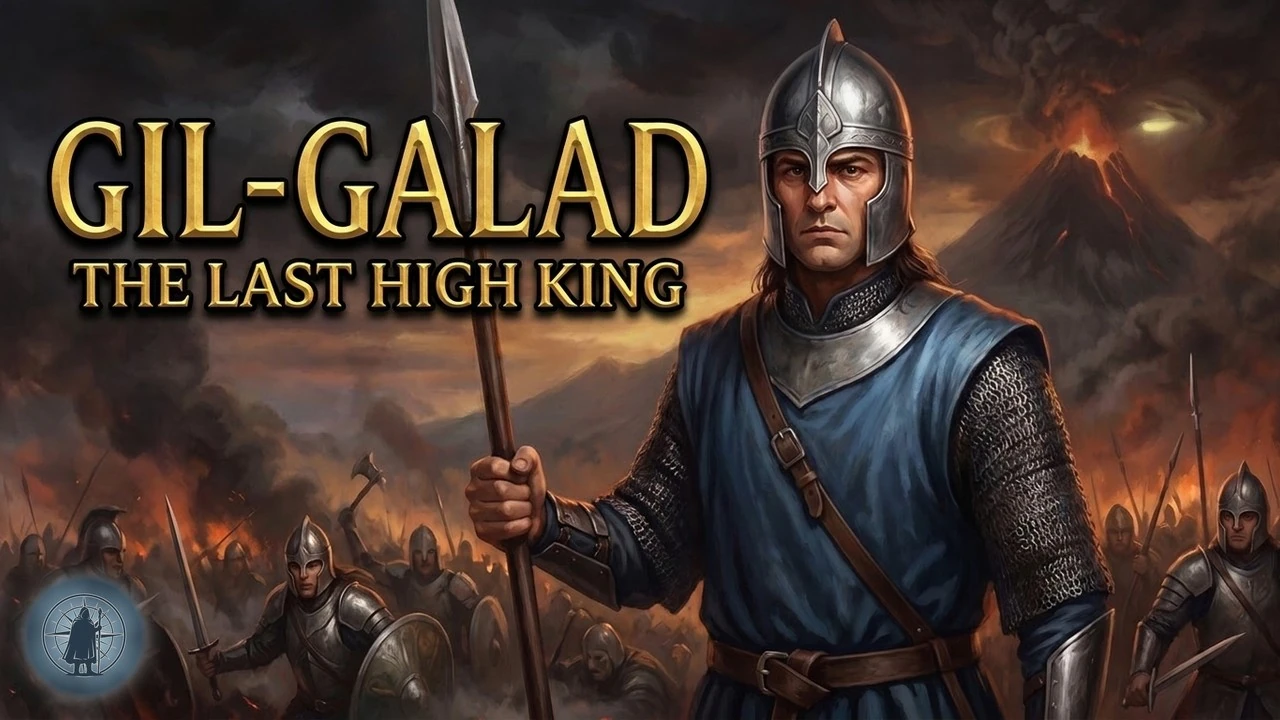 Watch the episode
Why Sauron Never Conquered Gil-galad
Watch the episode
Why Sauron Never Conquered Gil-galad
Research Notes: Gil-galad — Last High King of the Noldor
Research pass verdict: ABUNDANT — but abundant in an unusual way. Gil-galad is mentioned
everywhere in the legendarium and dramatized almost nowhere. The record of his deeds is rich
(Silmarillion, LOTR Appendices A/B, Unfinished Tales, HoME V/XI/XII, The Nature of Middle-earth);
the record of his person is close to nil — he has no dialogue anywhere in The Silmarillion,
and exactly one first-person document in the entire corpus. That absence is the most
interesting thing about him, and it is treated below as load-bearing evidence, not as a gap.
Eight distinct themes, each with 3+ hard specifics. No under-band risk.
Redundancy warning for the writer. The channel has already published *The Last Alliance of
Elves and Men, Elendil the Tall, Narsil and Andúril, Annatar's Deception, Celebrimbor*,
The Three Elven Rings, Isildur: Hero and Failure, and *How the Rings of Power Were Really
Forged*. This episode must not be a Last Alliance re-tell. The unclaimed spine: the ~3,520-year
reign, the parentage as an editorial artifact, Lindon as a rearguard state, eight centuries of
Númenórean correspondence, the door that stayed shut to Annatar, and the fact that a king this
consequential left no voice, no heir and no grave — only twelve lines a gardener half-remembered.
How to use this file. It runs long (~20k words) because most of its bulk is **verbatim primary
text with page citations** rather than summary — Gil-galad's material is scattered across six books
and the exact wording matters, so it is reproduced here instead of paraphrased. Fast path for the
script writer: (1) Discrete Analytical Themes at the foot — eight self-contained sections, each
already carrying its own evidence; (2) Suggested Section Mapping immediately after it;
(3) Contradictions §12 — four "quotations" in wide circulation that are not in Tolkien and
must never reach the script. Everything above those is lookup material, not required reading.
Sourcing note. Primary quotations below were pulled from full running texts (Internet Archive
scans of HoME V/XI/XII, The Silmarillion, Unfinished Tales; verbatim Appendix B; FOTR).
Page citations are Christopher Tolkien's own internal cross-references where he gives them.
Obvious OCR damage to diacritics was silently restored; wording is otherwise verbatim. Items
reaching us only through secondary description are marked [secondary].
Overview
Ereinion Gil-galad is the fourth and last High King of the Noldor in Middle-earth. He holds the title from the fall of Gondolin (F.A. 510) to his death on the slopes of Orodruin (S.A. 3441) — on the legendarium's own chronology, roughly 3,520 years, longer than the whole Third Age, longer than Fingolfin, Fingon and Turgon's reigns combined by an order of magnitude. Appendix B calls him *"last heir of the kings of the Noldor in exile… acknowledged as High King of the Elves of the West." The Shibboleth calls him "the last king of the Eldar in Middle-earth, and the last male descendant of Finwë except Elrond the Half-elven."*
He is the Elf-king who shut his door on Sauron and sent warnings to everyone else's, who spent eight hundred years writing to Númenor, who held two of the Three Rings and gave both away, and who is the last person ever to command an Elvish host in a field battle.
He is also, in the strictest textual sense, a man made of holes. Tolkien changed his father four times and never settled it. His mother is never named in any surviving version except one scribbled note. He has no wife, no child, no heir, no tomb. He speaks not one word in The Silmarillion. What Tolkien gave him instead is a spear, a silver shield full of stars, one diplomatic letter, and a fragment of a lay that a hobbit gardener recites in the dark below Weathertop — and then, at the Council of Elrond, the only surviving eyewitness stands up and tells the room what it was like to watch him die.
The episode's real subject is the gap between how enormously important Gil-galad is to the shape of Middle-earth's history and how little of him actually exists on the page.
Primary Sources
The Silmarillion — Ch. 18, "Of the Ruin of Beleriand and the Fall of Fingolfin" (p. 154)
"Great was the lamentation in Hithlum when the fall of Fingolfin became known, and Fingon in
sorrow took the lordship of the house of Fingolfin and the kingdom of the Noldor; but **his young
son Ereinion (who was after named Gil-galad) he sent to the Havens**."
His first appearance in the published book is an evacuation. He is introduced as cargo.
Provenance flag (major): this sentence rests on a single late pencilled marginal note in the Grey Annals — see "Contradictions and Variants," Theme 1.
The Silmarillion — Ch. 20, "Of the Fifth Battle" (pp. 193, 196)
Fingon's death at the Nirnaeth (F.A. 472) — Gothmog *"hewed him with his black axe, and a white flame sprang up from the helm of Fingon as it was cloven. Thus fell the High King of the Noldor; and they beat him into the dust with their maces, and his banner, blue and silver, they trod into the mire of his blood."* (Note the blue-and-silver — Renée Vink argues this heraldic correspondence is the only real argument for the Fingon parentage. See Scholarly Perspectives.)
The sack of the Falas, F.A. 473:
"Then the Havens were laid in ruin, and the tower of Barad Nimras cast down; and the most part of
Círdan's people were slain or enslaved. But some went aboard ship and escaped by sea; and among
them was **Ereinion Gil-galad, the son of Fingon, whom his father had sent to the Havens after the
Dagor Bragollach**. This remnant sailed with Círdan south to the Isle of Balar…"
Provenance flag: the Gil-galad clause is Christopher Tolkien's editorial insertion. The *Grey Annals §§256–7 (HoME XI, pp. 90ff.) narrate the sack and the flight to Balar with *no mention of Gil-galad at all**.
The Silmarillion — Ch. 23, "Of Tuor and the Fall of Gondolin" (p. 243)
"And when the tidings came to Balar of the fall of Gondolin and the death of Turgon, **Ereinion
Gil-galad son of Fingon was named High King of the Noldor in Middle-earth**."
Note the verb: named, on a refugee island, by the survivors. Not "succeeded." Note also that the Silmarillion Index entry for Turgon never uses the phrase "High King" — he is "Called the Wise… called (like Thingol) the Hidden King." Turgon's High Kingship is attested chiefly by the sentence that ends it.
The Silmarillion — Ch. 24, "Of the Voyage of Eärendil" (pp. 247, 254)
The Third Kinslaying (c. F.A. 538): *"Too late the ships of Círdan and Gil-galad the High King came hasting to the aid of the Elves of Sirion… Then such few of that people as did not perish in the assault joined themselves to Gil-galad, and went with him to Balar."*
The end of the Age, and the choice to stay:
"Yet not all the Eldalië were willing to forsake the Hither Lands where they had long suffered and
long dwelt; and some lingered many an age in Middle-earth. Among those were Círdan the Shipwright,
and Celeborn of Doriath, with Galadriel his wife… In Middle-earth dwelt also **Gil-galad the High
King**, and with him was Elrond Half-elven…"
The Silmarillion never narrates a single deed of his in the War of Wrath. The First Age is the hole.
The Silmarillion — "Of the Rings of Power and the Third Age"
The making of Lindon:
"In the Great Battle and the tumults of the fall of Thangorodrim there were mighty convulsions in
the earth, and Beleriand was broken and laid waste… In the east, in Ossiriand, the walls of Ered
Luin were broken, and a great gap was made in them towards the south, and a gulf of the sea flowed
in. Into that gulf the River Lhûn fell by a new course, and it was called therefore the Gulf of
Lhûn. That country had of old been named Lindon by the Noldor, and this name it bore thereafter;
and many of the Eldar still dwelt there, lingering, unwilling yet to forsake Beleriand where they
had fought and laboured long. Gil-galad son of Fingon was their king, and with him was Elrond
Half-elven…"
Provenance flag (major): Christopher Tolkien states plainly that in this very sentence, *"in the published text (The Silmarillion p. 286) Fingon is an editorial alteration of Felagund"* (HoME XII, p. 349).
Mithlond:
"Upon the shores of the Gulf of Lhûn the Elves built their havens, and named them Mithlond;
and there they held many ships, for the harbourage was good. From the Grey Havens the Eldar ever
and anon set sail, fleeing from the darkness of the days of Earth…"
And the contrast that defines the political geography: *"Only in Eregion, which Men called Hollin, did Elves of Noldorin race establish a lasting realm beyond the Ered Luin."*
The refusal of Annatar — and note that Gil-galad does not merely shut a door, he sends warnings:
"Men he found the easiest to sway of all the peoples of the Earth; but long he sought to persuade
the Elves to his service… **Only to Lindon he did not come, for Gil-galad and Elrond doubted him
and his fair-seeming, and though they knew not who in truth he was they would not admit him to
that land. But elsewhere the Elves received him gladly, and few among them hearkened to the
messengers from Lindon bidding them beware**; for Sauron took to himself the name of Annatar, the
Lord of Gifts…"
Sauron's counter-propaganda, in which he names Gil-galad aloud:
"'**Alas, for the weakness of the great! For a mighty king is Gil-galad, and wise in all lore is
Master Elrond, and yet they will not aid me in my labours.** Can it be that they do not desire to
see other lands become as blissful as their own? But wherefore should Middle-earth remain for ever
desolate and dark, whereas the Elves could make it as fair as Eressëa, nay even as Valinor?…'"
The war, compressed: *"From that time war never ceased between Sauron and the Elves; and Eregion was laid waste, and Celebrimbor slain, and the doors of Moria were shut. In that time the stronghold and refuge of Imladris… was founded by Elrond Half-elven." And the holding: "**But in Lindon Gil-galad still maintained his power, and Sauron dared not as yet to pass the Mountains of Ered Luin nor to assail the Havens; and Gil-galad was aided by the Númenóreans.*"
The realm at its greatest extent (as Sauron finds it on returning from Númenor's fall):
"There he found that **the power of Gil-galad had grown great in the years of his absence, and it
was spread now over wide regions of the north and west, and had passed beyond the Misty Mountains
and the Great River even to the borders of Greenwood the Great**, and was drawing nigh to the
strong places where once he had dwelt secure."
Elendil received; the towers built:
"Elendil was cast up by the waves in the land of Lindon, and he was befriended by Gil-galad.
Thence he passed up the River Lhûn, and beyond Ered Luin he established his realm."
"It is said that **the towers of Emyn Beraid were not built indeed by the Exiles of Númenor, but
were raised by Gil-galad for Elendil, his friend**; and the Seeing Stone of Emyn Beraid was set in
Elostirion, the tallest of the towers."
That palantír looked west, toward Eressëa. Gil-galad built a tower so a mortal man could look at the country Gil-galad himself had declined to sail to. It is the most affecting fact about him and it is one sentence long.
The Last Alliance:
"Now Elendil and Gil-galad took counsel together, for they perceived that Sauron would grow too
strong and would overcome all his enemies one by one, if they did not unite against him. Therefore
they made that League which is called the Last Alliance… It is said that the host that was there
assembled was fairer and more splendid in arms than any that has since been seen in Middle-earth,
and none greater has been mustered since the host of the Valar went against Thangorodrim."
"All living things were divided in that day, and some of every kind, even of beasts and birds,
were found in either host, save the Elves only. **They alone were undivided and followed
Gil-galad.**"
"Against Aeglos the spear of Gil-galad none could stand; and the sword of Elendil filled Orcs
and Men with fear, for it shone with the light of the sun and of the moon, and it was named
Narsil."
"Then Gil-galad and Elendil passed into Mordor and encompassed the stronghold of Sauron; and they
laid siege to it for seven years… **But at the last the siege was so strait that Sauron himself
came forth; and he wrestled with Gil-galad and Elendil, and they both were slain**, and the sword
of Elendil broke under him as he fell. But Sauron also was thrown down, and with the hilt-shard of
Narsil Isildur cut the Ruling Ring from the hand of Sauron and took it for his own."
The terminus:
"Elendil the Tall and Gil-galad the High King were no more. **Never again was such a host
assembled, nor was there any such league of Elves and Men; for after Elendil's day the two kindreds
became estranged.**"
On the Three, deliberately vague — the chapter never names Gil-galad as a Ring-bearer at all: *"they were given into the hands of the Wise, who concealed them and never again used them openly while Sauron kept the Ruling Ring."* Only the Third Age holders are named: Vilya with Elrond, Nenya in Lórien, and "*At the first that Ring [Narya] had been entrusted to Círdan, Lord of the Havens*; but he had surrendered it to Mithrandir."
The Lord of the Rings — Appendix B, "The Tale of Years," Second Age headnote (verbatim)
"In the beginning of this age many of the High Elves still remained. Most of these dwelt in Lindon
west of the Ered Luin… **In Lindon north of the Lune dwelt Gil-galad, last heir of the kings of the
Noldor in exile. He was acknowledged as High King of the Elves of the West.** In Lindon south of
the Lune dwelt for a time Celeborn, kinsman of Thingol; his wife was Galadriel, greatest of Elven
women."
Note the title as Tolkien himself framed it in the Appendix: not merely High King of the Noldor but "High King of the Elves of the West."
Textual variant: the "Celeborn in Lindon south of the Lune" clause is a **revised-edition replacement; the first edition* read "Celeborn in the south of the forest"* (i.e. Greenwood). Christopher notes this in UT, "The History of Galadriel and Celeborn."
Key dated entries (verbatim):
"1 — Foundation of the Grey Havens, and of Lindon."
"600 — The first ships of the Númenóreans appear off the coasts."
"750 — Eregion founded by the Noldor."
"**1200 — Sauron endeavours to seduce the Eldar. Gil-galad refuses to treat with him; but the
smiths of Eregion are won over.** The Númenóreans begin to make permanent havens."
"c. 1500 — The Elven-smiths instructed by Sauron reach the height of their skill. They begin the
forging of the Rings of Power."
"c. 1590 — The Three Rings are completed in Eregion."
"c. 1600 — Sauron forges the One Ring in Orodruin. He completes the Barad-dûr. Celebrimbor
perceives the designs of Sauron."
"1693 — War of the Elves and Sauron begins. The Three Rings are hidden."
"1695 — Sauron's forces invade Eriador. Gil-galad sends Elrond to Eregion."
"**1697 — Eregion laid waste. Death of Celebrimbor. The gates of Moria are shut. Elrond retreats
with remnant of the Noldor and founds the refuge of Imladris.**"
"1699 — Sauron overruns Eriador."
"1700 — Tar-Minastir sends a great navy from Númenor to Lindon. Sauron is defeated."
"1701 — Sauron is driven out of Eriador. The Westlands have peace for a long while."
"2251 — Death of Tar-Atanamir. Tar-Ancalimon takes the sceptre. Rebellion and division of the
Númenóreans begins. About this time the Nazgûl or Ringwraiths… first appear."
"3430 — The Last Alliance… 3431 — Gil-galad and Elendil march east to Imladris. 3434 — [crossing
of the Misty Mountains] Battle of Dagorlad… siege of Barad-dûr begins. 3440 — Anárion slain.
3441 — Sauron overthrown by Elendil and Gil-galad, who perish."
Appendix B, Third Age headnote — the plainest statement of his Ring-custody:
"**they had been held at first by the three greatest of the Eldar: Gil-galad, Galadriel and Círdan.
Gil-galad before he died gave his ring to Elrond; Círdan later surrendered his to Mithrandir.**"
The Lord of the Rings — "A Knife in the Dark" (FOTR I.11)
The set-up, verbatim:
"'It is told that **Elendil stood there watching for the coming of Gil-galad out of the West, in
the days of the Last Alliance**.'
The hobbits gazed at Strider… 'Who was Gil-galad?' asked Merry; but Strider did not answer, and
seemed to be lost in thought. Suddenly a low voice murmured:"
The lay, exactly as printed (note the lower-case continuation lines — nearly every website mis-capitalises them):
Gil-galad was an Elven-king.
Of him the harpers sadly sing:
the last whose realm was fair and free
between the Mountains and the Sea.
His sword was long, his lance was keen,
his shining helm afar was seen;
the countless stars of heaven's field
were mirrored in his silver shield.
But long ago he rode away,
and where he dwelleth none can say;
for into darkness fell his star
in Mordor where the shadows are.
The authorship exchange, verbatim:
"The others turned in amazement, for the voice was Sam's.
'Don't stop!' said Merry.
'That's all I know,' stammered Sam, blushing. 'I learned it from Mr. Bilbo when I was a lad. He
used to tell me tales like that, knowing how I was always one for hearing about Elves. It was Mr.
Bilbo as taught me my letters… And he wrote poetry. He wrote what I have just said.'
'He did not make it up,' said Strider. '**It is part of the lay that is called The Fall of
Gil-galad, which is in an ancient tongue. Bilbo must have translated it. I never knew that.**'
'There was a lot more,' said Sam, '**all about Mordor. I didn't learn that part, it gave me the
shivers.** I never thought I should be going that way myself!'"
Frodo's gloss, same chapter: *"'Gil-galad was the last of the great Elf-kings of Middle-earth. Gil-galad is Starlight in their tongue.'"* Aragorn promises they may hear the rest in Rivendell — a promise the book never keeps.
The Lord of the Rings — "The Council of Elrond" (FOTR II.2)
The richest Gil-galad passage in all of Tolkien, delivered by somebody else about him. Elrond's narration, then the banners speech, verbatim and in order:
"But Sauron of Mordor assailed them, and they made the Last Alliance of Elves and Men, and the
hosts of Gil-galad and Elendil were mustered in Arnor."
"Thereupon Elrond paused a while and sighed. 'I remember well the splendour of their banners,'
he said. '**It recalled to me the glory of the Elder Days and the hosts of Beleriand, so many great
princes and captains were assembled. And yet not so many, nor so fair, as when Thangorodrim was
broken, and the Elves deemed that evil was ended for ever, and it was not so.**'"
"'You remember?' said Frodo… 'But I thought that the fall of Gil-galad was a long age ago.'"
"I have seen three ages in the West of the world, and many defeats, and many fruitless victories."
"I was the herald of Gil-galad and marched with his host. I was at the Battle of Dagorlad
before the Black Gate of Mordor, where we had the mastery: for **the Spear of Gil-galad and the
Sword of Elendil, Aiglos and Narsil, none could withstand.** I beheld the last combat on the slopes
of Orodruin, where Gil-galad died, and Elendil fell, and Narsil broke beneath him; but Sauron
himself was overthrown, and Isildur cut the Ring from his hand with the hilt-shard of his father's
sword, and took it for his own."
The honour guard at the end of the Noldorin kingship — two Elves:
"He alone stood by his father in that last mortal contest; and **by Gil-galad only Círdan stood,
and I**. But Isildur would not listen to our counsel."
Elrond's summation — the thesis paragraph of the whole episode, verbatim:
"**Fruitless did I call the victory of the Last Alliance? Not wholly so, yet it did not achieve its
end. Sauron was diminished, but not destroyed. His Ring was lost but not unmade. The Dark Tower was
broken, but its foundations were not removed; for they were made with the power of the Ring, and
while it remains they will endure. Many Elves and many mighty Men, and many of their friends, had
perished in the war. Anárion was slain, and Isildur was slain; and Gil-galad and Elendil were no
more. Never again shall there be any such league of Elves and Men; for Men multiply and the
Firstborn decrease, and the two kindreds are estranged. And ever since that day the race of Númenor
has decayed, and the span of their years has lessened.**"
Note Tolkien's verbs, all different: Gil-galad died, Elendil fell, Sauron was overthrown.
Isildur's scroll, read aloud by Gandalf — the only text that says how Gil-galad died:
"It was hot when I first took it, hot as a glede, and my hand was scorched… Yet even as I write it
is cooled, and it seemeth to shrink… **The Ring misseth, maybe, the heat of Sauron's hand, which
was black and yet burned like fire, and so Gil-galad was destroyed.**"
Death by touch. Not the mace of the films. Burned.
The Lord of the Rings — Appendix A, I(i), and the Silmarillion Index
The end of the High-elven kingship, correctly cited. *(See "Contradictions" §12 — the sentence "with him died the line of the High Kings of the Noldor in Middle-earth" is not a quotation from anywhere. These three are the real texts.)*
"The sons of Eärendil were Elros and Elrond, the Peredhil or Half-elven. In them alone the line of
the heroic chieftains of the Edain in the First Age was preserved; and **after the fall of Gil-galad
the lineage of the High-elven Kings was also in Middle-earth only represented by their
descendants**." — LOTR, Appendix A, I(i)
"Gil-galad 'Star of Radiance', the name by which Ereinion son of Fingon was afterwards known.
After the death of Turgon he became the last High King of the Noldor in Middle-earth…" —
Silmarillion Index
"In all the days of the Third Age, after the fall of Gil-galad, Master Elrond abode in Imladris,
and he gathered there many Elves… and he preserved through many lives of Men the memory of all that
had been fair." — Silm., "Of the Rings of Power"
Elrond is Master Elrond, never king. After 3441 the Eldar of Middle-earth are three regional lords with no crown between them: Galadriel (Lórien — *"who alone remained of those who led the Noldor to exile in Beleriand"*), Círdan (the Havens), Elrond (Imladris). The Elves stop being a nation and become three enclaves.
The Lord of the Rings — ROTK VI.9, "The Grey Havens": Vilya finally shown
"Elrond wore a mantle of grey and had a star upon his forehead, and a silver harp was in his hand,
and upon his finger was a ring of gold with a great blue stone, Vilya, mightiest of the Three."
The Ring Gil-galad handed off is not seen on the page until the last chapter of the book, on its way out of the world.
The Lord of the Rings — TTT IV.2, "The Passage of the Marshes": the battlefield now
Gil-galad's greatest victory field, three thousand years later:
"'I have seen them too. In the pools when the candles were lit. They lie in all the pools, pale
faces, deep deep under the dark water. I saw them: **grim faces and evil, and noble faces and sad.
Many faces proud and fair, and weeds in their silver hair. But all foul, all rotting, all dead. A
fell light is in them.**' Frodo hid his eyes in his hands. 'I know not who they are; but I thought I
saw there Men and Elves, and Orcs beside them.'"
"'Yes, yes,' said Gollum. 'All dead, all rotten. Elves and Men and Orcs. The Dead Marshes. **There
was a great battle long ago**… Tall Men with long swords, and terrible Elves, and Orcses shrieking.
They fought on the plain for days and months at the Black Gates. **But the Marshes have grown since
then, swallowed up the graves; always creeping, creeping.**'"
Letter 226 (to L. W. Forster, 31 Dec 1960): "*The Dead Marshes and the approaches to the Morannon owe something to Northern France after the Battle of the Somme.*" Gil-galad's victory field is Tolkien's Somme — and "weeds in their silver hair" are, on the plain reading, his own Elves.
Unfinished Tales — "Aldarion and Erendis": the letter to Tar-Meneldur (pp. 199–200)
Gil-galad's only recorded first-person words in the entire legendarium. Delivered by Aldarion in S.A. 882, immediately before Meneldur resolved to resign the Sceptre (883).
The frame: *"It was sealed and bore his device of white stars upon a blue rondure. Upon the outer fold was written: 'Given at Mithlond to the hand of the Lord Aldarion King's Heir of Númenórë, to be delivered to the High King at Armenelos in person.'"*
Full text, verbatim:
"Ereinion Gil-galad son of Fingon to Tar-Meneldur of the line of Eärendil, greeting: the Valar
keep you and may no shadow fall upon the Isle of Kings.
Long I have owed you thanks, for you have so many times sent to me your son Anardil Aldarion: **the
greatest Elf-friend that now is among Men, as I deem.** At this time I ask your pardon, if I have
detained him overlong in my service; for I had great need of the knowledge of Men and their tongues
which he alone possesses. He has dared many perils to bring me counsel. Of my need he will speak to
you; yet he does not guess how great it is, being young and full of hope. **Therefore I write this
for the eyes of the King of Númenórë only.**
**A new shadow arises in the East. It is no tyranny of evil Men, as your son believes; but a
servant of Morgoth is stirring, and evil things wake again. Each year it gains in strength, for
most Men are ripe to its purpose. Not far off is the day, I judge, when it will become too great
for the Eldar unaided to withstand.** Therefore, whenever I behold a tall ship of the Kings of Men,
my heart is eased. And now I make bold to seek your help. If you have any strength of Men to spare,
lend it to me, I beg.
Your son will report to you, if you will, all our reasons. But in fine it is his counsel (and that
is ever wise) that **when assault comes, as it surely will, we should seek to hold the Westlands,
where still the Eldar dwell, and Men of your race, whose hearts are not yet darkened. At the least
we must defend Eriador about the long rivers west of the mountains that we name Hithaeglir: our
chief defence.** But in that mountain-wall there is a great gap southward in the land of
Calenardhon; and by that way inroad from the East must come…
So the Lord Aldarion long has seen. At Vinyalondë by the mouth of Gwathló he has long laboured to
establish such haven, secure against sea and land; but his mighty works have been in vain… But
he has never had men enough; whereas Círdan has no wrights or masons to spare.
The King will know his own needs; but if he will listen with favour to the Lord Aldarion, and
support him as he may, then hope will be greater in the world. **The memories of the First Age are
dim, and all things in Middle-earth grow colder. Let not the ancient friendship of Eldar and
Dúnedain wane also.**
**Behold! The darkness that is to come is filled with hatred for us, but it hates you no less. The
Great Sea will not be too wide for its wings, if it is suffered to come to full growth.**
Manwë keep you under the One, and send fair wind to your sails."
Meneldur's reaction, immediately following: *"Meneldur let the parchment fall into his lap. Great clouds borne upon a wind out of the East brought darkness early… '**May Eru call me before such a time comes!*' he cried aloud." He then resigns the Sceptre rather than answer it.
MAJOR EDITORIAL FLAG. The salutation as printed is Christopher Tolkien's emendation. Tolkien's manuscript read "Finellach Gil-galad of the House of Finarfin." Christopher substituted "Ereinion Gil-galad son of Fingon" to harmonise with the Silmarillion he had already published; he likewise changed "King Finellach Gil-galad of Lindon" to "King Gil-galad of Lindon" in "A Description of the Island of Númenor" (UT p. 168). He states both changes openly at HoME XII p. 351. **Gil-galad's one surviving letter has been retouched to support an ancestry his author had discarded.**
Cross-reference, UT "The Line of Elros," V (Tar-Meneldur): he resigned *"suddenly and long before due time, as a stroke of policy, in troubles that arose, **owing to the disquiet of Gil-galad in Lindon, when he first became aware that an evil spirit, hostile to Eldar and Dúnedain, was stirring in Middle-earth*."
Unfinished Tales — Númenórean contact and the mallorn
- First contact, S.A. 600 (late philological essay quoted in UT): *"It was six hundred years after the departure of the survivors of the Atani over the sea to Númenor that a ship first came again out of the West to Middle-earth and passed up the Gulf of Lhûn. **Its captain and mariners were welcomed by Gil-galad; and thus was begun the friendship and alliance of Númenor with the Eldar of Lindon." The captain was Véantur* (born S.A. 451). - Véantur to his grandson Aldarion: *"we will go to Mithlond and see the tall blue mountains of Middle-earth… Good welcome you will find from Círdan the Shipwright and from King Gil-galad."* - S.A. 725, Aldarion's first voyage: *"he made the friendship of Círdan and Gil-galad, and journeyed far in Lindon and the west of Eriador, and marvelled at all that he saw."* - UT, "The Line of Elros," VI (Tar-Aldarion): *"He was a great mariner and ship-builder… where he became the friend and counsellor of Gil-galad."* - The mallorn chain (UT, "A Description of the Island of Númenor"): *"some were given as gift by Tar-Aldarion… to King Gil-galad of Lindon. **They did not take root in that land; but Gil-galad gave some to his kinswoman Galadriel**, and under her power they grew and flourished in the guarded land of Lothlórien."* A gift Gil-galad could not use became the defining feature of the most beautiful place in the Third Age — and, through Galadriel's gift-box, the mallorn in Sam's Party Field.
Unfinished Tales — the estrangement of Númenor
- UT, "The Line of Elros," VII (Tar-Ancalimë): "*After Aldarion's death she neglected all his policies and gave no further aid to Gil-galad." Christopher's flat verdict: "There is no mention of any further development of the alliance with Gil-galad, or of the sending of the aid that he requested in his letter to Tar-Meneldur." And on Aldarion himself: "Aldarion was too late, or too early. Too late: for the power that hated Númenor had already waked. Too early: for the time was not yet ripe for Númenor to show its power or to come back into the battle for the world.*" - UT, "The Line of Elros," XI (Tar-Minastir): "*He loved the Eldar but envied them. He it was who sent a great fleet to the aid of Gil-galad in the first war against Sauron.*" - Akallabêth on the schism: "in his day *the people of Númenor became divided. On the one hand was the greater party, and they were called the King's Men, and they grew proud and were estranged from the Eldar and the Valar. And on the other hand was the lesser party, and they were called the Elendili, the Elf-friends.*" - Akallabêth on Gil-galad's realm as the Faithful's destination: "*They alone came now ever to the north and the land of Gil-galad, keeping their friendship with the Elves and lending them aid against Sauron*; and their haven was Pelargir above the mouths of Anduin the Great." And under Ar-Gimilzôr's persecution: "*thence many set sail to Middle-earth, seeking the northern coasts where they might speak still with the Eldar in the kingdom of Gil-galad.** This was known to the kings, but they hindered it not, so long as the Elendili departed from their land and did not return."* - Akallabêth on Sauron's grudge: "nor did he forget *the aid that Tar-Minastir had rendered to Gil-galad of old**, in that time when the One Ring was forged and there was war between Sauron and the Elves in Eriador."* - Flag: Gil-galad is never named anywhere in the Ar-Pharazôn / Sauron-hostage sequence. Any script implying they interacted is extrapolating.
Unfinished Tales — "Concerning Galadriel and Celeborn": the War of the Elves and Sauron
Christopher's own warning about the source's status, which the writer must respect:
"The text bearing this title is a short and hasty outline, very roughly composed, which is
nonetheless almost the sole narrative source for the events in the West of Middle-earth up to
the defeat and expulsion of Sauron from Eriador in the year 1701."
The campaign, verbatim in sequence:
"When Sauron learned of the repentance and revolt of Celebrimbor his disguise fell and his wrath
was revealed; and gathering a great force he moved over Calenardhon (Rohan) to the invasion of
Eriador in the year 1695. **When news of this reached Gil-galad he sent out a force under Elrond
Half-elven; but Elrond had far to go, and Sauron turned north and made at once for Eregion.**"
"Sauron's host was far greater than theirs, great enough both to hold them off and closely to
invest Eregion."
"Concerning the Three Rings Sauron could learn nothing from Celebrimbor; and he had him put to
death. **But he guessed the truth, that the Three had been committed to Elvish guardians: and that
must mean to Galadriel and Gil-galad.**"
"Now Sauron's immediate purpose was **to take Lindon, where he believed that he had most chance of
seizing one, or more, of the Three Rings**; and he called in therefore his scattered forces and
marched west towards the land of Gil-galad, ravaging as he went."
The relief — the single most cinematic paragraph available:
"**As soon as Gil-galad began to fear that Sauron would come with open war into Eriador he sent
messages to Númenor**; and on the shores of Lindon the Númenóreans began to build up a force and
supplies for war. **In 1695, when Sauron invaded Eriador, Gil-galad called on Númenor for aid. Then
Tar-Minastir the King sent out a great navy; but it was delayed, and did not reach the coasts of
Middle-earth until the year 1700.** By that time Sauron had mastered all Eriador, save only
besieged Imladris, and had reached the line of the River Lhûn… **Gil-galad and the Númenóreans were
holding the Lhûn in desperate defence of the Grey Havens, when in the very nick of time the great
armament of Tar-Minastir came in; and Sauron's host was heavily defeated and driven back.** The
Númenórean admiral Ciryatur sent part of his ships to make a landing further to the south."
The rout: "Sauron was driven away south-east after great slaughter at Sarn Ford… *In the Battle of the Gwathló Sauron was routed utterly and he himself only narrowly escaped… broken and humiliated he returned to Mordor, and vowed vengeance upon Númenor.** The army that was besieging Imladris was caught between Elrond and Gil-galad, and utterly destroyed. **Eriador was cleared of the enemy, but lay largely in ruins.*"
Five years. Gil-galad sent for help in 1695; it landed in 1700, with the enemy on his last river.
No numbers exist. No army sizes, ship counts or casualty figures appear anywhere in these texts — only relative statements ("far greater than theirs," "a great navy," "no more than a bodyguard"). Any figure in a script is invention.
Unfinished Tales — the Rings, the vice-regency, and the Council of 1701
"It was at that time that she received Nenya, the White Ring, from Celebrimbor… Celebrimbor
followed her counsel that the Ring of Air and the Ring of Fire should be sent out of Eregion; and
he entrusted them to Gil-galad in Lindon."
"At this time the first Council was held, and it was there determined that an Elvish stronghold in
the east of Eriador should be maintained at Imladris rather than in Eregion. **At that time also
Gil-galad gave Vilya, the Blue Ring, to Elrond, and appointed him to be his vice-regent in Eriador;
but the Red Ring he kept, until he gave it to Círdan when he set out from Lindon in the days of the
Last Alliance.**"
Christopher's note 11: "Earlier in this narrative it is said that *Gil-galad gave Narya, the Red Ring, to Círdan as soon as he himself received it from Celebrimbor**, and this agrees with the statements in Appendix B… and in Of the Rings of Power… **The statement here, at variance with the others, was added in the margin of the text.*"
Unfinished Tales — the alliance's hidden cost (Appendix D, "The Port of Lond Daer")
"The changes that followed were largely due to the operations of Tar-Aldarion, the Mariner-king,
who formed a friendship and alliance with Gil-galad… **This entry into Eriador later proved of
great importance in the war against Sauron (Second Age 1693–1701)**; but it was in origin a
timber-port and ship-building harbour."
The Númenóreans logged Minhiriath and Enedwaith on an industrial scale. The native forest-folk (ancestors of the Dunlendings) burned the wood-stores and destroyed the haven repeatedly — and in the War of the Elves and Sauron the men of Minhiriath fought on Sauron's side, out of hatred for the Númenóreans who had stripped their forests. [secondary — verify page before quoting verbatim] Gil-galad's great alliance manufactured some of Sauron's own recruits.
Unfinished Tales — the Silvan princes and command friction (Appendix B to "Galadriel and Celeborn")
"The Silvan Elves were hardy and valiant, but ill-equipped with armour or weapons in comparison
with the Eldar of the West; also **they were independent, and not disposed to place themselves under
the supreme command of Gil-galad. Their losses were thus more grievous than they need have been,
even in that terrible war. Malgalad and more than half his following perished in the great battle of
the Dagorlad, being cut off from the main host and driven into the Dead Marshes. Oropher was slain
in the first assault upon Mordor, rushing forward at the head of his most doughty warriors before
Gil-galad had given the signal for the advance.** Thranduil his son survived, but when the war ended
and Sauron was slain (as it seemed) **he led back home barely a third of the army that had marched
to war**."
Gil-galad as supreme commander of the Alliance — and resented for it. Thranduil's father died disobeying his order to hold; the Lórien king's people were driven into the Dead Marshes, where Frodo finds them still. *(Christopher notes Malgalad occurs nowhere else and can probably be equated with Amdír, father of Amroth — "But which name replaced the other I cannot say.")*
The Nature of Middle-earth — ch. XVIII, "Note on the Delay of Gil-galad and the Númenóreans"
A late text specifically about why the help came so late. By S.A. 1700 the Elves and their allies were holding little more than the line of the Lhûn; the note discusses "the great host of Minastir" in that context. That Tolkien wrote a dedicated note about the delay shows he considered the near-failure structurally important. **[secondary — summarized from description; do not quote verbatim without the book.]**
The History of Middle-earth — the drafting record
- HoME V (The Lost Road), The Fall of Númenor FN II §14, p. 29 — Gil-galad's **first appearance anywhere*, with no Finarfinian connection at all: "and he made a league with Gil-galad the Elf-king who was descended from Fëanor." Christopher (p. 33): "Here is certainly the first appearance of Gil-galad… descended from Fëanor (**it would be interesting to know his parentage*)…" - HoME V, p. 33 — the struck-through rewriting: *"But in the land that was left north and south of the gulf the Elves remained, and Gil-galad son of Felagund son of Finrod was their king."* (At this date "Finrod" = the later Finarfin.) - HoME V, p. 34 — the seed of Lindon, in a pencilled note: *"Beleriand was all sunk except for a few islands = mountains, and part of Ossiriand (called Lindon) where Gil-galad dwelt."* - HoME V, "The Etymologies," pp. 358, 362 — at this stage gilgalad is a common noun: "gilgalad starlight" under GIL-, and "N calad light (cf. Gilgalad)" under KAL-. - HoME XI (The War of the Jewels), pp. 242–3 — additions to the Quenta Silmarillion: *"he sent away his wife Meril to her own folk in Eglorest, and with her went their son, yet an elvenchild, and Gilgalad Starlight he was called for the brightness of his eye."* - HoME XI, Grey Annals §108, p. 44 — the reason the Felagund parentage collapsed: *"'An oath I too shall swear and must be free to fulfill it… **Nor shall anything of all my realm endure that a son should inherit.**' But it is said that not until that hour had such cold thoughts ruled him; for indeed she whom he had loved was Amarië of the Vanyar, and she was not permitted to go with him into exile."* - HoME XI, Grey Annals §157, p. 56 — the entire textual basis of the published parentage, one late pencilled marginal addition: *"[But his young son (?Findor) [sic] Gilgalad he sent to the Havens.]" Christopher at p. 243: "But this, adopted after much hesitation, was not in fact by any means the last of my father's speculations on this question."* - HoME XII (The Peoples of Middle-earth), pp. 349–51 — "The parentage of Gil-galad," the definitive editorial excursus. Full quotations in "Contradictions and Variants" below. - HoME XII, p. 347 — the definitive gloss of the name, tucked inside the Galadriel etymology: *"Galad occurs also in the epessé of Ereinion ('scion of kings') by which he was chiefly remembered in legend, Gil-galad 'star of radiance': **he was the last king of the Eldar in Middle-earth, and the last male descendant of Finwë except Elrond the Half-elven.** The epessé was given to him because **his helm and mail, and his shield overlaid with silver and set with a device of white stars, shone from afar like a star in sunlight or moonlight and could be seen by Elvish eyes at a great distance if he stood upon a height.*" - HoME XII, p. 347 n.47 — *"From this work was derived Gil-galad's name Ereinion introduced into The Silmarillion." i.e. the name "Ereinion" in the published book is *Christopher's importation from the 1968 essay**. - HoME XII, p. 361 n.35 — the tables gave Fingon an unnamed wife and two children, **Ernis (> Erien) and Finbor, *"but in the final table they were struck out, with the note that Fingon 'had no child or wife.'*" - HoME XII, pp. 173–4, 185 n.10 — an abandoned kinship: the early Tale of Years has **Galadriel as Gil-galad's sister* ("the Lady Galadriel of the Noldor, sister of Gil-galad"*), later reassigned so she became Felagund's sister.
The Letters of J.R.R. Tolkien
Gil-galad never gets a sustained authorial character study in the published Letters the way Sauron, Galadriel or Frodo do — but **Letter 131 is the single richest Gil-galad source in the whole correspondence**, and it is Tolkien narrating the Second Age in his own voice. Verified quotations:
Letter 131 (to Milton Waldman, 1951 — reproduced as the preface to the second edition of *The Silmarillion*): - "The next cycle deals (or would deal) with the Second Age. *But it is on Earth a dark age, and not very much of its history is (or need be) told.*" - "In the first we see a sort of second fall or at least 'error' of the Elves… *But they wanted to have their cake without eating it.** … They thus became obsessed with 'fading' … and their efforts all really a kind of embalming."* - "We hear of a lingering kingdom, in the extreme North-west… under Gil-galad"; and — the crispest statement of his one recorded act of judgement — "*Gil-galad repulsed all such overtures, as also did Elrond.*" - "*The last Elf-Kingdom of Gil-galad is maintained precariously on the extreme west-shores, where are the havens of the Ships.*" - "*The Second Age ends with the Last Alliance (of Elves and Men), and the great siege of Mordor… But at a cost, and with one disastrous mistake. Gil-galad and Elendil are slain in the act of slaying Sauron.** … But it is not unmade, and the Dark Tower built with its aid still stands, empty but not destroyed. **So ends the Second Age with the coming of the Númenórean realms and the passing of the last kingship of the High Elves.*"
That last paragraph is "the victory that fails," in Tolkien's own hand, and it explicitly prefigures the War of the Ring ("the Dark Tower… still stands, empty but not destroyed").
Letter 154 (to Naomi Mitchison, 25 Sept 1954) — the famous "embalmers" formulation, and **it is 154, not 131* (a very common misattribution): "with or without his assistance they were 'embalmers'. They wanted to have their cake and eat it: to live in the mortal historical Middle-earth… and so tried to stop its change and history, stop its growth, keep it as a pleasaunce."* This is Lindon's political psychology in one sentence.
A letter of September 1954, quoted at UT note 8: "…and those of Eregion *refused the warnings of Gil-galad and Elrond**. The particular 'desire' of the Eregion Elves — an 'allegory' if you like of a love of machinery, and technical devices — is also symbolized by their special friendship with the Dwarves of Moria."*
Letter 195 (to Amy Ronald, 15 Dec 1956) — "*Actually I am a Christian, and indeed a Roman Catholic, so that I do not expect 'history' to be anything but a 'long defeat' — though it contains (and in a legend may contain more clearly and movingly) some samples or glimpses of final victory.*" Pair with Galadriel, FOTR II.7: *"together through ages of the world we have fought the long defeat."*
Letter 226 (to L. W. Forster, 31 Dec 1960) — "*The Dead Marshes and the approaches to the Morannon owe something to Northern France after the Battle of the Somme.*"
Letter 247 (to Col. Worskett, 20 Sept 1963) — the warrant for the Sam's-poem theme: *"Part of the attraction of the L.R. is, I think, due to the **glimpses of a large history in the background: an attraction like that of viewing far off an unvisited island, or seeing the towers of a distant city gleaming in a sunlit mist.*"
Two unverified leads worth a print check before use: - Letter 200 (to Major R. Bowen, 25 June 1957) — indexed under *Elendil · Gil-galad · Númenor · Sauron* (Carpenter pp. 259–60; 2023 rev. pp. 374–75). Unread; likely the second-richest Gil-galad letter. [unverified] - Letter 210 (on the Zimmerman film treatment) — reportedly objects that the script gave Aragorn rather than Sam the Fall of Gil-galad, "which was wholly inappropriate." **[unverified paraphrase — but if it checks out it is gold: Tolkien insisting the lay belongs in a gardener's mouth.]**
Timeline
First Age
| Year | Event | Source | |---|---|---| | mid-400s | Ereinion born (no year is ever stated; "mid-400s" is inference) | inference | | 455–456 | Dagor Bragollach; Fingolfin slain. Fingon takes the kingship and sends his young son to the Havens | Silm. 154 | | 472 | Nirnaeth Arnoediad. Fingon slain by Gothmog; his blue-and-silver banner trodden into his blood. Gil-galad is absent | Silm. 193 | | 473 | Brithombar and Eglarest sacked; Barad Nimras cast down. Círdan and Gil-galad escape by sea to the Isle of Balar | Silm. 196 (clause is CT's insertion) | | 495 | (Orodreth-variant only) Fall of Nargothrond — in the late genealogy Gil-galad would have been raised there and escaped to Sirion's Mouths | HoME XII 350; Martinez | | 510 | Fall of Gondolin; Turgon slain. "Ereinion Gil-galad son of Fingon was named High King of the Noldor in Middle-earth" | Silm. 243 | | c. 538 | Third Kinslaying at Sirion; Gil-galad's and Círdan's ships arrive too late; survivors join him on Balar | Silm. 247 | | 545–587/590 | War of Wrath. Beleriand broken and drowned. No deed of Gil-galad's is recorded in it | Silm. 24 | | end of Age | Eönwë summons the Elves West; the Exiles are pardoned. Gil-galad does not go | Silm. 254 |Second Age
| Year | Event | Source | |---|---|---| | 1 | "Foundation of the Grey Havens, and of Lindon." | App. B | | 600 | Véantur's ship reaches Mithlond — first Númenórean vessel in Middle-earth. "Its captain and mariners were welcomed by Gil-galad" | UT; App. B | | 725 | Aldarion first comes to Lindon; makes the friendship of Círdan and Gil-galad | UT | | 750 | Eregion founded by the Noldor | App. B | | c. 800s | Vinyalondë built by Aldarion at the Gwathló mouth | UT | | 882 | Gil-galad's letter to Tar-Meneldur, delivered in person by Aldarion | UT 199–200 | | 883 | Tar-Meneldur resigns the Sceptre rather than answer it | UT | | 1075–1280 | Tar-Ancalimë reigns; after Aldarion's death (1098) "she neglected all his policies and gave no further aid to Gil-galad" | UT | | c. 1000 | Sauron chooses Mordor, begins Barad-dûr | App. B | | 1200 | "Sauron endeavours to seduce the Eldar. Gil-galad refuses to treat with him; but the smiths of Eregion are won over." Messengers from Lindon warn the other realms; few listen | App. B; Silm. | | c. 1500 | Ring-forging begins | App. B | | c. 1590 | The Three completed | App. B | | c. 1600 | The One forged; Celebrimbor perceives Sauron's design | App. B | | 1693 | War of the Elves and Sauron begins. The Three are hidden. Vilya and Narya entrusted to Gil-galad; Nenya to Galadriel | App. B; UT | | 1695 | Sauron invades Eriador. Gil-galad sends Elrond to Eregion — and sends to Númenor for aid | App. B; UT | | 1697 | Eregion laid waste; Celebrimbor slain; Moria's gates shut; Imladris founded | App. B | | 1699 | Sauron overruns Eriador; Imladris besieged; the defenders hold the Lhûn | App. B; UT | | 1700 | Tar-Minastir's navy arrives "in the very nick of time." Slaughter at Sarn Ford; Ciryatur lands at the Gwathló; Battle of the Gwathló — Sauron routed and barely escapes | App. B; UT | | 1701 | Sauron driven out of Eriador. First Council held; Vilya given to Elrond, who is made vice-regent in Eriador (UT version) | App. B; UT | | c. 1800 | Númenóreans begin permanent dominions on the coasts; the shadow falls on Númenor | App. B | | 2251 | Tar-Ancalimon; the King's Men / Elendili schism; the Nazgûl first appear | App. B; Akallabêth | | c. 2900s–3100s | Under Ar-Gimilzôr the Faithful still sail north to Gil-galad's kingdom in defiance of the Crown | Akallabêth | | 3255–3262 | Ar-Pharazôn seizes the sceptre; lands at Umbar; Sauron taken to Númenor. Gil-galad is never named in this sequence | App. B | | 3319 | Downfall of Númenor. | Akallabêth | | 3320 | Elendil cast up in Lindon and befriended by Gil-galad; Realms in Exile founded. Gil-galad raises the towers of Emyn Beraid for Elendil (date not stated) | Silm. | | 3429 | Sauron takes Minas Ithil; Isildur flees north to Elendil | App. B | | 3430 | The Last Alliance formed | App. B | | 3431 | "Gil-galad and Elendil march east to Imladris." | App. B | | 3434 | Host crosses the Misty Mountains. Battle of Dagorlad. Oropher killed charging before Gil-galad's signal. Siege of Barad-dûr begins | App. B; UT | | 3440 | Anárion slain | App. B | | 3441 | "Sauron overthrown by Elendil and Gil-galad, who perish." Isildur cuts the Ring. Second Age ends | App. B |Reign length, computed: F.A. 510 → S.A. 3441 = roughly **80 remaining First Age years + 3,441 Second Age years ≈ 3,520 years.* Longer than the Third Age (3,021 years). (Derived figure — Tolkien never states it. Present it as a calculation.)*
Key Characters
Ereinion Gil-galad — Fourth and last High King of the Noldor in Middle-earth; Appendix B, "acknowledged as High King of the Elves of the West"; the Shibboleth, "the last male descendant of Finwë except Elrond the Half-elven." Bearer of Aeglos and a silver shield of white stars; holder of Vilya and Narya. Never married; no children; no recorded grave.
Círdan the Shipwright — Lord of the Falas, then Balar, then Mithlond. Gil-galad's guardian in childhood and his lord of the Havens for three and a half millennia; receiver of Narya from his hand; one of only two Elves standing with him at his death. **Tolkien never writes them a single exchange of dialogue.**
Elrond Half-elven — herald, then vice-regent in Eriador, then bearer of Vilya. Founder of Imladris (1697). Almost everything vivid we know about Gil-galad comes out of Elrond's mouth at the Council. Also the only other male descendant of Finwë left alive.
Celebrimbor — Lord of Eregion; the man who did what Gil-galad refused to do, and who at the end sent north the two Rings he could not protect.
Galadriel — the other surviving Noldorin royal; keeps Nenya; receives the mallorn-seeds; and notably does not take the High Kingship when Gil-galad dies. (In one abandoned draft layer she was his sister.)
Aldarion (Tar-Aldarion) — sixth King of Númenor; "the greatest Elf-friend that now is among Men, as I deem" (Gil-galad's own words); friend, counsellor and courier. The only relationship of Gil-galad's we get to watch from outside.
Tar-Meneldur — fifth King; recipient of the letter; resigns rather than answer it.
Tar-Minastir — eleventh King. Sent the fleet that saved Lindon in 1700. *"He loved the Eldar but envied them."*
Ciryatur — the Númenórean admiral whose southern landing at the Gwathló turned the war.
Oropher — Sindarin king of Greenwood, father of Thranduil; refused to serve under Gil-galad's supreme command and died charging before the signal at Dagorlad.
Elendil the Tall — cast up in Lindon and befriended; given towers; died beside him.
Sauron / Annatar — the one being Gil-galad correctly identified on sight and shut out — and the being who eventually killed him with a bare hand.
Samwise Gamgee — the last person in The Lord of the Rings to speak Gil-galad's name aloud, and the reason anyone at Weathertop knows it.
Geography
Lindon — all that stayed above water of Ossiriand/east Beleriand. The Gulf of Lhûn was torn through the Ered Luin by the War of Wrath and the River Lhûn fell into it "by a new course." Founded S.A. 1. Etymology: lin- "sing, make a musical sound" (Silm., "Elements in Quenya and Sindarin Names") — the Noldorin name for the land of the Green-elves. **The last Noldorin kingdom is named after somebody else's music.**
Forlindon / Harlindon — map-attested only. They appear on the LOTR general map with the havens Forlond and Harlond; there is no running-text passage naming them. The one substantive claim — that Harlindon's Elves were largely Sindarin and the region a fief under Celeborn — comes from unpublished material quoted by Christopher Tolkien (UT, note 2), who warns it may belong to a later period. Flag if the script implies narrative authority.
Mithlond (the Grey Havens) — at the head of the Gulf; Círdan's seat; the port from which the Eldar "ever and anon set sail." The kingdom's central institution is an exit.
Isle of Balar — refuge F.A. 473–590 and the place he was named High King. Now under the sea.
Realm extent — by the end of the Second Age his power "had passed beyond the Misty Mountains and the Great River even to the borders of Greenwood the Great." That is authority, not settlement: the population of Lindon only ever shrank.
Emyn Beraid / Elostirion — raised by Gil-galad for Elendil; the westward palantír. Later the Shire's western horizon.
Amon Sûl (Weathertop) — where Elendil "stood there watching for the coming of Gil-galad out of the West." Three thousand years later four hobbits camp in a dell below it and one recites a poem about the king who came. Tolkien puts the poem in that exact place on purpose.
Eregion (Hollin) — the one Noldorin realm east of the Ered Luin, and the one Gil-galad could not govern or save.
Imladris — founded on the run in 1697; besieged 1699–1700; became his vice-regency.
Vinyalondë / Lond Daer Enedh — the joint haven at the Gwathló mouth: strategically decisive in 1700, ecologically catastrophic for Minhiriath and Enedwaith.
Sarn Ford, the Gwathló, Tharbad — the 1700 campaign's battlefields.
Dagorlad — "Battle Plain"; S.A. 3434; the last field battle an Elvish host ever won. **Three thousand years later it is the Dead Marshes** — the graves swallowed, the faces still visible under the water, and, per Letter 226, modelled on the Somme. Half the Lórien contingent died there in 3434 by being "driven into the Dead Marshes" while the marsh was still a battlefield.
Orodruin — S.A. 3441.
The march: Amon Sûl (3430) → Imladris (3431) → over the Misty Mountains → Dagorlad (3434). Three years on the road, well over a thousand miles. Then seven more years in the siege lines. **Gil-galad spent the last decade of a 3,500-year life inside a siege camp.**
Themes and Symbolism
(Compressed — each of these is developed with full evidence in "Discrete Analytical Themes" below.)
1. The king as a survivor of evacuations. Hithlum, the Falas, Balar — his early biography is a list of places he was sent away from before they fell. He inherits the crown by subtraction. 2. Preservation as a political programme. Letter 154's "embalmers… they wanted to have their cake and eat it" is Lindon's political psychology in one sentence. 3. The long defeat in administrative form. He wins in 1701, at Dagorlad, at Orodruin — and every victory leaves the Elves smaller. Elrond: "many defeats, and many fruitless victories." 4. Sacrificial kingship. Fingolfin, Fingon, Turgon, Gil-galad — four High Kings, four deaths in personal combat. Tolkien's kings are spent, not retired. *(Present as the show's own reading; no published article makes this argument — see Scholarly Perspectives.)* 5. Being right without jurisdiction. He refuses Annatar and sends warnings; "few among them hearkened to the messengers from Lindon." Correct, and powerless, because the workshop is in another realm. 6. The star that falls. Named for starlight; his shield mirrors "the countless stars of heaven's field"; the lay ends "into darkness fell his star / in Mordor where the shadows are." 7. The alliance as a moral ledger. Númenor saves Lindon in 1700; the same friendship's timber trade strips Minhiriath and drives its people into Sauron's ranks. 8. Command without consent. Oropher would not serve under him and died for it; Thranduil brought home a third of his army. 9. Defeated valour. Tolkien, "Beowulf: The Monsters and the Critics," quoting W. P. Ker: *"the gods, who are defeated, think that defeat no refutation"; and in his own voice, an "absolute resistance, perfect because without hope" (pp. 20–21) and "**The worth of defeated valour in this world is deeply felt*" (p. 23). The best single line available for this episode. 10. The unburied king. Fingolfin gets a cairn no Orc dares approach; Elendil gets a tomb and then "the memorial of a memorial." Gil-galad gets a song and a swamp.
Scholarly Perspectives
Honest finding: there is very little formal academic work on Gil-galad specifically. No monograph chapter by Shippey, Flieger or Garth treats him as a subject. The real body of commentary is (a) Christopher Tolkien's own, (b) a handful of journal articles, (c) serious fan-scholarship.
- Christopher Tolkien is the character's principal critic, and his verdict is the strongest quote available: "*It would nonetheless have been very much better to have left Gil-galad's parentage obscure" (HoME XII, p. 351), and "Gil-galad as the son of Fingon… was an ephemeral idea*" (same page). He also identifies the structural reason for the thinness: like Celebrimbor, Gil-galad was *a figure who first appeared in The Lord of the Rings* and whose history had to be devised afterwards.** He was invented as a name in a fragment of verse and back-written into an Elder Days biography that never had a story to hold it.
- Renée Vink, "The Parentage of Gil-galad: A Textual History," Lembas Extra 2012/13, pp. 35–44 (orig. 2003, rewritten 2009). Her argument: the only good reason for the Fingon parentage is aesthetic — the blue-and-silver correspondence between Gil-galad's device and Fingolfin's banner ("his banner, blue and silver, they trod into the mire of his blood"). She holds that the published Silmarillion, built on a limited grasp of the material, made the Fingon tradition "virtually unshakeable," and that Orodreth has the better claim, for three reasons: (i) the crown of the Noldor-in-exile then descends to a descendant of Finarfin, who is king of the Noldor in Aman; (ii) a Finarfinian has a blood motive against Sauron — avenging Finrod, whom Sauron destroyed in Tol-in-Gaurhoth; (iii) as Finduilas's brother, he alone of the Noldorin kings fights with a spear — the weapon with which his sister was pinned to a tree at the Crossings of Teiglin. (Third point is a striking, quotable reading; flag as interpretation, not text.)
- Kristine Larsen, "'And with him was Elrond Half-Elven': The High King and His Herald," Univ. of Vermont Tolkien Conference, 8 April 2017 — reads the Gil-galad/Elrond lord-and-herald bond against medieval romance convention.
- Lawrence Krikorian, "Realism in fantasy: The Lord of the Rings as 'history… feigned'," Mallorn 59 (2018), pp. 14–17 — argues that Elrond's eyewitness account of standing as Gil-galad's herald thousands of years before the Council is precisely what makes the narrative function as history rather than allegory, and a principal source of Tolkien's "impression of depth." **Useful inversion for the script: the character's thinness in the record is the mechanism of the depth.**
- Jason Fisher, "Three Rings for—Whom Exactly? And Why?: Justifying the Disposition of the Three Elven Rings," Tolkien Studies 5.1 (2008), pp. 99–108 — on Gil-galad's stewardship of Vilya and Narya and why he distributed them.
- Tom Shippey, "Poems by Tolkien: The Lord of the Rings," in Drout ed., *The J.R.R. Tolkien Encyclopedia* (Routledge, 2006/2013), pp. 245–6: the longer lay does not exist; Sam's fragment appears to have been composed while Tolkien was writing the chapter. Form: a ballad, quatrains, eulogy mode, rhyming AABB/CCDD. Shippey is also the origin of "the long defeat" as a critical term (The Road to Middle-earth; and "Fighting the Long Defeat: Philology in Tolkien's Life and Fiction," in Roots and Branches, Walking Tree, 2007, pp. 139–156).
- Michael D. C. Drout, Namiko Hitotsubashi & Rachel Scavera, "Tolkien's Creation of the Impression of Depth," Tolkien Studies 11 (2014), pp. 167–211 — the four factors by which Tolkien manufactures historical depth. Sam's fragment is a textbook instance of factor 2: apparently casual, incomplete mention of a background treated as taken for granted. Compare Tolkien himself in the Beowulf lecture, p. 27: the poem creates the illusion of surveying a past *"that itself had depth and reached backward into a dark antiquity of sorrow. **This impression of depth is an effect and a justification of the use of episodes and allusions to old tales.*"
- Thomas Kullmann, "Poetic Insertions in Tolkien's The Lord of the Rings," Connotations 23.2 (2013/14), pp. 283–309 (open access) — on this poem specifically: *"Sam Gamgee rather inadvertently provides a poetic answer to the question 'Who was Gil-galad?'"*; readers register the echo between "in Mordor where the shadows are" and the Ring-verse, and become aware of Middle-earth's hidden connectedness. His conclusion: "*Poetry emerges as the main medium in the process of handing down ancient history or myth.*"
- Katherine Sas & Curtis Weyant, "'Ever-Defeated Never Altogether Subdued': Fighting the Long Defeat…," Journal of Tolkien Research 10.1 (2020), Art. 8 — the citable definition, and it names our exact case: the long defeat is *"the ongoing, seemingly vain struggle of good against an apparently endless tide of evil, **where even the occasional victories of the heroes are often fruitless or short lived*." Compare Elrond: "many defeats, and many fruitless victories."
- Richard Z. Gallant, "Galadriel and Wyrd," Journal of Tolkien Research 10.2 (2020), Art. 5 (open access) — "*Wyrd is what happens to the hero, Northern courage is how the hero, often defiantly, faces his or her wyrd*"; and on the Elves: *"the event is 'the long defeat' that they have spent tens of thousands of years resisting, doomed that they are."*
- Norbert Schürer, "Second Age, Middle Age," Journal of Tolkien Research 15.2 (2022), Art. 6 — the scholarly warrant for this episode's whole premise. Tolkien thought of the Second Age *"as uniquely looking backwards and forwards in time," and its "incomplete and fragmentary nature… shows that Tolkien was unsuccessful in creating a center and meaning to his legendarium. Instead of creating hope for improvement, **they ultimately always exposed the corruption, decay, decline, and failure at the center of the human experience."* The man who ended the Second Age is a hole in his own record — and that is a property of the Age, not just of him.**
- Verlyn Flieger — no verbatim quote was obtainable; do not put her in quotation marks. Her Splintered Light thesis is usable as paraphrase: the created light is progressively splintered and diminished (Lamps → Trees → Silmarils → Eärendil's Star → the Phial), with the Elves sundered in parallel. Gil-galad's reign sits in that trough. She has no specific treatment of the Second Age. John Garth has no Second Age material (his relevance here is the Somme, via Letter 226); Dimitra Fimi and John Rateliff say nothing substantive about Gil-galad.
- Wayne G. Hammond & Christina Scull, The LOTR: A Reader's Companion (2005), p. 86 — gloss "star of bright light"; J.R.R. Tolkien: Artist & Illustrator (1995), pp. 193–4 — the **two lozenge devices Tolkien drew for Gil-galad on an envelope postmarked 1960: stars on a blue** field, an elongated star in each corner.
- Margaret R. Purdy, "Symbols of Immortality: A Comparison of European and Elvish Heraldry," Mythlore 9.1 (1982) — Elvish heraldry is personal, not inherited; notes the blue field against the poem's silver shield.
- Michael Martinez (middle-earth.xenite.org) — the most substantial fan-scholarly reconstruction: that The Silmarillion shouldn't be treated as absolute canon here given Christopher's own admissions; that under the Orodreth parentage Gil-galad plausibly grew up in Nargothrond and escaped at its fall in 495 — a completely different First Age biography; and a reading of Gil-galad as cautious and defensive by temperament, preferring holding actions to confrontation. Also proposes, on the death, that Sauron struck first with scorching heat and Elendil counter-attacked while he was occupied.
- "SonomaSage," The Problem of Gil-galad, High King of Elves (Substack, 2023) — the sharpest statement of the thinness case, usable as a foil: Tolkien left Gil-galad undeveloped **because a developed Gil-galad breaks the Second Age plot.** A High King with open sea-lanes to Avallónë would have been warned about Annatar by his own kin; then no Rings, no Lord of the Rings. Blunt formulation: *"The One Ring had to be made. Everyone had to act like naive fools when Sauron shows up." The counter the script should give: Tolkien in fact makes Gil-galad the one who isn't* fooled, and who sends the warnings nobody heeds.**
- "Gil-galad was an Elven King: Kingship and Personhood in the last High King of the Noldor" (Mereth Aderthad 2025, Silmarillion Writers' Guild) — the checkable finding: **Gil-galad is the only Noldorin High King without a single line of dialogue anywhere in The Silmarillion.** Finwë, Fëanor, Fingolfin, Fingon and Turgon all speak. The negative-space inventory: no childhood, no depicted family relationships, no recorded grief at any kinsman's death, no mourning rites, no burial place, no romance. He "is always talked about."
- Two readings NOT to dress up as scholarship. (a) The **Fingolfin / Fingon / Gil-galad / Théoden** "the king dies in single combat to buy the war" pattern is real in the primary texts (Silm.: *"Thus died Fingolfin, High King of the Noldor, most proud and valiant of the Elven-kings of old"; "Thus fell the High King of the Noldor… his banner, blue and silver, they trod into the mire of his blood"*) — but no published article makes the argument. Present it as the show's own reading, not as received criticism. (b) "Only the song remains" is not a named motif in the literature; the defensible substitutes are Hannon, "The Lord of the Rings as Elegy," Mythlore 24.2 (2004), and Rosegrant, "Tolkien's Dialogue Between Enchantment and Loss," Mythlore 33.2 (2015).
- Reception — Peter Jackson (2001), Mark Ferguson. Gil-galad appears wordlessly in the Fellowship prologue beside Elrond. Production stills survive showing **Sauron lifting him by the throat and burning him with a bare hand** — i.e. book-accurate to Isildur's scroll — and it was cut. Ferguson, quoted in later interviews: *"Of course, at the beginning, I thought there's no way I could be cut out. I'm central to the plot, really! Having, you know, by being **the only one who was going to head-to-head with Sauron."* [The "too violent" explanation is a paraphrase of a DVD interview — do not quote it as Ferguson's own sentence; other write-ups attribute the cut to streamlining toward Elrond.] Either way: the most-watched version of the Last Alliance omits the High King's death entirely.**
- Reception — Amazon's The Rings of Power (Benjamin Walker). Two seasons aired; **Season 3 premieres 11 Nov 2026*, so it has not aired as of production. Walker in his own words: "in the first season he's kind of this peacetime conciliar, and in the second season the wheels have come off… he has to start inching toward who we know he'll become — which is this wartime general"* (TheWrap); on the Rings, "They're playing with technology that nobody fully understands. *It's a bit 'Oppenheimer' of Tolkien*" (Nerdist, 2024); and, notably, a correct reading of the books before the show departed from it: "*Gil-galad in the books has this prescient sense of he's always a bit ahead of the curve on anticipating the rise of evil**… He understands that the price of peace is vigilance and that gives him a kind of melancholy"* (2022). Departures worth naming on air: (1) the mithril-cures-Elvish-fading plot is wholly invented — in Tolkien mithril is an ore and fading is metaphysical; (2) **the show inverts his defining canonical trait**, relocating the scepticism to Elrond and making Gil-galad the credulous one, when the texts say "Only to Lindon he did not come, for Gil-galad and Elrond doubted him" and Letter 131 says "Gil-galad repulsed all such overtures"; (3) it treats passage to Valinor as something a High King can grant (it is the Valar's gift); (4) it puts Silvan Elves under his direct authority when UT explicitly says they were *"not disposed to place themselves under the supreme command of Gil-galad."* The fan verdict generally separates actor from script; the best-stated version of the sympathetic side is that *"he's admittedly a really difficult character to adapt, in that we know a little about some of the things he does but very little about what he's like."* Note that r/tolkienfans formally excludes show discussion, so the argument lives in r/LOTR_on_Prime.
Contradictions and Variants
1. The parentage — four fathers, in drafting order
| Stage | Father | Source | |---|---|---| | ~1937, first appearance | "descended from Fëanor" | Fall of Númenor FN II §14, HoME V p. 29 | | FN II revision → 1950 | son of Felagund (Finrod) | HoME V pp. 33–4; QS additions HoME XI 242–3; early Tale of Years | | 1951 | voided — the Grey Annals establish Felagund had no wife (Amarië stayed in Aman) | HoME XI p. 44, §108 | | late 1950s | son of Fingon — one pencilled marginal note | HoME XI p. 56, §157 → Silm. p. 154 | | Aug. 1965 / 1968 | son of Orodreth (Artaher/Arothir), son of Angrod, son of Finarfin | HoME XII pp. 349–51, "The Shibboleth of Fëanor" |
Christopher's own account of the earliest layer: *"My father originally supposed that Gil-galad was the son of Felagund King of Nargothrond… it remained his belief until after the completion of The Lord of the Rings… and from **Of the Rings of Power, where in the published text (The Silmarillion p. 286) Fingon is an editorial alteration of Felagund*." (HoME XII p. 349)
The August 1965 note, verbatim (HoME XII p. 350):
"Finrod left his wife in Valinor and had no children in exile. Angrod's son was Artaresto, who
was beloved by Finrod and escaped when Angrod was slain, and dwelt with Finrod. Finrod made him his
'steward' and he succeeded him in Nargothrond. His Sindarin name was Rodreth (altered to
Orodreth because of his love of the mountains). His children were **Finduilas and Artanáro =
Rodnor later called Gil-galad. (Their mother was a Sindarin lady of the North. She called her
son Gil-galad.**) Rodnor Gil-galad escaped and eventually came to Sirion's Mouth and was King of the
Noldor there."
Christopher's verdict, verbatim (HoME XII p. 351):
"**There can be no doubt that this was my father's last word on the subject; but nothing of this
late and radically altered conception ever touched the existing narratives, and it was obviously
impossible to introduce it into the published Silmarillion. It would nonetheless have been very
much better to have left Gil-galad's parentage obscure.**"
"Much closer analysis of the admittedly extremely complex material than I had made twenty years ago
makes it clear that Gil-galad as the son of Fingon (see XI.56, 243) was an ephemeral idea."
And the disclosure of the silent edits (same page):
"I should mention also that in the published text of Aldarion and Erendis (Unfinished Tales
p. 199) the letter of Gil-galad to Tar-Meneldur opens 'Ereinion Gil-galad son of Fingon', but
the original has 'Finellach Gil-galad of the House of Finarfin'… So also in the text of *A
Description of the Island of Númenor (Unfinished Tales* p. 168) I printed 'King Gil-galad of
Lindon' where the original has 'King Finellach Gil-galad of Lindon'."
Consequences worth stating on air: - Under the Fingon version the kingship stays in the House of Fingolfin; under the Orodreth version the last Noldorin crown in Middle-earth belongs to the House of Finarfin. - In the final genealogy, because Finduilas was never re-marked, she becomes Gil-galad's sister (HoME XII p. 351). - In the same late material Tolkien struck Fingon's wife and children out of the tables with the note that Fingon "had no child or wife" (HoME XII p. 361 n.35). The published book therefore contradicts his final intention twice over.
Writer's rule: do not present either father as settled fact. The honest formulation is: *the published Silmarillion says Fingon; Tolkien's last surviving note says Orodreth; and his editor said afterwards that he wished he had left it blank.*
Correction to a common claim: there is **no note anywhere that Fingon had a son by a mortal woman. The two facts that get garbled into that are (a) the struck-out Elvish children Ernis/Erien and Finbor, and (b) the 1965 note's "a Sindarin lady of the North." No version names a mortal mother; no surviving version names Gil-galad's mother at all except "Meril" (the Felagund layer) and "a Sindarin lady of the North."**
2. Who held Narya through the Second Age
| Source | Answer | |---|---| | LOTR App. B | Círdan, "at first," of the three greatest of the Eldar | | Silm., "Of the Rings of Power" | "At the first that Ring had been entrusted to Círdan" | | UT main text | Gil-galad received it from Celebrimbor and gave it to Círdan at once | | UT marginal note | Gil-galad kept it himself until he set out for the Last Alliance (c. 3430) |
Christopher's note 11 calls the marginal statement "at variance with the others." For a Gil-galad episode the marginal version is the dramatically loaded one — a king who carried the Ring of Fire for 1,700 years and handed it over on the day he marched.
3. When Vilya passed to Elrond — a 1,740-year discrepancy
- UT: at the first Council, c. S.A. 1701, together with the vice-regency of Eriador. - LOTR App. B: "Gil-galad before he died gave his ring to Elrond" — i.e. S.A. 3441. - Silm. Index splits the difference: Elrond is "keeper of Vilya… which he had received from Gil-galad," undated.
Irreconcilable. Safe formulation: *Elrond held Vilya from Gil-galad, and certainly by the end of the Second Age.*
4. Sauron's Eregion disguise
Silmarillion: "Annatar, the Lord of Gifts." UT: he posed as an emissary of the Valar, "thus anticipating the Istari." Different stories; do not blend them into one sentence.5. Who ruled Eregion
Revised Appendix B calls Celebrimbor "Lord of Eregion." UT has Galadriel and Celeborn ruling it, with Celebrimbor's smiths revolting against them c. 1350–1400. Christopher flags the conflict himself.6. The Second Age campaign rests on one rough outline
Everything vivid about 1693–1701 — Celeborn's sortie, Durin's Dwarves, Amroth's Elves, the siege of Imladris, Ciryatur, Sarn Ford, the Battle of the Gwathló — comes from a text Christopher describes as "a short and hasty outline, very roughly composed." It is not in the Silmarillion and not in Appendix B (which never mentions the siege of Imladris at all). Appendix B also puts the decisive defeat in 1700 and the expulsion in 1701; the UT outline compresses the fighting into 1700.7. Forlindon and Harlindon are map names
Neither appears in running narrative text. The Harlindon-as-Celeborn's-fief claim comes from unpublished material Christopher quotes and himself hedges.8. No numbers exist
There are no army sizes, ship counts or casualty figures anywhere for 1693–1701 or for Dagorlad — only relative statements. Any figure in the script is invention. (This is exactly the kind of error the fact-checker has caught before.)9. The manner of his death
Three accounts, unreconciled: Silm. — "he wrestled with Gil-galad and Elendil, and they both were slain"; Elrond — "Gil-galad died, and Elendil fell"; Isildur's scroll — *"the heat of Sauron's hand, which was black and yet burned like fire, and so Gil-galad was destroyed."* Tolkien never gives a blow-by-blow, and the ambiguity is deliberate.10. Aeglos vs. Aiglos
Editions of LOTR before 2005 spell it Aiglos; the 2005 50th-anniversary text and after use Aeglos. The Silmarillion (1977) already prints Aeglos. Both spellings therefore coexist across contemporaneous published books. Elrond's Council line is usually quoted as Aiglos.11. Date errors in circulation — do not import
- Some secondary sources give his death as S.A. 3431. Wrong: 3441. (3431 is the march to Imladris.) - Some fan pages date the Bragollach evacuation to 456; the Silmarillion text ties it to the aftermath of Fingolfin's death (455–456). Say "455–456," not a single confident year.12. Four widely-circulated "quotations" that are not quotations — DO NOT USE
These are the highest-risk items in the whole topic, because they sound canonical and appear in fan summaries. All four were checked against full text and are not in Tolkien:
1. "Never has any army been mustered again like it since…" — not Elrond's line, not anywhere. The two real analogues are the narrator's *"none greater has been mustered since the host of the Valar went against Thangorodrim" and "Never again was such a host assembled, nor was there any such league of Elves and Men."* Elrond's own words at the Council are the banners speech, which is better anyway. 2. "With him died the line of the High Kings of the Noldor in Middle-earth" — not a quotation from "Of the Rings of Power" or anywhere else. Use LOTR Appendix A I(i) (*"after the fall of Gil-galad the lineage of the High-elven Kings was also in Middle-earth only represented by their descendants"), the Silmarillion Index gloss, or best of all Letter 131: "the passing of the last kingship of the High Elves."* 3. "The flame of Aeglos consumed…" — not Tolkien. **There is no canonical statement about Aeglos's fate at all.** It is simply never mentioned again after Dagorlad. 4. "Gil-galad was scorched" — Isildur's word is "destroyed." "Scorched" in that passage describes Isildur's own hand on the Ring ("my hand was scorched"), not Gil-galad. Note also that Isildur is reasoning backwards from his own burn to Gil-galad's death — it is a witness's inference, not narration.
13. Non-canonical material to avoid
A Sindarin quatrain circulating online — *"Gil-galad wields a well-made spear / the Orc will fear my point of ice…" — is sometimes attributed to "Of the Rings of Power and the Third Age." *It is not Tolkien.** It is fan composition, as are the Sindarin "I Lant Gil-galad" translations at RealElvish/Gwaith-i-Phethdain. Never quote as canon.14. Two smaller precision points
- The war is eleven years; the siege is seven. 3430 (Alliance formed) → 3441 (Sauron overthrown) = 11 years. The Silmarillion's "seven years" applies only to the siege of Barad-dûr (3434–3441). Note the calendar gap the script can use: the muster is 3430–31 but **the host does not cross the Misty Mountains until 3434** — three unaccounted years of gathering and marching. - Amon Sûl is a waiting-place, not the muster. The only canonical link is Aragorn's line: *"It is told that Elendil stood there watching for the coming of Gil-galad out of the West, in the days of the Last Alliance." The Alliance is not said to have been formed there; the Silmarillion* says the host "halted for a while at Imladris." (Elrond's own words: the hosts *"were mustered in Arnor."*) A script that stages the founding council on Weathertop is extrapolating — though the image of Elendil watching west from that hill for an Elven king is fully canonical and is far better material. - Anárion's death and the Crown of Gondor. LOTR Appendix A: Anárion was killed by a stone cast from Barad-dûr that crushed his war-helm, which is why the Crown of Gondor descends from Isildur's helm — the one he wore at Dagorlad. **[Verify the exact wording against Appendix A(iii) in print.]** A superb beat if it checks out: the crown Aragorn wears exists because Anárion's was smashed outside Sauron's tower.
Linguistic Notes
- Ereinion (Sindarin) — his father-name. Silm. Index: *"Ereinion 'Scion of Kings', the son of
Fingon, known always by his surname Gil-galad." Elements list, s.v. ar(a)-: "Ereinion 'scion of
kings' has the plural of aran; cf. Fornost Erain 'Nor-bury of the Kings'." *The name itself is
Christopher's importation into the published book from the 1968 Shibboleth** (HoME XII p. 347 n.47).
He is named, at birth, for a job.
- Gil-galad (Sindarin) — an epessë, an after-name, given by others, not by parents. UT p. 266
makes the technical point: *"an epessé might become the name generally used… (as was the case, for
instance, with Ereinion, always known by his epessé Gil-galad)." Gloss: "star of radiance"*
(HoME XII p. 347; Silm. Index); "star of bright light" (Hammond & Scull, Reader's Companion
p. 86); Frodo's plain rendering, FOTR I.11: "Gil-galad is Starlight in their tongue."
- Why the name — the single best citation, appearing both at HoME XII p. 347 and (as a quoted
"record") at UT p. 220, note 24: "because *his helm and mail, and his shield overlaid with
silver and set with a device of white stars, shone from afar like a star in sunlight or moonlight,
and could be seen by Elvish eyes at a great distance if they stood upon a height."* This is the
visual-canon citation for the character. Compare the letter's seal: *"his device of white stars
upon a blue rondure*."
- Elements: gil "star" (Dagor-nuin-Giliath, Osgiliath, Gil-Estel); galad < root kal-/gal-
"shine" (Calacirya, Calaquendi, galvorn, Galadriel). The Silmarillion element list explicitly
warns: "The last two names have no connexion with Sindarin galadh 'tree'."
- In "The Etymologies" (HoME V, pp. 358, 362) gilgalad is still a common noun, "starlight,"
not yet a name — and calad "light" is glossed "cf. Gilgalad." The name began as a word.
- Artanáro (Quenya) / Rodnor (Sindarin) — his names in the Shibboleth; ar(a)- "noble, high" +
nár "fire" → roughly "noble flame." Note the recycling: Artanáro Rhodothir was first **Orodreth's
own** name before Tolkien handed it down to the son.
- Orodreth's names: Artaresto (superseded) → Artaher (Q) / Arothir (S); early Sindarin
Rodreth, "altered to Orodreth because of his love of the mountains."
- Finellach (< Finhenlach < Finlachen) — the name in the Unfinished Tales manuscripts before
Christopher's emendation. Finwain — another variant. (?)Findor — the barely-legible name in
the Grey Annals pencilled note.
- Aeglos / Aiglos (Sindarin) — Silm. Index: "Aeglos 'Snow-point', the spear of Gil-galad."
los "snow" (element list, s.v. los, alongside Oiolossë and Amon Uilos); aeg "point, sharp" <
root AYAK (cf. maeg "sharp, piercing"). Also a plant: UT, "Narn i Hîn Húrin," note 14 —
"*Aeglos, 'snowthorn', is said to have been like furze (gorse), but larger, and with white
flowers. Aeglos was also the name of the spear of Gil-galad.*" The last High King of the Noldor
carried a spear named after a white-flowering thornbush from the Túrin story.
- Lindon — lin- "sing, make a musical sound" (Ainulindalë, Laurelin, Lindar, lómelindi).
- Mithlond — mith "grey" + lond "haven." Elostirion — star-watching tower. Dagorlad —
"Battle Plain."
- Naming pattern worth saying aloud: Ereinion, Gil-galad, Artanáro, Rodnor, Finellach, Finwain.
Six names, and not one is a personal name — they are titles, dynastic markers, or descriptions of
light. He has no nickname. Nobody in the legendarium ever calls him anything affectionate.
Additional Context
The correspondence that ran the Second Age. S.A. 600, a Númenórean ship reaches Mithlond after five centuries of empty horizon and "its captain and mariners were welcomed by Gil-galad." 725, the crown prince becomes his friend. 882, he writes to the King of Númenor warning of a servant of Morgoth and asking for men — and Tar-Meneldur, unable to answer, resigns the throne. 1098, Aldarion dies and his daughter "neglected all his policies and gave no further aid to Gil-galad." 1695, Gil-galad calls for the fleet; 1700, five years later, it arrives with Sauron on the Lhûn. 2251, Númenor splits and the Faithful start sailing north to his kingdom in defiance of their own kings. 3320, the survivors of the Downfall are cast up on his shore and he builds them a tower. 3441, the King of the Elves and the King of Men die on the same mountainside. **The whole Second Age can be told as the arc of one correspondence that nobody answered fast enough.**
"Rhymes of Lore." Sam's fragment belongs to an in-world genre of preserved-but-half-understood verse. The named companion is Gandalf's, riding to Minas Tirith (TT III.11): *"Tall ships and tall kings / Three times three, / What brought they from the foundered land / Over the flowing sea? / Seven stars and seven stones / And one white tree."* Robert Foster reads Rhymes of Lore as mnemonics for retaining ancient fact. The frame-story point: **Gil-galad reaches the reader as a hobbit's half-remembered schoolroom recitation of Bilbo's translation of a lay in a language Sam cannot read — three verses out of a poem "all about Mordor" that nobody ever hears.**
Gil-galad and the Shire. Two of his threads run to the Fourth Age. The Tower Hills he raised for Elendil become the Shire's western horizon. And the mallorn-nuts Aldarion gave him, which would not grow in Lindon, went to Galadriel — whose gift-box gave Sam the seed of the mallorn in the Party Field. The High King who left no heir left two things in the hobbits' landscape, and the hobbits have no idea.
Questions for Further Research
- What happened to Aeglos? Nothing. It is never mentioned after Dagorlad. Unlike Narsil, nobody keeps the shards. (Only three attestations exist in total: FOTR II.2, Silm.* "Of the Rings of Power," and the Silm. Index — plus the plant note at UT Narn n.14. There is **no scene in which the spear is used, described, forged or handed on.** A script that puts Aeglos in his hand at Eregion or the Lhûn is extrapolating.)* - Why give away both Rings? Never explained. The usual reading (Elrond needed Vilya for Imladris; Círdan needed Narya at the Havens) is inference. It is the one decision that reveals character, and Tolkien declines to gloss it. - Did he ever consider sailing West? No text says. The refusal of Eönwë's summons is described as a collective decision of the lingerers, never attributed to him personally. - Was he acclaimed or did he inherit? "was named High King" on Balar, by refugees, when word of Turgon's death arrived. That reads closer to acclamation than to succession. - Where is his body? Never stated — and the silence is loud, because Tolkien buries almost everyone else with care. Fingolfin: Thorondor recovers the body and Turgon builds a cairn "No Orc dared ever after to pass over." Elendil, who died on the same slope: entombed by Isildur on Amon Anwar / Halifirien, later moved by Cirion to the Hallows of Minas Tirith, and the green mound kept as "the memorial of a memorial." Gil-galad: nothing. No cairn, no casket, no mound, no relic. Only the battlefield, which is now a marsh. - What happened to Isildur two years later (T.A. 2, the Gladden Fields) — useful as the coda that proves Gil-galad's death bought nothing: *"he was heedless and set no guard, deeming that all his foes were overthrown… There the Ring betrayed him and avenged its maker."* Of Isildur's ~200 Dúnedain, Elrond says "three men only came ever back over the mountains after long wandering." Ohtar carried the shards of Narsil to Imladris; the Elendilmir was still on Isildur's brow when he died. Two years after the High King of the Elves died to make Sauron's defeat possible, the man he died beside had already thrown it away.
Compelling Quotes for Narration
(The 18 highest-value lines. Full context and further quotations are in Primary Sources above.)
1. "Fingon in sorrow took the lordship of the house of Fingolfin and the kingdom of the Noldor; but his young son Ereinion (who was after named Gil-galad) he sent to the Havens." — Silm. 154 2. "And when the tidings came to Balar of the fall of Gondolin and the death of Turgon, Ereinion Gil-galad son of Fingon was named High King of the Noldor in Middle-earth." — Silm. 243 3. "He was the last king of the Eldar in Middle-earth, and the last male descendant of Finwë except Elrond the Half-elven." — HoME XII 347 4. "Only to Lindon he did not come, for Gil-galad and Elrond doubted him and his fair-seeming… few among them hearkened to the messengers from Lindon bidding them beware." — Silm. 5. "Alas, for the weakness of the great! For a mighty king is Gil-galad, and wise in all lore is Master Elrond, and yet they will not aid me in my labours." — Sauron/Annatar, Silm. 6. "A new shadow arises in the East… a servant of Morgoth is stirring, and evil things wake again. Each year it gains in strength, for most Men are ripe to its purpose." — Gil-galad's letter, UT 199 7. "The memories of the First Age are dim, and all things in Middle-earth grow colder. Let not the ancient friendship of Eldar and Dúnedain wane also." — Gil-galad's letter, UT 200 8. "Behold! The darkness that is to come is filled with hatred for us, but it hates you no less. The Great Sea will not be too wide for its wings, if it is suffered to come to full growth." — Gil-galad's letter, UT 200 9. "Gil-galad and the Númenóreans were holding the Lhûn in desperate defence of the Grey Havens, when in the very nick of time the great armament of Tar-Minastir came in." — UT 10. "It is said that the towers of Emyn Beraid were not built indeed by the Exiles of Númenor, but were raised by Gil-galad for Elendil, his friend." — Silm. 11. "All living things were divided in that day… save the Elves only. They alone were undivided and followed Gil-galad." — Silm. 12. "The Spear of Gil-galad and the Sword of Elendil, Aiglos and Narsil, none could withstand." — Elrond, FOTR II.2 13. "The Ring misseth, maybe, the heat of Sauron's hand, which was black and yet burned like fire, and so Gil-galad was destroyed." — Isildur's scroll, FOTR II.2 14. "By Gil-galad only Círdan stood, and I." — Elrond, FOTR II.2 15. "Fruitless did I call the victory of the Last Alliance? Not wholly so, yet it did not achieve its end. Sauron was diminished, but not destroyed. His Ring was lost but not unmade. The Dark Tower was broken, but its foundations were not removed." — Elrond, FOTR II.2 16. "Gil-galad and Elendil are slain in the act of slaying Sauron… So ends the Second Age with the coming of the Númenórean realms and the passing of the last kingship of the High Elves." — Letter 131 17. "'Who was Gil-galad?' asked Merry; but Strider did not answer, and seemed to be lost in thought." — FOTR I.11 18. "But long ago he rode away, / and where he dwelleth none can say; / for into darkness fell his star / in Mordor where the shadows are." — FOTR I.11
Also keep close to hand: "It would nonetheless have been very much better to have left Gil-galad's parentage obscure" (Christopher Tolkien, HoME XII 351) · "Many faces proud and fair, and weeds in their silver hair" (TTT IV.2) · "The worth of defeated valour in this world is deeply felt" (Tolkien, Beowulf essay, p. 23).
Visual Elements to Highlight
1. A boy put aboard a ship for the Falas while the north burns behind him (F.A. 455–456). 2. The Isle of Balar: a rock crowded with refugees, and a young Elf being named High King of a kingdom with no land. 3. The drowning of Beleriand from a deck — the Ered Luin cracking, the Gulf of Lhûn flooding in. 4. Mithlond at dawn, S.A. 600: a Númenórean sail on an empty horizon for the first time in 600 years. 5. The seal being pressed — white stars on a blue rondure — and the letter put into Aldarion's hand. 6. Tar-Meneldur alone with the parchment as the eastern clouds come over the candles. 7. The shut gate: Annatar, fair and shining, turned away at the border of Lindon. No words spoken. 8. Riders out of Lindon carrying warnings to realms that will not listen. 9. The Lhûn line, 1700: the last river, and sails coming up the gulf in the nick of time. 10. Two Rings arriving from a burning city in a courier's hand — and the king giving both away. 11. Elostirion rising on the Tower Hills; Elendil at the westward stone. 12. The muster at Amon Sûl, 3430, and Elendil watching west for him. 13. Dagorlad: the silver shield of white stars and the white spear in the front rank; Oropher's charge breaking early on the flank. 14. Seven years of the same fire on the same horizon outside Barad-dûr. 15. Orodruin: a black hand, and a light going out. Two Elves standing by. 16. The same ground three thousand years later: the Dead Marshes, pale faces under the water, weeds in silver hair, a hobbit staring down at Gil-galad's war. 17. Fingolfin's cairn and Elendil's green mound, side by side with an empty slope — the king with no grave. 18. Three thousand years later: a dell below Weathertop, a gardener reciting twelve lines, the Nazgûl closing in.
Discrete Analytical Themes
Theme 1: The King Who Was Assembled by an Editor
Core idea: The most basic fact about a dynastic monarch — who his father was — is not a fact at all but an unresolved authorial revision that Tolkien's editor was forced to decide, and later said he had decided wrongly. Evidence: - Four fathers in drafting order: "descended from Fëanor" (Fall of Númenor FN II §14, HoME V p. 29 — his first appearance anywhere) → Felagund (HoME V pp. 33–4; QS additions XI 242–3) → parentage voided when the Grey Annals (1951, XI p. 44) established Felagund had no wife → Fingon, on the strength of one pencilled marginal note (Grey Annals §157, XI p. 56) → **Orodreth, son of Angrod, son of Finarfin** (Aug. 1965 note; "The Shibboleth of Fëanor," 1968, XII 349–51). - Christopher, verbatim: "in the published text (The Silmarillion p. 286) *Fingon is an editorial alteration of Felagund" (XII 349); "Gil-galad as the son of Fingon… was an ephemeral idea*" and "*It would nonetheless have been very much better to have left Gil-galad's parentage obscure*" (XII 351). - The edits reached into other books: the letter in Unfinished Tales opens "Ereinion Gil-galad son of Fingon," but the manuscript reads "Finellach Gil-galad of the House of Finarfin"; and "King Gil-galad of Lindon" in "A Description of the Island of Númenor" was "King Finellach Gil-galad" (XII 351). The Balar escape-clause in Silm. Ch. 20 is likewise Christopher's insertion — the Grey Annals mention no Gil-galad there at all. - In the same late material Tolkien struck Fingon's wife and children (Ernis/Erien, Finbor) out of the tables with the note that Fingon "had no child or wife" (XII 361 n.35). - Stakes: Fingon-version = the crown stays in the House of Fingolfin; Orodreth-version = the last Noldorin crown belongs to the House of Finarfin, and Finduilas becomes Gil-galad's sister. Distinction: This is about textual construction — the character as a publishing decision. It touches none of his deeds, his realm, or his death.Theme 2: The High King With No Voice
Core idea: For a figure of his historical weight, Gil-galad is written almost entirely in the third person; he is the only Noldorin High King who never speaks, and his single first-person document is a diplomatic letter asking for help he does not get. Evidence: - Zero lines of dialogue anywhere in The Silmarillion. Finwë, Fëanor, Fingolfin, Fingon and Turgon all speak in that book. (Mereth Aderthad 2025 paper, Silmarillion Writers' Guild.) - His only self-expression in the corpus: the letter at UT pp. 199–200 — *"A new shadow arises in the East… Not far off is the day, I judge, when it will become too great for the Eldar unaided to withstand… If you have any strength of Men to spare, lend it to me, I beg."* And even that text has been editorially retouched (Theme 1). - Everything vivid about him arrives in somebody else's mouth: Elrond's at the Council ("I was the herald of Gil-galad and marched with his host"; "by Gil-galad only Círdan stood, and I"), Sauron's propaganda ("a mighty king is Gil-galad… and yet they will not aid me in my labours"), Isildur's scroll, Christopher Tolkien's footnotes. - The negative space is total: no childhood, no depicted relationship with Círdan across 3,000 years of shared work, no recorded grief at any kinsman's death, no marriage, no child, no burial place. - Tolkien wrote long expository Letters defending Galadriel, Sauron, Frodo and the Ring — and essentially nothing about his last Elven High King. [Absence-of-evidence claim; state it as such.] - Christopher's structural diagnosis: like Celebrimbor, Gil-galad *first appeared in The Lord of the Rings* and had to have a history devised for him afterwards. Distinction: This is about characterization and narrative technique — the missing interior life. Theme 1 is about his ancestry; Theme 8 is about how he is remembered.Theme 3: Lindon, the Kingdom Made of Leftovers
Core idea: Gil-galad's realm is not a conquest or a founding but the drowned world's surviving edge — a rearguard state whose capital exists to help its own citizens leave. Evidence: - The founding text: *"the walls of Ered Luin were broken, and a great gap was made in them towards the south, and a gulf of the sea flowed in. Into that gulf the River Lhûn fell by a new course… many of the Eldar still dwelt there, **lingering, unwilling yet to forsake Beleriand where they had fought and laboured long." Founded S.A. 1* (App. B). - At the end of the First Age **Eönwë summoned the Elves West and the Exiles were pardoned. Gil-galad did not go.** The last Noldorin kingdom is founded by people declining an offer of paradise. - Its capital, Mithlond, is where "the Eldar ever and anon set sail." The state's central institution is an exit, and the population only ever shrinks. - Its name means land of song — lin- "sing," the Noldorin name for Ossiriand, land of the Green-elves. The last Noldorin realm is named for other people's music. - Appendix B: "In Lindon north of the Lune dwelt Gil-galad… acknowledged as *High King of the Elves of the West."* Yet the same text notes that Eregion is the only Noldorin realm beyond the Ered Luin** — the polity that matters most is outside his borders. - At its peak his power "had passed beyond the Misty Mountains and the Great River even to the borders of Greenwood the Great" — authority, not settlement. - Caution to note on air: Forlindon and Harlindon are map-only names; the claim that Harlindon was a Sindarin fief under Celeborn comes from unpublished material Christopher himself hedges. Distinction: This is about place and political condition — geography, demography, the psychology of a holding action. Theme 4 is the office; this is the ground.Theme 4: Thirty-Five Centuries, and Then the Office Dies
Core idea: Gil-galad reigns longer than every previous Noldorin High King combined and then ends the institution outright — no heir, no successor, no claimant. Evidence: - Reign F.A. 510 → S.A. 3441 ≈ 3,520 years (derived; Tolkien never states it). Longer than the entire Third Age (3,021 years). - Succession: Fingolfin → Fingon (472) → Turgon (510) → Gil-galad, with the House of Fëanor dispossessed. He is "named High King" on Balar, by refugees, when word of Turgon's death arrives — acclamation more than inheritance. Note the Silmarillion Index never once calls Turgon "High King": the office's own paper trail is thin at the joint. - He never married and had no children. No one succeeds; the title simply stops. Galadriel — the other surviving Noldorin royal — does not take it. - HoME XII p. 347: "the last king of the Eldar in Middle-earth, and *the last male descendant of Finwë except Elrond the Half-elven*." When he dies, the House of Finwë in Middle-earth is one half-elven loremaster in a valley. - Superlative discipline: he is the last High King of the Noldor in Middle-earth. Finarfin remained in Aman ruling the Noldor who never left (the texts note he never formally claimed the kingship) and outlives him. "Last High King of the Noldor" is right; "last king of the Noldor anywhere" is not. - Even at the summit, his command is contested: the Silvan princes were *"not disposed to place themselves under the supreme command of Gil-galad"; *Oropher died charging before Gil-galad gave the signal to advance; Malgalad's people were driven into the Dead Marshes; Thranduil "led back home barely a third of the army that had marched to war."** - What replaces the crown: three regional lords and no kingdom — Galadriel in Lórien, Círdan at the Havens, and "Master Elrond" at Imladris, who *"preserved through many lives of Men the memory of all that had been fair." LOTR App. A: "after the fall of Gil-galad the lineage of the High-elven Kings was also in Middle-earth only represented by their descendants."* Tolkien's own summary, Letter 131: "the passing of the last kingship of the High Elves." - Elrond's verdict on what the victory bought — the line that should anchor this section: "*Fruitless did I call the victory of the Last Alliance? Not wholly so, yet it did not achieve its end. Sauron was diminished, but not destroyed. His Ring was lost but not unmade. The Dark Tower was broken, but its foundations were not removed.*" Distinction: This is about the institution of kingship and its extinction — duration, succession mechanics, termination. Theme 3 is the realm; this is the crown.Theme 5: The Correspondence That Ran the Second Age
Core idea: Gil-galad's most consequential activity is not battle but eight centuries of patient, mostly-unanswered diplomacy with Númenor — an alliance that saved him at the last possible moment and also manufactured some of his enemy's recruits. Evidence: - S.A. 600: the first Númenórean ship in six hundred years comes up the Gulf of Lhûn; *"its captain and mariners were welcomed by Gil-galad; and thus was begun the friendship and alliance of Númenor with the Eldar of Lindon." 725: Aldarion "made the friendship of Círdan and Gil-galad."* - 882, the letter: *"A new shadow arises in the East… a servant of Morgoth is stirring… If you have any strength of Men to spare, lend it to me, I beg." *Tar-Meneldur's answer is to resign the Sceptre the following year* rather than decide. (UT: he resigned "owing to the disquiet of Gil-galad in Lindon.") This is Gil-galad naming Sauron's return *three centuries before Annatar reaches Eregion**. - The alliance lapses: after Aldarion's death Tar-Ancalimë *"neglected all his policies and gave no further aid to Gil-galad," and Christopher notes flatly there is *no record the requested aid was ever sent. His epitaph on the whole effort: "Aldarion was too late, or too early." - 1695–1700: Gil-galad calls for the fleet the year Sauron invades. It arrives five years later, by which time Sauron *"had mastered all Eriador, save only besieged Imladris, and had reached the line of the River Lhûn." Then: "**in the very nick of time the great armament of Tar-Minastir came in.*" Slaughter at Sarn Ford; Ciryatur's landing at the Gwathló; Sauron *"broken and humiliated… vowed vengeance upon Númenor." Tar-Minastir: "He loved the Eldar but envied them."* - The ledger's other side: Lond Daer's timber trade stripped Minhiriath and Enedwaith; the forest-folk burned the wood-stores and destroyed the haven repeatedly — and in the War of the Elves and Sauron the men of Minhiriath fought on Sauron's side. The same haven that made the rescue possible made the enemies. **[Verify the Minhiriath-siding-with-Sauron line against UT App. D before scripting as verbatim.]** - The friendship survives the estrangement: after the King's Men schism, "*They alone came now ever to the north and the land of Gil-galad*" — the Faithful, sailing north in defiance of their own kings, right up to the Downfall, after which Elendil is *"cast up by the waves in the land of Lindon"* and befriended. Distinction: This is about statecraft, delay, and cost — the only sustained relationship the texts give him, running the whole length of the Second Age. Not the Rings (Theme 6), not the war (Theme 7).Theme 6: The Door That Stayed Shut
Core idea: Gil-galad's one recorded act of judgement is a refusal — he shut Sauron out, warned everyone else, was completely right, and it changed nothing, because the workshop was in another kingdom. Evidence: - c. S.A. 1200: "*Only to Lindon he did not come, for Gil-galad and Elrond doubted him and his fair-seeming, and though they knew not who in truth he was they would not admit him to that land.*" Appendix B, flat: *"Gil-galad refuses to treat with him; but the smiths of Eregion are won over."* - He didn't just close a border — he sent couriers: "few among them hearkened to *the messengers from Lindon bidding them beware*." Tolkien in a 1954 letter (quoted UT n.8): *"those of Eregion refused the warnings of Gil-galad and Elrond."* - Sauron's own frustration is the proof: *"Alas, for the weakness of the great! For a mighty king is Gil-galad… and yet they will not aid me in my labours."* - Jurisdictionally useless: Eregion is a separate polity; every Ring of Power is made in a realm Gil-galad does not govern. - The vindication arrives as freight: in 1693 Celebrimbor sends **Vilya and Narya north to Gil-galad*. Sauron reasons it out under torture: "he guessed the truth, that the Three had been committed to Elvish guardians: and that must mean to Galadriel and Gil-galad."* His whole 1700 offensive is aimed at Lindon *"where he believed that he had most chance of seizing one, or more, of the Three Rings."* - And Gil-galad keeps neither. He gives Narya to Círdan and Vilya to Elrond, and makes Elrond his vice-regent in Eriador. The anti-Fëanor and the anti-Celebrimbor — and Tolkien never explains why. The texts can't even agree when: Vilya to Elrond at the Council of 1701 (UT) or "before he died" in 3441 (App. B); Narya to Círdan immediately (App. B, Silm., UT main text) or kept for 1,700 years and handed over on the day he marched (UT marginal note). Distinction: This is about a single act of discernment and its aftershocks — refusal, warning, custody, delegation. Theme 5 is Númenor; this is Sauron and the Rings.Theme 7: Aeglos and the Black Hand
Core idea: The war-king exists only as images — a spear, a shield of stars, one sentence about one battle — and the most physically specific thing ever written about him is his death, reported in a memo that isn't about him. Evidence: - Aeglos — Silm. Index: "'Snow-point', the spear of Gil-galad" (aeg "point, sharp" < root AYAK + los "snow"). Total attestations in the published legendarium: three (FOTR II.2; Silm. "Of the Rings of Power"; the Silm. Index) plus the plant note at UT Narn n.14: *"'snowthorn'… like furze (gorse), but larger, and with white flowers." *There is no scene in which the spear is used, described, forged, or handed on.* Spelled Aiglos in LOTR before 2005, Aeglos* after — and the 1977 Silmarillion already prints Aeglos. - Dagorlad, S.A. 3434: "Against Aeglos the spear of Gil-galad none could stand" (Silm.); *"the Spear of Gil-galad and the Sword of Elendil, Aiglos and Narsil, none could withstand"* (Elrond). The last field battle an Elvish host ever won. And: *"All living things were divided in that day… save the Elves only. They alone were undivided and followed Gil-galad."* - The look of him — the one canonical description, UT p. 220 n.24 / HoME XII 347: *"his helm and mail, and his shield overlaid with silver and set with a device of white stars, shone from afar like a star in sunlight or moonlight, and could be seen by Elvish eyes at a great distance if they stood upon a height."* Heraldry: white stars on blue (the letter's seal; Tolkien's own 1960 envelope sketches, Hammond & Scull pp. 193–4). - The siege: 3434–3441, seven years; Anárion killed by a stone from the tower in 3440. He spent the last decade of a 3,500-year life in a siege camp. - The death, 3441 — three accounts, unreconciled: Silm. — *"he wrestled with Gil-galad and Elendil, and they both were slain"; Elrond — "Gil-galad died, and Elendil fell"; *Isildur's scroll — *"the heat of Sauron's hand, which was black and yet burned like fire, and so Gil-galad was destroyed*." Burned, by a touch. The most precise account of the High King's death survives as an aside in a memorandum about a ring. - Witnesses: "by Gil-galad only Círdan stood, and I." Two Elves. - No numbers exist for any of it — not army sizes, not ship counts, not casualties. Distinction: This is about the martial image and the physical death — weapon, heraldry, battle, mechanism. Theme 8 is what happens to the memory afterwards.Theme 8: A Song and a Swamp
Core idea: With no heir, no tomb and no relic, everything Gil-galad left behind is two things — twelve lines of a lost lay in a language nobody at the campfire speaks, and a battlefield that turned into a bog full of drowned Elvish faces. Evidence: - The trigger is Merry's question — "Who was Gil-galad?" — and **Strider, the heir of Elendil, does not answer. It is Sam* who does: "I learned it from Mr. Bilbo when I was a lad."* Aragorn corrects the credit: "He did not make it up. It is part of the lay that is called *The Fall of Gil-galad, which is in an ancient tongue. Bilbo must have translated it. I never knew that.*" Sam: "There was a lot more, all about Mordor. I didn't learn that part, it gave me the shivers." - Twelve lines, ballad metre, AABB tetrameter — English folk-song measure, not epic. Its own second line admits it's a genre: "Of him the harpers sadly sing." It ends *"for into darkness fell his star / in Mordor where the shadows are." Frodo's gloss: "Gil-galad is Starlight in their tongue."* - Tom Shippey (Drout ed., Encyclopedia, pp. 245–6): the longer lay does not exist; the fragment appears to have been composed while Tolkien was drafting the chapter. Aragorn promises they may hear the rest at Rivendell; the book never delivers it. Tolkien's own account of why this works (Letter 247): "*glimpses of a large history in the background: an attraction like that of viewing far off an unvisited island, or seeing the towers of a distant city gleaming in a sunlit mist*." And, from the Beowulf lecture (p. 27): "*This impression of depth is an effect and a justification of the use of episodes and allusions to old tales."* Drout, Hitotsubashi & Scavera* (Tolkien Studies* 11, 2014) classify exactly this move as factor 2 of the depth effect. - Thomas Kullmann (Connotations 23.2): *"Sam Gamgee rather inadvertently provides a poetic answer to the question 'Who was Gil-galad?'" — and "**Poetry emerges as the main medium in the process of handing down ancient history or myth.*" - Lawrence Krikorian (Mallorn 59): Elrond's first-person recollection of events millennia old *"helps to make the narrative function as history rather than allegory… lends an impression of depth." The thinness is* the mechanism. - The other memorial is a swamp. Dagorlad, three thousand years on, is the Dead Marshes: "grim faces and evil, and noble faces and sad. *Many faces proud and fair, and weeds in their silver hair. But all foul, all rotting, all dead." Gollum: "the Marshes have grown since then, swallowed up the graves; always creeping, creeping.*" Half the Lórien contingent was *"driven into the Dead Marshes" at Dagorlad itself (UT). Tolkien, Letter 226: "**The Dead Marshes and the approaches to the Morannon owe something to Northern France after the Battle of the Somme.*" Gil-galad's victory field is Tolkien's Somme, and the Ring-bearer walks over it without knowing whose war it was. - The unburial, by contrast. Fingolfin gets a cairn "No Orc dared ever after to pass over." Elendil, who died beside him, gets a tomb on Amon Anwar and then a green mound kept as *"the memorial of a memorial" (UT, "Cirion and Eorl"). *Gil-galad has no recorded grave, and Aeglos is never mentioned again.** - Placement is deliberate: Sam recites it in a dell below Amon Sûl — where Elendil *"stood there watching for the coming of Gil-galad out of the West"* and where the Alliance mustered in 3430 — on the night the Nazgûl attack. The memory of the king who beat Sauron is sung on the ground where he raised his army, minutes before Sauron's servants stab the Ring-bearer. - The physical legacy runs to the Shire and nobody notices: the Tower Hills he raised for Elendil become the Shire's western horizon; the mallorn in the Party Field descends from nuts Aldarion gave Gil-galad, which wouldn't grow in Lindon, which he gave to Galadriel, who gave one to Sam. - Adaptation footnote: Jackson's prologue gives him no lines and cut his death for violence — the most-watched version of the Last Alliance omits the High King's death entirely. The Rings of Power makes him a lead and inverts his defining trait, portraying as slow to see danger the one Elf-lord the texts say saw it first. Distinction: This is about transmission and memory — how a king survives as folklore and as landscape, and what the survival is made of. Theme 7 is the death itself; this is everything after it.Suggested Section Mapping (writer's convenience — not binding)
The eight themes map cleanly to a seven-section body plus a cold open and closing:
| Section | Theme | Spine | |---|---|---| | Cold open | 8 (partial) | Merry asks "Who was Gil-galad?" — and Aragorn doesn't answer | | 1 | 1 | The boy with four fathers: a king assembled by an editor | | 2 | 3 | Lindon — a kingdom made of leftovers, and a capital that is an exit | | 3 | 4 | Thirty-five centuries on a throne nobody inherits | | 4 | 5 | The letter: eight hundred years of asking Númenor for help | | 5 | 6 | The door that stayed shut — and the two Rings he gave away | | 6 | 7 | Aeglos, Dagorlad, and a hand that burned like fire | | 7 | 2 + 8 | The king with no voice: a song, a swamp, and what the harpers sing | | Closing | — | The mallorn in the Party Field; the towers on the Shire's horizon |
Theme 2 (the silence) is the one that can either carry its own section or be threaded through — it is the episode's argument, so the writer should decide early which. Both work; do not do both.
Sources Consulted: Gil-galad — Last High King of the Noldor
Ranked roughly by usefulness to the script. ★★★ = quoted heavily; ★★ = supporting; ★ = context or checked-and-discarded.
Primary — J.R.R. Tolkien
★★★ The Silmarillion
Read at full text via ae-lib.org.ua and an Internet Archive scan (archive.org); the two agree. - Ch. 18, "Of the Ruin of Beleriand and the Fall of Fingolfin" — p. 154 (sent to the Havens) - Ch. 20, "Of the Fifth Battle" — pp. 193, 196 (Fingon's death and banner; the sack of the Falas; escape to Balar) - Ch. 23, "Of Tuor and the Fall of Gondolin" — p. 243 (named High King) - Ch. 24, "Of the Voyage of Eärendil and the War of Wrath" — pp. 247, 254 (Sirion; the lingerers) - "Akallabêth" — the King's Men schism; the Elendili sailing north to Gil-galad; Ar-Gimilzôr's persecution; Tar-Minastir's aid remembered by Sauron - "Of the Rings of Power and the Third Age" — pp. 286–98 and the single densest source in the book: Lindon and Mithlond; the refusal of Annatar; the war; the realm's extent; Elendil befriended; the towers of Emyn Beraid; the Last Alliance; the deaths; Elrond at Imladris - Index (Gil-galad, Ereinion, Aeglos, Círdan, Turgon) and **"Elements in Quenya and Sindarin Names"* (gil, kal-/gal-, ar(a)-, los, lin-*) — the etymological backbone★★★ The Lord of the Rings
Full text of FOTR via ae-lib.org.ua; Appendix B verbatim via lotr.bib.bz. - FOTR I.11, "A Knife in the Dark" — Merry's question; Sam's recitation of The Fall of Gil-galad (three stanzas verbatim, lower-case continuation lines); the Bilbo/Strider authorship exchange; Frodo's "Gil-galad is Starlight in their tongue"; Elendil watching from Amon Sûl - FOTR II.2, "The Council of Elrond" — the whole Gil-galad testimony: the banners speech; "I was the herald of Gil-galad"; Aiglos and Narsil; "by Gil-galad only Círdan stood, and I"; the "Fruitless did I call the victory" paragraph; Isildur's scroll on the heat of Sauron's hand - TTT III.11, "The Palantír" — the Rhymes of Lore comparison ("Tall ships and tall kings") - TTT IV.2, "The Passage of the Marshes" — the Dead Marshes: Gil-galad's battlefield, three millennia on - ROTK VI.9, "The Grey Havens" — Vilya finally shown on Elrond's finger - Appendix A I(i) — "after the fall of Gil-galad the lineage of the High-elven Kings…"; and the Crown of Gondor / Anárion's crushed helm note (flagged for print verification) - Appendix B, "The Tale of Years" — Second Age headnote ("High King of the Elves of the West"); every dated entry from S.A. 1 to 3441; Third Age headnote on the Three Rings' first holders★★★ Unfinished Tales
Internet Archive scan (OCR; diacritics restored by hand in quotation). - "Aldarion and Erendis: The Mariner's Wife," pp. 174–217 — Véantur (S.A. 600); Aldarion's first voyage (725); Gil-galad's letter to Tar-Meneldur in full, pp. 199–200, with the seal ("white stars upon a blue rondure"); Meneldur's reaction; the chronology note; note 24, p. 220 — why he was called Gil-galad (the shining helm, mail and star-set silver shield). *The single most important non-Silmarillion source in this pass.* - "A Description of the Island of Númenor," p. 168 — the mallorn-nuts from Tar-Aldarion to Gil-galad to Galadriel - "The Line of Elros: Kings of Númenor," pp. 219–20 — Tar-Meneldur's abdication "owing to the disquiet of Gil-galad"; Tar-Ancalimë ("gave no further aid to Gil-galad"); **Tar-Minastir ("He loved the Eldar but envied them")** - "The History of Galadriel and Celeborn," pp. 236–66 — the only narrative source for the War of the Elves and Sauron (Christopher: "a short and hasty outline, very roughly composed"): Elrond sent in 1695; Celebrimbor's death and banner; the drive on Lindon; the Lhûn line; **Tar-Minastir's navy "in the very nick of time"; Ciryatur; Sarn Ford; the Battle of the Gwathló**; the first Council of 1701; Vilya to Elrond and the vice-regency; note 11 on the Narya contradiction; Appendix B on the Silvan princes (Oropher, Malgalad/Amdír, Thranduil's third); Appendix D, "The Port of Lond Daer"; Elvish naming (epessë, p. 266) - "Narn i Hîn Húrin," note 14 — aeglos the plant: "like furze (gorse), but larger, and with white flowers" - "Cirion and Eorl" — Elendil's tomb on Amon Anwar, "the memorial of a memorial" (the contrast with Gil-galad's absent grave) - "The Disaster of the Gladden Fields" — Isildur's end; Ohtar and the shards. *(Checked for variant accounts of Gil-galad's death: there are none.)*★★★ The History of Middle-earth
Internet Archive scans: vol. V, vol. XI, vol. XII. - HoME V, The Lost Road — pp. 29–34: Gil-galad's first appearance ("descended from Fëanor"), the Felagund revision, the seed of Lindon; pp. 358, 362: "The Etymologies" (gilgalad as the common noun "starlight"; calad) - HoME XI, The War of the Jewels — p. 44 (Grey Annals §108, Felagund and Amarië); **p. 56 (§157, the single pencilled note that created the Fingon parentage)**; pp. 90ff (§§256–7, the Falas and Balar without Gil-galad); pp. 242–3 (the QS additions; Meril; "Gilgalad Starlight… for the brightness of his eye"; Christopher's "adopted after much hesitation") - HoME XII, The Peoples of Middle-earth — pp. 349–51, "The parentage of Gil-galad": the full drafting history, the August 1965 note, the final genealogy, and Christopher's two decisive sentences ("an ephemeral idea"; "**it would nonetheless have been very much better to have left Gil-galad's parentage obscure*") plus his disclosure of the two silent edits in Unfinished Tales*; p. 347 ("The Shibboleth of Fëanor" — "star of radiance," "the last male descendant of Finwë except Elrond the Half-elven," the shining-arms explanation, and n.47 on importing "Ereinion"); p. 361 n.35 (Fingon's struck-out wife and children); pp. 173–4, 185 n.10 (the abandoned Galadriel-as-sister layer); p. 313 and notes ("Of Dwarves and Men")★★ The Letters of J.R.R. Tolkien
- 131 (Waldman, 1951) — verified in full (it is reprinted as the preface to the 2nd ed. of *The Silmarillion*). The richest Gil-galad source in the correspondence. - 154 (Mitchison, 1954) — the "embalmers / cake and eat it" passage. **Commonly misattributed to 131; it is 154.** - 195 (Amy Ronald, 1956) — "the long defeat" - 226 (L. W. Forster, 1960) — the Dead Marshes and the Somme - 247 (Col. Worskett, 1963) — "glimpses of a large history in the background" - A letter of Sept 1954, quoted at UT note 8 — "those of Eregion refused the warnings of Gil-galad and Elrond" - 200 (Major Bowen, 1957) — indexed under Elendil/Gil-galad/Númenor/Sauron; **unread, flagged as a lead** (Carpenter pp. 259–60; 2023 rev. pp. 374–75) - 210 (Zimmerman treatment) — reportedly objects that the script gave the Fall of Gil-galad to Aragorn rather than Sam; unverified paraphrase - 144, 156, 181, 211 — checked, nothing relevant found★★ The Nature of Middle-earth
- Ch. XVIII, "Note on the Delay of Gil-galad and the Númenóreans" — a whole late text about why the fleet was five years late. Summarized from secondary description only; not read at primary level.★ Other Tolkien
- "Beowulf: The Monsters and the Critics" (in The Monsters and the Critics and Other Essays, 1983) — pp. 20–21 (W. P. Ker's "the gods, who are defeated, think that defeat no refutation"; "absolute resistance, perfect because without hope"), p. 23 ("the worth of defeated valour in this world is deeply felt"), p. 27 (the "impression of depth" passage). The thematic backbone. - Preface to The Adventures of Tom Bombadil (1962) — the Red Book verse classification, context for how a hobbit ends up reciting an Elvish lay.Secondary — reference and scholarship
★★★ Most useful
- Thain's Book, "Gil-galad" — thainsbook.minastirith.cz. The best single dated reference: a full First and Second Age chronology **with page citations into FOTR, the Appendices, the Silmarillion, UT and HoME XI/XII.** Used to build and cross-check the timeline. - Wikipedia, "Gil-galad" — en.wikipedia.org. Unusually well-sourced for a Tolkien page; the route to Vink, Krikorian, Purdy, Hammond & Scull, and the Ferguson DVD claim. - Christopher Tolkien's editorial apparatus (HoME XII 349–51; UT notes 8, 11, 24; the "Concerning Galadriel and Celeborn" framing note) — effectively the primary scholarship on this character.★★ Journal and conference work
- Renée Vink, "The Parentage of Gil-galad: A Textual History," Lembas Extra 2012/13, pp. 35–44 (orig. 2003, rev. 2009). Academia.edu record — Cloudflare-gated; not read. Argument reconstructed from Wikipedia's sourced summary. *Do not quote her in quotation marks.* Her Orodreth case (Finarfinian crown; Finrod blood-debt; the spear as a memorial to Finduilas) is the most usable interpretive idea in this pass. - Lawrence Krikorian, "Realism in fantasy: The Lord of the Rings as 'history… feigned'," Mallorn 59 (2018), pp. 14–17. PDF - Michael D. C. Drout, Namiko Hitotsubashi & Rachel Scavera, "Tolkien's Creation of the Impression of Depth," Tolkien Studies 11 (2014), pp. 167–211 - Thomas Kullmann, "Poetic Insertions in Tolkien's The Lord of the Rings," Connotations 23.2 (2013/14), pp. 283–309 (open access) — the one piece that analyses the Gil-galad poem in situ - Katherine Sas & Curtis Weyant, "'Ever-Defeated Never Altogether Subdued': Fighting the Long Defeat…," Journal of Tolkien Research 10.1 (2020), Art. 8 (open access) - Richard Z. Gallant, "Galadriel and Wyrd," Journal of Tolkien Research 10.2 (2020), Art. 5 (open access) - Norbert Schürer, "Second Age, Middle Age," Journal of Tolkien Research 15.2 (2022), Art. 6 — the scholarly case for why the Second Age record is thin - Tom Shippey, "Poems by Tolkien: The Lord of the Rings," in Drout ed., *The J.R.R. Tolkien Encyclopedia (Routledge), pp. 245–6; The Road to Middle-earth*; "Fighting the Long Defeat," in Roots and Branches (Walking Tree, 2007), pp. 139–156 - Jason Fisher, "Three Rings for—Whom Exactly? And Why?," Tolkien Studies 5.1 (2008), pp. 99–108 — paywalled, not read; reported argument (the Three mirror the Silmarils; Eärendil's descendant gets the ring of air) should be presented as Fisher's inference - Kristine Larsen, "'And with him was Elrond Half-Elven': The High King and His Herald," Univ. of Vermont Tolkien Conference 2017 — Academia.edu-gated, not read - Margaret R. Purdy, "Symbols of Immortality: A Comparison of European and Elvish Heraldry," Mythlore 9.1 (1982). dc.swosu.edu - Wayne G. Hammond & Christina Scull, The Lord of the Rings: A Reader's Companion (2005), p. 86; J.R.R. Tolkien: Artist & Illustrator (1995), pp. 193–4 (the 1960 envelope heraldry sketches) - "Gil-galad was an Elven King: Kingship and Personhood in the last High King of the Noldor," Mereth Aderthad 2025, Silmarillion Writers' Guild — source of the checkable "no dialogue in the Silmarillion" finding and the negative-space inventory - Oshun, "Character Biography: Gil-galad," SWG★★ Fan-scholarly
- Michael Martinez, middle-earth.xenite.org — "Gil-galad Was An Elven-king"; "How Did Gil-galad and Elendil Stand against Sauron?". The Nargothrond-upbringing reconstruction under the Orodreth parentage, and a defensible reading of the last combat. - "SonomaSage," "The Problem of Gil-galad, High King of Elves" (Substack, 2023) — link. The sharpest "he's thin because a thick version breaks the plot" argument. Useful as a foil to answer, not to endorse — the texts make Gil-galad the one who isn't fooled. - rec.arts.books.tolkien FAQ, "Who was Gil-galad's father?" — stason.org - Encyclopedia of Arda — Aeglos, Lindon, Forlindon, Harlindon — used to confirm that Forlindon and Harlindon are map-only names - Middle-earth in a Year (blog) — Gil-galad's Plea For Aid - StorytellingDB, "The History of Lindon"★ Reception / adaptation
- Benjamin Walker interviews: TheWrap; Nerdist (2024); The Daily Beast; Showbiz Junkies (2022) - ScreenRant, CBR, Collider — book-reader critiques of the show's Gil-galad and the mithril retcon - Mark Ferguson on the cut death scene — FOTR Special Extended Edition DVD (New Line, 2001) via Wikipedia; Bold Entrance interview (2024). **The "too violent" line is a paraphrase, not a direct quote.** - r/LOTR_on_Prime (fan debate; r/tolkienfans formally excludes show discussion)Sources checked and rejected / blocked
- tolkiengateway.net — Cloudflare-gated (HTTP 403 to both WebFetch and curl throughout this session). Reached only via search snippets. Not relied on for any quotation. - lotr.fandom.com — HTTP 402 to WebFetch; MediaWiki API used where unavoidable. Low weight. - grokipedia.com — HTTP 403. - academia.edu (Vink, Larsen) — Cloudflare-gated. Both papers cited but unread; flagged in-text. - Fenopaedia / elfenomeno.com — contains a date error, giving Gil-galad's death as S.A. 3431 rather than 3441. Not used. - RealElvish.net "I Lant Gil-galad" / Gwaith-i-Phethdain "Glir Gil-galad" — Sindarin versions of the poem. Fan translations, not Tolkien. Some sites attribute a Sindarin Aeglos quatrain to "Of the Rings of Power"; it is fabricated. Explicitly excluded.
Internal cross-references (prior episodes in this channel)
Existing research notes reused for verified quotes and to police redundancy:
- production/episodes/the-three-elven-rings/research/notes.md
- production/episodes/elendil-the-tall/research/notes.md
- production/episodes/annatars-deception-how-sauron-fooled-the-greatest-elven-smith/research/notes.md
Adjacent published episodes the script must not re-tell: The Last Alliance of Elves and Men, Elendil the Tall, Narsil and Andúril, Celebrimbor, The Three Elven Rings, Isildur: Hero and Failure, How the Rings of Power Were Really Forged.