Transcript
Elros
Why Elrond's Twin Chose to Die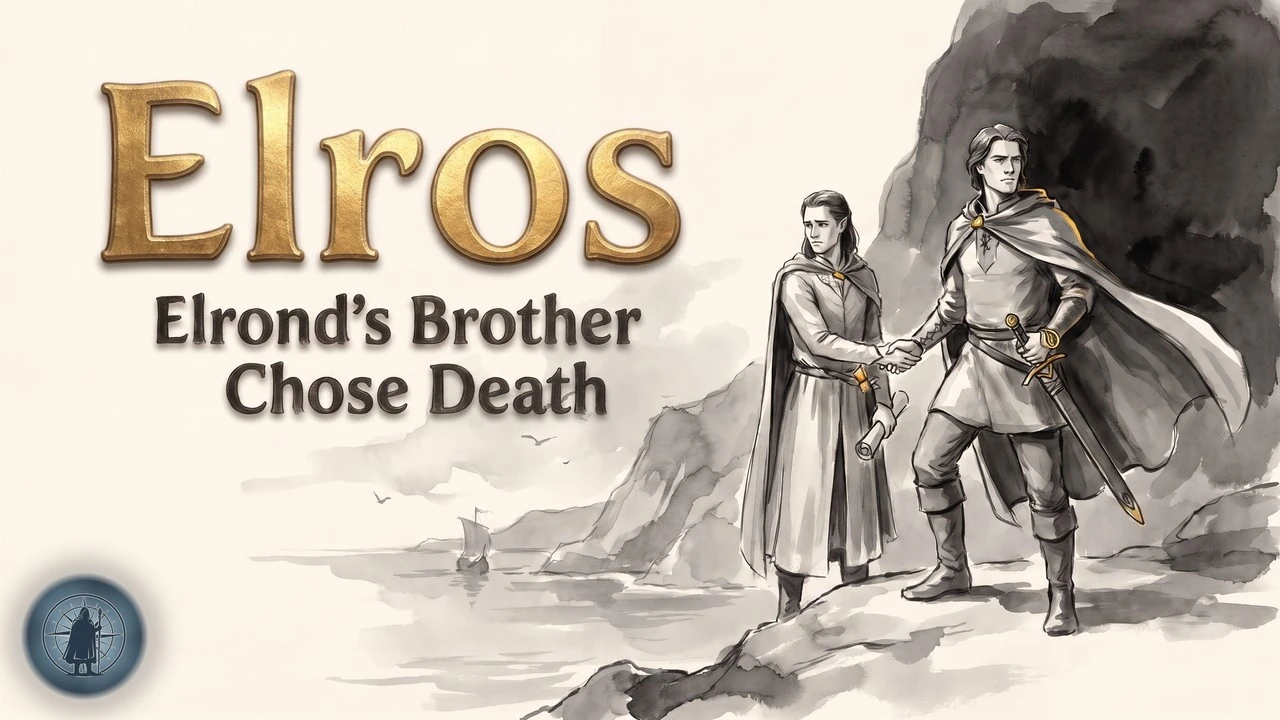 Watch the episode
Elros: Why Elrond's Twin Chose to Die
SECTION: The Last of the Half-elven
Elros was born at the Havens of Sirion, in what's usually given as the year 532 of the First Age. That number isn't in the published Silmarillion. It comes out of the wider chronology assembled from Tolkien's papers, so it's a working date, not a definitive one. The place he was born, though, is certain, and that place tells us what kind of childhood this was going to be.
The Havens were a refugee settlement at the mouth of the river Sirion - the last address of a people who had already lost everywhere else. Doriath had fallen. Gondolin had fallen. What survived of both kingdoms had washed up on that one shore together, and living among them were Eärendil the Mariner and Elwing the White, and their two sons.
Elros and Elrond were the last of the Half-elven. That phrase actually undersells them. Three kinds of being met in those two boys. Through Eärendil came the blood of Men, from Tuor of the House of Hador. Through both parents came the Elves - Noldor on the father's side, and on the mother's the royal house of Doriath. And through Elwing's great-grandmother Melian, who was an angel of the Powers before she took a body and married a king in the woods, came something else again. Maia blood. The same stuff the servants of the Valar were made of.
That three-fold mixture already ran in the family. Their mother Elwing carried all three strands herself, through Beren and Lúthien. What was new in Elros and Elrond is that it arrived from both sides of a marriage at once - the blood of Men and the Noldor from their father, Doriath and the Maia from their mother, meeting in the same generation.
When the twins were around six years old, the surviving sons of Fëanor came to Sirion for the Silmaril that Elwing wore, and the Havens burned. Elwing threw herself into the sea rather than give the jewel up. Eärendil was away at sea and knew nothing about it. And the two boys were taken. If you're interested in more of their stories, we have done episodes on both Elwing and Eärendil on the channel.
Anyway, what happened next is the strangest thing in Elros's early life. The Silmarillion says that Maglor, one of those two sons of Fëanor, "took pity on Elrond and Elros, and love grew after between them, though contrary to Fëanor's oath." So Elros spent his boyhood in Maglor's house, with the man whose war had just killed his mother, and over the years the three of them came to care about one another. That's the published account, and it's the one this channel has followed before.
There is an older version, though. In earlier drafts Tolkien had the twins simply found afterwards - abandoned, unhurt, near a cave and a waterfall, with no fostering and no affection involved at all. Christopher Tolkien didn't select that version for the published book, but it existed, which means the tender account of Elros's childhood was something Tolkien settled on late.
The name itself never settled either. Tolkien wrote "Elros" at least three separate ways across two decades of his own life. In a letter from nineteen fifty-eight he broke it into the Sindarin word for Elf, plus "ros", from an old root meaning dew, or the spray thrown off a waterfall. In an essay a year or two later Tolkien wrote that it meant "Star-glitter." In a much later piece, from nineteen sixty-eight or after, he wrote "star-foam." Then in an essay called "The Problem of Ros," written around nineteen sixty-nine, Tolkien floated the idea that ros wasn't Elvish at all but a word from the speech of Men, meaning foam or the white crest of a wave - and then argued himself back out of it, on the grounds that Cair Andros in Gondor uses the same piece.
So Tolkien never fully decided what his own name for the boy actually meant. Whichever reading is right, it points two directions at once - at his father's star, and at the sea his mother was carried over. His brother's name, Elrond, is generally read as star-dome, the vault of the sky. The two names share a first half honoring the same father, and then go somewhere completely different in the second.
SECTION: The Choice of Elrond and Elros
The First Age ended in the War of Wrath, which began in the year 545. Eärendil had sailed to Valinor carrying the Silmaril, the Powers of the West came out in force, Morgoth's strength was broken, and Beleriand itself went under the sea. That story belongs to Eärendil. What matters for Elros is the reckoning that came afterwards.
What gets this story started is the legal problem with Elros's family. Mortals were forbidden to set foot in Valinor. Eärendil had done exactly that, and Elwing had followed him. They had also, between them, mixed two kindreds whose fates ran in opposite directions. Manwë's judgment was that neither of them would be punished for the voyage, but they couldn't go on being two things at once. Each had to be reckoned as one kind or the other, and then live out whatever that kind was owed.
And when the judgment came down, it came down for their sons too.
Let's take the two sides one at a time. Be reckoned among the Eldar, and you're immortal inside the world - you can be killed, but you can't grow old, and when the world ends you end with it, because the Elves belong to Arda and never leave it. Be reckoned among the Atani, among Men, and you get a short span, a fixed one, and then you go somewhere the Elves can't follow and nobody living knows anything about.
The Silmarillion doesn't stage this as a scene. It just tells us in a sentence. Elrond chose to be of Elven-kind. And Elros chose to be a king and a mortal, and to die in the world.
That's it. There was no debate. We were given no insights into the reasoning of either brother.
The two results are not remotely symmetrical in what they cost. Elrond's answer bought him everything that came afterwards: Rivendell, the keeping of Vilya, a seat at the Council that decided what to do about the Ring, and something like six and a half thousand more years of Middle-earth. Elros's answer bought him four hundred and ten years on a throne and then nothing anybody could describe. Both brothers got what they asked for. But only one of the brothers is still in the story at the end of it.
What Tolkien built here, whether or not he set out to build it, is about as close to a controlled experiment as a legend ever gets. Two people with the same father and the same mother. The same blood in exactly the same proportions. The same burned childhood, the same captivity, the same foster-father. The same offer, on the same day, from the same authority, in the same words. Every variable was held steady except one - and the two brothers chose differently.
That structure is rare even inside Tolkien's family trees, because every other time a Half-elven makes this decision, somebody is standing in front of them. Lúthien gave up deathlessness for Beren. Arwen gave it up for Aragorn, thousands of years later. In both cases the reason is easy to see: a woman chose a mortal man, and took his fate to stay with him. Readers and scholars of Tolkien have pointed out that Elros is the exception to that pattern. There's no wife in the story yet, no lover waiting on the other side of the fork, nothing in the text that says he did it for anybody. So far as the sources go, Elros picked the short life because of what he was, not because of who he loved.
That dynamic showed up again in Tolkien's work, too. In a letter from nineteen fifty-four, Tolkien mentions that Elrond's own sons, Elladan and Elrohir, had put the same decision off - they were still hanging between the two fates, unassigned, late into the Third Age. So this wasn't a one-time exemption written for two boys and then closed. It's a standing feature of that bloodline, which makes the silence around the original fork even more conspicuous. Unfortunately, the time it mattered most is a time when nobody wrote down what anybody was saying or thinking about.
SECTION: What Tolkien Meant by the Gift of Men
So what did Elros actually take? It's easy to hear "he chose to be mortal" and file it under tragedy - the brother who drew the short straw. Tolkien would have rejected that interpretation, and he said so in writing more than once.
The clearest statement is in a long letter he sent his publisher Milton Waldman around nineteen fifty-one, explaining the whole legendarium from the ground up. In it Tolkien writes that "the Doom (or the Gift) of Men is mortality, freedom from the circles of the world." "or the Gift" is in parenthesis. That parenthesis says it all. The same fact can be described as a sentence passed on you or as a present handed to you, and Tolkien refuses to settle which word is correct, because in his world it depends entirely on how you receive it.
The Silmarillion may complicate it further. Death is called the gift of Ilúvatar, "which as Time wears even the Powers shall envy." The Valar - the angelic governors of the world, who cannot die, who will still be standing at the end of everything - are described as eventually coming to envy what Men were handed. That's quite a claim.The text tells us what went wrong with it:
"Melkor has cast his shadow upon it, and confounded it with darkness, and brought forth evil out of good, and fear out of hope."
So death isn't a punishment Men were sentenced to. It's a release they were given, and then taught to be afraid of.
And now the other side of the fork. This isn't the easy option it might sound like either. The Eldar are bound to Arda while it lasts. They love the world, they've been shaped for it, they accumulate everything it does to them - and they cannot get out. Elves who die in Middle-earth don't leave; they go to the Halls of Mandos, still inside the world, and may come back into it. Whatever is beyond the world, the Elves don't get to see it. Their reward is the whole of time and nothing after it.
There's a second half to that bargain that Tolkien is careful about. Where Men go isn't hidden from just the Elves. The Valar don't know either. They can say what happens to an Elvish spirit because Elvish spirits stay in their jurisdiction. They cannot say what happens to a human one, because it leaves. So the offer given to Elros and Elrond wasn't a choice between a known thing and a known thing. One door had a very long, very well-documented corridor behind it. The other door had no information behind it at all, from anybody, including the Powers who were holding it open.
Tolkien also named, very specifically, the failure mode that ruins people on that question. In the same letter to Waldman, Tolkien warns against confusing true deathlessness with what he called "limitless serial longevity" - just more and more years, one after another, forever. That isn't freedom from time so much as being chained to it with a longer chain. And in Tolkien's legendarium, wanting that is the reliable signature of a soul going bad. It's what the Rings of Power sell. It's what Númenor eventually rebels to demand.
Elros is the control case. He had the real alternative on the table - the actual Elvish entitlement was his to accept - and he handed it back, and then lived five hundred years without ever second-guessing his decision.
Readers and scholars of Tolkien have argued for a long time that this is the plainest dramatization anywhere in his work of his own Catholic position on dying: that a death freely accepted is a release, and that grasping after more years is corrosive in a way that has nothing to do with how many years you actually get. That's a reading rather than a proof - Tolkien never wrote "Elros is my model of a good death" in so many words. But the numbers he gave Elros, and the numbers he gave the kings who came after, make the case on their own.
SECTION: Tar-Minyatur, First King of Númenor
The reward for the Edain who had fought against Morgoth was an island. The Valar raised it out of the Great Sea, west of Middle-earth and east of Valinor. The Elves called it Elenna - "Starwards" - because Eärendil's star hung over the road there. The people sailing to it were steering by the light of a man who had been one of them.
Elenna is shaped like a five-pointed star. Five great points of land - Forostar in the north, Andustar in the northwest, Hyarnustar in the southwest, Hyarrostar in the southeast, Orrostar in the northeast - all radiating from a central region called Mittalmar. And at the heart of Mittalmar stands the Meneltarma, the Pillar of Heaven, a mountain kept as holy ground for Eru Ilúvatar himself. No temple was ever built on it. No image, no altar, no idol. The Númenóreans went up it and were silent. That practice starts in Elros's own lifetime, under his own kingship. Three thousand years later though, a temple does eventually get built on that island, but it is to worship somebody else entirely.
Elros was given the kingdom rather than winning it. The Akallabêth tells us: he was the son of Eärendil "whom the Valar appointed to be the first King of the Dúnedain." He didn't take a throne off anyone and he didn't inherit one - the office was created and he was placed in it. That's a distinction the later kings of Númenor lose track of almost completely - they end up treating the sceptre as property, and property is a thing you keep.
He was crowned in the year 32 of the Second Age, at somewhere around ninety years old. By the standards of his own line that's young. Númenóreans matured late and lived for centuries, and Elros ruled until the year 442. Four hundred and ten years on the throne, which ended up being the longest reign any King of Númenor ever had.
He took a Quenya throne-name: Tar-Minyatur, which translates as High First-ruler. That set a rule nobody broke for more than a thousand years. Every King and Queen of Númenor after him took a formal name in Quenya, the High-elven tongue, right up until a king called Ar-Adûnakhôr took his royal name in Adûnaic, the ordinary speech of Men, instead. Everyone at the time understood exactly what that switch meant about where the island's loyalties had gone.
Under Elros the capital went up: Armenelos, which the Akallabêth calls the fairest of cities, including the tower and the citadel that he raised himself. In the King's Court there, during his reign, the Elves of Tol Eressëa sent a seedling of the White Tree of Eressëa through Celeborn, and it was planted and named Nimloth. That sapling is the ancestor of the White Tree of Gondor, by way of one fruit that Isildur stole in the dark thousands of years later.
Elros did bring some luggage from Middle-earth. Four named objects crossed the sea with him and became the regalia of a brand-new kingdom: the Ring of Barahir, the Axe of Tuor, the Bow of Bregor, and Aranrúth, which had been the sword of Thingol in Doriath. So two Houses of Men and the royal line of the Grey-elves were carried in a ship to an island that didn't exist a century earlier.
Another fun fact about Númenor we've shared before. Tolkien had a recurring nightmare he called his Atlantis complex - a great green wave rolling in over trees and fields, unstoppable. He had it from childhood, and he later found that his son Michael had been having the same dream without either of them ever mentioning it. Tolkien wrote that the Númenor legends were "my own use for my own purposes of the Atlantis legend," and he said the dream stopped coming once he'd written the Downfall. Tolkien handed that dream to Faramir. So the island Elros founded came directly out of Tolkien's nightmares.
SECTION: How Elros Died at Five Hundred
We already mentioned the most distinct number in this story. Elros "lived five hundred years, and ruled the Númenóreans four hundred years and ten."
Five hundred years, and it wasn't a span he negotiated or a bargain he struck with anybody. The Valar had granted the Edain long life along with the island, and the Akallabêth says the Númenóreans got "wisdom and power and life more enduring than any others of mortal race have possessed," with the royal house taking the largest share of all - "all his line, the kings and lords of the royal house, had long life even according to the measure of the Númenóreans." Even by the standards of the longest-lived Men who ever existed, Elros's family were outliers. But there was always a ceiling on it, and Elros reached his in the year 442 of the Second Age.
The proportions of his life come out strange. He was crowned at about ninety and ruled for four hundred and ten years, which means more than four fifths of his entire existence was spent as a reigning king. There's barely any private Elros. The boy at Sirion, a young man in the years after the War of Wrath, and then four centuries of office.
Elros wasn't dying of anything. His death is probably stranger than it is sad. The Númenóreans of that era didn't decay into senility and then suddenly die; they stayed sound almost to the end, and then they left. The Akallabêth describes the practice as a custom of the whole royal house: the Lords of Númenor "had been wont to wed late in their long lives and to depart and leave the mastery to their sons when these were come to full stature of body and mind." That's the whole pattern, and Elros is where it starts. He did it first and everybody after him was copying a founder.
So the first King of Númenor, four hundred and ten years into a reign nobody was challenging, in a kingdom at the beginning of its golden age, in a body that still worked, set the sceptre down and let go of his life.
Maybe a beautiful moment. But Tolkien never wrote the scene.
It's tempting to fill that in. There's no farewell speech in any source, no chosen hilltop, no last look at the sea, no recorded words to his children. Tolkien wrote nothing.
We do get the aftermath, though. Elros had four children, named in the Unfinished Tales record called "The Line of Elros": Vardamir Nólimon, the eldest; a daughter, Tindómiel; and two more sons, Manwendil and Atanalcar.
Vardamir inherited. He became Tar-Vardamir, second King of Númenor - and then immediately gave the sceptre to his own son, Tar-Amandil, and went back to his books. Nólimon, the name he's remembered by, means something like lover of lore. He never actually reigned. The second king in the history of the kingdom held the office for a formality and then passed it down, because his father's habit of stepping aside had already hardened into the family's idea of how the job worked.
One generation out, the custom was so strong it skipped a king entirely.
That's what Elros actually built, more than the citadel and more than the naming convention. He built a working assumption about power and time: that you hold the office while you're good at it, and then you give it to somebody who'll be better. Then you stop. You're not defeated, you just accept the shape of a life.
SECTION: Tar-Atanamir and the Broken Custom
There's a chapter called "The Line of Elros" that is pretty boring. It's a list of twenty-five rulers with birth years, death years and reign lengths. But a curve shows up in those numbers that nobody in the text ever comments on.
The spans of rule get shorter. Not dramatically and not all at once, but steadily. Each generation of the royal house is allotted a little less than the one before it, and the further the family gets from the founder, the harder that founding custom becomes to keep. Stepping down while you're still strong is an easy discipline when you've got four centuries of rule behind you. But it's a much harder one when your father got fewer years than his father did. Anyone could calculate where this was heading.
Christopher Tolkien's framing of that chapter makes the same observation. With it, he may frame up the whole Númenórean tragedy. Nothing attacks the island for two thousand years. No enemy, plague, or war. The decline we see is entirely internal, and it's measured in a genealogy - a slow shrinking of the one thing the Valar had actually given them.
About two thousand years after Elros, roughly fifteen reigns down the list, everything snaps. Death was no longer viewed as a gift, but a curse.
The king is Tar-Atanamir, and the Akallabêth calls him the Great. Later Númenóreans called him the Unwilling. In his reign the Valar sent Messengers to the island to reason with the Númenóreans about death - to tell them that the span they'd been given was a gift and not a slight, and that the Ban on sailing west wasn't a cage. Tolkien tells us: Tar-Atanamir "was ill pleased with the counsel of the Messengers and gave little heed to it."
So he just refused to go. Like no one before him.
He would not surrender his life, and he would not surrender the sceptre. The text says he was the first of the Númenóreans to do this, "denying to his son the kingship at the height of his days," and that he held on until he was witless and unmanned - senile, propped up, still technically ruling an island he could no longer govern, while his heir stood there aging in the wings.
Tolkien warned about this error in a letter. It wasn't deathlessness Tar-Atanamir was after, it was serial longevity - more years, then more years, then more years, each one worth less than the last, bought by refusing to let go of the previous one. He wanted the number to keep going up.
The damage wasn't confined to one throne room. That same reign is when the island splits. On one side the King's Men, who resented the Ban, resented the Elves, and above all resented dying - people who had begun to read their own short span as a sentence unfairly imposed by Powers who'd exempted themselves. On the other side the Faithful, the Elendili, who kept the old reverence, kept the Elvish tongues, kept going up the Meneltarma in silence. That split never healed. Every disaster left in Númenor's history, all the way to the fleet that sails west and the wave that answers, stems from Tar-Atanamir refusing to die.
Two thousand years is a long time for an idea to hold. It's also long enough for people to forget that the idea was ever a decision. By Tar-Atanamir's day the custom of departing would have looked like tradition - something the old kings did, for reasons nobody had needed to explain in a very long while. And traditions with forgotten reasons are the easiest kind to break.
SECTION: Elros, Aragorn, and the Longest Life
It's easy to read Elros as the longest-lived Man in Tolkien's world. Five hundred years, no Man before or after, done. It's a good line. Few claims come without complication...
The complication is Elros's own grandfather. Tuor, the Man who married Idril of Gondolin and fathered Eärendil, sailed west with his wife in a ship called Eärrámë, and the Silmarillion says that afterwards he was numbered among the Elder Kindred and his fate was sundered from the fate of Men. His death is never narrated - not delayed or dated. It's just never written about. So the strict version of the superlative is safe: Elros lived longer than any Man whose death is on record. The loose version, longest-lived Man with a full stop, may bump into a grandfather who may not have died as a Man at all.
That's a better fact than the clean superlative would have been. Tuor is the one Man in the legendarium who seems to have gone the other way - reckoned among the Elder Kindred rather than choosing against them. Two generations later his grandson Elros was offered that same standing formally, by name, and said no.
Now let's follow the line Elros founded. It doesn't survive by the royal succession - that fails completely at the Downfall of Numenor, with a king drowned in the wreck of his own armada. It does survive sideways. The fourth King of Númenor, Tar-Elendil, had a daughter named Silmariën, and her descendants became the Lords of Andúnië, and from that branch came Elendil, and from Elendil came Isildur and Anárion, and from them the kings of Arnor and Gondor. Every one of them, all the way down, is carrying Elros's blood by a route that runs through a daughter who never sat on the throne.
Which brings this to the end of the Third Age, and to Aragorn, who does the same thing Elros did.
Aragorn lived two hundred and ten years - a good span for the last of the Númenórean blood, and two fifths of what Elros got. And at the end of it he laid down his life voluntarily, at a time he chose, while he was still himself, and Arwen begged him to stay and he wouldn't. Nobody made him go. The old Númenórean custom, performed exactly as Elros performed it, at two fifths the length, six thousand years later.
Two hundred and ten against five hundred shows the whole erosion in one comparison, and the best part is that Aragorn is the good case. He's the one who got it right. Every generation between him and Elros that shaved a few more years off the inheritance is priced into that shorter number.
So the pattern held, after a fashion, right to the end of the story. And still the most interesting question about Elros can't be answered.
Tolkien never wrote a parting between the two brothers. Not a farewell, not an argument, not a last night before the ships. There's no record of Elrond visiting Númenor during those four hundred and ten years, no letter, no message, no report of grief when the news came. Elrond lived on for six thousand more years and the texts never once show him thinking about it. The last time the sources put the two of them in a room together, they're children in the house of the enemy who raised them.
And nothing anywhere says whether Elros was afraid. A great deal of how we read him rests on that absence - on the total lack of recorded doubt, which reads like serenity and might just as easily be a gap in the paperwork. It's an argument from silence.
But maybe the silence is the point, and Tolkien left the room empty because a man who genuinely believed death was a gift would have nothing dramatic to say about it. Or maybe he just never got around to writing the scene, the way he never got around to settling what the name meant. The sources don't distinguish between those two, and at this point, it seems like there's nothing left to check.