Research & Sources
Elros
Why Elrond's Twin Chose to Die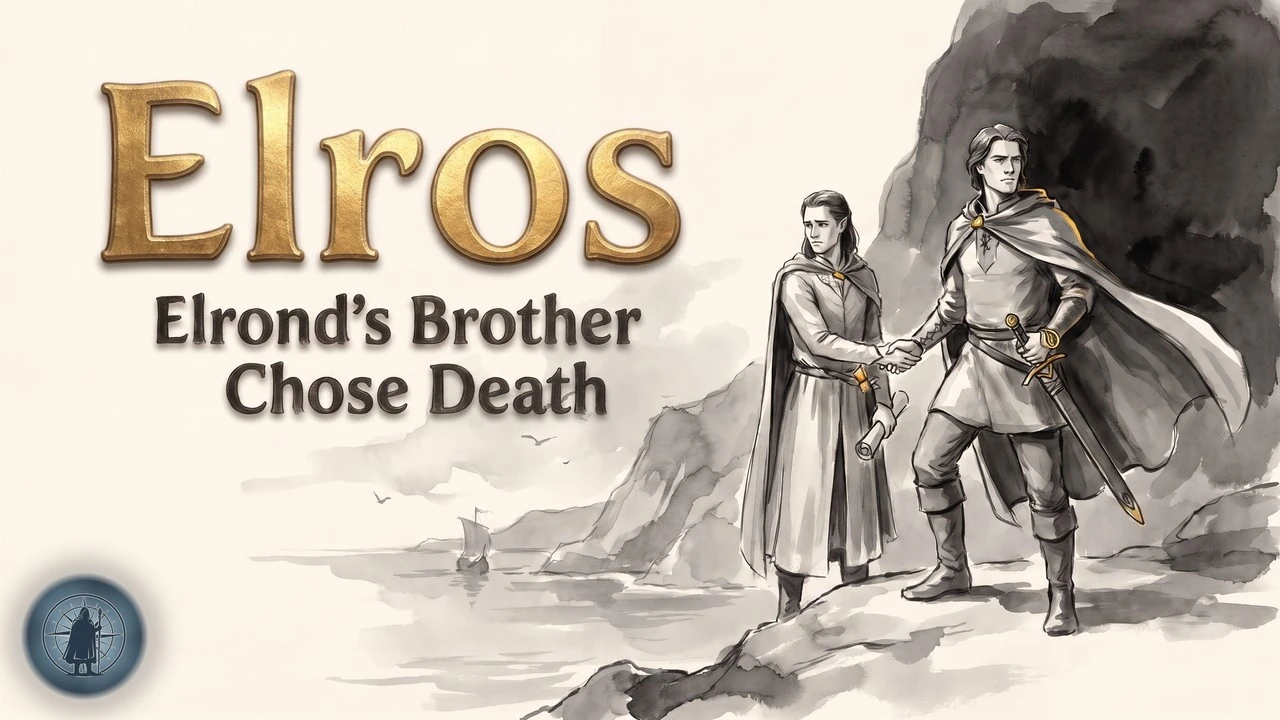 Watch the episode
Elros: Why Elrond's Twin Chose to Die
Research Notes: Elros — The Twin Who Chose to Die
Note on scope: The channel has already produced episodes on Eärendil, Doriath, and Maglor's Fate. This topic assumes that setup rather than re-explaining it: the War of Wrath, the Silmaril's recovery, the Third Kinslaying at the Havens of Sirion, and Maglor's role are backstory the script should gesture at briefly (a sentence or a callback line), not retell. The spine of this episode is narrower and later: the Choice of the Half-elven, Elros's decision, his 410-year reign as Tar-Minyatur, his voluntary death at 500, and what his choice set in motion for the House of Elros and Númenor.
Overview
Elros and Elrond, twin sons of Eärendil the Mariner and Elwing the White, were the last of the Half-elven — beings with the blood of Elves, Men, and (through Melian) the Maiar all mixed in one lineage. At the close of the First Age, after their parents' voyage to Valinor secured the intervention that ended Morgoth's power, the twins were given a choice no one else in Middle-earth's history received on quite these terms: to be judged among the Elder Kindred (the Eldar, and so immortal, bound to Arda until its end) or among the Atani (Men, and so mortal, granted "the Gift of Ilúvatar" — death, and release from the world). Elrond chose the Eldar. Elros chose Men. Same parents, same blood, same offer, opposite answers — and from that fork came two of the great institutional legacies of Middle-earth: Rivendell under Elrond, and Númenor under Elros, who took the throne-name Tar-Minyatur, "High First-ruler," and became the progenitor of the entire line of Dúnedain kings that runs forward through Elendil, Isildur, and eventually Aragorn.
Elros's story is short in surface incident — found a a kingdom, rule it a very long time, die on schedule — and enormous in implication. He is Tolkien's demonstration piece for what "the Gift of Men" is supposed to look like when a being who *understood Elvish immortality from the inside* nonetheless chooses mortality and, five centuries later, keeps the bargain willingly. Everything that goes wrong in Númenor over the next three thousand years — the fear of death, the refusal to abdicate, the rebellion against the Valar, the Downfall — is measured against the man who did it right the first time and then never spoke of it again, because there was nothing left to say: he "laid him down to sleep" and was gone.
Primary Sources
The Silmarillion
- Elrond and Elros are the twin sons of Eärendil and Elwing, born at the Havens of Sirion (traditionally dated F.A. 532 in the wider chronology built from Tolkien's papers — the published Silmarillion itself does not give a numbered year). - During the Third Kinslaying, when the remaining sons of Fëanor (Maedhros and Maglor) assaulted the Havens of Sirion to seize the Silmaril, Elwing cast herself into the sea rather than surrender it (and was transformed and carried to Eärendil by Ulmo's power). The twins were taken captive. "Of the Voyage of Eärendil" records that **Maglor took pity on Elrond and Elros, and love grew after between them, though contrary to Fëanor's oath.** This is Maglor's Fate territory — cross-reference, don't retell. - After Eärendil's voyage to Valinor and the War of Wrath, the Valar granted the sons of Eärendil the same choice given their parents: judgment among the Eldar or among Men. The Silmarillion's own account is brief and formal — it does not dramatize a scene of the twins deciding, only the outcome: **"Elrond chose to be of Elven-kind... but to Elros he chose to be a king and a mortal, and to die in the world."** (Paraphrase of the "Of the Voyage of Eärendil and the War of Wrath" material — the published chapter states the choice and its result rather than staging a dialogue; treat any scripted "farewell scene" between the brothers as invented drama, not canon — see Contradictions section.) - The Akallabêth ("The Downfall of Númenor," in The Silmarillion) is the primary text for Elros's kingship: - **"Elros son of Eärendil, whom the Valar appointed to be the first King of the Dúnedain"** — his kingship is explicitly a Valarin appointment, not an election or inheritance in the ordinary sense. - **"[He] lived five hundred years, and ruled the Númenóreans four hundred years and ten."** This is the single hardest number in the whole topic: 500 years of life, 410 of them (S.A. 32–442) as king. - Armenelos, "fairest of cities," was built in his reign, including **"the tower and the citadel that was raised by Elros."** - The Valar's reward to the Edain generally, and the line of Elros specifically, was long life: **"all his line, the kings and lords of the royal house, had long life even according to the measure of the Númenóreans"** — they possessed "wisdom and power and life more enduring than any others of mortal race have possessed." - The early custom of the House of Elros: **"the Lords of Númenor had been wont to wed late in their long lives and to depart and leave the mastery to their sons when these were come to full stature of body and mind"** — i.e., voluntary abdication and voluntary death were the norm Elros established, not an exception he alone practiced. - The break in that custom comes generations later with Tar-Atanamir, who **"was ill pleased with the counsel of the Messengers [of the Valar] and gave little heed to it" and who refused to depart until he was witless and unmanned, denying to his son the kingship at the height of his days** — explicitly marked as a first, a reversal of what Elros began. - The theological anchor for why any of this matters: mortality is called, elsewhere in the legendarium (in material describing the nature of the Second Children), **"the gift of Ilúvatar, which as Time wears even the Powers shall envy. But Melkor has cast his shadow upon it, and confounded it with darkness, and brought forth evil out of good, and fear out of hope."** This is the frame Elros's death is meant to exemplify uncorrupted, and that Númenor's later kings exemplify corrupted.
Unfinished Tales
- "The Line of Elros: Kings of Númenor" is the chapter-length genealogical and chronological record — the single most important primary-source document for this episode. It gives, king by king: birth year, death year (or year of "surrender of life"/"surrender of the sceptre"), and length of reign, from Elros (Tar-Minyatur) down to Ar-Pharazôn, the twenty-fifth and last ruler. - Confirms Elros's coronation year as S.A. 32 and reign length of 410 years (S.A. 32–442). - Confirms he was already an old man "in the reckoning of the Eldar" when he took the crown, but is generally rendered as around 90 years old at his coronation (compare: full maturity for Númenóreans came around age 100 or later given their extended lifespans — this places Elros as still young for a man of his line at ascension, a detail worth using for scale). - Elros's heirlooms brought from Middle-earth to Númenor are listed here: **the Ring of Barahir, the Axe of Tuor, the Bow of Bregor, and Aranrúth, the sword of Thingol** — physical objects tying Elros's new kingdom directly back to the First Age heroes of all three Houses of the Edain plus the Elvish royal line of Doriath (again: cross-reference to the Doriath episode, don't re-explain). - Elros's children: Vardamir Nólimon (eldest son and heir), Tindómiel (daughter), Manwendil, and Atanalcar. Vardamir is a small, sharp irony worth keeping: he technically became Tar-Vardamir on Elros's death but "immediately" ceded the sceptre to his own son, Tar-Amandil — the second king of Númenor never functioned as a reigning king at all, having already inherited his father's habit of stepping aside. - The chapter's running theme, made explicit in Christopher Tolkien's editorial framing, is the decline of the gift across generations: each king's allotted span is shorter than his father's, and the custom of relinquishing the sceptre (and, eventually, life) while still hale becomes harder to sustain the further the line runs from Elros.
The History of Middle-earth (HoME)
- The Peoples of Middle-earth (HoME 12) preserves earlier draft material on "The Heirs of Elendil" and the Tale of Years of the Second Age, including chronological workings that predate the tidied-up version published in Unfinished Tales. Christopher Tolkien's notes there flag that his father revised the numbers for the Second Age's early chronology more than once — the S.A. 32 coronation date and the 410-year reign figure are the settled published numbers, but earlier layers of the legendarium had different arithmetic for when Númenor was founded relative to the end of the War of Wrath. Treat the S.A. 32 date as the citable canonical figure; note for the writer that Tolkien's internal chronology for the early Second Age was one of the most reworked stretches of the whole legendarium. - Earlier draft material (predating the "Maglor took pity" account) has a variant in which the twins are simply found abandoned, unharmed, near a cave and a waterfall, rather than being raised for years in Maglor's company. This is a genuine textual variant, not fan invention — flag it as such rather than picking one silently. The published Silmarillion account (extended fostering, real affection with Maglor) is the version in general circulation and the one the channel's existing Maglor episode presumably follows; the abandonment variant is older draft material Christopher Tolkien did not select for the published text. - HoME materials on the names of Finwë's descendants and related etymological essays (see Linguistic Notes) show Tolkien revisiting and re-translating the name "Elros" itself more than once across decades — a textual evolution, not just fan debate.
The Letters of J.R.R. Tolkien
- Letter 131 (to Milton Waldman, publisher, c. 1951) contains the clearest single statement of the theology underlying Elros's choice: **"The Doom [or the Gift] of Men is mortality, freedom from the circles of the world."** Elves are bound to Arda "while it lasts," loving its beauty but unable to leave it even in death; Men are granted the opposite — a short stay and then release. This letter is the single best quotable source for explaining why Elros's choice is framed as a gift rather than a punishment, and it should anchor the episode's thematic core. - Letter 131 also warns against a **confusion Tolkien considered one of the chief causes of human ruin in his legendarium**: mistaking "limitless serial longevity" for true immortality — clinging to Time rather than being free of it. This is the exact failure mode Tar-Atanamir and, later, Ar-Pharazôn fall into; Elros is the control case who does not make this mistake. - Letter 153 (to Peter Hastings, 1954) discusses the mechanics of the Half-elven choice further down the family tree: Elrond's own sons, Elladan and Elrohir, are described as delaying their choice, remaining for a time uncommitted between the fates of Elves and Men — confirming that the choice-of-fate mechanism recurs in the bloodline and is not a one-off exception made only for Elrond and Elros. Useful as a single line establishing that Elros and Elrond's fork was not unique to them alone, without diverting into Arwen/Aragorn territory (a different episode's material). - Tolkien's letters describing his own recurring "Atlantis complex" dream (a "Great Wave" nightmare, inherited without being told to his son Michael) are the autobiographical seed of Númenor itself. Letter 227 states plainly that the Númenor legends are **"my own use for my own purposes of the Atlantis legend... a special personal concern with this tradition of the culture-bearing men of the Sea."** Tolkien said the dream stopped recurring once he had written the story of the Downfall — he "bequeathed" the dream itself to Faramir in The Lord of the Rings. This belongs in Themes/Symbolism and gives the episode a way to talk about *why Númenor exists as a story at all*, tied to the man who founded it.
The Fall of Númenor (2022 Tolkien Estate compilation)
- This volume assembles the various Second Age texts (Akallabêth, the Tale of Years, relevant Letters excerpts) into a single reading text; it does not add new primary content about Elros beyond what's in the Akallabêth and Unfinished Tales, but is a convenient single-volume citation if the production wants one unified "Second Age" source reference in the script's back matter.
Timeline
- F.A. 532 (commonly cited derived date; not a number the published Silmarillion itself states) — Birth of the twins Elrond and Elros at the Havens of Sirion, sons of Eärendil and Elwing. - ~F.A. 538 (twins approximately six years old) — The Third Kinslaying: the sons of Fëanor assault the Havens of Sirion for the Silmaril. Elwing casts herself into the sea; the twins are taken captive by Maglor and Maedhros. (Cross-reference: Doriath, Maglor's Fate episodes.) - F.A. 545 (War of Wrath) — Eärendil's voyage to Valinor with the Silmaril secures the intervention of the Valar; the War of Wrath breaks Morgoth's power and ends the First Age. (Cross-reference: Eärendil episode.) - End of the First Age — The Valar grant Eärendil and Elwing, and by extension their sons, the Choice of the Half-elven: judgment among the Eldar (immortal) or among Men (mortal, with the Gift of Ilúvatar). Elrond chooses the Eldar; Elros chooses Men. This is the hinge event of the whole episode. - Early Second Age — The Edain who fought against Morgoth are granted the island of Elenna (Númenor) as a reward and dwelling-place. Elros leads the migration; the star of Eärendil, his own father, is described as a guiding light in the west during this era of settlement. - S.A. 32 — Elros crowned first King of Númenor, taking the Quenya throne-name Tar-Minyatur ("High First-ruler"), establishing the tradition (broken more than a thousand years later by Ar-Adûnakhôr) that every King of Númenor take a royal name in Quenya rather than the vernacular Adûnaic. - First century of the Second Age (during Elros's reign) — The Eldar of Tol Eressëa, through Celeborn, give the Númenóreans a seedling of the White Tree of Eressëa; it is planted in the King's Court at Armenelos as Nimloth, living symbol of the friendship between Eldar and Dúnedain, and ancestor (many centuries later, via a fruit Isildur saves) of the White Tree of Gondor. - S.A. 32–442 — Elros's reign as Tar-Minyatur: 410 years, the longest reign of any King of Númenor. Founding and building of Armenelos, "fairest of cities," including its tower and citadel. - S.A. 442 — Elros, having lived 500 years total, voluntarily lays down his life at the height of his line's health and wisdom — the founding demonstration of the Númenórean custom of relinquishing life while still hale, rather than being overtaken by age. His son Vardamir Nólimon becomes king in name (Tar-Vardamir) but cedes the sceptre almost immediately to his own son, Tar-Amandil. - S.A. 2029–2221 (roughly 15 reigns / c. 2,000 years later) — Reign of **Tar-Atanamir the Great**, later called "the Unwilling": the first King of Númenor to refuse to surrender the sceptre or his life, clinging to rule "until he was witless and unmanned." The Shadow falls openly over Númenor in his reign; the populace splits into the King's Men (who resent mortality and the Valar's Ban) and the Faithful (Elendili, who keep the old reverence). This is the direct thematic payoff of Elros's choice two thousand years earlier — the moment the pattern he set breaks. - S.A. 3319 — The Downfall of Númenor under Ar-Pharazôn (outside this episode's main scope, but the endpoint the Atanamir thread is heading toward; useful as a single closing-beat reference rather than a retelling).
Key Characters
- Elros (Tar-Minyatur) — Twin son of Eärendil and Elwing; chose the Gift of Men over Elven immortality at the end of the First Age; first King of Númenor, reigning 410 years (S.A. 32–442) before voluntarily dying at 500. Founder of the line of Dúnedain kings that runs through Elendil, Isildur, Anárion, and eventually Aragorn. His central trait, textually: total absence of second-guessing. Nothing in the sources suggests he ever regretted the choice or feared its final payment. - Elrond Half-elven — Elros's twin; chose the Eldar and thus immortality within Arda; lord of Rivendell, ringbearer of Vilya, present through the entire remainder of the Second and Third Ages until he departs over Sea after the War of the Ring. The episode's structural counterweight to Elros — same origin, same offer, permanently divergent path. His own sons, Elladan and Elrohir, later face (and delay) the same choice (Letter 153), showing the fork recurs down the bloodline. - Eärendil and Elwing — Elros and Elrond's parents. Eärendil's voyage to Valinor and the resulting War of Wrath is the reason the Choice of the Half-elven is offered at all. (Cross-reference: existing Eärendil episode — do not retell the Silmaril voyage.) - Maglor — Son of Fëanor who, with Maedhros, captured the twins during the Third Kinslaying and then, per the published Silmarillion, raised them with real affection. Formative for Elros's childhood but belongs to the existing Maglor's Fate episode — reference only, e.g. a single sentence noting Elros's earliest years were spent in the house of his parents' enemy. - Tar-Vardamir (Vardamir Nólimon) — Elros's eldest son and heir; became king in name only, ceding the sceptre almost immediately to his own son. A small but sharp detail: the second King of Númenor never really reigned. - Tar-Atanamir the Great ("the Unwilling") — King of Númenor roughly two millennia after Elros; the first to refuse the ancient custom of surrendering life and rule, clinging to the throne into senility. His reign is the hinge point where the Elros model of graceful mortality visibly fails, and where the island's population splits into King's Men and the Faithful. He functions in this episode purely as contrast/ payoff, not as a character to develop in his own right. - Manwë / the Valar — The authority that appointed Elros king and offered the Half-elven their choice; some later material specifically names Manwë as the one who pronounces judgment on behalf of Eru Ilúvatar in these choice-of-fate cases.
Geography
- The Havens of Sirion — Elros's birthplace, a refugee settlement at the mouth of the River Sirion in Beleriand; destroyed by the Third Kinslaying during his childhood. (Cross-reference: Doriath episode for the fuller Sirion/Kinslaying context.) - Elenna ("Starwards"), i.e. Númenor — The star-shaped island given to the Edain as their new home at the start of the Second Age, named for the star of Eärendil that guided the Edain there. Its five promontories: Forostar (north), Andustar (northwest), Hyarnustar (southwest), Hyarrostar (southeast), and Orrostar (northeast), radiating from the central region, Mittalmar. - Meneltarma ("Pillar of Heaven") — The sacred mountain at the heart of Mittalmar, used by the Númenóreans (from Elros's own era onward) as a place of reverence toward Eru Ilúvatar; no temple or image was built there, only silence — a detail worth using visually, since Elros's own dynasty is the one that establishes this practice of worship-without-idolatry, later corrupted entirely under Ar-Pharazôn and Sauron's influence (a downstream episode's material, not this one's). - Armenelos — The Númenórean capital, built up during Elros's reign; called "fairest of cities" in the Akallabêth. Contains the tower and citadel Elros himself raised, and the King's Court where Nimloth the White Tree was planted. - Tol Eressëa — The Lonely Isle, source of the Nimloth seedling gifted to Númenor through Celeborn during Elros's reign; the physical link between Númenor and Valinor that the later Ban of the Valar would forbid Númenóreans from sailing toward.
Themes and Symbolism
- Death as gift, not defeat. The Silmarillion's own framing of mortality — "the gift of Ilúvatar, which as Time wears even the Powers shall envy" — is the theological spine of the whole episode. Elros is the one figure in the legendarium who had *lived the alternative* (as a Half-elven child raised among those with the option of Elvish immortality) and picked mortality anyway, then kept faith with that choice for five full centuries without recorded complaint. - The corruption of a good gift into a curse. Tolkien's own gloss (Letter 131) specifically flags confusing "true immortality" with "limitless serial longevity" as one of his legendarium's central causes of ruin. Elros never makes this mistake; Tar-Atanamir, two thousand years later, does — and that failure metastasizes into the Downfall. The episode's throughline can be built entirely on this single conceptual hinge without needing to retell the Downfall itself. - Twins as a controlled experiment. Elrond and Elros share parentage, upbringing, and the literal same offer at the literal same moment, and diverge completely. Their story lets Tolkien isolate "the choice itself" as the variable, stripped of any difference in nature or nurture — a structure worth naming explicitly in the script. - Kingship as appointment, not conquest or inheritance. Elros doesn't win Númenor; the Silmarillion is explicit that the Valar appointed him. His authority is granted, not seized — a contrast worth holding up against later Númenórean kings who increasingly treat the sceptre as a possession to be clung to rather than a trust. - Tolkien's Atlantis complex. The autobiographical dream material (Letters, and Tolkien's own account of "bequeathing" the dream to Faramir) makes Númenor, and by extension Elros's kingdom-founding, one of the most personally-freighted inventions in the entire legendarium — not an abstract worldbuilding exercise but the working-out of a dream Tolkien had been having "beginning with memory," in his words, since childhood. - The silence around the parting of the brothers. Tolkien never wrote a scene of Elrond and Elros saying goodbye, nor any later reunion, nor any recorded correspondence or grief. The absence is itself worth treating as a theme: two brothers who took the same doorway to opposite futures, and whose last recorded moment together is a shared childhood as captives — not a farewell.
Scholarly Perspectives
- Multiple Tolkien-studies treatments of the Half-elven (see Sources list — Amy Mantravadi's "A Doom or a Gift?", the Leiden University thesis on Tolkien and modern philosophies of death, and various Tolkien-blog essays) converge on reading Elros and Elrond's split choice as Tolkien's clearest dramatization of his Catholic position on death: that mortality freely accepted is a release and a gift, while its refusal (grasping at "serial longevity") is a spiritually corrosive error — the same argument Tolkien makes more directly in his letters about Denethor and about the Númenórean rebellion generally. - Scholars reading the Half-elven pattern across the whole legendarium (Lúthien, Elros, Arwen) note that in every generation, the Elvish party who could choose either fate chooses for love or duty toward Men — Lúthien for Beren, Arwen for Aragorn — while Elros is the outlier: he chooses mortality with no stated romantic motive at all, purely (so far as the text says) as a personal orientation toward the mortal side of his own nature. This makes his choice, in the scholarly framing, the "purest" test case of the Gift of Men as a philosophy rather than a plot device serving a love story — worth a paragraph in the script distinguishing Elros's choice from Lúthien's and Arwen's, since the natural comparison will occur to viewers and deserves to be addressed rather than ignored. - Note for the writer: none of this scholarship is peer-reviewed academic consensus in the way, say, historical scholarship would be — it is serious enthusiast/independent Tolkien criticism (thesis-level and blog-essay-level). Present it as "readers and scholars of Tolkien have argued," not as settled academic fact.
Contradictions and Variants
- The captivity of the twins: the widely-known, published account (Silmarillion) has Maglor raising Elrond and Elros with real affection after the Third Kinslaying. Earlier draft material (predating the published text) instead has the twins simply found abandoned and unharmed near a cave/waterfall. These are genuinely different textual layers, not fan disagreement — flag as a variant, and default to the published version since that's presumably what the existing Maglor's Fate episode already uses. - "Twins" as an explicit label: some published passages describe Elrond and Elros as sons of Eärendil without the word "twin" attached in every instance, while certain HoME draft material explicitly calls them "the twin sons of Eärendil." The fact that they are twins is treated as settled by virtually all secondary sources and was almost certainly Tolkien's intent throughout, but the word itself is not uniformly present in every layer of text — a minor point, not worth dwelling on, but don't present a specific quoted use of the word "twin" as being from a specific published Silmarillion page without verifying it first. - The mechanics/date of the founding of Númenor: HoME 12 (*The Peoples of Middle-earth*) preserves earlier chronological workings for the start of the Second Age that don't perfectly match the tidied Unfinished Tales dates. S.A. 32 for Elros's coronation and 410 years for his reign are the settled, published, citable figures — use those — but the writer should know Tolkien reworked this stretch of chronology more than once, so no one specific number should be treated as having been fixed from the start. - The exact circumstance of Elros's death: Tolkien records that Elros died voluntarily at 500 having reigned 410 years, but does not narrate a death scene. Any dramatized "Elros chooses the day, says his farewells, walks to a particular place and dies there" sequence is reasonable dramatization consistent with the Númenórean custom described for his descendants (dying "while yet hale," per the Akallabêth's general description of the early custom), but is not itself a scene Tolkien wrote for Elros specifically — flag any such staged death scene in the script as informed invention, not direct quotation.
Linguistic Notes
- Etymology of "Elros" is one of the more interesting small case studies of Tolkien revising his own invented languages over decades: - In a 1958 letter, Tolkien parsed the name as Sindarin eld-/ell- (the Sindarin term for the High-Elven exiles, i.e. "Elf") + ros, derived from a primitive Elvish root rossē, meaning "dew" or "spray (of a fall or fountain)." - In a separate essay probably written 1959–1960, Tolkien instead glossed the name as meaning "Star-glitter." - In a still later excursus on the names of Finwë's descendants, written 1968 or after, he glossed it as "star-foam." - The generally cited breakdown of the Sindarin elements is el ("star") + ros ("foam"/"spray") — meaning the name plausibly reads as "star-foam" or "star-spray," evoking both his father Eärendil's star and the sea his mother Elwing was transformed over. In a still later essay ("The Problem of Ros," 1969 or later) Tolkien considered and then rejected a theory that ros was instead a word from the language of the Bëorians for "foam"/"white wave-crest," citing the Sindarin place-name Cair Andros as a counter-example. - Takeaway for the script: Tolkien himself never fully settled what "Elros" means — a genuine, sourced instance of his invented etymologies shifting across nearly two decades of his life, useful as a "even Tolkien couldn't stop revising this" beat. - Elrond, by contrast, is generally read as "star-dome" or "vault of stars" (el + (r)ond, "dome/cave"), giving the brothers' names a shared "star" element (both carry el, honoring Eärendil, whose own name means "sea-lover"/"devoted to the sea" but is associated throughout the legendarium with his star) while diverging in their second element — a nice formal echo of their shared origin and divergent fates, worth a single line in the script if it doesn't feel like padding. - Tar-Minyatur: Quenya, generally parsed as tar- (the prefix meaning "high," used for every King of Númenor's throne-name) + minya ("first") + tur ("ruler" / "master") — "High First-ruler" or "High King, the First." Establishes the naming convention (Tar- + Quenya epithet) that every King of Númenor after him follows until Ar-Adûnakhôr breaks it more than a millennium later by taking an Adûnaic (Mannish) name instead — itself a marker of Númenor's turn away from the Eldar and the Valar.
Additional Context
- Cross-references, deliberately not re-explained here: the Third Kinslaying and Doriath's fall (existing Doriath episode); Eärendil's voyage and the Silmaril (existing Eärendil episode); Maglor's fostering of the twins and his subsequent fate (existing Maglor's Fate episode). This episode should assume the audience either knows these or can be given a single-sentence reminder, and should spend its runtime on material those episodes did not cover: the choice itself, Elros's reign, his death, and the House of Elros's long decline. - Real-world resonance: Tolkien's recurring "Great Wave"/Atlantis dream (see Letters, Themes section) gives the Elros/Númenor material an unusually direct line back to Tolkien's own psychology — useful if the script wants a closing beat connecting the in-world "gift of death" theme to the author's own lifelong preoccupation with the drowned-world dream and his statement that writing the Downfall of Númenor was what finally stopped the dream recurring. - Downstream legacy: every King of Arnor and Gondor through the Third Age, including Aragorn, descends from the House of Elros via Elendil (himself descended from Silmariën, sister of the fourth King, Tar-Elendil — the line runs through the Lords of Andúnië rather than through the unbroken royal succession, which failed at the Downfall). Aragorn's own eventual chosen death at 210 years is a direct, deliberate echo of Elros's precedent, closing the loop nearly six thousand years later — a strong closing image for the script if it wants to gesture forward without retelling Aragorn's own story in full.
Questions for Further Research
- Tolkien never wrote a scene of Elrond and Elros parting, nor any indication of contact between them during Elros's 410-year reign or after. Was this an intentional narrative silence, or simply unwritten? No source resolves this — treat it as a genuine gap, not a puzzle with a hidden answer. - The exact age/mechanism by which the Choice of the Half-elven was "made" — was it a single spoken decision, a felt inclination that simply became fixed, a formal ceremony? The sources describe the outcome of the choice, not its phenomenology. Any dramatization of "the moment of choosing" is the scriptwriter's invention layered onto a canonical fact, not itself canonical. - Whether Elros ever felt fear or doubt as his five-hundredth year approached is never addressed in any source. The absence of recorded doubt is doing a lot of thematic work in this episode's framing (see Themes) — worth being honest in the script that this is an argument from textual silence, not a stated fact.
Compelling Quotes for Narration
1. "The Doom (or the Gift) of Men is mortality, freedom from the circles of the world." — J.R.R. Tolkien, Letters, No. 131 (to Milton Waldman) 2. "[Death is] the gift of Ilúvatar, which as Time wears even the Powers shall envy. But Melkor has cast his shadow upon it, and confounded it with darkness..." — The Silmarillion 3. "Elros son of Eärendil, whom the Valar appointed to be the first King of the Dúnedain... lived five hundred years, and ruled the Númenóreans four hundred years and ten." — The Silmarillion, Akallabêth 4. "[The Lords of Númenor] had been wont to wed late in their long lives and to depart and leave the mastery to their sons when these were come to full stature of body and mind." — The Silmarillion, Akallabêth (describing the custom Elros originates) 5. "[Tar-Atanamir] was the first of the Númenóreans to do [refuse to surrender his life], denying to his son the kingship at the height of his days." — The Silmarillion, Akallabêth (the contrast/payoff beat, roughly two thousand years after Elros)
Visual Elements to Highlight
1. Two identical young boys standing before the Valar (or their emissary), asked the same question, walking away toward opposite doors/futures — the "controlled experiment" image for the choice itself. 2. Elros as an old (by Elvish reckoning) but still-vigorous man, crowned Tar-Minyatur, the star-shaped island of Elenna spread beneath him — the founding-king image. 3. The White Tree Nimloth, newly planted as a sapling in the King's Court at Armenelos — small, fragile, freighted with meaning far beyond its size at that moment. 4. Elros at 500, still visibly hale, choosing to lie down and die rather than being forced to by decrepitude — the deliberate contrast with later kings' fear. 5. Tar-Atanamir, centuries later, clinging to the throne into witless old age — the negative mirror image of Elros's death, staged so the parallel/contrast reads visually even without narration spelling it out.
Sources Consulted
See companion file sources.md for the full list with URLs and notes on reliability/use.
Discrete Analytical Themes
Theme 1: The Choice as a Controlled Experiment in Free Will
Core idea: Elrond and Elros share identical parentage, upbringing, and the literal same offer at the literal same moment, and this design lets the story isolate "the choice itself" as the only variable, stripped of any confound of nature or nurture. Evidence: - Both are twin sons of Eärendil and Elwing, both raised together in Maglor's household after the Third Kinslaying, both offered the same choice by the Valar at the same historical moment (end of the First Age). - Elrond "chose to be of Elven-kind" and remained immortal in Arda; Elros "chose to be a king and a mortal, and to die in the world" (Silmarillion, "Of the Voyage of Eärendil and the War of Wrath"). - The choice recurs down the bloodline exactly once more in a documented, named way: Elrond's own sons Elladan and Elrohir "delay their choice" (Letters, No. 153), confirming the mechanism is heritable, not a one-off exception. Distinction: This theme is about the STRUCTURE of the choice as a narrative device (same inputs, opposite outputs) — not about the theology of what mortality means (that's Theme 2) or about the twins' personal relationship (Theme 5).Theme 2: Death as Doctrine — the Uncorrupted Gift of Men
Core idea: Elros is the legendarium's clearest demonstration that mortality, freely accepted and freely exercised at the end, is framed by Tolkien as a gift rather than a defeat — the theological control case against which every later Númenórean failure is measured. Evidence: - Letters, No. 131: "The Doom (or the Gift) of Men is mortality, freedom from the circles of the world," contrasted explicitly with the Elves' doom of being bound to Arda "while it lasts." - The Silmarillion's description of death as "the gift of Ilúvatar, which as Time wears even the Powers shall envy," corrupted only by Melkor's shadow into something feared. - Elros lived 500 years and, per the Akallabêth, simply laid down his life at the end of them, having ruled 410 of those years — no recorded resistance, negotiation, or regret. - Letters, No. 131 explicitly names the failure mode this avoids: confusing true immortality with "limitless serial longevity" — the specific error Tar-Atanamir and, later, Ar-Pharazôn make. Distinction: This theme is about the THEOLOGY/PHILOSOPHY of Elros's individual death — not the political institutions he built (Theme 3) or the multi-generational decline of his line (Theme 4).Theme 3: Tar-Minyatur — Building Númenor's Institutions from Scratch
Core idea: Elros's kingship is an appointment by the Valar, not a conquest or simple inheritance, and in his 410-year reign he personally establishes the naming convention, architecture, and sacred geography that every subsequent King of Númenor inherits. Evidence: - "Elros son of Eärendil, whom the Valar appointed to be the first King of the Dúnedain" (Akallabêth) — explicit appointment, not conquest. - Crowned S.A. 32, taking the Quenya throne-name Tar-Minyatur ("High First-ruler"), establishing the Tar- + Quenya-epithet naming convention every king follows until Ar-Adûnakhôr breaks it over a millennium later. - Built Armenelos, "fairest of cities," including its tower and citadel (Akallabêth); received the White Tree seedling Nimloth from Celeborn via Tol Eressëa during his reign, planted in the King's Court as the living symbol of Eldar-Dúnedain friendship. - Brought named heirlooms from Middle-earth as founding regalia: the Ring of Barahir, the Axe of Tuor, the Bow of Bregor, and Aranrúth, sword of Thingol (Unfinished Tales, "The Line of Elros"). Distinction: This theme is about the CONCRETE POLITICAL/PHYSICAL institutions Elros built during his reign — not his personal death (Theme 2) or what happened to those institutions generations later (Theme 4).Theme 4: The House of Elros's Long Decline — From Graceful Death to Terror of Death
Core idea: The custom Elros originated — kings relinquishing life and the sceptre voluntarily while still hale — visibly breaks roughly two thousand years later under Tar-Atanamir, marking the exact point where Númenor's relationship to mortality curdles from gift into grievance. Evidence: - Akallabêth: the early custom was that Lords of Númenor "depart and leave the mastery to their sons when these were come to full stature of body and mind" — Elros's own pattern, generalized to his whole line. - Vardamir Nólimon, Elros's own son, became King in name only (Tar-Vardamir) and immediately ceded the sceptre to his own son, Tar-Amandil — the custom holding firm one generation out. - Tar-Atanamir "was the first of the Númenóreans to [refuse to surrender life and throne]... denying to his son the kingship at the height of his days" and "lived on into old age and senility" (Akallabêth) — explicitly marked as a first, a break from Elros's founding pattern. - This same reign sees Númenor's population split into the King's Men (resentful of mortality and the Valar's Ban) and the Faithful/Elendili (who keep the old reverence) — the direct social fallout of the broken custom. Distinction: This theme is about the MULTI-GENERATIONAL institutional decline over roughly two millennia — not Elros's own individual choice/death (Theme 2), and not his reign's founding acts (Theme 3).Theme 5: Twins Divided — Shared Origin, Undocumented Parting
Core idea: Elrond and Elros's only clearly documented time together is their shared childhood captivity under Maglor; Tolkien never wrote a farewell scene, a reunion, or any recorded contact between them across Elros's 410-year reign, making their bond after the Choice a textual silence rather than a described relationship. Evidence: - The published Silmarillion account has Maglor "take pity" on both twins after the Third Kinslaying, with "love [growing] after between them" — their only substantially narrated shared experience. - Earlier draft material (pre-dating the published Silmarillion) instead has the twins simply found abandoned near a cave and waterfall — a genuine textual variant in how their shared childhood is even told. - No source — not the Silmarillion, not Unfinished Tales, not the published Letters — narrates a scene of the brothers parting after the Choice, nor any later meeting or correspondence during Elros's life. - Elrond's own sons later "delay their choice" (Letters 153) — the one explicit textual echo of the Elrond/Elros fork recurring, underlining how unusual it is that the original fork itself was never dramatized. Distinction: This theme is about the RELATIONSHIP (or its textual absence) between the two brothers specifically — not the abstract mechanics of the choice as a device (Theme 1) or Elros's solo reign and death (Themes 2–4).Theme 6: Elros as Tolkien's Atlantis — the Autobiographical Root of Númenor
Core idea: Númenor, and by extension the entire stage on which Elros's story plays out, originates in a specific recurring nightmare of Tolkien's own — making Elros's kingdom-founding one of the most personally freighted inventions in the legendarium rather than an abstract worldbuilding exercise. Evidence: - Tolkien's letters describe a recurring "Great Wave" dream he called his "Atlantis complex," which he discovered — without ever having mentioned it — his son Michael also experienced. - Letters, No. 227: the Númenor legends are "my own use for my own purposes of the Atlantis legend... a special personal concern with this tradition of the culture-bearing men of the Sea." - Tolkien stated the dream stopped recurring once he had written the Downfall of Númenor, and that he "bequeathed" the dream itself to Faramir in The Lord of the Rings. - Letters, No. 156 places the Faithful's escape from Númenor in explicitly Noachian terms ("the small party of the Faithful... escaped in Nine Ships"), showing Tolkien reading his own invented history through a real-world flood-myth lens. Distinction: This theme is about the REAL-WORLD, AUTHORIAL origin of the Númenor setting itself — a different register from the in-world theology (Theme 2) or in-world politics (Themes 3–4).Theme 7: Etymology in Motion — Tolkien Couldn't Settle What "Elros" Means
Core idea: Tolkien revised his own gloss of the name "Elros" at least three times across roughly two decades, making the name itself a small case study in how unfixed his invented-language etymologies remained even for a figure as important as the first King of Númenor. Evidence: - A 1958 letter parses Elros as Sindarin eld-/ell- ("Elf," specifically the High-Elven exiles) + ros (from primitive Elvish rossē, "dew, spray of a fall or fountain"). - A c. 1959–1960 essay instead glosses the name as "Star-glitter." - A c. 1968-or-later excursus on the names of Finwë's descendants glosses it as "star-foam," generally parsed as el ("star") + ros ("foam"/"spray"). - A separate late essay, "The Problem of Ros" (1969 or later), considers and rejects a theory that ros is instead a Bëorian (Mannish) word for "foam"/wave-crest, citing the place-name Cair Andros as a counter-example. Distinction: This theme is purely LINGUISTIC/TEXTUAL-HISTORY — Tolkien's shifting private etymological work — distinct from every in-world thematic or narrative theme above.Theme 8: The Superlative Problem — Was Elros Really the Longest-Lived Man?
Core idea: Elros's 500 years is routinely cited as the longest lifespan of any Man in Tolkien's legendarium, but the claim has a real counter-example worth flagging rather than asserting as flat fact, and the comparison across the Ages (Elros to Aragorn) is itself a strong closing beat. Evidence: - Elros: 500 years total lived, 410 as king (Akallabêth) — the figure behind the "longest-lived Man" claim. - Counter-example: Tuor, father of Eärendil, was "numbered among the Elder Kindred" and taken to Valinor in life; the Silmarillion states his fate was "sundered from the fate of Men" and never narrates his death at all — meaning the strict claim "Elros is the longest-lived Man who ever died" may be true, but "longest-lived Man" full stop is arguably false or at least unresolved, since Tuor may never have died as a Man at all. - Downstream comparison: Aragorn, Elros's own descendant roughly six thousand years later, dies by the same voluntary method at 210 years — a fraction of Elros's span, illustrating just how far the gift had eroded by the end of the Third Age even in its best-case (non-corrupted) exercise. Distinction: This theme is a FACT-CHECKING/COMPARATIVE coda distinct from all others — explicitly interrogating a superlative rather than building out a new narrative or thematic strand, and it gives the script a clean, checked closing comparison (Elros to Aragorn) rather than a vague gesture at "the line continues."Sources Consulted: Elros — The Twin Who Chose to Die
Primary Texts (canonical)
- The Silmarillion (J.R.R. Tolkien, ed. Christopher Tolkien) — "Of the Voyage of Eärendil and the War of Wrath" (the Choice of the Half-elven) and "Akallabêth: The Downfall of Númenor" (Elros's kingship, reign length, death, the custom of surrendering life, Tar-Atanamir's break with it). Most-used primary source in these notes; text accessed via full-text PDF mirror (westofwest.org/docs/sil/akallabeth.pdf, read via a reader-mode proxy since direct fetch returned 403) and cross-checked against summaries at teawithtolkien.com/blog/akallabeth and teawithtolkien.com/blog/quentasilm24. - Unfinished Tales (J.R.R. Tolkien, ed. Christopher Tolkien) — "The Line of Elros: Kings of Númenor," the chapter-length regnal chronology giving Elros's coronation year (S.A. 32), reign length (410 years), heirlooms brought to Númenor, and his children. Accessed via Tolkien Gateway's summary/table-of-contents page for this chapter (direct text of the full chapter not reproduced online; treat cited figures as high-confidence since they're corroborated across multiple secondary sources). - The History of Middle-earth, specifically The Peoples of Middle-earth (HoME 12) — draft/earlier chronological material on the Second Age and "The Heirs of Elendil," and earlier draft variants of the twins' captivity (the "found abandoned" version vs. the published Maglor-fostering version). Accessed indirectly via secondary summaries (Tolkien Gateway, Silmarillion Writers Guild) rather than direct volume text — flagged in notes.md as lower-confidence and clearly marked as paraphrase, not verbatim quotation. - The Letters of J.R.R. Tolkien (ed. Humphrey Carpenter) — Letter 131 (to Milton Waldman: "The Doom [or Gift] of Men is mortality, freedom from the circles of the world"; the immortality-vs-serial-longevity distinction), Letter 153 (to Peter Hastings: Elladan and Elrohir delaying their choice), Letter 156 (Noachian framing of the Faithful's escape), Letter 227 (Númenor as personal use of the Atlantis legend). Accessed via secondary quotation aggregators (Tea with Tolkien on X, jrrjokien.com essay "A Doom or a Gift?", krharriman.substack.com theological commentary series) — the Letter 131 quote in particular is widely and consistently reproduced across sources and treated as high-confidence. - The Fall of Númenor (2022 Tolkien Estate/HarperCollins compilation, ed. Brian Sibley) — noted as a convenient single-volume assembly of the Second Age material; did not surface new primary content beyond the Akallabêth/Unfinished Tales sources above in this research pass.
Secondary/Reference Sources
- Tolkien Gateway — primary wiki reference throughout: - https://tolkiengateway.net/wiki/Elros - https://tolkiengateway.net/wiki/House_of_Elros - https://tolkiengateway.net/wiki/Tar-Atanamir - https://tolkiengateway.net/wiki/The_Line_of_Elros:_Kings_of_N%C3%BAmenor - https://tolkiengateway.net/wiki/Half-elven - https://tolkiengateway.net/wiki/Tar-Minastir (dead end, redirect check) - Note: direct WebFetch to tolkiengateway.net returned HTTP 403 in this session; all Tolkien Gateway content was retrieved via a reader-mode proxy (r.jina.ai/https://tolkiengateway.net/...). Content quality was good and internally consistent with other sources, but treat any single-source Gateway claim not corroborated elsewhere with mild caution. - The Encyclopedia of Arda — https://www.encyclopedia-of-arda.com/h/houseofelros.php — used for the House of Elros lineage/decline summary and confirmation of the Elros-to-Elendil-to-Aragorn succession path via the Lords of Andúnië. - Silmarillion Writers Guild — character reference pages, used for cross-checking cited facts (birth, capture, choice, coronation age, reign, lifespan, descendants): - https://www.silmarillionwritersguild.org/reference/references/pf/elros.php - https://www.silmarillionwritersguild.org/reference/characterofthemonth/elros.php - https://www.silmarillionwritersguild.org/reference/silmsummaries/akallabeth.php - askmiddlearth.tumblr.com (Tolkien Q&A blog) — "Twins in Middle Earth (Part 2)": https://askmiddlearth.tumblr.com/post/57244111537/twins-in-middle-earth-part-2 — used only to confirm that "twin" status, while near-universally accepted, is not stated with the word "twin" in every layer of published text; low weight, used for a single caveat only. - Tea with Tolkien (teawithtolkien.com) — chapter guide/podcast companion site, used for Akallabêth and "Of the Voyage of Eärendil" quote-checking: https://www.teawithtolkien.com/blog/akallabeth , https://www.teawithtolkien.com/blog/quentasilm24 - ElfDict / Parf Edhellen (elfdict.com) — used to cross-check the Sindarin elements el ("star") and ros ("foam"/"spray") for the etymology section.
Scholarly / Essay Sources (enthusiast-academic, not peer-reviewed)
- Amy Mantravadi, "A Doom or a Gift?" (jrrjokien.com) — https://www.jrrjokien.com/p/a-doom-or-a-gift — essay on the theology of mortality in Tolkien's legendarium. - "The Elven Perspective of Life, Death and Immortality" (academia.edu) — https://www.academia.edu/35507829/ - Leiden University student thesis, "J.R.R. Tolkien and the Modern Philosophies of Death..." — https://studenttheses.universiteitleiden.nl/access/item:3463407/view - krharriman.substack.com, "Biblical and Theological Commentary on Tolkien's Letters, Part 6" — https://krharriman.substack.com/p/biblical-and-theological-commentaries - Note for the script team: all of the above are independent/enthusiast Tolkien criticism (blog-essay or thesis level), not peer-reviewed journal scholarship. Notes.md phrases claims drawn from these as "readers/scholars of Tolkien have argued," not as settled academic consensus.
Sources Checked but Not Usable
- https://tolkiengateway.net/wiki/Choice_of_the_Half-elven — stub page, no article text as of this research pass. - Direct fetches to tolkiengateway.net and westofwest.org returned HTTP 403 (bot blocking); worked around via r.jina.ai reader-mode proxy for both.
Most Useful Sources (ranked)
1. The Silmarillion (Akallabêth + "Of the Voyage of Eärendil") — irreplaceable primary text for reign length, lifespan, death, and the theology of mortality. 2. Unfinished Tales, "The Line of Elros" — the only source for exact regnal dates, heirlooms, and children. 3. Tolkien Gateway (Elros, House of Elros, Tar-Atanamir pages) — best single aggregator for cross-checking dates and quotes quickly. 4. The Letters of J.R.R. Tolkien (No. 131 especially) — essential for the thematic "gift vs. doom" framing that should anchor the script. 5. Encyclopedia of Arda — best source for the multi-generational decline/succession picture (House of Elros to Aragorn).
Gaps / Scarce Information
- No source narrates a farewell scene between Elrond and Elros, nor any documented contact between them after the Choice. This is a genuine silence in the text, not a research failure — flagged explicitly in notes.md's Questions for Further Research. - Full verbatim text of the Unfinished Tales "Line of Elros" chapter and of HoME 12 were not directly accessible in this research pass (paywalled/out-of-print full-text not available via open web search); all figures from these were corroborated across at least two independent secondary sources before inclusion.