Transcript
Elendil the Tall
The Man Who Saved Numenor's Soul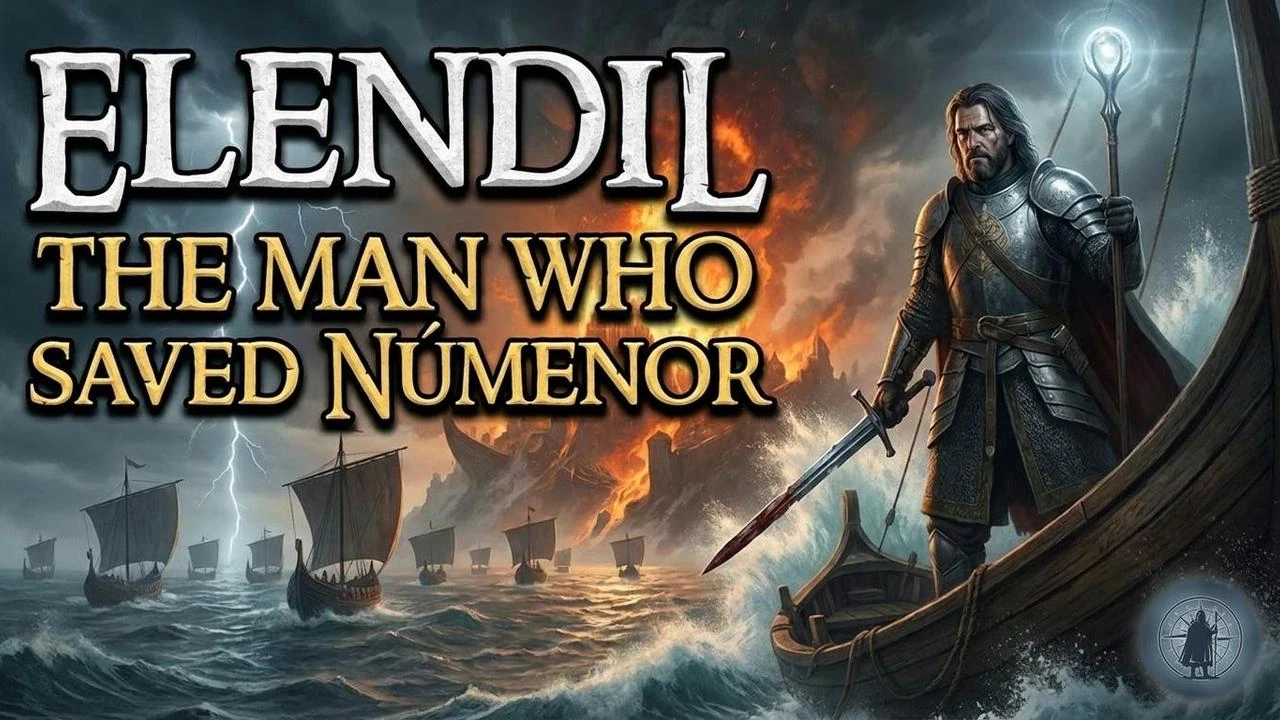 Watch the episode
Elendil the Tall: The Man Who Saved Numenor's Soul | Tolkien Deep Dive
Watch the episode
Elendil the Tall: The Man Who Saved Numenor's Soul | Tolkien Deep Dive
Main Narrative — Elendil the Tall: The Standard That Broke
At the Council of Elrond, three thousand years after the fact, an Elf-lord recounted a single afternoon on a volcano. He had been there. He had watched two kings die. He had watched a sword shear in two beneath a falling man. And he remembered the name of the man who fell.
Elendil. The Tall. Last Lord of Andúnië. First High King of the Dúnedain in exile. The standard-bearer of a drowned civilization.
You have probably never thought of him as a main character. He stands in the prologue of the films for ninety seconds before being swatted aside by Sauron. He is a tomb in a chronology, a name on a list of ancestors, a glow in the background of Aragorn's coronation. The Ring, the Hobbits, the Fellowship — they all crowd him out.
But every time the broken sword appears in The Lord of the Rings — and it appears constantly — it is his sword. Every time a king's hand closes around the Stones of Seeing, it traces back to the Stones he carried. Every time Aragorn speaks Quenya at a public moment, he is repeating Elendil's words. The Third Age is, in a real sense, the age of his unfinished business.
So today I want to look squarely at the man — the giant who outran the wave, the founder of two kingdoms, the king whose death made Sauron's defeat possible, and the ancestor whose oath would be spoken three millennia later in a city that hadn't yet been built.
I'm going to tell you the story of Elendil. And I'm going to tell you why his sword had to break.
SECTION: A Family of Faithful Lords
Here is the first thing to understand about Elendil. His loyalty was not his idea.
We tend to read him as a singular hero — the one righteous man amid a corrupted court. But Tolkien is precise about this. Elendil was the latest in a long, deliberate, multi-generational chain of dissenters. His father Amandil was Lord of Andúnië before him. His father had been Lord of Andúnië. And so on, back through the centuries, all the way to a woman named Silmarien — a princess of Númenor in the early Second Age, eldest child of the fourth king Tar-Elendil.
Silmarien had been passed over for the throne. The crown went to her younger brother. But she was given lordship of the western haven of Andúnië, and her descendants kept something the kings of Númenor were quietly losing.
They kept the friendship of the Elves.
While the kings of Númenor grew suspicious of the Eldar, jealous of their immortality, resentful of the Ban that forbade men from sailing west to Valinor — the Lords of Andúnië went on speaking Quenya in their halls. They went on welcoming Elven ships at their docks. They went on remembering, openly, that Númenor was a gift — not a possession, not a right, but a gift from the Valar in reward for the Edain who had stood with the Eldar against Morgoth in the First Age.
By the time Elendil was born, around the year 3119 of the Second Age, this dissent had become dangerous. The reigning kings actively persecuted those who kept the old loyalties. The very name Quenya was forbidden in court. Children who spoke it were punished. To remain loyal to the Elves and to the Valar was to be a kind of recusant — a person keeping the old worship in the teeth of an official creed that had turned against it.
Joseph Pearce and others have noted how strongly this resembles the situation of English Catholics in Tolkien's own ancestry — a beleaguered minority maintaining a forbidden devotion under a hostile state. Tolkien's own mother was a convert to Catholicism whose family disowned her for it. He understood, at the deepest personal level, what it meant to inherit a faith that the powers of the world had decided to crush.
So when Elendil grew up in his father's house at Rómenna, on the eastern shore where the dwindling Faithful had been forced to gather, he was not learning a new virtue. He was learning the virtue his line had been keeping alive for fifteen hundred years.
The Quenya cognomen Tolkien gives him — the title of honor by which the Elves remembered him — is Voronda. The Faithful. The Steadfast.
It describes his office, not his temperament. The Faithful was a role he had been raised to fill.
SECTION: The Wave That Was Coming
Here is the strange thing about the Downfall of Númenor. Elendil saw it coming for decades.
By the time Sauron arrived on the island as Ar-Pharazôn's "prisoner" — captured in war and brought home in chains, the most catastrophically ill-advised hostage in the history of Middle-earth — the Faithful had been watching the kings drift toward darkness for generations. Sauron simply accelerated what was already underway. Within a few years he had become Ar-Pharazôn's chief counsellor. He persuaded the king to cut down Nimloth, the White Tree that had grown in the courts of the kings since the days of Aldarion. He built a great temple to Morgoth in the heart of Armenelos. The persecution of the Faithful intensified into something much closer to extermination.
Elendil watched this. He prepared.
His father Amandil had once been a friend of Ar-Pharazôn — they had been close in youth — and for a long time Amandil tried to argue the king back to sanity. But after Sauron came, the door was closed. Amandil was banished from the court. He returned to Rómenna and made a final, desperate decision.
He would sail west.
Not to escape. To plead.
He would do what his ancestor Eärendil had done in the First Age, when the Noldor were trapped in Beleriand under Morgoth's shadow — sail in defiance of every prohibition, cross the forbidden sea, and beg the Valar for mercy on his people. He told no one his exact route. He took three loyal servants and sailed east, then turned secretly north, intending to circle the world and approach Aman from the west like the dawn.
Before he left, he gave his son a single instruction.
Prepare the ships.
Elendil obeyed. While Ar-Pharazôn began amassing the Great Armament — a fleet of war ships meant to invade Aman itself, sail through the Ban of the Valar, and seize immortality at the point of a sword — Elendil quietly built and provisioned a counter-fleet of his own. Not for war. For escape.
The Akallabêth tells us, in plain terms: "Elendil did all that his father had bidden, and his ships lay off the east coast of the land; and the Faithful put aboard their wives and their children, and their heirlooms, and great store of goods."
What did he load? Everything that mattered. The seven palantíri — the seeing-stones, gifts the Eldar of Tol Eressëa had given his family for centuries — were brought aboard. The seedling of Nimloth, which Isildur had stolen at the last possible moment from the King's garden before Sauron burned the tree, came too. Scrolls, lore, the Quenya tongue itself. Heirlooms. The genealogies. The maps of the western world that no Edain were now permitted to know.
In nine ships, Elendil packed a civilization.
There is a passage in Tolkien's Letter 257 that gives this preparation a haunting personal resonance. Tolkien describes a recurring nightmare he had carried since childhood — "the Great Wave, towering up, and coming in ineluctably over the trees and green fields." He gave that dream to Faramir. He says the dream stopped only after he wrote the Akallabêth.
Elendil is the man inside that dream who sees the wave coming. Not the man who is drowned by it. The man who builds the boat.
SECTION: Nine Ships in the Black Gale
In the year 3319 of the Second Age, Ar-Pharazôn launched the Great Armament.
His war-fleet sailed west into the forbidden sea. Manwë, eldest of the Valar, laid down his guardianship of the world and called upon Ilúvatar himself. And Eru — the One, who had not directly intervened in the world since the Music — answered.
The seas were bent. The world was made round. The Undying Lands were taken out of the circles of the world entirely — removed, sealed off, accessible now only by the Straight Road that no mortal ship could find. And in the convulsion, Númenor, the great island gift, was drowned.
Andúnië, Elendil's ancestral haven on the western coast, was the first city to go under. The mountain Meneltarma, where his people had worshipped Eru in the open air, sank beneath the waves. The whole island folded into the deep.
But on the eastern shore, where the remnant had gathered, Elendil's nine ships were already at sea.
Listen to how Tolkien writes the moment.
"Nine ships there were: four for Elendil, and for Isildur three, and for Anárion two; and they fled before the black gale out of the twilight of doom into the darkness of the world."
Notice the precision. He doesn't say "many ships" or "a fleet." He says nine. Four and three and two. He lays it out like a manifest. This is the bookkeeping of an apocalypse.
Why nine? Tolkien never quite explains. But nine is one of his ringing numbers — the Nine Walkers of the Fellowship, the Nine Riders, the nine Rings given to mortal men. The number resonates. It feels like the right number for a covenant.
The wind that drove them — the black gale — was no ordinary storm. It was the convulsion of the world being remade. It tore Elendil's ships apart from his sons' ships. The four vessels carrying the High King were driven north and made landfall in Lindon, the Elven realm in the northwest of Middle-earth, where Gil-galad himself, High King of the Noldor, came down to the shore to meet his old ally.
Imagine that landing. The water still seething. The skies still wrong. And out of the eastern dawn comes a fleet of refugees — and at their head, stepping onto the strand, the tallest man any Elf had ever seen.
Unfinished Tales gives us his height precisely. Two and a half rangar. The Númenórean ranga was about thirty-eight inches. That puts Elendil at very nearly eight feet tall. He was, the text says, "the tallest of all the Númenóreans who escaped the Downfall." Even by the standards of his own people — already a head taller than ordinary men — he was a giant.
The five remaining ships, carrying Isildur and Anárion, were driven south by different winds and made landfall at Pelargir, on the great river Anduin, hundreds of miles away.
The line of Eärendil had survived. The seedling of Nimloth had survived. The seven palantíri had survived. The Quenya tongue had survived. A civilization of three thousand years lay drowned beneath the new sea — and on two separate beaches, in two separate kingdoms-to-be, the survivors counted what was left.
It was enough.
SECTION: The Architect of Two Kingdoms
Now here is where most accounts of Elendil go wrong. They treat him as the survivor of the story and stop there. The Noah who reaches dry land. The refugee who weeps on the beach.
But that is not what he did.
What he did, in the space of a single year, was architect a constitutional structure that would govern the next three thousand years of Middle-earth.
The two landings — north and south, separated by the breadth of a continent — could have been the founding of one shattered remnant. Instead Elendil deliberately turned the separation into a feature of the new polity. He took the north for himself as High King and made it a single realm: Arnor, with its capital at Annúminas on the shores of Lake Nenuial. His sons, Isildur and Anárion, would rule the south together as joint kings of Gondor, with three great cities — Osgiliath in the center, Minas Anor and Minas Ithil flanking it east and west.
Two kingdoms. One High King. A Realms in Exile — plural — that would survive, in some form, until Arvedui's day in the Third Age and arguably until Aragorn reunified them at his coronation.
And he did something else. He distributed the seven palantíri.
These were the seeing-stones — Fëanor's invention, it is now believed, though they had come into the hands of the Lords of Andúnië through Eldar gift. Each could communicate with the others across vast distances. Together they formed a network. And Elendil, with what looks remarkably like the eye of an engineer, placed them with care.
Three went to Arnor. The chief stone went to Amon Sûl — Weathertop — where he and Gil-galad would later muster their armies. A second went to Annúminas, the capital. A third to the Tower of Elostirion in the Emyn Beraid, the white tower Gil-galad raised in his honor.
Four went to Gondor. Osgiliath held the master-stone of the South, capable of summoning all the others. Minas Anor and Minas Ithil each had one. The seventh went to the haven of Orthanc, far to the north, to bind the realms together.
But the stone in Elostirion — the seventh, the westernmost — was different.
That stone did not communicate with the others. It looked one way only. It looked west, across the bent ocean, toward the Master-stone in the Tower of Avallónë on Tol Eressëa, the lost island of the Eldar. Through it, the exiles in Middle-earth could still gaze at the Undying Lands they had been forbidden to reach.
Think about the design choice. Elendil was building a kingdom and a communications system, and he reserved one of his seven precious stones for grief. For the act of looking, helplessly, at what could not be returned to.
No refugee thinks that way. Only a man who understood exactly what he had carried out of the wreck — and what he had not — would reserve a stone for the act of looking back.
SECTION: The Oath That Founded a Dynasty
When Elendil first stepped from his ship onto the shore of Middle-earth — wet, exhausted, the wind of the world's remaking still in his hair — he spoke seven words in Quenya.
Et Eärello Endorenna utúlien. Sinome maruvan ar Hildinyar tenn' Ambar-metta.
In English: "Out of the Great Sea to Middle-earth I am come. In this place will I abide, and my heirs, unto the ending of the world."
These are the most important words any mortal ever spoke in Tolkien's legendarium.
Look at the grammar. Utúlien is a perfect-tense verb: "I have come." It frames a single completed act. The crossing is over. The drowned world is behind. The new shore is here.
Maruvan is a future-tense verb: "I will abide." It binds the speaker to a place — and notice the next phrase, ar Hildinyar, "and my heirs." The oath does not bind only Elendil. It binds every descendant down to the ending of the world.
In Tolkien's careful linguistic construction, this is no poetic flourish — it is a constitutive speech-act. It is what makes a refugee a king. It is what turns landfall into founding. The grammar itself does the work — perfect tense closes Númenor, future tense opens Arnor and Gondor, and the binding of heirs makes the whole thing dynastic.
In the medieval imagination Tolkien drew from, a king's first words on his land were the land's foundation. The walls of the city, the laws of the realm, the lineage of the house — all of it began with a sentence said aloud. Elendil's oath is exactly that kind of speech-act.
And here is what makes it extraordinary in the deep design of the legendarium.
Three thousand years later — at a coronation in a city Elendil never saw, before a people who had nearly forgotten his name — his thirty-ninth great-grandson would speak the same seven words. Verbatim. In the same Quenya. With no translation offered.
We will come back to that.
For now, just register the architecture. Elendil bound the future to the present in a single sentence. And the future kept the appointment.
SECTION: The Combat on the Mountain
For more than a hundred years after the founding, Elendil ruled in peace.
Then Sauron came back.
He had survived the Downfall — bodily destroyed in the flood, but his spirit had returned to Middle-earth, taken up the One Ring he had forged in the Second Age, and rebuilt himself in Mordor. By the year 3429 of the Second Age, he was strong enough to attack Gondor. Minas Ithil fell. The seedling of Nimloth, which Isildur had brought into the city and replanted, was nearly destroyed again — Isildur escaped down the Anduin with another sapling and his family, but his brother Anárion held Osgiliath alone against Sauron's onslaught for years.
In the north, Elendil and Gil-galad — the same Elf-king who had received him on the strand of Lindon a hundred and ten years earlier — formed the Last Alliance of Elves and Men. Their hosts mustered at Amon Sûl, where the chief palantír of the North watched the muster fields. Then they marched south.
The Battle of Dagorlad was a massacre. The Last Alliance shattered Sauron's army utterly. Elrond, who was Gil-galad's herald and an eyewitness, told the Council of Elrond at Rivendell three thousand years later: "the Spear of Gil-galad and the Sword of Elendil, Aiglos and Narsil, none could withstand."
Then came the seven-year siege of Barad-dûr.
Seven years. Imagine that. Seven years of dark towers and slow attrition, of arrows from black walls, of supplies trickling north and south through hostile country. In the sixth year of the siege, a stone cast from the tower struck Anárion and killed him. Elendil's younger son, the holder of Osgiliath, the joint-king of Gondor, died beneath his own father's eyes.
The Silmarillion is silent on what Elendil felt.
In the seventh year, Sauron came forth from his tower for the final combat. And on the slopes of Mount Doom — Orodruin, the mountain whose fire had forged the Ring he wore — the Dark Lord met two kings.
Here the texts diverge slightly, and the divergence is itself meaningful.
The Silmarillion tells us: "Sauron himself came forth; and he wrestled with Gil-galad and Elendil, and they both were slain, and the sword of Elendil broke under him as he fell. But Sauron also was thrown down, and with the hilt-shard of Narsil Isildur cut the Ruling Ring from the hand of Sauron and took it for his own."
Elrond, who was actually there, says it slightly differently. "I beheld the last combat on the slopes of Orodruin, where Gil-galad died, and Elendil fell, and Narsil broke beneath him; but Sauron himself was overthrown, and Isildur cut the Ring from his hand with the hilt-shard of his father's sword."
Notice what the eyewitness leaves out. He does not narrate the wrestling. He does not describe the blow. He sees only the result: Gil-galad dies, Elendil falls, the sword breaks. Then Sauron is overthrown.
Christopher Tolkien observed that this ambiguity is deliberate. Heroic legend resists granular reconstruction. We are not meant to know exactly how it happened. We are meant to know that it happened — and to feel the shape of the event, which is the shape of a sacrifice that succeeds in the moment of failing.
Because look at what the sundered sword does.
If Narsil had not shattered, Isildur would have had no shard to cut the Ring with. The hilt-piece of his father's sundered weapon — pointed, jagged, suddenly the sharpest thing on the mountain — became the instrument of the Ring's removal. Elendil's death produced the only blade in Middle-earth at that moment that could do the necessary work.
This is the deepest meaning of the shattering. It is not a defeat. It is a victory shaped like a defeat. The standard fell. And in falling, it became the knife.
SECTION: The Shards That Outlived Him
Two years after the wrestling on Orodruin, Isildur died too.
He was riding north from Gondor toward Arnor, wearing his father's silver circlet — the Elendilmir, the white star of the High King — and carrying the One Ring on a chain about his neck. At the Gladden Fields, where the Anduin spreads into marsh and reed, an orc ambush fell on his company. The Ring betrayed him; it slipped from his finger as he tried to swim away, and the orcs shot him in the river.
But before the final attack, when he saw the end coming, Isildur did one thing right.
He summoned his esquire, a young man named Ohtar, and pressed something into his hands. Two pieces of jagged metal — what was left of his father's sword. And he gave Ohtar an order that Tolkien preserved in the Unfinished Tales:
"Save them from capture by all means that you can find, and at all costs; even at the cost of being held a coward who deserted me. Take your companion with you and flee! Go!"
Even at the cost of being held a coward. Isildur is telling his squire that the shards of Narsil are worth more than his own reputation, more than the dignity of a battlefield death. The relic must survive. Whatever else happens.
Ohtar fled. He ran north through hostile country, carrying the shattered sword of a dead high king in a bundle on his back, and he reached Imladris — Rivendell — where Elrond received him and laid the shards in the house of his protection.
There they remained.
For three thousand years.
Through the founding of the Northern Kingdom and its slow withering. Through the war with Angmar and the fall of Arthedain. Through the dwindling of the Dúnedain into a few hundred Rangers in the wild. Through the rise of Sauron a second time and the long shadow over Mirkwood. Through every year of the Third Age that no one alive could remember the beginning of — the sundered sword waited in Elrond's house.
And then a man came to claim it.
You know how this ends. Aragorn, son of Arathorn, thirty-ninth in descent from Elendil through an unbroken line of chieftains and kings, took the shards to the smiths of Rivendell. They were reforged. The new blade was given a new name — not Narsil, "Sun and Moon," but Andúril, "Flame of the West." A new sword for a new age. But the metal was the same. The atoms that gave way under Elendil on the slopes of Orodruin were the atoms that flashed in Aragorn's hand at the Black Gate.
And then, on a spring day in the year 3019 of the Third Age, in the city of Minas Tirith — a city Elendil never saw, a city whose name had not yet been chosen when he died — Aragorn was crowned King of Arnor and Gondor reunited. And before he passed under the Crown, he stood at the gates and spoke seven words in Quenya.
The same seven words.
Et Eärello Endorenna utúlien. Sinome maruvan ar Hildinyar tenn' Ambar-metta.
Out of the Great Sea to Middle-earth I am come. In this place will I abide, and my heirs, unto the ending of the world.
Three thousand years. The same sentence. The same Quenya. The same perfect tense closing one age, the same future tense opening the next, the same binding of heirs unto the ending of the world.
The oath kept its appointment.
And here, finally, is what I think Elendil's life is for, in the design of the legendarium.
He is not a great hero in the way that Beren is, or Túrin, or Frodo. He does not perform a singular impossible act. He does not win a war by his own genius. He fights bravely, founds wisely, and dies losing the duel he was meant to win.
What he does — and what no one else in Tolkien's mythology does so completely — is carry things forward. He is the man through whom Númenor crosses into Middle-earth. He is the man through whom the First and Second Ages reach the Third. He is the bridge between the drowned world and the world that survives. The palantíri pass through him. The White Tree passes through him. The Quenya tongue passes through him. The blood of Eärendil passes through him. The oath passes through him. And, most centrally of all, the broken sword passes through him.
Everything that survives the Downfall survives because Elendil chose, in advance, to make sure it would.
He is a Noachian figure, yes — Tolkien's own word for it. But he is more than that. He is the fixed point at the hinge of the legendarium. Without him, there is no Aragorn. Without Aragorn, there is no Frodo on the road to Mordor with anyone behind him to hold the West. Without that, there is no destruction of the Ring.
The standard broke on Orodruin. But the standard was not the sword. The standard was the man — and the man had spent his whole life making sure that what he carried would arrive on the other side.