Research & Sources
Elendil the Tall
The Man Who Saved Numenor's Soul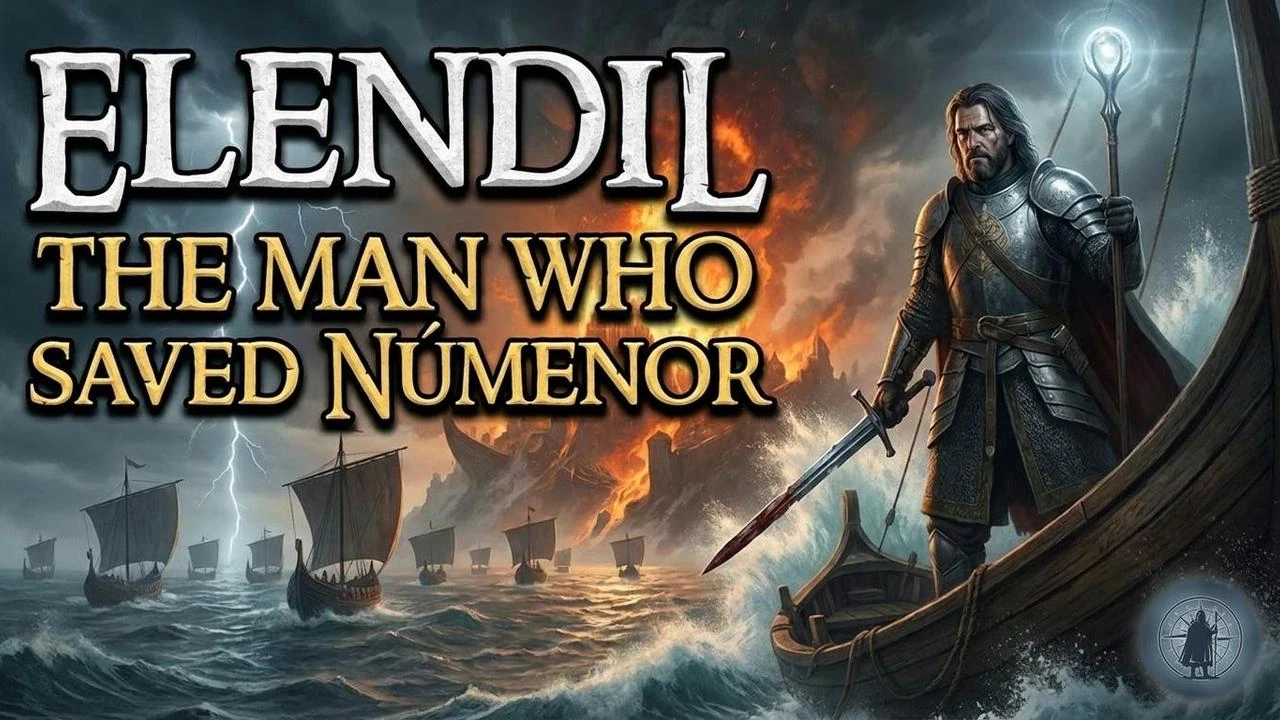 Watch the episode
Elendil the Tall: The Man Who Saved Numenor's Soul | Tolkien Deep Dive
Watch the episode
Elendil the Tall: The Man Who Saved Numenor's Soul | Tolkien Deep Dive
Research Notes: Elendil the Tall
Overview
Elendil the Tall (SA c. 3119 – SA 3441) was the last Lord of Andúnië on Númenor, leader of the Faithful who survived the Downfall, founder of the Realms in Exile (Arnor and Gondor), first High King of the Dúnedain, and the man whose broken sword would later be reforged as Andúril, the Flame of the West. He stands as one of Tolkien's most consequential mortal characters: a Noah-figure, a founder-king, a martyr at the Last Alliance — and the ancestor whose oath Aragorn would echo three thousand years later at his coronation.
His arc is the hinge between two ages. He carries the seedling of Nimloth, the seven palantíri, the mithril Elendilmir, and — most importantly — the cultural and spiritual inheritance of Númenor across the sundering sea, salvaging from the wreck of a corrupted civilization the seeds of two new ones. He dies at the height of his glory, wrestling with Sauron on the slopes of Orodruin. His sword breaks beneath him. That breaking becomes the most important fracture in Middle-earth's history: from a shattered hilt-shard, Isildur cuts the Ring; from the same shards, three thousand years later, Aragorn's reforged blade re-founds the kingdom.
He is, in short, the standard that broke — and the standard that was raised again.
Primary Sources
The Silmarillion (Akallabêth & Of the Rings of Power)
The Akallabêth gives the core narrative. Elendil's father Amandil, last Lord of Andúnië, sets sail westward in secret to plead for Valinor's mercy as Eärendil once did. Before leaving, he commands Elendil to prepare ships:
- "Elendil did all that his father had bidden, and his ships lay off the east coast of the land; and the Faithful put aboard their wives and their children, and their heirlooms, and great store of goods." (The Silmarillion, Akallabêth)
The number of ships is fixed in the text: - "Nine ships there were: four for Elendil, and for Isildur three, and for Anárion two; and they fled before the black gale out of the twilight of doom into the darkness of the world." (Akallabêth)
The ships carried the seven palantíri (gifts of the Eldar of Tol Eressëa to Amandil's house) and a seedling of Nimloth, the White Tree, which Isildur had earlier rescued at peril of his life from the King's court before Sauron had it burned.
On the final battle of the Last Alliance, the Silmarillion records (in Of the Rings of Power and the Third Age): - "Sauron himself came forth; and he wrestled with Gil-galad and Elendil, and they both were slain, and the sword of Elendil broke under him as he fell. But Sauron also was thrown down, and with the hilt-shard of Narsil Isildur cut the Ruling Ring from the hand of Sauron and took it for his own."
The Lord of the Rings
Elrond's eyewitness account at the Council of Elrond is the canonical version of Elendil's death: - "I was the herald of Gil-galad and marched with his host. I was at the Battle of Dagorlad before the Black Gate of Mordor, where we had the mastery: for the Spear of Gil-galad and the Sword of Elendil, Aiglos and Narsil, none could withstand. I beheld the last combat on the slopes of Orodruin, where Gil-galad died, and Elendil fell, and Narsil broke beneath him; but Sauron himself was overthrown, and Isildur cut the Ring from his hand with the hilt-shard of his father's sword, and took it for his own." (FOTR, Book II, Ch. 2, "The Council of Elrond")
The Oath of Elendil — spoken on landfall in Middle-earth and repeated by Aragorn at his coronation: - "Et Eärello Endorenna utúlien. Sinome maruvan ar Hildinyar tenn' Ambar-metta!" - "Out of the Great Sea to Middle-earth I am come. In this place will I abide, and my heirs, unto the ending of the world." (ROTK, Book VI, Ch. 5, "The Steward and the King")
Appendix A traces the descent of Aragorn from Elendil through 39 generations and confirms the partition: Elendil holds Arnor in the north as High King; Isildur and Anárion hold Gondor jointly in the south.
Unfinished Tales
"The Disaster of the Gladden Fields" provides the most detailed account of what happened to Elendil's heirloom sword and his line after his death. Two years after Elendil's fall, Isildur — wearing the Elendilmir — was ambushed by orcs en route from Gondor to Arnor. Before the final attack he ordered his esquire Ohtar to flee with the shards of Narsil to Rivendell: - "The shards of Elendil's sword he committed to Ohtar his esquire... 'Save them from capture by all means that you can find, and at all costs; even at the cost of being held a coward who deserted me. Take your companion with you and flee! Go!'" (UT, "The Disaster of the Gladden Fields")
This sequence preserves the central relic — the broken sword — across the Third Age until Aragorn.
UT also describes Elendil's height: 2.5 rangar, just under eight feet — "the tallest of all the Númenóreans who escaped the Downfall." Even by Númenórean standards he was a giant.
The Letters of J.R.R. Tolkien
In Letter 131 (to Milton Waldman, c. 1951), Tolkien explicitly frames Elendil as a Noachian figure: - Tolkien describes the escape of the Faithful as "a kind of Noachian situation" with Elendil "their leader" as "a Noachian figure."
Letter 257 (1964) recounts Tolkien's recurring dream of "the Great Wave, towering up, and coming in ineluctably over the trees and green fields" — the dream he gave to Faramir, and the dream that births Númenor's drowning. Elendil is the dream's survivor: the man who outruns the wave.
The History of Middle-earth
The legend of Elendil long predates the published Silmarillion. In The Lost Road (HoME V) and The Notion Club Papers (HoME IX), Tolkien used the name-pair Amandil/Elendil ("Bliss-friend" / "Elf-friend") in time-travel narratives where these names recur down generations of fathers and sons, eventually surfacing in Anglo-Saxon England as Oswin/Ælfwine. The legendarium absorbed and rationalized this older draft material: Elendil the Faithful becomes the keystone joining the mythic and historical strata of Tolkien's invented past.
Key Facts & Timeline
- SA c. 3119 — Elendil born in Númenor, son of Amandil - SA c. 3175–3262 — Reign of Tar-Palantir, last Faithful king; brief respite for Elf-friends - SA 3255 — Ar-Pharazôn seizes the throne; persecution intensifies - SA 3262 — Sauron taken to Númenor as "prisoner"; corrupts Ar-Pharazôn - SA c. 3310 — Building of the Great Armament begins - SA 3319 — Amandil sails west alone to plead with the Valar; never returns. Ar-Pharazôn breaks the Ban and sails to Aman. Númenor is drowned. Elendil and his nine ships ride the storm east to Middle-earth - SA 3320 — Founding of the Realms in Exile. Elendil establishes Arnor (capital Annúminas) as High King; Isildur and Anárion jointly rule Gondor (Osgiliath, Minas Anor, Minas Ithil). Seven palantíri distributed - SA 3429 — Sauron attacks Gondor; Minas Ithil falls; Anárion holds Osgiliath - SA 3430 — Last Alliance of Elves and Men formed at Amon Sûl - SA 3434 — Battle of Dagorlad; the Alliance breaks Sauron's host - SA 3434–3441 — Seven-year Siege of Barad-dûr - SA 3441 — Sauron emerges; combat on Orodruin. Gil-galad and Elendil slain. Narsil breaks. Isildur cuts the Ring. Second Age ends. - TA 2 — Two years later, Isildur dies at Gladden Fields; Ohtar bears the shards of Narsil to Rivendell
Significant Characters
- Amandil — Father; last Lord of Andúnië; once friend of Ar-Pharazôn; sails west like Eärendil and is never seen again. His prayer is what saves the nine ships. - Isildur — Eldest son. Rescued the seedling of Nimloth. Cuts the Ring from Sauron with Narsil's hilt-shard. Fails to destroy it. Dies at Gladden Fields two years after his father. - Anárion — Second son. Holds Osgiliath against Sauron in the years before the Last Alliance. Killed by a stone cast from Barad-dûr during the siege, before his father's final combat. - Gil-galad — High King of the Noldor in Lindon. Befriends Elendil at his landing. His co-equal at the Last Alliance. Dies beside him on Orodruin. Bearer of Aiglos and Vilya. - Elrond — Gil-galad's herald; eyewitness to Elendil's fall; preserves the shards of Narsil and the memory of the Last Alliance into the Third Age. - Aragorn / Elessar — Elendil's 39th-great-grandson; reforges Narsil into Andúril; speaks Elendil's oath at his coronation; reunifies the Realms in Exile.
Geographic Locations
- Andúnië — Westernmost haven of Númenor; seat of the Faithful Lords. Westward-facing; their first city to be drowned. - Rómenna — Eastern haven of Númenor where the Faithful gathered in their last years and where Elendil's nine ships waited. - Lindon — The Elven realm in northwestern Middle-earth where Elendil first made landfall and was received by Gil-galad. - Annúminas — "Tower of the West"; capital Elendil founded on the shores of Lake Nenuial in Arnor. - Amon Sûl (Weathertop) — Northern watchtower; site of the chief palantír of the North-kingdom; where Elendil and Gil-galad united their hosts before the Last Alliance. - Tower Hills (Emyn Beraid) — Where Gil-galad raised the white tower Elostirion housing the seventh, westward-facing palantír — the one through which the Faithful could still gaze toward lost Eressëa. - Pelargir — Older Faithful haven on the Anduin; landing point of Isildur and Anárion's ships. - Osgiliath, Minas Anor, Minas Ithil — The triple cities of Gondor founded by Elendil's sons. - Dagorlad / Orodruin — Battlefield and place of his death.
Themes & Symbolism
- The Noachian Survivor. Tolkien's own framing. Elendil is the righteous remnant who escapes divine judgment with the seeds of culture (palantíri, White Tree, the Faithful, the language) intact. But unlike Noah he is also an imperialist — a founder of realms — which scholar Nicholas Birns identifies as a key Tolkien complication of the biblical type.
- Faithfulness as the Cardinal Virtue. His epithet Voronda — "the Faithful" — is the cognomen Tolkien gives him in Quenya. In a legendarium where pride, possessiveness, and oath-breaking destroy realms (Fëanor, Ar-Pharazôn, Isildur, Denethor), Elendil's distinguishing virtue is simply that he kept faith with what he loved when keeping faith cost everything.
- The Standard That Broke. The breaking of Narsil is one of Tolkien's most freighted images. It is simultaneously: a defeat (Elendil dies), a victory (Sauron is unmade), a relic (the hilt-shard cuts the Ring), and a promise (the shards await reforging). The broken sword is the visual synecdoche of the entire Third Age — an interregnum waiting to be made whole.
- Inheritance Across Catastrophe. Elendil's whole biography is a meditation on what survives a civilizational collapse. Stones, a tree, an oath, a sword, a name. These five objects/acts are how Númenor crosses into Middle-earth. Each becomes load-bearing in the later mythology.
- The Oath as Foundation Document. Et Eärello Endorenna utúlien. When Aragorn speaks these words at the gates of Minas Tirith three millennia later, he is performing a foundation ritual: re-uttering the founding oath restores the founding. Elendil's oath is the constitution of the Dúnedain — a verbal landing-stone.
- Catholic / Sacrificial Resonance. Elendil dies victorious-in-defeat: he and Gil-galad are both killed, but their deaths are the necessary condition of Sauron's overthrow. The pattern is closer to martyrdom than to heroic conquest. (Tolkien's Catholicism is doctrinally distinct from straightforward Noah-typology — Elendil is also a figure of Christian sacrificial kingship, the king who dies that the people may live.)
Scholarly Interpretations & Theories
- Noachian Reading (Tolkien's own). Letter 131. The Faithful's escape is "a kind of Noachian situation"; Elendil is "a Noachian figure." This is the closest the legendarium comes to a one-to-one biblical type.
- Atlantis Complex (Tolkien's own). Letter 257 and elsewhere. Tolkien's recurring dream of the Great Wave, which stopped after he wrote the Downfall, plants Elendil specifically as the dreamer who escapes the wave. He is the part of the dream that wakes up.
- Imperialist Caveat (Nicholas Birns). Birns notes that Elendil departs from the Noah type by founding kingdoms — he is not just a remnant but a colonist. The Realms in Exile carry both the virtue of Númenor and the problem of Númenor: a great Mannish dominion in Middle-earth.
- Jason / Golden Fleece (J.K. Newman). A classical-studies reading: Isildur's taking of the Ring with the hilt-shard parallels Jason's seizure of the Fleece — a precious prize that brings ruin. The connection makes Elendil's broken sword the cause of the catastrophe, not just its instrument.
- Germanic / Anglo-Saxon Substrate (HoME V & IX). The Amandil/Elendil father-son name pair began life in The Lost Road and The Notion Club Papers as a recurring time-travel motif, with Anglo-Saxon counterparts Oswin/Ælfwine. Christopher Tolkien's editorial notes track how this older "Elf-friend" theme was absorbed into the published mythology.
- The Faithful as Recusants. Some Catholic readers (e.g., Joseph Pearce) read the Faithful's persecuted status under Ar-Gimilzôr and Ar-Pharazôn as inflected by Tolkien's Catholic-recusant English heritage — a beleaguered minority keeping the old worship in defiance of a corrupted state religion.
Contradictions & Different Versions
- Elendil's height. Some texts give 2.5 rangar (~7'11"); other drafts and adaptations vary. The figure of the exceptionally tall man is the constant.
- Etymology of the name. Tolkien shifted between two readings: the older eled + ndil ("Elf-friend," equated in the Etymologies with Anglo-Saxon Ælfwine) and the later elen + ndil ("Star-lover" / "devoted to stars," with the "Elf-friend" sense taken as the Edainic folk meaning that confused elen with elda). Both readings are canonical at different stages.
- The Combat on Orodruin. The Silmarillion says Sauron "wrestled with Gil-galad and Elendil." Elrond's eyewitness account at the Council says only "Gil-galad died, and Elendil fell, and Narsil broke beneath him." Whether the two kings fought Sauron simultaneously or in sequence, and the precise mechanics of Sauron's defeat, are deliberately left numinous. (Christopher Tolkien notes this ambiguity is a feature, not a bug — heroic legend resists granular reconstruction.)
- The Drafts in HoME. The earliest Númenor material (HoME V) makes Elendil a more straightforwardly Anglo-Saxon figure; later drafts integrate him into the high mythology. Christopher Tolkien tracks this evolution at length.
- Peter Jackson's films. The prologue (Peter McKenzie) shows Sauron physically smashing Elendil and a passive Isildur picking up the shards more or less by accident — a substantial departure from the books, where Elendil and Gil-galad's deaths cause Sauron's overthrow rather than being mere collateral damage.
Cultural & Linguistic Context
- Elendil (Quenya) — Two readings: (1) elen + ndil, "Star-lover, one devoted to stars/astronomy" (the older, learned meaning); (2) eled + ndil, "Elf-friend" (the popular Edainic meaning). Tolkien retained both. Compare Eärendil ("Sea-lover/-friend"), Elendil's distant ancestor. - Voronda (Quenya) — "The Faithful, steadfast." Elendil's epithet of honor. - Andúnië (Quenya) — "Sunset"; the western haven of which Elendil was the last lord. - Nimloth (Sindarin) — "White Blossom"; the White Tree of Númenor. - Narsil (Quenya) — From nar- "fire/sun" + thil- "moon"; "Sun and Moon," the two great lights. The sword is named for cosmic complementarity. Reforged as Andúril, "Flame of the West." - Aiglos (Sindarin) — "Snow-point" or "Icicle"; Gil-galad's spear. - Et Eärello Endorenna utúlien… — Quenya. The verbs utúlien (perfect tense, "I have come") and maruvan (future, "I will abide") frame the oath as a closed past act and a binding future commitment, a single sentence that founds a dynasty.
Questions & Mysteries
- Did Elendil ever know his father's fate? Amandil sailed west and never returned. Tolkien implies the prayer reached Manwë (since the Faithful are spared), but Amandil's personal end is silent. Elendil presumably died not knowing.
- Why nine ships? A symbolic number across the legendarium (the Nine Walkers, the Nine Riders, the nine Rings of Men). Tolkien never explains; the resonance is left to do its work.
- What was Elendil's role in Anárion's death? Anárion was killed at Barad-dûr a year before the final combat, struck by a stone from the tower. The Silmarillion says little of his father's grief.
- Why couldn't the Elostirion stone communicate with the others? Tolkien tells us only that it gazed west toward the Master-stone in the Tower of Avallónë on Tol Eressëa — a silent western-facing window through which the Faithful could still see the Undying Lands they had been forbidden. A consolation, not a tool.
- Did Elendil ever truly believe Númenor could be saved? His preparations begin years before the Downfall. He builds the ships and stocks them with heirlooms while his father still hopes. The text suggests a kind of clear-eyed, prepared faith — neither despair nor optimism.
Compelling Quotes for Narration
1. "Out of the Great Sea to Middle-earth I am come. In this place will I abide, and my heirs, unto the ending of the world." (The Oath of Elendil — ROTK, Book VI, Ch. 5)
2. "Nine ships there were: four for Elendil, and for Isildur three, and for Anárion two; and they fled before the black gale out of the twilight of doom into the darkness of the world." (Silmarillion, Akallabêth)
3. "The Spear of Gil-galad and the Sword of Elendil, Aiglos and Narsil, none could withstand." (Elrond — FOTR, II.2)
4. "I beheld the last combat on the slopes of Orodruin, where Gil-galad died, and Elendil fell, and Narsil broke beneath him." (Elrond — FOTR, II.2)
5. "Sauron himself came forth; and he wrestled with Gil-galad and Elendil, and they both were slain, and the sword of Elendil broke under him as he fell." (Silmarillion, Of the Rings of Power and the Third Age)
6. "Save them from capture by all means that you can find, and at all costs; even at the cost of being held a coward who deserted me." (Isildur to Ohtar, on the shards — UT, Disaster of the Gladden Fields)
7. Tolkien's own framing (Letter 131): the Faithful's escape was "a kind of Noachian situation," Elendil "a Noachian figure."
Visual Elements to Highlight
1. The nine ships at anchor off Rómenna's coast, sails furled, waiting in the eerie calm before the wave. 2. The black gale bearing the ships east as Númenor sinks behind them. 3. Elendil's first landfall in Lindon, a giant of a man stepping ashore with the seedling of Nimloth in one hand. 4. The seven palantíri being divided in council — three for Arnor, four for Gondor — the seventh set in Elostirion to gaze west. 5. Elendil and Gil-galad on the field of Dagorlad, Aiglos and Narsil flashing. 6. The seven-year siege of Barad-dûr: dark tower, fire in the sky, the slow grinding of years. 7. The combat on Orodruin: two kings against the Dark Lord, the moment Narsil shears. 8. The hilt-shard in Isildur's hand, the Ring on it. 9. Three thousand years later: Aragorn at the gates of Minas Tirith, hand on Andúril, speaking Et Eärello Endorenna utúlien.
Discrete Analytical Themes
Theme 1: The Inherited Faith
Core idea: Elendil's faithfulness is not a personal virtue he discovered but a multi-generational inheritance from the Lords of Andúnië, descended from Silmarien and ultimately from Eärendil — and his life consists of paying that inheritance forward. Evidence: - The Lords of Andúnië descend from Tar-Elendil's daughter Silmarien, the senior line that the kingship had passed over (Akallabêth). - His father Amandil leads the Faithful and sails west like their ancestor Eärendil (Akallabêth). - Elendil's name Voronda — "the Faithful" — is a Quenya cognomen that defines him as the embodiment of an ancestral type. Distinction: This is about the vertical dimension — Elendil as a node in a long family chain — not the horizontal political acts he takes.Theme 2: The Noachian Survivor
Core idea: Elendil is the one righteous man preserved through divine judgment to seed a new world, but with a Tolkien-specific twist: he doesn't merely survive, he carries forward. Evidence: - Tolkien explicitly: "a Noachian figure" amid "a kind of Noachian situation" (Letter 131). - The Faithful's salvation is contingent on Amandil's prayer reaching Manwë — explicit divine intervention. - The cargo of the nine ships is not just people: palantíri, Nimloth's seedling, scrolls, heirlooms — a civilization in nine hulls. Distinction: This is about the vertical salvation moment — the wave and the deliverance — not what Elendil did with the deliverance afterward.Theme 3: The Founder-King
Core idea: Elendil's act of founding is genuinely creative — he is not merely a refugee but the architect of two kingdoms whose institutions, cities, palantír-network, and joint-rule structure shape the next three thousand years of Middle-earth. Evidence: - Founds Arnor with capital Annúminas; sons found Gondor with three cities (Akallabêth, Appendix A). - Distributes seven palantíri across a deliberately conceived north-south communications network. - The dual structure (High King of the North, joint kings of the South) is the Realms in Exile — a constitutional innovation that survives until Arvedui's time. Distinction: This is about Elendil as political architect — what he built — not what he believed or what he sacrificed.Theme 4: The Standard That Broke
Core idea: Elendil's defining moment is his death-and-fracture: he falls in combat, his sword shatters, but the breaking is the precondition of Sauron's overthrow and of every redemption that follows. Evidence: - "the sword of Elendil broke under him as he fell" (Silmarillion, Of the Rings of Power). - The hilt-shard becomes the instrument that cuts the Ring (Elrond's account). - The shards are preserved by Ohtar, kept in Rivendell, reforged as Andúril — the breaking is reversible only in the fullness of time. Distinction: This is about the specific moment of death and its symbolic afterlife — the broken sword as relic — not Elendil's life or his founding.Theme 5: The Oath as Founding Document
Core idea: Et Eärello Endorenna utúlien is not a poetic flourish but a constitutive speech-act — the verbal foundation of Dúnedain identity, repeated by Aragorn three millennia later to refound what Elendil first founded. Evidence: - "Out of the Great Sea to Middle-earth I am come. In this place will I abide, and my heirs, unto the ending of the world" (ROTK, VI.5). - Aragorn re-speaks the oath at his coronation, explicitly tying his kingship to Elendil's act. - The oath binds heirs — it is a dynastic instrument, not just a personal vow. Distinction: This theme is about language and ritual — the oath as the thing that makes Elendil's act binding across time — distinct from the political founding (Theme 3) or the relic of the sword (Theme 4).Theme 6: The Bridge Between Ages
Core idea: Elendil personally carries the inheritance of the First and Second Ages (descent from Eärendil, gifts of the Eldar, lore of Númenor) into the Third Age, making him the single human figure through whom the entire pre-Third-Age legendarium reaches the world of Frodo and Aragorn. Evidence: - Direct descendant of Eärendil and Elwing, thus carrying half-elven blood (Appendix A). - Brings the palantíri (Eldar gift), Nimloth (a scion of Telperion), and the language of Quenya into Arnor and Gondor. - His line — unbroken through three thousand years — produces Aragorn, the Ring's destruction, and the Fourth Age. Distinction: This theme is about Elendil's position in the deep timeline — what makes him uniquely necessary as a connector — not his personal acts within his own age.Theme 7: Tolkien's Own Dream-Survivor
Core idea: Elendil sits at the meeting-point of Tolkien's most personal mythopoeic material — the recurring Atlantis-wave dream, the Lost Road time-travel project, and the Anglo-Saxon Ælfwine motif — making him not just a character but a node in Tolkien's autobiographical mythology. Evidence: - Letter 257 on the recurring Great Wave dream that ceased only after the Akallabêth was written. - The Lost Road and Notion Club Papers (HoME V, IX) use Amandil/Elendil as recurring father-son names across time. - The Etymologies explicitly equates Elendil with Anglo-Saxon Ælfwine ("Elf-friend"). Distinction: This is about Elendil's role outside the diegesis — as a vessel for Tolkien's personal preoccupations — distinct from his in-world functions.Sources Consulted
See sources.md for the full list with URLs and usage notes.
Sources Consulted: Elendil the Tall
Primary Texts (Tolkien)
- The Silmarillion — Akallabêth: The Downfall of Númenor and Of the Rings of Power and the Third Age. The core narrative source: Faithful, ships, escape, founding, Last Alliance, Elendil's death, Narsil's breaking. - The Lord of the Rings — Book II, Ch. 2 ("The Council of Elrond") for Elrond's eyewitness account of Orodruin; Appendix A (Annals of the Kings) for the genealogy and partition of the Realms in Exile; Book VI, Ch. 5 ("The Steward and the King") for Aragorn's coronation and the Oath; Appendix B for the Tale of Years (SA 3319–3441). - Unfinished Tales — Part Three, I: "The Disaster of the Gladden Fields" (Isildur's death, the shards of Narsil, Ohtar). Part Two, III: "The Line of Elros" / supplementary Númenor material on Elendil's height and lineage. - The Letters of J.R.R. Tolkien — Letter 131 (to Milton Waldman, c. 1951, Elendil as "Noachian figure"); Letter 257 (1964, the Great Wave dream). - The History of Middle-earth — The Lost Road (HoME V) and Sauron Defeated / The Notion Club Papers (HoME IX) for the pre-mythology Amandil/Elendil time-travel material; The Etymologies (HoME V) for Elendil = Ælfwine; The Peoples of Middle-earth (HoME XII) for late genealogical material on the Lords of Andúnië.
Web Sources Consulted
Most Useful
- Tolkien Gateway — https://tolkiengateway.net/wiki/Elendil — Most thorough single-page treatment, with citations to primary texts. Also consulted: /wiki/Faithful, /wiki/Last_Alliance_of_Elves_and_Men, /wiki/Battle_of_Dagorlad, /wiki/War_of_the_Last_Alliance, /wiki/Akallab%C3%AAth, /wiki/Star_of_Elendil, /wiki/Oath_of_Elendil, /wiki/Realms_in_Exile, /wiki/Amandil, /wiki/The_Disaster_of_the_Gladden_Fields, /wiki/Gil-galad. (Tolkien Gateway returned 403 in WebFetch — used via WebSearch summaries.) - Wikipedia: Elendil — https://en.wikipedia.org/wiki/Elendil — Excellent for scholarly framing (Birns, Newman, Letter 131 quote), Quenya etymology, films/adaptations, lineage summary. - The One Wiki to Rule Them All (Fandom) — https://lotr.fandom.com/wiki/Elendil and related pages (Narsil, Anduril, Elendilmir, Realms in Exile, Disaster of the Gladden Fields, War of the Last Alliance). Useful for cross-checking dates and minor details.Secondary / Supporting
- LitCharts Silmarillion — https://www.litcharts.com/lit/the-silmarillion/characters/elendil — Brief but accurate character analysis. - Tea with Tolkien (Akallabêth guide) — https://www.teawithtolkien.com/blog/akallabeth — Useful chapter walkthrough. - Silmarillion Writers' Guild — Akallabêth summary — https://www.silmarillionwritersguild.org/reference/silmsummaries/akallabeth.php — Detailed plot summary. - Ted Nasmith — "The Ships of the Faithful" — https://www.tednasmith.com/tolkien/the-ships-of-the-faithful/ — Visual reference for the nine ships imagery. - Glæmscrafu (Elendil's words) — https://glaemscrafu.jrrvf.com/english/elendil.html — Detailed linguistic treatment of the Oath. - Parf Edhellen / elfdict — https://www.elfdict.com/w/elendil/q — Quenya etymology (elen + ndil vs eled + ndil). - Thain's Book — https://thainsbook.minastirith.cz/elendil.html — Concise reference. - Drums of Atlantis: "Tolkien and his Atlantis Complex" — https://drumsofatlantis.com/tolkien-and-his-atlantis-complex — Atlantis/Noah/dream context. - Dr. Philip Mitchell (Dallas Baptist) — "Tolkien and the Atlantis Myth" — https://www.dbu.edu/mitchell/tolkien-medieval-tradition-resources/numenoratlantis.html — Scholarly framing. - Middle-earth & J.R.R. Tolkien Blog (Michael Martinez) — "How Did Gil-galad and Elendil Stand against Sauron?" — https://middle-earth.xenite.org/how-did-gil-galad-and-elendil-stand-against-sauron/ — Detailed combat analysis. - TheOneRing.net — "The Rings of Power: analysing Elendil the Faithful" — https://www.theonering.net/torwp/2024/08/26/119162-the-rings-of-power-analysing-elendil-the-faithful/ — Modern adaptation context.Coverage Assessment
Abundance: Elendil is exceptionally well-documented for a Second Age figure. Primary-source citations are easy; the principal narrative is fixed across the Akallabêth, the Council of Elrond, and the Disaster of the Gladden Fields, with Tolkien's own letters supplying the interpretive frame.
Gaps: - Elendil's interiority — his marriage, his early life on Númenor, his reaction to Anárion's death — is almost entirely absent from the texts. - His mother is not named. - The exact mechanics of his combat with Sauron are deliberately left mythic. - The seven-year siege of Barad-dûr is summarized but not narrated in detail.
Most useful for the script: Elrond's eyewitness account at the Council of Elrond, the Akallabêth's nine-ships passage, the Oath in The Steward and the King, and Letter 131's "Noachian figure" framing — these four citations carry most of the episode's conceptual weight.