Transcript
Durin's Bane
The Balrog That Slept Through the War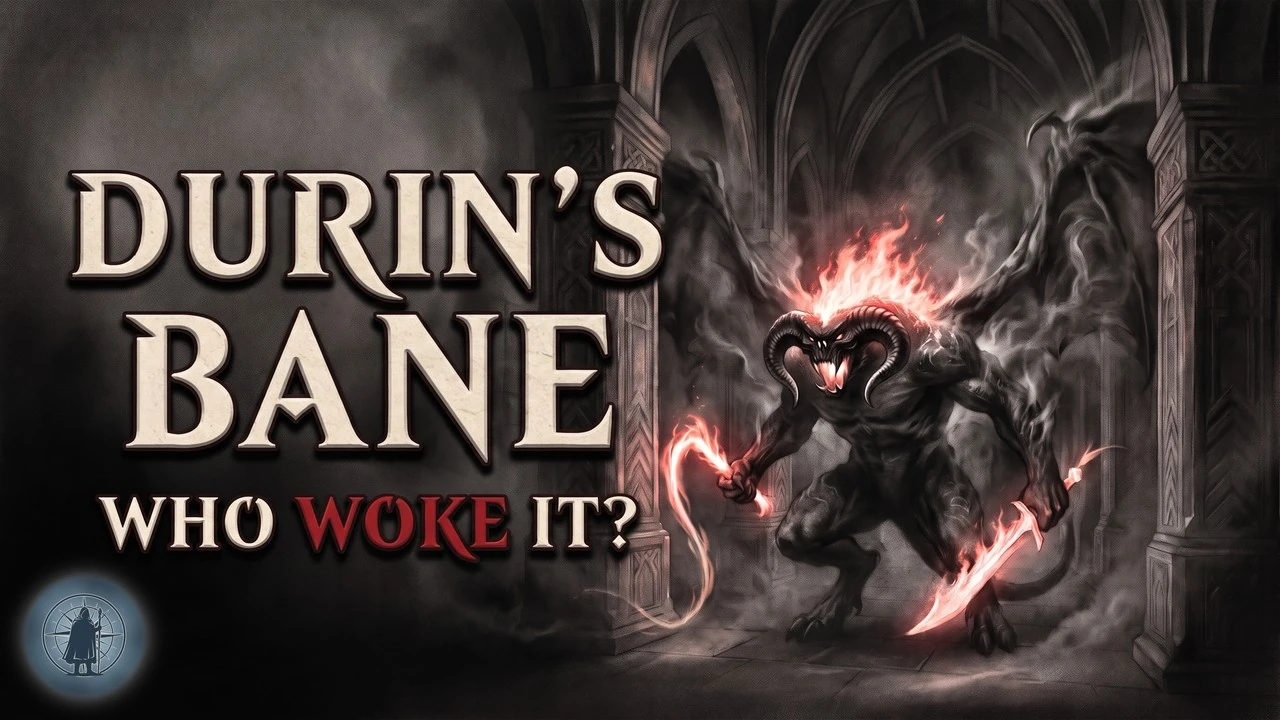 Watch the episode
Durin's Bane: The Balrog That Slept Through the War | LOTR Explained
SECTION: How One Balrog Escaped the War of Wrath
"The Balrog is a survivor from the Silmarillion and the legends of the First Age. So is Shelob."
Tolkien wrote that in April of 1954, in a letter to his friend Naomi Mitchison. She was reading the page proofs of The Fellowship of the Ring and had sent him a list of questions. The book wasn't even in the shops yet.
Tolkien went on to say what Balrogs were.
"The Balrogs, of whom the whips were the chief weapons, were primeval spirits of destroying fire, chief servants of the primeval Dark Power of the First Age."
That Dark Power is Morgoth, the first Dark Lord, the one Sauron served.
Then Tolkien says the Balrogs "were supposed to have been all destroyed in the overthrow of Thangorodrim, his fortress in the North. But it is here found (there is usually a hang-over especially of evil from one age to another) that one had escaped and taken refuge under the mountains of Hithaeglin." Hithaeglin is an early spelling of the Elvish name for the Misty Mountains.
So the people of Middle-earth assumed the Balrogs were gone, and the Silmarillion explains why. At the end of the First Age, the Host of the West, the army of the Valar and the Elves of Valinor, crossed the sea to go to war with Morgoth. It's called the War of Wrath. They broke Thangorodrim, the mountains Morgoth had piled up over his fortress of Angband, and they threw Morgoth out of the world. And about his Balrogs, the Silmarillion says this:
"the Balrogs were destroyed, save some few that fled and hid themselves in caverns inaccessible at the roots of the earth."
That means more than one got away. Tolkien never says how many. Durin's Bane is simply the only one of those few that we ever hear about again.
Tolkien's history of the Dwarves, in the appendices at the back of The Lord of the Rings, adds a detail. The Balrog of Moria had come "flying from Thangorodrim," and had "lain hidden at the foundations of the earth since the coming of the Host of the West." Flying there is the old word for fleeing, the way an army is put to flight. Tolkien gives no route and no date. While the Host of the West was marching on Angband, the Balrog that became Durin's Bane went down into the dark under the mountains, and stayed there.
That escape route is older than The Lord of the Rings. By 1937 Tolkien had written a long prose version of the Silmarillion, which his son Christopher published decades later, and the line about the few that fled is already in it. In December of that year, Tolkien started a sequel to The Hobbit. Nobody, Tolkien included, knew yet that it was going to need a Balrog.
In The Hobbit, Moria is barely more than a name. Gandalf reminds Thorin, "Your grandfather Thror was killed, you remember, in the mines of Moria by Azog the Goblin." In 1937, goblins are the only danger anybody mentions there.
Then, around 1939, Tolkien got the Fellowship as far as Moria and jotted down a plan for what would chase them through it. That first plan says they're "pursued by goblins and a BR." BR was Tolkien's shorthand for a Black Rider. Then Tolkien wrote over it, and the Black Rider became a Balrog.
So the gap Tolkien had left in the Silmarillion a couple of years earlier works nicely. Instead of inventing a new creature for Moria, Tolkien went back to the First Age and used one he'd already given a way out. In a way, that's a hang-over too. Durin's Bane is a captain from Morgoth's war, walking into a Third Age story more than six thousand years after that war ended.
SECTION: Shadow and Flame: What a Balrog Actually Is
Under the Valar, the great Powers who govern the world, Tolkien puts the Maiar. They're lesser spirits of the same kind, angels more or less, and they existed before the world was made. Gandalf is one of the Maiar. So is Sauron. And so is every Balrog.
The Silmarillion's account of the Powers ends with a short passage on the ones who went over to Melkor, the Vala who became Morgoth.
"For of the Maiar many were drawn to his splendour in the days of his greatness, and remained in that allegiance down into his darkness; and others he corrupted afterwards to his service with lies and treacherous gifts. Dreadful among these spirits were the Valaraukar, the scourges of fire that in Middle-earth were called the Balrogs, demons of terror."
That gives two roads into Morgoth's service. Some spirits came early, because they admired him, and others were bought later with lies and gifts. We're not sure which road Durin's Bane took, but we're sure it took one of them.
The Silmarillion describes the Balrogs again when Morgoth gathers them in Utumno, his first fortress in the far north. They were "those spirits who first adhered to him in the days of his splendour, and became most like him in his corruption: their hearts were of fire, but they were cloaked in darkness, and terror went before them; they had whips of flame."
So a Balrog is fire on the inside and darkness on the outside. When Aragorn tries to describe what he saw in Moria, he ends up in the same place: "It was both a shadow and a flame, strong and terrible."
Fire on its own isn't evil in Tolkien's world. In the Silmarillion, the Sun is steered by Arien, a Maia of fire, the same kind of spirit as a Balrog, whom Melkor "had not deceived nor drawn to his service." A spirit of fire could go either way. The Balrogs are the ones that went to Morgoth.
In the First Age, they were his officers. Gothmog, the Lord of Balrogs, killed Fingon, High King of the Noldor, at the Battle of Unnumbered Tears. Later Gothmog fought Ecthelion of the Fountain in the King's square at Gondolin, where each of them killed the other. Glorfindel met another Balrog high on a mountain pass while Gondolin's survivors were escaping, and the two of them fell into the abyss together. Balrogs led Morgoth's armies, and they died in his battles.
The names tell us something too. Balrog is Sindarin, the everyday Elvish of Middle-earth. Bal means power and raug means demon, so a Balrog is a Demon of Might, and the older Quenya form is Valarauko. "Durin's Bane" is the Dwarves' name for this one. Bane comes from the Old English word bana, a slayer. So the Dwarves named it after the king it killed.
Its shape is harder to pin down. On the bridge it looks "like a great shadow, in the middle of which was a dark form, of man-shape maybe, yet greater." The shadow around it reaches out "like two vast wings," and a moment later "its wings were spread from wall to wall." Tolkien never says whether those wings are shadow or something more solid. Durin's Bane never flies, though, and it falls twice, the second time to its death.
There's one more thing about Durin's Bane. It never says a word.
And that was deliberate. In 1958 Tolkien was sent a proposed film script of The Lord of the Rings, and one of his many objections was this: "The Balrog never speaks or makes any vocal sound at all. Above all he does not laugh or sneer." Whatever Durin's Bane wanted, it never told anyone.
SECTION: Asleep Under Caradhras While Sauron Forged the Ring
Celeborn tells the Fellowship where the Balrog was hiding. "We long have feared that under Caradhras a terror slept." Caradhras is the Redhorn, the mountain that turned the Fellowship back with snow and forced them into Moria in the first place.
This Balrog stayed hidden for the whole of the Second Age, which lasted more than three thousand years, and then for nearly two thousand more in the Third Age. That's over five thousand years under one mountain. And the Second Age was Sauron's age.
So let's walk through what happened while the Balrog lay quiet.
Around the year 1000 of the Second Age, Sauron settled in Mordor and began building Barad-dûr. Around 1600, in the fire of Mount Doom, he forged the One Ring. Then Sauron went to war on Eregion, the land of the Elven-smiths who'd made the Rings of Power with his help. Eregion sat right up against the western side of the Misty Mountains. Its people had been friends with the Dwarves of Moria for centuries, and the road from their city ran to Moria's West-gate.
Tolkien's entry for the year 1697 reads, "Eregion laid waste. Death of Celebrimbor. The gates of Moria are shut." The Dwarves of Moria had come out and attacked Sauron's army from behind, and then they pulled back inside the mountain and closed the doors. So in 1697, Sauron, who'd had the One Ring for about a century, was fighting a war on Moria's doorstep. Under Caradhras, the Balrog didn't stir.
Then Númenor rose to its height and drowned. Sauron was overthrown at the end of the Last Alliance in thirty-four forty-one, and Isildur cut the Ring from his hand. Two years into the Third Age, Isildur was ambushed by Orcs at the Gladden Fields, by the river Anduin, and the Ring slipped off his finger into the water. It stayed in the river mud until a hobbit named Déagol found it in twenty-four sixty-three. For 1,978 of those years, the Ring lay in the river on the eastern side of the Misty Mountains while the Balrog lay inside them, under Caradhras. Neither of them moved.
Balrogs had done this kind of thing before. When the Valar first went to war on Morgoth, back in the Years of the Trees, they captured him and dragged him off to Valinor in chains. But they didn't search far enough down. "Far beneath the ruined halls of Angband, in vaults to which the Valar in the haste of their assault had not descended, Balrogs lurked still, awaiting ever the return of their Lord." Ages later, when Morgoth came back to Middle-earth and the great spider Ungoliant turned on him, he let out a terrible cry, and those Balrogs came up "as a tempest of fire" and drove her off.
The difference is what those Balrogs were waiting for. Their master was coming back. Soon after Durin's Bane went down, Morgoth was thrown out of the world, and nobody expected him back.
There's one more version of the long quiet, and Tolkien deleted it almost right away. In the first draft of the scene on the bridge, Gandalf tells the Balrog to go back, and gives a reason: "Go back into the fiery depths. It is forbidden for any Balrog to come beneath the sky since Fionwe son of Manwe overthrew Thangorodrim." Fionwë was Tolkien's early name for the commander of the Host of the West. In that draft, the Balrog stayed underground because the Valar had forbidden it to come out. Tolkien scrapped that line and never brought it back.
In the finished book, Tolkien kept the plainest version. A terror lay under Caradhras, and for more than five thousand years, nobody dug deep enough to find it.
SECTION: Third Age 1980: Mithril and the Death of Durin VI
But one day...the Dwarves did.
As the Fellowship makes its way through Moria, Gandalf explains what the Dwarves were digging for. They'd found a metal there that, as far as anyone knew, existed nowhere else in the world. "Moria-silver, or true-silver as some have called it: mithril the Elves name it." It was light, harder than steel, and it never tarnished, and it made Khazad-dûm rich.
Gandalf also tells them where the vein went. "The lode led north towards Caradhras, and down to darkness."
Tolkien's history of the Dwarves describes what happened next. As mithril got harder to find every year, the Dwarves kept digging further down after it, and "thus they roused from sleep a thing of terror." Tolkien dates it to 1980 of the Third Age: "A Balrog appears in Moria, and slays Durin VI."
Durin the Sixth was born in 1731, so he was nearly two hundred and fifty when the Balrog killed him. The name "Durin's Bane" comes from this king. The first Durin, Durin the Deathless, was the eldest of the Seven Fathers of the Dwarves, and the Dwarves believed that each king named Durin was the Deathless one himself, reincarnated. So to a Dwarf, the name probably meant the thing that killed Durin himself.
Tolkien's history is short on the rest. "Durin was slain by it, and the year after Náin I, his son; and then the glory of Moria passed, and its people were destroyed or fled far away." Tolkien's entry for 1981 is a list of losses: "Náin I slain. The Dwarves flee from Moria. Many of the Silvan Elves of Lórien flee south. Amroth and Nimrodel are lost."
The last two lines tell us how far the fear reached. The Elves of Lórien lived in the woods just beyond Moria's eastern gate, down the river Silverlode, and many of them left. Legolas sings part of their story to the Fellowship, the Lay of Nimrodel, and explains what it's about. "It is long and sad, for it tells how sorrow came upon Lothlórien, Lórien of the Blossom, when the Dwarves awakened evil in the mountains."
Nimrodel was an Elf-maid of Lórien who fled south and was lost in the mountains. Amroth, the king of Lórien, who loved her, waited for her at a haven on the southern coast and was swept out to sea. In Legolas's words, "neither Nimrodel nor Amroth came ever back."
Gimli gets angry at the song. "But the Dwarves did not make the evil."
And Legolas answers, "I said not so; yet evil came."
Legolas is careful there. He says the evil came when the Dwarves dug, and he leaves the question of who made it alone. Gandalf, standing in Moria, is harder on them: "The Dwarves tell no tale; but even as mithril was the foundation of their wealth, so also it was their destruction: they delved too greedily and too deep, and disturbed that from which they fled, Durin's Bane."
The Dwarves do often say the same about themselves. At the Council of Elrond, Glóin calls Moria the wonder of the northern world, and then says, "Too deep we delved there, and woke the nameless fear."
The survivors of 1981 went north under Náin's son, Thráin the First. In 1999 he founded the Kingdom under the Mountain at Erebor, the Lonely Mountain that the dragon Smaug would take nearly eight hundred years later. So eighteen years after the flight, an exiled people had a new kingdom. They'd lost the old one, though, along with its name. Looking up at the mountains on the way south, Gimli mutters: "under them lies Khazad-dûm, the Dwarrowdelf, that is now called the Black Pit, Moria in the Elvish tongue."
SECTION: Did Sauron Wake the Balrog of Moria?
Now let's get back to Tolkien's footnote that we mentioned. About the Dwarves rousing the Balrog from sleep. It's one line long.
"Or released from prison; it may well be that it had already been awakened by the malice of Sauron."
So Tolkien gives two reasons the Balrog came up. In the main text, the Dwarves dig for mithril. In the footnote, Sauron may have had something to do with it.
In 1980, Sauron was hiding in Dol Guldur, a fortress in southern Mirkwood, where he'd lived as the Necromancer since about the year ten fifty of the Third Age. Dol Guldur looked across the Anduin toward Lórien, and Lórien sat at Moria's eastern door. Tolkien's entry for 1980 has another event in it. The full line reads, "The Witch-king comes to Mordor and there gathers the Nazgûl. A Balrog appears in Moria, and slays Durin VI." That's five years after the Witch-king's kingdom of Angmar was broken at Fornost. Tolkien puts the Witch-king and the Balrog side by side in the same year, but never says they're connected.
Tolkien did think about connecting Sauron to the Balrog, though, because he once wrote it out. In an early draft of the Lórien chapters, published long after his death, Celeborn says, "I doubt much if this Balrog has lain hid in the Misty Mountains … he was sent by Sauron from Orodruin, the Mountain of Fire." Orodruin is Mount Doom. In that version, the Balrog is Sauron's weapon, sent across Middle-earth with a purpose.
Tolkien dropped it, and a later draft of the same scene put the blame back on the Dwarves and their digging. Then, years later, Tolkien wrote the appendices and let Sauron back in at the bottom of the page.
There's more evidence on Sauron's side. Around twenty-four eighty, Tolkien writes, "Sauron begins to people Moria with his creatures." From then on Moria is full of Orcs, and they share the mountain with a Balrog for over five hundred years, apparently without trouble. And not long before the Council of Elrond, a messenger from Mordor rode to King Dáin at the Lonely Mountain with an offer. If the Dwarves would help find a certain ring, Sauron would return three of the old Dwarf-rings, "and the realm of Moria shall be yours for ever." That's a strange thing to promise unless Sauron believed Moria was his to give away.
The evidence on the other side is the Balrog's own record. In the 1,039 years between 1980 and the Fellowship, it's never once shown taking an order from anybody, and none of the Dwarf deaths Tolkien describes in Moria after 1981 is put on the Balrog. In twenty-seven ninety, Thrór, Thorin's grandfather, walked into Moria alone and was killed by the Orc Azog. In twenty-nine ninety-four, Balin, who'd come back to retake the place, was shot by an Orc hiding behind a stone. The record of Balin's colony, the Book of Mazarbul, never mentions a Balrog at all.
In between those two deaths, in twenty-seven ninety-nine, the Dwarves won a great battle at Moria's East-gate, and they could have walked straight in. Dáin Ironfoot, who'd killed Azog that day, refused.
"Only I have looked through the shadow of the Gate. Beyond the shadow it waits for you still: Durin's Bane. The world must change and some other power than ours must come before Durin's Folk walk again in Moria."
Dáin could feel it waiting, and nothing came out.
Even the Orcs feared the Balrog. On the day the Fellowship met it, Gandalf says that when it arrived, "the orcs themselves were afraid and fell silent." And in Lórien, Legolas spells out what it was. "It was a Balrog of Morgoth; of all elf-banes the most deadly, save the One who sits in the Dark Tower." Legolas calls it Morgoth's, and ranks it below Sauron.
Tolkien had more than one chance to settle this, and never did. In a draft, Tolkien wrote "sent by Sauron" and then cut it. In the appendices, Tolkien wrote "roused from sleep," and then put the malice of Sauron in a footnote under the same sentence. That leaves two versions of the Balrog on one page. In one it's a leftover that answers to nobody. In the other it's within reach of Sauron's hatred.
Tolkien left both. He lets our imaginations take it from there.
SECTION: Gandalf and the Balrog, From Durin's Bridge to the Peak
On the fifteenth of January, thirty nineteen, the Fellowship was in the Chamber of Mazarbul, beside Balin's tomb, when the drums started and the Orcs came. Gandalf stayed behind to hold the door with a spell of shutting. Something on the other side pushed back.
"It laid hold of the iron ring, and then it perceived me and my spell. What it was I cannot guess, but I have never felt such a challenge. The counter-spell was terrible. It nearly broke me."
The Balrog answered Gandalf's spell with one of its own, will against will, and the door broke.
The Fellowship ran for Durin's Bridge, a single span of stone with no rail, over a chasm nobody had ever measured. When the Balrog leapt across the fire burning in the hall behind them, "its streaming mane kindled, and blazed behind it. In its right hand was a blade like a stabbing tongue of fire; in its left it held a whip of many thongs."
Legolas knew it at once. "Ai! ai! A Balrog! A Balrog is come!" Gimli cried out "Durin's Bane!" and let his axe fall and covered his face. "A Balrog," Gandalf muttered. "Now I understand." And then, "This is a foe beyond any of you."
Gandalf stood in the middle of the bridge and spoke to it.
"You cannot pass. I am a servant of the Secret Fire, wielder of the flame of Anor. You cannot pass. The dark fire will not avail you, flame of Udûn. Go back to the Shadow! You cannot pass."
Anor is the Elvish word for the Sun, the fire Arien steers. Udûn is the Elvish name for Utumno, Morgoth's first fortress, where the Balrogs were gathered. The Secret Fire belongs to Ilúvatar, the One God, and Tolkien reportedly told a friend it stood for the Holy Spirit. In Tolkien's early drafts, Gandalf called himself "the master of the White Fire." In the published book he's a servant. Two spirits of the same order stood on that bridge, and Gandalf named the difference between them, which was the fire each one served.
Gandalf broke the bridge under the Balrog's feet with his staff. As the Balrog fell, it swung its whip, and the thongs caught Gandalf around the knees and dragged him over the edge. "Fly, you fools!" he cried, and was gone.
Weeks later, in Fangorn, Gandalf returned from death as "the white", and Gimli asks him what happened. "Name him not!" Gandalf says, and for a moment he looks "old as death." Then he tells us. "Long I fell, and he fell with me. His fire was about me. I was burned. Then we plunged into the deep water and all was dark." At the bottom, on "the uttermost foundations of stone," the Balrog's fire went out. "He was with me still. His fire was quenched, but now he was a thing of slime, stronger than a strangling snake."
Gandalf won't say much about where they fought. "Far, far below the deepest delving of the Dwarves, the world is gnawed by nameless things. Even Sauron knows them not. They are older than he." Then the Balrog fled, and Gandalf chased it, "clutching at his heel," up through tunnels the Dwarves never dug. "Thus he brought me back at last to the secret ways of Khazad-dûm: too well he knew them all."
That's the only clue Tolkien gives us about what the Balrog did with its thousand years in Moria, and it suggests the Balrog spent them learning its way around.
The Balrog led Gandalf to the Endless Stair, "many thousand steps" in an unbroken spiral, up to Durin's Tower on the peak of Zirakzigil, the Silvertine. Out in the open air, the Balrog "burst into new flame," and people watching from far off saw lightning strike the mountain. Tolkien's timeline has Gandalf reaching the peak on the twenty-third of January, and the fight ending on the twenty-fifth.
"I threw down my enemy, and he fell from the high place and broke the mountain-side where he smote it in his ruin. Then darkness took me; and I strayed out of thought and time."
Gandalf died there too. "Naked I was sent back, for a brief time, until my task is done." In a letter, Tolkien put it this way: "Thus Gandalf faced and suffered death; and came back or was sent back, as he says, with enhanced power."
Two hundred and twenty years earlier, Dáin had said that some other power than the Dwarves' would have to come before Durin's Folk walked in Moria again. The power that came was a Maia. And in Tolkien's notes for the appendices, a king called Durin the Seventh leads his people home to Khazad-dûm in the Fourth Age.
SECTION: Could Durin's Bane Have Taken the One Ring?
Let's go back to the bridge for a moment. On the fifteenth of January, when Gandalf turned to face the Balrog, Frodo had just run across that same bridge with the One Ring. The Balrog was awake, and the Ring had just gone past, right in front of it. Durin's Bane went for Gandalf.
So could it have taken the Ring? Tolkien never says, but he did have rules. The rules about power, at least, are clear. At the Council of Elrond, Elrond says the Ring's strength "is too great for anyone to wield at will, save only those who have already a great power of their own. But for them it holds an even deadlier peril. The very desire of it corrupts the heart."
Gandalf had that kind of power, and Tolkien told us what would have happened if Gandalf had used it. In a draft letter from 1963, Tolkien wrote, "Gandalf as Ring-Lord would have been far worse than Sauron." In the same letter, Tolkien says that Galadriel thought of herself as able to wield the Ring and take the Dark Lord's place. A Balrog is a Maia, the same order of spirit as Gandalf. On raw power alone, sure, it could have taken the ring.
But using the Ring takes a particular kind of wanting. In Fangorn, Gandalf describes what goes on in Sauron's mind. "Indeed he is in great fear, not knowing what mighty one may suddenly appear, wielding the Ring, and assailing him with war, seeking to cast him down and take his place. That we should wish to cast him down and have no one in his place is not a thought that occurs to his mind." Sauron expects the Ring to go to somebody who wants his throne.
The Balrogs don't look like that kind of spirit. The Silmarillion defines them by their loyalty, as the spirits who "first adhered" to Morgoth and became most like him. When Durin's Bane came up from under Caradhras in 1980, its Lord was still gone, and a spirit made for serving, with nobody left to serve, doesn't obviously want a throne of its own. Tolkien never wrote that, but I think it is a reasonable interpretation.
So does the bridge tell us who woke the Balrog? Not really. A Balrog that ignores Sauron's Ring when it goes right past doesn't act much like Sauron's agent. But that same Balrog had spent over five hundred years sharing its halls with Sauron's Orcs, and Sauron offered those halls to Dáin as if he owned them.
I think Tolkien left the question open on purpose, because either way the cost was the same: two kings, a kingdom, and a pair of Elves from Lórien. Legolas had already said it, beside the stream of Nimrodel. "I said not so; yet evil came." The Dwarves dug, Sauron may have reached out from his fortress in Mirkwood, and nobody can say how much of it was which. In Tolkien's world, an evil left over from an older age doesn't need a single author or an order to follow. It lies under the mountain until somebody's greed, or somebody's malice, reaches far enough down to find it.