
Research & Sources
Durin's Bane
The Balrog That Slept Through the War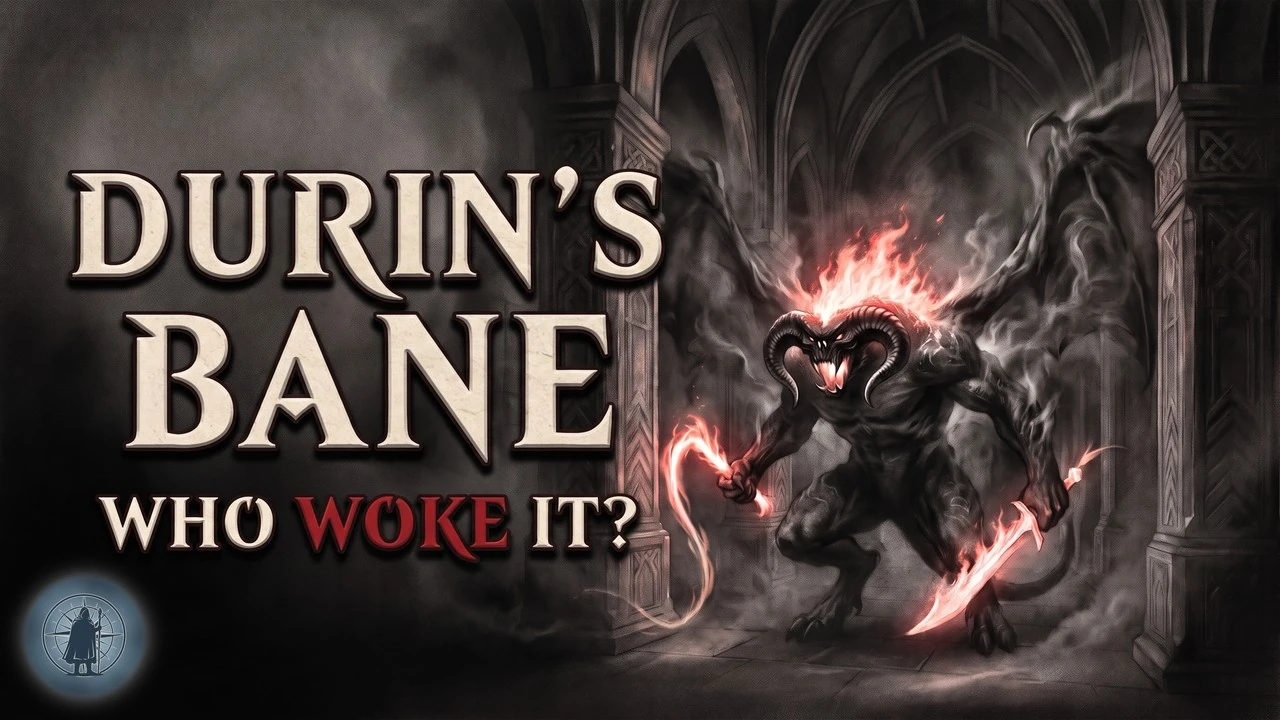 Watch the episode
Durin's Bane: The Balrog That Slept Through the War | LOTR Explained
Research Notes: Durin's Bane — The Balrog That Slept Through the War
Sufficiency verdict (read first): The topic sustains the 29–36 min band. There are 8 discrete themes below, each with 3+ hard specifics. The primary material is spread across LotR (II.4–II.7, III.5, Appendices A and B), The Silmarillion (Valaquenta, ch. 9, ch. 24), Letters 144 / 210 / 181 / 246, Unfinished Tales (Galadriel & Celeborn), and the HoME drafts (Morgoth's Ring, *The Treason of Isengard*). The weak spot is the pitch's closing question (could it have taken the Ring?): Tolkien never addresses it, so that section must be built from what he says about who can wield the Ring and what Balrogs are, plainly labelled as inference.
Quote-confidence key (for the fact-checker): - (V) = verified this pass against retrieved full text (LotR passages from Marquette's Anduin text for II.3, II.6, II.7, III.5; Bridge lines from Wikipedia's cited quotations). - (S) = quoted in two or more independent secondary sources; not checked against the printed page. - (M) = standard text from the researcher's reading; wording should be checked before narration.
CORRECTIONS TO THE PITCH (verify-before-writing)
The pitch's claims were treated as hypotheses. Results:
1. "Every other Balrog died when the Valar broke Beleriand." — PARTLY WRONG; do not state it. - The Silmarillion ch. 24 says the opposite of "every other died": "the Balrogs were destroyed, save some few that fled and hid themselves in caverns inaccessible at the roots of the earth" (S). Plural survivors, number unstated. - Tolkien's Letter 144 (to Naomi Mitchison, 25 April 1954) says they "were supposed to have been all destroyed in the overthrow of Thangorodrim … but it is here found (there is usually a hang-over especially of evil from one age to another) that one had escaped" (S). That supports "everyone thought they all died", not "they all died". - Safe phrasing: "Of the few that fled, Durin's Bane is the only one we ever hear of again." Any line like "the last Balrog" or "the only survivor" is a false absolute. - The pitch's "went down instead of west" is fine as imagery (the defeated were not sent west; the Balrog went under). But Tolkien gives no route: Appendix A says only that it was "flying from Thangorodrim" (fleeing, not airborne) and hid "at the foundations of the earth".
2. "Slept." — SUPPORTED, but the text offers a second option. - Appendix A (III, Durin's Folk): the Dwarves "roused from sleep a thing of terror that, flying from Thangorodrim, had lain hidden at the foundations of the earth since the coming of the Host of the West: a Balrog of Morgoth" (S). Attached footnote: "**Or released from prison; it may well be that it had already been awakened by the malice of Sauron.**" (S) - Celeborn: "We long have feared that under Caradhras a terror slept." (V, FotR II.7) - Glóin (FotR II.2): "Too deep we delved there, and woke the nameless fear." (S/M) - So "slept" is Tolkien's own word, but the footnote puts "prison" and "Sauron's malice" on the table. The writer should not present "slept" as the settled answer.
3. TA 1980 and Durin VI — CONFIRMED, with one edition note. - Appendix B, Third Age 1980: "The Witch-king comes to Mordor and there gathers the Nazgûl. A Balrog appears in Moria, and slays Durin VI." (S, quoted on several chronology sites) - 1981: "Náin I slain. The Dwarves flee from Moria. Many of the Silvan Elves of Lórien flee south. Amroth and Nimrodel are lost." (S/M) - Appendix A: "Durin was slain by it, and the year after Náin I, his son" (M). - Edition note: a Tolkien Gateway talk page records some debate over 1980 vs 1981 for Durin VI's death; the 50th-anniversary text has 1980. Use 1980. - The pitch's "Durin VI's miners" is fine. But the text doesn't say the king ordered the deep seam. Appendix A says "the Dwarves delved deep at that time, seeking for mithril" (M). Gandalf blames the whole people: "they delved too greedily and too deep" (M, FotR II.4).
4. **"Never summoned, never seeking … slept beneath Khazad-dûm through Sauron's entire second rise." — "slept through" holds for the Second Age; "never summoned" is unprovable.** - It did lie hidden through all of the Second Age: Sauron's return (c. SA 1000), the forging of the One (c. 1600), the sack of Eregion at Moria's doors (1697), Númenor and the Last Alliance. - But it woke in TA 1980, while Sauron was in Dol Guldur (he had been there since c. TA 1050). It woke in the same year the Witch-king came to Mordor. Appendix A's footnote raises Sauron's malice as a possible cause. "Never summoned" is an argument from silence, and the one footnote on the subject points the other way. Frame it as an open question (see Theme 5).
5. Did the Balrog ever demonstrably respond to Sauron? — NO DIRECT TEXT. Only circumstantial evidence. - For a link: the App. A footnote; the same-year Witch-king entry; App. B c. 2480 "Sauron begins to people Moria with his creatures" (M); Sauron's messenger offering Dáin "the realm of Moria … for ever" (S/M, FotR II.2). In a rejected draft, Celeborn says "I doubt much if this Balrog has lain hid in the Misty Mountains … he was sent by Sauron from Orodruin, the Mountain of Fire" (S, Treason of Isengard). Tolkien dropped that. - Against a link: no text shows it obeying an order; it never leaves Moria in 1,039 years. Legolas ranks it below Sauron: "of all elf-banes the most deadly, save the One who sits in the Dark Tower" (V). Gandalf's own speeches about Sauron's plans never mention it. - Gandalf never comments on a Sauron–Balrog link. His only judgments are "A Balrog … Now I understand" and "This is a foe beyond any of you" (V). Don't attribute a Sauron remark to Gandalf.
6. "…still asleep when the Ring passed a hundred miles overhead." — DOES NOT HOLD AS WRITTEN. Recast it. - Timing is wrong. Déagol found the Ring in TA 2463. Sméagol took it under the Misty Mountains c. 2470 and Bilbo found it in 2941. The Balrog had been awake since 1980, about 480 years before the Ring ever went under the mountains. - "Overhead" is wrong. Gollum's lake lay deep under the mountains near goblin-town (under the High Pass, east of Rivendell), well north of Moria. It was beside the Balrog's world, never above it. Tolkien gives no distance. A rough map estimate puts it on the order of 150–200 miles north of Moria (estimate, not canon). Anchor: Gandalf says Rivendell to Hollin is "Five-and-forty leagues as the crow flies" (V) = 135 miles, and Moria lies south-east of Hollin. - What actually fits the pitch's idea (use these instead): - (a) TA 2 to 1980: the One Ring lay in the Anduin at the Gladden Fields from Isildur's death (TA 2) until Déagol found it (2463). That covers the first ~1,978 years of the Third Age, and the Balrog slept beneath Moria for all of them. Distance from Moria is not given; a rough map reading puts it in the region of 100 miles north-east, across the mountains (estimate, flag it as such). This is the honest version of "a hundred miles away". - (b) SA 1697: Sauron, who had held the One since c. 1600, laid waste to Eregion. His war reached Moria's own doors: the Dwarves of Khazad-dûm struck his rear, withdrew, and the Doors were shut (App. B 1697; UT). The Ring's maker, carrying the Ring, was within a few leagues of the sleeping Balrog. Tolkien never says Sauron wore it that day, but he held it continuously until SA 3441. - (c) 15 January 3019: the Ring passed **directly over the Balrog's deeps and across Durin's Bridge in Frodo's pocket**, and the Balrog was awake. It went for Gandalf. Nothing in the text shows it noticing or seeking the Ring. This is the strongest evidence the episode has on "could it have taken the Ring?"
7. **"Mastery of the Ring requires a will bent on dominion … the Balrog had power without ambition." — INTERPRETATION, not text. Usable if labelled.** - Tolkien on who could wield it: Elrond: "Its strength … is too great for anyone to wield at will, save only those who have already a great power of their own" (M, FotR II.2). Letter 246 (draft, 1963) says Galadriel "conceived of herself as capable of wielding the Ring and supplanting the Dark Lord" and that "Gandalf as Ring-Lord would have been far worse than Sauron" (S). By Tolkien's logic a Maia, which a Balrog is, would have the power. - "Without ambition" is the channel's reading. The texts show the Balrogs defined by **allegiance to Morgoth** ("spirits who first adhered to him … and became most like him in his corruption", Sil. ch. 3; "awaiting ever the return of their Lord", Sil. ch. 9). They are not shown as indifferent. Better: "power bound to a master, not a will of its own" (interpretation).
8. Balrog numbers, nature, wings — notes for accuracy. - Number: a single late marginal note says "There should not be supposed more than say 3 or at most 7 ever existed" (Morgoth's Ring, p. 80, commentary on the Annals of Aman). Every narrative text has many ("a host of Balrogs" still appears in the 1958 Annals). Not settled canon. - Nature: Maiar, spirits older than the World (Valaquenta: "Dreadful among these spirits were the Valaraukar, the scourges of fire that in Middle-earth were called the Balrogs, demons of terror"). - Wings: genuinely ambiguous. In LotR, "the shadow about it reached out like two vast wings" (simile) and then "its wings were spread from wall to wall" (V via Wikipedia). It never flies in any text. Glorfindel's Balrog dies by falling; Durin's Bane falls from the Bridge and dies falling from the peak. - Horns are not in the text. The channel's ram-horn Balrog is a visual house choice (feedback_balrog_ram_horns). Narration must not describe horns as Tolkien's. - It never speaks. Letter 210: "The Balrog never speaks or makes any vocal sound at all. Above all he does not laugh or sneer" (S). Relevant to Rings of Power S3 (see Additional Context).
Overview
Durin's Bane is the Balrog of Moria. It was a Maia corrupted by Melkor before the World was made, and one of the Valaraukar who were Morgoth's captains in the First Age. When the Host of the West broke Thangorodrim, it fled and hid "at the foundations of the earth", under the roots of Caradhras beneath Khazad-dûm. Nothing is heard of it for all 3,441 years of the Second Age, nor for the first 1,980 years of the Third. Then the Dwarves, chasing mithril, "delved too greedily and too deep." It killed King Durin VI (TA 1980) and his son Náin I (1981), drove Durin's Folk into a thousand-year exile, and emptied part of Lórien. It then stayed in Moria for another 1,039 years and did nothing anyone recorded, until the Fellowship crossed Durin's Bridge on 15 January 3019. Gandalf fought it from the bridge to the bottom of the world and up the Endless Stair to the peak of Zirakzigil. On 25 January he threw it down and died himself.
Three things make it more than a monster-of-the-week: - It is a leftover. Tolkien called it a "hang-over" of evil from one age to another (Letter 144). It is a First Age being walking into a Third Age story. - Its motives are a blank. It never speaks (Letter 210), never states a purpose, and never leaves its hall. Tolkien himself left its link to Sauron open in a single footnote. - It was invented mid-draft. In Tolkien's first Moria outline the pursuer was a Black Rider; "a Balrog" was written over "BR" (HoME VII, as reported by secondary sources). The "escape clause" that made its survival possible had been written into the 1937 Quenta Silmarillion just before LotR was begun.
Time-span arithmetic (derived, not stated by Tolkien): - Hidden from the War of Wrath to TA 1980: the whole Second Age (3,441 years) plus 1,980 years ≈ 5,420 years, plus however long before the end of the First Age it fled. Tolkien Gateway's chronology dates the War of Wrath FA 545–587, from HoME's late Tale of Years. The published Silmarillion gives no dates. "More than five thousand years" is safe; "five thousand four hundred" is a derivation. - Awake in Moria: TA 1980 → 3019 = 1,039 years. - Total time in Moria: ≈ 6,460 years.
Primary Sources
The Silmarillion (1977, ed. Christopher Tolkien)
- Valaquenta, "Of the Enemies": "For of the Maiar many were drawn to his splendour in the days of his greatness, and remained in that allegiance down into his darkness; and others he corrupted afterwards to his service with lies and treacherous gifts. Dreadful among these spirits were the Valaraukar, the scourges of fire that in Middle-earth were called the Balrogs, demons of terror." (S) - Two routes into evil: drawn by splendour (early, willing) or corrupted afterwards (lies and gifts). Which route Durin's Bane took is unknown. - Quenta ch. 3 (Utumno; check chapter): "And in Utumno he gathered his demons about him, those spirits who first adhered to him in the days of his splendour, and became most like him in his corruption: their hearts were of fire, but they were cloaked in darkness, and terror went before them; they had whips of flame. Balrogs they were named in Middle-earth in later days." (S) - Ch. 9, "Of the Flight of the Noldor" (Ungoliant): "Far beneath the ruined halls of Angband, in vaults to which the Valar in the haste of their assault had not descended, Balrogs lurked still, awaiting ever the return of their Lord; and now swiftly they arose, and passing over Hithlum they came to Lammoth as a tempest of fire. With their whips of flame they smote asunder the webs of Ungoliant…" (S) - Key precedent: this is the first time Balrogs survive a divine assault by going deep and waiting. Durin's Bane does it a second time, with no Lord left to wait for. - Ch. 18, Dagor Bragollach: "great rivers of flame that ran down swifter than Balrogs from Thangorodrim" (S). Balrogs move on foot here, which matters for the wings debate. - Ch. 24, "Of the Voyage of Eärendil and the War of Wrath": "the Balrogs were destroyed, save some few that fled and hid themselves in caverns inaccessible at the roots of the earth; and the uncounted legions of the Orcs perished like straw in a great fire…" (S; the second clause is M) - Ch. 11, "Of the Sun and Moon" (contrast figure): Arien, the Maia who steers the Sun, is a spirit of fire "whom Melkor had not deceived nor drawn to his service" (M). She is the same kind of being as a Balrog, but stayed loyal. This sets up Gandalf's "flame of Anor" (Anor = the Sun).
The Lord of the Rings
FotR II.3 "The Ring Goes South" (V) - Gandalf: "Five-and-forty leagues as the crow flies we have come" (Rivendell → Hollin; distance anchor). - Gandalf: "under them lies Khazad-dûm, the Dwarrowdelf, that is now called the Black Pit, Moria in the Elvish tongue. Yonder stands Barazinbar, the Redhorn, cruel Caradhras; and beyond him are Silvertine and Cloudyhead: Celebdil the White, and Fanuidhol the Grey, that we call Zirak-zigil and Bundushathûr." (Gimli speaking; V) - Note: Caradhras, the mountain that drove back the Fellowship with snow, is the mountain the Balrog sleeps under (Celeborn, II.7). Celebdil/Zirakzigil is where it dies.
FotR II.4 "A Journey in the Dark" (M; text not retrieved this pass, so check wording) - Gandalf on mithril: "Moria-silver, or true-silver as some have called it: mithril the Elves name it. … The lode led north towards Caradhras, and down to darkness. The Dwarves tell no tale; but even as mithril was the foundation of their wealth, so also it was their destruction: they delved too greedily and too deep, and disturbed that from which they fled, Durin's Bane." - The exact phrase "the Dwarves tell no tale; but even as mithril was the foundation of their wealth…" is confirmed across several earlier channel notes (khazad-dûm, mithril episodes). - Gandalf after the Watcher: "Something has crept, or has been driven out of dark waters under the mountains. There are older and fouler things than Orcs in the deep places of the world." (M) - Gandalf and Aragorn have each been through Moria before and come out alive. Aragorn: "I too once passed the Dimrill Gate…" (M). Gandalf went in searching for Thráin (M). The Balrog did not stir for either. - Book of Mazarbul, last page: "We cannot get out … drums, drums in the deep … they are coming." (M) The book never names the Balrog; Balin's colony (2989–2994) fell to Orcs and the Watcher, as far as the text shows.
FotR II.5 "The Bridge of Khazad-dûm" (V for lines confirmed via Wikipedia/essay quotations; M otherwise) - Gandalf at the Mazarbul door: "Then something came into the chamber — I felt it through the door, and the orcs themselves were afraid and fell silent. It laid hold of the iron ring, and then it perceived me and my spell. What it was I cannot guess, but I have never felt such a challenge. The counter-spell was terrible. It nearly broke me." (S) - The Balrog counters a spell. It is a mind and a will, not a beast. - The Orcs fear it, so it is not simply one of Sauron's troops. - First sight: "What it was could not be seen: it was like a great shadow, in the middle of which was a dark form, of man-shape maybe, yet greater; and a power and terror seemed to be in it and go before it." (V) - "Its streaming mane kindled, and blazed behind it. In its right hand was a blade like a stabbing tongue of fire; in its left it held a whip of many thongs." (S) - Legolas: "Ai! ai! A Balrog! A Balrog is come!" (M) Gimli: "Durin's Bane!" … "letting his axe fall he covered his face." (S) - Gandalf: "A Balrog … Now I understand." … "This is a foe beyond any of you." (V) - "His enemy halted again, facing him, and the shadow about it reached out like two vast wings." Then: "suddenly it drew itself up to a great height, and its wings were spread from wall to wall." (V) - Gandalf: "You cannot pass. … I am a servant of the Secret Fire, wielder of the flame of Anor. You cannot pass. The dark fire will not avail you, flame of Udûn. Go back to the Shadow! You cannot pass." (V) - The fall: "With a terrible cry the Balrog fell forward, and its shadow plunged down and vanished. But even as it fell it swung its whip, and the thongs lashed and curled about the wizard's knees, dragging him to the brink. … 'Fly, you fools!' he cried, and was gone." (M)
FotR II.6 "Lothlórien" (V) - Legolas on the Lay of Nimrodel: "It is long and sad, for it tells how sorrow came upon Lothlórien, Lórien of the Blossom, when the Dwarves awakened evil in the mountains." - Gimli: "But the Dwarves did not make the evil." - Legolas: "I said not so; yet evil came. … Then many of the Elves of Nimrodel's kindred left their dwellings and departed and she was lost far in the South … But neither Nimrodel nor Amroth came ever back." - The Balrog's waking emptied part of an Elf-kingdom without the Balrog ever leaving Moria. Fear alone did it.
FotR II.7 "The Mirror of Galadriel" (V) - Aragorn: "An evil of the Ancient World it seemed, such as I have never seen before. It was both a shadow and a flame, strong and terrible." - Legolas: "It was a Balrog of Morgoth; of all elf-banes the most deadly, save the One who sits in the Dark Tower." - Gimli: "Indeed I saw upon the bridge that which haunts our darkest dreams, I saw Durin's Bane." - Celeborn: "Alas! We long have feared that under Caradhras a terror slept. But had I known that the Dwarves had stirred up this evil in Moria again, I would have forbidden you to pass the northern borders … one would say that at the last Gandalf fell from wisdom into folly, going needlessly into the net of Moria." - Galadriel: "Needless were none of the deeds of Gandalf in life." - "Stirred up this evil in Moria again": the Elves know it from 1980. - "Long have feared … slept": Lórien knew of the sleeper before 1980. (Or Celeborn means since 1980. Ambiguous; don't overclaim.)
TT III.5 "The White Rider" (V; all retrieved verbatim) - Gimli: "Come, Gandalf, tell us how you fared with the Balrog!" - "'Name him not!' said Gandalf, and for a moment it seemed that a cloud of pain passed over his face, and he sat silent, looking old as death. 'Long time I fell,' he said at last … 'Long I fell, and he fell with me. His fire was about me. I was burned. Then we plunged into the deep water and all was dark. Cold it was as the tide of death: almost it froze my heart.'" - Gimli: "Deep is the abyss that is spanned by Durin's Bridge, and none has measured it." - Gandalf: "Yet it has a bottom, beyond light and knowledge. Thither I came at last, to the uttermost foundations of stone. He was with me still. His fire was quenched, but now he was a thing of slime, stronger than a strangling snake." - "We fought far under the living earth, where time is not counted. Ever he clutched me, and ever I hewed him, till at last he fled into dark tunnels. They were not made by Durin's folk, Gimli son of Glóin. Far, far below the deepest delving of the Dwarves, the world is gnawed by nameless things. Even Sauron knows them not. They are older than he. Now I have walked there, but I will bring no report to darken the light of day. In that despair my enemy was my only hope, and I pursued him, clutching at his heel. Thus he brought me back at last to the secret ways of Khazad-dûm: too well he knew them all. Ever up now we went, until we came to the Endless Stair." - "Too well he knew them all" is the only textual evidence of what the Balrog did with its millennia: it learned the place. - "From the lowest dungeon to the highest peak it climbed, ascending in unbroken spiral in many thousand steps, until it issued at last in Durin's Tower carved in the living rock of Zirak-zigil, the pinnacle of the Silvertine." - "Out he sprang, and even as I came behind, he burst into new flame. There was none to see, or perhaps in after ages songs would still be sung of the Battle of the Peak. … Those that looked up from afar thought that the mountain was crowned with storm. Thunder they heard, and lightning, they said, smote upon Celebdil, and leaped back broken into tongues of fire. … I threw down my enemy, and he fell from the high place and broke the mountain-side where he smote it in his ruin. Then darkness took me; and I strayed out of thought and time…" - "Naked I was sent back — for a brief time, until my task is done." - Same chapter, on Sauron's mind (V): "Indeed he is in great fear, not knowing what mighty one may suddenly appear, wielding the Ring, and assailing him with war, seeking to cast him down and take his place. That we should wish to cast him down and have no one in his place is not a thought that occurs to his mind." This is what Sauron expects a "mighty one" to do with the Ring. Use it in Theme 8.
Appendix A, III "Durin's Folk" (S/M) - "The Dwarves delved deep at that time, seeking for mithril, the metal beyond price that was becoming yearly ever harder to win. Thus they roused from sleep* a thing of terror that, flying from Thangorodrim, had lain hidden at the foundations of the earth since the coming of the Host of the West: a Balrog of Morgoth. Durin was slain by it, and the year after Náin I, his son; and then the glory of Moria passed, and its people were destroyed or fled far away." - "roused from sleep … flying from Thangorodrim … a Balrog of Morgoth" is (S), confirmed by several secondary quotations. The opening clause about mithril "becoming yearly ever harder to win" is (M); check it against the print text. - Footnote: "*Or released from prison; it may well be that it had already been awakened by the malice of Sauron." (S) - After Azanulbizar (TA 2799), Dáin Ironfoot: "Only I have looked through the shadow of the Gate. Beyond the shadow it waits for you still: Durin's Bane. The world must change and some other power than ours must come before Durin's Folk walk again in Moria." (M; quoted identically in this channel's khazad-dûm notes) - Dáin's prophecy comes true: the "other power" is Gandalf, 220 years later.
Appendix B, "The Tale of Years" (S/M) - SA c. 1600: Sauron forges the One Ring. 1693: War of the Elves and Sauron begins. 1697: "Eregion laid waste. Death of Celebrimbor. The gates of Moria are shut. Elrond retreats with remnant of the Noldor and founds the refuge of Imladris." (verbatim per the channel's Eregion notes) - TA c. 1050: shadow falls on Greenwood (Dol Guldur). 1974–75: fall of Arnor; Battle of Fornost; Witch-king vanishes from the North. - **TA 1980: "The Witch-king comes to Mordor and there gathers the Nazgûl. A Balrog appears in Moria, and slays Durin VI."** - TA 1981: Náin I slain; Dwarves flee Moria; Silvan Elves of Lórien flee south; Amroth and Nimrodel lost. - TA 1999: Thráin I comes to Erebor and founds the Kingdom under the Mountain. Exile becomes a new kingdom 18 years after the flight. - TA 2000–2002: Nazgûl besiege and take Minas Ithil. - TA 2463: Déagol finds the One Ring; murdered by Sméagol. c. 2470: Sméagol hides in the Misty Mountains. - TA c. 2480: "Orcs begin to make secret strongholds in the Misty Mountains so as to bar all the passes into Eriador. Sauron begins to people Moria with his creatures." (M) - TA 2790: Thrór enters Moria and is slain by Azog. 2793–2799: War of the Dwarves and Orcs; 2799 Battle of Azanulbizar (Nanduhirion). - TA 2941: Bilbo finds the Ring under the Misty Mountains. - TA 2989: Balin enters Moria. 2994: Balin perishes; the colony is destroyed. - TA 3019: 13 Jan, Company reaches Moria; 14 Jan, night in Hall Twenty-one; **15 Jan, the Bridge of Khazad-dûm and the fall of Gandalf** (the Mazarbul fight is the same day as the Bridge; an earlier channel episode got this wrong). 23 Jan: Gandalf pursues the Balrog to the peak of Zirakzigil. 25 Jan: he casts down the Balrog and passes away. 14 Feb: Gandalf returns to life and lies in trance. 17 Feb: Gwaihir bears him to Lórien. (M; 23/25 Jan per channel's earlier verified notes)
Appendix A, Durin's line (family tree; check against print) (M) - Durin VI 1731–1980; Náin I 1832–1981; Thráin I 1934–2190. - On these dates Durin VI was ~249 when killed and Náin I ~149 (derived).
The Hobbit (1937)
- Moria appears only as goblin-mines: Gandalf tells Thorin "Your grandfather Thror was killed, you remember, in the mines of Moria by Azog the Goblin." (M, ch. 1) - In 1937 there was no Balrog in Moria. The Balrog came out of drafting LotR in 1939–40.Unfinished Tales (1980)
- "The History of Galadriel and Celeborn and of Amroth King of Lórien": in SA 1697 the Dwarves of Khazad-dûm (under Durin III) and Elves of Lórinand (under Amroth) struck Sauron's rear. Sauron turned and beat them, and they withdrew into Moria; the Doors were shut (paraphrase per channel's Eregion notes; S). - Same chapter: the Amroth & Nimrodel tale. The Balrog's waking drives Nimrodel to flee south; Amroth is lost at sea off Edhellond waiting for her (S). Tolkien Gateway has the departure linked to TA 1981. Secondary sources disagree on 1980 vs 1981, so use App. B's 1981 entry.The History of Middle-earth
- HoME V, The Lost Road (QS 1937), "Conclusion": "The Balrogs were destroyed, save some few that fled and hid themselves in caverns inaccessible at the roots of the earth." (S) The escape clause is already there in 1937, before LotR was begun (Dec 1937). One secondary source says earlier draftings had all Balrogs destroyed. That is unconfirmed; flag it if used. - HoME VII, The Treason of Isengard (1989), "The Mines of Moria" (S, via a draft-tracing essay and the channel's Narya notes): - First outline: "They are pursued by goblins and a BR [Black Rider]"; Tolkien wrote "a Balrog" over "BR." - First Bridge draft (p. 198 per Narya notes): "'You cannot pass,' he said. 'Go back [struck out: *into the fiery depths. It is forbidden for any Balrog to come beneath the sky since Fionwe son of Manwe overthrew Thangorodrim*]. I am the master of the White Fire. The red flame cannot come this way.'" - A Valar edict briefly existed confining Balrogs underground. That is an in-world reason the Balrog stayed down, and Tolkien deleted it at once. - Later fair copy: "I am the master of White Flame … The Red Fire cannot come this way. Go back to the Shadow!" The published "Secret Fire / flame of Anor / flame of Udûn" wording does not appear in Treason of Isengard. - The first full draft made the Balrog more man-like; Tolkien noted it should be made less clear. "the shadow about him reached out like great wings" first appears in draft C. - Lothlórien drafts. Celeborn: "I doubt much if this Balrog has lain hid in the Misty Mountains … he was sent by Sauron from Orodruin, the Mountain of Fire." Galadriel: "None know what may lie hid at the roots of the ancient hills." Later: "we believe that it was a Balrog that they aroused long ago when they probed too deep beneath the mountains", and "Not since the Days of Flight have I heard that one of those fell things was loose." - Tolkien drafted the "Sauron sent it" theory and then rejected it. That is the single best piece of evidence for Theme 5. - Tolkien briefly toyed with the bridge foe being Saruman (secondary report); no effect on the final text. - HoME X, Morgoth's Ring (1993): the marginal note on Balrog numbers ("say 3 or at most 7", p. 80). The 1958 Annals of Aman text still gives "a host of Balrogs". Christopher Tolkien says early Balrogs were "less terrible and certainly more destructible." - HoME XII, The Peoples of Middle-earth (1996), "The Making of Appendix A": Durin VII leads the Dwarves back to Khazad-dûm in the Fourth Age, where they dwell "until the world grew old and the Dwarves failed and the days of Durin's race were ended." The Balrog's death is what makes the return possible.Letters of J.R.R. Tolkien
- Letter 144 (to Naomi Mitchison, 25 April 1954) (S, two independent quotations agree): "The Balrog is a survivor from the Silmarillion and the legends of the First Age. So is Shelob. The Balrogs, of whom the whips were the chief weapons, were primeval spirits of destroying fire, chief servants of the primeval Dark Power of the First Age. They were supposed to have been all destroyed in the overthrow of Thangorodrim, his fortress in the North. But it is here found (there is usually a hang-over especially of evil from one age to another) that one had escaped and taken refuge under the mountains of Hithaeglin (the Misty Mountains). It is observable that only the Elf knows what the thing is — and doubtless Gandalf." - "Only the Elf knows what the thing is": Gimli has only a Dwarf-name for it ("Durin's Bane"). Legolas names its kind. Gandalf recognizes it only on sight at the bridge. - Letter 210 (1958, commentary on the Zimmerman film treatment): "The Balrog never speaks or makes any vocal sound at all. Above all he does not laugh or sneer…" (S) - Letter 181 (draft, 1956): "Thus Gandalf faced and suffered death; and came back or was sent back, as he says, with enhanced power." (S) - Letter 246 (draft to Eileen Elgar, Sept 1963; the sent version differs): Galadriel "conceived of herself as capable of wielding the Ring and supplanting the Dark Lord"; "Gandalf as Ring-Lord would have been far worse than Sauron. He would have remained 'righteous', but self-righteous." (S; check wording against Letters)Timeline (in-world)
| Date | Event | Source | |---|---|---| | Before Arda | Maiar drawn to Melkor's splendour or corrupted later; the Valaraukar among them | Valaquenta | | Years of the Trees | Balrogs in Utumno; after Utumno falls, Balrogs survive hidden in Angband's deep vaults | Sil. ch. 3, ch. 9 | | End of Years of Trees | Balrogs rise from the vaults to save Morgoth from Ungoliant | Sil. ch. 9 | | FA 1–510 | Balrogs at Fëanor's death, the Nirnaeth (Fingon), the Fall of Gondolin (Gothmog, Glorfindel's foe) | Sil. | | FA c. 545–587 | War of Wrath; Thangorodrim broken; Balrogs destroyed "save some few that fled and hid" | Sil. ch. 24; dates via HoME XI chronology (flag) | | Same | Durin's Bane flees ("flying from Thangorodrim") and hides "at the foundations of the earth" under Caradhras | App. A; FotR II.7 | | SA c. 1000 | Sauron re-emerges, builds Barad-dûr | App. B | | SA c. 1600 | One Ring forged | App. B | | SA 1697 | Eregion destroyed at Moria's doorstep; Dwarves sally, then the gates of Moria shut | App. B; UT | | SA 3434–3441 | Last Alliance; Sauron overthrown; Isildur takes the Ring | App. B | | TA 2 | Isildur killed at the Gladden Fields; Ring lost in the Anduin | App. B | | TA c. 1050 | Sauron (as the Necromancer) in Dol Guldur | App. B | | TA 1975 | Witch-king defeated at Fornost, flees | App. B | | TA 1980 | Witch-king comes to Mordor; Balrog appears in Moria; Durin VI slain | App. B | | TA 1981 | Náin I slain; Dwarves flee; Lórien exodus; Amroth & Nimrodel lost | App. B; FotR II.6; UT | | TA 1999 | Thráin I founds Erebor | App. B | | TA 2063–2460 | Watchful Peace (Sauron withdraws from Dol Guldur) | App. B | | TA 2463 | Ring found by Déagol; c. 2470 Sméagol goes under the Misty Mountains | App. B | | TA c. 2480 | Sauron begins to people Moria with his creatures | App. B | | TA 2790 | Thrór slain by Azog in Moria | App. A | | TA 2799 | Battle of Azanulbizar; Dáin feels the Balrog through the Gate | App. A | | TA 2941 | Bilbo finds the Ring (north of Moria, under the High Pass region) | Hobbit; App. B | | TA 2989–2994 | Balin's colony; destroyed | App. B; FotR II.5 | | TA 3018 | Sauron's messenger offers Dáin Moria "for ever" | FotR II.2 | | TA 3019, 15 Jan | Mazarbul and the Bridge; Gandalf falls with the Balrog | App. B; FotR II.5 | | 15–23 Jan | Fall, the water, the foundations of stone, the nameless things, the Endless Stair | TT III.5 | | 23–25 Jan | Battle of the Peak on Zirakzigil; Balrog cast down; Gandalf dies | App. B; TT III.5 | | Fourth Age | Durin VII leads Durin's Folk back to Khazad-dûm | HoME XII |
Hard spans (derived): - Hidden ≈ 5,420+ years. - Awake ≈ 1,039 years. - Orcs and Balrog cohabit Moria c. 2480–3019 ≈ 540 years. - The Ring lay at the Gladden Fields 2,461 years (TA 2–2463); 1,978 of them overlap the Balrog's sleep. - Durin's Folk in exile from Moria: TA 1981 → at least the Fourth Age (more than 1,000 years). - Gandalf pursues the Balrog 8 days (15→23 Jan); the peak fight runs 23→25 Jan.
Key Characters
- Durin's Bane. - A Balrog (Valarauko), Maia of fire, "a Balrog of Morgoth" (App. A; Legolas). - Nameless: "Durin's Bane" is a Dwarvish epithet, meaning Durin's slayer (OE bana, "slayer"). - Never speaks (Letter 210). Wields whip and flaming sword. Counters Gandalf's shutting-spell. - Feared by Orcs. Knows the secret ways of Khazad-dûm "too well" (TT III.5). - Dies on Zirakzigil, TA 3019. - Durin VI. - King of Khazad-dûm (b. 1731). Killed TA 1980; his death gives the Balrog its name. - The "Durin" of "Durin's Bane" is Durin VI, not Durin the Deathless (I). - The six Durins are believed by the Dwarves to be returns of the first Durin (App. A). "Durin's Bane" therefore resonates as the bane of the line itself. That last point is interpretation. - Náin I. Son of Durin VI (b. 1832). Holds out a year; slain TA 1981. - Thráin I. Son of Náin I. Leads the exiles; founds Erebor 1999. - Dáin II Ironfoot. Kills Azog at Azanulbizar (2799). Looks into Moria and refuses to enter: "Beyond the shadow it waits for you still." - Balin. Recolonizes 2989; killed 2994 (by Orcs, per the Book of Mazarbul; no Balrog role stated). - Gandalf (Olórin). - Maia, Istar; bearer of Narya, the Ring of Fire (from c. TA 1000). - The Balrog's peer in kind. Confronts it 15 Jan 3019; casts it down 25 Jan; dies; is sent back. - Amroth & Nimrodel. Lórien elves whose tragedy is a side-effect of the waking (TA 1981). - Sauron. - The absent question mark. In Dol Guldur when the Balrog wakes. - Peoples Moria with Orcs from c. 2480. Offers Moria to Dáin in 3018. - No text shows him commanding it. - Legolas, Gimli, Aragorn, Celeborn, Galadriel. The witnesses who name it: "Balrog of Morgoth" / "Durin's Bane" / "shadow and a flame" / "a terror slept". - Gothmog (contrast). Lord of Balrogs, slain by Ecthelion at Gondolin. Shows what Balrogs were for in the First Age: captains of armies. Durin's Bane commands nothing.
Geography
- Khazad-dûm / Moria / Dwarrowdelf. Under the three Mountains of Moria: Caradhras/Barazinbar (Redhorn), Celebdil/Zirakzigil (Silvertine), Fanuidhol/Bundushathûr (Cloudyhead). - Founded by Durin I; renamed "Moria", the Black Pit, after the Balrog. - The Balrog's lair. "Under Caradhras" (Celeborn). The mithril "lode led north towards Caradhras, and down to darkness" (Gandalf, M). So it lay under the Redhorn, the same mountain that turned back the Fellowship's pass attempt. - Below Moria. Tunnels "not made by Durin's folk"; the "uttermost foundations of stone"; the nameless things that "Even Sauron knows … not." - Durin's Bridge. A single stone arch, without kerb or rail, over a chasm "none has measured" (Gimli, V). - The Endless Stair → Durin's Tower → Zirakzigil peak. "Many thousand steps." The tower is "crumbled into dust" after the battle (V). - The Gladden Fields. On the Anduin east of the mountains. The Ring lay in the river TA 2–2463. Rough map estimate: on the order of 100 miles from Moria (not canon). - Gollum's lake / goblin-town. Under the Misty Mountains near the High Pass, east of Rivendell and well north of Moria. Rough estimate: 150–200 miles (not canon). - Eregion / Hollin. West of Moria's West-gate. Destroyed SA 1697; the highroad from Ost-in-Edhil ran to Moria's West-gate (UT). - Lothlórien. East of Moria down the Silverlode. Lost many Silvan Elves in 1981 to fear of the Balrog. - Azanulbizar / Dimrill Dale / Kheled-zâram. Before the East-gate: Dáin's battle (2799); the Fellowship's exit (3019). - Distances Tolkien does give: - "Five-and-forty leagues as the crow flies" (Rivendell → Hollin) (V). - Gimli's "three hundred leagues" for the North (V, rhetorical). - A Moria traverse of roughly forty miles West-gate to East-gate (M; check II.4 wording).
Themes and Symbolism
- Evil as hang-over. Tolkien's own phrase (Letter 144): "there is usually a hang-over especially of evil from one age to another." - Parallel survivals: Shelob (named in the same letter), the Watcher in the Water, the nameless things, Old Man Willow. - Moria is where the First Age leaks into the Third. - Greed digs its own pit. Gandalf's "too greedily and too deep." Jane Chance reads the Balrog as the monstrous projection of Dwarvish avarice. - Gimli's protest: "the Dwarves did not make the evil." - Legolas: "I said not so; yet evil came." Agency and consequence are kept separate. - Shadow and flame. Fire inside, darkness outside ("their hearts were of fire, but they were cloaked in darkness"). Aragorn: "both a shadow and a flame." Evil as privation wrapped around stolen creative fire. - Fire that stayed vs. fire that went. Gandalf ("servant of the Secret Fire, wielder of the flame of Anor") against the "flame of Udûn." - Clyde Kilby reported that Tolkien identified the Secret Fire with the Holy Spirit (*Tolkien and The Silmarillion*, 1976; S). - The drafts' "master of the White Fire" became "servant" in print: from self-assertion to service. - Waiting without a master. The Balrogs once "lurked still, awaiting ever the return of their Lord" (Sil. ch. 9). Durin's Bane does the same thing after its Lord is cast into the Void. It is loyalty with no object, and stillness that looks like sleep. - Death and return. Gandalf's descent to "the uttermost foundations" and ascent to the peak reads as a harrowing and a resurrection ("Naked I was sent back"). - Barrs and Chance see the change from Grey to White as a transfiguration. - Providence by reluctance. Gandalf did not want Moria. Aragorn warned "beware". Celeborn calls it folly; Galadriel answers "Needless were none of the deeds of Gandalf in life."
Scholarly Perspectives
- Tom Shippey (The Road to Middle-earth): Tolkien's philological essay "Sigelwara Land" (Medium Ævum, 1932/1934), on the OE Sigelhearwan (fire + soot-black), "helped to naturalise the Balrog". The demon of fire and blackness came out of a word-puzzle. - Joe Abbott, "Tolkien's Monsters … (Part 1): The Balrog of Khazad-dûm" (Mythlore 16.1, 1989): - Surt's "sviga lævi" (Norse fire-giant whose flame ends the world) is "a short step" from the flaming whip. - Compares Aragorn's "both a shadow and a flame" to Grendel. - The Bridge also echoes Surt and the breaking of Bifröst (interpretive tradition). - Alexander M. Bruce, "Maldon and Moria" (Mythlore 26.1, 2007): - Gandalf's stand may "correct the behavior of the self-serving Byrhtnoth through the actions of the self-less Gandalf." - Byrhtnoth, from pride (ofermod), let the Vikings cross the causeway. Gandalf's whole speech is "You cannot pass." - Jane Chance (Tolkien's Art, 1979): Moria's two falls (Durin's folk 1980, Balin's 2994) are "brought about through avarice", "their internal vice", which the Balrog "monstrously projects." - Gandalf's death and return is a transfiguration. - Clive Tolley (2014): the bridge contest is closer to medieval vision literature (*St Patrick's Purgatory*, Dante) than to shamanic duels. - Dimitra Fimi ("Filming Folklore", Picturing Tolkien, 2011): - Jackson's winged Balrog (after John Howe) expresses its "satanic, demonic nature." - Earlier artists such as Ted Nasmith drew it without wings. The films made wings standard. - The "Truth About Balrogs" tradition (tolkien.slimy.com, fan scholarship): the "at most seven" figure is "a widely accepted point of Tolkien lore which is contradicted by every extant narrative writing on the subject." (Quoted in this channel's Balrog-number notes.) - Fan/encyclopedic inference (label as such): - Encyclopedia of Arda reads the c. 2480 Orc occupation as happening "apparently with the Balrog's acquiescence", and reads Sauron's offer of Moria to Dáin as suggesting the Balrog served him. - The 1995 net FAQ (Bouvin) argues the opposite: Sauron, ringless in the Third Age, could not have commanded a Maia, and the Balrog simply acted from "common evil". - Both are inference.
Contradictions and Variants
1. All destroyed vs. some few fled. - Letter 144: "supposed to have been all destroyed". - Sil. ch. 24 / QS 1937: "save some few that fled and hid". - Possibly earlier drafts: all destroyed (unconfirmed). 2. Sleep vs. prison vs. Sauron. - App. A main text: "roused from sleep". - App. A footnote: "Or released from prison; it may well be that it had already been awakened by the malice of Sauron." - Drafts (TI): "sent by Sauron from Orodruin" (rejected). 3. Where it came from. The final text has it hiding since the War of Wrath. The draft Celeborn doubts that, then a later draft Celeborn accepts it ("aroused long ago"). 4. Numbers. "At most 7" (late marginal note) vs. "a host" in every narrative (Morgoth's Ring p. 80). 5. Wings. "Like two vast wings" (simile) vs. "its wings were spread from wall to wall." The draft C line was "like great wings." App. A's "flying from Thangorodrim" uses "flying" as "fleeing." 6. Gandalf's words. Drafts: "master of the White Fire … The red flame cannot come this way"; struck edict "forbidden for any Balrog to come beneath the sky". Published: "servant of the Secret Fire." 7. Durin VI's death year. 1980 (50th-anniv. App. B) vs. reported 1981 readings (TG talk page). 8. Pursuer in the first outline. A Black Rider, overwritten "a Balrog". 9. Adaptations. - The Rings of Power S1 (2022) shows a Balrog under Khazad-dûm in the Second Age, stirred by mining. That contradicts App. A/B, where it lies hidden until TA 1980. - S3 (announced SDCC, July 2026) is reported to give the Balrog a voice (Simon Pegg; per Gizmodo/Wikipedia). Tolkien: "The Balrog never speaks or makes any vocal sound at all." - News claim; re-verify before narrating.
Linguistic Notes
- Balrog. Sindarin bal "power" + raug/rog "demon": "Demon of Might." - Quenya Valarauko, pl. Valaraukar (Valaquenta). - Earlier etymologies: Noldorin balch "cruel" + rhaug; Quenya Malarauko. Earliest: "an Orc-word." - Durin's Bane. OE bana "slayer, murderer" (cf. Beowulf). The Dwarves name it by its victim, not its nature. Gimli never uses "Balrog." - Udûn. Sindarin for Utumno, Melkor's first fortress, where the Balrogs were gathered. "Flame of Udûn" means "fire from Utumno." The same name is used for the vale inside Mordor's Black Gate. - Anor. Sindarin "Sun." "Flame of Anor" ties to Arien, a fire-Maia who refused Melkor. - Some commentators read it as an allusion to Narya. Interpretive; Tolkien never glosses it. - Secret Fire / Flame Imperishable. The creative power of Ilúvatar (Ainulindalë). - Khazad-dûm. Khuzdul "Mansion of the Khazâd"; English "Dwarrowdelf." - Moria = "Black Pit/Chasm" (Sindarin mor "dark" + ia "void"). - It is an Elvish name of fear, coined after the Balrog. Scholars note the anachronism on the West Door inscription. - Zirakzigil (Khuzdul) = Silvertine = Celebdil. Barazinbar = Redhorn = Caradhras. - Hithaeglir (Misty Mountains). Letter 144 prints "Hithaeglin", an earlier form. - Mithril. Sindarin "grey-glitter"; "Moria-silver, or true-silver."
Additional Context
- Composition history. - Moria and the Bridge were drafted c. 1939–40. - The 1937 Hobbit has only goblins in Moria. - The 1937 Quenta Silmarillion escape clause ("save some few") predates LotR's Balrog. - The Balrog grows in power as Tolkien writes. Christopher Tolkien says early Balrogs were "less terrible and certainly more destructible." - Same-year coincidence (1980). The Witch-king, beaten at Fornost in 1975, arrives in Mordor in 1980 and gathers the Nine. In the same Tale-of-Years entry, the Balrog wakes. Twenty-two years later Minas Ithil falls (2002). Tolkien juxtaposes them but never links them causally. - The Balrog's reach without moving. Its waking emptied Moria, weakened Lórien, drove the Dwarves to Erebor (and so, in time, to Smaug and to The Hobbit). It did all that without leaving its mountain. - Chain from Erebor to The Hobbit is interpretive: Erebor founded 1999; Smaug attacks 2770; Thrór's return to Moria 2790. - Current relevance. Rings of Power S3's talking Balrog (2026 announcement) makes Letter 210 a timely hook: Tolkien insisted on its silence.
Questions for Further Research
1. Exact print wording of App. A's mithril sentence ("the metal beyond price that was becoming yearly ever harder to win"). Not verified this pass. 2. App. B 3019 entries for 23/25 Jan and 14/17 Feb. Taken from the channel's prior verified notes; recheck against print. 3. Did the Dwarves of Moria fight in the Last Alliance (Wikipedia cites Silmarillion "Of the Rings of Power")? Not needed unless the writer uses SA 3434. 4. Did earlier Quenta drafts (HoME IV) have all Balrogs destroyed? Reported, not confirmed. 5. Exact Council of Elrond wording of the messenger's offer and Glóin's "woke the nameless fear." Chapter II.2 was not retrievable this pass. 6. No text says what the Balrog did between 1981 and 3019. "Too well he knew them all" is the only clue. 7. Was Durin's Bane among the Balrogs who rose against Ungoliant, or at Gondolin? Unknowable; don't speculate as fact.
Discrete Analytical Themes
Theme 1: The Escape Clause — How One Balrog Survived the End of an Age
Core idea: Tolkien's texts never let all the Balrogs die. A survival loophole written in 1937, before LotR existed, became the door Durin's Bane walked through. Evidence: - "the Balrogs were destroyed, save some few that fled and hid themselves in caverns inaccessible at the roots of the earth" (Sil. ch. 24; already in QS 1937, HoME V). - Letter 144 (25 Apr 1954): "They were supposed to have been all destroyed … But it is here found (there is usually a hang-over especially of evil from one age to another) that one had escaped and taken refuge under the mountains of Hithaeglin." - App. A: "flying from Thangorodrim, had lain hidden at the foundations of the earth since the coming of the Host of the West." "Flying" means fleeing; there is no route and no date. - HoME VII: the first Moria outline had a Black Rider as the pursuer; "a Balrog" was written over "BR." - Correction to carry: "some few" fled, so this was not the "last Balrog". It is the only one we meet again. Distinction: This theme is about the WAR OF WRATH SURVIVAL and its textual origin: the loophole and the authorial decision. It is not about what the creature is (Theme 2) or how it lay dormant (Theme 3).Theme 2: What Durin's Bane Actually Was — A Maia With No Voice
Core idea: The Balrog is a fallen spirit of the same order as Gandalf, made of fire wrapped in shadow. It is a mind that counters spells but never once speaks. Evidence: - Valaquenta: "Dreadful among these spirits were the Valaraukar, the scourges of fire that in Middle-earth were called the Balrogs, demons of terror." Some Maiar were "drawn to his splendour", others "corrupted afterwards … with lies and treacherous gifts." - "their hearts were of fire, but they were cloaked in darkness, and terror went before them; they had whips of flame" (Sil.). Aragorn: "both a shadow and a flame, strong and terrible" (V). - At Mazarbul it "perceived me and my spell … The counter-spell was terrible. It nearly broke me." The Orcs "were afraid and fell silent." - Letter 210: "The Balrog never speaks or makes any vocal sound at all. Above all he does not laugh or sneer." - Form: "of man-shape maybe, yet greater"; wings simile vs. "its wings were spread from wall to wall"; never flies; it falls twice (Bridge, then peak) and the second fall kills it. - Numbers context: "say 3 or at most 7" (Morgoth's Ring p. 80) vs. "a host" in every narrative. - Letter 144: "only the Elf knows what the thing is". Gimli has only the name "Durin's Bane." Distinction: This theme covers NATURE AND FORM: ontology, appearance, silence. It does not cover its history (Themes 1, 3, 4) or its loyalties (Theme 5).Theme 3: Asleep, Imprisoned, or Waiting? The Five-Thousand-Year Silence
Core idea: Tolkien gives three competing accounts of the dormancy. One is sleep, one is prison, and one is Sauron's malice. A First-Age precedent suggests a fourth: Balrogs go deep and wait. Evidence: - App. A: "roused from sleep a thing of terror." Footnote: "Or released from prison; it may well be that it had already been awakened by the malice of Sauron." - Celeborn: "We long have feared that under Caradhras a terror slept" (V). Glóin: "woke the nameless fear." - Precedent: after the Valar's first assault, "Balrogs lurked still, awaiting ever the return of their Lord" in vaults the Valar never reached (Sil. ch. 9). - Struck draft edict: "It is forbidden for any Balrog to come beneath the sky since Fionwe son of Manwe overthrew Thangorodrim" (HoME VII p. 198). This was a "prison" by decree, which Tolkien deleted. - Span: all 3,441 years of the Second Age plus 1,980 of the Third, ≈ 5,420 years (derived). - It slept through the forging of the One (c. SA 1600) and the sack of Eregion at Moria's own doors (SA 1697, "The gates of Moria are shut"). Distinction: This theme is about the NATURE OF THE DORMANCY: what "sleep" means and the competing explanations. Theme 1 covers the escape; Theme 4 covers the waking event.Theme 4: TA 1980 — Mithril, Durin VI and the Fall of the Dwarrowdelf
Core idea: The waking is a precise historical catastrophe. Mithril-hunger drives a mine too deep; two kings die in two years; an Elf-realm bleeds; a people goes into exile for a millennium. Evidence: - Gandalf: "The lode led north towards Caradhras, and down to darkness … even as mithril was the foundation of their wealth, so also it was their destruction: they delved too greedily and too deep, and disturbed that from which they fled, Durin's Bane." - App. B 1980: "A Balrog appears in Moria, and slays Durin VI." - 1981: "Náin I slain. The Dwarves flee from Moria. Many of the Silvan Elves of Lórien flee south. Amroth and Nimrodel are lost." Durin VI 1731–1980; Náin I 1832–1981 (App. A tree). - Legolas: "sorrow came upon Lothlórien … when the Dwarves awakened evil in the mountains." Gimli: "But the Dwarves did not make the evil." Legolas: "I said not so; yet evil came" (V). - 1999: Thráin I founds Erebor. Khazad-dûm becomes "Moria", the Black Pit. - Jane Chance: avarice as "their internal vice", which the Balrog "monstrously projects." Distinction: This theme is the EVENT AND ITS HUMAN COST (Dwarves and Elves) in 1980–81. It is not about why it slept (Theme 3) or whether Sauron caused it (Theme 5).Theme 5: Sauron's Shadow on the Deep — Did the Balrog Ever Answer Him?
Core idea: Tolkien plants circumstantial links between the Balrog and Sauron, and once drafted outright that Sauron sent it. He then deleted that and never wrote an act of obedience. Evidence: - App. A footnote: "it may well be that it had already been awakened by the malice of Sauron." Sauron had been in Dol Guldur since c. TA 1050. - Same Tale-of-Years entry, TA 1980: "The Witch-king comes to Mordor and there gathers the Nazgûl. A Balrog appears in Moria…" - c. TA 2480: "Sauron begins to people Moria with his creatures." Orcs and Balrog then share Moria for about 540 years. - 3018: Sauron's messenger offers Dáin three Dwarf-rings and "the realm of Moria … for ever" (FotR II.2). This is an offer Sauron could only make if he believed Moria was his to give. - Rejected TI draft. Celeborn: "I doubt much if this Balrog has lain hid in the Misty Mountains … he was sent by Sauron from Orodruin, the Mountain of Fire." Later draft: "aroused long ago when they probed too deep." - Against: Legolas: "of all elf-banes the most deadly, save the One who sits in the Dark Tower." It is ranked below Sauron, not as his. No text shows it taking an order. Gandalf never links them. Distinction: This theme is about ALLEGIANCE AND CAUSATION BETWEEN TWO MAIAR. It is not the waking event itself (Theme 4) or the Ring question (Theme 8).Theme 6: A Thousand Years Awake, Doing Nothing — The Balrog as Tenant
Core idea: Once awake, the Balrog never leaves Moria in 1,039 years. It does not hunt, conquer or serve visibly. Its whole footprint is a no-go zone that every power in Middle-earth respects. Evidence: - TA 2790: Thrór walks into Moria and is killed by Azog, not the Balrog. - TA 2799: Dáin at the Gate after Azanulbizar: "Beyond the shadow it waits for you still: Durin's Bane. The world must change and some other power than ours must come before Durin's Folk walk again in Moria." - Gandalf (searching for Thráin) and Aragorn both pass through Moria and come out. Balin's colony (2989–2994) falls to Orcs and the Watcher; the Book of Mazarbul never names the Balrog. - Gandalf, TT III.5: "Thus he brought me back at last to the secret ways of Khazad-dûm: too well he knew them all." That is the only trace of what it did: it learned the place. - Gandalf at the West-gate: "There are older and fouler things than Orcs in the deep places of the world." The Balrog shares the deep with the nameless things that "Even Sauron knows … not." - Contrast: Gothmog, "Lord of Balrogs, high-captain of Angband", led armies and killed High King Fingon. Durin's Bane commands no one. Distinction: This theme is about the BALROG'S BEHAVIOUR WHILE AWAKE (1980–3019): inertia, territory, reputation. It is distinct from dormancy (Theme 3) and from the Sauron question (Theme 5).Theme 7: Peer Against Peer — The Bridge, the Abyss and the Peak
Core idea: The confrontation is two spirits of the same order and two kinds of fire. It runs from a counter-spell through the bottom of the world to a fight of ten days in all (15–25 Jan) ending on a mountain-top. Evidence: - 15 Jan 3019. Gandalf: "A Balrog … Now I understand." / "This is a foe beyond any of you." - "I am a servant of the Secret Fire, wielder of the flame of Anor … The dark fire will not avail you, flame of Udûn. Go back to the Shadow! You cannot pass." The draft read "I am the master of the White Fire. The red flame cannot come this way" (HoME VII). - "Name him not!" … "Long I fell, and he fell with me … His fire was quenched, but now he was a thing of slime, stronger than a strangling snake" (V). - The Endless Stair, "many thousand steps", to Durin's Tower on Zirakzigil. Battle of the Peak 23–25 Jan: "I threw down my enemy, and he fell from the high place and broke the mountain-side where he smote it in his ruin" (V). - Letter 181: "Thus Gandalf faced and suffered death; and came back or was sent back … with enhanced power." - Bruce: Gandalf as the anti-Byrhtnoth (Maldon). Kilby: the Secret Fire = the Holy Spirit. - Dáin's prophecy ("some other power than ours") fulfilled. Durin VII returns in the Fourth Age. Distinction: This theme is THE DEATH OF DURIN'S BANE AND WHAT THE DUEL MEANS. It is the only section about the climax; Theme 2 covers its nature in the abstract.Theme 8: Could It Have Taken the Ring? — Power, Allegiance and a Ring It Ignored
Core idea: Tolkien never answers this. By his own rules about who can wield the Ring, a Maia has the power. But the text shows the Balrog ignoring the Ring, and the Balrogs are defined by service to Morgoth, not by Sauron's kind of ambition. Evidence: - Elrond (FotR II.2): the Ring is "too great for anyone to wield at will, save only those who have already a great power of their own. But for them it holds an even deadlier peril. The very desire of it corrupts the heart" (M). - Letter 246 (draft 1963): Galadriel "conceived of herself as capable of wielding the Ring and supplanting the Dark Lord"; "Gandalf as Ring-Lord would have been far worse than Sauron." Ring mastery is a Maia-tier possibility. - Gandalf on Sauron's mind (TT III.5, V): he fears "what mighty one may suddenly appear, wielding the Ring … seeking to cast him down and take his place." The Ring presupposes a will to replace a master. - Balrogs are "those spirits who first adhered to him … and became most like him in his corruption" and once "lurked still, awaiting ever the return of their Lord." Their defining trait is allegiance (interpretation of these lines). - Ring geography (corrected pitch claim): - (a) SA 1697: Sauron, the Ring's holder, at Moria's doors while the Balrog slept. - (b) TA 2–1980: the Ring lay at the Gladden Fields, roughly ~100 miles away (map estimate), for 1,978 years of the Balrog's sleep. - (c) 15 Jan 3019: the Ring crossed Durin's Bridge in Frodo's keeping. The Balrog was awake and within yards, and pursued Gandalf, not the Ring-bearer. - Analogy only: Bombadil, over whom "the Ring has no power" (Council of Elrond). Power without desire is untouched, but Tolkien never applies this to Balrogs. Distinction: This theme is the COUNTERFACTUAL AND ITS LIMITS: Ring mechanics against Balrog nature. It is the only theme built on inference, and should be narrated as such.Compelling Quotes for Narration (priority order)
1. "Thus they roused from sleep a thing of terror that, flying from Thangorodrim, had lain hidden at the foundations of the earth since the coming of the Host of the West: a Balrog of Morgoth." (App. A) 2. "Or released from prison; it may well be that it had already been awakened by the malice of Sauron." (App. A, footnote) 3. "We long have feared that under Caradhras a terror slept." (Celeborn, FotR II.7) 4. "there is usually a hang-over especially of evil from one age to another" (Letter 144) 5. "they delved too greedily and too deep, and disturbed that from which they fled, Durin's Bane." (Gandalf, FotR II.4) 6. "I said not so; yet evil came." (Legolas, FotR II.6) 7. "Beyond the shadow it waits for you still: Durin's Bane." (Dáin, App. A) 8. "The Balrog never speaks or makes any vocal sound at all." (Letter 210) 9. "You cannot pass … flame of Udûn. Go back to the Shadow!" (FotR II.5) 10. "Name him not!" (Gandalf, TT III.5) 11. "too well he knew them all" (Gandalf, TT III.5) 12. "I threw down my enemy, and he fell from the high place and broke the mountain-side where he smote it in his ruin." (TT III.5)
Visual Elements to Highlight
1. Thangorodrim falling; a single shadow-and-flame shape going down into a fissure while the Host rides in from the west. 2. The dark under Caradhras: a dim ember in black rock, ages passing above. No horns described in narration (house visual only). 3. Dwarf miners following a silver lode downward by lamplight; the rock face splitting onto red light. 4. Silvan Elves leaving Lórien in 1981; Nimrodel on the mountain road; Amroth's empty ship. 5. Dáin at the East-gate in 2799, staring into the shadow. 6. Durin's Bridge: Gandalf small and grey before a shadow that fills the hall. 7. The two falling together into black water; the "thing of slime" in the foundations. 8. Zirakzigil peak in storm, lightning "leaping back broken into tongues of fire." 9. Map beat: Moria, the Gladden Fields and goblin-town, showing how near and how far the Ring came.
Sources: Durin's Bane — The Balrog That Slept Through the War
Confidence tags used in notes.md: (V) verified this pass against retrieved full text; (S) quoted in 2+ independent secondary sources; (M) researcher's reading, check wording.
Primary sources (Tolkien)
| Source | Sections used | How accessed | Usefulness | |---|---|---|---| | The Lord of the Rings, FotR II.3 "The Ring Goes South" | Gandalf's 45 leagues; Mountains of Moria names | Full text via Marquette Anduin passage pages (anduin.marquette.edu/3/s2/03/r/135275–135489) | (V) distance anchor | | FotR II.4 "A Journey in the Dark" | Mithril / "too greedily and too deep"; Watcher; Book of Mazarbul | Not retrievable (Anduin has no passages for II.4–II.5); prior channel notes + memory | (M) high — check wording | | FotR II.5 "The Bridge of Khazad-dûm" | Mazarbul counter-spell; description; "You cannot pass"; wings | Wikipedia (Balrog article) quotations + Bouvin FAQ quotations | (V)/(S) essential | | FotR II.6 "Lothlórien" | Legolas/Gimli on Nimrodel: "when the Dwarves awakened evil in the mountains" | Anduin 3/s2/06/r/135808–135979 | (V) excellent, new to channel | | FotR II.7 "The Mirror of Galadriel" | Aragorn, Legolas, Gimli, Celeborn ("a terror slept"), Galadriel | Anduin 3/s2/07/r/135980–136095 | (V) essential | | TT III.5 "The White Rider" | "Name him not!"; the fall; nameless things; Endless Stair; Battle of the Peak; Sauron's fear of a "mighty one" with the Ring | Anduin 3/s3/05/r/137056–137229 | (V) essential | | RotK Appendix A III "Durin's Folk" | "roused from sleep … flying from Thangorodrim"; footnote "Or released from prison … malice of Sauron"; Dáin's warning; Durin's line dates | Secondary quotations (Tolkien Gateway talk page, thetolkien.forum, Encyclopedia of Arda, "On Balrogs" essay) | (S) essential — print-check recommended | | RotK Appendix B "The Tale of Years" | SA 1600/1697; TA 1980, 1981, 1999, 2463, c. 2480, 2790, 2799, 2989/2994, 3019 Jan | Chronology sites (Tolkien Gateway search snippets, valarguild.org, sbu.edu) + channel's Eregion/Narya notes | (S) | | The Hobbit ch. 1 | Thrór killed in Moria by Azog (no Balrog in 1937) | Memory | (M) | | The Silmarillion — Valaquenta; Quenta ch. 3, 9, 11, 18, 24 | Balrog nature; Ungoliant vaults precedent; "save some few that fled"; Arien contrast | Bouvin FAQ quotations; search confirmations | (S) | | Unfinished Tales, "History of Galadriel and Celeborn and of Amroth" | SA 1697 Dwarvish sally and shut Doors; Amroth & Nimrodel | Channel's Eregion notes; Tolkien Gateway/valarguild summaries | (S) paraphrase only | | HoME V The Lost Road (QS 1937, Conclusion) | Escape clause predates LotR | "On Balrogs" essay; forum quotations | (S) | | HoME VII The Treason of Isengard (1989), Moria and Lórien chapters | Black Rider → Balrog in outline; struck edict "forbidden for any Balrog to come beneath the sky" (p. 198); "master of the White Fire"; Celeborn's rejected "sent by Sauron from Orodruin" | sweatingtomordor blog (quotes drafts); Goodreads TI quote page; channel's Narya notes | (S) high value | | HoME X Morgoth's Ring (1993) | "say 3 or at most 7" (p. 80); "a host of Balrogs" in 1958 Annals; CT "less terrible and certainly more destructible" | Wikipedia citations; channel's Balrog-number notes | (S) | | HoME XII The Peoples of Middle-earth (1996), "The Making of Appendix A" | Durin VII's return | Wikipedia (Moria) citations | (S) | | Letter 144 (to Naomi Mitchison, 25 Apr 1954) | "supposed to have been all destroyed … one had escaped"; "hang-over … of evil"; "only the Elf knows" | Bouvin FAQ + "On Balrogs" essay (agree verbatim) | (S) the single most important quote for the corrections | | Letter 181 (draft, 1956) | Gandalf "faced and suffered death" | Bouvin FAQ | (S) | | Letter 210 (1958, Zimmerman critique) | "The Balrog never speaks or makes any vocal sound at all" | Bouvin FAQ | (S) | | Letter 246 (draft, Sept 1963, to Eileen Elgar) | Galadriel's self-conception as Ring-wielder; "Gandalf as Ring-Lord would have been far worse than Sauron" | Tolkien Gateway search summary; forum/Goodreads/MetaFilter quotations | (S) check wording |
Secondary and scholarly sources
- Wikipedia, "Balrog" — wikitext retrieved via https://en.wikipedia.org/w/index.php?title=Balrog&action=raw. Most useful secondary source: cited LotR quotations; the marginal-note citation (Tolkien 1993 p. 80); scholarship (Shippey, Abbott, Bruce, Fimi, Tolley); Rings of Power S3 talking-Balrog report (Gizmodo, 24 July 2026). - Wikipedia, "Moria, Middle-earth" — https://en.wikipedia.org/wiki/Moria,_Middle-earth (wikitext). Jane Chance avarice reading; Barrs transfiguration; West-door anachronism note; Durin VII. - Bouvin, N. O., "Balrogs" FAQ (1995) — https://cs.au.dk/~bouvin/tolkien/balrogs.html. Verbatim quotations of Letters 144/181/210, Silmarillion and Bridge passages; the 538-year Orc–Balrog cohabitation argument. - "On Balrogs" (essay, Google Doc) — https://docs.google.com/document/d/1OG2rnPX0xMeHEHQAftLaOGrlOcHrMi5jqKHvoJcv1v4/mobilebasic. HoME citations for drafts, numbers and wings; corroborates Letter 144 and App. A wording. - "Let's Stir Some Evil: Tracing the Balrog through Lord of the Rings" (It's a Dangerous Business, Frodo blog, 10 Oct 2014) — https://sweatingtomordor.wordpress.com/2014/10/10/lets-stir-some-evil-tracing-the-balrog-through-lord-of-the-rings/. Quotes the HoME VI–VII drafts (Black Rider → Balrog; edict; Lórien drafts). - Goodreads, The Treason of Isengard quotes — https://www.goodreads.com/work/quotes/2963999 (the "sent by Sauron from Orodruin" draft line). - Encyclopedia of Arda, "Durin's Bane" — https://www.encyclopedia-of-arda.com/d/durinsbane.html (Dol Guldur / App. A footnote reading; "acquiescence" inference — label as inference). - Encyclopedia of Arda, "Terror" — https://arda.glyphweb.com/t/terror.html. - Tolkien Gateway — Durin's Bane, Balrogs, Third Age 1980/1981, Talk:Durin VI, Letter 144, Letter 246 (https://tolkiengateway.net/wiki/...). Blocked by a Cloudflare challenge this pass; used only via search-result snippets. Recommend a direct check of https://tolkiengateway.net/wiki/Durin%27s_Bane by the fact-checker if access is available. - valarguild.org Tolkien Encyclopedia, Third/Second Age timelines — https://valarguild.org/tolkien/encyc/events/timeline/Third_Age.htm. - St. Bonaventure Inklings page, "Tolkien's Third Age" — https://web.sbu.edu/friedsam/inklings/tolkien's_third.htm (paraphrased chronology; low weight). - Marquette University Anduin (Tolkien manuscript database, passage text) — https://anduin.marquette.edu/ (exact LotR text for II.3, II.6, II.7, III.5).
Scholarship cited (via Wikipedia, not read directly)
- Shippey, Tom. The Road to Middle-earth, 3rd ed. (2005) — "Sigelwara Land" naturalising the Balrog. - Abbott, Joe. "Tolkien's Monsters: Concept and Function in The Lord of the Rings (Part 1): The Balrog of Khazad-dûm." Mythlore 16.1 (1989): 19–33. - Bruce, Alexander M. "Maldon and Moria." Mythlore 26.1 (2007). - Chance (Nitzsche), Jane. Tolkien's Art: A Mythology for England (1979/1980), pp. 42, 108–109. - Tolley, Clive. "Old English influence on The Lord of the Rings," in Beowulf and Other Stories (2014), p. 55. - Fimi, Dimitra. "Filming Folklore," in Picturing Tolkien (McFarland, 2011), p. 86. - Barrs, Jerram. Echoes of Eden (Crossway, 2013), p. 123. - Kilby, Clyde S. Tolkien and The Silmarillion (1976) — Secret Fire = Holy Spirit (reported).
Prior channel research reused (cross-checked, not copied blind)
- production/episodes/the-balrog-number-debate/research/notes.md (numbers, marginal note, etymology) - production/episodes/khazad-dum-the-greatest-kingdom-of-the-dwarves/research/notes.md (Dáin quote, Moria timeline) - production/episodes/narya-and-the-spell-of-shutting-what-gandalfs-ring-actually-does/research/notes.md (HoME VII p. 198 Bridge draft text; 3019 dates) - production/episodes/the-war-of-the-elves-and-sauron-how-eregion-fell-and-rivendell-was-born/research/notes.md (App. B 1697 verbatim; UT sally) - production/learning/lore_accuracy_drift.json (prior errors: Mazarbul date; invented distances; "gates shut for three thousand years")