Research & Sources
Cirith Ungol
Shelob's Pass Into Mordor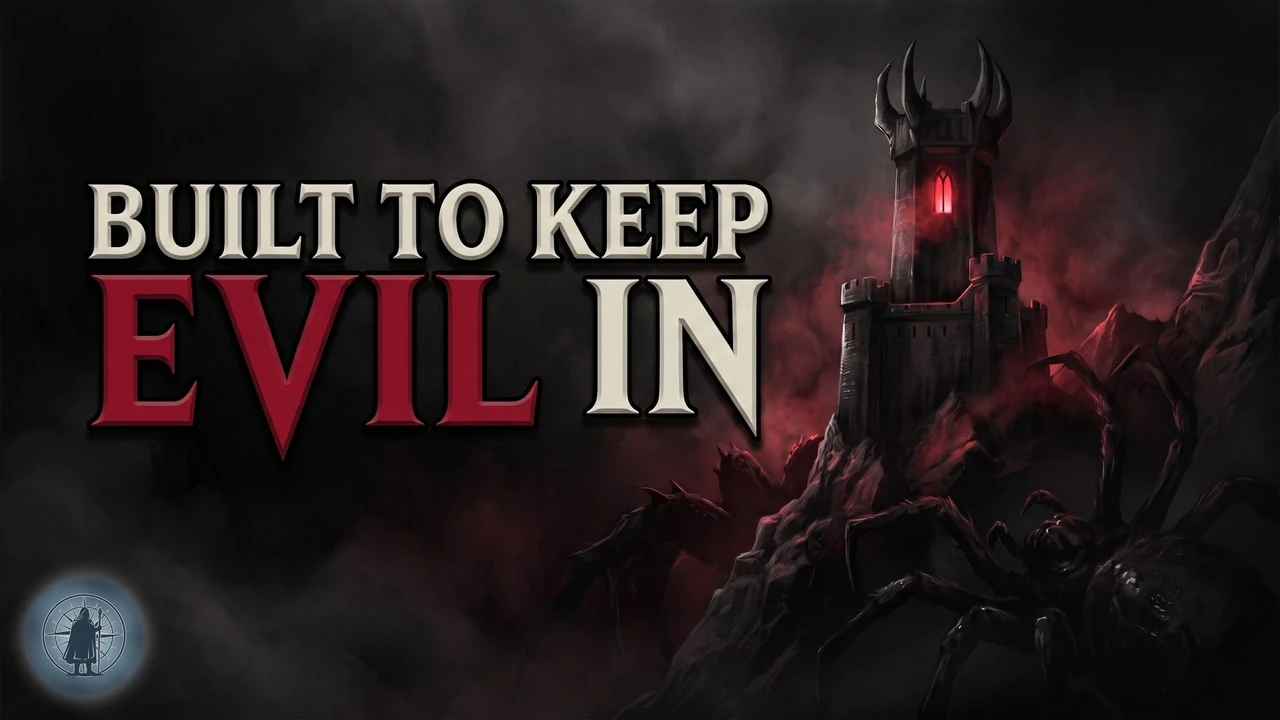 Watch the episode
Cirith Ungol: Shelob's Pass Into Mordor | Tolkien Lore Explained
Watch the episode
Cirith Ungol: Shelob's Pass Into Mordor | Tolkien Lore Explained
Research Notes: Cirith Ungol — The Spider's Pass Into Mordor
Source-confidence note (read first)
This topic is abundantly sourced. Four full chapters of The Lord of the Rings are set on or immediately around this pass — The Two Towers IV.8 "The Stairs of Cirith Ungol", IV.9 "Shelob's Lair", IV.10 "The Choices of Master Samwise", and The Return of the King VI.1 "The Tower of Cirith Ungol" — plus substantial setup in IV.3 "The Black Gate is Closed", IV.6 "The Forbidden Pool" and IV.7 "Journey to the Cross-roads", and the aftermath in VI.2 "The Land of Shadow". The history behind it is dated in Appendix A and Appendix B. There is no shortage of material; the eight themes below are all carried by primary text, not inference.
Three cautions the script must honour:
1. The "48 Uruk-hai and 160 Orcs" garrison figure that circulates online is NOT Tolkien. It comes from Iron Crown Enterprises' 1984 MERP roleplaying module *The Tower of Cirith Ungol and Shelob's Lair. Tolkien's only figures are Sam's estimates*: Shagrat's company "about forty", Gorbag's "more than twice as large". Use those, and say they are Sam's guess. 2. Tolkien never states who re-garrisoned the Tower, or when. Wikis assert the Nazgûl seized it (some even name "Ren" and "Indûr" — those names are from other games/fan sources, not Tolkien). The text says only that it was a work of Gondor that later served Mordor. Treat the "Nazgûl took it in 1980" claim as reasonable inference from Appendix B's dating of the Nazgûl's return, and label it as inference. 3. Shelob's ultimate fate is deliberately unresolved by Tolkien. Do not say Sam killed her.
Overview
Cirith Ungol is the single most consequential piece of terrain in The Lord of the Rings, and almost everything about it is an inversion. It is a mountain pass through the Ephel Dúath, the western wall of Mordor. Gondor cut a fortress into it during the confident centuries after the Last Alliance — and built that fortress facing the wrong way on purpose, because its job was not to stop an army coming in but to stop anything crawling out. Fifteen hundred years later, Gondor's watch had failed, the fortress had changed hands, and the lock Gondor set on Mordor's back door had become the door Sauron's own creatures used, and — in the last irony — the door by which the Ring got in.
Guarding that pass is not a garrison but an appetite: Shelob, the last child of Ungoliant, who was squatting in the mountain before Sauron arrived and who serves nobody. Sauron does not command her. He feeds her. She is a better lock than any gate because she is not loyal to anything and therefore cannot be suborned, bribed, or ordered to stand down.
And the pass is where the story of the Ring almost ends and does not — because two hobbits climb stairs cut by dead Gondorian masons, because an elf-glass holds light that a spider's ancestor drank from a tree seven thousand years earlier, and because a hundred and twenty orcs kill each other over a mail-shirt before Sam Gamgee has to fight any of them.
Primary Sources
The Lord of the Rings — the four Cirith Ungol chapters
#### The Two Towers, Book IV, Ch. 3 — "The Black Gate is Closed" (the pass is first proposed)
Gollum's pitch, when Frodo despairs at the Morannon. This is the seed of everything:
- "There is another way. O yes indeed there is. Another way, darker, more difficult to find, more secret." (Gollum, TT IV.3) - "A little path leading up into the mountains; and then a stair, a narrow stair, O yes, very long and narrow." (Gollum, TT IV.3) — note that Gollum describes the route's structure exactly: path → stair → stair → tunnel → cleft. - "And then more stairs. And then a tunnel, a dark tunnel; and at last a little cleft, and a path high above the main pass." (Gollum, TT IV.3) - "It was that way that Sméagol got out of the darkness. But it was years ago." (Gollum, TT IV.3) - "The path may have vanished now; but perhaps not, perhaps not." (Gollum, TT IV.3) - "The old fortress, very old, very horrible now." (Gollum, TT IV.3) - "O no, not empty! Very dreadful things live there. Orcs, yes always Orcs; but worse things, worse things live there too." (Gollum, TT IV.3, when Sam asks whether the tower is empty) — Gollum knows about Shelob here and does not say so. - "Master will have to go that way. That is the only other way. For the mountains are lower there." (Gollum, TT IV.3) - Narrator's note (crucial): "The name of the perilous place and the high pass he could not tell, or would not." (TT IV.3) — Gollum deliberately withholds the name Cirith Ungol, and the narrator flags the withholding. - On why the route might work: "He does not expect attack that way. His Eye is all around, but it attends more to some places than to others." (Gollum, TT IV.3)
Also from Gollum's account of Minas Ithil in the same chapter, which establishes Gondor's architectural presence in the range: - "They built very tall towers, and one they raised was silver-white, and in it there was a stone like the Moon." (Gollum, TT IV.3) - "That would be Minas Ithil that Isildur the son of Elendil built." (Frodo, TT IV.3)
#### The Two Towers, Book IV, Ch. 6 — "The Forbidden Pool" (Faramir's warning)
Faramir is the last person in the story with institutional Gondorian knowledge of the pass, and what he has is folklore and dread rather than intelligence:
- "But there is some dark terror that dwells in the passes above Minas Morgul." (Faramir, TT IV.6) - "If Cirith Ungol is named, old men and masters of lore will blanch and fall silent." (Faramir, TT IV.6) - "Do not go to Cirith Ungol!" (Faramir, TT IV.6) - "Do not approach their citadel. You will be espied." (Faramir, on Minas Morgul, TT IV.6) - "It is a place of sleepless malice, full of lidless eyes." (Faramir, on Minas Morgul, TT IV.6)
This is a very sharp historical point for the episode: **the Gondorian state has forgotten its own fortress.** Faramir, Captain of Ithilien, son of the Steward, knows the pass only as a name that makes old men go quiet.
#### The Two Towers, Book IV, Ch. 7 — "Journey to the Cross-roads"
- "Do not drink of any stream that flows from Imlad Morgul, the Valley of Living Death." (Faramir, TT IV.7) - "The land is empty. Nothing is on the road, and no sound of foot, or horn, or bowstring is anywhere to be heard." (Faramir, TT IV.7) - "A waiting silence broods above the Nameless Land. I do not know what this portends." (TT IV.7) - "Storm is coming. Hasten while you may!" (Faramir's parting, TT IV.7) - "In the very centre four ways met." (the Cross-roads, TT IV.7) - "The brief glow fell upon a huge sitting figure, still and solemn as the great stone kings of Argonath." (TT IV.7) — the beheaded statue of a Gondorian king. - "Its head was gone, and in its place was set in mockery a round rough-hewn stone." (TT IV.7) - "They cannot conquer for ever!" (Frodo, TT IV.7) — on seeing white and yellow flowers grown as a crown round the fallen king's real head. This is the thematic key to the entire Gondorian half of the episode. - "The voice of Morgulduin, the polluted stream that flowed from the Valley of the Wraiths." (TT IV.7)
#### The Two Towers, Book IV, Ch. 8 — "The Stairs of Cirith Ungol"
The Morgul Vale: - "A long-tilted valley, a deep gulf of shadow, ran back far into the mountains. Upon the further side, some way within the valley's arms, high on a rocky seat upon the black knees of the Ephel Dúath, stood the walls and tower of Minas Morgul." (TT IV.8) - "Paler indeed than the moon ailing in some slow eclipse was the light of it now, wavering and blowing like a noisome exhalation of decay, a corpse-light, a light that illuminated nothing." (TT IV.8) - "the walls of the evil city stood, and its cavernous gate, shaped like an open mouth with gleaming teeth, was gaping wide." (TT IV.8)
The stairs themselves. Two distinct flights, and Tolkien distinguishes them precisely: - The Straight Stair: cut between two walls, "almost as steep as a ladder"; steps narrow, unevenly spaced, some worn smooth at the edges, some broken, some that crack when trodden on. - The Winding Stair: does not delve into the mountain; the cliff-face sets back and the stairway snakes to and fro across it. - "First stair's past. Clever hobbits to climb so high, very clever hobbits. Just a few more little steps and that's all, yes." (Gollum, TT IV.8) - "There's another stair still... Much longer stair. Rest when we get to the top of next stair. Not yet." (Gollum, TT IV.8) - "Hobbits have climbed the Straight Stair. Next comes the Winding Stair." (Gollum, TT IV.8) - "We shall see," said Gollum softly. "O yes, we shall see!" (Gollum, TT IV.8 — his answer when asked what comes after the tunnel; the most sinister line he speaks in the book.) - "O yes, there's a tunnel... But hobbits can rest before they try that. If they get through that, they'll be nearly at the top." (Gollum, TT IV.8)
The "tale that really mattered" conversation, on the stair between the two flights — one of the most quoted passages in Tolkien, and it happens on this pass: - "Folk seem to have been just landed in them, usually – their paths were laid that way, as you put it. But I expect they had lots of chances, like us, of turning back, only they didn't." (Sam, TT IV.8) - "The people in them come, and go when their part's ended. Our part will end later – or sooner." (Sam, TT IV.8) - Frodo's despair note: "All is lost. Even if my errand is performed, no one will ever know." (TT IV.8)
Gollum's near-repentance — the single most important character beat on the pass: - Gollum returns from wherever he has been (the text does not say; the implication is that he has gone to Shelob) and finds Frodo asleep with Sam's head on his knee. He looks, for a moment, like "an old weary hobbit, shrunken by the years that had carried him far beyond his time" (TT IV.8). - "slowly putting out a trembling hand, very cautiously he touched Frodo's knee – but almost the touch was a caress." (TT IV.8) - Sam wakes: "'Hey you!' he said roughly. 'What are you up to?'" / "'Nothing, nothing,' said Gollum softly. 'Nice Master!'" (TT IV.8) - "'Sneaking,' said Gollum, and the green glint did not leave his eyes." — and the moment is gone.
#### The Two Towers, Book IV, Ch. 9 — "Shelob's Lair"
The tunnel, Torech Ungol: - "This is the way in... This is the entrance to the tunnel." He did not speak its name: **Torech Ungol, Shelob's Lair.** (TT IV.9) - "a foul reek, as if filth unnameable were piled and hoarded in the dark within" (TT IV.9) - "Not since the lightless passages of Moria had Frodo or Sam known such darkness" (TT IV.9) - "night always had been, and always would be, and night was all" (TT IV.9) - "The walls felt, to their surprise, smooth, and the floor was straight and even" (TT IV.9) — i.e. it is a made passage, not a natural cave; another Gondorian or older work, now infested. - "The tunnel was high and wide, so wide that the hobbits walked abreast" — and, per the chapter, so wide that walking abreast and touching the side-walls with outstretched hands, they could not reach each other. - "There's more than one passage here" (Sam, TT IV.9) - "the tunnel forked, or so it seemed, and in the dark they could not tell which was the wider way" (TT IV.9) - "She had many exits from her lair" (TT IV.9) - "long tentacles, or hanging growths perhaps: they could not tell what they were" (TT IV.9)
The Shelob history passage — the most important single block of text in the episode. Reproduced as fully as sources allow:
"There agelong she had dwelt, an evil thing in spider-form, even such as once of old had lived in
the Land of the Elves in the West that is now under the Sea, such as Beren fought in the Mountains
of Terror in Doriath, and so came to Lúthien upon the green sward amid the hemlocks in the
moonlight long ago. How Shelob came there, flying from ruin, no tale tells, for out of the Dark
Years few tales have come. But still, she was there, who was there before Sauron, and before the
first stone of Barad-dûr; and she served none but herself, drinking the blood of Elves and Men,
bloated and grown fat with endless brooding on her feasts, weaving webs of shadow; for all living
things were her food, and her vomit darkness."
— The Two Towers, IV.9 "Shelob's Lair"
And:
"Far and wide her lesser broods, bastards of the miserable mates, her own offspring, that she
slew, spread from glen to glen, from the Ephel Dúath to the eastern hills, to Dol Guldur and the
fastnesses of Mirkwood."
— The Two Towers, IV.9
And:
"Little she knew of or cared for towers, or rings, or anything devised by mind or hand, who only
desired death for all others, mind and body, and for herself a glut of life, alone, swollen till
the mountains could no longer hold her up and the darkness could not contain her."
— The Two Towers, IV.9
- "Shelob the Great, last child of Ungoliant to trouble the unhappy world" (TT IV.9) — the full phrasing in context is that none could rival her; "**None could rival her, Shelob the Great, last child of Ungoliant to trouble the unhappy world.**"
Sauron and Shelob — the arrangement: - "And as for Sauron: he knew where she lurked." (TT IV.9) - "as a man may cast a dainty to his cat (his cat he calls her, but she owns him not)" (TT IV.9) - "Sometimes Sauron would send her prisoners that he had no better uses for" (TT IV.9) - It pleased him that she dwelt there, an insatiable guard on that ancient path into his land — a better watch than any he could set himself.
Gollum and Shelob: - "Already, years before, Gollum had beheld her, Sméagol who pried into all dark holes, and in past days he had bowed and worshipped her, and the darkness of her evil will walked through all the ways of his weariness beside him, cutting him off from light and from regret." (TT IV.9) - "he had promised to bring her food" (TT IV.9) - "Got him! At last, my precious, we've got him, yes, the nassty hobbit" (Gollum, TT IV.9) - "She'll get the other. O yes, Shelob will get him, not Sméagol: he promised" (Gollum, TT IV.9)
The Phial: - "Aiya Eärendil Elenion Ancalima!" (Frodo, TT IV.9) — Quenya, "Hail Eärendil, brightest of stars". Frodo does not know he is going to say it; the text notes he does not know why he speaks the words. Tolkien derived the phrasing from the Old English Crist line "éala éarendel engla beorhtast" ("hail Earendel, brightest of angels"), the line that started the whole legendarium. - "two great clusters of many-windowed eyes – the coming menace was unmasked" (TT IV.9) - "Monstrous and abominable eyes they were, bestial and yet filled with purpose" (TT IV.9) - "a light in his mind, almost unbearably bright at first" (TT IV.9)
The single most important sentence for the episode's central image — what the Phial actually is, at the moment Frodo raises it in Torech Ungol:
"…it kindled to a silver flame, a minute heart of dazzling light, as though **Eärendil had himself
come down from the high sunset paths with the last Silmaril upon his brow**."
— TT IV.9
And Shelob's reaction to Frodo's cry — she is not frightened by the words:
"…the light of the phial then showed them the eyes of Shelob, **who knew that cry from ages old and
was not afraid of it**." (TT IV.9)
More of the tunnel's darkness — the best single sentence Tolkien wrote about Torech Ungol:
"They walked as it were in a black vapour wrought of veritable darkness itself that, as it was
breathed, brought blindness not only to the eyes but to the mind, so that even the memory of
colours and of forms and of any light faded out of thought." (TT IV.9)
Frodo's turn at the eyes, before the retreat:
"'Galadriel!' he called, and gathering his courage he lifted up the Phial once more. The eyes
halted. For a moment their regard relaxed, as if some hint of doubt troubled them. Then Frodo's
heart flamed within him, and without thinking what he did, whether it was folly or despair or
courage, he took the Phial in his left hand, and with his right hand drew his sword." (TT IV.9)
Sam's recall of Galadriel's words in the dark: "A light when all other lights go out! And now indeed light alone can help us." (TT IV.9)
Shelob's physical description, as Sam first sees her:
"Most like a spider she was, but huger than the great hunting beasts, and more terrible than they
because of the evil purpose in her remorseless eyes." (TT IV.9)
"Great horns she had, and behind her short stalk-like neck was her huge swollen body, a vast
bloated bag, swaying and sagging between her legs; its great bulk was black, blotched with livid
marks, but the belly underneath was pale and luminous and gave forth a stench." (TT IV.9)
*(Variant flag: "between" vs "beneath her legs" appears in different transcriptions. Verify against
print before putting either on screen.)*
Variant flag: "Little she knew of or cared for towers…" vs "Little did she know of or cared for towers…" — both circulate online. Prefer "Little she knew" (the grammatically parallel reading), but do not stake anything on it.
#### The Two Towers, Book IV, Ch. 10 — "The Choices of Master Samwise"
Sam vs. Shelob — Tolkien's own framing is that this is a hobbit gardener against a Great Spider older than the Dark Tower, and the hobbit wins: - "He sprang forward with a yell, and seized his master's sword in his left hand." (TT IV.10) - "the shining sword bit upon her foot and shore away the claw." (TT IV.10) - "One great eye went dark." (TT IV.10) - "Poison frothed and bubbled from the wound." (TT IV.10) - "she drove her huge bulk down on him again." (TT IV.10) - "thrust herself upon a bitter spike" (TT IV.10) — Shelob's own weight drives Sting into her belly. Sam does not stab her; she impales herself on a held blade. This is precisely how Tolkien handles the "small hero kills great monster" problem. - "No such anguish had Shelob ever known, or dreamed of knowing." (TT IV.10) - "she sprang backwards in a convulsive leap." (TT IV.10) - "And with that he staggered to his feet and was Samwise the hobbit" (TT IV.10) — after invoking the Phial. - "the glass blazed suddenly like a white torch in his hand." (TT IV.10) - "No such terror out of heaven had ever burned in Shelob's face." (TT IV.10) - "she rolled aside and began to crawl, claw by claw, towards the opening." (TT IV.10) - Her fate is left open: "Shelob was gone; and whether she lay long in her lair, nursing her malice..." — the tale does not tell whether she healed or died. Sam never kills her.
Sam's crisis: - "no stir of life could he find, nor feel the faintest flutter of the heart." (TT IV.10) - "'He's dead!' he said. 'Not asleep, dead!'" (TT IV.10) - "black despair came down on him, and Sam bowed to the ground." (TT IV.10) - "'The errand must not fail.' And you are the last of all the Company." (Sam's inner debate, TT IV.10) - "he kissed the cold forehead, and softly drew the chain over it." (TT IV.10) - "at once his head was bowed to the ground with the weight of the Ring." (TT IV.10)
The orcs arrive, and Sam learns Frodo lives: - "'This fellow isn't dead!'" (Shagrat, TT IV.10) — "When she binds with cords, she's after meat." Shelob's venom paralyses; she does not eat dead prey. - "'They may, but they've got eyes and ears everywhere; some among my lot.'" (Gorbag, TT IV.10) - Gorbag's assessment of the unseen enemy: "By all the signs, Captain Shagrat, I'd say there's a large warrior loose, Elf most likely, with an elf-sword anyway, and an axe as well maybe; and he's loose in your bounds, too, and you've never spotted him. Very funny indeed!" (TT IV.10) — the orcs invent a phantom Elf-lord out of Sam Gamgee, and then spend the next chapter terrified of him. - Final line of The Two Towers: "Frodo was alive but taken by the Enemy."
#### The Return of the King, Book VI, Ch. 1 — "The Tower of Cirith Ungol"
The tower's architecture: - "Its eastern face stood up in three great tiers from a shelf in the mountain-wall" (RK VI.1) - "one above the other, diminishing as they rise, with sheer sides of cunning masonry" (RK VI.1) - "its back was to a great cliff behind, from which it jutted out in pointed bastions" (RK VI.1) - "sheer sides of cunning masonry that looked north-east and south-east" (RK VI.1) - "About the lowest tier, two hundred feet below where Sam now stood, there was a battlemented wall" (RK VI.1) — a hard, usable number: 200 feet from the upper path down to the lowest tier. - "Its gate, upon the near south-eastern side, opened on a broad road" (RK VI.1) - "The narrow upper way on which Sam stood leapt swiftly down by stair and steep path to meet the main road" (RK VI.1) - "Only too clearly Sam saw how hopeless it would be for him to creep down under those many-eyed walls and pass the watchful gate." (RK VI.1)
The revelation — the episode's thesis statement:
"It was indeed one of the works of Gondor long ago, an eastern outpost of the defences of Ithilien,
made when, after the Last Alliance, Men of Westernesse kept watch on the evil land of Sauron where
his creatures still lurked."
— The Return of the King, VI.1
"As he gazed at it suddenly Sam understood, almost with a shock, that this stronghold had been
built not to keep enemies out of Mordor, but to keep them in."
— The Return of the King, VI.1
And the reversal, in the same passage: now it served the opposite purpose — to prevent escape from Mordor by any who had slipped past Shelob and the vigilance of the Morgul Vale.
The Two Watchers: - "They were like great figures seated upon thrones. Each had three joined bodies, and three heads facing outward, and inward, and across the gateway." (RK VI.1) - "The heads had vulture-faces, and on their great knees were laid clawlike hands." (RK VI.1) - "some dreadful spirit of evil vigilance abode in them" (RK VI.1) - "Visible or invisible none could pass unheeded." (RK VI.1) - Sam gets in by holding up the Phial; going out, Frodo raises it and Sam cries **"Gilthoniel, A Elbereth!"** and "The will of the Watchers was broken with a suddenness like the snapping of a cord" (RK VI.1). - "Only by a hair did they escape. A bell clanged; and from the Watchers there went up a high and dreadful wail. Far up above in the darkness it was answered. Out of the black sky there came dropping like a bolt a winged shape, rending the clouds with a ghastly shriek." (RK VI.1) - "The keystone of the arch crashed almost on their heels, and the wall above crumbled, and fell in ruin." (RK VI.1)
The orc slaughter — numbers, names, and who killed whom: - "Shagrat's company had seemed to be about forty, and Gorbag's more than twice as large" (RK VI.1) — this is Sam's estimate, i.e. roughly 40 Tower-orcs and 80+ Morgul-orcs, ~120 total. - "Almost certainly they were quarrelling about Frodo, and the spoil." (RK VI.1) - "The mithril coat! Of course, Frodo was wearing it, and they would find it." (RK VI.1) - "Gorbag would covet it. But the orders of the Dark Tower were Frodo's only protection." (RK VI.1) - Shagrat on killing Gorbag: "I gave him better than I got, but he knifed me, the dung, before I throttled him." (RK VI.1) - "Gorbag's swine got to the gate first, and none of ours got out." (Snaga, RK VI.1) - Shagrat finishing the job when Gorbag proves not quite dead: "Got you, Gorbag! Not quite dead, eh? Well, I'll finish my job now." (RK VI.1) - Named orcs and fates: Shagrat (captain of the Tower; the only survivor to leave, escaping with the mithril coat and Frodo's gear for Barad-dûr); Gorbag (captain from Minas Morgul; killed by Shagrat, twice); Snaga ("slave" — a lesser orc, whipping Frodo; Sam slashes his whip-hand, and he falls from the trap-door/ladder to his death); Radbug (killed by Shagrat, who squeezed his eyes out); Lagduf and Muzgash (shot down by arrows as they ran for the gate). - Snaga's warning that shows the phantom has spread: "There's a great fighter about, one of those bloody-handed Elves, or one of the filthy [tarks]" (RK VI.1) - Snaga to Frodo: "You've not got long to live in peace, I guess; but if you don't want the fun to begin right now, take my advice and hold your tongue." (RK VI.1, approximate)
Sam finds Frodo: - "It was Frodo. He was naked, lying as if in a swoon on a heap of filthy rags" (RK VI.1) - "across his side there ran an ugly whip-weal" (RK VI.1) - "They stripped me of everything; and then two great brutes came and questioned me" (Frodo, RK VI.1) - "I think they had just been pouring some horrible burning drink down my throat" (Frodo, RK VI.1) - "They've taken everything, Sam. Everything I had. Do you understand? Everything!" (Frodo, RK VI.1) - "The quest has failed, Sam. Even if we get out of here, we can't escape." (Frodo, RK VI.1) - "I took it, Mr. Frodo, begging your pardon. And I've kept it safe" (Sam, RK VI.1) - "Give it to me! You can't have it!" (Frodo, RK VI.1) — the Ring turns Frodo on Sam; for a moment Frodo sees "a foul little creature with greedy eyes and slobbering mouth". This happens inside the tower.
Sam's temptation — the Ring's offer, and the refusal: - "he saw Samwise the Strong, Hero of the Age, striding with a flaming sword" (RK VI.1) - "armies flocking to his call as he marched to the overthrow of Barad-dûr" (RK VI.1) - "the vale of Gorgoroth became a garden of flowers and trees and brought forth fruit" (RK VI.1) - **"The one small garden of a free gardener was all his need and due, not a garden swollen to a realm; his own hands to use, not the hands of others to command."** (RK VI.1) - "all these notions are only a trick" (RK VI.1) - "deep down in him lived still unconquered his plain hobbit-sense" (RK VI.1) - "he knew in the core of his heart that he was not large enough to bear such a burden" (RK VI.1) - "he had shrunk again to a very small and frightened hobbit" (RK VI.1)
Sam's song in the dark, which is what actually finds Frodo (Frodo hears the tune and it draws Snaga's shout, which tells Sam where the chamber is): - "In western lands beneath the Sun the flowers may rise in Spring" (RK VI.1) - "the trees may bud, the waters run, the merry finches sing" (RK VI.1) - "Though here at journey's end I lie in darkness buried deep" (RK VI.1) - "above all shadows rides the Sun and Stars for ever dwell" (RK VI.1) - "I will not say the Day is done, nor bid the Stars farewell" (RK VI.1) - "His voice sounded thin and quavering in the cold dark tower: the voice of a forlorn and weary hobbit." (RK VI.1) - The orc's answer: "Ho la! You up there, you dunghill rat! Stop your squeaking, or I'll come and deal with you." (RK VI.1)
Frodo's theology of orcs, spoken in this chapter:
"No, they eat and drink, Sam. The Shadow that bred them can only mock, it cannot make: not real
new things of its own. I don't think it gave life to the orcs, it only ruined them and twisted
them; and if they are to live at all, they have to live like other living creatures."
— Frodo, The Return of the King, VI.1
The orc-gear disguise: - "long hairy breeches of some unclean beast-fell, and a tunic of dirty leather" (RK VI.1) - "a black cap with iron rim, and iron hoops covered with leather upon which the Evil Eye [was painted]" (RK VI.1) - "The Morgul-stuff, Gorbag's gear, was a better fit and better made" (RK VI.1)
#### The Return of the King, Book VI, Ch. 2 — "The Land of Shadow" (what the pass opens onto)
- "The eastern faces of the Ephel Dúath were sheer, falling in cliff and precipice to the black trough" (RK VI.2) - "the slopes of the Morgai had already risen almost to the level of the road" (RK VI.2) — the Morgai is the inner ridge, a second, lower wall inside the Ephel Dúath, with a dry trough between them; the pass does not open onto Gorgoroth directly. - "they were deep in the valley between the mountains. It sloped up gently northward" (RK VI.2) - "Still far away, forty miles at least, they saw Mount Doom" (RK VI.2) — a hard distance: **c. 40 miles from the inner side of the pass to Orodruin.** - "its huge cone rising to a great height, where its reeking head was swathed in cloud" (RK VI.2) - "Behind it there hung a vast shadow, ominous as a thunder-cloud, the veils of Barad-dûr" (RK VI.2) - "Carach Angren, the Isenmouthe, beyond which lay the deep dale of Udûn" (RK VI.2) - "the old castle of Durthang, now one of the many orc-holds that clustered about the dale of Udûn" (RK VI.2) — **Durthang is a second former Gondorian fortress in the Ephel Dúath, also repurposed by Mordor.** Cirith Ungol is not a one-off; it is a pattern. - "a flying bridge of stone leapt over the chasm and bore the road across" (RK VI.2)
The Silmarillion — the ancestor
Shelob's whole meaning depends on Ungoliant, and on the Two Trees.
- Ungoliant, in spider-form, allied with Melkor to destroy the Two Trees of Valinor; she drank the light of Telperion and Laurelin and the Wells of Varda, and swelled monstrously. ("Of the Darkening of Valinor") - **"But she had disowned her Master, desiring to be mistress of her own lust, taking all things to herself to feed her emptiness."* (The Silmarillion*, "Of the Darkening of Valinor") — this is the sentence Shelob inherits wholesale. - After the theft of the Silmarils, Ungoliant demanded them, Melkor refused, and she nearly destroyed him until the Balrogs of Angband drove her off. She fled south to Ered Gorgoroth (the Mountains of Terror) above Dorthonion, and there she bred with the spiders of that country; her offspring infested the valley, which was thereafter called Nan Dungortheb, the Valley of Dreadful Death. ("Of the Flight of the Noldor") - **"Of the fate of Ungoliant no tale tells. Yet some have said that she ended long ago, when in her uttermost famine she devoured herself at last."* (The Silmarillion*) — note the structural rhyme: Tolkien leaves Ungoliant's death untold, and then leaves Shelob's untold too. - Beren crossed Nan Dungortheb and fought those spiders on his way to Doriath — the direct cross-reference the "Shelob's Lair" passage makes ("such as Beren fought in the Mountains of Terror in Doriath"). - The Silmaril that Beren and Lúthien won from Morgoth's crown descends to Elwing, and Eärendil bears it into the sky as the Star. That star's light is what Galadriel catches in her fountain and gives to Frodo. The light Shelob's mother drank is the light that drives Shelob off.
The Lord of the Rings, Appendix A — the decay
The single most important historical sentence for this episode, on the aftermath of the Great Plague of T.A. 1636:
"Then for weariness and fewness of men the watch on the borders of Mordor ceased and the
fortresses that guarded the passes were unmanned."
— The Lord of the Rings, Appendix A, "Annals of the Kings and Rulers: Gondor and the Heirs of
Anárion"
That is the hinge of the entire history. Gondor did not lose Cirith Ungol in battle. Gondor ran out of people.
The Lord of the Rings, Appendix B — "The Tale of Years" (dates)
See the timeline section below.
The Letters of J.R.R. Tolkien
- Letter 246 (to Eileen Elgar, Sept. 1963), on the near-repentance on the stairs: Tolkien calls it, for him, "perhaps the most tragic moment in the Tale" — the moment when Sam fails to note "the complete change in Gollum's tone and aspect"; Gollum's "repentance is blighted and all Frodo's pity is... wasted." Tolkien adds that Sam "could hardly have acted differently" given what he knew. He also speculates that had Gollum repented out of love for Frodo, he might in the end have "voluntarily cast himself into the fire" — the same outcome, freely chosen. - Letter 144 (to Naomi Mitchison, 1954) discusses Shelob and her descent from Ungoliant, and the status of the great spiders. - On the name: Tolkien explained (in a letter to his son Christopher) that **"Shelob" is simply "she" + "lob"*, lob being an archaic English word for spider (from Old English loppe*). Not a Sindarin or Quenya word at all — a plain English joke, which is why it lands so oddly next to Torech Ungol. Compare "attercop" in The Hobbit (Old English attorcoppa, "poison-head"). - Letter 66 / the 1944 letters to Christopher: while writing these very chapters, Tolkien wrote that he had "got the hero into such a fix that not even an author will be able to extricate him without labour and difficulty." (Quoted by Christopher Tolkien in The War of the Ring.)
The History of Middle-earth
- HoME VIII, The War of the Ring (1990), Part Two: "The Ring Goes East", Ch. VIII is titled "Kirith Ungol" — preserving Tolkien's earlier spelling. The volume documents how the Cirith Ungol material was drafted, and includes the 1944 remark about having got the hero into a fix. - Draft name/spelling: Tolkien first wrote Kirith Ungol (with K), and an early gloss renders it "Spider Glen" rather than "Cleft of the Spider". The chapter title in HoME VIII preserves the K-spelling deliberately. - Draft geography differed: in earlier drafts the pass was guarded by Minas Morgul itself rather than by a separate Tower of Cirith Ungol; the Tower as a distinct third fortress is a later development. (Flagged: this is reported from Tolkien Gateway's summary of HoME VIII; verify against the volume before asserting details on air.) - HoME IX, Sauron Defeated, continues the drafting of Book VI.
Unfinished Tales
Not directly about the pass, but relevant background: the Nazgûl's hunt for the Ring, and the general picture of Gondor's border management in the late Third Age. Nothing in Unfinished Tales contradicts the LOTR account of Cirith Ungol.
Timeline
Second Age - S.A. c. 1000 — Sauron begins to build Barad-dûr in Mordor. Shelob is already in the Ephel Dúath: "she was there before Sauron, and before the first stone of Barad-dûr" (TT IV.9). Her arrival "flying from ruin" out of the Dark Years is undated by Tolkien — "no tale tells." - S.A. 3320 — Elendil's sons found Minas Ithil (Isildur) and Minas Anor (Anárion); the Gondorian presence in the Ephel Dúath begins. - S.A. 3429–3441 — The War of the Last Alliance; Sauron overthrown S.A. 3441.
Third Age — the vigilance - Early T.A. — Gondor builds the watch-works around Mordor: the Towers of the Teeth (Narchost and Carchost) at the Morannon, Durthang in the northern Ephel Dúath, and the **Tower of Cirith Ungol**, "an eastern outpost of the defences of Ithilien" (RK VI.1). Tolkien does not give a construction year; "after the Last Alliance" is as precise as the text gets. - T.A. 1432–1448 — The Kin-strife; Gondor's first great self-inflicted wound. - T.A. 1636 — The Great Plague. King Telemnar and his children die. Osgiliath is devastated; the White Tree dies. And: "for weariness and fewness of men the watch on the borders of Mordor ceased and the fortresses that guarded the passes were unmanned" (Appendix A). This is the year Cirith Ungol goes dark. - T.A. 1856 — Battle of the Plains; Gondor loses its eastern territories. - T.A. 1944 — Battle of the Camp; King Ondoher killed. - T.A. 1980 — The Witch-king returns to Mordor and gathers the Nazgûl there. (Appendix B.) The fortresses have been empty for ~344 years by this point. *Whether the Nazgûl personally took over the Tower of Cirith Ungol is inference, not stated text — flag it.* - T.A. 2000 — The Nazgûl issue from Mordor and besiege Minas Ithil. - T.A. 2002 — After a two-year siege, Minas Ithil falls and becomes Minas Morgul; the Ithil-stone (a palantír) is lost to Sauron. Gondor's forward position on the Morgul road is gone. - T.A. 2043 / 2050 — Eärnur is challenged by the Witch-king; in 2050 he rides to Minas Morgul and is never seen again. The line of Kings ends; the Stewards rule. - T.A. 2475 — Uruks take Osgiliath; the city is finally ruined and deserted. - T.A. 2941–2951 — Sauron declares himself openly in Mordor and rebuilds Barad-dûr. - T.A. 3017 — Gollum is released from Barad-dûr, having been tortured; he had passed Cirith Ungol on his way in.
Third Age 3019 — the eleven days that matter (Appendix B, "The Tale of Years") - March 7 — Frodo taken by Faramir to Henneth Annûn. - March 8/9 — Frodo leaves Henneth Annûn; Faramir's warning about Cirith Ungol. - March 10 — The Dawnless Day; the Morgul-host issues from Minas Morgul; Frodo and Sam watch the Witch-king ride out from the hiding-place above the road. - March 10–11 — Frodo, Sam and Gollum climb the Straight Stair and the Winding Stair; the conversation about "the tale that really mattered"; Gollum's near-repentance is blighted. - March 12 — Frodo is led into Shelob's Lair. He is stung and taken; Sam fights Shelob and drives her off; Sam takes the Ring; Shagrat's and Gorbag's companies carry Frodo into the Tower. (Appendix B dates Frodo's entry into Shelob's Lair to 12 March.) - March 13 — Frodo is taken by the orcs of the Tower. The quarrel over the mithril coat breaks out; the two companies destroy each other. Shagrat escapes toward Barad-dûr with Frodo's gear. - March 14 — Sam wakes in the afternoon outside the gate of the Tower, passes the Watchers with the Phial, kills Snaga, and finds Frodo. They take orc-gear and escape, breaking the Watchers on the way out. A Nazgûl on a fell beast answers the Watchers' cry. - March 15 — Frodo and Sam are in the trough between the Ephel Dúath and the Morgai; on this same day the Witch-king is destroyed at the Pelennor. - March 25 — The Ring goes into the Fire.
Note the compression worth stating on air: **from Frodo being stung to Sam getting him out is barely two days**, and Frodo spends most of it unconscious in a tower he never sees the outside of.
Key Characters
Shelob. Not a monster-of-the-week. She is the last surviving child of Ungoliant, a being from the deep mythological past squatting in the geopolitics of the Third Age like a fossil in a wall. She has no allegiance, no plan, and no interest in the Ring — "Little she knew of or cared for towers, or rings, or anything devised by mind or hand." She is the only major antagonist in *The Lord of the Rings* who cannot be corrupted, bargained with, or recruited, because she wants nothing that can be given. Her name is English (she + lob, spider); her lair's name is Sindarin (Torech Ungol). Her fate is left untold, exactly as her mother's is.
Sauron. In this story Sauron is a landlord who tolerates a sitting tenant because she is a better lock than a gate. "His cat he calls her, but she owns him not." The pass is the one place in his realm where his security depends on something he does not control — and it is the place the Ring walks through.
Sam Gamgee. The pass is Sam's book. He fights Shelob and drives her off; he becomes Ring-bearer for roughly a day and a night; he is offered a vision of himself as "Samwise the Strong, Hero of the Age" turning Gorgoroth into a garden, and refuses it on the grounds that he would rather have one real garden than a fake empire; he sings a song in a dark tower and it works; and he never has to fight the garrison because the garrison has already killed itself.
Frodo. Almost entirely passive at Cirith Ungol — stung, stripped, whipped, interrogated, unconscious. His two active moments are enormous: raising the Phial in the tunnel and crying "Aiya Eärendil Elenion Ancalima!", and then, in the Tower, snatching at Sam and calling him a thief. The pass is where Frodo's agency runs out.
Gollum. Cirith Ungol is Gollum's home ground; he escaped Mordor this way, and he "bowed and worshipped" Shelob. On the stairs he comes closer to repentance than at any other point in the book, and Sam's one rough word ends it. Tolkien thought this the most tragic moment in the whole work.
Shagrat. Captain of the Tower; an Uruk of Mordor. Kills Gorbag, Radbug (by squeezing his eyes
out), and finishes Gorbag again when he stirs. The only orc to leave the Tower alive, carrying the
mithril coat and the elven-cloak to Barad-dûr — which is exactly what convinces Sauron he
has caught the wrong hobbit and, later, that the Ring is loose in the wrong hands.
NOT Sting — Sam takes Sting after Frodo is captured and carries it through the Tower and on to
Mount Doom (canon corpus objects/sting/canonical.md). The blade the Mouth of Sauron later
displays is the sword Sam left behind in the lair, not the one Shagrat carried off. An earlier
draft of these notes had Shagrat taking Sting; corrected 2026-08-15 after it reached a script.
Gorbag. Captain from Minas Morgul. Sharp, cynical, and the source of the book's best orc-talk — the fantasy of deserting with "a few trusty lads" and "setting up somewhere on our own," the suspicion of "the Big Bosses", the accurate deduction that a great warrior is loose in Shagrat's bounds. He is more perceptive than his captain and it kills him.
Snaga, Radbug, Lagduf, Muzgash. The named dead. Snaga is not really a name — it is Black Speech for "slave," a class label used for the smaller orc-breeds. He is the last orc alive in the tower and dies falling from the ladder to the top chamber after Sam cuts his whip-hand.
Faramir. The custodian of what Gondor remembers, which is almost nothing: a name that makes loremasters go quiet.
Geography
The Ephel Dúath — Sindarin "fence of shadow", the Mountains of Shadow; Mordor's western and southern wall. Cirith Ungol pierces it.
The Morgul Vale (Imlad Morgul) — the valley of Minas Morgul, the main road into Mordor from the west, and the reason the secret pass matters: the main road is watched.
The Cross-roads — where four ways meet, and where the beheaded statue of a Gondorian king wears a crown of white flowers.
The stair-route, in Tolkien's order: the road from the Cross-roads → the Morgul road climbing under Minas Morgul's walls → a side-path breaking off and climbing → the Straight Stair (a ladder-steep flight cut between two walls) → a stretch of path → the Winding Stair (snaking back and forth up an open cliff-face) → the tunnel, Torech Ungol → the cleft at the top → and, beyond the cleft, the Tower of Cirith Ungol sitting on a shelf of the mountain-wall, covering the path from the inside.
Torech Ungol — the tunnel. Made, not natural (smooth walls, even floor). High and wide enough that two hobbits walking abreast with arms outstretched cannot touch each other. It forks; there are many side-openings; Shelob has multiple exits.
The Tower — three tiers rising from a shelf, diminishing as they rise, backed against a cliff, with pointed bastions; a battlemented wall around the lowest tier two hundred feet below the upper path; the gate on the south-eastern side, guarded by the Two Watchers; a courtyard; and a topmost chamber reached by a trap-door and ladder, where Frodo was held. The tower's whole orientation is eastward — looking into Mordor.
The Morgai — the inner ridge, lower than the Ephel Dúath, running parallel with a dry trough between. Getting through the pass does not put you in Mordor proper; it puts you in a ditch between two walls.
Durthang — another old Gondorian castle in the northern Ephel Dúath, "now one of the many orc-holds that clustered about the dale of Udûn." Proof that Cirith Ungol's fate was systemic.
Distance to the objective — from the inner side, Mount Doom is "forty miles at least" away (RK VI.2). The pass is not the finish line; it is roughly the halfway point of the Mordor leg.
Discrete Analytical Themes
(Themes and symbolism — one per body section.)
Theme 1 — The fortress that faces the wrong way
Gondor built a stronghold whose entire logic was containment. Its gate opens inward. Its watch looks east. Its purpose was to make sure that whatever survived Sauron's fall could not get out. When the men who built it went away, the same architecture served the opposite master perfectly — because a wall does not know which side it is on. This is Tolkien's most concrete image of how vigilance decays into liability.
Theme 2 — Depopulation as defeat
No siege took Cirith Ungol. A plague did. "For weariness and fewness of men the watch on the borders of Mordor ceased." Tolkien, who had watched an empire hollow out in his own lifetime, makes Gondor's central strategic failure demographic and administrative rather than martial.
Theme 3 — Older evil, indifferent evil
Shelob is not Sauron's. She predates him, ignores his politics, and would eat him if she could. Tolkien insists repeatedly that the world's malice is not all one thing with one head — that beneath the organised evil of the Dark Lord there is an older, dumber, hungrier evil that simply wants everything gone. "For all living things were her food, and her vomit darkness."
Theme 4 — Light as inheritance
Ungoliant drank the Two Trees. One drop of that light survived in the Silmarils; one Silmaril was cut from Morgoth's crown by Beren and Lúthien; that Silmaril went into the sky on Eärendil's brow; Galadriel caught its light in the water of her fountain and put it in a glass; Frodo carried it into a hole in a mountain and it burned Ungoliant's daughter. **The weapon that works at Cirith Ungol is seven thousand years of inherited light.** (Arithmetic: ~590 remaining Years of the Trees + 3,441 S.A. + 3,019 T.A. + the ~50 years to the rising of the Sun ≈ 7,100. Say "seven thousand"; the round "eight thousand" overstates it.) Nothing else in the hobbits' possession touches Shelob.
Theme 5 — Evil is self-cancelling
Sam does not storm Cirith Ungol. He arrives to find it emptied, because roughly 120 orcs killed each other over a shirt. Frodo's line in the same chapter — "The Shadow that bred them can only mock, it cannot make" — is the doctrinal statement; the courtyard full of corpses is the demonstration. Compare Ungoliant, who "in her uttermost famine devoured herself at last."
Theme 6 — The refusal of scale
Sam, holding the Ring inside an enemy fortress, is shown himself as "Samwise the Strong, Hero of the Age" and Gorgoroth turned to a garden. He says no, and Tolkien's reason is not humility-as-virtue but a precise moral claim: "the one small garden of a free gardener was all his need and due, not a garden swollen to a realm; his own hands to use, not the hands of others to command." The refusal is about scale, not about goodness.
Theme 7 — Blighted mercy
On the stairs Gollum almost turns. One suspicious word from Sam ends it, and the pass becomes an ambush instead of a passage. Tolkien called it the most tragic moment in the Tale — and also said Sam could hardly have done otherwise. Both are true, which is what makes it tragedy rather than blame.
Theme 8 — Catholic resonance
The invocation that breaks the Watchers is a call on Elbereth/Varda — the Star-kindler, whom Tolkien elsewhere connects to Marian devotion. The pattern of the sequence is a harrowing: a descent through a lightless tunnel full of the dead, an apparent death, a body laid out, a return, and a rescue from a tower. Tolkien's own word for the shape is eucatastrophe — and Cirith Ungol contains two, back to back: Shelob driven off by the Phial, and the tower found already emptied.
Scholarly Perspectives
- Joyce Tally Lionarons reads Shelob and the Elves as structural polar opposites — spiders as darkness and consumption, Elves as light and making. - Alison Milbank stresses the Galadriel–Shelob opposition: Galadriel refuses domination and gives away the light that then defeats the spider. Milbank also identifies a "convincing Freudian vagina dentata" in Shelob's presentation. - Patrick Grant offers a Jungian reading: Shelob as Frodo's shadow, Galadriel as his anima. - Jane Chance pairs Shelob with Saruman as the book's two tower-dwelling "monsters" with parallel narrative structures — Saruman's evil being intellectual, Shelob's physical. She emphasises Shelob's gluttony, her sloth (she is fed by orcs), and her fecundity. - George H. Thomson compares Shelob to Sin and Death in Milton's Paradise Lost: figures who serve no ultimate power but their own appetite, embodying "the Death and Chaos that would overcome all." - Zoë Jaques reads Shelob as "monstrous maternity" and Sam's fight as a masculine rite of passage. - Brenda Partridge maps the lair as womb, the tunnel-mouths as orifices, the webs as hair, the sword as violation. - Daniel Timmons pushes back hard on the sexualised readings, arguing they reveal "more about decadent critic attitudes" than about Tolkien. - John Halbrooks ("Orc-Talk: Tolkien and Ordinary Evil") reads the Shagrat/Gorbag dialogue as Tolkien's portrait of evil as petty rather than satanic: "desire without empathy, casual hypocrisy, self-centeredness." He notes the orcs speak in deliberately modern military-bureaucratic register ("orders", "the Big Bosses") against the archaic diction of Rohan and Gondor, and links it to Tolkien's wartime letters to Christopher describing army hierarchies as "lesser servants of Mordor." Halbrooks' sharpest point: Gorbag's dream of freedom (going off with "a few trusty lads" and answering to nobody) is a deliberate parody of Sam's garden — both are visions of autonomy, and Tolkien makes you feel the difference. - Tom Hillman, "Gollum's Blighted Repentance and What Bilbo Saw" (Mythmoot III, Signum University) — a full paper on the stairs scene and Letter 246. *(PDF located but not text-readable in this session; cite the paper's existence and argument, not specific quotations from it.)*
Contradictions and Variants
- Spelling: Kirith vs. Cirith. Tolkien wrote Kirith Ungol in drafts and in some published index material; the final published form is Cirith Ungol. HoME VIII's chapter is titled "Kirith Ungol". An early gloss reads "Spider Glen"; the settled gloss is "Cleft of the Spider". - Who guarded the pass in the drafts. Reported (Tolkien Gateway, summarising HoME VIII): in earlier drafts the pass was overlooked by Minas Morgul itself, and the separate Tower of Cirith Ungol emerged later. Verify before asserting. - The "Nameless Pass". Faramir and Gollum both avoid naming it. This is a deliberate motif, not a variant — but note that "the Nameless Pass" is not a second, different pass. - Who retook the Tower, and when. Unstated. Appendix B gives 1980 for the Nazgûl's return to Mordor and 2000–2002 for the taking of Minas Ithil, so a re-occupation somewhere in that window is the natural inference — but Tolkien never says it. Wiki claims naming specific Nazgûl (e.g. "Ren", "Indûr") derive from non-Tolkien sources (Iron Crown's MERP), and must not be used. - Garrison size. Tolkien gives only Sam's estimate (~40 + more than twice that). The widely repeated "48 Uruk-hai and 160 Orcs" is a 1984 roleplaying-game statistic. - Shelob's fate. Explicitly unresolved: "whether she lay long in her lair, nursing her malice... this tale does not tell." Adaptations that kill her are adapting, not reporting. - Shelob's origin date. Undated on purpose: "How Shelob came there, flying from ruin, no tale tells, for out of the Dark Years few tales have come."
Linguistic Notes
- Cirith (S.) — "cleft", a narrow passage cut through rock or earth; from the root kir-, "to cut". Compare Cirith Gorgor (the Haunted Pass, at the Morannon), Cirith Thoronath (Eagles' Cleft, in Gondolin), Cirith Forn en Andrath (the High Pass over the Misty Mountains). - Ungol (S.) — "spider". So Cirith Ungol = "Cleft of the Spider" / "Spider's Pass". Both elements are listed in The Silmarillion's appendix "Elements in Quenya and Sindarin Names". - Torech Ungol — "Spider's Lair" (torech, "lair, hole"). - Ungoliant — from Quenya Ungweliantë / Ungoliantë, "dark spider" / "gloom-weaver" (ungwë, "gloom, dark shadow"; liantë, "spider"). The Sindarin ungol descends from the same root — so Cirith Ungol is, etymologically, "the cleft of Ungoliant's kind". - Shelob — not Elvish at all. English she + lob, an archaic English word for spider, from Old English loppe. Tolkien said so explicitly in a letter to Christopher. This is a deliberate register-clash: the place has a High-Elvish name and the thing living in it has a farmyard one. Compare attercop in The Hobbit (OE attorcoppa, "poison-head"). - Ephel Dúath — "fence of shadow" (ephel, "outer fence"; dúath, "dark shadow"), Englished as the Mountains of Shadow. - Morgai — "black fence/hedge" (mor-, "black"; cai, "hedge, fence"). - Minas Morgul — "Tower of Sorcery/Black Magic" (mor- + gûl, "sorcery, necromancy"), formerly Minas Ithil, "Tower of the Moon". Imlad Morgul — "Morgul deep-valley". - Carach Angren — "Iron Jaws", Englished as the Isenmouthe. - Cirith Gorgor — "Haunted Pass" / "Pass of Terror" (gorgor, "extreme horror, dread"). - Snaga — Black Speech for "slave"; a class term for lesser orc-breeds, not a personal name. - Aiya Eärendil Elenion Ancalima! — Quenya, "Hail Eärendil, brightest of stars". Modelled on the Old English Crist I line éala éarendel engla beorhtast ("Hail Earendel, brightest of angels"), the line that Tolkien said first set the whole legendarium going in 1913. - Gilthoniel, A Elbereth! — Sindarin invocation of Varda, "Star-kindler, O Elbereth!"
Additional Context: adaptations and cultural afterlife
- Peter Jackson's The Return of the King (2003) restructures the sequence heavily: Gollum turns Frodo against Sam and Frodo sends Sam away on the stairs (not in the book); Shelob attacks Frodo alone after Sam has gone; the tower sequence is compressed and Sam fights his way in rather than finding the garrison already dead. The film's Shelob was modelled on the New Zealand tunnel-web spider Porrhothele antipodiana, a species Jackson dislikes. - The 1981 BBC Radio adaptation used a performer from the Radiophonic Workshop for Shelob's sounds. - Iron Crown Enterprises, The Tower of Cirith Ungol and Shelob's Lair (1984) — the MERP module that is the origin of most of the "hard numbers" floating around online. Not canon. - Middle-earth: Shadow of War (2017) makes Shelob a shape-shifting woman and an ally — creative director Michael de Plater framed her as the honest counterpart to a manipulative Galadriel. This is the furthest any adaptation has travelled from Tolkien on this topic. - Cirith Ungol, the American heavy metal band (formed 1971, Ventura CA), took the name from the pass — probably the single most widely encountered use of the phrase outside the books.
Print-scan verification addendum
A second research pass cross-checked this dossier against ~29 independent print scans of The Return of the King (Open Library search-inside). The Appendix B date table above is now double-sourced — 23 entries reproduced word-for-word by an independent extraction method over a different source family. Treat those dates as solid. Net changes:
1. The hinge quote — Tolkien names the pass himself (Appendix A I(iv)). This is the single most important sentence for the episode's thesis, and it is verbatim canon:
"But it was not until 2000 that they issued from Mordor by the Pass of Cirith Ungol and laid
siege to Minas Ithil. This they took in 2002, and captured the palantir of the tower. They
were not expelled while the Third Age lasted; and Minas Ithil became a place of fear, and was
renamed Minas Morgul."
Tolkien states outright that the Nazgul came out through Cirith Ungol — not through the Black Gate. The pass Gondor built to keep evil in is the pass evil came out of. Use this.
Companion line, same appendix: Minas Anor "was now renamed Minas Tirith, as the city ever on guard against the evil of Morgul."
2. NEW FACT — the Towers of the Teeth were still manned by Gondor in T.A. 1944 (*Unfinished Tales*, "Cirion and Eorl", note 15) — three centuries after the Great Plague ended the watch. This sharpens the thesis decisively: **Gondor kept the front door manned long after it abandoned the back stairs.** The Morannon held; the mountain passes did not; and in T.A. 2000 the Nazgul came out through Cirith Ungol.
3. "The Dark Tower was empty" is NOT a Tolkien phrase. Exact-phrase search returns 13 hits across exactly two books — John Buchan's The House of the Four Winds and Stephen King's Wolves of the Calla. Zero in Tolkien. Never use it. The authentic line for that beat: "but Sauron could wait, and it may well be that the opening of Mordor was what he chiefly desired."
4. Attribution corrections. - Carach Angren "Iron Jaws" and Carchost "Fang Fort" are Tolkien's own glosses (Silmarillion Appendix, s.v. carak-). Narchost remains without an authorial gloss. - "Battle of the Plains" is not in Appendix B. The 1856 entry is nine words. That name, the enslavement of the Rhovanion Northmen, Marhwini, and the origin of the Eotheod are all Unfinished Tales. Attribute accordingly. - The often-quoted present-tense "the watch on the borders of Mordor ceases" as an Appendix B entry is a fan-wiki tense-shift. All 29 scans place that sentence in Appendix A, past tense: "For weariness and fewness of men the watch on the borders of Mordor ceased." - Faramir's warning about the pass is in IV.6 "The Forbidden Pool", not IV.7.
5. Wording to guard if quoted on screen.
| Read | Not | |---|---| | "A Balrog appears in Moria" (1980) | "The Balrog" — the chronicler doesn't yet know what it is | | "Earnur rides to Minas Morgul and is lost" (2050) | "vanishes" / "is never seen again" | | "The challenge is renewed" (2050) | "repeated" | | "None of that riding were ever heard of again" | "none of those riders" — riding is a collective noun | | "the faint heart of his youth" | "the faint heart of youth" | | "Mordor is left unguarded" (1640) | four words, full stop — don't pad it | | "No people dwelt there afterwards" (App. A, 2475) | the strongest closing beat in the sequence |
6. Three lines still wanting a print check (low stakes, flagged for the fact-checker): "drives (the) Wainriders" at 1944; "In the last years of Denethor I" at 2475; and the diacritics/punctuation of anything quoted verbatim on screen.
Questions for Further Research
- Does any published Tolkien text state a construction date for the Tower of Cirith Ungol? (Working answer: no — "after the Last Alliance" is the limit.) - Does Tolkien anywhere say who re-garrisoned it? (Working answer: no.) - Is there anything in HoME VIII about how late Shelob entered the drafting, and whether the tunnel originally had a different guardian? - Exact Letter number and date for the "she + lob" etymology letter to Christopher. - Whether Tolkien anywhere estimates the height of the pass or the length of the climb.
Compelling Quotes for Narration (top tier)
1. "As he gazed at it suddenly Sam understood, almost with a shock, that this stronghold had been built not to keep enemies out of Mordor, but to keep them in." — RK VI.1 2. "Then for weariness and fewness of men the watch on the borders of Mordor ceased and the fortresses that guarded the passes were unmanned." — Appendix A 3. "But still, she was there, who was there before Sauron, and before the first stone of Barad-dûr." — TT IV.9 4. "his cat he calls her, but she owns him not" — TT IV.9 5. "Little she knew of or cared for towers, or rings, or anything devised by mind or hand." — TT IV.9 6. "If Cirith Ungol is named, old men and masters of lore will blanch and fall silent." — Faramir, TT IV.6 7. "The name of the perilous place and the high pass he could not tell, or would not." — TT IV.3 8. "They cannot conquer for ever!" — Frodo at the Cross-roads, TT IV.7 9. "The one small garden of a free gardener was all his need and due, not a garden swollen to a realm." — RK VI.1 10. "The Shadow that bred them can only mock, it cannot make: not real new things of its own." — Frodo, RK VI.1 11. "Aiya Eärendil Elenion Ancalima!" — Frodo, TT IV.9 12. "above all shadows rides the Sun and Stars for ever dwell" — Sam's song, RK VI.1 13. "Frodo was alive but taken by the Enemy." — closing line of The Two Towers 14. "a corpse-light, a light that illuminated nothing" — the Morgul Vale, TT IV.8 15. "for all living things were her food, and her vomit darkness" — TT IV.9
Visual Elements to Highlight
1. The Morgul Vale at night — the corpse-light on the walls, the gate "shaped like an open mouth with gleaming teeth". 2. The beheaded king at the Cross-roads with flowers grown as a crown, lit by one shaft of sunset. 3. The Straight Stair: a ladder-steep flight cut between two walls, seen from below. 4. The Winding Stair snaking across an open cliff-face with a sheer drop. 5. Torech Ungol's mouth — a hole in the rock breathing a visible reek. 6. Shelob's eye-clusters lit by the Phial in absolute dark. 7. Sam holding Sting upward as Shelob's own bulk comes down on it. 8. The Tower: three diminishing tiers on a shelf of the mountain-wall, with the horn on top and the 200-foot drop to the battlemented lowest tier. 9. The Two Watchers — three joined bodies, three vulture-heads, clawlike hands on great knees. 10. The empty courtyard strewn with orc dead in two liveries — Tower and Morgul. 11. Frodo naked on filthy rags in the topmost chamber with a whip-weal across his side. 12. The escape: the Phial raised, the Watchers cracking, a winged shape dropping out of black cloud. 13. A wide shot from the inner side: the Morgai trough, and Orodruin forty miles off.