Transcript
Celeborn
Galadriel's Unfinished Husband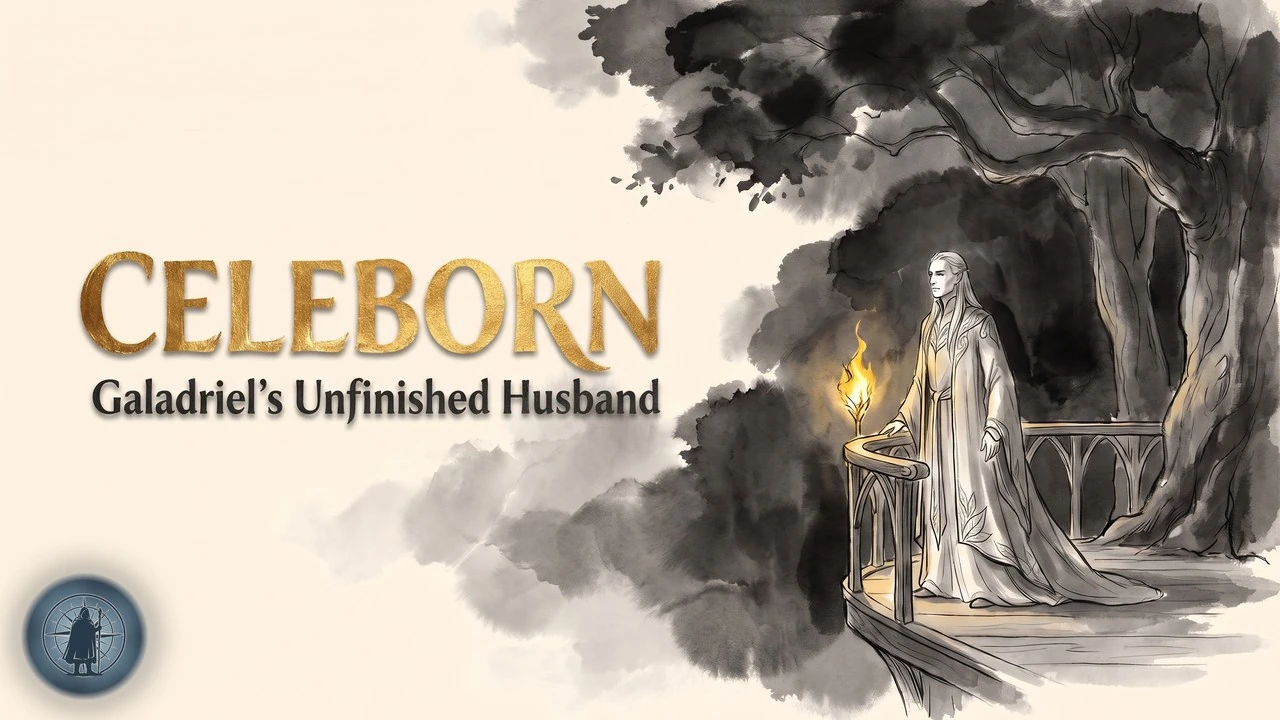 Watch the episode
Celeborn: Galadriel's Unfinished Husband
SECTION: Is Celeborn Really the Wisest Elf in Middle-earth?
Let's start in Caras Galadhon, the city in the trees at the heart of Lothlórien, in the middle of January in the year thirty nineteen of the Third Age. Gandalf has just fallen to the Balrog in Moria. The eight who are left of the Fellowship climb up into a great mallorn tree, and there, on two chairs under a branch full of leaves, sit the Lord and Lady of the Galadhrim.
Tolkien describes Celeborn and Galadriel together. "Very tall they were, and the Lady no less tall than the Lord; and they were grave and beautiful." Galadriel's hair is deep gold. Celeborn's is "of silver long and bright." Neither of them looks old, except in the eyes, which Tolkien calls "the wells of deep memory."
Celeborn speaks up first. Galadriel says nothing through the welcomes, while her husband greets the guests one at a time, with something specific for half of them.
To Aragorn he says, "It is eight and thirty years of the world outside since you came to this land; and those years lie heavy on you." An Elf who's lived through whole ages of the world has been keeping count of one mortal man's decades. To Legolas he says, "Too seldom do my kindred journey hither from the North." Legolas's father Thranduil rules a woodland kingdom in Mirkwood, so that's the first hint Tolkien gives about where Celeborn himself comes from.
To Gimli, Celeborn is generous. "Today we have broken our long law. May it be a sign that though the world is now dark better days are at hand, and that friendship shall be renewed between our peoples."
Then Celeborn counts heads. "Here there are eight. Nine were to set out: so said the messages." When he learns that the ninth was Gandalf, and that Gandalf fell in Moria, the warmth fades.
"Had I known that the Dwarves had stirred up this evil in Moria again, I would have forbidden you to pass the northern borders... And if it were possible, one would say that at the last Gandalf fell from wisdom into folly, going needlessly into the net of Moria."
The friendship Celeborn offered Durin's folk a few minutes earlier is suddenly in doubt, with Gimli standing right there.
Galadriel answers him in front of everyone. She defends Gandalf, and then she defends Gimli. "Do not repent of your welcome to the Dwarf. If our folk had been exiled long and far from Lothlórien, who of the Galadhrim, even Celeborn the Wise, would pass nigh and would not wish to look upon their ancient home, though it had become an abode of dragons?"
That's the only place in The Lord of the Rings where anybody gives Celeborn that title, and his own wife uses it while she's correcting him.
There's a silence. Then Celeborn speaks again. "I did not know that your plight was so evil. Let Gimli forget my harsh words: I spoke in the trouble of my heart."
And right after that apology, Galadriel turns to Frodo and tells him how the Elves of Middle-earth rate her husband.
"For the Lord of the Galadhrim is accounted the wisest of the Elves of Middle-earth, and a giver of gifts beyond the power of kings."
That's a comment about Celeborn's reputation, about how other people judge him. But it only covers the Elves on this side of the sea. And the timing is a little strange. Galadriel makes it about a minute after her husband has had to take back what he said about Gandalf.
Tolkien doesn't give Celeborn much room to prove it, either. He has about twenty or so speeches in the entire The Lord of the Rings, most of them in two chapters in Lórien. His biggest victory, the capture of Sauron's old fortress at Dol Guldur, happens out of the text, in an appendix. On this page he says hello, loses his temper, says sorry, and then steps back behind his wife.
SECTION: What Celeborn Told the Fellowship Before Rauros
In that first audience with the fellowship Galadriel describes her own gift, and its limits.
"I will not give you counsel, saying do this, or do that. For not in doing or contriving, nor in choosing between this course and another, can I avail; but only in knowing what was and is, and in part also what shall be."
So Galadriel's gift is knowing, and she says that she can't help anybody choose. So unsurprisingly, about a month later, when the Fellowship has to choose, it's Celeborn who does the talking.
On their last night in Lórien, Celeborn calls the Company back to his chamber and names the decision none of them has managed to make. It's a question of which bank of the river to be on. The Great River Anduin can't be crossed between Lórien and Gondor without a boat, and the bridges at Osgiliath are broken. "The way to Minas Tirith lies upon this side, upon the west; but the straight road of the Quest lies east of the River, upon the darker shore."
Only Boromir answers, for the west bank and Minas Tirith. The others say nothing. Aragorn intended to go to Minas Tirith with Boromir, and now he doesn't want to leave Frodo. So Celeborn doesn't push. "It is not my part to choose for you; but I will help you as I may." He gives them boats.
And Celeborn is honest about what boats can do. They'll take the Company down to the rapids of Sarn Gebir, where the boats will have to be carried, and maybe as far as the falls of Rauros. "Yet they will not give you counsel: in the end you must leave them and the River, and turn west — or east."
Tolkien adds a dry little note about how Aragorn took it. The gift of boats comforted him "not least because there would now be no need to decide his course for some days." So the boats really bought everyone some time. The Company uses up every day of it, and the choice will still be waiting for them above Rauros.
At the parting feast, Celeborn talks them down the whole length of the river, past the island of Tol Brandir and the falls and the Dead Marshes, all the way to Cirith Gorgor and the gates of Mordor. And he warns Boromir about a forest on the west side of the river. Fangorn, he says, "is a strange land, and is now little known."
Boromir isn't impressed. He's heard about Fangorn in Minas Tirith, and it all sounds to him like old wives' tales. Celeborn's answer may be the best line Tolkien ever gave him.
"Then I need say no more. But do not despise the lore that has come down from distant years; for oft it may chance that old wives keep in memory word of things that once were needful for the wise to know."
About two weeks later, Merry and Pippin run for their lives into Fangorn Forest and meet Treebeard.
Before the Company leaves, Gimli asks Galadriel for a single strand of her hair, and Celeborn and Galadriel take it very differently. "Celeborn gazed at the Dwarf in wonder, but the Lady smiled."
SECTION: Tar, Keleborn, Teleporno: Five Celeborns in Thirty Years
The Celeborn of those two chapters wasn't there when Tolkien started writing about Lothlórien. In the early 1940s, when Tolkien first drafted the Company's arrival in the Golden Wood, the Lady was already taking shape, but the Lord sitting beside her barely had a name.
Those drafts were published decades later, in The Treason of Isengard. There we can watch Tolkien hunt for him. At first the Lord is simply Tar, and then Aran, both words for "king." Then he's Galdaran, the "tree-king," and Galathir, the "tree-lord." After that the name Keleborn turns up, spelled with a K, and for a moment Tolkien even tries Arafain in its place. So it took a little time for the Lord of Lórien to develop.
The first real answer about who Celeborn was comes in a draft of the appendix on languages, written before the summer of 1950. In that draft, Celeborn's native language is the speech of the woodland Elves, the language of Lórien and of Thranduil's realm in Mirkwood. So at this stage he's effectively a Wood-elf, one of the forest people he rules. Then, in a revision made in 1951, Tolkien changes that. Celeborn becomes a Sinda, one of the Grey-elves, the people of King Thingol of Doriath in the First Age.
This is the Celeborn that eventually goes into print. The appendices to The Return of the King came out in October 1955, and in the Tale of Years Tolkien introduces him with a connection that's loose enough to cover almost anything. "In Lindon south of the Lune dwelt for a time Celeborn, kinsman of Thingol; his wife was Galadriel, greatest of Elven women."
A relative of Thingol could be a brother or a very distant cousin. That vagueness turned out to be useful, because nothing Tolkien wrote about Celeborn afterwards ever quite explained it.
In 1967, Tolkien went further. The Road Goes Ever On, a book of songs with Tolkien's own notes, explains that Galadriel crossed the Blue Mountains "with her husband Celeborn (one of the Sindar)." As far as I can tell, that's the only book published in Tolkien's lifetime that specifically says what kind of Elf Celeborn was.
So by 1967 the question was seemingly settled. Celeborn was a Grey-elf of Doriath who had married a princess of the Noldor, the Elves who crossed the sea from the Undying Lands, and he'd lived in Middle-earth with her ever since.
Then, around 1968, Tolkien changed the answer completely. In a set of notes on the names Galadriel, Celeborn and Lórien, and in a long late essay on Elvish language and history called The Shibboleth of Fëanor, Celeborn becomes a Teler, one of the sea-elves of Alqualondë in the Undying Lands, and a grandson of their king, Olwë. He has a Telerin name, Teleporno, and "Celeborn" is just the form it took in the Grey-elven language.
The idea stuck. On the 17th of December 1972, Tolkien answered a reader named Richard Jeffery, who'd written to him with questions. Tolkien told Jeffery that Celeborn's name in Quenya was Telporno, and that Celeborn was related to Thingol only distantly, because he'd come from Valinor.
So if you're counting, that makes four different Celeborns in about thirty years. There's a title with no person behind it, then a Wood-elf, then a Grey-elf of Doriath, and finally a prince of the sea-elves of Aman. And all the way through, "kinsman of Thingol" held up. Olwë was Thingol's brother, so even a sea-elf from across the ocean could be counted as Thingol's relative, as long as nobody looked too closely.
Tolkien wrote that letter to Richard Jeffery eight and a half months before his death, on the 2nd of September 1973. And Tolkien still wasn't finished with Celeborn. There was a fifth one to come, and it came in the last month of Tolkien's life.
SECTION: Why Tolkien Kept Rewriting Celeborn for Galadriel
When Christopher Tolkien edited his father's late papers for Unfinished Tales in 1980, he opened the chapter on Galadriel and Celeborn with a warning. He said, "There is no part of the history of Middle-earth more full of problems than the story of Galadriel and Celeborn." He went on to give the reason: "the role and importance of Galadriel only emerged slowly, and... her story underwent continual refashionings."
That explains most of what happened to Celeborn. Elrond came into The Lord of the Rings from the older Silmarillion stories. Galadriel went the other way. Tolkien created her for Lothlórien in the 1940s and then had to work her backward into the First Age. Every time Tolkien changed his mind about who Galadriel was, her husband had to change with her.
There are three Galadriels to keep track of.
The first comes from an outline Tolkien wrote after The Lord of the Rings was published, called Concerning Galadriel and Celeborn. When Morgoth was overthrown at the end of the First Age, the exiled Elves were free to sail home, and Galadriel chose not to, "for love of Celeborn, who would not leave Middle-earth (and probably with some pride of her own...)." So this Celeborn has to belong to Middle-earth, because his refusal to leave is her reason for staying.
By the late 1960s, Galadriel had a different reason. She was now a proud rebel, one of the leaders of the Noldor who left the Undying Lands against the will of the Valar. In 1967 Tolkien wrote that a ban was set on her return, and that "she had replied proudly that she had no wish to do so." In 1971 Tolkien told a reader, "Galadriel was a penitent: in her youth a leader in the rebellion against the Valar."
Around then, in The Shibboleth of Fëanor, Tolkien explains that "Galadriel" was the Grey-elven form of a Telerin name, Alatáriel, which means "maiden crowned with a garland of bright radiance." That name was given to her by her lover, Teleporno of the Teleri, whom she married later in Beleriand.
So in this version, the name the whole world knows her by was Celeborn's name for her. For Celeborn to give her that name, he has to stop being a Grey-elf of Doriath and become a sea-elf, living in the Undying Lands before the Noldor ever left.
The third Galadriel is the one Tolkien wanted by the summer of 1973, with no part in the rebellion at all. This shift does create a problem. The Noldor left the Undying Lands in ships taken from the Teleri, after killing them at their harbor in Alqualondë, or on foot over the Grinding Ice in the far north. Both were the rebels' road.
Celeborn is the solution. Christopher Tolkien summarized the August 1973 note in Unfinished Tales. Galadriel had opposed Fëanor from the start and gone to live with her mother's people at Alqualondë. "There she met Celeborn, who is here again a Telerian prince, the grandson of Olwë of Alqualondë and thus her close kinsman. Together they planned to build a ship and sail in it to Middle-earth." Then Morgoth destroyed the light of the Trees, the Noldor attacked the harbor, and Galadriel was on the other side of that fight: "she with Celeborn fought heroically in defence of Alqualondë against the assault of the Noldor, and Celeborn's ship was saved from them."
So Celeborn ends up with a ship that nobody had to kill for. And with it, Galadriel can leave the Undying Lands with clean hands.
That fix had a cost, though. Galadriel's mother, Eärwen, was Olwë's daughter. If Celeborn is Olwë's grandson, then he and Galadriel are first cousins. In The Silmarillion, when Maeglin falls for his first cousin Idril, Tolkien writes that "the Eldar wedded not with kin so near." In the 1973 note, Tolkien doesn't seem bothered by it.
Christopher Tolkien didn't adopt any of this. When he put The Silmarillion together in 1977, he kept the Doriath meeting: Galadriel lived in Thingol's kingdom, "for in Doriath dwelt Celeborn, kinsman of Thingol, and there was great love between them." In Unfinished Tales, he explained why. A Telerin Celeborn from the Undying Lands contradicted The Silmarillion, The Road Goes Ever On, and Appendix B to The Lord of the Rings.
So the published Silmarillion has one Celeborn, and the last thing Tolkien wrote about him describes another.
SECTION: Celeborn's Family Tree and the White Tree Called Celeborn
Even inside the Doriath story, the one that's in print, Celeborn's family doesn't sit still.
In Unfinished Tales, Christopher Tolkien gives the genealogy he followed. Celeborn "was the grandson of Thingol's brother Elmo." Then Christopher adds everything there is to know about Elmo, which is almost nothing. He calls Elmo "a shadowy figure about whom nothing is told," except that he was the younger brother of Elwë and Olwë, and was "beloved of Elwë with whom he remained." Elwë is Thingol's older name. So there were three brothers. Olwë went over the sea and became king of the Teleri. Elwë became Thingol, king of Doriath. And Elmo went with Elwë.
In December 1959, Tolkien drew up a family table for this branch. It runs from Elmo to a son named Galadhon, and from Galadhon to two sons, Celeborn and Galathil. And Nimloth appears on that table twice. In one place she's Galadhon's daughter, which would make her Celeborn's sister. In another she's Galathil's daughter, which makes her his niece. Tolkien's second thought was niece, and that's the form Christopher printed.
Then the generations start to shift. In a note from around 1965, Celeborn is Elmo's son instead of his grandson, and he was born in Beleriand. In a language note from around 1969, he's called Celeborn Gildírion, the son of someone named Gildír, a father we hear nothing else about. That's three different fathers in ten years, and that's before we count the Telerin story, where his grandfather is Olwë.
The niece matters because of who she married. Nimloth married Dior, the son of Beren and Lúthien. Their daughter was Elwing, and Elwing's sons were Elrond and Elros. So in this family tree, Elrond is the great-grandson of Celeborn's brother. And in the year 109 of the Third Age, Elrond married Celeborn's daughter, Celebrían. Through Elros, the line runs on to the kings of Númenor and, in the end, to Aragorn.
There's a pattern in the family's names, too. Tolkien never points it out, but it's hard to miss once you notice it. Galadhon has the Elvish word for tree, galadh, right in it. Galathil sounds like Galathilion, the White Tree that grew in the Elvish city of Tirion. Nimloth is also the name of the White Tree of Númenor.
And Celeborn is the name of a White Tree, too. In The Silmarillion, a seedling of Galathilion was planted on the island of Tol Eressëa, off the coast of the Undying Lands, and it was called Celeborn. From that tree came Nimloth of Númenor, and from Nimloth came the White Tree of Gondor in Minas Tirith.
And the pattern holds on both sides. In the line of the White Trees, the tree called Celeborn sits between Galathilion and Nimloth. On the Elf's side, Celeborn has a brother with a name like Galathilion and a niece named Nimloth.
And then Tolkien changed what the name meant. Celeborn was built from two Grey-elven words, celeb, "silver," and orn, "tree." That fits a tree descended from Telperion, the silver Tree of Valinor, and Christopher Tolkien thought silver-tree was probably the original meaning. But around 1968, when Celeborn became Teleporno, Tolkien traced the second half of the name to an old root meaning "uprising" or "tall." So Silver-tree became Silver-tall.
That suits the Celeborn of The Lord of the Rings, a very tall Elf with long silver hair. It also cuts him loose from the White Tree he'd shared a name with. Celeborn had started out in the 1940s drafts as a tree-king and a tree-lord, and he ended up with a name that didn't mean tree at all.
SECTION: Celeborn in Eregion and the War of the Elves and Sauron
If Celeborn was a prince of Doriath, the obvious question is whether he was there when it fell.
In the year 503 of the First Age, by the usual reckoning, Dwarves from the city of Nogrod killed King Thingol and sacked his halls at Menegroth. Around 506, the sons of Fëanor attacked for the Silmaril and killed Dior and Nimloth. A prince of Doriath would have lost his king and his niece.
But Tolkien never says Celeborn was there. In the same speech where Galadriel praises her husband, she says that "ere the fall of Nargothrond or Gondolin I passed over the mountains," which puts her east of the Blue Mountains before the year 495. Concerning Galadriel and Celeborn says she "did not go West at the Downfall of Melkor, but crossed Ered Lindon with Celeborn," which sounds like the end of the First Age. Christopher Tolkien points out that it's natural to assume the two of them saw the ruin of Doriath, but that no text actually says so.
The outline does say how Celeborn felt about it. "Celeborn had no liking for Dwarves of any race (as he showed to Gimli in Lothlórien), and never forgave them for their part in the destruction of Doriath." Tolkien makes the connection himself, from the First Age straight to the harsh words in Caras Galadhon.
After the First Age, Celeborn's life turns into a list of addresses. The Tale of Years puts him first in Harlindon, the part of Lindon south of the river Lune, and a later text has him ruling it under the High King, Gil-galad. In the outline, the couple then settle by Lake Nenuial as Lord and Lady of the Elves of Eriador, and "about the year 700 of the Second Age," they move east and found Eregion, a realm of mostly Noldor smiths beside the west gate of Moria. Appendix B tells it differently. There, the lord of Eregion is Celebrimbor, and Celeborn isn't mentioned.
This is where the old grudge makes a difference. Around thirteen fifty to fourteen hundred in the Second Age, Sauron, disguised as Annatar, has won over the smiths of Eregion. Galadriel leaves for the woodland realm across the mountains that will one day be Lórien, and she takes the short road, straight through the Dwarf city of Khazad-dûm. Celeborn refuses to set foot in it, so he's left behind in Eregion, where, by this account, Celebrimbor doesn't pay much attention to him.
Then Sauron comes for the Rings. In the war that runs from sixteen ninety-five to sixteen ninety-seven, Celeborn fights for Eregion, leads one attack out against Sauron's army, and then joins Elrond, whose army can't break through in time. Eregion is destroyed, Celebrimbor is killed, and Celeborn escapes north with Elrond to a hidden valley that becomes Imladris, which you probably know as Rivendell. Galadriel eventually comes back through Moria looking for him and finds him there. In this account, that's also where Elrond first sees their daughter, Celebrían.
Then, in the outline, Galadriel's longing for the sea takes them south to Belfalas, to the place later called Dol Amroth. She'd left the woodland realm in the care of their son, Amroth.
In other papers, though, Tolkien gave Amroth different parents. In a version written in 1969 or after, Amroth is the son of Amdír, a king of Lórien who died at the Battle of Dagorlad. In another note, which Tolkien rejected, Amroth is Celeborn's son by an earlier wife who had left them both. So Amroth ends up with three sets of parents.
The fixed point is the year nineteen eighty-one of the Third Age. Appendix B puts Amroth's loss in that year, the year after a Balrog woke in Moria. After that, Celeborn and Galadriel took charge of Lórien. They gave up the titles King and Queen and ruled as Lord and Lady.
SECTION: Dol Guldur, East Lórien, and the Elf Who Stayed Behind
By the time the Fellowship arrived, Celeborn and Galadriel had ruled Lórien together for more than a thousand years, and the losses had already started.
In the year twenty-five oh-nine of the Third Age, their daughter Celebrían was on her way to Lórien when Orcs ambushed her in the Redhorn Pass, above Moria, and she received a poisoned wound. Elrond healed her body, but she lost all delight in Middle-earth, and the next year she sailed into the West.
In the War of the Ring, almost everything Celeborn does happens in the appendices. Lórien was attacked three times from Dol Guldur, Sauron's old fortress across the river in southern Mirkwood: on the 11th of March, thirty nineteen, on the 15th, the same day as the battle on the Pelennor Fields, and on the 22nd. In Appendix B, Tolkien writes that "the power that dwelt there was too great for any to overcome, unless Sauron had come there himself." The border woods were badly hurt, but every assault was driven back.
Then Celeborn went on the attack.
"Celeborn came forth and led the host of Lórien over Anduin in many boats. They took Dol Guldur, and Galadriel threw down its walls and laid bare its pits, and the forest was cleansed."
Celeborn had given the Fellowship three boats on this same river. Now he crossed it with an army.
On the 6th of April, the Elves' New Year, Celeborn met Thranduil in the middle of the forest, and together they renamed Mirkwood Eryn Lasgalen, "the Wood of Greenleaves." Thranduil took the north, the Beornings and the Woodmen got the middle, and Celeborn "took the southern wood below the Narrows, and named it East Lórien." It's a whole new Elvish realm, and it barely gets a mention.
That August, on the road north, the Elves said goodbye to King Aragorn. Galadriel told him to "Use well the days!" Celeborn said something sadder. "Kinsman, farewell! May your doom be other than mine, and your treasure remain with you to the end!"
Aragorn's treasure is Arwen, Celeborn's own granddaughter. With the One Ring gone, the power of Galadriel's ring was fading, and her time in Middle-earth was nearly over. Celeborn seems to hint that he knows his own wife was leaving.
A few weeks later, near Moria, Celeborn and Galadriel said goodbye to the hobbits and turned for home "by the Redhorn Gate." It's the same pass where Celebrían was taken, five hundred and ten years before.
On the 29th of September, thirty twenty-one, Galadriel sailed from the Grey Havens with Elrond, Gandalf, Bilbo and Frodo. Celeborn didn't go with her. In the Doriath story, that was the end of about seven thousand years together in Middle-earth.
In the old outline from the 1950s, Galadriel had refused to leave Middle-earth because Celeborn wouldn't. At the end of the Third Age, it plays out a different way. She goes, and he stays.
Celeborn left Lórien too, in the end. Appendix B says that "after the passing of Galadriel in a few years Celeborn grew weary of his realm and went to Imladris to dwell with the sons of Elrond," his grandsons Elladan and Elrohir. Behind him, "there was no longer light or song in Caras Galadhon."
More than a century later, after Aragorn's death, Arwen went to Lórien alone. The Tale of Aragorn and Arwen says that "Galadriel had passed away and Celeborn also was gone, and the land was silent." It doesn't say where Celeborn had actually gone.
Tolkien gives Celeborn's ending half a sentence, in the Prologue, in a passage about the libraries of Rivendell. "There is no record of the day when at last he sought the Grey Havens, and with him went the last living memory of the Elder Days in Middle-earth."
So the books leave a lot open. We don't know whether Celeborn was born in the forests of Doriath or by the harbor of Alqualondë. We don't know whether his father was Galadhon, or Elmo, or a Gildír we know nothing else about. We don't know whether he saw Doriath fall, or whether Amroth was his son. And we don't know when he finally went down to the Havens.
Tolkien was still working on the first of those questions in the last month of his life. Tolkien answered the last one in the Prologue, by just writing down that nobody knows.