Transcript
Ar-Pharazôn
The King Who Invaded Heaven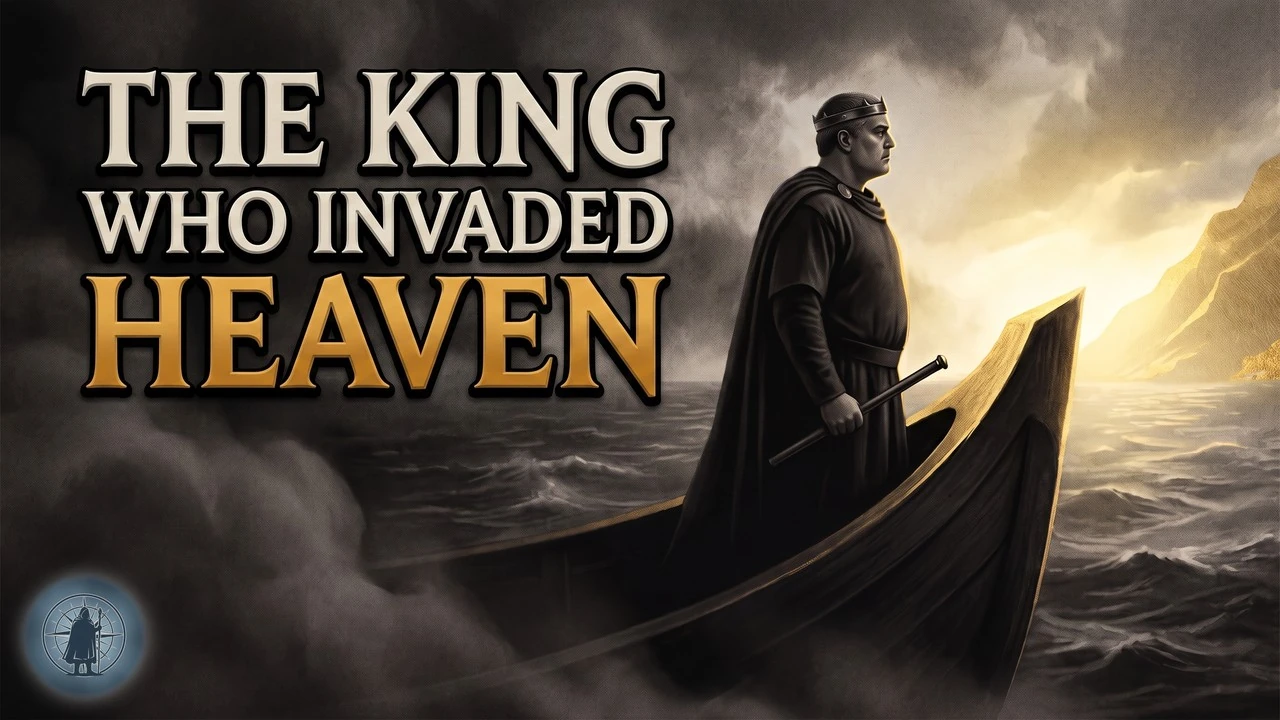 Watch the episode
Ar-Pharazôn: The King Who Invaded Heaven | Silmarillion Explained
Watch the episode
Ar-Pharazôn: The King Who Invaded Heaven | Silmarillion Explained
SECTION: How Pharazôn Took a Throne That Wasn't His
Let's go back to the year thirty-one eighteen of the Second Age, and the birth of a boy who wasn't supposed to be king.
His name was Pharazôn, and his father was Gimilkhâd - the younger son, which in Númenor settled the question. The sceptre went to the elder brother, Inziladûn, who ruled as Tar-Palantir and spent his whole reign trying to repair something his own family had spent three centuries breaking.
Númenor had split in two by then. The King's Men had turned away from the Elves, from the Valar, and from the idea that anybody could tell a Númenórean where he was allowed to sail. The Faithful hadn't. Tar-Palantir was one of the Faithful, and he tended the White Tree at Armenelos again and said the old prayers on the holy mountain again. In Tolkien's timeline, the year thirty-one seventy-five gets one flat line, and it tells you how that landed.
"Repentance of Tar-Palantir. Civil war in Númenor."
And the leader of the opposition was the King's own brother. Gimilkhâd "became leader of the King's Party, and resisted the will of Tar-Palantir as openly as he dared, and yet more in secret."
So Pharazôn grew up inside a family argument that was also a national one. He was on the losing side of it, with a father who was the most powerful man in Númenor. And he wasn't the King.
Then Pharazôn left, and that's the part we sometimes forget. Before he was anything else, this man was a soldier, abroad for decades - "a leader in the wars that the Númenóreans made then in the coastlands of Middle-earth, seeking to extend their dominion over Men." That's just a polite way of describing tribute, fortresses and forced labor. He ran that operation, and came home rich on it.
Gimilkhâd died in thirty-two forty-three, and his son sailed home.
"Therefore when he came back to Númenor, hearing of his father's death, the hearts of the people were turned to him; for he brought with him great wealth, and was for the time free in his giving."
For the time.
Three words in the middle of a compliment, quietly attaching an expiry date to it. The generosity was a purchase. And in a draft of this material Tolkien summed the man up plainly. Pharazôn had "courage and strength of will rather than of wisdom, as after appeared, when he was corrupted by the counsels of his father, and the acclaim of the people."
The counsels of his father, and the acclaim of the people. Two things - and Sauron isn't either of them. Tolkien has the last King of Númenor spoiled twice over before Sauron ever laid eyes on him.
Then in thirty-two fifty-five Tar-Palantir died, after seventy-eight years on the throne, having had exactly one child. A daughter.
Her name was Míriel, and she wasn't a claimant or a candidate. She was the Queen. Centuries earlier Tar-Aldarion had changed the law so the eldest child inherited the sceptre, man or woman, and Míriel was the eldest and the only. Tolkien tells us specifically: "to her now by right and the laws of the Númenóreans came the sceptre."
Pharazôn married her.
She was his first cousin - born in thirty-one seventeen, a year older than him, "the child of his father's brother."
Númenórean law didn't allow that marriage, "even in the royal house," for anyone more closely related than second cousins. So the wedding was technically illegal. It was also forced. Tolkien explains both charges at once: Pharazôn took her to wife against her will, "doing evil in this and evil also in that the laws of Númenor did not permit the marriage."
Two crimes. One against a woman, one against a statute. And then he "seized the sceptre into his own hand."
He renamed her, too. Míriel is Quenya. Elvish. The Elvish his family had spent generations suppressing. It means something close to jewel-daughter. He gave her Ar-Zimraphel instead - Adûnaic, the language of the new regime, meaning, as far as we can read it, element for element the same thing. Pharazôn didn't erase his wife's name. He translated it.
Also - there's a cold little note attached to that sceptre. "The sceptre of Númenor is said to have perished with Ar-Pharazôn." The sceptre he married a woman to get hold of went down with him.
SECTION: The Day Sauron Knelt at Umbar
For six years after taking the throne, Ar-Pharazôn does nothing that Tolkien writes down. Not one event between thirty-two fifty-five and thirty-two sixty-one. It's a real silence, and it stays that way.
What breaks it is news from the East. Ships' captains came home reporting that Sauron had taken the title King of Men, and had "declared his purpose to drive the Númenóreans into the sea, and destroy even Númenor, if that might be."
That's a direct threat. Any king would have to answer it.
Ar-Pharazôn's answer went far beyond playing defense. He decided, "without counsel of the Valar, or the aid of any wisdom but his own," that he'd claim the title King of Men himself and force Sauron to kneel as his vassal. And the reason Tolkien gives for it is rank, not strategy. "For in his pride he deemed that no king should ever arise so mighty as to vie with the Heir of Eärendil."
So in thirty-two sixty-one Ar-Pharazôn sailed. "And men saw his sails coming up out of the sunset, dyed as with scarlet and gleaming with red and gold, and fear fell upon the dwellers by the coasts, and they fled far away."
He landed at Umbar - and the popular version of this scene imagines an invasion beach. Umbar had been made a great fortress of Númenor in the year twenty-two eighty, nine hundred and eighty-one years before Ar-Pharazôn got there. He was tying up in his own harbor.
Then he marched inland for seven days "with banner and trumpet," through a countryside that emptied ahead of him. He stopped on a hill in open ground and set up a throne, with his army's tents ringed around it, "blue, golden, and white, as a field of tall flowers."
Ar-Pharazôn then sent heralds ordering the Dark Lord of Mordor to walk out and bow to the real king.
And Sauron came.
"Even from his mighty tower of Barad-dûr he came, and made no offer of battle."
Tolkien tells us why Sauron came out. There was no mystery to it. Sauron looked at what had landed on the shores and did some quickarithmetic. The Númenóreans "surpassed all rumour of them," he couldn't trust his own greatest servants to withstand them, and "he saw not his time yet." So "he humbled himself before Ar-Pharazôn and smoothed his tongue."
And there we see Umbar settled without a battle.
In nineteen fifty-eight, answering a reader's letter, Tolkien summed up what actually happened there in two sentences. Ar-Pharazôn "conquered a terrified Sauron's subjects, not Sauron." And then: "Sauron's personal 'surrender' was voluntary and cunning: he got free transport to Númenor!"
Free transport. So the Dark Lord didn't really lose a war at Umbar. He swindled his way into a ticket to Numenor.
And the crossing was the King's own idea. "It came into his mind that, for the better keeping of Sauron and of his oaths of fealty, he should be brought to Númenor, there to dwell as a hostage." That's street smarts. He doesn't trust the surrender, so he keeps the prisoner where he can watch him. Then Tolkien turns it inside out in one sentence: "To this Sauron assented as one constrained, yet in his secret thought he received it gladly, for it chimed indeed with his desire."
Sauron pretended to be dragged onto a boat he wanted to be on.
There was also something aboard that ship the King knew nothing about. Tolkien, in that same letter: "He naturally had the One Ring, and so very soon dominated the minds and wills of most of the Númenóreans." And then,: "I do not think Ar-Pharazôn knew anything about the One Ring."
So the King of Númenor inspected his hostage, was pleased with himself, and sailed home with the Ruling Ring in his hold.
And here's the strangest afterlife of that day. Elendil's own descendants - the children of the men Ar-Pharazôn hunted - raised a white pillar on the headland above Umbar, crowned with a globe of crystal that could be seen from the coasts of Gondor. Even the Faithful "remembered with pride the coming of the great host of Ar-Pharazôn out of the deeps of the Sea."
His enemies built him a monument. It stood about two thousand years. Then Umbar fell to the servants of Sauron, and "the memorial of his humiliation was thrown down."
SECTION: Sauron's Three Years to the Inner Council
Sauron arrived in Númenor in the year thirty-two sixty-two, as a prisoner, on somebody else's ship, with no army and no allies on the island.
There was every reason for the high court to hate him.
Three years later he was considered trustworthy enough to be in the room where the decisions got made.
"Yet such was the cunning of his mind and mouth, and the strength of his hidden will, that ere three years had passed he had become closest to the secret counsels of the King."
Three years is all it took to get to the inner room. After that, fifty-seven years to the end of the world.
Tolkien names two very ordinary tools, neither being a magic spell.
"Flattery sweet as honey was ever on his tongue, and knowledge he had of many things yet unrevealed to Men."
Flattery, and being useful. Sauron was a craftsman before he was anything else, and he'd landed in a culture obsessed with building things. He could simply be the man who knew how.
But the sentence that actually explains the capture of the Númenórean state isn't about Sauron at all.
"And seeing the favour that he had of their lord all the councillors began to fawn upon him, save one alone, Amandil lord of Andúnië."
Seeing the favour that he had of their lord.
The council fell to the King's preference rather than to Sauron. Nobody had to be turned individually - they only had to notice which way Ar-Pharazôn was leaning and get there first.
The exception was Amandil, Lord of Andúnië, and Amandil wasn't an outsider. In one of Tolkien's drafts, Amandil and Pharazon had been close friends when they were younger, before getting into politics. Now Amandil was dismissed, "for Sauron hated him above all others in Númenor."
But he was left alive, and Tolkien's explanation of why is cold political reporting. Amandil "was so noble, and had been so mighty a captain of the sea, that he was still held in honour by many of the people, and neither the King nor Sauron dared to lay hands on him as yet."
So just not "yet". The regime seemed to be working on a schedule.
Then comes the conversion, and it happens in a private room rather than a temple. "And Ar-Pharazôn said: 'Who is the Lord of the Darkness?' Then behind locked doors Sauron spoke to the King, and he lied."
What he told him was that the Valar had been running a fraud - that Eru was "a phantom devised in the folly of their hearts," and that the real power was Melkor. The title Sauron flattered him with began to do the real work.
"Lord of All, Giver of Freedom, and he shall make you stronger than they."
Giver of Freedom. Sold to a man who'd spent his entire life resenting a rule.
Tolkien compresses the next forty-eight years into a few words: "Sauron seduces the King and corrupts the Númenóreans."
He gave it just a single line for half a century of dirty work that eventually blew up the world.
For Tolkien readers, there's a very familar pattern here.
Melkor was taken prisoner by the Valar, chained, held three ages in Mandos, then released - because Manwë believed his repentance and because Manwë was merciful. And Melkor wrecked Valinor from inside the court that had pardoned him.
Sauron ran his old master's playbook in Númenor with one change. He made one small tweak. Melkor had to be released to do his damage.
Sauron got promoted instead.
And the promotion was Ar-Pharazôn's own doing, for a reason he was never going to argue himself out of. The prisoner was the trophy. Having Sauron in Armenelos was standing proof that the King had beaten Sauron, and a man doesn't go looking for holes in his own greatest victory.
SECTION: Why Did Ar-Pharazôn Cut Down Nimloth?
In the courts of the King at Armenelos there was a white tree called Nimloth.
It wasn't decorative. Nimloth came down, several generations removed, from Telperion - one of the Two Trees that lit Valinor before there was a Sun or a Moon - and the Elves had given its line to Númenor as a gift, back when Númenor still accepted gifts from Elves. The tree in the royal courtyard was a living connection to the light of the West.
It was also a prophecy. Tar-Palantir, in his last years, had said "that when the Tree died then the line of Kings also would perish."
Sauron wanted it cut down. Of course he did - it was a memorial of the Elves and of Valinor standing at the center of what he considered his new capital.
But Ar-Pharazôn said no.
And his reason for refusing is easy to overlook. "At the first the King would not assent to this, since he believed that the fortunes of his house were bound up with the Tree, as was forespoken by Tar-Palantir."
He believed it. This is a king who by now hated the Elves, hated the Valar, had accepted Melkor as the true lord of the world, and had let a foreign prisoner rewrite his kingdom's religion - and he still wouldn't touch the tree, because a dead uncle had said his family's luck was tied to it.
Tolkien's judgment is one sentence: "Thus in his folly he who now hated the Eldar and the Valar vainly clung to the shadow of the old allegiance of Númenor."
Ar-Pharazôn threw out the faith and kept the superstition.
So Nimloth stood - guarded day and night by soldiers in the King's service, in courts closed to the Faithful entirely.
Word reached Amandil that the King was wavering.
Amandil told his son Elendil, and Elendil's sons. Elendil's son Isildur said nothing at all.
That night Isildur went out alone, in disguise, and got into the courts. "At that time Nimloth was dark and bore no bloom, for it was late in the autumn, and its winter was nigh." He stole a fruit off the tree and turned to flee. But a guard woke. "And he was assailed, and fought his way out, receiving many wounds". So Isildur escaped without being recognized but he nearly died from it.
Then they planted the fruit.
And "when its first leaf opened then Isildur, who had lain long and come near to death, arose and was troubled no more by his wounds."
Isildur recovered at the exact moment the seedling did.
Tolkien puts the two events in order. "None too soon was this done; for after the assault the King yielded to Sauron and felled the White Tree, and turned then wholly away from the allegiance of his fathers."
The King lost his temper, not the argument.
Ar-Pharazôn had held out against the most persuasive being in the world on this one point for years, and what finally broke him was a burglary. Somebody stole from his courtyard, so he killed the tree.
He still hadn't stopped believing the tree carried his family's fortune when he gave the order.
The wood of the tree didn't go to waste. "The first fire upon the altar Sauron kindled with the hewn wood of Nimloth, and it crackled and was consumed; but men marvelled at the reek that went up from it, so that the land lay under a cloud for seven days."
Burning the wood resulted in seven days of smoke over an entire island. Seven days of smoke from a single tree.
Tar-Palantir's prophecy came true, though not the way a superstition works.
The line of Kings perished, because the man who cut the tree down was the same man who made many bad choices that will follow.
SECTION: The Temple of Armenelos and the False Charges
Ar-Pharazôn also demolished a building. But the building was...more than a building. And maybe not a building at all.
Near the center of Númenor stood the Meneltarma, the Pillar of Heaven, and it was the island's only holy place. And this is what the Númenóreans built there. "No building, no raised altar, not even a pile of undressed stones, ever stood there; and no other likeness of a temple did the Númenóreans possess in all the days of their grace, until the coming of Sauron."
Nothing. In three thousand years, a civilization of master builders never put anything on their sacred mountain. No tool and no weapon was ever carried up it. And nobody spoke there - "none might speak any word, save the King only."
The King was the only priest Númenor had, and he had three speaking parts a year: a prayer in early spring, praise at midsummer, thanksgiving at the end of autumn. Three days, one voice, on a bare mountain, and all the rest was silence.
Ar-Pharazôn abolished this arrangement. He forbade anyone to climb the Meneltarma on pain of death - which means the last King of Númenor made his own priesthood a capital offense, and then declined to commit it.
What went up instead went up in the middle of the capital. The temple at Armenelos was a circle at the base, with walls fifty feet thick. It measured five hundred feet across, rose five hundred feet into the air, and was crowned with a dome roofed in silver. Inside was an altar of fire, and at the crown of the dome a vent, out of which came smoke, constantly.
The silver didn't stay silver. "Soon the light was darkened, and the silver became black."
Feature by feature, that building is the mountain turned inside out. Enclosed instead of open, worked metal instead of bare rock, perpetual smoke instead of three spoken prayers, and burning bodies instead of silence.
Then there was killing. Killing of the unfaithful.
"And most often from among the Faithful they chose their victims; yet never openly on the charge that they would not worship Melkor, the Giver of Freedom, rather was cause sought against them that they hated the King and were his rebels, or that they plotted against their kin, devising lies and poisons."
It was a government burning people over religion but they never called it that. They considered it treason. Conspiracy. Poisoning. Everyone knew what the trials were really for, and the documents said something else, which is how it's always done. Tolkien's line is bleak: "These charges were for the most part false; yet those were bitter days, and hate brings forth hate."
The whole apparatus existed to hold off death. "But for all this Death did not depart from the land, rather it came sooner and more often, and in many dreadful guises." Madness, sickness, and "men took weapons in those days and slew one another for little cause."
From the inside, it looked like it was working. With Sauron's help "they multiplied their possessions, and they devised engines, and they built ever greater ships." Tolkien gives us something to pause about: "Nonetheless for long it seemed to the Númenóreans that they prospered, and if they were not increased in happiness, yet they grew more strong, and their rich men ever richer."
They were richer. They were not happier. They were stronger too. and rich men richer.
So nothing about those fifty-seven years looked like decline while it was happening, which is probably why nobody stopped it.
And Ar-Pharazôn didn't invent the repression. His own grandfather Ar-Gimilzôr had already banned the Elvish languages, punished anyone who welcomed a ship out of the West, and moved the Faithful bodily to Rómenna in the east - "and there they were watched." Pharazôn inherited a surveillance state. What he added was the altar.
"Thus Ar-Pharazôn, King of the Land of the Star, grew to the mightiest tyrant that had yet been in the world since the reign of Morgoth, though in truth Sauron ruled all from behind the throne."
Ar-Pharazôn built the largest tyranny any mortal man had ever managed. And he didn't even realize that he wasn't wasn't the one running it.
SECTION: Ar-Pharazôn's Loophole: Sailing East to the West
Tolkien wrote the fall of Númenor more than once, and one version - told from the Men's side, in their own language - has a scene that never made it into the finished book. It's good evidence for how Ar-Pharazôn's mind worked.
In that telling, messengers of the Valar come to Númenor and reason with the King directly, and part of what they try to explain is the shape of the world.
"And behold! the fashion of the Earth is such that a girdle may be set about it. Or as an apple it hangeth on the branches of Heaven, and it is round and fair, and the seas and lands are but the rind of the fruit."
They also demolish the premise of the entire Númenórean grievance - the belief that the Undying Lands make you undying. "It is not the land of Aman that maketh its people deathless, but the dwellers therein do hallow the land; and there you should rather wither the sooner, as moths in a flame too bright and hot."
Going there would burn a mortal out faster, not make him live longer. They told the King this, to his face, in his own hall.
Ar-Pharazôn listened. Then he stood up in council and made an argument.
"For if we shall believe this, that one who goeth west shall return out of the East, then shall it not also be that one who goeth ever east shall come up at last behind the West, and yet break no ban?"
That's a lawyer talking, not a rebel.
The Ban says don't sail west far enough to lose sight of Númenor. Fine, says the King - so sail east. Go all the way round the apple and arrive at Valinor from behind. Every word of the prohibition kept, and he'd be standing on the shore of the Undying Lands having technically obeyed.
Amandil's answer, which Tolkien added in the margin later, is brief.
"Yet to go behind a command is not to keep it."
And what does the King do on being told his loophole doesn't work? He doesn't repent, and he doesn't rage. He "pondered in his secret thought the building of ships of great draught and burden, and the setting up of outposts of his power upon far shores."
When told the shortcut wouldn't hold, Ar-Pharazôn started thinking about bigger ships.
This is probably why the last stretch of his life takes as long as it does. Fifty-seven years is a strange amount of time to spend being corrupted. But Ar-Pharazôn wasn't wrestling with his conscience for fifty-seven years. He was hunting for the gap in the wording. A rebel breaks the rule and knows he's breaking it. This man went back over the wording again and again, looking for the sentence that would let him have what he wanted without technically taking it.
That same text lays one more charge on him personally, and it lands before Sauron ever sets foot on the island: "But he Ar-Pharazôn the king fell into doubt, and in his day the offering of the first-fruits was neglected; and men went seldom to the hallow in the high place."
The religion was already withering under him. Sauron showed up at a house that had stopped praying.
And that's exactly the temperament the final pitch is aimed at. When Sauron makes his move, he never asks the King to rebel against anybody. He tells him he's being cheated. "Against all justice is it done that this gift, which is his due, should be withheld from the King of Kings, Ar-Pharazôn, mightiest of the sons of Earth. But great kings do not brook denials, and take what is their due."
Tolkien also has a shorter version of that same speech.
"But great Kings take what is their right."
Rather than ask Ar-Pharazôn to commit a sin, Sauron convinced him he was owed something and that he should take it.
SECTION: The Great Armament: Nine Years and One Doubt
In the year thirty-three ten, Ar-Pharazôn began building the Great Armament. It sailed in thirty-three nineteen.
Nine years.
That number changes what kind of act this was. A war fleet built over nine years is a program. Levies and taxes, timber and forges, a decade of a nation's industrial output aimed at one target. He had nine years to call it off.
What he built was "the greatest armament that the world had seen." Tolkien never gives a number of ships. He describes it instead: "the fleets of the Númenóreans darkened the sea upon the west of the land, and they were like an archipelago of a thousand isles; their masts were as a forest upon the mountains, and their sails like a brooding cloud."
And across those nine years the warnings arrive in order, escalating. First the sea turned on them, and ships began to sink as "such a grief had not till then befallen them since the rising of the Star." Then clouds came in from the west shaped like eagles, spread over the island with lightning under their wings. "'Behold the Eagles of the Lords of the West!' they cried. 'The Eagles of Manwë are come upon Númenor!'" Then the lightning started killing people, in the fields and in the streets of the city.
Then it struck the temple. A bolt "smote the dome of the Temple and shore it asunder, and it was wreathed in flame." And Sauron was standing on the pinnacle of that dome. He defied the lightning, and it didn't touch him. "And in that hour men called him a god and did all that he would."
A direct warning from the Powers of the World got turned into a miracle for the other side, in front of a watching city.
Then, finally, the mountain. "The land shook under them, and a groaning as of thunder underground was mingled with the roaring of the sea, and smoke issued from the peak of the Meneltarma." The mountain nobody was allowed to climb any more had started smoking.
"But all the more did Ar-Pharazôn press on with his armament."
And the King's public line on all of it went like this. "The Lords of the West have plotted against us. They strike first. The next blow shall be ours!"
Then Tolkien adds: "These words the King himself spoke, but they were devised by Sauron."
The mightiest tyrant since Morgoth, standing in front of his people at the crisis of his reign.
So the fleet went, with Ar-Pharazôn aboard his flagship Alcarondas - "many-oared it was and many-masted, golden and sable; and upon it the throne of Ar-Pharazôn was set." And below its deck: "there was little wind, but they had many oars and many strong slaves to row beneath the lash."
A fleet sailing to demand that death be abolished for men of worth, rowed there by men being whipped.
Then they came in sight of the shore.
"For Ar-Pharazôn wavered at the end, and almost he turned back."
Two hundred and one years old, nine years of building - and he nearly called the whole thing off. What stopped him was the view. "His heart misgave him when he looked upon the soundless shores and saw Taniquetil shining, whiter than snow, colder than death, silent, immutable, terrible as the shadow of the light of Ilúvatar."
He got close enough to see Taniquetil properly, and he understood.
"But pride was now his master."
Ar-Pharazôn went ashore and claimed the land for his own, "if none should do battle for it."
Nobody did.
The Elves had gone from Túna, and the host camped around an empty city. The invasion of heaven succeeded. There was nobody there to fight.
Then Manwë appealed to Eru directly, and Tolkien later called what came next "a miracle: a direct action of God the Creator, changing the fashion of the world." The world was bent into a sphere, the seas poured into the gap, and Númenor went down with everyone on it.
But Ar-Pharazôn wasn't on a ship - he was standing on the shore of Aman.
"But Ar-Pharazôn the King and the mortal warriors that had set foot upon the land of Aman were buried under falling hills: there it is said that they lie imprisoned in the Caves of the Forgotten, until the Last Battle and the Day of Doom."
He isn't killed, only buried and kept.
The man who spent sixty-four years trying to get out of dying is one of the few figures in the whole legendarium who doesn't get to. He asked for a life without end, and he was given exactly that - under a mountain, in the dark, with no throne and no crown, for as long as the world lasts.
Back home, Míriel "strove to ascend the steep ways of the Meneltarma to the holy place" - the summit her husband had made it a capital crime to climb - and she didn't make it. "The waters overtook her, and her cry was lost in the roaring of the wind."
Sauron laughed three times: at the trumpets sounding for battle, at the thunder of the storm, and a third time at a private thought of his own, "thinking what he would do now in the world, being rid of the Edain for ever."
The abyss took him mid-laugh, along with his throne, his temple, and the fair form he never got back.
The drowning of Númenor took thirty-nine days.