Transcript
Witch-king of Angmar
Rise & Fall of the Nazgul Lord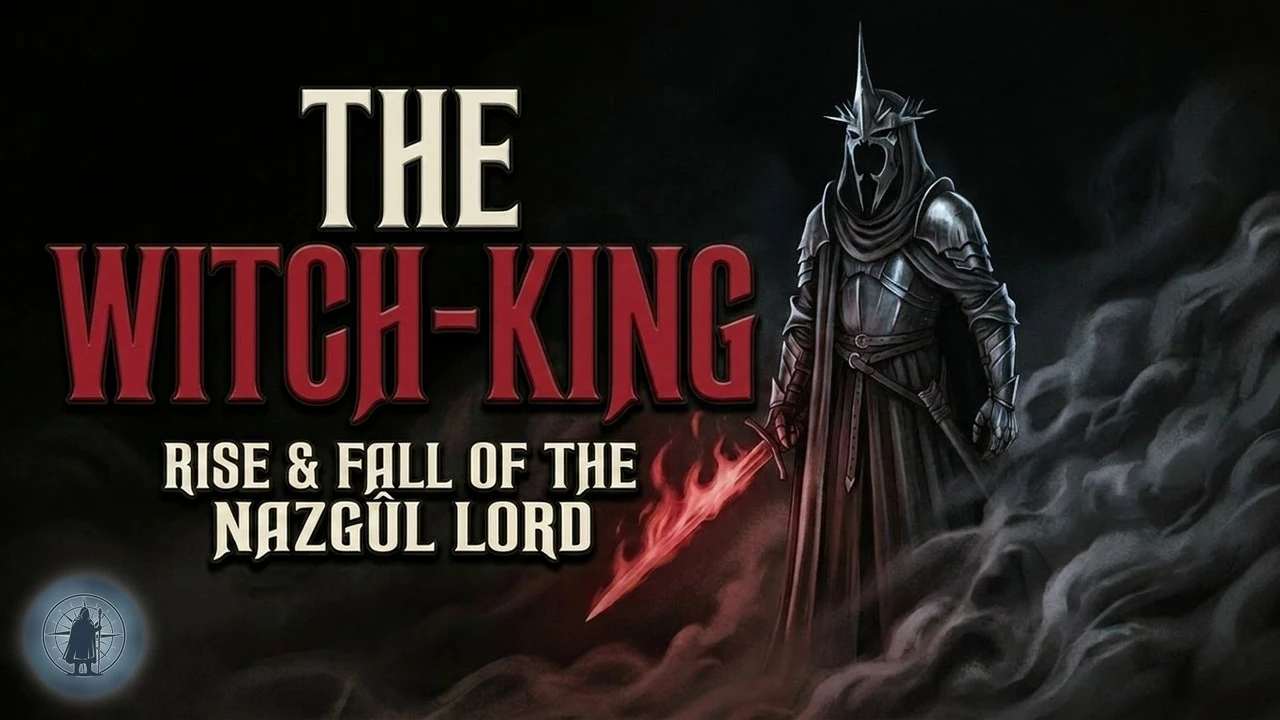 Watch the episode
Witch-king of Angmar: Rise & Fall of the Nazgul Lord | Tolkien Explained
Watch the episode
Witch-king of Angmar: Rise & Fall of the Nazgul Lord | Tolkien Explained
SECTION: The Crown on No Head
Start with the crown, because that's the whole riddle of him.
When the Lord of the Nazgûl rode through the broken Gate of Minas Tirith, Tolkien gives us one of the strangest images in all of his writing. "He wore a kingly crown," the text says, "and yet upon no head visible was it set. The red fires shone between it and the mantled shoulders vast and dark." That sentence is describing something pretty specific. A gold circlet. A robe. A pair of shoulders. And between the circlet and the black mantle - nothing. Firelight, shining straight through the gap where a face should be.
That gap is the whole point of him. This is a king with no head to wear it, a voice with no throat, a will with no man left to want anything. He calls himself Death and he is, in a sense, telling the truth - because there's almost nobody home.
He has many names and not one of them is his. The Witch-king. The Lord of the Nazgûl. The Lord of Morgul. The Black Captain. The Pale King. Every one of those is a title, an office, a job description. His actual name - the name his mother gave him, the name of the living man he used to be - Tolkien never tells us. That silence is deliberate - the most deliberate thing about the character. Somewhere back in the Second Age there was a mortal man, probably of Númenórean blood, a great king or a sorcerer or a warrior. Then Sauron handed him a Ring. And the man spent it - his life, his death, his name, his face - and bought power with the whole of himself.
The scholar Tom Shippey summed it up well. He said the Witch-king "hovers close to being an abstraction," a huge shadow that has thinned almost into an idea. The theologian George Hunsinger reached for a phrase from Karl Barth to describe this kind of evil - das Nichtige, "the nothingness" - a thing that is, in Barth's words, actual and yet empty at the same time. That's the paradox underneath everything that follows. The mace is real. It shatters shields. The voice is real. It curses Gandalf to his face. The terror is real, real enough to break an army. But the thing under the circlet is hollow all the way down.
We'll spend the rest of this story watching that emptiness build a kingdom, break a kingdom, and finally - a thousand years later - fall to a weapon it never saw coming.
SECTION: The Patient War
Here's the part people forget, because the films skip it and the emptiness is more fun to talk about. Before he was a monster in a horror-movie sense, the Witch-king was a general. A patient, methodical, frighteningly good general. And the war he fought is one of the longest sustained campaigns of evil anywhere in Tolkien.
Around the year 1300 of the Third Age, he appeared in the far North and founded a realm called Angmar - "Iron-home" - straddling the cold northern ends of the Misty Mountains, with its capital at Carn Dûm. The placement wasn't an accident. It was a knife laid against a throat. Just south of Angmar lay the wreckage of Arnor, the great North-kingdom of the Dúnedain, the sister-realm to Gondor. By this point Arnor had already broken itself into three feuding successor-states - Arthedain, Cardolan, and Rhudaur - that spent as much energy hating each other as guarding their borders. The Witch-king was clever. He looked at that division and built his fortress exactly where it would do the most damage.
Then, he took his time. This is what makes him so chilling as a strategist - he was in no hurry at all. In 1356 he killed Argeleb the First of Arthedain in battle. He corrupted the hill-men of Rhudaur, turning that realm into a vassal and a fifth column before he ever marched on it openly. In 1409 he launched his great assault - Cardolan overrun, Rhudaur swallowed, and the watchtower of Amon Sûl, the hill we know better as Weathertop, thrown down in fire. King Arveleg the First died there. Only the Elves of Lindon and Rivendell kept Arthedain from falling entirely that year.
And when a weapon better than any army came along, he used it. The Great Plague swept through in 1636, and it hit the Dúnedain of the North hardest of all. The Witch-king didn't cause the plague - but he read the map afterward and moved into the empty spaces. He sent evil spirits into the deserted grave-mounds of Cardolan, the Barrow-downs, to make sure the dead lands stayed dead and haunted. Those little details matter a lot here.
Finally, in 1974 - nearly seven centuries after he first appeared in the North - his forces overran Arthedain and took its last capital, Fornost. The North-kingdom of Arnor was finished. Its last king, Arvedui, fled into the ice of the far North and drowned in the Icebay of Forochel, taking two of the palantíri down with him.
Six hundred and seventy-four years, from the founding of Angmar to the fall of Fornost. He outwaited an entire civilization rather than raging his way to victory. Every one of those dead kings - Argeleb, Arveleg, Arvedui - was a patient move in a game the Dúnedain didn't realize they were losing until it was over.
SECTION: The Weapon of Despair
So how does a hollow thing break kingdoms? His real weapon was aimed at the mind, and it went to work long before any blade was drawn.
Tolkien keeps using the same word around him - despair. At the Gate of Gondor he is "a vast menace of despair." That's the weapon. Wherever the Nazgûl went they carried a cold pressure of the will, a certainty of defeat that soaked into everyone near them. Men threw down their weapons and ran, or simply stood and waited to die, because the wraith had quietly stolen their ability to imagine winning.
The Dúnedain had a name for the sickness the Ringwraiths left behind. They called it the Black Breath, or the Black Shadow - a creeping cold that pulled the living down into fever, into dark dreams, and finally into a sleep they never woke from. After the battle before Minas Tirith, three of the story's bravest people go down with it - Faramir, Éowyn, and Merry - and no ordinary healing touches them. It takes the hands of the true king, and the old herb-lore of athelas, to call them back. Their bodies were barely marked. It was their spirits the wraith-cold had gotten into.
There's a small, telling detail about just how heavy this dread was. When the Nazgûl were around, horses went mad with fear at the smell of them. Every mount in the story panics, bolts, throws its rider - every mount but one. Only Shadowfax, the greatest horse in Middle-earth, could carry a rider straight toward that fear and not break. The terror was a physical weight on the world, and it took something close to legendary to stand up under it.
But still - this is the crack in the weapon - the dread has a limit. It has a name that undoes it. On Weathertop, when the wraiths close in on Frodo, a wounded hobbit with a splinter of a Morgul-knife already working toward his heart, he does something that pushes them back. He cries out to Elbereth - Varda, the Valië who kindled the stars. And the chief of the Nazgûl, this towering menace, flinches. A being made mostly of shadow, recoiling from a name of light. The weapon of fear turns out to have one frequency it cannot stand to hear.
SECTION: The Prophecy and the Fall of Angmar
Now rewind to the fall of Fornost in 1974, because the very next year something happens that will pretty quietly decide everything - and almost nobody in the story understands it at the time.
Arnor is broken, but Gondor has not the people of the North. A great fleet comes up out of the South under the Gondorian prince Eärnur, and joins with the Elves - Círdan out of Lindon, and Glorfindel out of Rivendell. Together, in the year 1975, they completely smash the armies of Angmar at the Battle of Fornost. The realm the Witch-king spent six centuries building is destroyed in a single day. The Witch-king rides out in a last fury, and the Gondorian prince's horse bolts in terror - even Eärnur can't hold his mount steady before that face. The Witch-king wheels and vanishes north, and it looks, for a moment, like he may have gotten away.
Eärnur wants to chase him down. But here Glorfindel stops him, and says a few words that change the rest of the story. "Do not pursue him. He will not return to this land. Far off yet is his doom, and not by the hand of man will he fall."
That line rhymes with a play you already know. In Macbeth, the witches promise their man that "none of woman born" shall harm him, and Macbeth walks into his last battle wrapped in that promise like armor - right up until Macduff tells him he was ripped from his mother's womb, and the whole comfort collapses on a technicality. Tolkien had read Macbeth closely, and he thought Shakespeare cheated - that the payoff was a letdown, a riddle solved by a quibble. So he did it again, properly. "Not by the hand of man will he fall" is exactly that kind of prophecy. It sounds like a shield. It sounds like near-immortality. And it is true - completely, literally true - in a way that leaves a door wide open, if you are willing to think about what the word "man" is subtly not saying.
And here's a cruel part that mdoern readers have often pointed out. Over the thousand years between Fornost and the end, that careful foretelling seems to curdle in the retelling. By the time we reach the Witch-king's last night, it has hardened in his own mouth into a boast - "no living man may hinder me." He's taken a warning and remembered it as a guarantee. The loophole that was always sitting in Glorfindel's exact words has been sanded away by his own pride, until he can't see it anymore. His misreading is what kills him in the end - the words meant to warn him become the shield he dies behind.
SECTION: The Lord of Morgul
After Fornost, the Witch-king disappears from the North for good - but not from the story. Around 1980 he slips back to Mordor to meet up with the eight other Ringwraiths to him. And now, the pattern of the rest of his existence becomes clear. He has no plans of his own anymore. He never really did. He is a tool in a hand, and the hand is Sauron's.
And that's the second half of the emptiness. There's no man left inside the crown, and there's no independent will either. The Witch-king is an extension of his master, aimed and thrown. Sauron sends him to found Angmar; he founds Angmar. Sauron sends him to take a fortress; he takes it. And the terrible thing is how little difference it makes to the results. A slave with the power of a demigod is still a slave. His whole existence is on loan, and the loan is the One Ring - which is why, when that Ring finally goes into the fire, the Nazgûl don't fight on. They don't scatter. They don't survive. Instead, they end. Every one of them, gone within moments, because the will that was holding them together is gone.
But that ending is far off. In the meantime he's given a new seat, and it's a masterpiece of dark irony. Around the year 2000 the Nazgûl head out of Mordor and lay siege to Minas Ithil - the Tower of the Rising Moon. It is one of the fairest strongholds Gondor ever raised and guards the pass into the enemy's land. After two years, it falls. And the beautiful moon-tower becomes Minas Morgul, the Tower of Sorcery - a place of sickly, corpse-light glow that even brave men can't look at straight. Gondor built a fortress to keep the darkness out. The darkness moved in and lit the windows.
From that captured tower the Witch-king finishes a job he'd started centuries earlier - the slow murder of the kings of Men. Eärnur, the same prince whose horse failed at Fornost, is now King of Gondor, and the Witch-king remembers him. Twice he sends a challenge to single combat, a dare to the king's pride. The first time, Eärnur's steward Mardil holds him back. The second time, in the year 2050, the king can't stand it. He rides down to the gate of Minas Morgul with a small escort - and, in the flat, awful words of the chronicle, "none saw how they perished." The line of the Kings of Gondor ends there, swallowed at a dark gate. The Ruling Stewards begin, and Gondor waits a thousand years for a king to come back. The Witch-king had unmade two royal houses now, North and South. He was very good at his work.
SECTION: His Hour at the Gate
Everything comes to a head on a single grey morning in the year 3019, in front of the Great Gate of Minas Tirith.
He is at the absolute peak of his power. Sauron has crowned the assault of the age. The Lord of the Nazgûl leads it, mounted on a great winged beast, a leathery horror out of a forgotten age. His sorcerers and a monstrous battering-ram named Grond hammer the Gate that no enemy has ever broken - and words of power, spoken three times, blast it open. And then, in Tolkien's phrasing, "in rode the Lord of the Nazgûl. A great black shape against the fires beyond he loomed up, grown to a vast menace of despair." Everyone in the gateway flees. Everyone but one old man on a white horse.
Gandalf holds the broken arch alone, and tells him to go back - "Fall into the nothingness that awaits you and your Master." And the Witch-king does the thing he almost never does. He throws back his hood. There is the crown, and under it nothing, and two eyes of red flame in the empty air, and he laughs. "Old fool," he says. "Old fool! This is my hour. Do you not know Death when you see it? Die now and curse in vain!" In that instant he might be the most dangerous he's ever been. The duel we are bracing for is about to begin. And then a rooster crows, somewhere in the city - a small, stupid, living sound, a bird announcing a dawn it can't see. And under it, far off, the horns of Rohan. The Rohirrim have come. And the Witch-king, on the very edge of victory, turns his back on Gandalf and rides out to meet them - toward the field where his doom has been waiting for a thousand years.
On the Pelennor he does terrible work. He crushes King Théoden of Rohan under his own falling horse. And then one rider will not move - a slight, helmeted figure standing over the fallen king, refusing to give ground. The Witch-king meets it with the one belief he's never doubted. "Thou fool. No living man may hinder me!" There it is - the prophecy, coming out as a boast, said out loud one last time.
And then the helmet comes off. "But no living man am I! You look upon a woman. Éowyn I am, Éomund's daughter." She had been called Dernhelm; she is the niece of the king he just killed; and she is definitely, not a man. The loophole in Glorfindel's thousand-year-old sentence has just walked onto the field and taken off its helmet.
It takes two to take down this type of evil. Éowyn strikes the head from the winged beast. The Witch-king shatters her shield and breaks her shield-arm with his mace. For a moment, she's finished - except that down by his knees, another figure the Witch-king never notice has crept close. Merry, the hobbit, drives a blade into the back of his knee. The wraith cries out, and buckles. And Éowyn, with her last strength, drives her sword between the crown and the mantle, into the empty place where a face should be. "The mantle and hauberk were empty. Shapeless they lay now on the ground." A cry goes up "into the shuddering air, and faded to a shrill wailing, passing with the wind, a voice bodiless and thin that died, and was swallowed up, and was never heard again in that age of this world."
Sauron's greatest captain, conquered by a woman and a hobbit. The two people a warrior-king would never bother to fear.
SECTION: The Blade from the Grave
But there's a line in that death-scene most people read straight past, and it holds the real ending. It's about Merry's knife.
Tolkien stops the action cold to tell us that this was no ordinary blade. "No other blade," he writes, "not though mightier hands had wielded it, would have dealt that foe a wound so bitter, cleaving the undead flesh, breaking the spell that knit his unseen sinews to his will." Éowyn's sword lands the killing stroke - but it only works because Merry's little knife has already broken the spell holding the wraith together. Without that first cut behind the knee, the wraith stays whole and the sword finds nothing to kill. So where did a hobbit get a blade that can wound a Witch-king?
Let's unwrap it a bit. Trace it back. Merry's knife is a barrow-blade, out of the Barrow-downs - one of the swords the four hobbits pulled from a grave-mound early in their journey. It was handed to them by Tom Bombadil. Those blades were old and Númenórean, forged long ago by the Dúnedain of the North-kingdom. Forged, the tale says, by the men of Arnor - and forged specifically for war against Angmar. Against the Witch-king's own realm.
Now, the two ends of his life snap together. In the second act of this story, he spent six centuries grinding the North-kingdom into dust - killing its kings, emptying Cardolan, filling its graves with wights so the dead lands would stay dead. And it was in exactly those graves, in the barrows of the realm he destroyed, that the weapon which would kill him lay waiting. The smiths who made that knife were more than a thousand years dead. The kingdom that armed itself against him was a memory. He had won that war so completely that he'd forgotten it was ever fought. And the whole time, the answer to him was lying in the ground of his greatest victory, wrapped in the dust of the people he'd murdered, just waiting for a hobbit's hand.
And that's how he ends. Not a villain undone by a hero's strength - he was stronger than anyone who faced him that day. He was undone by his own history, reaching up out of the grave he'd dug for it. The barrow he haunted armed the hand that killed him. The prophecy he misremembered named the woman who found him. Everything he did to make himself safe was quietly building the thing that would end him.
Whether that's fate or a thousand-to-one accident, Tolkien never quite says. He probably means for you to feel both. Maybe some greater power guided that blade into that grave and that hobbit into that fight. Or maybe the world is just built so that a power that spends itself entirely on domination will, sooner or later, be handed the bill by the very things it thought it had crushed. Either way, the crown came down. And between the gold and the mantle, where a face should have been, there was only the wind.