
Research & Sources
Witch-king of Angmar
Rise & Fall of the Nazgul Lord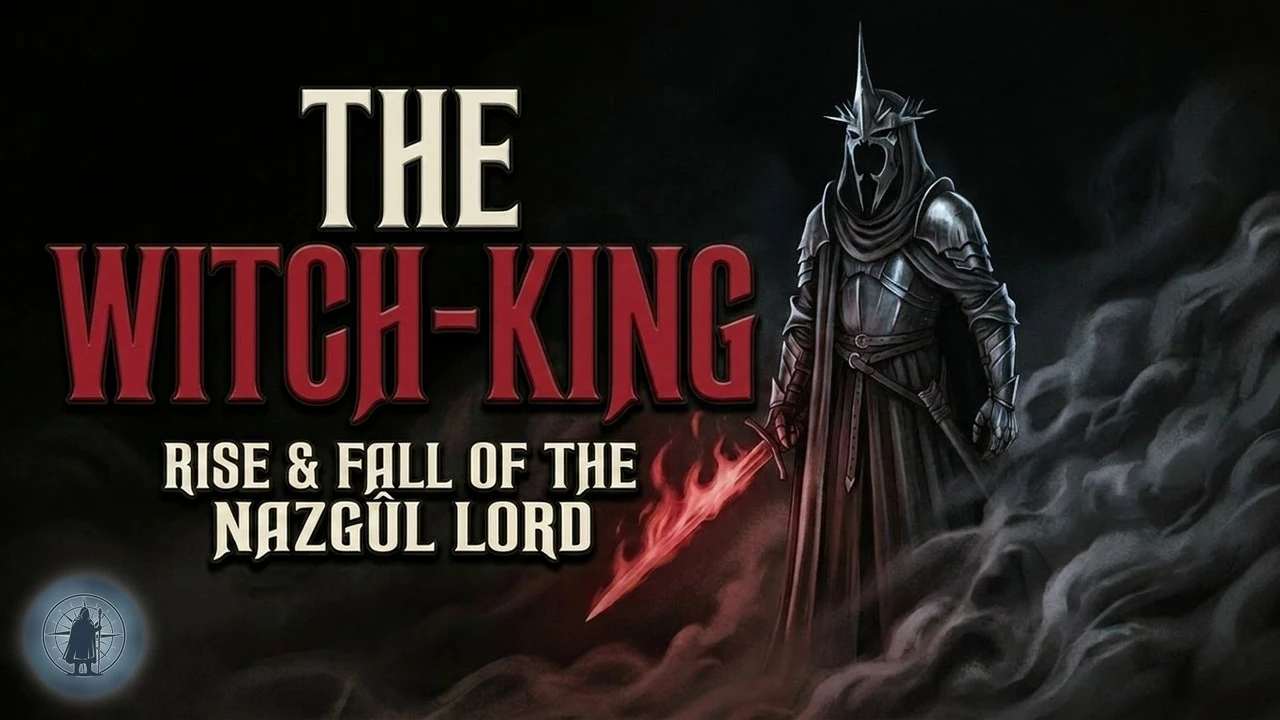 Watch the episode
Witch-king of Angmar: Rise & Fall of the Nazgul Lord | Tolkien Explained
Watch the episode
Witch-king of Angmar: Rise & Fall of the Nazgul Lord | Tolkien Explained
Research Notes: The Witch-king of Angmar
Overview
The Witch-king of Angmar is the chief of the Nazgûl (Ringwraiths), the Lord of the Nine Riders, and Sauron's most feared servant and greatest captain. He is a figure who spans nearly the entire arc of Middle-earth's later history: a mortal Man of (probably) Númenórean blood who accepted one of the Nine Rings of Power in the Second Age, was consumed into wraith-hood, founded and ruled the northern realm of Angmar for centuries in the Third Age, single-handedly engineered the destruction of the Dúnedain kingdom of Arnor, became the Lord of Morgul ruling from a captured Gondorian fortress, extinguished the line of the Kings of Gondor, and finally led Sauron's armies in the War of the Ring — only to be slain at the Battle of the Pelennor Fields by a woman and a hobbit, fulfilling a prophecy spoken a thousand years earlier.
He is Tolkien's fullest study of the Ring-corrupted mortal: a king who traded his life and name for power and became, in the end, a crown set upon no head — "a vast menace of despair," a being who called himself Death and yet was empty at the core. His story is the channel's ideal subject because it braids together nearly every age and theme: the seduction of the Rings, the long defeat of the Dúnedain, the deceptive prophecy, and the overthrow of the mighty by the overlooked.
Primary Sources
The Lord of the Rings (main narrative)
- Weathertop (Book I, ch. 11, "A Knife in the Dark"): The Witch-king leads the attack on Frodo's camp and stabs him in the shoulder with a Morgul-knife, a splinter of which breaks off and works toward Frodo's heart to make him a wraith under the Nazgûl's dominion. Frodo cries "O Elbereth! Gilthoniel!" and strikes at the chief Rider's foot; Elbereth's name is "a name of terror for the Nazgûl." - The Gate of Minas Tirith (Book V, ch. 4, "The Siege of Gondor"): The most powerful description of the Witch-king at his height. "In rode the Lord of the Nazgûl. A great black shape against the fires beyond he loomed up, grown to a vast menace of despair." His crown is described: "there rode a great shape... he wore a kingly crown, and yet upon no head visible was it set. The red fires shone between it and the mantled shoulders vast and dark." - Gandalf's defiance at the Gate: "You cannot enter here... Go back to the abyss prepared for you! Go back! Fall into the nothingness that awaits you and your Master. Go!" The Witch-king answers: "Old fool! Old fool! This is my hour. Do you not know Death when you see it? Die now and curse in vain!" He flings back his hood, revealing his empty crown; a cock crows in the City, and the horns of Rohan sound — the Witch-king turns away to meet the new threat, and the duel with Gandalf never happens. - The Battle of the Pelennor Fields (Book V, ch. 6): The Witch-king, mounted on a fell winged beast, mortally wounds King Théoden (crushed under his horse Snowmane). Éowyn (disguised as "Dernhelm") stands alone with Merry. The exchange: - Witch-king: "Hinder me? Thou fool. No living man may hinder me!" - Éowyn: "But no living man am I! You look upon a woman. Éowyn I am, Éomund's daughter. You stand between me and my lord and kin. Begone, if you be not deathless! For living or dark undead, I will smite you, if you touch him." - She beheads the winged beast; the Witch-king breaks her shield and shield-arm with his mace; Merry stabs him behind the knee with a barrow-blade of Westernesse; Éowyn drives her sword "between crown and mantle." - Death: "the mantle and hauberk were empty. Shapeless they lay now on the ground... and a cry went up into the shuddering air, and faded to a shrill wailing, passing with the wind, a voice bodiless and thin that died, and was swallowed up, and was never heard again in that age of this world." - Key footnote on Merry's role: "for it is said in the songs of the Mark that in this deed Éowyn had the aid of Théoden's esquire, and that he also was not a Man but a Halfling out of a far country." - The barrow-blade's significance: "No other blade, not though mightier hands had wielded it, would have dealt that foe a wound so bitter, cloving the undead flesh, breaking the spell that knit his unseen sinews to his will." The blade was forged by the Dúnedain of the North-kingdom (Arnor) specifically against the realm of Angmar — the kingdom the Witch-king himself had destroyed.
The Lord of the Rings — Appendix A (The North-kingdom and the Dúnedain)
- Glorfindel's prophecy at the Battle of Fornost (T.A. 1975), spoken to restrain King Eärnur of Gondor from pursuing the fleeing Witch-king: "Do not pursue him! He will not return to this land. Far off yet is his doom, and not by the hand of man will he fall." (Appendix A) — the pivotal prophecy of the episode. - The account of Eärnur: the Witch-king, now Lord of Morgul, twice sends Eärnur a taunting challenge to single combat. Restrained the first time by his Steward Mardil, Eärnur rides out on the second challenge (2050) "with a small escort of knights of his household" to the gate of Minas Morgul, and "none saw how they perished." The Witch-king thus ends the line of the Kings of Gondor.
The Lord of the Rings — Appendix B (The Tale of Years)
The primary source for the dated chronology (see Timeline below). Key: the Nine Rings given to mortal Men in the Second Age; the Nazgûl first appear c. S.A. 2251; the Witch-king reappears and founds Angmar c. T.A. 1300; the fall of Fornost 1974; Fornost battle 1975; the taking of Minas Ithil 2002; Eärnur lost 2050.
Unfinished Tales — "The Hunt for the Ring"
- Christopher Tolkien's edition provides the fullest late-life material on the Witch-king's nature. It states the chief of the Ringwraiths was of Númenórean origin and had been the ruler of a northern kingdom with its capital at Carn Dûm. - On the disposition of the Nazgûl in 3018: seven Ringwraiths under the Witch-king were housed in Minas Morgul; two (including Khamûl the Easterling) at Dol Guldur. - Analyzes the Witch-king's psychology during the Hunt — his fear when Frodo invokes Elbereth, and the suggestion that he (rather than a random accident) may have set the Barrow-wight in the Barrow-downs. Notes the Nazgûl's terror is greatest when concentrated, and that their chief was the most potent. - Sauron's June 3018 double stroke: orcs sent against Thranduil's realm (to free/recover Gollum) and the Witch-king leading an assault on Osgiliath/Gondor to test Denethor's strength — the pretext under which the Nazgûl crossed the Anduin to begin the hunt for the Shire.
The Letters of J.R.R. Tolkien
- Tolkien discusses the nature of the Ringwraiths: mortal Men enslaved by the Nine Rings, who "became for ever invisible save to him that wore the Ruling Ring, and they walked in the twilight world under the eye of the Dark Lord." Their power and permanence depend wholly on Sauron and the One Ring — when the One is destroyed, the Nazgûl are unmade. - On the Macbeth prophecy device (frequently cited via Shippey rather than a single letter): Tolkien found the "no man of woman born" and "Birnam wood" prophecies in Macbeth to be anticlimactic cheats, and is understood to have written both "properly" into his own tale — the marching of the Ents/Huorns on Isengard (a wood that truly walks) and the Witch-king felled by a woman and a hobbit (a foe truly not a "man").
Timeline (Third Age unless noted)
- Second Age c. 1600–1697: Sauron forges the Rings; the Nine given to mortal Men, "great kings, sorcerers, and warriors of old" (from the Ring-verse tradition and The Silmarillion, "Of the Rings of Power"). - S.A. c. 2251: The Nazgûl first appear; the Witch-king is among them, though his mortal identity is never named. - T.A. c. 1300: The Nazgûl reappear in the north. The Witch-king founds the realm of Angmar east and west of the northern Misty Mountains, capital at Carn Dûm; he is henceforth known as the Witch-king / Lord of Angmar. (Appendix B) - T.A. 1356: King Argeleb I of Arthedain slain in war with Rhudaur and Angmar. (Appendix B) - T.A. 1409: The great assault — Angmar overruns Cardolan, defeats Rhudaur (already fallen under Angmar's sway via evil Hill-men), destroys the watchtower of Amon Sûl (Weathertop); King Arveleg I slain. The Elves of Lindon and Rivendell prevent total conquest of Arthedain. (Appendix B) - T.A. 1636–37: The Great Plague devastates the surviving Dúnedain. The Witch-king sends evil spirits — the Barrow-wights — into the Barrow-downs (Tyrn Gorthad) of the deserted realm of Cardolan. (Appendix B) - T.A. 1974: The Witch-king's forces overrun Arthedain and capture Fornost Erain; the North-kingdom of Arnor falls. (Appendix B) - T.A. 1975: King Arvedui, Last-King of Arthedain, flees north and drowns in the Icebay of Forochel (the palantíri of Annúminas and Amon Sûl lost with him). A Gondorian army under Prince Eärnur, with Círdan of Lindon and Glorfindel of Rivendell, destroys the armies of Angmar at the Battle of Fornost. The Witch-king challenges Eärnur, whose horse bolts; he flees, and Glorfindel speaks his prophecy. Angmar is destroyed as a realm. (Appendix A & B) - T.A. 1980: The Witch-king returns to Mordor and gathers the other eight Ringwraiths. (Appendix B — the same year Durin's Bane, unrelated, drives the Dwarves from Moria.) - T.A. 2000–2002: The Nazgûl issue from Mordor and besiege Minas Ithil; after two years it falls (2002). The city becomes Minas Morgul; its palantír (the Ithil-stone) is taken by Sauron. The Witch-king becomes the Lord of Morgul. (Appendix B) - T.A. 2043 & 2050: Eärnur, now King of Gondor, is challenged to single combat by the Witch-king; restrained by his Steward Mardil in 2043, he rides out at the second challenge (2050) and is never seen again. The line of the Kings of Gondor ends; the Ruling Stewards begin. (Appendix A & B) - T.A. 3018: The War of the Ring. June 20: assault on Osgiliath. The Nazgûl cross the Anduin (the Hunt for the Ring). Sept 22: Rangers driven from Sarn Ford; the Riders enter the Shire. Oct 6: Weathertop — Frodo stabbed with the Morgul-knife. Oct 20: the Nazgûl swept away at the Ford of Bruinen (Elrond's flood); they return unmounted to Mordor. (Appendix B) - T.A. 3019: March 10, the Morgul-host issues from Minas Morgul under the Witch-king. March 13: Anduin crossing won; Faramir retreats. March 15: the Siege of Minas Tirith — the Witch-king breaks the Great Gate with the ram Grond and sorcery, confronts Gandalf, then is called away by the Rohirrim's horns; at the Battle of the Pelennor Fields he slays Théoden and is himself slain by Éowyn and Merry. (Appendix B; Book V)
Key Characters
- The Witch-king / Lord of the Nazgûl / Lord of Morgul / Black Captain / the Pale King: chief of the Nine, Sauron's greatest captain and most feared servant. Mortal Man, probably of Númenórean descent; identity/name never given by Tolkien. - Sauron: his master; the Witch-king's power, will, and very existence are bound to Sauron and the One Ring. - Glorfindel (of Rivendell): Elf-lord who rides at the Battle of Fornost and utters the prophecy of the Witch-king's doom. - Eärnur: Prince, then King, of Gondor. Present at Fornost (whose horse fails before the Witch-king), and later lured to his death at Minas Morgul (2050) — a personal, decades-spanning rivalry. Son of King Eärnil II. His loss ends the Kings of Gondor. - Argeleb I, Arveleg I, Arvedui: Kings of Arthedain, all destroyed or slain in the Angmar wars — the human cost of the Witch-king's campaign. - Éowyn: Lady of Rohan, "Dernhelm," slayer of the Witch-king ("no living man am I"). - Meriadoc (Merry) Brandybuck: hobbit whose barrow-blade of Westernesse breaks the spell binding the Witch-king, enabling Éowyn's killing stroke. - Théoden: King of Rohan, mortally wounded by the Witch-king at Pelennor. - Khamûl the Easterling: second of the Nazgûl, the Witch-king's chief lieutenant (stationed at Dol Guldur). - Mardil Voronwë: Steward who twice restrains Eärnur; founder of the Ruling Stewards.
Geography
- Angmar: "Iron-home." A realm founded c. T.A. 1300 straddling the northern ends of the Misty Mountains, in the cold lands about Mount Gundabad. Its purpose was strategic: to lie athwart the Dúnedain successor-states and destroy them. - Carn Dûm: capital of Angmar, in the northwestern spur of the Misty Mountains. Name uncertain; often glossed "Red Valley" (Sindarin carn "red" + tûm "valley"). - Arnor / Arthedain / Cardolan / Rhudaur: the North-kingdom and its three feuding successor-realms, the targets of the 675-year war of attrition. Their division was the weakness the Witch-king exploited. - Fornost Erain ("Norbury of the Kings"): last capital of Arthedain, captured 1974; the fall of the North-kingdom. - Amon Sûl / Weathertop: hilltop watchtower with a palantír, destroyed 1409; later the site of Frodo's wounding in 3018 — a location bookending the Witch-king's story. - Barrow-downs (Tyrn Gorthad): haunted with wights sent by the Witch-king after the Plague. - Minas Ithil → Minas Morgul ("Tower of the Rising Moon" → "Tower of Sorcery/Dark Sorcery"): the Gondorian fortress guarding the pass into Mordor, captured 2002 and made the Witch-king's seat and the Nazgûl's fortress. - Minas Tirith / Pelennor Fields: the site of his final battle and death, T.A. 3019.
Themes & Symbolism
- Kingship inverted: he was a king who became a wraith; his crown sits on no head; he rules by terror, not stewardship. He is the dark mirror of the returning true king (Aragorn) — Fleming Rutledge contrasts the invisible "pale king" of destruction with the hidden, healing king of restoration. - The seduction of the Rings: the Witch-king is the ultimate cautionary example of what the Nine do to mortals — power purchased with the annihilation of the self. - Evil as nothingness (Boethian): Tom Shippey reads him as "hover[ing] close to being an abstraction," a shadow who names himself Death. Theologian George Hunsinger links this to Karl Barth's das Nichtige — "actual and yet empty at the same time." His mace, his crown, his voice are all present; the man is gone. - Terror as a weapon: the "Black Breath," the aura of despair, the will-sapping dread — the Nazgûl fight the mind before the body. - Fate and the deceptive prophecy: Glorfindel's foretelling operates like the Macbeth prophecies — literally true, deceptively reassuring, and fulfilled through a loophole the proud enemy never imagined. - The overlooked overthrow the mighty: the woman and the hobbit — the two figures a warrior-king would most dismiss — undo Sauron's greatest captain. Tolkien's recurring conviction that history turns on the "small hands" while the eyes of the great are elsewhere. - The long defeat and posthumous justice: the very kingdom he destroyed (Arnor) forged, centuries earlier, the one blade that could kill him — Merry's barrow-sword. The North gets its revenge from beyond its own grave.
Scholarly Interpretations & Theories
- Tom Shippey (The Road to Middle-earth, J.R.R. Tolkien: Author of the Century): the Witch-king as Boethian "absence of good," an abstraction of despair; and the Macbeth connection — Tolkien "read Macbeth closely" and redeemed its cheated prophecies by making his own come literally true. - George Hunsinger / Karl Barth: the Witch-king as das Nichtige, "nothingness" that is nonetheless "an active cosmic power, a power of destruction... actual and yet empty." - Fleming Rutledge (The Battle for Middle-earth): the pale, invisible king vs. the true hidden king — a theological reading of destruction against restoration/providence. - Jeff LaSala (Tor essay): explores how Glorfindel's precise words ("not by the hand of man") may have been softened over a thousand years of retelling into the Witch-king's own overconfident boast ("no living man may hinder me"), so that his hubris is built on a corrupted memory of the very prophecy that dooms him. - On his identity: fan and scholarly debate over whether the Witch-king is one of the named Númenórean lords (e.g., a Black Númenórean king). Tolkien deliberately left him nameless; the "Númenórean origin" note in Unfinished Tales is the strongest canonical hint, not a settled identity.
Contradictions & Different Versions
- "Wizard King" draft name: Tolkien's early drafts called him the "Wizard King," raising the possibility he was once conceived as more overtly a sorcerer; the published text settles on a corrupted mortal king, not an Istar. (History of Middle-earth drafting material.) - The prophecy's exact wording varies slightly in retelling: Appendix A gives "not by the hand of man will he fall"; it is popularly quoted as "not by the hand of man shall he fall." Both circulate; the "will" form is the Appendix A text. - Glorfindel as prophet vs. the Witch-king's boast: the two lines ("not by the hand of man" vs. "no living man may hinder me") are sometimes conflated. They are distinct — one Glorfindel's foretelling (1975), the other the Witch-king's own words at Pelennor (3019). The overlap is thematic, not textual. - Carn Dûm etymology is uncertain; "Red Valley" is a favored but not authorial gloss (David Salo). Early manuscript names (Carndoom / Caron-dûn) attached to Dimrill Dale, not Angmar. - Barrow-wights' origin: the Appendix/Unfinished Tales attribute their sending to the Witch-king/Angmar after 1636; the degree of his direct agency vs. general evil is a matter of emphasis across texts.
Cultural & Linguistic Context
- Nazgûl: Black Speech, nazg ("ring") + gûl ("wraith/spirit; sorcery"). Nazg is echoed in the Ring-inscription ("ash nazg durbatulûk"). Tolkien thought it "probable" nazg was subconsciously derived from Irish nasc ("bond, link"). Gûl also carries the sense of necromantic "magic" (cf. Dol Guldur, "Hill of Sorcery"), with a fortuitous English echo in "ghoul." - Angmar: Sindarin/Quenya "Iron-home" (anga "iron" + mbar "dwelling/home"); pure Sindarin would be Angbar, pure Quenya Angamar. - Minas Morgul: "Tower of Sorcery / Dark Sorcery" (minas "tower" + mor "dark/black" + gûl "sorcery"), renamed from Minas Ithil, "Tower of the (Rising) Moon." - Macbeth: the "no man of woman born" prophecy is the acknowledged literary ancestor of the Witch-king's doom; Tolkien is understood to have deliberately "done it properly."
Questions & Mysteries
- Who was he before the Ring? Tolkien never names him. The strongest hint is "of Númenórean origin, king with capital at Carn Dûm" — but was he a Black Númenórean, a lord of the Númenórean colonies, or something else? Deliberately unanswered. - How much of the "no man" fulfillment is fate vs. accident? Was Éowyn's presence providential (eucatastrophe) or chance? The text keeps both readings alive. - Did the Witch-king know the prophecy? His boast "no living man may hinder me" suggests he trusted it — the question is whether pride blinded him to its loophole. - Why does Elbereth's name terrify him so? The Nazgûl's fear of the Valië Varda invites theological reading — the wraith of nothingness recoiling from the light of the Kindler of Stars.
Compelling Quotes for Narration
1. "In rode the Lord of the Nazgûl. A great black shape against the fires beyond he loomed up, grown to a vast menace of despair." — The Return of the King, "The Siege of Gondor" 2. "This is my hour. Do you not know Death when you see it? Die now and curse in vain!" — The Witch-king to Gandalf, ROTK, "The Siege of Gondor" 3. "You cannot enter here... Fall into the nothingness that awaits you and your Master." — Gandalf, same scene 4. "Far off yet is his doom, and not by the hand of man will he fall." — Glorfindel, ROTK, Appendix A 5. "Hinder me? Thou fool. No living man may hinder me!" — the Witch-king at Pelennor 6. "But no living man am I! You look upon a woman. Éowyn I am, Éomund's daughter." — Éowyn, ROTK, "The Battle of the Pelennor Fields" 7. "No other blade... would have dealt that foe a wound so bitter... breaking the spell that knit his unseen sinews to his will." — ROTK, on Merry's barrow-blade 8. "A cry went up into the shuddering air, and faded to a shrill wailing... a voice bodiless and thin that died, and was swallowed up, and was never heard again in that age of this world." — his death, ROTK
Visual Elements to Highlight
1. The founding of Angmar — a black tower rising at Carn Dûm in the cold northern mountains. 2. The 1409 assault on Amon Sûl / Weathertop, its watchtower burning. 3. Glorfindel on his white horse restraining Eärnur amid the rout of Fornost, speaking the prophecy. 4. The two-year siege of Minas Ithil; the moon-tower going dark and becoming Minas Morgul, sickly and luminous. 5. Grond battering the Great Gate of Minas Tirith; the Witch-king riding through the shattered arch, crown on no head, red fire between crown and shoulders. 6. Gandalf on Shadowfax alone before the broken Gate; the cock's crow; the horns of Rohan. 7. Éowyn unhelming before the winged beast; Merry's blade behind the knee; the empty mantle collapsing.