Transcript
The Watcher in the Water
What Gnaws Beneath Moria?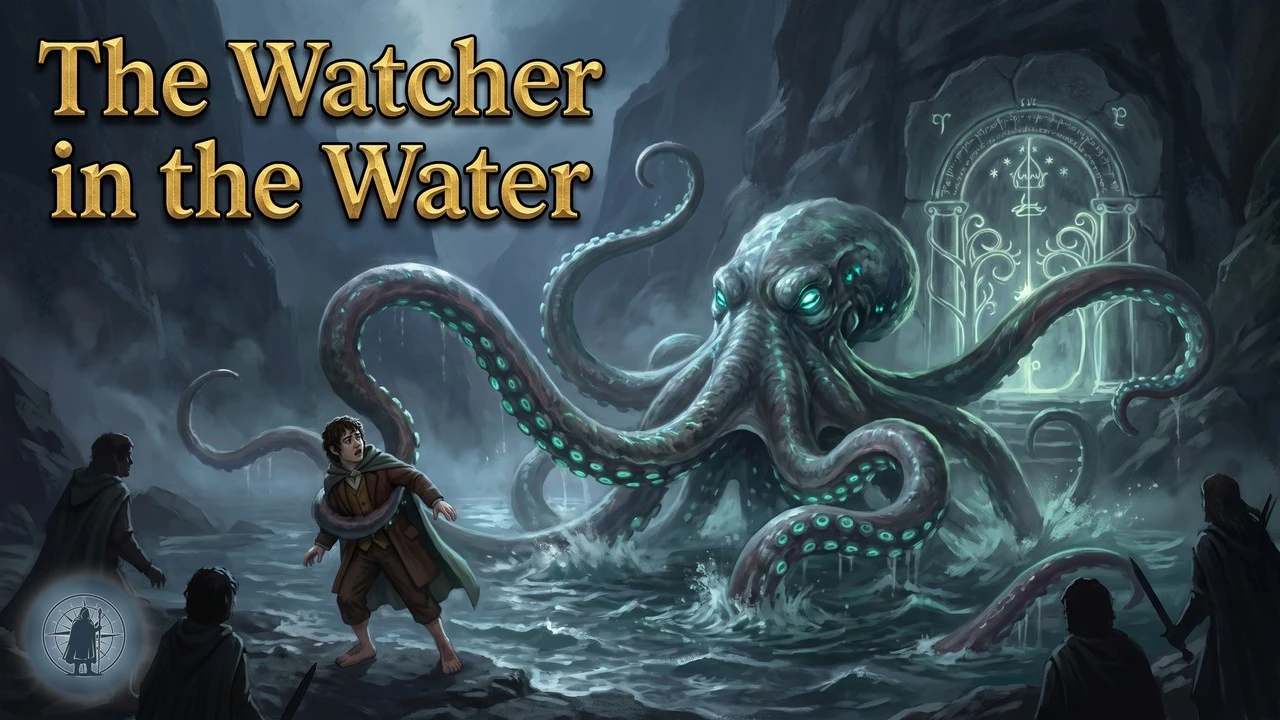 Watch the episode
The Watcher in the Water: What Gnaws Beneath Moria?
Watch the episode
The Watcher in the Water: What Gnaws Beneath Moria?
SECTION: The Echo Across Two Books
Two passages, in two different books, both spoken by Gandalf. They are separated by hundreds of pages and by the wizard's own death. And they share almost the same words.
The first comes in The Fellowship of the Ring, just outside the West-gate of Moria, after a many-armed creature has hauled itself out of a stagnant pool and tried to drag Frodo into the water. The Fellowship slams the doors. Stones fall against them on the far side. Holly-trees are torn down. And Gandalf, standing in the dark with the company shaken and bleeding, says this:
"There are older and fouler things than Orcs in the deep places of the world."
The second comes much later, in The Two Towers. Gandalf has died, fallen with the Balrog through fire and water and stone, and walked some impossible road below the deepest places of Khazad-dûm. He has come back unbodied, and then rebodied, and now sits with Aragorn and Legolas and Gimli in Fangorn, recounting the descent. He tells them this:
"Far, far below the deepest delving of the Dwarves, the world is gnawed by nameless things. Even Sauron knows them not. They are older than he."
Listen to the lexicon. Older. Deep places. The world. The same character, with the same authority, returning to the same vocabulary across two books and a death.
Tolkien is not a careless writer. He does not repeat himself by accident. The echo is the door this entire episode walks through — because the moment a careful reader notices it, a question becomes unavoidable.
Are the two creatures connected?
Is the thing in the pool at the West-gate one of the things gnawing below? Is the Watcher in the Water a Nameless Thing that climbed?
The honest answer is that Tolkien never tells us. But the honest answer is also that he wrote those two passages exactly as he wrote them — and the shared language is the most concrete in-text evidence we have that he wanted us, at minimum, to feel the connection. Whatever else is true about these two creatures, they were placed in the prose by the same lexicon. That is the textual fact this whole investigation rests on.
SECTION: The Vertical Stack of Moria
To understand what "below the Balrog" actually means, the geography needs to come first. Most readers picture Moria as a single dark space — vast halls, a bridge, a chasm. The reality, as Tolkien constructed it, is a vertical stack at least four layers deep.
At the top, seven great halls carved into the bones of the Misty Mountains. The Twenty-first Hall. The Chamber of Mazarbul. The pillared galleries of Durin's folk above-ground in stone.
Below that, the Deeps. Sub-levels descending through generations of dwarvish excavation. This is where the mithril was — the silver-steel of Khazad-dûm, the metal that made Durin's people the richest line in Middle-earth.
Below the Deeps lies the Bridge of Khazad-dûm. Fifty feet of unrailed stone across the Black Chasm. Tolkien gives the chasm no measured depth. He says only that it is bottomless, which in a literal-minded reading means he is using an old narrative word for "I am declining to specify."
And below the bridge — somewhere in the fire and shadow that Gandalf called Durin's Bane — lived the Balrog. A Maia, fallen with Morgoth in the First Age, hidden in the roots of the mountain since the War of Wrath had broken Angband and scattered the surviving servants of the Enemy. The dwarves of Durin VI woke it in the year 1980 of the Third Age, mining "too greedily and too deep" after fresh seams of mithril. Durin VI died that year. His son fell the next. Khazad-dûm became Moria — the Black Pit — and was abandoned in 1981.
But here is the line that changes everything we thought we knew about the bottom of the world.
When Gandalf tells the three hunters about his fall and the long fight in the deep, he says he pursued the Balrog through "dark tunnels." And then this:
"They were not made by Durin's folk, Gimli son of Glóin. Far, far below the deepest delving of the Dwarves, the world is gnawed by nameless things."
Read that line as a structural claim. The Balrog's domain — the fire and the chasm and the shadow that broke an empire — is not the bottom. There is a layer beneath. Tunnels not cut by the dwarves and not, by implication, cut by the Balrog either. Something else made them, and is still making them, by eating the rock.
And the Balrog used those tunnels as a highway. Gandalf adds: "too well he knew them all." A creature of fire, an ancient Maia of Morgoth's host, treats the gnawn passages below his own abyss as familiar ground. He did not make them. He simply lives upstairs from whatever did.
From those bottom tunnels rises the Endless Stair — a single spiral of stone climbing through the living rock of Celebdil all the way to Durin's Tower at the summit. Roughly seven thousand meters of ascent. The dwarves believed the Endless Stair lost in legend. It was not lost. It was buried beneath them, beginning in a layer they had never reached.
So the picture is this. Halls. Mines. Bridge and chasm. Balrog. And beneath the Balrog, gnawed tunnels more ancient than the Balrog's awareness of them. Four layers. And the moment we have that vertical stack in mind, the question of the Watcher reframes itself. Because the Watcher does not live in any of the upper layers. The Watcher lives in water, at the western face of the mountain, in a pool that did not exist when the dwarves built the gate.
The river Sirannon — the Gate-stream — was dammed. By what, Tolkien does not say. But something dammed it, and the pool rose, and what was in the pool was not there when Celebrimbor's people walked these stones.
SECTION: The Three Doors
So what is it? What is the Watcher, and what are the Nameless Things, and how do they relate?
Three major frameworks have been built around these questions. Each opens a different door onto a possible answer. Each has canonical support. None is complete.
The first door is the Same-Being theory. It is the most popular reading on the open internet, and it has real textual weight behind it. The argument runs: the verbal echo between Gandalf's two passages is not accidental; the geography of Moria allows for routes between the deepest gnawn tunnels and the western face of the mountain through cracked rock; the Sirannon was dammed by something with both purpose and reach; the Watcher's tentacles, Gandalf notes, were "all guided by one purpose," implying a controlling intelligence; therefore the Watcher is one of the things from below, surfaced through fissures into a flooded gatehouse pool. Tidy. Elegant. It explains the echo by collapsing two creatures into one.
The second door is the Discord-of-the-Music theory. This one draws on a passage Tolkien wrote not for the published narrative but for his late theological essays — collected by Christopher Tolkien in the volume Morgoth's Ring, under the heading "Notes on Motives in The Silmarillion." Here Tolkien proposes a category of evil that has fascinated scholars ever since. Quote:
"Out of the discords of the Music — not directly out of either of the themes, Eru's or Melkor's, but of their dissonance with regard one to another — evil things appeared in Arda, which did not descend from any direct plan or vision of Melkor: they were not his children; and therefore, though they might hate him, they did not love him either."
Set that beside what Gandalf says about the things that gnaw. Evil that descended from neither Eru's theme nor Melkor's, but from the interaction between them. Authored by no one. Prior to any servant of Morgoth, because it emerged during the Music itself, before Eä was fully made. This is the only frame in Tolkien's own writing that opens enough space for what Gandalf describes — beings so primordial that Sauron, the most knowledgeable evil in Middle-earth, does not register their existence.
The third door is the Ungoliant-Kin theory. The Silmarillion tells us that Ungoliant — the spider-shape who drank the light of the Two Trees — "descended from the darkness that lies about Arda." Not from the thought of Ilúvatar. Not from the Ainur who entered Eä. From the darkness around the world. She is the canonical template for old evil from outside the system, and she carries Quenya names that mean Unlight and Queen of the Unlight: Úcal, Úcalatári. The gnawing things, on this reading, are her kindred — not literal offspring, but spirits of similar origin. Aquatic things, gnawing things, devouring things that have no allegiance and no master.
Three doors. Three frames. And each, on its own, accounts for some of the evidence but not all of it.
What is striking is that the three theories are not mutually exclusive. The Discord and the Ungoliant-Kin readings may be the same reading expressed in different idioms — both describe primordial spirits outside the standard Ainur descent. And the Same-Being theory could sit on top of either, as a particular case of what surfaces.
But there is one detail, in the FOTR passage, that strains every one of these theories at once. And it is the detail most readings rush past.
SECTION: The Hand That Knew the Ring
When the Watcher reaches out of the pool at Moria's West-gate, it does not grab Aragorn. It does not grab Boromir, the tallest target in the company. It does not grab Sam, who is closest to Frodo. Tolkien is explicit:
"Of all in the Company it took Frodo."
Of all in the company. Out of nine — wizard, ranger, prince of Gondor, four halflings, a dwarf, an elf — the tentacle finds the hobbit who carries the Ring.
Gandalf notices. Privately, after the doors are shut, he observes that the arms "were all guided by one purpose." There is a mind behind the strike. The Watcher is not flailing. The Watcher is aiming.
And the aim is the problem.
Because here is what is hard to reconcile. A Nameless Thing — a creature so ancient that Sauron does not know of it, so old that it arose before the Dark Lord's lieutenancy or possibly before the descent of the Ainur into Eä — should not register the Ring. Ring-awareness is a property of beings inside Sauron's cosmological system. The Ringwraiths sense it because they are bound to it. Sauron senses it because he forged it. Saruman senses it because he has studied Sauron. Bilbo and Frodo and Gollum sense it because they have carried it. The pattern is consistent: beings who can read the Ring are beings whose biography touches Sauron's.
A creature older than Sauron, by definition, has no such biography. It should not see the Ring. It should not care.
And yet, of all in the company, the tentacle took Frodo.
There are three ways to hold this.
The first is to abandon the Same-Being theory. The Watcher is not a Nameless Thing. The verbal echo in Gandalf's two passages is thematic, not literal — Tolkien is signaling kinship in register, not in species. The Watcher is something else. Perhaps a corrupted Maia, perhaps a creature bred by Morgoth in the First Age and forgotten, perhaps an Ungoliant-kin spirit but one that — being closer to the surface and closer to the events of the late Third Age — has come to know what stirs in Middle-earth. This reading preserves Gandalf's pre-Sauron claim as a true cosmological statement about the gnawing things only, and treats the Watcher as a distinct and lesser creature.
The second is to refine what "older than Sauron" actually means. The line might mean: older than Sauron's lieutenancy, older than the founding of Mordor, older than the Second Age. Not literally pre-Eä, not literally a child of the Music's discord. A First-Age survivor that Sauron, who was Morgoth's chief lieutenant, somehow never met. This is a smaller claim, and it would let a Nameless Thing know about the Ring through ordinary acquaintance with the late Third Age.
The third is the strangest, and the one most attentive readers eventually circle back to. Perhaps the Ring is not the only thing the Watcher senses. Perhaps it senses Frodo — the bearer, the conduit, the unnatural concentration of will and weight that the Ring imposes on whoever carries it. A being in the registers of dissonance and unlight might not "see" Sauron's craft as such. But it might see a disturbance — something the dark waters could feel as a thinning of the world. And the tentacle reached for the thinness.
On this reading, the Watcher does not know the Ring at all. The Watcher simply knows where reality is fraying.
None of these resolves cleanly. That is the point. The Ring-targeting is the puzzle inside the puzzle — the detail that breaks every clean identification and forces the question deeper than any single theory can carry it.
SECTION: The Seam in the Theology
Step back from the creatures themselves for a moment. The bigger question lurking under all of this concerns Tolkien's stated theology — whether it can hold these beings at all.
Tolkien wrote, in Letter 153 and across his late essays, a careful theological frame for evil in his legendarium. He called it Boethian — borrowing from the Christian philosopher Boethius — as against Manichean. The distinction matters. In a Manichean cosmos, good and evil are equal and opposite forces, both eternal, locked in symmetrical war. In a Boethian cosmos, only good is real; evil is privation, the absence or marring of good. Morgoth cannot create. He can only corrupt what Eru has already made. Orcs are not a new race made from nothing — they are something twisted out of elves, or men, or some earlier creature. The shadow has no being of its own.
This frame is consistent across most of Tolkien's writing. And it is the frame within which Sauron is comprehensible. Sauron is the corruption of a Maia of Aulë. The Ring is the corruption of craftsmanship. Mordor is the corruption of land. Everything dark in the legendarium can be traced to a thing originally good that has been broken.
Everything, that is, except a handful of beings Tolkien himself flagged as awkward. And the awkwardness shows up most clearly in Morgoth's Ring, in the late essays where he was still working out the theology in the last years of his life.
There he writes the passage already quoted — that some evil things appeared in Arda out of the dissonance between Eru's theme and Melkor's, descending from no one's plan, the children of no single will. Christopher Tolkien, editing these notes, flagged the section as containing "inconsistent solutions." His father had not resolved the question. He had simply admitted that the system did not quite close.
This is the seam. And the Nameless Things — and possibly the Watcher, and possibly Ungoliant, and possibly the things that gnaw — live in it.
What this means, theologically, is something unusual for Tolkien. The Boethian frame says evil is the absence of being. But the discord-evils are something stranger. They are not the absence of being. They are being that should not have been, that emerged from the interference pattern of two themes that were each, in themselves, intelligible. They are not Eru's children. They are not Melkor's children. They are what happened in the space between.
A Catholic theologian would call this metaphysically uncomfortable. Tolkien knew it. He admitted it, then withdrew the admission to his letters and his essays, then returned to it again. The Nameless Things are the literary form this discomfort takes — beings the author cannot quite place inside his own system, and so leaves on the edge, unnamed and unreported.
SECTION: The Door-Shutter of the West
Set the cosmological question aside. The Watcher's identity will not be resolved by any reading currently on the table. But the Watcher's function — what it actually does in the plot of The Lord of the Rings — is precise, and underappreciated, and worth tracing on its own.
What the Watcher does is close a door.
Read the West-gate sequence carefully. The Fellowship arrives at the doors of Durin. They cannot solve the password. They camp. Bill the pony grows restless. Frodo throws a stone into the pool. Ripples spread, and from them, something stirs. Then Gandalf finally cracks the password — mellon, friend — and the doors swing open. The company hurries in. And as they cross the threshold:
A tentacle takes Frodo by the foot.
Sam hacks at it with his sword. The hobbit is released. They fling themselves inside the gate. And then comes the moment the prose makes vivid and most readers do not stop to think about. The doors slam. From the far side, against the closed stone, comes a thud and rumble. Stones, piling up. And the holly-trees that guarded the gate — the ancient hollies of Hollin, the trees that gave the land its name — those holly-trees are dragged down. Torn up by the roots. Hauled against the doors.
The Watcher does not just attack. The Watcher seals the entrance behind the Fellowship. It piles stone. It uproots living trees. It makes the doors a one-way mouth.
This is not the work of a flailing brute. It is engineering. Slow, deliberate, terrestrial work — and entirely impossible to reconcile with the dim, mindless creature most readers carry in their imagination.
The consequence is total. Frodo cannot turn back. The Fellowship is committed to the eastern passage through Moria — through Balin's tomb, through the Bridge of Khazad-dûm, into the Balrog's reach and Gandalf's fall. The whole arc of the next two books is set in motion partly by the choices of the company, but partly, also, by a creature in a pool deciding which way the doors will open.
Read with this in mind, the Watcher fills a precise mythological slot. The scholar Charles Huttar has noticed it: in the gate-monster traditions of Greek and Norse epic, formidable thresholds are guarded by formidable creatures, and the crossing of those thresholds is one-way. Scylla on her strait. The clashing Wandering Rocks. The Watcher at the West-gate joins that company. It is the Scylla of Moria — a many-armed creature in dark water, set at the strait, that lets you through once and never lets you back.
And the Dwarves of Balin's colony, four years before the Fellowship, learned the same lesson in the same place. The single line they left in the Book of Mazarbul reads: "the pool is up to the wall at Westgate." They could not go out that way either. The Watcher had closed the door on them too.
Whatever the Watcher is, this is what it does. It is the gate-shutter. It is the reason there is no retreat. And in a story about a journey east into the heart of evil, the creature that closes the western door behind you is not a side-character. It is the geometry of the road.
SECTION: The Refused Name
Here, at the end, is the strangest fact about all of this. And it is the fact that holds the whole episode together.
Tolkien's legendarium is obsessed with naming. Every mountain has a name in Sindarin and another in Khuzdul and possibly a third in Westron. Every sword is named. Every horse is named. The wizards have names in Valinor and names in Middle-earth, names of the West and names of the East. Bombadil — the deepest enigma of the legendarium, the figure Tolkien explicitly said was meant to be unexplained — is still given a name in Sindarin: Iarwain Ben-adar. "Old and Fatherless." Even the most enigmatic being is offered a label, a handle, a place inside the linguistic web.
Ungoliant, whose origin is half outside the world, is given Quenya names: Úcal, Úcalatári. Unlight, Queen of the Unlight. Even she sits inside language.
But the things that gnaw the world below the Balrog have no Elvish name. No Khuzdul name. No name in Westron. Tolkien gives them only the English designation — and the English designation is itself a refusal. The Nameless Things. The name is the negation of a name.
And it goes further. In the drafts that became The Fellowship of the Ring, collected by Christopher Tolkien in The Treason of Isengard, the Watcher was originally called something more concrete: the Dweller in the Pool. That title carries a Lovecraftian register, a clearer sense of identity, a creature locatable in a place. Tolkien cut it. The published name became the Watcher in the Water — vaguer, less located, more about the act of watching than about a being who dwells. The drift in the drafts is from named-thing to unnamed-action.
And there is more in the drafts. An early version had Gandalf say he had "never before seen or heard tell of such a creature." Tolkien cut that line. Another draft had Gandalf state that the Watcher was "guarding the Dwarf-door." Tolkien cut that too. Every revision moves in the same direction. Every revision withdraws an explanation that had once been written down.
And then there is Gandalf's refusal in The Two Towers. After the long fight, after the fall, after the chase through gnawn tunnels that predate any servant of the Enemy, the wizard returns to his friends and says of what he saw down there:
"I will bring no report to darken the light of day."
In the same speech, describing the road his unbodied spirit walked between death and rebirth, he says:
"I wandered far on roads that I will not tell."
Read those two sentences side by side. They have the same shape. The same refusal. Tolkien is making a structural equation here. What lies below the Balrog and what lies beyond death are placed in the same category — the unreportable. The road Gandalf walked in his spirit-form and the tunnels gnawn by the things below are both refused to language. They are the same kind of silence.
This is not laziness, or Tolkien shrugging because he had not worked out the answer. The drafts prove it. He had answers. He had drafted explanations. He had given the Watcher a Lovecraftian name and Gandalf a confession of unfamiliarity and a statement of guard-duty. He cut them all. He moved the prose, draft by draft, toward greater silence.
In Letter 144 to Naomi Mitchison, Tolkien writes plainly that his legendarium contains intentional enigmas — Bombadil is one — and that the function of an enigma in a mythology is to give the world its sense of vastness. To leave the reader certain that beyond what is told, there is more, and that the more is not idle ornament but real and old and unmastered.
The Nameless Things are the legendarium's deepest expression of this principle. They are not under-described because Tolkien forgot to describe them. They are under-described because the withholding is the thing he wanted on the page. A name would close them. A description would domesticate them. A theory — even a beautiful one, even one drawn from his own essays in Morgoth's Ring — would shrink them into something the system can hold.
And so we are left, at the bottom of Moria and at the bottom of Tolkien's cosmology, with creatures that are not in any language. The Watcher in the Water, who closed the western door behind the Fellowship and may or may not be kin to the gnawing things below. The Nameless Things themselves, who eat the rock beneath the Balrog and were old before the Dark Lord was born. And the wizard who saw them, and walked among them, and came back, and would not say.
The deepest answer Tolkien gives us is that there is no answer. Only the refusal, and the silence after.