
Research & Sources
The Watcher in the Water
What Gnaws Beneath Moria?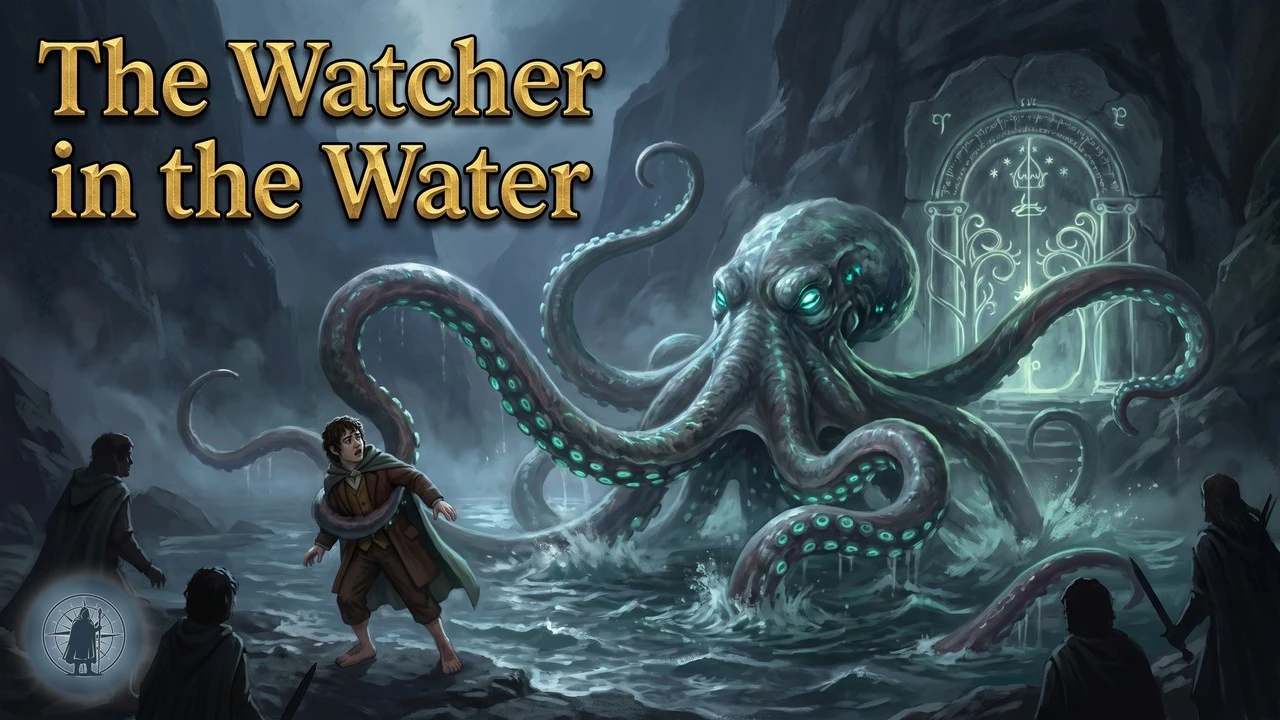 Watch the episode
The Watcher in the Water: What Gnaws Beneath Moria?
Watch the episode
The Watcher in the Water: What Gnaws Beneath Moria?
Research Notes: The Watcher in the Water and the Nameless Things
Overview
Two of Tolkien's most enduring mysteries inhabit Moria: the tentacled Watcher that strikes from the dark pool at the West-gate, and the "nameless things" that gnaw the world far below the Balrog's deepest haunts. Tolkien deliberately left both unexplained — they exist at the edge of his cosmology, in a region where the author himself declines to give a report. This research compiles every canonical reference, the major fan theories (the "same being" theory, the "pre-Eru evil" theory, the "Ungoliant-kin" theory), Christopher Tolkien's editorial notes on the drafts in The Treason of Isengard, and the relevant cosmological framework from the Ainulindalë and Morgoth's Ring.
The central interpretive question — and the one the script will turn on — is whether Gandalf's line "older than Sauron" can be read as pointing at the Watcher, and whether either creature can be explained inside Tolkien's stated metaphysics, or whether they sit at a deliberate seam in it.
Primary Sources
The Watcher in the Water — Fellowship of the Ring
Book II, Chapter 4: "A Journey in the Dark"
The first appearance, at the dam-pool outside the West-gate:
"Out from the water a long sinuous tentacle had crawled; it was pale-green and luminous and wet. Its fingered end had hold of Frodo's foot, and was dragging him into the water."
After the doors are shut behind the Fellowship:
"Out from the water one or more long sinuous tentacles had crawled; they were pale-green and luminous and wet. Their fingered ends groped over the wall... Twenty other arms came rippling out."
Gandalf's reaction, from the same chapter (the closest thing we get to canonical commentary):
"Something has crept, or has been driven out of dark waters under the mountains. There are older and fouler things than Orcs in the deep places of the world."
This is the line that the Two Towers passage about "nameless things" later seems to rhyme with — and the rhyme is the bedrock of the "same being" theory.
Gandalf privately observes that of all the Fellowship the creature reached for Frodo first, the Ring-bearer:
"I do not know what it was, but many coiling arms seized him at once... Of all in the Company it took Frodo."
The Watcher in the Water — Book of Mazarbul
Book II, Chapter 5: "The Bridge of Khazad-dûm"
The Dwarves of Balin's colony left a single written record, read aloud by Gandalf from the burned, hacked, and stained Book of Mazarbul:
"We cannot get out. We cannot get out. They have taken the Bridge and second hall. ... the pool is up to the wall at Westgate. The Watcher in the Water took Óin. We cannot get out. The end comes... drums, drums in the deep... they are coming."
This is the only place Tolkien gives the creature its name. The name is dwarvish use, not an Elvish, Mannish, or Valinorean designation — meaning no one outside the dwarves of Balin's company seems to have known of it before the events of FOTR.
The Watcher in the Water — Drafts (HoMe VII: The Treason of Isengard)
Christopher Tolkien's edition preserves the earlier name and several telling changes:
- In the draft entitled "The Mines of Moria (1): The Lord of Moria", the creature is first called "the Dweller in the Pool" — a name carrying clearer Lovecraftian register than the published "Watcher." - The tentacles in draft originally "came wriggling over the threshold" in moonlight; the published text shifts this to starlight. - In the draft Gandalf told Frodo he had "never before seen or heard tell of such a creature" — Tolkien struck this line. The published version leaves Gandalf's familiarity carefully ambiguous: he names category ("older and fouler things") but not species. - A draft fragment has Gandalf say explicitly "the Watcher was guarding the Dwarf-door" — also cut from the published text. - A pencilled marginal note from Tolkien: "Insert words of Gimli saying that there were traditions among the Dwarves about strangling fingers in the dark." Christopher Tolkien speculates this was added because Gandalf, in the same passage, tells Frodo that the tentacles "were all guided by one purpose." The draft phrasing — "making for the travellers as if directed by something in the deep pools that could see them all" — was simplified to "the arms were all guided by one purpose," removing the explicit second intelligence in the deep.
Editorial significance: every change tightens the mystery. Tolkien knew what he was doing — he was deliberately withdrawing explanations he had once written down.
The Nameless Things — The Two Towers
Book III, Chapter 5: "The White Rider"
Gandalf, reborn, recounts his fall with the Balrog to Aragorn, Legolas, and Gimli in Fangorn. The relevant passages:
"Long time I fell. Long I fell, and he fell with me. His fire was about me. I was burned. Then we plunged into the deep water and all was dark. Cold it was as the tide of death: almost it froze my heart."
After the underwater struggle:
"We fought far under the living earth, where time is not counted. Ever he clutched me, and ever I hewed him, till at last he fled into dark tunnels. They were not made by Durin's folk, Gimli son of Glóin. Far, far below the deepest delving of the Dwarves, the world is gnawed by nameless things. Even Sauron knows them not. They are older than he. Now I have walked there, but I will bring no report to darken the light of day. In that despair my enemy was my only hope, and I pursued him, clutching at his heel. Thus he brought me back at last to the secret ways of Khazad-dûm: too well he knew them all. Ever up now we went, until we came to the Endless Stair."
Then the climb to Durin's Tower on Celebdil (Zirakzigil), the two-day battle on the peak, the fall, and the unbodied wandering:
"Then darkness took me, and I strayed out of thought and time, and I wandered far on roads that I will not tell... Naked I was sent back — for a brief time, until my task is done. And naked I lay upon the mountain-top... There I lay staring upward, while the stars wheeled over, and each day was as long as a life-age of the earth."
Two structurally identical refusals to report — "I will bring no report to darken the light of day" and "I wandered far on roads that I will not tell" — bookend the descent. The Nameless Things and the unbodied state Gandalf passes through are both placed outside the speakable.
Earlier-Echo Line in FOTR
Crucial for the "same being" theory — Gandalf's FOTR warning before they enter Moria (Book II, Ch. 4) uses almost the same phrasing as his TTT account:
- FOTR: "There are older and fouler things than Orcs in the deep places of the world." - TTT: "Far, far below the deepest delving of the Dwarves, the world is gnawed by nameless things... They are older than he."
The verbal echo is intentional. Tolkien sets the Watcher up in book two with the same lexicon ("older," "deep places") he later uses for the Nameless Things in book three. This is the strongest in-text basis for reading the two as kin, even if not identical.
Timeline
Where the canonical dates can be reconstructed:
| Date | Event | Source | |---|---|---| | Before the Music | Ainur exist in thought of Ilúvatar; spirits not all named | Ainulindalë | | During the Music | Melkor's discord, dissonance with Eru's theme | Ainulindalë / Morgoth's Ring | | Spring of Arda | Ainur descend into Eä; Melkor begins corruption of matter | Silmarillion | | Years of the Trees | Ungoliant already present in the south of Avathar, "descended from the darkness that lies about Arda" | Silmarillion ("Of the Darkening of Valinor") | | First Age | Morgoth in Utumno and Angband breeds monsters of "divers shapes and kinds" | Silmarillion | | S.A. 1697 (approx.) | Sauron sacks Eregion; the Elven traffic between Ost-in-Edhil and Khazad-dûm declines | Appendix B | | T.A. 1980 | Balrog awakened by dwarves delving for mithril; Durin VI slain — "Durin's Bane" | Appendix A | | T.A. 1981 | Dwarves abandon Khazad-dûm | Appendix B | | Sometime after | Sirannon is dammed; pool forms at West-gate; date never given by Tolkien | Tolkien Gateway / FOTR | | T.A. 2989 | Balin's expedition enters Moria | Appendix B | | T.A. 2994 | Watcher takes Óin at the West-gate; colony falls | Book of Mazarbul | | T.A. 3019, Jan 13 | Fellowship reaches West-gate; Watcher attacks Frodo; doors sealed | FOTR Book II Ch. 4 | | T.A. 3019, Jan 14–25 | Gandalf's fall with the Balrog; descent through nameless-thing tunnels; ascent of Endless Stair; battle on Zirakzigil | TTT Book III Ch. 5 |
The Watcher's appearance window is wide and unfixed — somewhere between T.A. 1981 (abandonment) and T.A. 2989 (Balin's arrival), but with no canonical date.
Key Characters / Beings
The Watcher in the Water
- Form: Many-armed; "twenty other arms came rippling out" implies at minimum 21 visible tentacles. Pale-green, luminous, fingered ends. The full body is never seen. - Habitat: The dark stagnant pool at the West-gate of Moria, formed by the damming of the Sirannon. - Intelligence: "All guided by one purpose" — a central controlling mind. Targets the Ring-bearer specifically. - Behavior: Seals the doors behind the Fellowship by piling stone and uprooting holly-trees against them. - Origin theories: Cold-drake (J.E.A. Tyler); kraken bred in Utumno (Allison Harl); one of the Nameless Things that climbed up through cracked rock (fan theory); a self-engineering creature that dammed the river itself (David Day, non-canonical). - Mythic function: Charles Huttar reads it as a Wandering-Rocks / Scylla figure — the triple-obstacle gate-guardian of Norse and Greek mythological structure (water + creature + closed doors).
The Nameless Things
- Form: Never described. Gandalf refuses to "bring report." - Habitat: Tunnels "not made by Durin's folk" below the deepest dwarvish mine-shafts. They make tunnels — they "gnaw" the earth. - Antiquity: Older than Sauron (a Maia present at the Music). This means either (a) literally older — predating the descent of the Ainur into Eä; or (b) older than Sauron's lieutenancy, i.e. First-Age survivors he never met. - Sauron's ignorance: "Even Sauron knows them not" — extraordinary, given Sauron's intelligence network and his lordship over creeping things. - Gandalf's reticence: Twice signaled — "I will bring no report" and structurally paralleled with his refusal to describe the road he walked between death and rebirth.
Gandalf (Olórin / Mithrandir)
The narrator of the Nameless Things passage. As a Maia of Manwë and Varda, he is one of the few beings whose age-comparison line is meaningful: when he says they are older than Sauron, he means it from a position of cosmological knowledge. His refusal to elaborate is therefore not ignorance but chosen silence.
Ungoliant (cross-reference)
- "She descended from the darkness that lies about Arda" (Silmarillion, "Of the Darkening of Valinor") - "Of that ancient darkness... she had come... but had disowned her Master, desiring to be mistress of her own lust." - One of the only canonical beings whose nature is partially outside the framework of "Ainur descended into Eä" — she comes from "the darkness about Arda," language that puts her at or near the Walls of the Night. - Names: Úcal ("Unlight"), Úcalatári ("Queen of the Unlight"). - Critical because she is the existing canonical template for "ancient evil whose nature Tolkien deliberately leaves outside the system."
Tom Bombadil (cross-reference)
- Iarwain Ben-adar, "Oldest and Fatherless." - Tolkien, Letter 144: "Even in a mythical Age there must be some enigmas, as there always are. Tom Bombadil is one (intentionally)... and he is in fact 'Eldest in Time'... a finite, created being 'in a world of other finites'." - The relevant point for this episode: Tolkien explicitly tells us in his letters that the legendarium contains intentional enigmas. The Watcher and the Nameless Things are best understood as further enigmas of the same kind — left ambiguous on purpose.
Geography of Moria's Deeps
From Appendix A, FOTR Book II Ch. 4, and Tolkien Gateway compilation:
- Above ground: Seven levels (halls) carved into the Misty Mountains. - Below ground: Many more sub-levels — the "Deeps" — with the deepest mines below the Bridge of Khazad-dûm. - The Bridge: A "slender bridge of stone, without kerb or rail," spanning the Black Chasm, 50 feet wide, of indeterminate depth. - The Balrog's domain: Below the bridge, in fires of the deep — the dwarves of Durin VI woke it in T.A. 1980 while mining mithril "too greedily and too deep." - Below the Balrog: Gandalf testifies that the Balrog's tunnels were not the deepest things in the rock. There are tunnels "not made by Durin's folk" gnawed by the Nameless Things. The Balrog knew those tunnels too — "too well he knew them all" — implying long acquaintance. - The Endless Stair: From those bottom tunnels, a single spiral stair rises up through the living rock of Celebdil/Zirakzigil to Durin's Tower at the summit. Approximate rise: ~7,000 m. The dwarves believed it lost.
The vertical stack of Moria, then, is at least four layers deep: 1. Dwarvish halls 2. Mithril mines 3. Balrog and his abyss 4. The Nameless Things' gnawn tunnels — older than the dwarves, older than the Balrog's awareness, older than Sauron.
This stack is the geological argument for the "same being" theory: if there are cracks between layers 3 and 4 (and Gandalf's account suggests there are — the Balrog uses them as a highway), then there are routes by which something from layer 4 could rise toward the surface. The Sirannon-damming creates the external end of such a route at Moria's western face.
Themes and Symbolism
1. The Unreportable
Gandalf refuses to describe the Nameless Things, and structurally parallels this refusal with his refusal to describe death itself ("roads that I will not tell"). The Nameless Things are positioned at the edge of the speakable — they are mysteries of the same kind as what lies beyond mortal life. This is a deliberate Tolkien technique: the refusal is the report.
2. Older Than Sauron
The phrase echoes throughout LOTR with weight. Sauron is, in Tolkien's hierarchy, near the top — a Maia of Aulë present at the Music. To call something "older than Sauron" is to push it before the descent of the Ainur into Eä, or at the very edge of it. It puts the Nameless Things in conversation with Ungoliant, Tom Bombadil, and the discords-of-the-Music — categories Tolkien himself keeps deliberately fuzzy.
3. The Gnawing World
The verb "gnawed" is striking. Not dwell in, not haunt — they consume the rock itself. They are not evil in the Sauronic sense (organized, willful, dominion-seeking) but in an entropic sense: anti-existence, slow erosion of being. This puts them in the Ungoliant register — devouring darkness rather than dominating evil. (Kappatsupatchi essay: "gnawed" signifies persistent, futile consumption.)
4. Guardians at Thresholds
Both the Watcher (at Moria's western threshold) and the Balrog (at the Bridge, the threshold to the deepest abyss) function as gatekeepers. Charles Huttar identifies this as a recurring Norse/Greek pattern in Tolkien — formidable gateways with persistent guardians. The Watcher fills the role of Scylla at the strait, and the closed doors behind the fellowship become permanent (the Watcher seals them and uproots holly-trees).
5. The Boethian Frame
Tolkien's evil-as-corruption theology (Boethian, not Manichean) is articulated across Letters 144, 153, and 156 and the essays in Morgoth's Ring. Evil cannot create — only corrupt and mar what already is. The Nameless Things test this frame: if they predate Sauron and arise independently of Morgoth (as the discord-of-the-Music passage in Morgoth's Ring explicitly states for at least some evils), then they are evil that arose from the interaction between Eru's theme and Melkor's, not from either alone. This is a genuinely fascinating theological move — evil as emergent dissonance rather than authored corruption.
Scholarly Perspectives
The Three Major Fan/Scholarly Theories
1. The "Same Being" Theory (Watcher = Nameless Thing) - Evidence: verbal echo between Gandalf's FOTR warning and TTT account; Watcher dwells at "deep waters under the mountains"; Sirannon damming + cracked rock creates plausible route up from the gnawn tunnels. - Strongest proponents: gamerant.com, cbr.com surveys; mainstream Tolkien-fandom default. - Weaknesses: pure surface coincidence is also possible; the Watcher targets Frodo for the Ring, implying it has knowledge of the Ring, which seems strange for a "Sauron-knows-them-not" creature.
2. The "Discord of the Music" / Pre-Eru-Plan Theory - Strongest canonical anchor: Tolkien, Morgoth's Ring, "Notes on Motives in The Silmarillion": "Out of the discords of the Music — sc. not directly out of either of the themes, Eru's or Melkor's, but of their dissonance with regard one to another — evil things appeared in Arda, which did not descend from any direct plan or vision of Melkor: they were not his children; and therefore, though they might hate him, they did not love him either." - This is Tolkien's own theological move to make room for evils not authored by Morgoth and not part of Eru's design — emergent from the interaction. - Reading: the Nameless Things are this class. They are old because they arise during the Music itself, before Eä is fully shaped.
3. The "Ungoliant-Kin" Theory - Anchor: Ungoliant "descended from the darkness that lies about Arda" — language that Tolkien deliberately differentiates from "descended from the thought of Ilúvatar." She is the canonical template for "old evil from outside the system." - The Nameless Things, on this reading, are her kindred — not literally her offspring (those become Shelob and the spiders of Mirkwood), but spirits of similar origin. - The Watcher fits this register: aquatic, devouring, intelligent-but-not-articulate, with no apparent allegiance. - This theory has the advantage of using existing canonical machinery rather than inventing a new category.
Minor Theories
- Corrupted Maiar gone wild — Úmaiar who fell before Sauron's rebellion, independent of Morgoth's hierarchy. Plausible but unsupported by direct text. - Morgoth-bred monsters forgotten by Sauron — possible: Morgoth bred monsters of "divers shapes and kinds" in Utumno (Silmarillion). The Valar didn't fully clear all the deep tunnels in the War of Wrath. Some could remain. Weakness: Gandalf says "Sauron knows them not," and Sauron was Morgoth's chief lieutenant. - Dagor Dagorath weapons — fan speculation that the Nameless Things are Morgoth's reserve for the prophesied last battle. No canonical support; appears in some popularizations. - J.E.A. Tyler's cold-drake reading of the Watcher — referenced in Wikipedia's Watcher article; treated as one option among many, not authoritative.
Tolkien's Own Statements
- Letter 144 (1954): explicitly tells Naomi Mitchison that the legendarium contains intentional enigmas; cites Bombadil as one. Establishes that not knowing is part of the design. - Letter 153 (1954, draft to Peter Hastings): long defense of his theology — Morgoth cannot create; evil corrupts what exists; the legendarium is "literature" not a systematic theology. - Morgoth's Ring, "Myths Transformed" / "Notes on Motives": contains the discord-of-the-Music passage above, plus the dissemination-of-Morgoth's-power thesis (his selfhood diffused into matter; Arda is "Morgoth's Ring").
Contradictions and Variants
- Draft vs. published Watcher: drafts had Gandalf say he had never seen or heard of such a creature, and that the Watcher was guarding the Dwarf-door explicitly. Both struck. The published version is more mysterious than the draft. - Watcher's name: "Dweller in the Pool" in early draft → "Watcher in the Water" in published text. The shift moves from passive habitation (Lovecraftian) to active surveillance (gatekeeping). - Tolkien's evolving theology of evil: the Boethian frame is consistent across the letters, but Morgoth's Ring introduces the "evil from discord" passage that complicates it — admitting evils outside Morgoth's authorship. Christopher Tolkien flags the section as containing "inconsistent solutions." - The Nameless Things never appear elsewhere: not in the Silmarillion, not in Unfinished Tales, not in HoMe, not in Letters. The Two Towers passage is their only canonical mention. This singularity is itself a clue — Tolkien dropped a stone into the well once, and never went back.
Linguistic Notes
- Khazad-dûm (Khuzdul, "Mansion of the Khazâd") - Moria (Sindarin, "Black Chasm" / "Black Pit") — named after the dwarves fled - Sirannon (Sindarin, "Gate-stream") - Zirakzigil (Khuzdul, "Silvertine") / Celebdil (Sindarin, "Silvertine") - Iarwain Ben-adar (Sindarin, "Old and Fatherless") — Bombadil - Úcal / Úcalatári (Quenya, "Unlight" / "Queen of the Unlight") — Ungoliant - Nameless Things — Tolkien gives them no Elvish name. The English designation is a refusal of language. Compare Iarwain Ben-adar, where "fatherless" sits inside a name. The Nameless Things refuse even that.
Additional Context
Why Tolkien Leaves Gaps
Tolkien's On Fairy-Stories essay argues that the function of fantasy is "recovery" — making us see the world freshly — and that this requires a sense of vastness beyond the tale. He achieves it through deliberate underwriting: the further from the narrative center, the less he tells us. The Watcher and the Nameless Things sit at the deep end of this gradient. Their unexplained quality is not laziness or oversight; it is a structural element of his mythopoeia.
The author Verlyn Flieger argues that Tolkien's mythology is intentionally "polyphonic" — preserving multiple incompatible accounts of the same events (as the Music itself is polyphonic) — and that creatures like the Nameless Things are the legendarium's way of admitting it doesn't close.
The Lovecraft Parallel
Tolkien wrote Lord of the Rings in the 1940s. H.P. Lovecraft died in 1937. There is no documented evidence Tolkien read Lovecraft, but the cultural register of "tentacled horror under dark water; ancient things below the world's deepest stones; the narrator who refuses to describe what he saw" is shared. The "Dweller in the Pool" draft name is the strongest tonal hint. Most modern adaptations (Jackson 2001) consciously lean Lovecraftian.
The Catholic Subtext
Tolkien's Catholic frame holds that evil is privation — privatio boni, the absence of being. The Nameless Things, who gnaw the world (consume being without making any), fit this register exactly. They are not rivals to creation; they are creation's slow undoing. Sauron, by contrast, wants to rule creation — he is the more comprehensible, more containable evil.
Questions for Further Research
- Did Tolkien ever reply in letters to a direct question about the Nameless Things? (Apparent answer: no.) - Did Christopher Tolkien write any commentary specifically on the TTT "nameless things" passage in HoMe? (Apparent answer: no significant note beyond the Treason of Isengard Watcher material.) - Are there scholarly essays in Tolkien Studies or Mythlore specifically on the Nameless Things? (At least one Tolkien-Society blog post on Ungoliant-discord exists but the connection essay is sparse.) - Verlyn Flieger's Splintered Light or Interrupted Music would likely have the cleanest scholarly framing — worth flagging for follow-up.
Discrete Analytical Themes
Theme 1: The Verbal Echo (Why the "Same Being" Theory Has Real Textual Basis)
Core idea: Gandalf uses nearly identical language for the Watcher and for the Nameless Things — and the echo is the most concrete in-text evidence that Tolkien wanted the reader to feel a connection. Evidence: - FOTR Book II Ch. 4: "There are older and fouler things than Orcs in the deep places of the world." (immediately after the Watcher attack) - TTT Book III Ch. 5: "Far, far below the deepest delving of the Dwarves, the world is gnawed by nameless things... They are older than he." - The shared lexicon: "older," "deep places," "the world." Two books apart, but spoken by the same character about the same general region. Distinction: This is about the textual evidence inside LOTR itself — what the published prose actually links, regardless of theory. It is the load-bearing observation for the entire episode.Theme 2: The Three Theories (Same Being / Pre-Eru / Ungoliant-Kin)
Core idea: The major interpretive frameworks fans and scholars have used to identify the Nameless Things, evaluated against canon. Evidence: - Same Being theory: Sirannon damming creates pool; cracks in rock; Watcher's tentacles "guided by one purpose" suggest intelligence consistent with Nameless Thing - Pre-Eru/Discord theory: Morgoth's Ring, "Notes on Motives" — "Out of the discords of the Music... evil things appeared in Arda, which did not descend from any direct plan or vision of Melkor" - Ungoliant-kin theory: Silmarillion — Ungoliant "descended from the darkness that lies about Arda"; canonical precedent for "old evil from outside the system" Distinction: This is about interpretive frameworks and how they map onto canon — the structured comparison of theories, not the textual evidence itself.Theme 3: The Geological Stack of Moria (Why "Below the Balrog" Means Something Specific)
Core idea: Moria is structured in vertical layers, and Gandalf's account establishes that the Nameless Things' tunnels are below even the Balrog's domain — a specific cosmological claim about how deep evil can go. Evidence: - Seven above-ground halls; many more sub-levels ("Deeps") below - Bridge of Khazad-dûm spans the Black Chasm of "indeterminate depth" - Balrog awakened by mithril-mining in T.A. 1980 — already below the dwarves' deepest delvings - Gandalf: tunnels of the Nameless Things "were not made by Durin's folk"; Balrog "too well he knew them all" — implying the Balrog used them but did not make them - Endless Stair: ~7,000 m from deepest tunnels to Zirakzigil summit Distinction: This is about the physical/geographical argument — what Moria's vertical structure tells us, separate from interpretation. Sets up the visual/spatial imagination of the episode.Theme 4: Tolkien's Theology of Evil (Boethian Frame and Its Cracks)
Core idea: Tolkien's stated theology is that evil cannot create, only corrupt — but Morgoth's Ring admits a third category: evil that emerges from the interaction of Eru's theme and Melkor's discord, authored by neither. Evidence: - Letter 153 (1954): Morgoth cannot create a spirit; orcs are corruptions of existing beings - Letter 144: legendarium contains intentional enigmas (Tom Bombadil cited) - Morgoth's Ring, "Notes on Motives": evil things from the discord "did not descend from any direct plan or vision of Melkor: they were not his children" - Christopher Tolkien on this section: contains "inconsistent solutions" — Tolkien himself flagged it as unresolved Distinction: This is about the theological/cosmological framework — the system into which the Nameless Things must fit, and the seam in that system that lets them exist.Theme 5: The Refusal to Report (What Gandalf Doesn't Say)
Core idea: Gandalf twice refuses to describe what he saw — both about the Nameless Things and about his unbodied state between death and rebirth. This is a deliberate technique, not narrative shyness. Evidence: - TTT III.5: "I will bring no report to darken the light of day." - Same chapter, about his death-passage: "I wandered far on roads that I will not tell." - Draft excisions in HoMe: Tolkien removed explanations he had once written (Gandalf's "never seen such a creature"; Watcher "guarding the Dwarf-door") - Letter 144: enigmas are intentional Distinction: This is about narrative technique and authorial intent — why Tolkien underwrites this material, and what the silence accomplishes.Theme 6: The Watcher's Targeted Strike (The Ring Question)
Core idea: The Watcher reaches for Frodo specifically — and this targeting is hard to reconcile with a creature so old Sauron doesn't know it. Evidence: - FOTR II.4: "Of all in the Company it took Frodo." - Gandalf privately notes the deliberateness — tentacles "all guided by one purpose" - A Nameless Thing predating Sauron should not register Ring-presence; only beings inside Sauron's cosmological system do - This is the strongest counter-evidence to the Same-Being theory — and the most fertile soil for the Ungoliant-kin or "lesser servant of darkness" reading Distinction: This is about the specific anomaly that complicates the simple identifications — the puzzle inside the puzzle. Drives the episode's central twist.Theme 7: The Sealing of Moria's West-Gate (The Watcher as Permanent Gatekeeper)
Core idea: After the attack, the Watcher seals the doors with piled stone and uprooted holly-trees — turning the gate into a one-way mouth. The west of Moria is closed for the rest of the legendarium. Evidence: - FOTR II.4: doors slammed shut; "thud and rumble" of stones falling against them; "the holly-trees were dragged down" - Functional consequence: Fellowship cannot retreat; Frodo's path through Moria is irrevocable - Mythological parallel (Huttar): Scylla-figure, Wandering Rocks; the triple-obstacle gate (water/creature/door) - Dwarves of Balin's colony also could not get out westward — "the pool is up to the wall at Westgate" Distinction: This is about the narrative function of the Watcher in LOTR's plot, separate from its identity question. The Watcher is the door-shutter of the West.Theme 8: The Refused Name (Why "Nameless" Is the Point)
Core idea: In a legendarium obsessed with naming — Quenya, Sindarin, Khuzdul, Westron, each thing named several ways — Tolkien gives one class of being no name at all. Even "Dweller in the Pool" was withdrawn in favor of the more guarded "Watcher in the Water." Namelessness is doing theological work. Evidence: - Compare Ungoliant: Úcal, Úcalatári — even the most-outside-the-system being has names - Compare Tom Bombadil: Iarwain Ben-adar, "Fatherless" — even the enigma is named - The Nameless Things refuse the basic linguistic move of the legendarium - Tolkien drafted, then deleted, the more concrete "Dweller in the Pool" for the Watcher - Linguistic refusal as a form of cosmological placement: outside language, outside narrative, outside Eru's plan Distinction: This is the synthesis theme — what the namelessness itself signifies in a legendarium where everything else is named. The episode's closing register.Sources Consulted: The Watcher in the Water and the Nameless Things
Primary Sources (Tolkien)
- The Fellowship of the Ring, Book II, Chapter 4 ("A Journey in the Dark") — Watcher attack and Gandalf's "older and fouler things" line - The Fellowship of the Ring, Book II, Chapter 5 ("The Bridge of Khazad-dûm") — Book of Mazarbul, "The Watcher in the Water took Óin" - The Two Towers, Book III, Chapter 5 ("The White Rider") — Gandalf's full account of his descent with the Balrog, the "nameless things" passage, the Endless Stair, Zirakzigil - The Silmarillion, "Ainulindalë" — Music of the Ainur, Melkor's discord - The Silmarillion, "Of the Darkening of Valinor" — Ungoliant: "She descended from the darkness that lies about Arda" - Letters of J.R.R. Tolkien, Letter 144 (to Naomi Mitchison, 1954) — intentional enigmas, Bombadil - Letters of J.R.R. Tolkien, Letter 153 (draft to Peter Hastings, 1954) — Boethian theology of evil; Morgoth cannot create - The History of Middle-earth, Vol. VII: The Treason of Isengard — Christopher Tolkien's edition; "Dweller in the Pool" draft name; struck lines about Gandalf having never seen the creature and the Watcher "guarding the Dwarf-door" - The History of Middle-earth, Vol. X: Morgoth's Ring, "Myths Transformed" / "Notes on Motives in The Silmarillion" — "Out of the discords of the Music... evil things appeared in Arda, which did not descend from any direct plan or vision of Melkor" - LOTR Appendix A — Durin's Bane, T.A. 1980 awakening - LOTR Appendix B — Tale of Years; Balin's expedition (T.A. 2989), Watcher takes Óin (T.A. 2994)
Web Sources (Most Useful)
- Wikipedia, "Watcher in the Water" — https://en.wikipedia.org/wiki/Watcher_in_the_Water — comprehensive scholarly summary; Tyler (cold-drake), Harl (Utumno kraken), Huttar (Scylla/Wandering Rocks), Treason of Isengard draft notes - Tolkien Gateway, "Watcher in the Water" — https://tolkiengateway.net/wiki/Watcher_in_the_Water — direct canonical references; (note: site frequently 403s for WebFetch but search snippets useful) - Tolkien Gateway, "Nameless things" — https://tolkiengateway.net/wiki/Nameless_things - Tolkien Gateway, "Endless Stair" — https://tolkiengateway.net/wiki/Endless_Stair - Tolkien Gateway, "Durin's Tower" — https://tolkiengateway.net/wiki/Durin%27s_Tower - Tolkien Gateway, "Letter 153" — https://tolkiengateway.net/wiki/Letter_153 - Tolkien Gateway, "Myths Transformed" — https://tolkiengateway.net/wiki/Myths_Transformed - Tolkien Gateway, "Walls of the Night" — https://tolkiengateway.net/wiki/Walls_of_the_Night - Tolkien Gateway, "Ainur" / "Maiar" — hierarchy and creation order - Fair Use Repository — "Notes on motives in THE SILMARILLION" — http://fair-use.org/j-r-r-tolkien/notes-on-motives-in-the-silmarillion/ — full text of the key Tolkien essay on discord-of-the-Music origin of evils
Scholarly / Essay Sources
- The Tolkien Society blog — "Ungoliant: A Fragment of Melkor's Discord?" (2014) — https://www.tolkiensociety.org/blog/2014/06/ungoliant-a-fragment-of-melkors-discord/ (403'd for fetch; search snippet usable) - "The World Is Gnawed By Nameless Things" — Kappatsupatchi essay — https://kappatsupatchi.wordpress.com/2016/09/05/the-world-is-gnawed-by-nameless-things/ — close reading of the "gnawed" verb; existential-meaninglessness interpretation - "The Watcher in the Water vs. The Dweller in the Pool" — Sweating to Mordor essay — https://sweatingtomordor.wordpress.com/2014/06/20/the-watcher-in-the-water-vs-the-dweller-in-the-pool/ — careful draft-vs-published comparison - askmiddlearth (Tumblr) — "The Nameless Things" — https://www.tumblr.com/askmiddlearth/78238780659/the-nameless-things — clean enumeration of three primary theories (aboriginal spirits / corrupted Maiar / pre-Sauron Morgoth-bred) - Middle-earth & J.R.R. Tolkien Blog — "What Are the Nameless Things Gandalf Refers to Below Khazad-dûm?" — https://middle-earth.xenite.org/what-are-the-nameless-things-gandalf-refers-to-below-khazad-dum/ - TheOneRing.net — "The Nameless Things" (2020) — https://www.theonering.net/torwp/2020/12/01/109048-the-nameless-things/ — Ungoliant-kin theory; life-vs-death framing - Council of Elrond — "Beyond the Walls of the World" — https://councilofelrond.com/middle-earth/beyond-the-walls-of-the-world/ — cosmology of the Void
Secondary Reference (Compendium/Aggregator)
- gamerant.com, "LOTR: What Are the Nameless Things?" — https://gamerant.com/lotr-nameless-things/ — fan-survey level - gamerant.com, "Bad Place to Dig Too Greedily and Too Deep" — Khazad-dûm structural breakdown - cbr.com, "Lord of the Rings Hides Something Much Darker in Moria Than the Balrog" — https://www.cbr.com/lord-rings-nameless-things-explained/ — three-theory survey - cbr.com, "Watcher in the Water Guards Moria" — https://www.cbr.com/lord-of-rings-watcher-in-the-water-moria-location-explained-lotr/ - cbr.com, "Watcher in the Water Is Tolkien's Kraken" — https://www.cbr.com/lord-of-rings-watcher-water-kraken/ - collider.com, "5 Beings Who Are Older Than Sauron" — useful for the comparative-age framing
Notes on Source Reliability
- Tolkien Gateway is the most rigorously canon-anchored Tolkien wiki; preferred over Fandom/One Wiki where available. - Letter 153 is a draft — Tolkien never sent it. Still treated as canonical by scholars because it's his most extended theological self-explanation. - Morgoth's Ring "Myths Transformed" passages were written in the 1950s, post-LOTR. Christopher Tolkien explicitly flags inconsistencies. The discord-of-the-Music passage is one of the most-cited but also most contested. - Verlyn Flieger (Splintered Light, Interrupted Music) is the standard scholarly authority on Tolkien's cosmology and the "polyphonic" nature of his mythology — recommended as further reading for the script writer if time permits. - David Day's works (e.g., "the Watcher dammed the Sirannon itself") are NOT canonical and have been criticized by the Tolkien Estate; treat as fan-speculation only.
Gaps / Limitations
- Tolkien never made any statement, in any letter or interview, that directly answers "what are the Nameless Things?" The TTT passage is the only canonical reference. - Christopher Tolkien wrote no significant editorial note on the Nameless Things passage in HoMe. - No academic essay in Tolkien Studies or Mythlore appears to focus specifically on the Nameless Things (based on web search; would need JSTOR/MLA for confirmation). - The "same being" theory is mostly post-Jackson popular fan speculation, not scholarly consensus. The script should present it as the central question, not the canonical answer.