Transcript
The Lost Chapters
What Colbert's New LOTR Movie Will Restore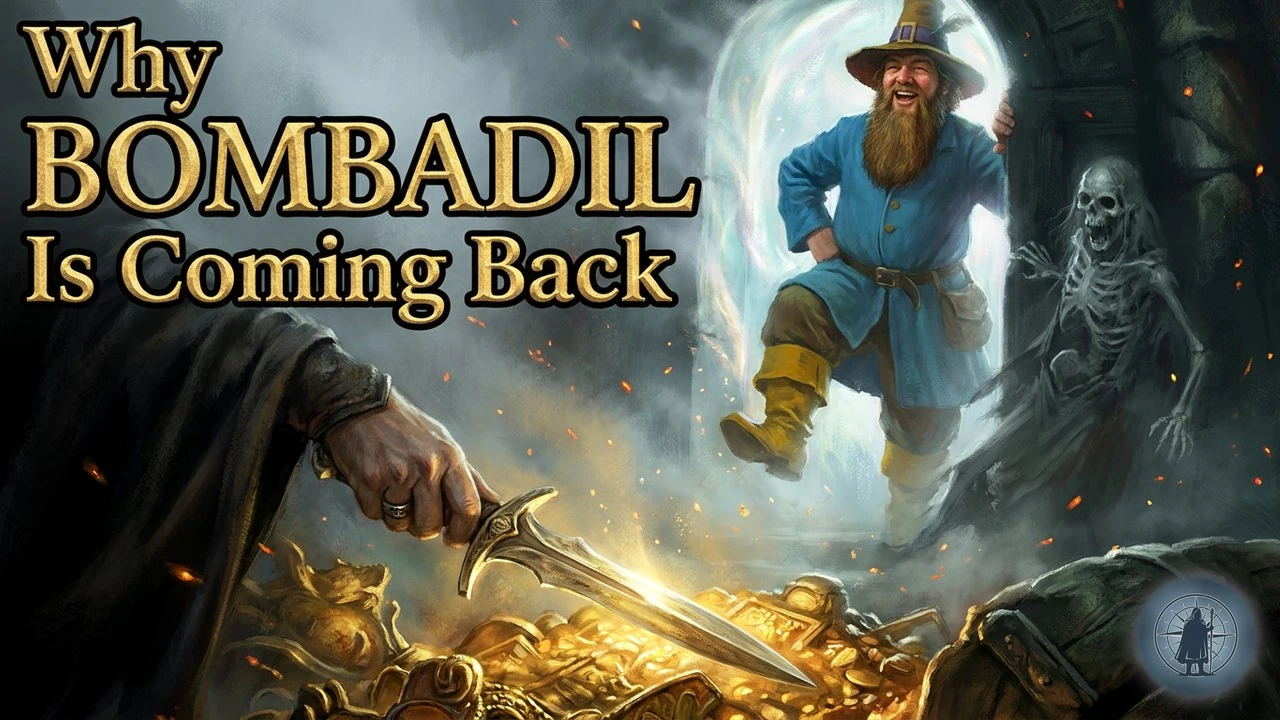 Watch the episode
The Lost Chapters: What Colbert's New LOTR Movie Will Restore
Watch the episode
The Lost Chapters: What Colbert's New LOTR Movie Will Restore
Main Narrative: The Lost Chapters — What Colbert's New Lord of the Rings Movie Will Restore
SECTION: A Film About the Pages Jackson Skipped
On Tolkien Reading Day, March 24th of 2026, a short video appeared on social media. In it, Stephen Colbert and Peter Jackson sat together and confirmed what the trade press had been chasing for months. Warner Bros. and New Line are making a new live-action Lord of the Rings film. The working title is Shadow of the Past. Colbert is co-writing it — with his son, the screenwriter Peter McGee, and with Philippa Boyens, the Oscar-winning co-writer of Jackson's original trilogy. Jackson and Fran Walsh produce. It will follow The Hunt for Gollum, which is targeting December 2027, so realistically we are talking about a 2028 or 2029 release.
What makes this announcement different from every other Tolkien adaptation rumor of the last decade is its scope. Shadow of the Past is not adapting The Hobbit again. It is not adapting an Appendix. It is adapting six specific chapters of the book Jackson already filmed. Chapters three through eight of The Fellowship of the Ring, Book One — Three is Company, A Short Cut to Mushrooms, A Conspiracy Unmasked, The Old Forest, In the House of Tom Bombadil, and Fog on the Barrow-downs.
These are the pages Jackson cut in 2001.
And inside those pages, almost invisible to a first-time reader, sits one of the longest-fused payoffs in all of fantasy literature. A piece of buried narrative architecture that the original films, for very understandable reasons, took out — and that, when you finally see it, makes the second-to-last battle of the entire trilogy mean something the films could never quite earn.
The official synopsis frames the film through Sam's eldest daughter, Elanor Gardner. Fourteen years after Frodo sails West, Elanor discovers what the synopsis calls "a long-buried secret" — about why the War of the Ring was nearly lost before it began. Sam, Merry, and Pippin then set out to retrace their first steps. That Elanor framing is a modern invention, and we will come back to it. The six chapters underneath it are not.
What follows is what is actually inside those chapters, and why the four hobbits left in a kitchen in Buckland on a September night are doing work that matters all the way to the Pelennor Fields.
SECTION: The Conspiracy in the Kitchen
The Fellowship of the Ring is supposed to begin in Rivendell. Eight companions stand around a council table, Elrond presiding, the world's representatives volunteering for an impossible task. That is the version every viewer of the films knows.
It is not, in the book, where the Fellowship begins.
The Fellowship begins in a kitchen in Buckland.
Frodo has bought a house at Crickhollow, on the far side of the Brandywine, as a decoy. The plan is to fake a quiet retirement, slip out at night, and disappear east toward Rivendell with only Sam as company. He arrives at the Crickhollow house with Sam, Merry, and Pippin. They make supper. They take baths. And then, sitting at the table afterward, Frodo gathers himself to deliver the speech he has been dreading for weeks — that he must leave them, that he must go alone, that he has a thing he cannot tell them about.
They cut him off before he can start.
They already know.
Sam, it turns out, has been reporting Frodo's conversations with Gandalf back to Merry for months. Merry has known about the Ring not for weeks but for years — he spotted Bilbo using it at the long-expected party, decades before, and then later got his hands on Bilbo's memoirs. Pippin has been let in on the conspiracy more recently. They have planned the whole thing. They have organized the decoy house. They have arranged for a fourth hobbit, Fredegar Bolger — Fatty Bolger — to stay behind at Crickhollow and impersonate Frodo, drawing any pursuit to the wrong door.
When Frodo tries to protest that the road is too dangerous, Merry answers him with one of the truest sentences in the entire book.
"You can trust us to stick to you through thick and thin – to the bitter end. And you can trust us to keep any secret of yours – closer than you keep it yourself."
This is the moment the Fellowship begins. Not Rivendell. A hobbit kitchen, four chairs, a Ring on a chain around one neck, and three friends informing the fourth that he was never solitary and was never going to be allowed to be. The Council of Elrond formalizes a thing the hobbits already decided in Buckland. Elrond ratifies. He does not initiate.
And it matters that Fatty Bolger stays behind, because three nights later the Black Riders ride down on the Crickhollow house. Fatty escapes by the back door, hammers on the Horn-call of Buckland, and raises the country. He is hunted for almost being Frodo. The films cut him entirely.
You can see why Jackson did. In a three-hour movie pointed at a Council and a Fellowship, an evening of hobbits ambushing their friend with the news that they refuse to abandon him is a beautiful scene with no engine. It does not move the plot toward the next ridge. It is a scene about who these four already are to each other before any plot starts pulling on them. That is exactly the kind of scene a standalone film about the cut chapters can afford to keep.
SECTION: The Forest That Remembers
The next morning the hobbits saddle their ponies, ride to the end of the lane, and pass through a tunnel under the High Hay — the great hedge the Bucklanders have spent generations maintaining to keep the Old Forest out of their fields. On the other side of the hedge, the trees lean in.
The first thing in the entire trilogy that nearly kills Frodo outside the Shire is not a Black Rider. It is a tree.
This is one of the strangest and most easily missed shifts in the early book. Sauron is not the only kind of evil in Middle-earth. There is also the kind of evil — or maybe not evil, exactly, but the kind of grievance — that the natural world has carried against the speaking peoples for a very long time. The Old Forest is the last surviving fragment of a primeval woodland that once covered all of Eriador. Tolkien is explicit about its temper. The trees "swayed when there was no wind, whispered at night, and misled travellers." The Forest is, in his own phrasing, "hostile to two-legged creatures because of the memory of many injuries."
There is a specific injury. Long before the events of the book, the trees of the Old Forest had begun pushing back at the High Hay — leaning over it, planting themselves against it. The Bucklanders responded by going out with axes and torches and burning a wide strip of the woodland to the ground. The scar is still there. They call it the Bonfire Glade. And the trees, in the slow patient way of trees, never forgave it.
So when four hobbits ride into the Forest from Buckland, the Forest knows where they are from.
The paths shift under them. They try to ride north, toward the East Road. They end up funneled south and east, down through a valley they did not mean to enter, toward a river none of them have heard of — the Withywindle. Tolkien writes that around the Withywindle "the queerness of the whole valley was concentrated." The river curls like a willow root. The air is heavy. The hobbits get drowsy. They sit down to rest under an enormous old willow growing out of the bank.
Old Man Willow sings them to sleep. Merry and Pippin disappear into cracks in his trunk. Frodo, half-conscious, gets tipped backward into the Withywindle and is held under the water by a root. He is drowning, in the second-oldest forest on the continent, ambushed by a tree that remembers an axe its grandfathers felt centuries before any hobbit was born.
This is a different category of antagonist than anything Jackson's films show. The Old Forest is not Sauron's. It is not corrupted by Morgoth. It is the world itself, holding a grudge. Most fantasy stories don't have room for that idea, because most fantasy stories sort the world into heroes, monsters, and inert scenery. Tolkien's world has a fourth thing — places that are awake and have been wronged. The Old Forest is the first time we meet that thing. The Ents, much later, are the second.
You cannot adapt the legendarium honestly without it.
SECTION: The One Being Power Cannot Touch
Frodo is half-drowned in the Withywindle, and he hears, coming down the path, a voice singing nonsense. Hey dol, merry dol, ring a dong dillo. A short, stocky figure in a battered hat with a blue feather in it, blue coat, yellow boots. Tom Bombadil.
Tom orders Old Man Willow to release the hobbits. The Willow obeys. Tom takes the four of them home, to a low yellow-lit house at the foot of the Barrow-downs, where Goldberry the River-daughter is waiting. And over the next two nights, the most important conversation in The Fellowship of the Ring takes place. Most readers don't notice it is happening.
Tom sings them his world's history. He tells them about the Forest, about the Barrow-downs, about a time before the rivers had names. And then, at one point in the evening, he asks to see the Ring.
Frodo, very reluctantly, hands it across.
Tom puts it on.
He does not vanish.
He holds it up to his eye. He laughs. He makes it disappear from his palm and produces it again from the other hand, like a magician at a children's party. He gives it back. And Frodo — suspicious now, almost angry — slips the Ring on himself, to make sure he can still vanish from Tom's sight.
Tom looks straight at him. Tells him to come back to the table. He can see Frodo perfectly.
There is no other being in the entire legendarium of whom this is true. Not Gandalf. Not Galadriel. Not Sauron. Not Morgoth himself. The One Ring is the single most dangerous artifact in Middle-earth, the concentrated will of a fallen god, and Tom Bombadil treats it the way an adult treats a child's toy that the child has insisted is magic.
The question of what Tom Bombadil is has filled scholarly books. Tolkien was asked, repeatedly, and he refused to answer. In Letter 144, written to a fan in 1954, he said outright that some things must remain enigmas. "Even in a mythical Age there must be some enigmas, as there always are. Tom Bombadil is one — intentionally."
What he was willing to explain was how Bombadil works. In the same letter, he wrote that Tom represents what he called "a natural pacifist view, which always arises in the mind when there is war." In Letter 153 he sharpened it further — Bombadil is "a particular embodying of pure (real) natural science: the spirit that desires knowledge of other things, their history and nature, because they are 'other' and wholly independent of the enquiring mind... entirely unconcerned with 'doing' anything with the knowledge."
That is the key. The Ring works by amplifying desire to use. Tom has no desire to use. He watches. He learns. He sings. He is not stronger than the Ring. He is sideways to it. He is not winning the temptation contest the Ring is offering. He is not playing.
Later, at the Council of Elrond, Gandalf will explain that this is also why Bombadil cannot be given the Ring for safekeeping. He would not so much resist it as forget where he put it. He would not understand why anyone cared.
This is why the Bombadil chapter was, for Jackson, structurally impossible. The One Ring is the engine of his films — the seductive evil at the center of every scene, the thing that bends great heroes toward ruin. To stop the movie for ninety minutes and meet a being who finds the engine boring is to break the engine. In a three-hour epic that has to deliver the audience to Rivendell, a Council, a Fellowship, and the road south, Bombadil is genuinely a problem.
In a hundred-and-ten-minute film whose central question is what kind of world does the Shire actually open onto — Bombadil is not a problem. Bombadil is the answer.
SECTION: The Garrison of the Dead
The hobbits leave Tom's house on the second morning. Tom gives them advice and a rhyme — a few lines of verse to sing if they fall into danger inside his country — and they ride east, toward the Great East Road and Bree. To get there, they have to cross the Barrow-downs.
The Barrow-downs are not haunted by accident.
The hills that the hobbits are riding through are an ancient cemetery. In the First Age, before the rising of the Sun, chieftains of the Edain were buried in these mounds. Centuries later, when the North-kingdom of Arnor extended south, the Dúnedain of the kingdom of Cardolan adopted the same hills as the burial ground for their princes. The Sindarin name for the place is Tyrn Gorthad — the Mounds of the Dead. Or, more precisely, the Mounds of the Wights.
Because of what came next.
After King Eärendur of Arnor died in T.A. 861, his three sons quarreled, and the great North-kingdom split into three smaller successor states. Arthedain in the west, with its capital at Fornost. Rhudaur in the east, between the Weather Hills and the Misty Mountains. And Cardolan in the south — including the Barrow-downs themselves. Around the same time, in the far north, a new realm rose under a sorcerer-king. The realm was called Angmar. The sorcerer-king, we eventually learn, was the chief of the Nazgûl. Angmar existed for one purpose. To destroy the heirs of Elendil.
In T.A. 1409, Angmar attacked Cardolan. The last prince of Cardolan fell defending Tyrn Gorthad — defending these very hills, against the very Witch-king. He was buried there, in one of the mounds, with his weapons and his treasure, by the survivors. Among his weapons were several daggers of Westernesse, forged in Arthedain specifically as weapons against the realm of Angmar.
Remember the daggers. We will come back to them.
Two centuries later, in T.A. 1636, the Great Plague swept north out of the south and emptied Cardolan entirely. The Dúnedain who had survived Angmar's invasion did not survive the plague. The land was depopulated. The mounds were left tended by nobody.
And it is at this point that the Witch-king made a strategic decision the films have never had time to explain. According to Appendix A, he sent evil spirits out of Angmar and Rhudaur into the empty mounds. The wights are not native ghosts. They were not buried there. They were posted there. They are a garrison.
This is not a horror-story flourish. It is a long-game political move. The Witch-king's purpose is to keep the surviving Dúnedain from ever returning to resettle Cardolan. He is not interested in the dead. He is interested in the land — and in keeping it uninhabitable for fourteen centuries, so that the kingdom that opposed him cannot reconstitute itself there. The wights are an act of posthumous occupation. The barrow that captures Frodo in the third week of September, T.A. 3018, has been a deliberate Angmarian outpost for one thousand three hundred and eighty-two years.
So when the cold mist comes down on the Barrow-downs, and the hobbits become separated, and Frodo wakes inside a stone barrow with a sword across his throat and his three friends laid out beside him in white shrouds and pale gold, what has caught him is the Witch-king's strategy, working as designed, ninety days before Frodo will reach the cracks of Mount Doom. The chant the wight sings as Frodo lies there —
Cold be hand and heart and bone, and cold be sleep under stone: never more to wake on stony bed, never, till the Sun fails and the Moon is dead.
— is the voice of Angmar, still on duty.
Frodo finds Tom's rhyme in his head. He sings it. Tom comes. Tom breaks the barrow open with a song, drives the wight out into the morning with another song, and brings the four hobbits out into the sun, alive.
And then Tom does the thing the entire trilogy is going to turn on. He selects four small daggers from the wight's treasure pile. He gives one to each hobbit.
He pauses on those four blades long enough to tell the hobbits what they are.
"Forged long years ago by Men of Westernesse: they were foes of the Dark Lord, but they were overcome by the evil king of Carn Dûm in the Land of Angmar."
Most first-time readers do not notice this line. They are too relieved that the hobbits are out of the barrow. The line goes by like atmosphere.
It is not atmosphere. It is the loaded gun.
SECTION: The Blade That Waited Sixteen Centuries
Sixteen hundred and ten years.
That is the gap between the moment that dagger went into the barrow with the last prince of Cardolan, and the moment it comes out again on Merry Brandybuck's belt. Sixteen hundred and ten years of dust on the blade. Sixteen hundred and ten years during which the kingdom that forged it ceased to exist, the king who buried it became a wight himself in another mound, the language it was tempered with stopped being spoken by anyone outside of Rivendell, and the enemy it was forged to fight slowly conquered everything within reach of Eriador.
Then a hobbit picks it up off a pile of stolen treasure, and walks it out into the sun, and almost two years later, on the field of the Pelennor, that hobbit uses it.
The Witch-king stands over the body of Théoden, King of Rohan. Éowyn, helmless, her shield arm broken, stands between the Witch-king and her uncle. She faces him with a drawn sword. The Witch-king is laughing. Behind him, unseen, crawling on his belly through the grass, is a halfling Éowyn had insisted should not be there at all. Merry Brandybuck draws the small dagger he has carried out of a Barrow-down. He drives it into the back of the Witch-king's knee.
The Witch-king buckles forward. The killing blow is Éowyn's, into the empty space where his face is not. The famous line — "I am no man" — is hers.
But the killing blow lands because the Witch-king has been unmade a half-second earlier. The spell that holds him together has been broken. And it was broken by a dagger forged in the mountains of Arthedain seventeen hundred years before, by a smith whose name no one has ever known, for use against this exact enemy.
Tolkien tells us this directly. He does not leave it to inference. The passage is one of the most extraordinary in the entire book.
"So passed the sword of the Barrow-downs, work of Westernesse. But glad would he have been to know its fate who wrought it slowly long ago in the North-kingdom when the Dúnedain were young, and chief among their foes was the dread realm of Angmar and its sorcerer king. No other blade, not though mightier hands had wielded it, would have dealt that foe a wound so bitter, cleaving the undead flesh, breaking the spell that knit his unseen sinews to his will."
No other blade. That is the line. Not Andúril. Not Glamdring. Not Sting. The sword Aragorn carries, reforged from the shards of Narsil, the literal blade of legend that cut the Ring from Sauron's hand — that sword could not have done what Merry's dagger did. Because Merry's dagger was not a great sword. It was a deliberately forged weapon against a deliberately specified enemy, and the smith who made it spent his life knowing what it was for.
And then, having done what it was forged to do, the blade disintegrates. It crumbles in Merry's hand. Its work is finished.
The Witch-king built his own death seventeen hundred years before it found him. He did it twice over. First by killing the prince of Cardolan in T.A. 1409 and standing by while the survivors buried the prince with his weapons. Then, two centuries later, by stationing his wights in the mounds to keep the Dúnedain from ever coming back to recover those weapons. He preserved the dagger. He guarded the dagger. He kept it where no living hand would ever lift it — until the one creature small enough, quiet enough, and overlooked enough to slip through a thousand-year garrison walked in, lifted the dagger off the pile, and walked it out the door.
This is the architecture the cut chapters carry. Without Chapter 8, the Witch-king's death is a clever line about gender and prophecy. With Chapter 8, the Witch-king's death is the closing of a debt his own kingdom incurred when the Dúnedain were young, and which has been quietly accruing interest for two thousand years.
Restoring those chapters is restoring the gear that makes the clock keep time.
SECTION: Elanor, and the Honest Question of Invention
This brings us back to the announcement, and to Elanor Gardner.
Elanor is real, in the sense that any character in a book is real. She is Sam's first child, born to him and Rosie Cotton on the 25th of March, S.R. 1421 — by the Gondor reckoning, the very day the Fourth Age begins. Frodo himself suggests her name. Elanor. The small gold star-shaped flower of Lothlórien, the one Sam fell in love with on the slopes of Cerin Amroth in the dark middle of the quest. In Sindarin the name parses as êl-anor — sun-star. Sam's daughter, born at the dawn of a new age, carries the Two Lights in her name.
She grows up. She becomes a maid of honour to Queen Arwen in Gondor. She marries Fastred of Greenholm, and they settle in the new region of the Westmarch, in a house on the Tower Hills. From them descend the Fairbairns of the Towers — Wardens of the Westmarch, and, in the long generations that follow, the keepers of the Red Book of Westmarch itself.
In the last entries of the appendices, Tolkien tells us that in S.R. 1482, after Rosie has died, Sam rides out of Bag End for the last time, west toward the Grey Havens. Before he goes, he gives the Red Book — the great compilation of Bilbo's and Frodo's and Sam's own writings, the source-text of The Lord of the Rings itself — to Elanor. She is the last person to see her father alive in Middle-earth. After that, the Fairbairns copy the Red Book, annotate it, keep it safe. Elanor is the legendarium's memory-keeper.
That much is canon. That much, Shadow of the Past can lean on honestly.
The rest is invention.
Tolkien gave Elanor no detective story. He gave her no long-buried secret to uncover. The film's framing — that Sam, Merry, and Pippin set out fourteen years after Frodo's departure to retrace their first steps because Elanor has found something — is a modern screenwriting frame, the work of Colbert and McGee and Boyens. It is not Tolkien.
The most plausible guess about the secret is that the film will dramatize the very thing we have just walked through. Elanor reads the Red Book in her window-seat at the Tower Hills. She reads about the dagger Merry pulled out of the Barrow-down. She follows the thread back — to Cardolan, to T.A. 1409, to a prince whose name Tolkien never gave. And the secret she uncovers is that the war was won by an artifact a thousand years older than anyone in the story knew. The dagger had been waiting.
If that is the move, it is a defensible one. Tolkien's text gives us the architecture. The film makes the architecture visible to a viewer who has not read the appendices. That is, in a charitable reading, the most an adaptation can be asked to do — show, with images, what the prose said in passing.
Which is the larger question this announcement raises. Why now? Why these chapters?
Jackson has been candid for two decades about why he cut them. His own arithmetic, which he has shared more than once in commentaries and interviews: in his screenplay for Fellowship, the hobbits left Hobbiton on page thirty and arrived at Rivendell by page sixty-three. Even at thirty-three pages of screen-time, the long road already felt long. To put another forty-five pages of Bonfire Glade and Withywindle and Bombadil and Barrow-wight into that sequence was, structurally, to break the film. His stated rule was that every scene had to push the story forward. The Bombadil sequence does not push the story forward. It pauses the story. It pauses the story to look at something.
He was not wrong about his own film. In 2001, in a three-hour blockbuster with one tonal register to maintain and a worldwide opening weekend to deliver, the cut was correct. The audience needed momentum. The film needed Rivendell by the end of Act One.
But that was 2001. The cultural form has changed since then. In the years between Jackson's Fellowship and Colbert's Shadow of the Past, audiences spent twenty years inside Game of Thrones, House of the Dragon, The Rings of Power, The Last of Us — long-form, lore-dense, slow-build, episodic, willing to dwell. A standalone two-hour film built only around six chapters does not have the same brief Jackson had. It does not have to set up the Fellowship. The audience already knows what the Fellowship is. It does not have to deliver the hobbits to Rivendell by Act One, because the hobbits going to Rivendell is not the film. The Old Forest is the film. The barrow is the film. The yellow boots in the doorway are the film.
The Bombadil scene that breaks momentum in a three-hour epic is the movie when the movie is a hundred and ten minutes about the Old Forest.
The chapters did not change in twenty-five years. The cultural form around them did. And what looked, in 2001, like a digression a serious adapter had to cut — looks now, in 2026, like exactly the kind of slow, strange, world-deepening, philosophically odd material a prestige film is uniquely shaped to carry.
What Jackson lost was the gear that made the clock keep time. What a 2028 standalone has the chance to do is put it back.
If Colbert, Boyens, and McGee can resist the temptation to fill the silence with action, if they can let Tom hold the Ring up to his eye for the unhurried moment that scene needs, if they can let Merry pause over the small dagger in his hand and not yet know what it is for, then Shadow of the Past will not be a footnote to Jackson's trilogy. It will be the page Jackson skipped — finally read aloud.