
Research & Sources
The Lost Chapters
What Colbert's New LOTR Movie Will Restore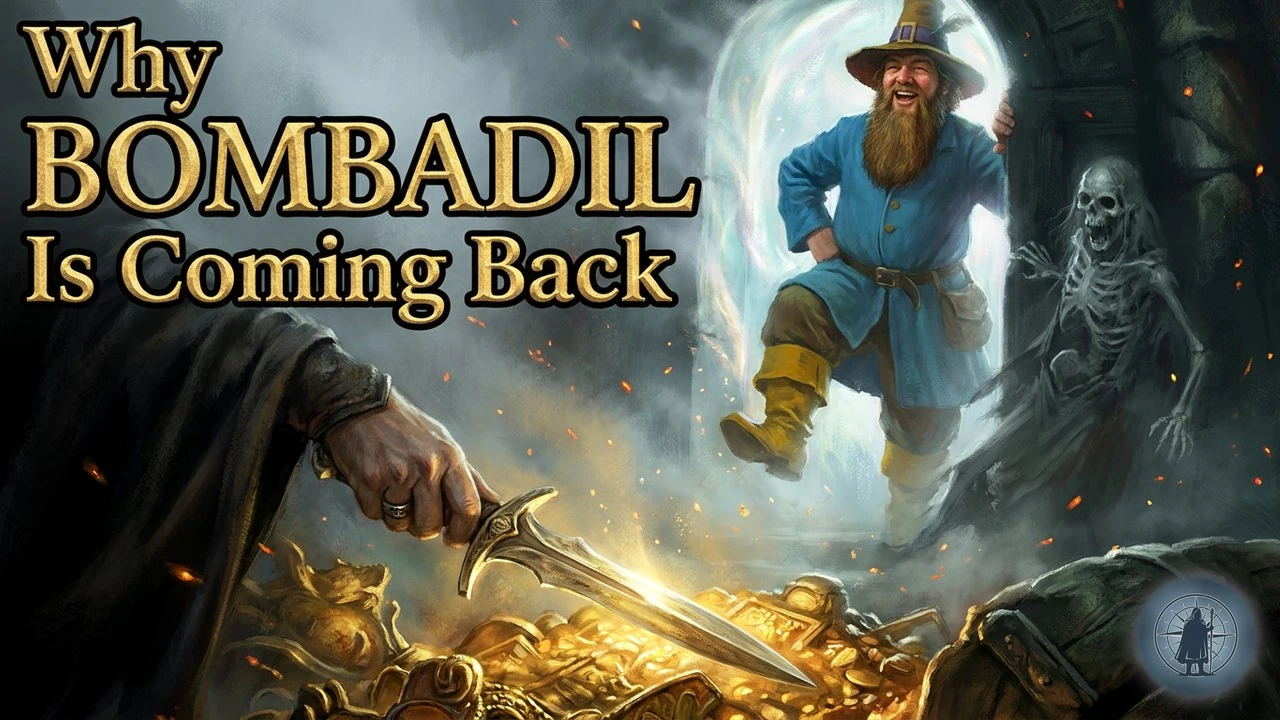 Watch the episode
The Lost Chapters: What Colbert's New LOTR Movie Will Restore
Watch the episode
The Lost Chapters: What Colbert's New LOTR Movie Will Restore
Research Notes: The Lost Chapters — What Colbert's New Lord of the Rings Movie Will Restore
Overview
In March 2026, Warner Bros. and New Line confirmed that Stephen Colbert is co-writing a new live-action Lord of the Rings film, working title "The Lord of the Rings: Shadow of the Past." Colbert is writing with his son, screenwriter Peter McGee, and Philippa Boyens (Oscar-winning co-writer of Peter Jackson's original trilogy). Peter Jackson and Fran Walsh produce. The film is expected to follow The Hunt for Gollum (Dec 2027), so realistically a 2028–2029 release.
The film's hook for Tolkien fans: it adapts the six chapters Jackson skipped in 2001 — The Fellowship of the Ring, Book I, Chapters 3 through 8: Three is Company, A Short Cut to Mushrooms, A Conspiracy Unmasked, The Old Forest, In the House of Tom Bombadil, and Fog on the Barrow-downs. These are the chapters that contain the Conspiracy at Crickhollow, Old Man Willow, Tom Bombadil, and the Barrow-wights — and, crucially, the Barrow-blade that Merry will one day use to break the Witch-king's spell at the Pelennor Fields.
The film is framed through Elanor Gardner, Sam's eldest daughter, who inherits the Red Book of Westmarch. Fourteen years after Frodo sails West, Elanor discovers "a long-buried secret" about why the War of the Ring was nearly lost before it began — and Sam, Merry, and Pippin set out to retrace those first steps. (The Elanor-detective frame is the film's own invention; Tolkien gave her no such story.)
The narrative payoff Jackson skipped — and the centerpiece of this episode — is the Barrow-blade. Merry takes a dagger from a wight's tomb in Chapter 8. A thousand pages later it breaks the spell on the Witch-king. Without those six chapters, the Witch-king's death is luck. With them, it is the cold, patient revenge of a kingdom that fell almost two thousand years before Frodo was born.
Primary Sources
The Lord of the Rings — The Fellowship of the Ring, Book I
"A Conspiracy Unmasked" (Chapter 5). At the Crickhollow house, Frodo prepares to tell Merry, Pippin, and Sam he must leave them. They cut him off: they already know. Sam has been reporting Frodo's conversations with Gandalf for months. Merry has known about the Ring since spotting Bilbo use it years before. Fredegar "Fatty" Bolger will stay at Crickhollow to impersonate Frodo and cover the escape.
- Quote (Merry to Frodo): "You can trust us to stick to you through thick and thin – to the bitter end. And you can trust us to keep any secret of yours – closer than you keep it yourself." (FotR I.5) - Merry reveals he saw Bilbo with the Ring decades before and later read his memoirs. - Sam confesses he was conscripted into the conspiracy as the "chief investigator." - The choice to go is theirs — it is not Gandalf's plan, not Elrond's plan, not Frodo's plan. The Fellowship begins here, in a hobbit kitchen, with four friends and a bath.
"The Old Forest" (Chapter 6). The hobbits leave Crickhollow through a tunnel under the Hedge and enter a forest that does not want them there.
- The Old Forest is the last shred of a primeval woodland that once covered all of Eriador (Tolkien Gateway / Old Forest). The trees "swayed when there was no wind, whispered at night, and misled travellers." - Tolkien wrote that the Forest was "hostile to two-legged creatures because of the memory of many injuries." Buckland's hedge had been attacked by the trees themselves — they planted themselves against it and leaned over it. The hobbits responded by burning a swath of forest, creating the "Bonfire Glade." The trees never forgave them. - The paths shift. The hobbits try to head north; they end up funneled south and east, down to the Withywindle — the river at the dark heart of the Forest, where "the queerness of the whole valley was concentrated." - Old Man Willow sings them to sleep. Merry and Pippin are swallowed into cracks in the trunk. Frodo is tipped into the river. He is half-drowned when a stranger comes singing nonsense down the path.
"In the House of Tom Bombadil" (Chapter 7). Tom carries them to his yellow-lit house at the foot of the Barrow-downs. Goldberry the River-daughter greets them. Over two nights Tom sings them his world's history.
- Tom holds out his hand for the Ring. He puts it on. He does not vanish. He holds it up to his eye and laughs — and then makes the Ring vanish, then produces it again from his other hand, and gives it back. - Frodo, suspicious, puts the Ring on himself. Tom looks straight at him and tells him to come back to the fire — he can see Frodo perfectly. - Quote (Tom Bombadil): "Eldest, that's what I am. Mark my words, my friends: Tom was here before the river and the trees; Tom remembers the first raindrop and the first acorn. He made paths before the Big People, and saw the little People arriving. He was here before the Kings and the graves and the Barrow-wights. When the Elves passed westward, Tom was here already, before the seas were bent. He knew the dark under the stars when it was fearless — before the Dark Lord came from Outside." (FotR I.7) - Tom teaches them a rhyme to summon him if they fall into danger within his borders. The rhyme will save their lives the next afternoon.
"Fog on the Barrow-downs" (Chapter 8). They leave Tom's house. A cold mist comes down on the open downs. The hobbits become separated. Frodo wakes inside a stone barrow with a sword across his throat and his three friends laid out beside him in white grave-clothes and gold.
- The wight's incantation: "Cold be hand and heart and bone, / and cold be sleep under stone: / never more to wake on stony bed, / never, till the Sun fails and the Moon is dead. / In the black wind the stars shall die, / and still on gold here let them lie, / till the dark lord lifts his hand / over dead sea and withered land." (FotR I.8) - A long pale arm crawls toward Sam with a sword. Frodo seizes a sword lying beside him and hacks the hand off. The blade shatters. He remembers Tom's rhyme and sings it — and Tom comes, breaks the barrow open, drives the wight away with a song, and brings the hobbits out into the sun. - Tom selects four daggers from the wight's treasure pile and gives one to each hobbit. He notes they are "forged long years ago by Men of Westernesse: they were foes of the Dark Lord, but they were overcome by the evil king of Carn Dûm in the Land of Angmar." (FotR I.8) - This is the line on which the Witch-king will die, almost a thousand pages later. Almost no first-time reader notices it.
The Lord of the Rings — The Return of the King, Book V
"The Battle of the Pelennor Fields" (RotK V.6). The Witch-king stands over Théoden. Éowyn confronts him. Merry crawls forward behind him and drives his Barrow-blade into the back of the Nazgûl's knee.
- Quote: "So passed the sword of the Barrow-downs, work of Westernesse. But glad would he have been to know its fate who wrought it slowly long ago in the North-kingdom when the Dúnedain were young, and chief among their foes was the dread realm of Angmar and its sorcerer king. No other blade, not though mightier hands had wielded it, would have dealt that foe a wound so bitter, cleaving the undead flesh, breaking the spell that knit his unseen sinews to his will." (RotK V.6) - This is the moment. The blade was forged in Arthedain specifically to fight Angmar. It was buried with a prince of Cardolan who died fighting the Witch-king in T.A. 1409. It sat in a barrow for 1,610 years. A hobbit picked it up off a pile of stolen treasure in Chapter 8 of Book I. And here, in the second-to-last battle of the War of the Ring, it does what it was forged to do. - The blade disintegrates after the blow — its purpose fulfilled. - Éowyn's killing stroke fulfills Glorfindel's prophecy ("not by the hand of man will he fall"), but the spell-breaking blow that allows her stroke to land is Merry's, with the blade of a dead kingdom.
The Lord of the Rings — Appendix A (Annals of the Kings and Rulers)
The history that makes the Barrow-blade possible.
- After King Eärendur of Arnor died in T.A. 861, his three sons quarreled and the North-kingdom split into three successor states: Arthedain (west, capital Fornost), Cardolan (south, including the Barrow-downs / Tyrn Gorthad), and Rhudaur (east, between the Weather Hills and the Misty Mountains). - The realm of Angmar rose in the north under a sorcerer-king — later revealed to be the chief of the Nazgûl — explicitly to destroy the heirs of Elendil. - Angmar overran Rhudaur. Cardolan was attacked in T.A. 1409; the last prince of Cardolan fell defending the Tyrn Gorthad. He was buried in a barrow with his weapons — including the blade that would one day kill the man who killed him. - The Great Plague of T.A. 1636 spread from the south and depopulated Cardolan entirely. The Witch-king then sent evil spirits out of Angmar and Rhudaur into the empty mounds to keep the Dúnedain from ever resettling the land. The Barrow-wights are an act of strategic, posthumous occupation. - Arthedain held out until T.A. 1974, when Fornost fell. The next year, in 1975, Eärnur of Gondor and Glorfindel of Rivendell shattered the Witch-king's army at the Battle of Fornost. The Witch-king fled south. Eärnur charged after him; his horse threw him. Glorfindel held him back and uttered the prophecy: "Far off yet is his doom, and not by the hand of man will he fall."
The Lord of the Rings — Return of the King, "The Grey Havens" and Appendix B (Tale of Years)
Elanor Gardner. Sam's first child, born 25 March S.R. 1421 (T.A. 3021) — the same day the Fourth Age began in Gondor.
- Named at Frodo's suggestion after elanor, the gold star-shaped flower of Lothlórien. The Sindarin name means "Sun-star" (êl + anor). - Frodo gives her her name shortly before leaving for the Grey Havens; she is the only one of Sam's children he meets. - As an adult she becomes a maid of honour to Queen Arwen in Gondor (S.R. 1436+). - She marries Fastred of Greenholm; they settle in the Westmarch at the Tower Hills. From them descend the Fairbairns of the Towers, Wardens of the Westmarch. - When Rosie dies in S.R. 1482, Sam rides west to leave Bag End. He gives Elanor the Red Book before going to the Grey Havens — the last person to see him alive in Middle-earth. The Fairbairns become the keepers of the Red Book, making copies and adding notes. - The film's premise — Elanor as the framing protagonist who uncovers "a long-buried secret" about the war — is a modern invention. Tolkien's text gives her the Red Book and the role of memory-keeper. Everything else is Colbert / McGee / Boyens.
Letters of J.R.R. Tolkien
Letter #144 to Naomi Mitchison (25 April 1954) — Tolkien answers a fan's questions about Tom Bombadil:
- "Tom Bombadil is not an important person — to the narrative. I suppose he has some importance as a 'comment'... But even in a mythical Age there must be some enigmas, as there always are. Tom Bombadil is one (intentionally)." - He describes Tom's stance toward power: "If you have, as it were taken 'a vow of poverty,' renounced control, and take your delight in things for themselves without reference to yourself, watching, observing, and to some extent knowing, then the question of the rights and wrongs of power might become utterly meaningless to you, and the means of power quite valueless. It is a natural pacifist view, which always arises in the mind when there is war."
Letter #153 to Peter Hastings (Sept 1954) — Tolkien refuses metaphysical labeling:
- "I do not mean him [Bombadil] to be an allegory — or I should not have given him so particular, individual, and ridiculous a name — but 'allegory' is the only mode of exhibiting certain functions: he is then an 'allegory'... a particular embodying of pure (real) natural science: the spirit that desires knowledge of other things, their history and nature, because they are 'other' and wholly independent of the enquiring mind, a spirit coeval with the rational mind, and entirely unconcerned with 'doing' anything with the knowledge."
Letter #210 to Forrest J. Ackerman (June 1958) — Tolkien tears apart Morton Grady Zimmerman's proposed Lord of the Rings film treatment. He is particularly furious about the misrepresentation of Bombadil; among other things he objects to Bombadil being treated as comic relief or dispensed with. The letter is the foundational document for arguments about what Jackson and any other adapter "owes" to Bombadil.
Key Facts & Timeline
In Middle-earth (Third Age years): - T.A. 861 — Arnor splits into Arthedain, Cardolan, Rhudaur after King Eärendur's death. - ~T.A. 1300 — Angmar arises under the Witch-king (later revealed as chief Nazgûl). - T.A. 1409 — Cardolan attacked by Angmar. Last prince of Cardolan dies at Tyrn Gorthad and is buried there with his weapons. Barrow-blades among them. - T.A. 1636 — Great Plague depopulates Cardolan. Witch-king sends evil spirits into the empty mounds. Barrow-wights begin. - T.A. 1974 — Fornost falls; Arthedain destroyed. - T.A. 1975 — Battle of Fornost. Witch-king's army shattered. Glorfindel utters the prophecy: not by the hand of man will he fall. - T.A. 3018, 26 September — Hobbits enter the Old Forest; Old Man Willow attacks; Bombadil rescues them. - T.A. 3018, 28 September — Hobbits captured by Barrow-wight. Bombadil rescues them; gives them the Barrow-blades. - T.A. 3019, 15 March — Battle of the Pelennor Fields. Merry's Barrow-blade breaks the Witch-king's spell; Éowyn kills him. Glorfindel's prophecy fulfilled. - T.A. 3021 / S.R. 1421, 25 March — Elanor Gardner born; Fourth Age begins. - S.R. 1482 — Sam gives Elanor the Red Book; sails West.
In our world: - 2001 — Jackson's Fellowship of the Ring released. Bombadil, the Old Forest, the Barrow-downs cut. Merry's sword in the films is a generic Elven blade given to him at Rivendell, not a Westernesse barrow-blade — the Pelennor payoff is excised. - 2024 — Rings of Power S2 includes the Stranger / Tom Bombadil; first major screen Bombadil. - March 24, 2026 (Tolkien Reading Day) — Colbert / Jackson video announces Shadow of the Past. - May 2026 — Jackson at Cannes confirms Colbert pitched him the project after re-reading LotR over Christmas. - Dec 2027 — The Hunt for Gollum release target. - Post-2027 / ~2028–2029 — Shadow of the Past expected release window.
Significant Characters
- Frodo Baggins — Ringbearer. In these chapters his leadership and limits are first tested; he is rescued twice (by Bombadil from Willow, from the wight), and shows his first real bravery (severing the wight's arm). - Sam Gamgee — Already secretly running an intelligence operation on Frodo for Merry's conspiracy. The hobbit kingdom's spy as well as gardener. - Meriadoc "Merry" Brandybuck — Architect of the Conspiracy. Knows the country, leads them through the Old Forest. Receives the Barrow-blade. Will use it 18 months later to break the Witch-king. - Peregrin "Pippin" Took — Comic-relief youngest, but the one who first speaks in Bombadil's house and the one most physically captured by Willow. - Fredegar "Fatty" Bolger — The hobbit who stays behind. Disguises himself as Frodo at Crickhollow, draws the Black Riders to the door, escapes barely, raises the Buckland alarm. Cut from the films. - Tom Bombadil — "Eldest." Not Maia, not Vala, not Elf, not anything Tolkien would name. The Ring has no power over him; he can see Frodo invisible; the Council of Elrond eventually rules he would lose the Ring or forget it because power is meaningless to him. - Goldberry, the River-daughter — Bombadil's wife. Spirit of the Withywindle. Greets the hobbits with: "Fair lady Goldberry." - Old Man Willow — Malign tree-spirit of the Withywindle, controlling most of the Old Forest. Tolkien's first symbol of the natural world's grievance against the speaking peoples. - The Barrow-wight — Spirit sent from Angmar to occupy the empty tombs of Cardolan. An instrument of dead, patient evil. - The Witch-king of Angmar — Chief of the Nazgûl. Author of Cardolan's ruin, sender of the wights, ultimate target of the blade his own war buried. - The last Prince of Cardolan — Unnamed in canon. Died T.A. 1409 defending Tyrn Gorthad against Angmar. Buried with the dagger Merry will inherit. The story's deepest unseen patron. - Glorfindel — Speaks the prophecy in T.A. 1975. Also cut from the Jackson films (replaced by Arwen). - Éowyn — Delivers the killing blow on the Pelennor; Merry's blade makes it possible. - Elanor Gardner — Sam's daughter. Memory-keeper of the Red Book. Framing protagonist of the Colbert film.
Geographic Locations
- The Shire — Frame and home. Hobbits leave it for the first time as actual quest-bearers. - Buckland — The strip of land east of the Brandywine River where the Brandybucks live; closer to the Old Forest than other hobbits like. Crickhollow is here. - Crickhollow — Frodo's "decoy" house in Buckland; site of the Conspiracy reveal. - The Hedge / High Hay — The great barrier the Bucklanders built to keep the Old Forest out. The trees have been pushing back against it for centuries. - The Old Forest — A surviving fragment of the primeval woodlands of Eriador. Trees are awake and hostile, especially around the Withywindle. - Bonfire Glade — The strip the hobbits burned to push the trees back. Visible scar of the human-tree war. - The Withywindle — River at the dark heart of the Forest. Source of its hostility. - House of Tom Bombadil — At the foot of the Barrow-downs, on the eastern edge of his domain. - The Barrow-downs / Tyrn Gorthad — Ancient cemetery hills where Edain chieftains were buried in the First Age, later the Dúnedain of Cardolan. Now haunted. - Cardolan — The southern successor-kingdom of Arnor. Destroyed by Angmar (1409) and plague (1636). Reduced to wightland. - Arthedain — The western successor-kingdom; held longest. Forged the daggers. Capital Fornost. - Angmar / Carn Dûm — The Witch-king's northern realm. Author of all of the above. - Pelennor Fields (RotK payoff site) — Where the buried blade does what it was forged for.
Themes & Symbolism
- The deep past as an active force. These chapters insist that the past is not background. Old grievances (the Forest's), old craft (the daggers), old kingdoms (Cardolan), old evils (the wights) all reach forward and act in the present. Without these chapters, the past is told. With them, the past acts. - Power one can refuse. Bombadil is the only being in the legendarium for whom the Ring is uninteresting. Tolkien insists this is not strength — it is renunciation. "A natural pacifist view, which always arises in the mind when there is war." (Letter 144) - The world before the speaking peoples. Bombadil's "Eldest" speech is Tolkien's clearest statement that Middle-earth is older than its stories. The trees, the river, the stones existed before language to describe them. This is the spiritual logic of his sub-creation. - Friendship as conspiracy. Frodo thinks he is going alone. He is not. The Conspiracy at Crickhollow reframes the entire quest: he was never solitary, never the one suffering for the others; the others insisted, against his protest, on suffering with him. - Hostility from the world, not just the enemy. The Old Forest and Old Man Willow are not Sauron's. They are old grievances of the natural world — the trees remember the axes. The first thing that nearly kills Frodo outside the Shire is not Black Riders. It is a willow. - Long-buried payoff. The Barrow-blade is the cleanest example of Tolkien's slow narrative architecture. Setup in Chapter 8, payoff in Return of the King. A thousand pages and 1,610 in-world years between blow and blade.
Scholarly Interpretations & Theories
- "What is Bombadil?" is a closed question — Tolkien deliberately refused to answer (Letters 144, 153, 210). Major scholarly positions: - The Maia view (popular fan-canon): a nature-spirit / Aulë-adjacent or unique Maia. Weakness: Maiar can be tempted by the Ring; Bombadil cannot. - The Vala view (Gene Hargrove): Aulë himself, with Goldberry as Yavanna. Weakness: Vala doctrine is hard to square with Tom's localized power. - The Genius Loci view: Tom is the spirit of Middle-earth itself, in localized form. Goldberry the spirit of the river. Most consistent with Tolkien's own descriptions in Letter 153 ("a particular embodying of pure (real) natural science"). - The Aboriginal Spirit view (Tom Shippey, Road to Middle-earth): Bombadil is older than the cosmogony — a pre-existing being from Tolkien's nursery poems whom Tolkien refused to retrofit into the legendarium's neat metaphysics. The enigma is partly an editorial honesty. - Why Jackson cut these chapters. Jackson's own stated reasoning (interviews, EE commentaries): Bombadil "doesn't move the story forward"; the Forest / Bombadil / Barrows sequence is "a self-contained adventure" that breaks momentum toward Rivendell. Jackson noted his Fellowship script had the hobbits leaving Hobbiton on page 30 and arriving at Rivendell by page 63; even at 63 pages it felt long. The commercial cinema imperative is forward momentum; episodic structure is the enemy. - Why Colbert can put them back. Multiple commentators (Slashfilm, Consequence, Empire) point out the cultural shift: post-Game of Thrones, post-Rings of Power, audiences accept slower, world-deepening episodic content. A standalone film built around only these six chapters (rather than embedding them in a three-hour epic that also has to set up the entire Fellowship) gives them room to breathe. The Bombadil scene that breaks momentum in a 3-hour film is the film when the film is 110 minutes about the Old Forest. - The Witch-king payoff and "earned" fate. Critics of the Jackson Pelennor (e.g., Tolkien essayist Tom Shippey, fan-scholar Corey Olsen on Mythgard) argue the films make the Witch-king's death feel like a one-liner ("I am no man"); the book makes it feel like the inevitable closing of a 2,000-year-old loop. The Barrow-blade is the loop. Restoring Chapter 8 is restoring the architecture.
Contradictions & Different Versions
- Bombadil's metaphysical status is the great unresolved item. Tolkien wrote contradictory letters and refused conclusive identification. Christopher Tolkien notes in HoME VI: The Return of the Shadow that Tom existed in his father's writing (as a Dutch doll, then in the 1934 Adventures of Tom Bombadil poem) before he had any place in the legendarium at all; he was retrofitted, not designed. - Who killed the Witch-king? Strictly Merry-and-Éowyn together; in the book the spell-breaking blow is Merry's, the killing blow is Éowyn's. The Jackson films give the spell-breaking moment ambiguously to both, but cut the lineage of Merry's blade entirely, so a viewer cannot reconstruct why his stab worked. - Glorfindel's prophecy attribution sometimes credited to Eärnur or to other sources in older drafts (HoME XII). - The Barrow-wights' origin spirits are deliberately vague — Tolkien left them unidentified. Christopher's HoME notes show his father considered (and rejected) labeling them as ghosts of the buried Dúnedain themselves; the canonical reading is that they are evil spirits sent from Angmar and Rhudaur to inhabit the bones. - Elanor's age when given the Red Book: ~61 (S.R. 1482, when Sam departs). The film will almost certainly make her younger.
Cultural & Linguistic Context
- Tyrn Gorthad — Sindarin: "Mounds of Wights / of the Dead." (Cf. gorthad = wight / barrow-spirit.) The Sindarin name is itself an admission of what the place has become. - Cardolan — Sindarin: "Red Land," from caran (red) + dol (hill) + the genitive marker; the chief geographic feature is the Red Hills. - Arthedain — "Realm of the Edain," the heartland of Númenórean memory in the north. - Carn Dûm — Witch-king's capital. Sindarin: "Dark Red" — color of dried blood; the name is darkly etymologically related to Cardolan. - Elanor — Sindarin êl (star) + anor (sun) = "Sun-star." A small, perfect Tolkien naming: Sam's daughter, born at the dawn of a new age, carries the Two Lights in her name. - Withywindle — Old English withy (willow) + windle (winding stream). The most archaic, Anglo-Saxon-flavored place-name in the book; a deliberate signal that we have left the Hobbit/idyll register and entered the deep mythic. - Bombadil's verse — Tolkien wrote Bombadil's lines in tetrameter with feminine endings ("hey dol, merry dol, ring a dong dillo") — a deliberately archaic, almost nursery-rhyme meter. Its incongruity is the point: in the book it sounds wrong, and that wrongness signals that an older order of being has stepped onto the page.
Questions & Mysteries
- Why does the Ring have no power over Bombadil? Officially unanswered. The most disciplined reading: because Bombadil has no desire to use, and the Ring works on desire to use. He is not stronger than it; he is uninterested in it. - Why did Tolkien refuse to integrate Bombadil into his clean metaphysics? Editorial honesty? Affection for an older creation? A deliberate philosophical statement that some things must remain enigmas? (See Letter 144.) - Who was the last prince of Cardolan? Unnamed. He is the silent patron of the climax of the entire trilogy. Tolkien gives him no name. The film, presumably, will. - What "long-buried secret" does Elanor uncover? This is the film's invention. The episode should flag clearly: Tolkien gave Elanor no such secret. Most plausible film synthesis: the Barrow-blade lineage itself, dramatized as a discovery Elanor makes by reading the Red Book and following a thread back to Cardolan. - Why are the trees of the Old Forest still hostile after thousands of years? Tolkien: long memory of injury. Modern reading: the legendarium's recurring lament that the speaking peoples have made the world an unsafe place for the things that were here first.
Compelling Quotes for Narration
1. "You can trust us to stick to you through thick and thin – to the bitter end. And you can trust us to keep any secret of yours – closer than you keep it yourself." — Merry to Frodo at Crickhollow (FotR I.5) 2. "Eldest, that's what I am. Mark my words, my friends: Tom was here before the river and the trees... He knew the dark under the stars when it was fearless – before the Dark Lord came from Outside." — Tom Bombadil (FotR I.7) 3. "Cold be hand and heart and bone, and cold be sleep under stone: never more to wake on stony bed, never, till the Sun fails and the Moon is dead." — Barrow-wight's chant (FotR I.8) 4. "Forged long years ago by Men of Westernesse: they were foes of the Dark Lord, but they were overcome by the evil king of Carn Dûm in the Land of Angmar." — Tom Bombadil, naming the daggers (FotR I.8) 5. "No other blade, not though mightier hands had wielded it, would have dealt that foe a wound so bitter, cleaving the undead flesh, breaking the spell that knit his unseen sinews to his will." — RotK V.6 6. "So passed the sword of the Barrow-downs, work of Westernesse. But glad would he have been to know its fate who wrought it slowly long ago in the North-kingdom when the Dúnedain were young, and chief among their foes was the dread realm of Angmar and its sorcerer king." — RotK V.6 7. "Far off yet is his doom, and not by the hand of man will he fall." — Glorfindel, after the Battle of Fornost, T.A. 1975 (Appendix A) 8. "Even in a mythical Age there must be some enigmas, as there always are. Tom Bombadil is one (intentionally)." — Tolkien, Letter 144
Visual Elements to Highlight
1. Crickhollow at night — yellow window-light, the four hobbits around the table, the reveal moment. 2. Bonfire Glade — black scar in the Old Forest, the trees leaning in from all sides. 3. The Withywindle and Old Man Willow — the river curling like a willow root, Frodo half in the water, two hobbits half-swallowed by bark. 4. Tom Bombadil silhouette — battered hat, blue feather, yellow boots, against the green. 5. Tom holding the Ring up to his eye — the iconic anti-temptation image. Goldberry behind him. 6. The Barrow-down at dusk — fog, standing stones, the white shape of a wight rising from a tomb. 7. The pile of treasure inside the barrow — gold, crowns, four small daggers among them. 8. Smithy of Arthedain (flashback) — a Dúnadan weaponsmith in the North-kingdom forging the daggers slowly, long ago. 9. Battle of Fornost (flashback) — Glorfindel on horseback, the Witch-king fleeing, the prophecy spoken into the open field. 10. Pelennor Fields — Merry kneeling behind the Witch-king, the small dagger going in, the dagger withering to ash, the spell breaking. 11. Elanor reading the Red Book in a window-seat at the Tower Hills, S.R. 1480s.
News-Peg Context (Item 7)
What has been publicly confirmed about The Lord of the Rings: Shadow of the Past (as of May 2026):
- Announcement: March 24, 2026 (Tolkien Reading Day), via a Colbert–Jackson conversation video posted to social media. Warner Bros. and New Line confirmed officially the next day. - Writers: Stephen Colbert, Philippa Boyens, Peter McGee (Colbert's son, a working screenwriter). - Producers: Peter Jackson, Fran Walsh, Philippa Boyens. - Studio: Warner Bros. / New Line. - Source material: FotR Book I Chapters 3–8 (Three is Company through Fog on the Barrow-downs). Confirmed in official synopsis and trade press. - Framing: "Fourteen years after the passing of Frodo – Sam, Merry, and Pippin set out to retrace the first steps of their adventure. Meanwhile, Sam's daughter, Elanor, has discovered a long-buried secret and is determined to uncover why the War of the Ring was very nearly lost before it even began." (Official synopsis, per Empire / Deadline / Goldderby.) - Inventions vs. canon: The Elanor framing protagonist, the "long-buried secret," and the 14-years-later coda are all film invention; Tolkien gives Elanor no investigative role. The episode must flag this honestly. - Origin of project: Per Jackson at Cannes 2026 — Colbert contacted Jackson approximately a year prior (early 2025), saying he had been re-reading LotR over Christmas and believed the cut chapters would make a great standalone film. - Release timeline: After The Hunt for Gollum (target Dec 2027). Realistic window: late 2028 or 2029. - Tom Bombadil: Confirmed present in the film. This will be the first major theatrical Bombadil (after his Rings of Power S2 appearance as "the Stranger / Tom" in 2024).
Why Jackson Cut Them (Item 8 — Bonus Angle)
Jackson's published reasoning (commentaries, EE booklets, post-2001 interviews): - Forward momentum: The Bombadil sequence "doesn't further the story." Jackson's stated screenwriting rule was that every scene must push toward the next plot beat; the Old Forest / Bombadil / Barrows arc is a self-contained adventure that pauses the larger one. - Tonal break: The "fairy-tale tone" of Bombadil — singing, rhyming, jolly — sat awkwardly against the gathering Nazgûl darkness. In a 3-hour film with one register to maintain, the cut was structural. - Page count: Script analysis Jackson has shared: hobbits leave Hobbiton p.30, arrive Rivendell p.63. He considered even those 33 pages too long. - The Ring stakes: Bombadil "fails" the Ring test in a way that breaks the story logic — the One Ring is supposed to be the ultimate seductive evil; here is one being who finds it boring. In a 3-hour epic this is a problem. In a 110-minute meditation on the Old Forest it is the point.
Why an episodic / standalone modern adaptation can restore them: - Post-2000s audiences trained on prestige TV (LotR Rings of Power, Game of Thrones, House of the Dragon) accept slow-build, lore-dense, character-piece installments. - A standalone film does not have to set up the Fellowship; the audience already knows. The film is freed to be about the lost chapters rather than embedding them. - Tonal break is not a problem when the tone is the subject. A film whose central question is "what is this old, strange world the Shire opens onto?" is allowed to be tonally strange.
Discrete Analytical Themes
Theme 1: The Conspiracy at Crickhollow (Friendship Reframed)
Core idea: The quest does not begin with Gandalf or Elrond. It begins in a kitchen in Buckland, when three hobbits inform Frodo he was never solitary. Evidence: - "You can trust us to stick to you through thick and thin – to the bitter end." (Merry, FotR I.5) - Sam has been spying for Merry for months. Merry has known about the Ring for years. - Fredegar Bolger volunteers to play decoy and is later actually attacked by Nazgûl at Crickhollow. Distinction: This is about the origin moment of the Fellowship — not Rivendell. It reframes the whole quest as freely chosen by friends, not assigned by elders. The script section can run on this alone.Theme 2: The Old Forest and the World's Older Grievance
Core idea: The first thing that nearly kills Frodo outside the Shire is not Sauron's; it is the natural world's long memory of being injured by axes. Evidence: - Tolkien: the Forest is "hostile to two-legged creatures because of the memory of many injuries." - The trees once attacked the Hedge; the hobbits burned the Bonfire Glade in retaliation. - Old Man Willow is the centerpiece, but the whole forest misdirects the hobbits. Distinction: This is about the world itself as antagonist, a category distinct from Sauron. It also distinguishes the legendarium from generic fantasy: Tolkien's world has grudges that pre-date the Dark Lord.Theme 3: Bombadil and the Power One Can Refuse
Core idea: The Ring has no power over Bombadil because Bombadil has no desire to use. He is Tolkien's clearest counter-example to the entire logic of the Ring. Evidence: - Tom puts on the Ring and does not vanish; sees Frodo invisible. - Letter 144: "a natural pacifist view, which always arises in the mind when there is war." - Letter 153: not allegory but "embodying pure natural science" — knowledge for its own sake. - Council of Elrond rejects Bombadil as Ring-keeper because he would lose it; he would not understand why it mattered. Distinction: This is about the philosophy of refusal — distinct from heroism, from strength, from temptation-and-resistance. Bombadil isn't strong against the Ring; he is sideways to it.Theme 4: The Wights as Posthumous Occupation
Core idea: The Barrow-wights are not random monsters. They are the Witch-king's strategic, undead garrison preventing the resurrection of a kingdom. Evidence: - Cardolan destroyed in T.A. 1409; Great Plague depopulates it in 1636. - Witch-king sends evil spirits from Angmar/Rhudaur into the empty mounds. - Wights successfully terrorize the region for 1,400 years; no Dúnedain return. Distinction: This is about evil as long-term political strategy, not as monster-of-the-week. Sauron and the Witch-king play centuries-long games. The wight that captures Frodo is part of a strategy from before Rohan existed.Theme 5: The Barrow-Blade Payoff (The Buried Loop)
Core idea: The dagger Merry pockets in Chapter 8 is the same dagger that breaks the Witch-king's spell at the Pelennor Fields. This is Tolkien's deepest single piece of narrative architecture. Evidence: - Daggers forged in Arthedain specifically as weapons against Angmar. - Buried T.A. 1409 with the last prince of Cardolan. - "No other blade, not though mightier hands had wielded it, would have dealt that foe a wound so bitter." (RotK V.6) - "Glad would he have been to know its fate who wrought it slowly long ago in the North-kingdom..." - 1,610 years between burial and stab. Distinction: This is THE centerpiece. It is why the cut chapters matter — without them the Witch-king's death is a clever line; with them it is the closing of a thousand-year revenge.Theme 6: Elanor and the Memory-Keeper Frame
Core idea: Sam's daughter, born at the dawn of the Fourth Age and named for a Lothlórien flower, inherits the Red Book and becomes the legendarium's memory. The film makes her its detective. Evidence: - Born 25 March T.A. 3021 / S.R. 1421 — the very day the Fourth Age begins. - Named at Frodo's suggestion: "Sun-star" in Sindarin. - Maid of honour to Queen Arwen in Gondor. - Receives the Red Book from Sam in S.R. 1482 before he sails West. - Fairbairns of the Westmarch become its keepers, copyists, annotators. Distinction: This is about who carries memory after the heroes are gone — and about the film's invention. The script can use this theme to be honest with the audience about what is canon vs. what is Colbert/McGee/Boyens.Theme 7: Why Jackson Cut Them / Why Now They Return
Core idea: The same six chapters that broke a 2001 blockbuster's momentum are the perfect material for a 2028 standalone. The cultural format changed; the chapters didn't. Evidence: - Jackson's stated rule: every scene must push the story forward. - Bombadil "doesn't move the story" in a 3-hour epic structure. - Post-Game-of-Thrones, post-Rings-of-Power audiences accept world-piece episodic storytelling. - A standalone film doesn't have to also set up the Fellowship; it can be about the cut chapters. Distinction: This is the meta-narrative theme — adaptation as cultural artifact. Distinct from the in-world themes. It is the "what does this news actually mean" section of the script.Sources Consulted
See sources.md for full list.
Sources Consulted
Primary Sources (Tolkien)
- The Lord of the Rings, The Fellowship of the Ring, Book I: - Ch. 5 "A Conspiracy Unmasked" - Ch. 6 "The Old Forest" - Ch. 7 "In the House of Tom Bombadil" - Ch. 8 "Fog on the Barrow-downs" - The Lord of the Rings, The Return of the King: - Book V Ch. 6 "The Battle of the Pelennor Fields" (the Barrow-blade narration) - Appendix A "Annals of the Kings and Rulers" — Arnor, Cardolan, the Witch-king of Angmar, Battle of Fornost - Appendix B "The Tale of Years" — dates of plague, fall of Cardolan, Pelennor, Elanor's birth and the gift of the Red Book - Ch. 9 "The Grey Havens" — Sam's departure and the Red Book inheritance - The Letters of J.R.R. Tolkien (Carpenter, ed.): - Letter #144 (to Naomi Mitchison, 25 Apr 1954) — Bombadil as "intentional enigma"; the "natural pacifist" passage - Letter #153 (to Peter Hastings, Sept 1954) — Bombadil and "pure natural science"; refusal of allegory - Letter #210 (to Forrest J. Ackerman, June 1958) — critique of Zimmerman film treatment, defense of Bombadil - The History of Middle-earth, Vol. VI: The Return of the Shadow (Christopher Tolkien, ed.) — drafting history of FotR Book I, Bombadil's pre-legendarium origin as a Dutch doll / 1934 Oxford Magazine poem.
Secondary / Scholarly
- Tom Shippey, The Road to Middle-earth — on Bombadil as a "rogue" element predating the legendarium's metaphysics. - Gene Hargrove, "Who Is Tom Bombadil?" (1986 essay, still widely cited). - Corey Olsen / Mythgard Institute — chapter-by-chapter exegesis of FotR Book I. - Journal of Tolkien Research — multiple papers on the Bombadil enigma: - "The Enduring Enigma of Tom Bombadil" (Valparaiso, JTR). - Volume 20 Issue 2 essay on Bombadil scholarship. - Sociedad Tolkien — "Tom Bombadil and the Hyper-fantastic in J.R.R. Tolkien" (Aelfwine Award essay, 2023).
Reference / Wiki
- Tolkien Gateway: pages on A Conspiracy Unmasked, The Old Forest, Old Man Willow, Tom Bombadil, Goldberry, Barrows / Barrow-downs, Barrow-wights, Cardolan, Arthedain, Rhudaur, Arnor, Daggers of Westernesse (Barrow-blades), Witch-king, Battle of Fornost, Elanor Gardner, Elanor (flower), Fairbairn family, The Lord of the Rings: Shadow of the Past. (Direct WebFetch blocked; accessed via search snippets.)
- Wikipedia: Tom Bombadil; Old Forest; Old Man Willow; Barrow-wight; Trees in Middle-earth; Fran Walsh.
- The One Wiki to Rule Them All (Fandom): parallel coverage for cross-checking.
- Thain's Book (thainsbook.minastirith.cz) — North-kingdom of Arnor, swords of Middle-earth.
News-Peg Sources (Shadow of the Past, 2026)
- Hollywood Reporter — Stephen Colbert Co-Writing New 'Lord of the Rings' Movie - Empire — Lord Of The Rings: Shadow Of The Past Movie Announced - Deadline (March 2026) — Stephen Colbert Set to Adapt Next 'Lord of the Rings' Movie - Deadline (May 2026, Cannes) — Peter Jackson On How Stephen Colbert Got 'LOTR: Shadow of the Past' - NPR — Stephen Colbert's next epic quest? Writing a new 'Lord of the Rings' movie - Goldderby — Stephen Colbert's 'Lord of the Rings' movie, explained - Consequence — Stephen Colbert's Lord of the Rings Movie Explained - NME — New Lord of the Rings sequel Shadow of the Past confirmed - Flickering Myth — Shadow of the Past to explore more untold tales from Fellowship - Primetimer — Warner Bros. confirms Colbert to co-write new LotR movie - Fandom Post — Shadow of the Past feature film in the works
Why Jackson Cut Tom Bombadil
- Slashfilm — Why Peter Jackson Cut Tom Bombadil - Screen Rant — LotR Cutting Tom Bombadil Was Right (& Tolkien May Agree) - Screen Rant — Rings of Power S2 Restores Three Fellowship Scenes Jackson Cut - CBR — The Films Lost a Ghostly Encounter, Thanks to Tom Bombadil - MovieWeb — Why the Lord of the Rings Movies Cut Tom Bombadil
Barrow-Blade / Witch-King Payoff
- GameRant — LotR: Why Merry's Sword Is The Missing Key To Destroying The Witch King - GameRant — Lord of the Rings: The Hobbits' Barrow-Blades, Explained - Alas, Not Me (blog) — "Glad Would He Have Been To Know Its Fate" - Foreshadowed and Foresung — The Words of Glorfindel and the Witch-King of Angmar
Elanor Gardner
- Slashfilm — Who Is Sam Gamgee's Daughter? Elanor's Backstory
Most Useful Sources
- For the Barrow-blade payoff: the Tolkien Gateway Daggers of Westernesse article (via search snippets) and the Alas-Not-Me blog post, both of which quote the full RotK V.6 passage. - For Bombadil's metaphysics: Letter 144 quotes accessible via priyasethtolkienfan blog and the Journal of Tolkien Research papers. - For the news peg: Empire, NPR, Deadline (March + May 2026 Cannes update) — together they triangulate the writing team, the synopsis, and the project's origin story. - For Cardolan / Arnor history: Tolkien Gateway Arnor, Cardolan, Barrow-downs pages and elfenomeno.com's "Fall of Cardolan" entry.
Gaps / Caveats
- WebFetch was blocked (HTTP 403) for tolkiengateway.net direct calls; primary-source quotes were captured via search engine snippets, which are accurate but should be page-checked against a physical/eBook copy before final script lock.
- The last Prince of Cardolan is unnamed in canon. Any name the Colbert film gives him will be invention.
- Elanor's role as detective/protagonist is film invention; flag this clearly in the script.
- HoME volumes were referenced from secondary scholarship, not from direct fetch.