
Research & Sources
Gandalf's Ring of Power
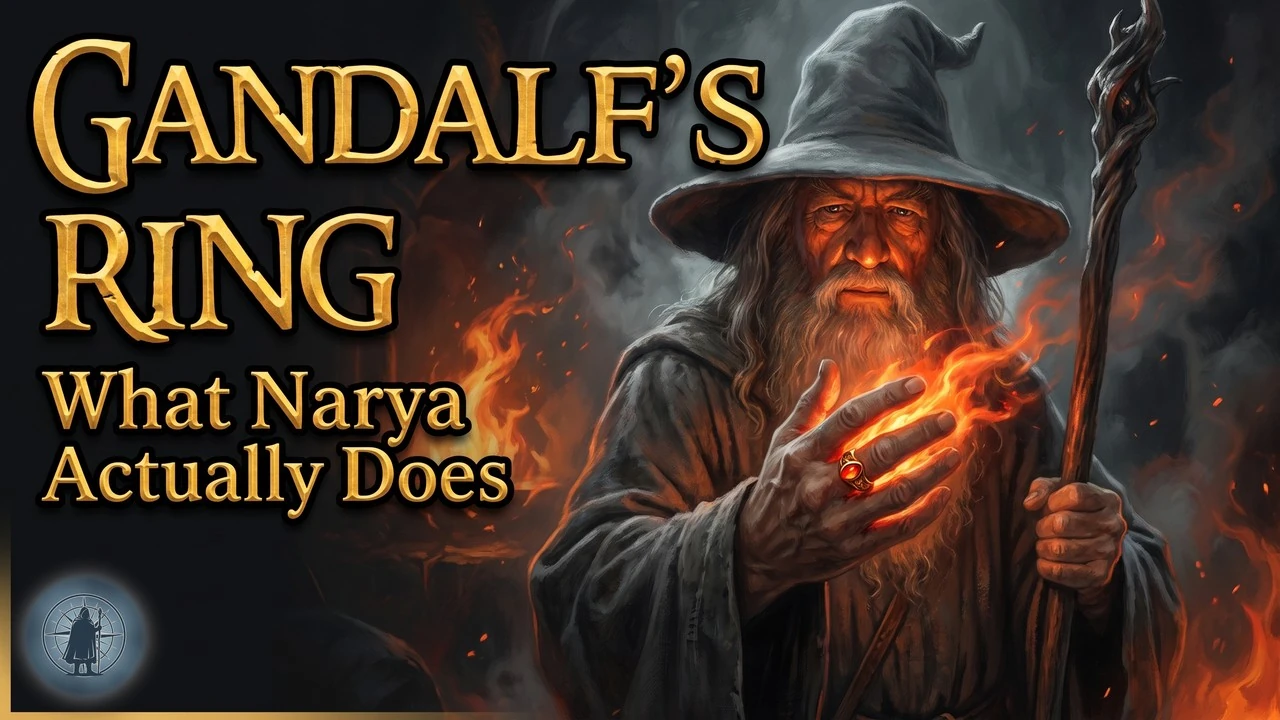 Watch the episode
Gandalf's Ring of Power
Research Notes: Narya and the Spell of Shutting — What Gandalf's Ring Actually Does
Sufficiency statement (read first)
This topic sustains a full 7-section, 29–36 minute episode. It yields 8 distinct analytical themes with hard evidence behind each. The topic is unusually well-supplied because it sits at the junction of four separate bodies of text: the Ainulindalë/Valaquenta cosmology, the Second Age ring-forging annals, Unfinished Tales' Istari essay, and the Moria chapters of *The Fellowship of the Ring — plus a documented draft history in The Treason of Isengard* and a forty-year fan-and- scholar argument with named participants (Kocher 1985 → Caldecott 2003 → McIntosh 2017).
Three accuracy warnings for the writer and the fact-checker, up front:
1. Do not say "Tolkien confirmed the Secret Fire is the Holy Spirit" without the provenance. That identification does not appear in any numbered Letter. It comes from Clyde S. Kilby's memoir of conversations with Tolkien in the summer of 1966, published in *Tolkien and The Silmarillion* (Harold Shaw, 1976), p. 59. It is a reported private remark, not written Tolkien. A previous episode on this channel ("Gandalf: The God Pretending to Be a Wizard") appears to have asserted it flatly. Correct it here. 2. "Flame of Anor" is never glossed by Tolkien anywhere. Not in the fiction, not in the Letters, not in the Silmarillion apparatus. Every reading of it is inference. Say so. 3. *The phrase "Secret Fire" appears in the published Silmarillion* exactly once as a proper term — in the opening paragraph of the Valaquenta**, not the Ainulindalë. (A lowercase "secret fire" appears once more, in the eschatological last movement of the Ainulindalë.) This is checkable and worth getting right; a first research pass failed to verify it and nearly flagged it as a fan misquote. See "Contradictions and Variants."
Ground already burned by prior episodes (avoid repeating): "The Three Elven Rings" covered Círdan's gift moment and the kindling/devouring fire symbolism; "Gandalf: The God Pretending to Be a Wizard" covered the Olórin backstory, Nienna's pedagogy, and gave a whole section to the Secret Fire as allegiance-declaration; "What Is Tolkien's Magic, Really?" already re-read the Bridge scene as identification rather than spellcasting. The fresh ground here is mechanical and evidential: the chain of custody of a physical object, the one spec sheet it ever gets, what Gandalf's magic actually costs him on the page, and the case-for/case-against on the Narya reading of "flame of Anor."
Overview
On 15 January T.A. 3019, on a stone span over a chasm in Moria, a man in grey says eleven words that have been argued about for seventy years: *"I am a servant of the Secret Fire, wielder of the flame of Anor."*
He is wearing, hidden under a glove, a Second Age Elven artefact called Narya, the Ring of Fire, given to him nineteen centuries earlier by a shipwright at the Grey Havens. He is also — though nobody on that bridge knows it — a Maia of Manwë and Varda, one of the spirits who sang before the world was made, and therefore something that was himself kindled by a fire older than Time.
The episode's question is a disentangling: are those the same fire? Is the "Secret Fire" the thing on his finger, or the thing at the heart of the world — and is the "flame of Anor" a third thing again? The answer requires separating three items that fan discourse routinely blurs:
- Narya — a made object. Forged by one named smith in a named city in a datable century. Its powers are described exactly once, by the man giving it away. - The Flame Imperishable / Secret Fire — Eru's own creative power. Uncreated, untransferable, and specifically established in the text as the one thing that cannot be found, taken, or wielded by anyone but Eru. Melkor spent ages looking for it and failed. - The flame of Anor — the light of the Sun, which in Tolkien's cosmology is the last fruit of Laurelin carried through the sky in a vessel steered by Arien, a fire-spirit Melkor could not corrupt. Created light, with a traceable pedigree, opposed in the same sentence to the "flame of Udûn" — Udûn being the Sindarin name of Utumno, Melkor's first fortress.
The most interesting structural fact about Gandalf's sentence is that the two halves use *different verbs*. He is a servant of the first thing and a wielder of the second. That grammar is the episode's spine.
Primary Sources
The Lord of the Rings — The Fellowship of the Ring, Book II, ch. 5, "The Bridge of Khazad-dûm"
The declaration, verbatim (published text; verified against two independent captures including Marquette University's Anduin manuscript database):
"'You cannot pass,' he said. The orcs stood still, and a dead silence fell. 'I am a servant of the
Secret Fire, wielder of the flame of Anor. You cannot pass. The dark fire will not avail you,
flame of Udûn. Go back to the Shadow! You cannot pass.'"
Notes that matter for scripting: - "I am a servant of the Secret Fire" comes immediately after the first "You cannot pass," not at the end of the speech. - The book says "You cannot pass" — four times across the scene. "You shall not pass" is the 2001 Peter Jackson film. The line most people quote is not in the book. - After the Balrog's sword shatters on Glamdring in "a stab of white fire," Gandalf repeats a fourth, bare "You cannot pass!" before breaking the bridge.
The Chamber of Mazarbul — Gandalf's own account of the spell of shutting (same chapter, spoken after the Fellowship escapes; this is the episode's title material):
"'I do not know,' answered Gandalf. 'But I found myself suddenly faced by something that I have
not met before. I could think of nothing to do but to try and put a shutting-spell on the door. I
know many; but to do things of that kind rightly requires time, and even then the door can be
broken by strength.
'As I stood there I could hear orc-voices on the other side: at any moment I thought they would
burst it open. I could not hear what was said; they seemed to be talking in their own hideous
language. All I caught was ghâsh: that is "fire". Then something came into the chamber — I felt
it through the door, and the orcs themselves were afraid and fell silent. It laid hold of the iron
ring, and then it perceived me and my spell.
'What it was I cannot guess, but I have never felt such a challenge. The counter-spell was
terrible. It nearly broke me. For an instant the door left my control and began to open! I had to
speak a word of Command. That proved too great a strain. The door burst in pieces. Something dark
as a cloud was blocking out all the light inside, and I was thrown backwards down the stairs...
'Ah! I have never felt so spent, but it is passing.'"
And his first words on staggering out, a few paragraphs earlier:
"'Well, well! That's over!' said the wizard struggling to his feet. 'I have done all that I could.
But I have met my match, and have nearly been destroyed... I am rather shaken.'"
Three details worth the writer's attention: (a) "I know many" — shutting-spells are a category Gandalf has studied, a craft with technique and prerequisites; (b) **"to do things of that kind rightly requires time" — his magic has a casting cost and a failure mode; (c) the Balrog's counter-spell beat him**, and the door broke. This is the wielder of the flame of Anor, half an hour before he says so, losing a contest of will through a door.
The Fellowship of the Ring, Book II, ch. 2, "The Council of Elrond"
Elrond on the Three — the single most important statement of what they are for. (Note: this is often misattributed online to The Silmarillion. It is Elrond, in LOTR.)
"The Three were not made by Sauron, nor did he ever touch them. But of them it is not permitted to
speak. So much only in this hour of doubt I may now say. They are not idle. But they were not made
as weapons of war or conquest: that is not their power. Those who made them did not desire strength
or domination or hoarded wealth, but understanding, making, and healing, to preserve all things
unstained."
And on their fate:
"'We know not for certain,' answered Elrond sadly. 'Some hope that the Three Rings, which Sauron
has never touched, would then become free, and their rulers might heal the hurts of the world that
he has wrought. But maybe when the One has gone, the Three will fail, and many fair things will
fade and be forgotten. That is my belief.'"
Gandalf is sitting in that council. He has the Ring of Fire on him. He votes to destroy the One anyway. (Elrond's "it is not permitted to speak" of them is also a hard data point about how secret the Three were kept.)
The Fellowship of the Ring, Book II, ch. 3, "The Ring Goes South" — Caradhras
"At last reluctantly Gandalf himself took a hand. Picking up a faggot he held it aloft for a
moment, and then with a word of command, naur an edraith ammen! he thrust the end of his staff
into the midst of it. At once a great spout of green and blue flame sprang out, and the wood
flared and sputtered."
And immediately after:
"'If there are any to see, then I at least am revealed to them,' he said. 'I have written *Gandalf
is here* in signs that all can read from Rivendell to the mouths of Anduin.'"
This is the best single piece of evidence about Gandalf's fire: it is **visible, attributable, and expensive in the tactical sense.** He uses it "reluctantly," and it is a signature.
The Fellowship of the Ring, Book II, ch. 4, "A Journey in the Dark" — the wolves
"'Naur an edraith ammen! Naur dan i ngaurhoth!' he cried. There was a roar and a crackle, and the
tree above him burst into a leaf and bloom of blinding flame."
Sindarin: roughly "Fire be for the saving of us! Fire against the werewolf-host!"
The Two Towers, Book III, ch. 5, "The White Rider"
Gandalf's own report of the Balrog fight, and the only place he describes his enemy's fire going out:
"His fire was quenched, but now he was a thing of slime, stronger than a strangling snake."
He also reports climbing the Endless Stair to Durin's Tower on Zirakzigil, and "Naked I was sent back — for a brief time, until my task is done."
The Return of the King, Book VI, ch. 9, "The Grey Havens"
The only time in the entire narrative of The Lord of the Rings that Narya is named:
"As he turned and came towards them Frodo saw that Gandalf now wore openly on his hand the Third
Ring, Narya the Great, and the stone upon it was as red as fire."
(Note the wording: "as red as fire," not "red as fire." And note the word "openly" — the text's own signal that for the preceding 2,021 years it was not.)
LOTR, Appendix B, "The Tale of Years"
On the coming of the Istari, c. T.A. 1000:
"When maybe a thousand years had passed, and the first shadow had fallen on Greenwood the Great,
the Istari or Wizards appeared in Middle-earth. It was afterwards said that they came out of the
Far West and were messengers sent to contest the power of Sauron, and to unite all those who had
the will to resist him; but they were forbidden to match his power with power, or to seek to
dominate Elves or Men by force and fear."
Appendix B also carries the note that Círdan surrendered Narya to Gandalf on his arrival, with the reason: Círdan saw further and deeper than any other in Middle-earth. (See "Contradictions and Variants" — two different phrasings of Círdan's speech circulate, and the archaic "thy/thee" version and the modern "your/you" version need checking against a physical copy before either is read aloud.)
The Silmarillion — Ainulindalë
The kindling of the Ainur:
"Then Ilúvatar said to them: 'Of the theme that I have declared to you, I will now that ye make in
harmony together a Great Music. And since I have kindled you with the Flame Imperishable, ye shall
show forth your powers in adorning this theme, each with his own thoughts and devices, if he
will.'"
Melkor's search — the passage that settles whether the Flame can be possessed:
"He had gone often alone into the void places seeking the Imperishable Flame; for desire grew hot
within him to bring into Being things of his own, and it seemed to him that Ilúvatar took no
thought for the Void, and he was impatient of its emptiness. Yet he found not the Fire, for it is
with Ilúvatar."
Note Tolkien's own variation inside four lines: "Imperishable Flame," then simply "the Fire." Note also that the text says Ilúvatar, not Eru, in that sentence.
The Eä declaration:
"Therefore I say: Eä! Let these things Be! And I will send forth into the Void the Flame
Imperishable, and it shall be at the heart of the World, and the World shall Be; and those of you
that will may go down into it."
**The one lowercase "secret fire" in the Ainulindalë — an End-of-Days passage about the Second Music, easy to miss and frequently conflated with the above:**
"Then the themes of Ilúvatar shall be played aright, and take Being in the moment of their
utterance, for all shall then understand fully his intent in their part, and each shall know the
comprehension of each, and Ilúvatar shall give to their thoughts the secret fire, being well
pleased."
The Silmarillion — Valaquenta, opening paragraph
The one capitalized "Secret Fire" in the published Silmarillion, and the exact sentence Kilby quoted back to Tolkien:
"Therefore Ilúvatar gave to their vision Being, and set it amid the Void, and the Secret Fire was
sent to burn at the heart of the World; and it was called Eä."
The Valaquenta also names the Balrogs' Quenya name: Valaraukar, "the scourges of fire that in Middle-earth were called the Balrogs" — Maiar corrupted to Melkor's service.
The Silmarillion — "Of the Sun and Moon and the Hiding of Valinor"
Arien, the Maia who steers the Sun, is described as **a spirit of fire whom Melkor had not deceived nor drawn to his service, and Melkor feared her. The Sun itself is the vessel bearing the last fruit of Laurelin**, the golden Tree, made by Aulë's people after the Trees' destruction.
This is the hinge of the "flame of Anor / flame of Udûn" contrast and it is almost never used in popular treatments: both sides of that antithesis are fire-Maiar. One class was seduced; one was not. Gandalf is not comparing a good flame to a bad flame in the abstract. He is naming two outcomes for spirits of the same order — and he is one of them.
The Silmarillion — "Of the Rings of Power and the Third Age"
On the Three:
"Now these were the Three that had last been made, and they possessed the greatest powers. Narya,
Nenya, and Vilya, they were named, the Rings of Fire, and of Water, and of Air, set with ruby and
adamant and sapphire; and of all the Elven-rings Sauron most desired to possess them, for those
who had them in their keeping could ward off the decays of time and postpone the weariness of the
world. But Sauron could not discover them, for they were given into the hands of the Wise, who
concealed them and never again used them openly while Sauron kept the Ruling Ring. Therefore the
Three remained unsullied, for they were forged by Celebrimbor alone, and the hand of Sauron had
never touched them; yet they also were subject to the One."
On secrecy — the single strongest piece of evidence against the "flame of Anor = Narya" reading:
"Of the Three Rings that the Elves had preserved unsullied no open word was ever spoken among the
Wise, and few even of the Eldar knew where they were bestowed."
"Therefore ere the Third Age was ended the Elves perceived that the Ring of Sapphire was with
Elrond, in the fair valley of Rivendell, upon whose house the stars of heaven most brightly shone;
whereas the Ring of Adamant was in the Land of Lórien where dwelt the Lady Galadriel. **But the Red
Ring remained hidden until the end, and none save Elrond and Galadriel and Círdan knew to whom it
had been committed.**"
Three people knew. Not the White Council at large. Not Saruman by right (he found out and resented it). Three. The idea that Gandalf announced it to a Balrog has to survive that sentence.
Unfinished Tales — "The Istari"
Círdan's gift speech (the Unfinished Tales register; see Variants):
"Take this ring, Master, for your labours will be heavy; but it will support you in the weariness
that you have taken upon yourself. For this is the Ring of Fire, and with it you may rekindle
hearts in a world that grows chill. But as for me, my heart is with the Sea, and I will dwell by
the grey shores until the last ship sails. I will await you."
On Círdan's judgement: "For Círdan saw further and deeper than any other in Middle-earth" — and he perceived in the grey-clad newcomer, who came last and seemed least, "the greatest spirit and the wisest."
On Saruman: the White Messenger, "who was skilled to uncover all secrets," became aware of the gift "and begrudged it, and it was the beginning of the hidden ill-will that he bore to the Grey."
On the Istari's embodiment and mandate: they were sent "clad in bodies as of Men, real and not feigned, but subject to the fears and pains and weariness of earth, able to hunger and thirst and be slain"; and they were forbidden "to match his power with power, or to seek to dominate Elves or Men by force and fear."
That last clause is the mandate a ring of amplification would violate. Narya's stated function — anti-weariness, anti-despair — is precisely the one kind of help an Istar could accept without breaking his brief.
The History of Middle-earth
HoME VII, The Treason of Isengard, ch. X, "The Mines of Moria (2): The Bridge," p. 198 — Christopher Tolkien's transcription of the earliest draft of the Bridge speech:
"'You cannot pass,' he said. 'Go back [struck out probably as soon as written: *into the fiery
depths. It is forbidden for any Balrog to come beneath the sky since Fionwe son of Manwe overthrew
Thangorodrim*]. I am the master of the White Fire. The red flame cannot come this way.'"
Then, in the later fair copy "C," Christopher records a change made in the act of writing:
"'You cannot pass. I am the master of White Flame. [Neither Red Fire nor Black Shadow can >] The
Red Fire cannot come this way. Go back to the Shadow!'"
Two things to say out loud in the episode. First: *in the drafts Gandalf calls himself a master*, not a servant.** The published text demotes him — and that demotion is the whole theological point. Second: the words "Secret Fire," "Anor," and "Udûn" appear nowhere in The Treason of Isengard. The final wording entered later than the drafting stage Christopher documents in that volume, and as far as can be established Christopher never narrates the moment it arrived. So the most famous sentence Gandalf ever speaks has no recoverable moment of composition. Flag that as a genuine gap, not a claim.
Also note the struck-out line: Tolkien's first instinct was to justify the confrontation by legal-mythological precedent ("it is forbidden for any Balrog to come beneath the sky since Fionwë overthrew Thangorodrim"). He deleted it immediately. The published line replaces a citation of law with a declaration of allegiance.
HoME I, The Book of Lost Tales, Part One, ch. 2, "The Music of the Ainur" (written 1919–20) — the term's first life:
"...(seeing that I have taught you much and set brightly the Secret Fire within you) that ye
exercise your minds and powers in adorning the theme to your own thoughts and devising."
and
"the secret fire burnt at the heart of the world."
In 1919 "Secret Fire" is Ilúvatar's own word for what he set within the Ainur. By 1948–51 that role has passed to "Flame Imperishable," and "secret fire" has migrated to the Valaquenta frame and the End-of-Days passage. The two terms are the same concept seen across thirty years of revision — which is the strongest argument for treating them as identical, and it is a compositional argument, not a textual one.
HoME X, Morgoth's Ring — Tolkien's own explanatory note attached to the *Athrabeth Finrod ah Andreth* commentary (cited by scholars at X:345; page not scan-verified):
"[The Flame Imperishable] appears to mean the Creative activity of Eru (in some sense distinct
from or within Him), by which things could be given a 'real' and independent (though derivative
and created) existence."
This is the closest thing to a definition Tolkien ever wrote down, and it settles the ontology: the Flame Imperishable is the power to confer independent existence. Not heat. Not light. Not morale. Being.
Morgoth's Ring also establishes that the final Ainulindalë was composed 1948–51, before LOTR was published — i.e. Tolkien had this cosmology in hand while writing the Bridge scene.
The Letters of J.R.R. Tolkien
Letter 131 (to Milton Waldman, 1951):
"The Elves of Eregion made Three supremely beautiful and powerful rings, almost solely of their own
imagination, and directed to the preservation of beauty: they did not confer invisibility."
"The chief power (of all the rings alike) was the prevention or slowing of decay (i.e. 'change'
viewed as a regrettable thing), the preservation of what is desired or loved, or its semblance —
this is more or less an Elvish motive."
"They hid the Three Rings, so that not even Sauron ever discovered where they were and they
remained unsullied."
"...the Three Rings of the Elves, wielded by secret guardians, are operative in preserving the
memory of the beauty of old, maintaining enchanted enclaves of peace where Time seems to stand
still and decay is restrained..."
Letter 144 (to Naomi Mitchison, 1954) — the constraint that makes the Three tragic:
"Though unsullied, because they were not made by Sauron nor touched by him, they were nonetheless
partly products of his instruction, and ultimately under the control of the One."
Letter 154 (to Naomi Mitchison, Sept 1954) — the "embalmers" critique:
"But the Elves are not wholly good or in the right... they were 'embalmers'. They wanted to have
their cake and eat it: to live in the mortal historical Middle-earth because they had become fond
of it... and so tried to stop its change and history, stop its growth, keep it as a pleasaunce...
and they were overburdened with sadness and nostalgic regret."
Letter 155 (draft to Naomi Mitchison, 1954) — Tolkien's magia / goeteia distinction, the frame for reading the shutting-spell:
"Both sides use both, but with different motives... Elves and Gandalf sparingly used magia for
real results (such as fire in a wet faggot) for specific beneficent purposes. The Enemy's magia
bulldozed people and things, and his goeteia terrified and subjugated."
"Fire in a wet faggot" is Tolkien describing Caradhras. It is the one worked example he gives of Gandalf's magic in his own commentary — and he classes it as a small, sparing, beneficent technical act. Not a weapon.
Letter 156 (1954, draft) — on Gandalf as "an incarnate 'angel'", and: "He was sent by a mere prudent plan of the angelic Valar or governors; but Authority had taken up this plan and enlarged it, at the moment of its failure. 'Naked I was sent back — for a brief time, until my task is done.'"
Important negative finding: no numbered Letter has been confirmed to contain the phrases "Flame Imperishable" or "Secret Fire" at all. Do not attribute the Holy Spirit reading to the Letters.
Outside the legendarium
- Clyde S. Kilby, Tolkien and The Silmarillion (Harold Shaw, 1976), p. 59. Kilby spent the summer of 1966 in Oxford seeing Tolkien two or three times a week and was the first outsider to read the Silmarillion manuscript. He reports: *"Professor Tolkien talked to me at some length about the use of the word 'holy' in The Silmarillion. Very specifically he told me that the 'Secret Fire sent to burn at the heart of the World' in the beginning was the Holy Spirit."* - The Qenya Lexicon (c. 1915). The entry Sā — "fire, especially in temples, etc." — is glossed by Tolkien himself as "A mystic name identified with the Holy Ghost." Reported by John Garth, Tolkien and the Great War. This is Tolkien's own hand, fifty years before Kilby, making the same association in his very first invented lexicon. It is the strongest documentary support the Holy Spirit reading has. - Airefëa (airë "holy" + fëa "spirit") — Tolkien's Quenya for "Holy Spirit," from his translations of Catholic prayers, published in Vinyar Tengwar 43 (January 2002). Caution: this is a prayer-translation coinage. Tolkien never applies it to the Flame Imperishable inside the narrative. Treat the equation as scholarly inference.
Timeline
Before Time - Ilúvatar kindles the Ainur "with the Flame Imperishable." Melkor searches the Void for it and fails: "he found not the Fire, for it is with Ilúvatar." (Ainulindalë) - The Flame Imperishable is sent into the Void; Eä begins. (Ainulindalë / Valaquenta)
Years of the Trees - Laurelin and Telperion. After their poisoning by Melkor and Ungoliant, Laurelin's last fruit becomes the Sun; Arien, a fire-spirit Melkor never corrupted, is set to steer it. Other fire-spirits — the Valaraukar — had already been seduced. (Silmarillion, "Of the Sun and Moon")
Second Age - c. 1500 — the Elven-smiths of Eregion, instructed by Annatar, begin the Rings of Power. - c. 1590 — the Three are completed by Celebrimbor alone, untouched by Sauron. - c. 1600 — Sauron forges the One in Orodruin; Celebrimbor perceives the design. - 1693 — War of the Elves and Sauron begins; the Three are hidden and never used openly while Sauron holds the One. - 1697 — Eregion laid waste; Celebrimbor killed. - Narya passes (accounts differ — see Variants) to Gil-galad and then to Círdan, or from Celebrimbor direct to Círdan. - 3441 — Sauron overthrown; the One passes out of knowledge. The Three can be used again.
Third Age - c. 1000 — the Istari arrive. **Círdan gives Narya to Gandalf at the Grey Havens on the day he lands. Gandalf holds it for 2,021 years**. - 1980 — Durin's Bane, a Balrog, is awakened in Moria and kills Durin VI. (1981: the Dwarves flee.) Note: Gandalf's future opponent wakes 980 years after Gandalf receives the Ring of Fire. - 2941 — The Hobbit. Gandalf's fire-magic in the pine trees above the Wargs. - 3018, Oct. — Council of Elrond. Elrond: the Three "were not made as weapons of war or conquest." Gandalf, holding one, votes to destroy the One. - 3019, 13 Jan. — the Chamber of Mazarbul. The spell of shutting fails. Gandalf: "I have never felt so spent." - 3019, 15 Jan. — the Bridge of Khazad-dûm. The declaration. Gandalf falls. - 3019, 23–25 Jan. — the Battle of the Peak: up the Endless Stair to Durin's Tower on Zirakzigil. On 25 January he casts down the Balrog and dies. - 3019, 14 Feb. — "Gandalf returns to life, and lies in trance." (Hammond & Scull's 50th Anniversary edition moves this to 15 Feb.) 17 Feb. — Gwaihir bears him to Lórien, where he is clothed anew. Roughly twenty days dead. - 3019, 2 Mar. — Meduseld. Gandalf raises Théoden: *"Your fingers would remember their old strength better, if they grasped a sword-hilt."* If Narya ever visibly does its job, this is the scene people point to. - 3021, 29 Sept. — the Grey Havens. Gandalf wears Narya openly for the first time in the narrative, and sails with the Three Keepers. End of the Third Age.
Open question the timeline creates: Narya was on Gandalf's hand when he died on Zirakzigil. His body lay on the peak for about twenty days; he was "sent back" naked and re-clothed in Lórien. The text never accounts for how the ring came back. It is simply on his finger at the Havens. Tolkien does not address it.
Key Characters
Gandalf / Olórin / Mithrandir / Incánus / Tharkûn / Láthspell. A Maia — himself kindled with the Flame Imperishable, which is why "servant of the Secret Fire" is a literal statement of his composition, not a metaphor. Sent c. T.A. 1000 "clad in bodies as of Men, real and not feigned," subject to weariness, hunger and death, and forbidden to match power with power. Bears Narya for the last two millennia of the Third Age, in secret. Dies 25 Jan 3019; returns 14 Feb; sails 29 Sept 3021.
Círdan the Shipwright. Lord of the Grey Havens; among the oldest Elves in Middle-earth. Holder of Narya between the Second Age and T.A. 1000. His one recorded act of judgement is the decisive one in this story: he hands a Ring of Power to a stranger on a dock, before anyone else has taken the measure of him, and explains himself by foresight — *"Círdan saw further and deeper than any other in Middle-earth."* He gets exactly one speech in the whole legendarium and it is Narya's entire instruction manual.
Celebrimbor. Grandson of Fëanor; sole maker of the Three, working alone and without Sauron's hand. Killed S.A. 1697. He never knew what his Ring of Fire would end up doing.
Saruman. Head of the Order and of the White Council; "skilled to uncover all secrets"; he learned of the gift and "begrudged it," and Unfinished Tales dates the beginning of his ill-will toward Gandalf to that discovery. The most consequential rivalry of the Third Age begins with a jewellery grievance.
Durin's Bane. A Balrog — a Valarauko, a fire-Maia Melkor seduced in the Years of the Trees. Awakened T.A. 1980. It is the only entity in the legendarium that beats Gandalf at a contest of spell and counter-spell (the Mazarbul door) and the only one that kills him.
Arien. The unfallen fire-Maia who steers the Sun — the "Anor" in "flame of Anor." Almost never mentioned in discussion of this line, and the person who makes the antithesis work.
Melkor / Morgoth. The one being who actively tried to acquire the Flame Imperishable and proved it unacquirable. His failure is the precedent that tells us Gandalf cannot be claiming to wield it.
Geography
- Mithlond, the Grey Havens — Lindon, at the Gulf of Lhûn. Where Narya changes hands twice, 2,021 years apart, in the only two scenes of its life. Structurally the episode's bookends. - Eregion / Ost-in-Edhil — where Celebrimbor forged it, c. S.A. 1590. Destroyed 1697. - Khazad-dûm / Moria — the Chamber of Mazarbul (the failed shutting-spell), the Bridge of Khazad-dûm (the declaration), the Endless Stair, Durin's Tower on Zirakzigil (the death). The three Moria locations correspond to the three stages of the episode's argument: magic that fails, identity that holds, and a body that dies anyway. - Anor — Sindarin for the Sun (Quenya Anar). Also embedded in Minas Anor (later Minas Tirith), "Tower of the Sun," and Anórien, "Sunlending." When Gandalf says "flame of Anor" in Moria he is naming, among other things, the heraldic principle of the kingdom he will spend the next two months defending. - Udûn — Sindarin "dark pit, underworld, hell"; the Sindarin name of Utumno, Melkor's first fortress. Sauron later reused it for the valley inside Mordor between the Morannon and the Isenmouthe — "in memory of his ancient master's greatest stronghold." So the antithesis Gandalf draws is geographic as well as moral: the Sun against Utumno.
Themes and Symbolism
Servant vs. wielder. The sentence's architecture is a hierarchy. What he serves is above him and not his. What he wields is beneath him and is. A Maia cannot own the power that made him; he can carry sunlight. The published text's most important revision was demoting "master" to "servant."
Allegiance as weapon. Gandalf does not cast a spell on the bridge. He states what he is and whom he belongs to, and the statement is the act. Compare the drafts, where he argued jurisdiction ("it is forbidden for any Balrog...") — Tolkien struck that out at once. The finished scene replaces a legal claim with a confession of faith.
Two fates for fire. Balrogs and Arien were the same kind of being. Gandalf's "flame of Anor" against "flame of Udûn" is not good-fire vs. bad-fire; it is the fire that stayed against the fire that went. And Gandalf, a third fire-kindled spirit, is announcing which column he is in.
Preservation in the hands of an ender. Narya's design purpose is to "ward off the decays of time and postpone the weariness of the world" (Silmarillion); Letter 131 calls the chief power of all rings "the prevention or slowing of decay." Círdan gives this to the one agent in Middle-earth whose success will end the Elvish age — and who says so at the Council. The Ring of Fire spends its whole working life assisting the man who will make it fail.
Costly magic. Every fire Gandalf makes has a bill attached. Caradhras reveals his position "from Rivendell to the mouths of Anduin." The shutting-spell leaves him "spent." The word of Command breaks the door and throws him down the stairs. Tolkien's own gloss on Gandalf's magic (Letter 155) is "fire in a wet faggot" — sparing, small, technical, beneficent.
Anti-despair as the real front. Círdan's warranty is explicitly psychological — support against weariness, rekindling of hearts "in a world that grows chill." Nothing in it is offensive. The war Tolkien actually depicts is a war against giving up: Théoden in the dark hall, Denethor at the pyre, Frodo on the road. If Narya works anywhere, it works there — invisibly, and without a single line of text crediting it.
Catholic frame. The Flame Imperishable as the power to confer independent being (HoME X); Tolkien's own 1915 gloss of Sā as "identified with the Holy Ghost"; the 1966 remark to Kilby. The episode can be honest about the theology without overclaiming: Tolkien made the association himself, twice, fifty years apart, and never once in print under his own name.
Scholarly Perspectives
- Paul Kocher, "Ilúvatar and The Secret Fire," Mythlore 12:1 (Autumn 1985), pp. 36–37. The earliest properly scholarly statement of the Holy Spirit reading — identifies Secret Fire and Flame Imperishable with the Holy Spirit across the different versions of the creation account, and reads Eru as a Trinity-compatible deity. Predates Caldecott by eighteen years. - Stratford Caldecott, Secret Fire: The Spiritual Vision of J.R.R. Tolkien (2003). Titled after the phrase. Reads the Secret Fire as divine love/eros — the wisdom and love of God burning at the heart of the world and sustaining it in existence. - *Jonathan S. McIntosh, The Flame Imperishable: Tolkien, St. Thomas, and the Metaphysics of Faërie (Angelico Press, 2017).* The book-length Thomistic reading: the Flame Imperishable is Eru's proper effect of bestowing esse — existence itself — and sub-creation is a derivative participation in it. McIntosh positions his book as filling a gap Flieger leaves open; see his blog post "Qualifying Flieger's Splintered Light," where he argues the diminishment of light in the legendarium is eucatastrophic rather than tragic, caused by "the aberrant interference of the evil of Melkor" rather than an inherent flaw. He also draws attention to the Qenya Lexicon Sā entry. - Verlyn Flieger, Splintered Light (1983; rev. 2002). Reads Tolkien's cosmology through Owen Barfield's theory of the splintering of an originally unified Logos. Her subject is light, not fire; she engages the End-of-Days "secret fire" passage as part of the restored-unity argument. Her framework is the default in Tolkien light-studies and the one McIntosh qualifies. - Fr. Aidan Kimel, "Ainulindalë: The Secret of the Secret Fire" (2023). Useful for locating the three passages precisely (Silmarillion pp. 3, 8–9, 13 in the standard pagination) and for reading the Flame through Lossky's Palamite distinction between divine essence and divine energies — God's creative activity as both inseparable from Him and genuinely present in the world. - The "distinction without difference" argument (Alexander, The Blog of Mazarbul, 4 Mar 2021). Sharp and quotable: **only Eru ever says "Flame Imperishable"; every created speaker, Gandalf included, says "Secret Fire."** The two names are the same thing seen from above and from below. To Eru it isn't secret; to everyone else it is. (Worth stress-testing against the actual text: in the published Silmarillion the narrator uses "Flame Imperishable" too — but the observation about direct speech holds and is a good frame.) - The xenite.org position ("Is the Secret Fire the Same as the Flame of Anor?"). Argues Secret Fire = Flame Imperishable, but flame of Anor ≠ Secret Fire — on the grounds that no Ainu could "wield" what belongs to Eru alone. Therefore Gandalf invokes the first as allegiance and wields the second as power. This is the cleanest logical form of the majority view. - Where the scholarship is thin: there is very little peer-reviewed work on the Narya side of this question specifically. Kocher (1985) is the only journal article located that treats the Secret Fire head-on. The Narya-as-flame-of-Anor argument lives almost entirely in fan scholarship — forums, the old Usenet-descended encyclopedias (the Valar Guild's entry dates to 3 July 2007), wikis, and blogs. That is itself a reportable fact: **the most-quoted sentence in the book has almost no academic literature devoted to its second clause.**
Contradictions and Variants
1. Who gave Narya to Círdan. The standard line (Silmarillion, "Of the Rings of Power"): Celebrimbor gave Narya and Vilya to Gil-galad, who passed Narya to Círdan. But Unfinished Tales, "The History of Galadriel and Celeborn," contains **two statements that disagree with each other inside the same essay** — one has Celebrimbor giving Narya directly to Círdan at the outset, the other has Gil-galad keeping it himself and handing it over only when he left Lindon for the War of the Last Alliance. Present this as an unresolved authorial inconsistency; do not pick one and assert it. (Exact wording of the two UT passages could not be verified verbatim — paraphrase.) 2. Círdan's gift speech: two registers in circulation. An archaic version ("Take now this Ring... for thy labours and thy cares will be heavy... thou shalt rekindle hearts to the valour of old in a world that grows chill") and a modern version ("Take this ring, Master, for your labours will be heavy..."). The archaic one is generally attributed to The Silmarillion / the Appendix B note, the modern one to Unfinished Tales. **Verify against physical copies before either is read aloud on camera.** The substance is identical either way: support against weariness, rekindling of hearts, and Círdan's own resignation to the shore. 3. Where "Secret Fire" actually appears in the published Silmarillion. As a capitalized proper term: once, in the opening paragraph of the Valaquenta — "the Secret Fire was sent to burn at the heart of the World; and it was called Eä." Lowercase "secret fire": once, in the Ainulindalë's End-of-Days passage. "Flame Imperishable" (or "Imperishable Flame"): three times in the Ainulindalë. A first research pass could not verify the Valaquenta sentence and flagged it as a possible fan misquote; Wikiquote and multiple independent sources place it in the Valaquenta's first paragraph, which matches the standard pagination (p. 13 / 15 depending on edition). **Ask the fact-checker to confirm against a physical copy** — it is load-bearing for the Kilby anecdote, since Kilby quotes that exact sentence back. 4. The draft Bridge speech. "I am the master of the White Fire. The red flame cannot come this way" (HoME VII p. 198) → "I am the master of White Flame... The Red Fire cannot come this way. Go back to the Shadow!" (text C) → the published "servant of the Secret Fire, wielder of the flame of Anor... flame of Udûn." *"Secret Fire," "Anor" and "Udûn" appear nowhere in The Treason of Isengard.* The moment the final wording entered is not documented in that volume and may never have been narrated by Christopher Tolkien at all. Say "we don't know when he wrote it," not "he wrote it in 1942." 5. Gandalf's date of return. Appendix B gives 14 February 3019 for "Gandalf returns to life, and lies in trance"; Hammond and Scull moved it to 15 February in the 50th Anniversary edition. Either is defensible; name the edition. 6. The Holy Spirit identification. Never written by Tolkien in the Letters. Attested by (a) the 1915 Qenya Lexicon gloss of Sā in Tolkien's own hand, and (b) Kilby's 1976 report of a 1966 conversation. Strong, but circumstantial and secondhand respectively. 7. "Flame of Anor" has no authorial gloss at all. Not in fiction, letters, or apparatus. Every published reading — Sun-light, Maia-authority, Narya, "what I stand for" — is inference.
Linguistic Notes
- Narya — from Quenya nár / nár-, "fire" (specifically fire as an element; a physical blaze is ruinë), from the root √NAR. The -ya suffix is adjectival/possessive: "the fiery one," "(ring) of fire." Epithets in the texts: "Narya the Great," "the Ring of Fire," "the Red Ring," "the Third Ring." Stone: a ruby. - Anor — Sindarin for the Sun (Quenya Anar), from the same primitive root √NAR as Narya. This is a real and quotable connection: Narya and Anor are etymological cousins. It is the single best philological argument the Narya-reading has, and it is worth stating fairly before answering it. - Udûn — Sindarin, "dark pit / underworld / hell"; the Sindarin name of Utumno. Reused by Sauron for the valley behind the Morannon. - ghâsh — Black Speech for "fire." The orcs are shouting the word for fire through the Mazarbul door moments before the fire-demon arrives. Tolkien puts the same concept in three languages inside two pages: ghâsh, naur, Anor. - naur an edraith ammen! naur dan i ngaurhoth! — Sindarin, roughly "Fire be for the saving of us! Fire against the werewolf-host!" Note that Gandalf's actual fire-spells are in Sindarin and are requests/imperatives, not claims of ownership. - Sā (Qenya Lexicon, c. 1915) — "fire, especially in temples, etc.," glossed by Tolkien as "a mystic name identified with the Holy Ghost." - Airefëa (airë "holy" + fëa "spirit") — Quenya "Holy Spirit," from Tolkien's Catholic prayer translations, Vinyar Tengwar 43 (2002). Not applied to the Flame Imperishable in the narrative. - Gandalf — from Old Norse Gandálfr in the Dvergatal of the Völuspá; gandr (a magic staff or wand, also a spirit/monster) + álfr (elf). His Khuzdul name Tharkûn is glossed "Staff-man," which preserves the same idea. Olórin from Quenya olos/olor, "dream, vision." Incánus — Tolkien offers two etymologies in Unfinished Tales: a Quenya derivation meaning roughly "mind-ruler," and the Latin incānus, "grey-haired." He left both standing.
Additional Context
- Gandalf's fire in The Hobbit (ch. 6, "Out of the Frying-Pan into the Fire"): "He gathered the huge pine-cones from the branches of the tree. Then he set one alight with bright blue fire, and threw it whizzing down among the circle of the wolves... Then another came and another, one in blue flames, one in red, another in green." And the narrator's aside: **"Gandalf had made a special study of bewitchments with fire and lights."* A study*. Not a gift, not a ring — a discipline he worked at. - The fireworks ("A Long-expected Party"): "there was a roar, and he whizzed three times over the heads of the crowd" — the red-golden dragon. Gandalf's fire is first introduced to the reader as entertainment for children. That is the register Tolkien wants: a power whose ordinary use is delight. - The Meduseld scene, 2 March 3019: "Your fingers would remember their old strength better, if they grasped a sword-hilt." The most-cited candidate for Narya visibly at work. The text credits no ring. - Denethor as the control case. A Steward with a palantír, not a ring, reasoning his way to despair while Gandalf goes room to room refusing it. The "world that grows chill" Círdan named is not a metaphor for winter. - Cultural afterlife. "You shall not pass" — the line the world remembers — is a film invention; Tolkien wrote "You cannot pass," and the difference is exactly the difference between a prohibition Gandalf issues and a fact he reports. Worth a beat.
Questions for Further Research
1. Which HoME volume, if any, documents the change from "master of White Flame" to "servant of the Secret Fire"? Not Treason of Isengard. Possibly Sauron Defeated (HoME IX) or the proof stage; Hammond & Scull's Reader's Companion would settle it. Unresolved here. 2. Exact verbatim wording and page of Círdan's speech in Unfinished Tales vs. the Appendix B note — needs a physical copy. 3. Where was Narya during the twenty days Gandalf's body lay on Zirakzigil? Tolkien never says. 4. Does The Nature of Middle-earth (2021) treat the Secret Fire anywhere? Not checked. 5. Kocher's full 1985 Mythlore argument is behind a repository wall; only the abstract was read.
Discrete Analytical Themes
Theme 1: The Grammar of the Boast
Core idea: The sentence's two halves use different verbs — servant of and wielder of — and that difference does all the theological work the scene needs. Evidence: - Published text: "I am a servant of the Secret Fire, wielder of the flame of Anor." (FotR II.5) - In the drafts he claims the opposite rank: "I am the master of the White Fire. The red flame cannot come this way." (HoME VII, Treason of Isengard, p. 198) — and later, "I am the master of White Flame... The Red Fire cannot come this way. Go back to the Shadow!" Tolkien demoted him from master to servant somewhere after this stage. - Melkor establishes that the first item cannot be owned: "he found not the Fire, for it is with Ilúvatar" (Ainulindalë). Nothing created can wield it — so "wielder" must attach to something else. - Tolkien struck out, apparently the moment he wrote it, a draft line justifying the confrontation by precedent: "*It is forbidden for any Balrog to come beneath the sky since Fionwe son of Manwe overthrew Thangorodrim.*" He replaced a legal claim with a statement of allegiance. Distinction: This is about the SENTENCE — its syntax and its revision history. It does not discuss what either fire is; it establishes that they must be two different kinds of thing.Theme 2: Chain of Custody — Narya as a Datable Object
Core idea: Narya is not a mystery; it is a manufactured item with a paper trail, three owners, and a documented inconsistency in the middle of it. Evidence: - Forged c. S.A. 1590 in Eregion by Celebrimbor alone: "the Three remained unsullied, for they were forged by Celebrimbor alone, and the hand of Sauron had never touched them; yet they also were subject to the One." (Silmarillion, "Of the Rings of Power") - Hidden at S.A. 1693, when the War of the Elves and Sauron begins; "never again used them openly while Sauron kept the Ruling Ring." Eregion destroyed 1697, Celebrimbor killed. - The variant: the Silmarillion line is Celebrimbor → Gil-galad → Círdan. Unfinished Tales, "The History of Galadriel and Celeborn," contradicts itself inside one essay — one passage has Celebrimbor handing it straight to Círdan, another has Gil-galad keeping it until he marched for the Last Alliance. Tolkien never reconciled it. - T.A. c.1000 → Gandalf, at Mithlond, on the day he lands. T.A. 3021, 29 Sept → over the Sea. Gandalf's tenure: 2,021 years, all but the last day of it in secret. - Letter 144: "Though unsullied... they were nonetheless partly products of his instruction, and ultimately under the control of the One." Distinction: This is PROVENANCE AND DATES — where the object came from and who held it. It says nothing about what it does.Theme 3: Círdan's Warranty — the Only Spec Sheet Narya Ever Gets
Core idea: Everything anyone knows about Narya's powers comes from one short speech by one Elf, and that speech promises nothing offensive whatsoever. Evidence: - The speech: "Take this ring, Master, for your labours will be heavy; **but it will support you in the weariness that you have taken upon yourself. For this is the Ring of Fire, and with it you may rekindle hearts in a world that grows chill.*" (Unfinished Tales*, "The Istari") - Two functions only: anti-weariness, anti-despair. Compare the design spec in the Silmarillion: those who held the Three "could **ward off the decays of time and postpone the weariness of the world**." - Elrond independently confirms the class: "they were **not made as weapons of war or conquest: that is not their power.** Those who made them did not desire strength or domination or hoarded wealth, but understanding, making, and healing." (FotR II.2) - Círdan's credential for making the call: "**Círdan saw further and deeper than any other in Middle-earth**," and he perceived in the newcomer "the greatest spirit and the wisest." - The fallout: Saruman, "skilled to uncover all secrets," learned of the gift and "**begrudged it, and it was the beginning of the hidden ill-will that he bore to the Grey.**" Distinction: This is the ring's STATED FUNCTION and its social consequences. Theme 2 says where it came from; this says what it claims to do — and what it conspicuously doesn't claim.Theme 4: The Flame Imperishable Is Not an Object
Core idea: The thing Gandalf serves is Eru's power to confer independent existence — uncreated, unlocatable, and specifically proven untakeable by the only being who ever tried. Evidence: - Tolkien's own definition, written in a note to the Athrabeth commentary: "[The Flame Imperishable] appears to mean the Creative activity of Eru (in some sense distinct from or within Him), **by which things could be given a 'real' and independent (though derivative and created) existence.*" (Morgoth's Ring*, HoME X, cited at X:345) - The proof of untakeability: "He had gone often alone into the void places seeking the Imperishable Flame; for desire grew hot within him to bring into Being things of his own... **Yet he found not the Fire, for it is with Ilúvatar.**" (Ainulindalë) - It is what Gandalf himself is made of: "since I have kindled you with the Flame Imperishable, ye shall show forth your powers." (Ainulindalë) — so "servant of the Secret Fire" is a statement about his own composition, not a slogan. - Its one act in the text: "And I will send forth into the Void the Flame Imperishable, and it shall be at the heart of the World, and the World shall Be." - Scholarly frame: McIntosh's Thomistic reading (2017) — Eru's proper effect is the bestowal of esse, existence itself; Kimel's Palamite reading — divine energies inseparable from the divine essence yet genuinely present in creation. Distinction: This is the METAPHYSICS of the first fire — a category (uncreated divine activity), deliberately contrasted against Theme 2's category (Second Age jewellery).Theme 5: The Kilby Problem — What We Actually Know About the Holy Spirit Reading
Core idea: The most confidently repeated claim about this line — that Tolkien said the Secret Fire is the Holy Spirit — rests on evidence most people repeating it have never examined. Evidence: - The source: Clyde S. Kilby, Tolkien and The Silmarillion (Harold Shaw, 1976), p. 59, reporting conversations in Oxford in the summer of 1966, two or three times a week: "Very specifically he told me that the 'Secret Fire sent to burn at the heart of the World' in the beginning was the Holy Spirit." **A memoir of speech, published ten years after the conversation and three years after Tolkien's death.** - *No numbered Letter* has been confirmed to contain either "Flame Imperishable" or "Secret Fire."** The identification is not in Tolkien's published correspondence at all. - The much stronger, much less quoted evidence: the Qenya Lexicon (c. 1915), entry Sā — "fire, especially in temples, etc." — glossed by Tolkien himself as "**A mystic name identified with the Holy Ghost.**" Fifty years before Kilby, in his own hand, in his first invented lexicon. - The scholarly lineage built on it: Paul Kocher, Mythlore 12:1 (1985), pp. 36–37, the first journal-level statement; Stratford Caldecott, Secret Fire (2003), which takes the phrase for its title; McIntosh (2017), which turns it into a Thomistic system. - The sentence Kilby quotes back is real and checkable: it is the opening paragraph of the Valaquenta — "the Secret Fire was sent to burn at the heart of the World; and it was called Eä." Distinction: This is EVIDENTIARY — how we know what we claim to know, and how a private remark became a settled fact. No other theme discusses provenance of interpretation.Theme 6: Two Fates of Fire — Anor Against Udûn
Core idea: Gandalf's antithesis is not good fire vs. evil fire; it names two outcomes available to spirits of the same order, and he is a third of the same kind. Evidence: - Anor is the Sun, and the Sun is the last fruit of Laurelin, set in a vessel made by Aulë's people and steered by Arien — "a spirit of fire **whom Melkor had not deceived nor drawn to his service*," and whom Melkor feared. (Silmarillion*, "Of the Sun and Moon") - Udûn is Sindarin for Utumno, Melkor's first fortress — and the Balrogs are the Valaraukar, "the scourges of fire," Maiar Melkor did seduce. (Valaquenta) - So the line sets one unfallen fire-Maia's light against one fallen fire-Maia's flame — and it is spoken by a third Maia who was also kindled with fire and did not fall. - Sauron later named a valley inside Mordor Udûn, between the Morannon and the Isenmouthe, "in memory of his ancient master's greatest stronghold" — the word is a live place-name in Book VI, not just an archaism. - Etymological kicker: Anor and Narya descend from the same primitive root √NAR, "fire." Gandalf's ring and the Sun are linguistic cousins — which is exactly why the Narya reading is tempting and why it needs answering rather than dismissing. Distinction: This is COSMOLOGY AND ETYMOLOGY of the second half of the line. Theme 4 handles the first half's metaphysics; this handles the second half's astronomy and philology.Theme 7: The Spell of Shutting — Gandalf's Magic as the Book Actually Shows It
Core idea: Two days before he calls himself wielder of the flame of Anor, Gandalf loses a magical contest through a closed door — and the text is candid that his power is a studied craft with a running cost and real failure modes. Evidence: - "I could think of nothing to do but to try and put a shutting-spell on the door. **I know many; but to do things of that kind rightly requires time, and even then the door can be broken by strength.*" (FotR* II.5) - "The counter-spell was terrible. It nearly broke me. For an instant the door left my control and began to open! I had to speak a word of Command. **That proved too great a strain. The door burst in pieces." And afterwards: "Ah! I have never felt so spent." Earlier: "I have met my match, and have nearly been destroyed.**" - Caradhras: "At last reluctantly Gandalf himself took a hand... naur an edraith ammen!" — and then, "If there are any to see, then I at least am revealed to them. *I have written Gandalf is here in signs that all can read from Rivendell to the mouths of Anduin.*" Fire-making costs him concealment. - The Hobbit, ch. 6: he sets pine-cones alight "with bright blue fire... one in blue flames, one in red, another in green" — and the narrator explains it as training: "**Gandalf had made a special study of bewitchments with fire and lights.**" - Tolkien's own classification, Letter 155: "Elves and Gandalf sparingly used magia for real results (such as fire in a wet faggot) for specific beneficent purposes." His one worked example of Gandalf's magic is the Caradhras campfire. Distinction: This is Gandalf's OPERATIONAL CAPABILITY as depicted — costly, learnable, defeatable. It is the empirical test any theory of "what the ring does" has to survive.Theme 8: The Verdict — Testing "Flame of Anor = Narya"
Core idea: The Narya reading is the most popular fan answer and the weakest one, and laying out its best case before dismantling it is the episode's payoff. Evidence for the reading: - The stone is literally right: "the Third Ring, Narya the Great, and the stone upon it was **as red as fire*." (RotK*, "The Grey Havens") - Círdan named it "the Ring of Fire," and Gandalf had held it for 2,021 years by the night on the bridge. - Narya and Anor share the root √NAR, "fire." - Gandalf is demonstrably the fire-wizard of the Third Age — pine-cones, fireworks, Caradhras, the wolves. Evidence against: - "**But the Red Ring remained hidden until the end, and none save Elrond and Galadriel and Círdan knew to whom it had been committed." (Silmarillion) — three people.** Elrond will not even discuss the Three at his own Council: "of them it is not permitted to speak." - The Istari were "forbidden to match his power with power" (Appendix B / Unfinished Tales) — a combat-amplifying ring would break the mandate Gandalf spent two thousand years honouring. - The Three "were not made as weapons of war or conquest: that is not their power" (Elrond). - The drafts say "master of the White Fire" and "the Red Fire cannot come this way" — in the earliest version the red flame is the enemy's. A red-stoned ring fits the wrong side of Tolkien's first colour scheme. - Narya is named exactly once in the narrative of The Lord of the Rings — at the Grey Havens, 2,021 years after he got it, and the text flags the moment with the word "openly." - And the scholarly form of the objection (xenite.org): no Maia can "wield" what is Eru's alone — so the "wielder" clause must point at created light, i.e. the Sun. Meanwhile Gandalf, uniquely in the entire legendarium, is the only character ever to call himself a servant of the Secret Fire. Distinction: This is the ADJUDICATION — it assembles evidence introduced in Themes 2, 3, 6 and 7 and renders a verdict. It should be the final section, not an early one.Compelling Quotes for Narration
1. "I am a servant of the Secret Fire, wielder of the flame of Anor. You cannot pass. The dark fire will not avail you, flame of Udûn. Go back to the Shadow!" — FotR II.5 2. "I am the master of the White Fire. The red flame cannot come this way." — the draft, HoME VII p. 198 3. "I could think of nothing to do but to try and put a shutting-spell on the door. I know many; but to do things of that kind rightly requires time." — FotR II.5 4. "The counter-spell was terrible. It nearly broke me." — FotR II.5 5. "Ah! I have never felt so spent, but it is passing." — FotR II.5 6. "Take this ring, Master, for your labours will be heavy... For this is the Ring of Fire, and with it you may rekindle hearts in a world that grows chill." — Unfinished Tales, "The Istari" 7. "Yet he found not the Fire, for it is with Ilúvatar." — Ainulindalë 8. "And since I have kindled you with the Flame Imperishable, ye shall show forth your powers." — Ainulindalë 9. "Therefore Ilúvatar gave to their vision Being, and set it amid the Void, and the Secret Fire was sent to burn at the heart of the World; and it was called Eä." — Valaquenta 10. "But the Red Ring remained hidden until the end, and none save Elrond and Galadriel and Círdan knew to whom it had been committed." — Silmarillion, "Of the Rings of Power and the Third Age" 11. "They were not made as weapons of war or conquest: that is not their power." — Elrond, FotR II.2 12. "I have written Gandalf is here in signs that all can read from Rivendell to the mouths of Anduin." — FotR II.3 13. "Gandalf had made a special study of bewitchments with fire and lights." — The Hobbit, ch. 6 14. "Frodo saw that Gandalf now wore openly on his hand the Third Ring, Narya the Great, and the stone upon it was as red as fire." — RotK, "The Grey Havens" 15. "Very specifically he told me that the 'Secret Fire sent to burn at the heart of the World' in the beginning was the Holy Spirit." — Clyde Kilby, 1976, on a conversation in 1966
Visual Elements to Highlight
1. A gloved hand on a staff — the ring concealed for two thousand years, shown as absence. 2. Mithlond at grey dawn: an old shipwright handing a small red-stoned ring to a newly landed traveller in grey, with no witnesses. 3. Celebrimbor alone at a forge in Eregion, working without his teacher — the Three made in secret. 4. The Chamber of Mazarbul door from Gandalf's side: an iron ring turning against his will. 5. The bridge: a narrow stone span, no parapet, fire on one end and a grey figure at the other. 6. Arien's vessel crossing above a dark world — the Sun as a person, not a lamp. 7. Utumno's pits under the far north, and the valley of Udûn in Mordor, as visual rhyme. 8. Zirakzigil's peak with a body lying on the snow for twenty days. 9. Meduseld: an old king's fingers closing on a sword-hilt. 10. The Grey Havens, 29 September 3021 — the ring finally worn openly, red as fire, as the ship pulls out.
Sources: Narya and the Spell of Shutting
Access note
Tolkien Gateway (tolkiengateway.net) returned HTTP 403 to every fetch in this session
(Cloudflare challenge), and Fandom wikis (lotr.fandom.com) returned HTTP 402. **web.archive.org
is blocked** for this tool. Everything below was therefore sourced from other routes: direct chapter
text mirrors, the Marquette manuscript archive, Wikiquote, transcription sites, and scholarly blogs.
Where a passage could only be reached through a summarizing layer, it is flagged in notes.md as
needing verification.
Primary texts (verbatim quotes drawn from these)
| Work | Sections used | |---|---| | The Fellowship of the Ring | Bk I ch.1 (fireworks); Bk II ch.2 "The Council of Elrond"; Bk II ch.3 "The Ring Goes South" (Caradhras); Bk II ch.4 "A Journey in the Dark" (wolves); Bk II ch.5 "The Bridge of Khazad-dûm" (the declaration + the Mazarbul account) | | The Two Towers | Bk III ch.5 "The White Rider" (Gandalf's report of the Balrog fight) | | The Return of the King | Bk VI ch.9 "The Grey Havens" (Narya revealed) | | LOTR Appendix B | "The Tale of Years" — S.A. c.1500 / c.1590 / c.1600 / 1693 / 1697; T.A. c.1000, 1980, 3019 (13 Jan, 15 Jan, 23–25 Jan, 14 Feb, 17 Feb, 2 Mar), 3021 (29 Sept) | | The Silmarillion | Ainulindalë (pp. 3, 8–9 std. pagination); Valaquenta opening paragraph (p. 13); "Of the Sun and Moon and the Hiding of Valinor" (Arien); "Of the Rings of Power and the Third Age" | | The Hobbit | ch. 6 "Out of the Frying-Pan into the Fire" | | Unfinished Tales | "The Istari" (Círdan's gift, Saruman's grievance, the Istari mandate); "The History of Galadriel and Celeborn" (the Narya custody variants) | | The History of Middle-earth | VII, The Treason of Isengard, ch. X "The Mines of Moria (2): The Bridge," p. 198 + surrounding commentary (draft Bridge speech); I, The Book of Lost Tales Part One, ch. 2 "The Music of the Ainur" (1919–20 "Secret Fire"); X, Morgoth's Ring (Ainulindalë textual history; the Athrabeth note on the Flame Imperishable, cited at X:345) | | The Letters of J.R.R. Tolkien | 131 (to Waldman, 1951); 144 (Mitchison, 1954); 154 (Mitchison, Sept 1954); 155 (draft to Mitchison, magia/goeteia); 156 (Gandalf as incarnate angel) |
Secondary and scholarly sources
- Paul Kocher, "Ilúvatar and The Secret Fire," Mythlore vol. 12, no. 1 (43), Autumn 1985, pp. 36–37. https://dc.swosu.edu/mythlore/vol12/iss1/7/ · https://www.jstor.org/stable/26810697 The only peer-reviewed-journal article located on this topic. Abstract read; full text gated. - Clyde S. Kilby, Tolkien and The Silmarillion (Harold Shaw, 1976), p. 59. The Holy Spirit remark, from conversations in Oxford, summer 1966. Cited via multiple convergent secondary sources; physical page not verified. - Stratford Caldecott, Secret Fire: The Spiritual Vision of J.R.R. Tolkien (Darton, Longman & Todd, 2003). - Jonathan S. McIntosh, The Flame Imperishable: Tolkien, St. Thomas, and the Metaphysics of Faërie (Angelico Press, 2017). Blog: https://jonathansmcintosh.wordpress.com/2011/12/01/the-secret-fire/ (Qenya Sā entry) · https://jonathansmcintosh.wordpress.com/2012/08/28/qualifying-fliegers-splintered-light/ - Verlyn Flieger, Splintered Light: Logos and Language in Tolkien's World (1983; rev. 2002). - John Garth, Tolkien and the Great War — source for the Qenya Lexicon (c. 1915) Sā gloss. - Vinyar Tengwar 43 (Jan 2002), "Words of Joy: Five Catholic Prayers in Quenya, Part One" (Wynne, Smith, Hostetter) — Airefëa. - Fr. Aidan Kimel, "Ainulindalë: The Secret of the Secret Fire," Eclectic Orthodoxy, 7 Mar 2023. https://afkimel.wordpress.com/2023/03/07/ainulindale-the-secret-of-the-secret-fire-2/ Most useful for pinpointing the three passages and the Lossky/Palamite reading. - "Distinction without Difference: A Theory on the Secret Fire and the Flame Imperishable," Alexander, The Blog of Mazarbul, 4 Mar 2021. https://www.theblogofmazarbul.com/2021/03/04/distinction-without-difference-theory/ Source of the "only Eru says Flame Imperishable" observation. - "Is the Secret Fire the Same as the Flame of Anor?" Michael Martinez, middle-earth.xenite.org. The cleanest statement of the majority position; the "no Ainu can wield Eru's flame" argument. - Robert Lazu Kmita, "Tolkien's Secret Fire and the Sacred Heart," OnePeterFive. https://onepeterfive.com/tolkiens-secret-fire-and-the-sacred-heart/ - Amy Mantravadi, "Servants of the Secret Fire." https://www.jrrjokien.com/p/servants-of-the-secret-fire Augustinian privation-of-evil framing. - Arveleg-(V), "Flame Imperishable or the Secret Fire," Valar Guild encyclopedia, 3 July 2007. https://valarguild.org/tolkien/encyc/articles/s/SecretFire.htm Cited in notes as evidence of how long this argument has run in fan scholarship. - Wikipedia, "Secret Fire" and "Cosmology of Tolkien's legendarium." Used for the Kilby provenance and Christopher Tolkien's "mystery of authorship" gloss. - Wikiquote, The Silmarillion. https://en.wikiquote.org/wiki/The_Silmarillion *Used to settle where "Secret Fire" (capitalized) actually appears — the Valaquenta, not the Ainulindalë.*
Text and manuscript resources
- Anduin, Marquette University Tolkien manuscript archive — https://anduin.marquette.edu/ (pages 3/s2/05/p/135758, /135760, /135789 were used to corroborate the Bridge and Mazarbul text verbatim). Most valuable single resource in this session for confirming exact published wording. - esl-bits.eu chapter text mirrors — full HTML chapter captures of FotR Bk I ch.1, Bk II ch.3/4/5 and The Hobbit ch.6, used as verbatim text. - epdf.pub cached copy of The Treason of Isengard — direct OCR of Christopher Tolkien's ch. X commentary and the p. 198 draft transcription. **The source of the biggest new find in this research** (the "master of the White Fire" drafts). - ldysinger.com transcription of Letter 131 — http://www.ldysinger.com/@texts2/1938_jrr_tolkien/06_on_LOTR_letter_131.htm - Glǽmscrafu / Eldamo / elfdict.com — Sindarin and Quenya glosses (naur an edraith ammen, nár, √NAR, Anor, Udûn). - Stephen C. Winter, "Wisdom from The Lord of the Rings" (stephencwinter.com) — Meduseld and Narya commentary; useful for the "rekindle hearts" operational reading.
Sources that were most useful
1. epdf.pub Treason of Isengard OCR — gave the actual draft text of the Bridge speech, which no wiki reproduces accurately. Theme 1 rests on it. 2. Marquette Anduin archive — the only route to verified verbatim published text once the wikis were blocked. 3. Wikiquote + Kimel — together settled the Valaquenta vs. Ainulindalë location of "Secret Fire," which a first pass had wrongly flagged as a fan misquote. 4. Kocher (1985) — establishes that the Holy Spirit reading is forty years old in the scholarship, not a recent internet invention.
Sources deliberately NOT relied on
- Tolkien Gateway and Fandom (inaccessible; also, both propagate the "Letters say the Secret Fire is the Holy Spirit" error). - Quora answers and forum posts, except as evidence that a given argument exists in the community. - Any claim that Tolkien glossed "flame of Anor." No such gloss was found in any source.
Gaps
- Which HoME volume documents "master of White Flame" → "servant of the Secret Fire." Not *Treason of Isengard. Hammond & Scull's Reader's Companion* would likely answer it; not accessible here. - Exact printed wording/page of Círdan's speech in Unfinished Tales vs. the Appendix B note (two registers circulate). - Kocher's full argument (repository-gated). - The Nature of Middle-earth (2021) — not searched for Secret Fire material.