
Research & Sources
Khamûl
Tolkien Named Only One Nazgûl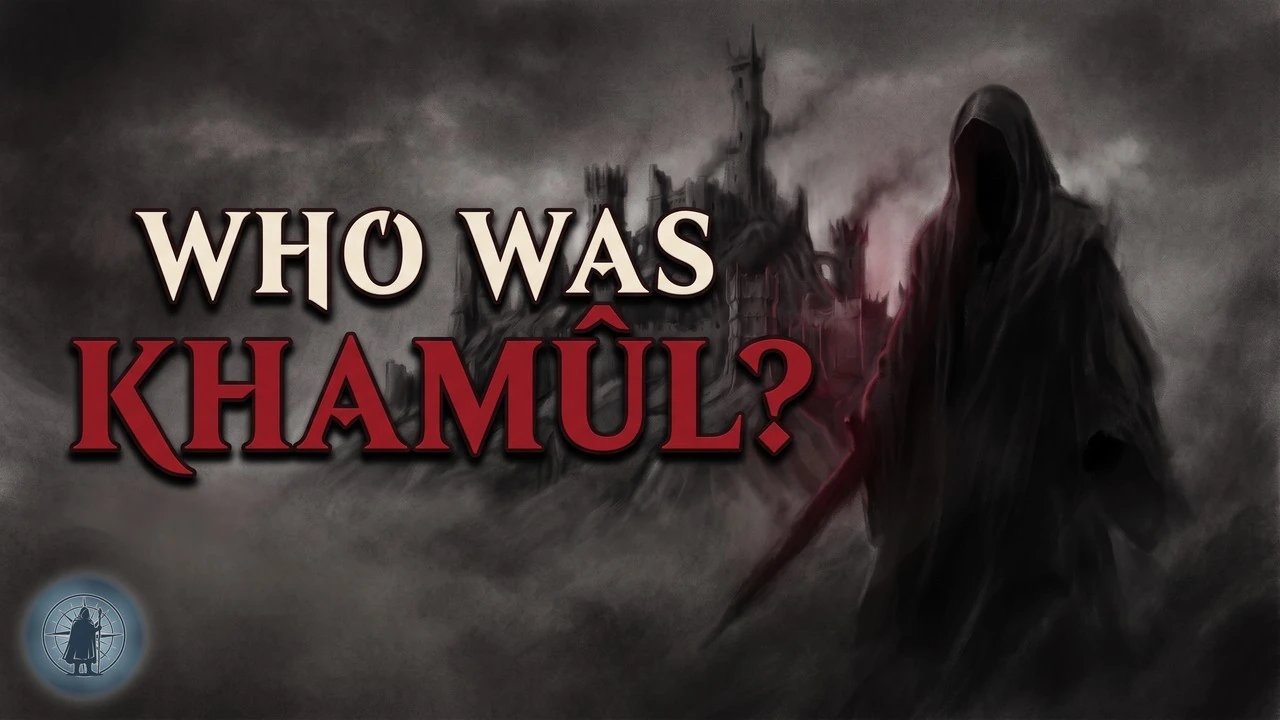 Watch the episode
Khamûl: Tolkien Named Only One Nazgûl
Research Notes: Khamûl the Easterling — The Only Nazgûl Tolkien Named
Overview
Of the Nine Ringwraiths who serve Sauron, only one is ever given a name by J.R.R. Tolkien himself: Khamûl. He appears by name in Unfinished Tales ("The Hunt for the Ring") and is referenced, unnamed by name but by role, in the Appendices of The Lord of the Rings as the Nazgûl sent to hold Dol Guldur from Third Age 2951. He is called "the Shadow of the East," "the Black Easterling," and "the Second Chief" — second only to the Witch-king of Angmar in power and authority among the Nine. He is also, uniquely among the Nazgûl, given an ethnic origin: he was a mortal lord of the Easterlings, from the land of Rhûn, one of the very few named Men of the East anywhere in Tolkien's legendarium (alongside figures like Bór and Ulfang from the First Age). This episode is a companion piece to an existing ranked-Nazgûl episode; its job is to go deep on the single wraith Tolkien bothered to individuate — what that naming does and doesn't tell us, and the genuine textual paradoxes it opens up: a being most attuned to the Ring's presence yet most crippled by the sun, a named person whose "name" may itself be a title, and a figure whose popular biography (the MERP game names for the other eight) is fan-game invention wrongly treated as canon.
Primary Sources
Unfinished Tales — "The Hunt for the Ring" (Part Three, Section IV)
This is the essential Khamûl text — Christopher Tolkien's compilation of his father's latest, unpublished notes on the movements of the Nazgûl in the months before The Lord of the Rings begins, written specifically to work out a consistent chronology of the "Black Rider" chapters of The Fellowship of the Ring.- Direct quote: "Of Khamûl it is said here that he was the most ready of all the Nazgûl, after the Black Captain [the Witch-king] himself, to perceive the presence of the Ring, but also the one whose power was the most confused and diminished by daylight." (Unfinished Tales, "The Hunt for the Ring") - The text names Khamûl explicitly as "the Shadow of the East" and, in an earlier/rejected draft layer, "the Black Easterling" and "the Second Chief." - Establishes that Khamûl commanded Dol Guldur as Sauron's lieutenant and was one of the three Nazgûl sent there in TA 2951. - Lays out the two-group split of the Nine sent to find the Shire: the Witch-king led a group (ultimately five, including himself) that crossed at the Sarn Ford and came up the Greenway to Bree and Weathertop; a second, smaller group — which included Khamûl — went first to Isengard to question Saruman, then came down toward the Shire from the north/west, entering via the North Moors/Buckland approach. - Chronology of Khamûl's Shire pursuit (per the essay's day-by-day reconstruction of September TA 3018): - 23 September: Khamûl rides up the lane to Bag End in Hobbiton and questions Gaffer Gamgee (Hamfast Gamgee), asking after "Baggins." The Gaffer, unnerved, tells him Frodo has "gone" and sold Bag End, sending him off toward Bucklebury/the east — inadvertently helpful misdirection that still points the Rider roughly the right way. - 24 September: Khamûl overtakes Frodo's trail near Woody End but his "power was confused" in daylight; the appearance of a company of Noldorin Elves (Gildor's people) drives him off before he can act, and he waits for night. - 25 September: Khamûl resumes the hunt, is joined by a companion-rider, and the two search the country toward the Brandywine, questioning Farmer Maggot. Khamûl sends his companion down the Causeway/south while he rides for the Bridge; Frodo's party crosses the river by the Bucklebury Ferry just ahead of him. - 26–28 September: Khamûl and a companion Nazgûl from the Dol Guldur contingent slip into Buckland by the North Gate in secret and search toward Crickhollow, arriving after Frodo, Pippin, and Sam have already gone into the Old Forest — the hobbits elude them again. - Khamûl is not one of the riders at the attack on Weathertop (6 October) — that assault was led by the Witch-king with four other Nazgûl from the Sarn Ford group. Khamûl's group, having lost the trail in the Shire, follows on afterward and the two bands reunite before the Ford of Bruinen. - All Nine horses (and by extension, presumably Khamûl's own mount) are swept away in the flood at the Ford of Bruinen on 20 October 3018, sent by Elrond and Gandalf; the Riders themselves, being spirits, are not destroyed, only unhorsed and driven back toward Mordor to regroup.
The Lord of the Rings — Appendix B ("The Tale of Years")
- TA 2951: "Sauron declares himself openly and gathers power in Mordor... He begins the rebuilding of Barad-dûr... Sauron sends three of the Nazgûl to reoccupy Dol Guldur." This is the appendix-level confirmation (unnamed here) of the event Unfinished Tales later identifies as Khamûl's Dol Guldur command beginning. - Appendix A / B chronicle Sauron's occupation of Dol Guldur under the guise of "the Necromancer" going back to TA c. 1050–1100, but it is only from 2951 onward that a Nazgûl — Khamûl — commands it in Sauron's name, openly, as a forward garrison threatening Lothlórien and Mirkwood's Woodland Realm for the remainder of the Third Age (2951–3019 = 68 years of Nazgûl occupation at Dol Guldur, ended only by the War of the Ring, when Galadriel and Celeborn assault and cast it down in 3019).The Lord of the Rings — The Fellowship of the Ring
- Book I, Chapter 3 ("Three Is Company"): the first Black Rider sniffing near the road out of Hobbiton — the episode long assumed by readers to be "generic" — is the one Unfinished Tales retroactively identifies as Khamûl. - Book I, Chapter 4 ("A Short Cut to Mushrooms"): Farmer Maggot's account of a Black Rider questioning him about "Baggins" — again, per the Hunt for the Ring chronology, this is Khamûl's search. - Sam's account of the Gaffer's exchange with the Rider, later recalled: "No, Mr. Baggins has gone away. Went this morning, and my Sam went with him: anyway all his stuff went. Yes, sold out and gone... He's moved to Bucklebury or some such place, away down yonder." (Gaffer Gamgee, FOTR I.3 — the words Khamûl's target victim actually hears) - Note for the fact-checker: Khamûl is not the rider who wounds Frodo with the Morgul-knife at Weathertop — that is the Witch-king in person, acting alone among the five in that final strike (RotK, Appendix A; corroborated by Unfinished Tales' timeline placing Khamûl still in or just clear of the Shire in that period). Multiple fan wikis and even some tertiary "encyclopedia" sites blur this; the episode should not repeat the error.The Silmarillion — "Of the Rings of Power and the Third Age"
- "Nine he [Sauron] gave to Mortal Men, proud and great, and so ensnared them. Long ago they fell under the dominion of the One, and they became Ringwraiths, shadows under his great Shadow, his most terrible servants." (The Silmarillion, "Of the Rings of Power and the Third Age") - "Yet Sauron was ever guileful, and it is said that among those whom he ensnared with the Nine Rings three were great lords of Númenórean race." (The Silmarillion / cf. Appendix A) — establishing that the other six, Khamûl among them, were not Númenórean: lesser or foreign men, kings and sorcerers of Middle-earth's own peoples, of whom Khamûl the Easterling is the only one Tolkien individually named and located (Rhûn). - This is the structural seed of the whole episode: three wraiths were once Númenórean nobility; six were not. Khamûl is our one confirmed window into that second, otherwise-anonymous half of the Nine.The Lord of the Rings — The Fellowship of the Ring, "The Shadow of the Past"
- Gandalf to Frodo on how a Ring-bearer among Men is consumed: the Nine "fell under the dominion of the One" and became "shadows under [Sauron's] great shadow." Mortal Ring-wearers do not die but "fade," becoming permanently invisible, walking in twilight under the eye of the dark power that rules the Rings, until it eventually devours them — the general mechanism by which men like Khamûl passed from king to wraith.Letters of J.R.R. Tolkien — Letter 210 (to Forrest J. Ackerman, June 1958)
Written to correct a proposed film treatment's depiction of the Black Riders (which had them screaming), this letter is Tolkien's own clearest statement of what the Nazgûl actually are as a threat: - "Their peril is almost entirely due to the unreasoning fear which they inspire (like ghosts)... They have no great physical power against the fearless, but what they have, and the fear that they inspire, is enormously increased in darkness." - Tolkien specifically singles out the Witch-king as "more powerful in all ways" than the other eight — the direct textual basis for treating Khamûl, as "Second Chief," as the most powerful of the remaining eight, not merely one of a faceless nine. - Tolkien's objection that the Riders should never "scream" reinforces how central silence and dread, not spectacle, are to their power — relevant to any script treatment of Khamûl's Shire hunt, which in the text is conducted through quiet interrogation (of the Gaffer, of Maggot, of Saruman), not violence.Timeline
- Second Age (date unspecified/uncertain, before SA 3319, the Downfall of Númenor): Sauron forges the One Ring at Mount Doom (c. SA 1600) and distributes the Nine Rings of Power to Men some time after; Khamûl, then a mortal lord/king among the Easterlings of Rhûn, receives one of the Nine and in time is "ensnared," fading into a Ringwraith. Tolkien gives no precise date for Khamûl's own transformation — treat any specific birth/binding year offered by fan encyclopedias as an unsupported inference, not canon. - c. TA 1000–1100: Sauron, as "the Necromancer," begins occupying Dol Guldur in southern Mirkwood in secret — centuries before any Nazgûl is sent there. - TA 2951: Sauron "declares himself openly," begins rebuilding Barad-dûr, and sends three of the Nazgûl, with Khamûl foremost among them, to garrison and hold Dol Guldur openly in his name (LotR Appendix B). Khamûl becomes, in effect, the visible face of Sauron's power in the vale of Anduin for the rest of the Age. - TA 2951–3018 (68 years): Khamûl commands Dol Guldur as "the Shadow of the East," a standing threat to Lothlórien and the Woodland Realm, while the Witch-king separately rules Minas Morgul (retaken from Gondor in TA 2002) as Sauron's chief captain overall. - Early TA 3018 (spring): Gollum is captured and brought to Mordor for interrogation; he reveals "Shire" and "Baggins" to Sauron. - c. late June 3018: Sauron dispatches the Nine, disguised as black-cloaked riders, from Minas Morgul to find the Shire and the Ring. The Nine split into two search parties (see Primary Sources above); Khamûl rides with the group that first calls at Isengard to question Saruman before turning toward the Shire. - 22 September 3018: Frodo's birthday (also Bilbo's, in absentia) — the day before he actually leaves Bag End. - 23 September 3018: Khamûl reaches Hobbiton and interrogates the Gaffer at Bag End; Frodo and companions leave that same evening. - 24 September 3018: Khamûl loses the trail at Woody End when Elves under Gildor Inglorion intervene. - 25 September 3018: Khamûl, with a companion, questions Farmer Maggot near the Brandywine; Frodo's party crosses by the Bucklebury Ferry just ahead of him. - 26–28 September 3018: Khamûl and a second Dol Guldur Nazgûl search Buckland and Crickhollow in secret, arriving too late — the hobbits have already gone into the Old Forest (26 September). - 6 October 3018: The Witch-king, with four other Nazgûl (not Khamûl), attacks the hobbits' camp on Weathertop; Frodo is stabbed with a Morgul-knife. - 20 October 3018: All Nine (regrouped) are swept from their horses at the Ford of Bruinen by the flood raised by Elrond and Gandalf; they are unhorsed, not destroyed, and withdraw to Mordor. - TA 3019, spring: The Nine, remounted on winged fell beasts, return to the field for the War of the Ring. - 15 March 3019 (Battle of the Pelennor Fields): The Witch-king, Lord of the Nazgûl, is slain by Éowyn and Merry. Per Tolkien Gateway/Nazgûl scholarship (not stated in so many words by Tolkien in the primary text, but standard inference from Khamûl's "Second Chief" rank), Khamûl becomes de facto lord of the remaining eight Nazgûl for the war's final weeks. - 25 March 3019: The One Ring is destroyed in the Fire of Orodruin; all remaining Nazgûl, Khamûl included, are annihilated in the collapse of Barad-dûr and the eruption of Mount Doom — "their spirits mounted, shrieking, up into the darkness, and never came again." - 2026 (real-world): Amazon's The Lord of the Rings: The Rings of Power announces (June 2025, ahead of San Diego Comic-Con coverage) British actor Zubin Varla cast as Khamûl the Easterling for Season 3 — the first time this specific, Tolkien-named Nazgûl has been individually cast and performed on screen. Real-world context only; not load-bearing for the episode's lore content.
Key Characters
- Khamûl the Easterling / the Shadow of the East / the Black Easterling / the Second Chief: Once a mortal lord among the Easterlings of Rhûn; received one of the Nine Rings from Sauron and became a Ringwraith. Second in power and authority only to the Witch-king of Angmar among the Nazgûl. Commanded Dol Guldur as Sauron's lieutenant from TA 2951. Led (or co-led) the Shire-search arm of the Hunt for the Ring in September 3018. Most sensitive of the Nine (after the Witch-king) to the Ring's presence, yet most impaired by daylight. Likely became lord of the remaining Nazgûl after the Witch-king's death at the Pelennor Fields; destroyed with the rest at the fall of Barad-dûr, 25 March 3019. - The Witch-king of Angmar: Lord of the Nazgûl, "more powerful in all ways" than the other eight (Letters 210); leads the Sarn Ford/Weathertop search group; personally wounds Frodo at Weathertop; slain at the Pelennor Fields by Éowyn and Merry, 15 March 3019. Foil to Khamûl throughout — the named-by-title captain versus the named-by-name subordinate. - Gaffer Gamgee (Hamfast Gamgee): Frodo's neighbor at Bagshot Row; unknowingly the first person in the narrative to speak with Khamûl face to face, and the source of the misdirection ("gone to Bucklebury") that both slightly helps and slightly hinders the wraith's hunt. - Farmer Maggot: Questioned by Khamûl and a companion near the Marish/Bamfurlong on 25 September 3018; his own account (given later to Frodo) is one of the few first-person "victim" descriptions of a Nazgûl interrogation in the text. - Saruman: Visited by Khamûl's search party at Isengard before the Shire hunt begins — establishing (obliquely) Saruman's foreknowledge of and complicity in the Nine's movements, feeding into his later betrayal. - Sauron: Distributed the Nine Rings; commands the Hunt for the Ring; Khamûl's maker and master throughout. - Gollum: His capture and interrogation by Sauron's forces in early TA 3018 is the direct trigger for the Hunt for the Ring and thus for Khamûl's entire narrative arc in the story. - Elrond and Gandalf: Raise the flood at the Ford of Bruinen (20 October 3018) that unhorses Khamûl and the other eight Nazgûl, ending the first phase of the Hunt. - Gildor Inglorion: Leader of the company of Noldorin Elves whose unexpected presence at Woody End (24 September 3018) drives Khamûl off before he can act on Frodo's trail — one of the more overlooked "near-misses" of the whole chase.
Geography
- Rhûn: The broad region east of Mirkwood/Rhovanion, centered on the great inland Sea of Rhûn; homeland of the Easterlings and, per Unfinished Tales, Khamûl's own origin before his transformation. One of the only specific geographic homelands ever assigned to a named Man of the East in the legendarium (compare Bór and Ulfang's peoples in the First Age, also from "the East"). - Dol Guldur: A fortress-hill in the southern reaches of Mirkwood (Greenwood the Great), directly across the Anduin vale from Lothlórien. Sauron's hidden seat as "the Necromancer" from roughly TA 1050–1100; garrisoned openly by three Nazgûl including Khamûl from TA 2951; a permanent strategic threat to Lothlórien and the Woodland Realm for 68 years; finally stormed and destroyed by Galadriel and Celeborn in TA 3019, timed with the fall of Barad-dûr. - Minas Morgul: The Witch-king's own seat (formerly Minas Ithil, a Gondorian city, captured TA 2002); the launch point of the Nine's ride in 3018 and their return point after the Ford of Bruinen — Khamûl's chain of command runs here even while his own garrison is at Dol Guldur. - Isengard: Visited by Khamûl's search group en route to the Shire — a detour that puts a Nazgûl directly in front of Saruman months before Gandalf's own imprisonment there. - The Shire — Hobbiton, Woody End, the Brandywine River/Bucklebury Ferry, Buckland, Crickhollow: The full stage of Khamûl's personal hunt in September 3018, traced day-by-day in "The Hunt for the Ring" — arguably the most geographically granular single stretch of any Nazgûl's movements Tolkien ever wrote. - The Ford of Bruinen: Where the flood raised by Elrond and Gandalf (20 October 3018) sweeps away the horses of all Nine Riders, Khamûl's included, ending the overland hunt. - The Black Gate / Barad-dûr, Mordor: The Nine's final muster and destruction, 25 March 3019.
Themes and Symbolism
- The Paradox of Being Named: In a legendarium built on the idea that names carry power and identity (cf. the significance of true names among Elves, Ents, Dwarves), Tolkien's decision to name exactly one of the Nine — and only in a posthumously-published working note, not the finished novel — is itself a meaningful authorial choice. It suggests the Nazgûl's namelessness in The Lord of the Rings proper is deliberate erasure (they were men, with names, and have lost even that), and that "Khamûl" survives only because Tolkien needed a peg to keep his own chronology straight while drafting — a name recovered almost by editorial accident. - Sensitivity and Blindness as a Single Curse: Khamûl's defining trait — the Nazgûl most attuned to the Ring's presence, and most impaired by daylight — dramatizes the Ring's whole logic of costly power: the closer a servant is drawn to the Ring's will, the more exposed and crippled he becomes in the world of ordinary things (sunlight, elves, a farmer's stubborn silence). It is the same trade Frodo himself begins to make. - The East as Sauron's Own Country: Rhûn, Khamûl's homeland, and Mordor/Dol Guldur, his commands, are both "east" in the legendarium's moral geography — the direction from which corruption of Men, as opposed to Elves, recurringly comes (cf. the Easterlings and Haradrim as Sauron's mannish allies in both the First Age and the War of the Ring). Khamûl is the hinge figure connecting "ordinary" human evil (a foreign king making a bad bargain) to the cosmic evil of the Nazgûl. - Christian/Catholic resonance — the wages of pride and long life: Like Númenor's own fall, the Nine Rings offer exactly what fallen, prideful men want (power, longevity) and deliver exactly what ruins them (endless deferred death, "fading," servitude). Khamûl, a non-Númenórean, shows this temptation was never unique to Númenórean pride — any "proud and great" man was vulnerable (Silmarillion, "Of the Rings of Power"). - Quiet dread over spectacle: Letter 210's insistence that the Nazgûl's power is "unreasoning fear," not physical violence or screaming, is enacted precisely in Khamûl's Shire scenes — he never fights anyone in the entire Hunt for the Ring narrative; he asks quiet questions of a gardener and a farmer, and it is enough to terrify the whole Shire grapevine.
Scholarly Perspectives
- Jason Fisher, "Khamûl — what's in a name?" (Lingwë: Musings of a Fish, Sept. 2007): A philological investigation into the possible sources of "Khamûl." Proposes a Celtic root kemb-/kamp- ("to bend"), citing Welsh cam and Old Irish camm ("crooked"), suggesting a "the bent/crooked one" reading consonant with wraith-etymologies elsewhere in Tolkien's naming. Also flags (with heavy caveats, calling it "the most distant possibility") a speculative echo of Mustafa Kemal (Atatürk) and, more substantively, a real-world namesake: Kumul (also spelled "Khamul" in some historic transliterations), a city in Central Asia noted by Marco Polo — geographically fitting for an "Easterling" name — plus a Sanskrit root khanda ("to break/divide") that Fisher connects to "Khand," a region associated with Rhûn in later Tolkien geography. Fisher is explicit that Tolkien never explained the name and that this is scholarly inference, not confirmed etymology — an example to flag for the script as "theory, not canon." - Tolkien Gateway's own talk-page/editorial debate on "Shadow of the East": A genuine textual-critical question, not settled by Tolkien: does the byname mean Khamûl came from the East (an Easterling by birth, reinforced by the earlier draft epithet "the Black Easterling"), or does it mean he commands in the East (i.e., at Dol Guldur, itself east of the Anduin/the "civilized" west)? The draft layering — "the Black Easterling" appears in an earlier/rejected version of the same Hunt for the Ring passage, later revised to "the Shadow of the East" — is cited by both sides: those who see it as confirming Easterling ancestry (the epithets are compatible and cumulative) and those who caution that Tolkien may have deliberately generalized the later epithet away from strict ethnic origin toward a broader geographic/political sense. The episode should present this explicitly as an open scholarly question, not resolve it falsely in either direction. - Popular/fan misconception vs. canon — the MERP names: Iron Crown Enterprises' 1987 role-playing sourcebook Middle-earth Role Playing (MERP), Vol. II: The Mannish Races invented full names and backstories for all nine Nazgûl, including "Er-Mûrazôr" for the Witch-king, and "Dwar of Waw," "Jí Indûr Dawndeath," "Akhôrahil the Blind Sorcerer," "Hoarmûrath of Dír," "Adûnaphel the Quiet," "Ren the Unclean," and "Ûvatha the Horseman" for the rest. These names have no basis whatsoever in anything Tolkien wrote — they are pure licensed-game invention — yet decades of repetition across wikis, forums, and even some tie-in media have caused them to be casually presented as "the names of the Nazgûl" alongside Khamûl's genuinely Tolkien-sourced name. This is a load-bearing distinction for the episode's whole premise and should be stated unambiguously.
Contradictions and Variants
- "Black Easterling" vs. "Shadow of the East": As above — an editorial layer-change within Tolkien's own unpublished drafts of "The Hunt for the Ring," not a contradiction between two published books, but still a real textual variant Christopher Tolkien preserved and noted. It changes how confidently the episode can assert "Khamûl was ethnically an Easterling" — the stronger draft epithet supports it; the final published epithet is more ambiguous. - Fan-encyclopedia overreach on dates: Several tertiary sources (encyclopedia-style fan wikis) assert a specific "birth year" for Khamûl (e.g., "c. Second Age 2250") with no citation to any Tolkien text. Tolkien never gives Khamûl a birth date, only the TA 2951 date for his Dol Guldur command and the implicit Second-Age window (before the Nine Rings' distribution and before Númenor's downfall, SA 3319) for his transformation. Treat any precise pre-Third-Age date for Khamûl as fan inference, not canon, and either omit it or flag it clearly as speculative if used. - Fan-encyclopedia overreach on Weathertop: At least one prominent fan-facing summary asserts Khamûl "wound[ed] Frodo at Weathertop" — this is incorrect. Tolkien's own timeline in "The Hunt for the Ring" places Khamûl's search group away from Weathertop on 6 October 3018 (still following up the Shire trail with the second Nazgûl band), while the Witch-king personally, alone among his four companions on that raid, stabs Frodo with the Morgul-knife. This is exactly the kind of superlative/attribution error the fact-checker should be alert for; do not let the script imply Khamûl was at Weathertop. - How many Nazgûl were originally at Dol Guldur: Appendix B says Sauron "sends three of the Nazgûl" in TA 2951; Unfinished Tales singles out Khamûl by name as the senior of that garrison but does not name the other two — an area where the text is deliberately incomplete and should be presented as such (three total, only one named). - Succession as "Lord of the Nazgûl" after the Witch-king's death: Tolkien does not, in the primary published texts, explicitly state in so many words that Khamûl formally became "Lord of the Nazgûl" after 15 March 3019. The inference rests on his established rank as "Second Chief"/"second only to the Witch-king" and is standard in secondary scholarship and fan-reference works, but the episode should flag it as a reasonable inference from Khamûl's stated rank rather than a directly quoted textual fact.
Linguistic Notes
- "Khamûl": No Elvish or other in-world etymology is given by Tolkien; the name sits outside the normal Sindarin/Quenya naming conventions used for most named entities in the legendarium, which is itself notable — it may be meant to read as an Easterling-language name, i.e., authentically foreign even in-world, rather than a translated epithet like the Witch-king's other titles. Scholarly speculation (Fisher) about real-world Central Asian/Turkic and Sanskrit resonances (see Scholarly Perspectives) remains unconfirmed by any Tolkien statement. - "Nazgûl": Black Speech, literally "Ring-wraith" (nazg = "ring," cognate with the Ring inscription's "nazg" in "ash nazg durbatulûk..."; gûl = "wraith/spirit," the same element as in "Minas Morgul," "the Tower of Sorcery," formerly Minas Ithil). Tolkien's own coinage, given a Black-Speech gloss in Appendix F. - "Dwimmerlaik": An Old-English-derived term used by Éowyn of the Witch-king ("Dwimmerlaik" — "spectre, work of necromancy") sometimes wrongly attached as an epithet specifically to Khamûl in fan lists; it belongs to the Witch-king in the primary text (RotK, "The Battle of the Pelennor Fields"). - "Shadow of the East" / "the Second Chief" / "the Black Easterling": All three are English glosses/epithets from the "Hunt for the Ring" manuscript layers, not Black-Speech or Mannish names — i.e., narratorial titles rather than what Khamûl might have called himself.
Additional Context
- Real-world casting (2026): Amazon's The Lord of the Rings: The Rings of Power announced British actor Zubin Varla as Khamûl the Easterling for Season 3 (announced ahead of San Diego Comic-Con coverage, widely reported June–July 2025/2026 press cycle). This is the first time this specific, Tolkien-named Nazgûl has been performed as an individuated, on-screen character rather than folded into the generic Nine — itself a small piece of evidence for how unusual it is that Tolkien named him at all. Use once, briefly, as a hook/closer; do not build episode analysis on show-only material, which sits in the Second Age (well before Khamûl's Third Age activity as depicted in the primary texts) and reflects the show's own invented characterization, not Tolkien's. - Companion episode note: This script should assume the audience may have already seen (or may next see) the channel's existing ranked-Nazgûl episode; avoid re-deriving the full "who are the Nine" explainer at the same depth — lead with Khamûl's specific, named material and let the general Nazgûl background (Silmarillion "Of the Rings of Power," the fading mechanism) serve strictly as scaffolding for his story, not the main event.
Questions for Further Research
- Does any surviving Tolkien manuscript (HoME, Marquette archives) give an in-world (non-English) name or additional biographical detail for Khamûl beyond what's excerpted in Unfinished Tales? (Not found in this pass — likely genuinely absent; Unfinished Tales appears to represent the full extent of Tolkien's writing on him.) - Is there a definitive statement anywhere (letters, drafts) on whether "Shadow of the East" is meant ethnically or geographically? (Appears to be genuinely unresolved — flagged above as a live scholarly question.) - What, if anything, does Tolkien say about the other two Nazgûl garrisoned at Dol Guldur alongside Khamûl in TA 2951? (Nothing found; they are never individuated.)
Compelling Quotes for Narration
1. "Of Khamûl it is said here that he was the most ready of all the Nazgûl, after the Black Captain himself, to perceive the presence of the Ring, but also the one whose power was the most confused and diminished by daylight." — Unfinished Tales, "The Hunt for the Ring" 2. "Nine he gave to Mortal Men, proud and great, and so ensnared them. Long ago they fell under the dominion of the One, and they became Ringwraiths, shadows under his great Shadow, his most terrible servants." — The Silmarillion, "Of the Rings of Power and the Third Age" 3. "No, Mr. Baggins has gone away... He's moved to Bucklebury or some such place, away down yonder." — Gaffer Gamgee, unknowingly answering Khamûl, The Fellowship of the Ring, I.3 4. "Their peril is almost entirely due to the unreasoning fear which they inspire (like ghosts)... what they have, and the fear that they inspire, is enormously increased in darkness." — J.R.R. Tolkien, Letter 210 5. Appendix B, TA 2951: "Sauron declares himself openly... Sauron sends three of the Nazgûl to reoccupy Dol Guldur." — The Lord of the Rings, Appendix B
Visual Elements to Highlight
1. A cloaked rider reining in at the gate of Bag End at dusk, questioning an old gardener under a darkening sky — the Hobbiton interrogation, 23 September 3018. 2. The tower of Dol Guldur brooding over southern Mirkwood, seen across the Anduin from the eaves of Lothlórien — 68 years of silent occupation. 3. A black-cloaked figure recoiling, half-dissolved in noon sunlight, at the edge of a wood full of Elvish starlight-song (the Woody End near-miss with Gildor's company). 4. The Sea of Rhûn and its eastern shore — Khamûl's lost, unnamed kingdom, before the Ring. 5. Nine shapes on winged fell beasts wheeling over the Pelennor, one now riderless in authority — the moment leadership passes to the "Second Chief."
Sources Consulted
See companion file sources.md in this same research folder for the full sourced list with URLs and usefulness notes.