
Transcript
Nenya
What Galadriel's Ring Actually Does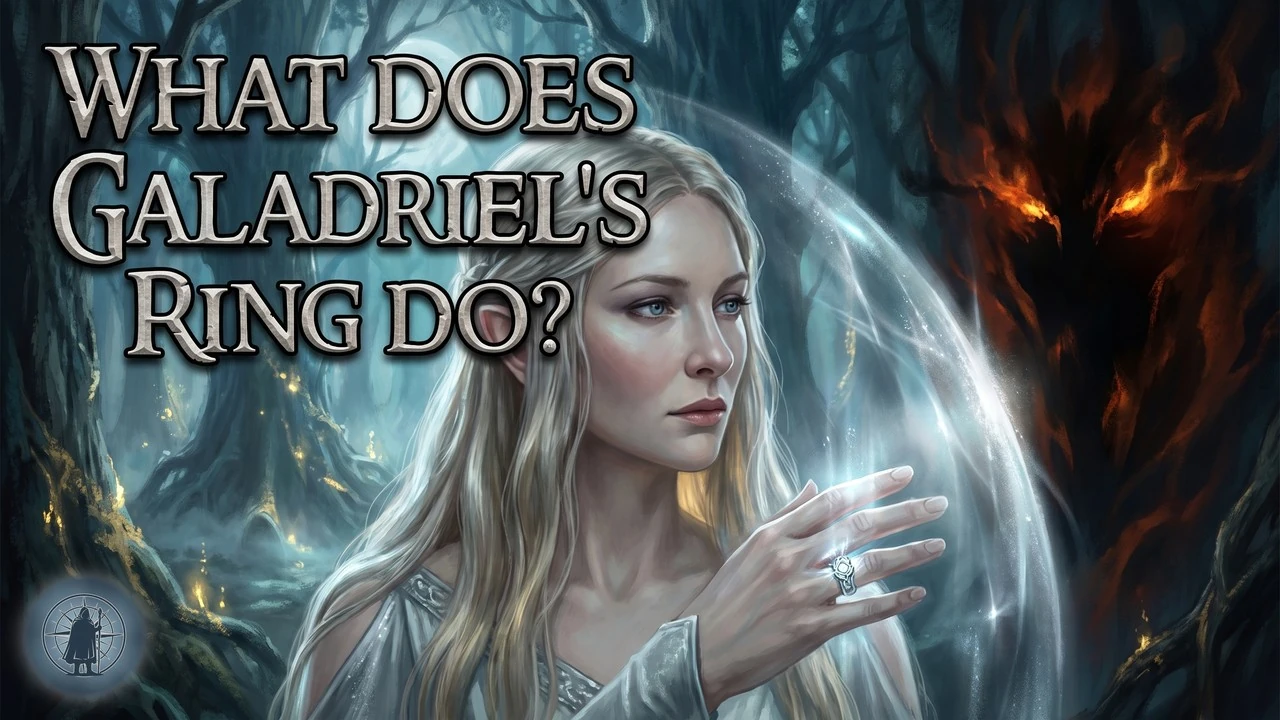 Watch the episode
Nenya: What Galadriel's Ring Actually Does
Watch the episode
Nenya: What Galadriel's Ring Actually Does
Main Narrative: How Does Galadriel Know? Nenya and the Limits of Elven Perception
SECTION: The Door That Is Closed
In the chapter called "The Mirror of Galadriel," in the second book of The Fellowship of the Ring, the Lady of Lothlorien turns to Frodo and tells him something that no other character in Tolkien's published work ever quite says about Sauron.
"Even as I speak to you," she tells him, "I perceive the Dark Lord and know his mind, or all of his mind that concerns the Elves. And he gropes ever to see me and my thought. But still the door is closed."
That is one of the strangest sentences in The Lord of the Rings. It is matter-of-fact. It is conversational. It is delivered by an Elf-queen standing in a garden by a basin of water, to a hobbit who has been in her realm for less than a week. And it describes a continuous, ongoing, two-way psychic confrontation with the most powerful evil in the world — happening in her head while she makes small talk.
Most readers slide past it on the first reading. The chapter is full of marvels. Galadriel reads minds at the supper table. She offers visions in a basin. She holds up her hand and reveals a ring on her finger. By the time we reach the temptation scene she is being asked to take the One, and we are still reeling from everything else she has done.
But the door line is the load-bearing image of the whole episode. She is not omniscient. She perceives Sauron only insofar as his thoughts touch the Elves. And the mutual contact is described with two precise verbs — perceive on her side, grope on his. He is reaching. She is watching him reach. And neither of them can break through.
So how does she do it? Where does this faculty come from?
The intuitive answer is the Ring. Frodo sees Nenya on her finger in the same chapter — a slim band of mithril set with a single white stone "flickering like a frosty star" — and the proximity of the two revelations invites the obvious conclusion. She sees because of the Ring. She knows because of the Ring. The Ring is the source.
That answer is mostly wrong. Tolkien's own writings — the published novels, the Silmarillion material, the late linguistic essays, and the letters — describe Nenya as doing one specific thing extraordinarily well, and that one thing is not perception. The mind-reading, the visions, the foresight, the closed door against Sauron — almost none of it is the Ring. Almost all of it comes from somewhere older, deeper, and stranger.
What follows is the actual answer, in layers — what Galadriel inherited, what she was taught, what every Elf can do, and what the Ring of Adamant actually is for. And at the end, the question of what separates her from Sauron, given that they are reaching for one another with very similar faculties.
SECTION: The Light in Her Hair
Start at the bottom of the stack.
Galadriel is one of the Calaquendi. The word is Quenya. Cala means light. Quendi means speakers — the original Elvish self-name. Calaquendi means literally "Elves of the Light," and it is not a poetic title. It is a biographical fact about a specific, finite group of Elves who once stood in Valinor and saw the Two Trees of the Valar burning in the air with their own physical eyes.
There were many Elves who never made that journey. They are called the Moriquendi, the Dark-Elves — not because they were evil, but because they had never been to the place where the great lights stood. The distinction was not moral. It was experiential. Some Elves had seen the Trees. Some had not. And in Tolkien's metaphysics, that experience was not a memory you carried; it was a property you became. The light entered you and changed what you were.
By the Third Age, when Frodo arrives in Lothlorien, almost no Calaquendi remain in Middle-earth. Most went West thousands of years before. A handful are still there: Galadriel. Glorfindel. A few others, debated by scholars. Celeborn, in some readings. The point is the rarity. By T.A. 3019, walking into Lothlorien and meeting Galadriel is, at the level of pure metaphysics, walking into the presence of a being who carries a wavelength of light no one else in Middle-earth has been alive long enough to remember directly.
Tolkien is not subtle about this. In one of the late biographical essays on Galadriel, he writes that "both lights of the Two Trees were captured in her tresses" — that is, her hair physically retains the radiance of Laurelin and Telperion. Frodo does not see this with his unaided eyes, but it is canonically true of her body. She is, in a literal sense, a vessel. The Trees are gone; she is one of the few places they still exist.
The Tolkien scholar Verlyn Flieger, in her book Splintered Light, makes this the foundation of an entire reading of the legendarium. The Two Trees are not just plot machinery. They are the metaphysical ground of higher awareness in the world. Anyone who saw them sees differently afterward. Anyone descended from those who saw them sees a little of what their ancestors saw. Galadriel sees because she once saw — and the once was so foundational that the seeing has never quite stopped.
This is the deepest layer. Before any Ring. Before any teacher. Before any acquired technique. Galadriel's first inheritance is that she stood under a light older than the sun and was, in some way, written on by it.
That alone, however, would not make her what she is. The light is the substrate. What was built on top of it is the next layer.
SECTION: The Pupil of Melian
In the First Age, before the Sun and Moon were made and before the destruction of Beleriand, Galadriel left Valinor with the rebel Noldor and crossed into Middle-earth. She arrived in the kingdom of Doriath, where her grandmother's brother's people had built a hidden realm in the forest of Neldoreth. And in Doriath she met Melian.
Melian was a Maia. She was an angelic being of the same order as Sauron and Gandalf — older than the world, vastly more powerful than any Elf, and clothed in incarnate form for love of the Sindarin king Thingol. Around the kingdom of Doriath she had spun what is called in the texts the Girdle of Melian: an enchantment that surrounded the entire realm with a protective field of will, so that no enemy of Thingol or the Valar could enter unless he possessed power greater than her own. For most of the First Age it held. Even Morgoth's armies could not pierce it.
In the Unfinished Tales, Tolkien writes that Galadriel "had dwelt with Melian, and had learned much of her... and Melian was a Maia of great power and wisdom." This is not a casual sentence. It tells us that the future Lady of Lothlorien spent decades — perhaps centuries — as the personal student of one of the most powerful Maiar ever to walk in Middle-earth. She did not just inherit her gifts. She studied. She apprenticed.
And what did she learn? The texts do not give a full curriculum. But the shape of what she later built tells us what she absorbed.
Lothlorien in the Third Age is, structurally, a smaller version of Doriath. It is a forested realm. It is ruled by an Elvish lord and a being of greater-than-Elvish power. It is surrounded by a kind of protective enclosure that confuses the senses of those who try to enter unbidden. Time inside it behaves differently from time outside it. It is a refuge from a darkening world.
The Girdle of Melian is the conceptual ancestor of what Galadriel later does in Lothlorien. She is, quite consciously, building her teacher's work in miniature, with the tools she has, in a much later age. Where Melian used the raw might of a Maia, Galadriel uses an Elven Ring — but the idea is the same, and she learned the idea in Doriath.
This is the second layer. Innate metaphysical capacity, refined and trained by direct apprenticeship to an angelic teacher. By the time she is given Nenya in the Second Age, she is already, by any reasonable measure, the most accomplished living practitioner of preservation magic outside the Undying Lands. She does not need a Ring to know what to do with one.
Which brings us to the Ring itself, and to a question whose answer is much narrower than most readers assume.
SECTION: What Nenya Actually Does
Tolkien wrote a long letter in 1951 to a publisher named Milton Waldman, trying to explain his entire mythology in a single document. The letter runs to about ten thousand words. It is the closest thing to an authorial summary of Middle-earth that exists. And in it, he says something about the Rings of Power that, once you read it, recolors everything.
"The chief power of all the rings alike," he writes, "was the prevention or slowing of decay — that is, change viewed as a regrettable thing — the preservation of what is desired or loved, or its semblance. This is more or less an Elvish motive."
Take that sentence at face value. The chief power of all the rings — the One included, the Three included, the Seven and the Nine included — is the slowing of decay. The preservation of what is loved. That is the function. That is what they were made for.
Tolkien goes further in the same letter. He describes the Elvish project of Middle-earth, the project that built Eregion and Lothlorien and Rivendell, with a single harsh word: embalming. "They wanted to have their cake and eat it," he writes, "to live in the mortal historical Middle-earth because they had become fond of it... and so tried to stop its change and history, stop its growth, keep it as a pleasaunce, even largely a desert, where they could be 'artists.'"
The Three Elven Rings are the highest, finest, most sophisticated expression of this impulse. They are embalming devices. Beautiful ones. Loving ones. But still — the function is to hold a moment in place against the river of time.
The Silmarillion confirms this in plainer language: "Those who had them in their keeping could ward off the decays of time and postpone the weariness of the world."
And Tolkien is specific about what that means for Galadriel personally. In a letter from 1963, addressing a reader's question about Lothlorien, he writes that "without the Ring, all that she had wrought with the aid of Nenya would fade and be forgotten." Lothlorien is what Nenya does. The realm itself — its preserved beauty, its slowed time, its concealment from the eyes of the enemy — is the work of the Ring. Take Nenya away, and Lothlorien decays.
Notice everything that is not on this list. Mind-reading is not on this list. The Mirror is not on this list. Foresight is not on this list. The detection of Sauron's thoughts as they grope through the dark is not on this list.
Nenya does one thing, magnificently. It preserves. It conceals. It holds the realm of Lothlorien in a kind of timeless amber against the corrosion of the outer world. That is a tremendous power. It is enough power that when the One Ring is destroyed and Nenya goes dark, Lothlorien begins to fade within a few short years and Galadriel's millennia-old work crumbles.
But it is not perception. The perception is hers. The Ring sustains her realm. Her mind is her own.
The clearest test case for this is the object on the dais in the garden — the basin of silver water that the chapter is named after.
SECTION: The Mirror Is Not Hers
When Galadriel takes Frodo and Sam down into the hollow garden where the Mirror stands, she explains what it does in language that should immediately stop a careful reader.
"Many things I can command the Mirror to reveal," she says, "and to some I can show what they desire to see. But the Mirror will also show things unbidden, and those are often stranger and more profitable than things which we wish to behold. What you will see, if you leave the Mirror free to work, I cannot tell. For it shows things that were, and things that are, and things that yet may be. But which it is that he sees, even the wisest cannot always tell."
Notice what she is admitting. The Lady herself does not know what Frodo will see, cannot interpret with certainty what he does see, and warns him that the visions are dangerous as a guide for action. She is not the operator of an oracle. She is the caretaker of a strange device that does most of its work autonomously.
Tolkien never says the Mirror is a creation of Nenya. He never says it is the work of Galadriel at all. The text describes it as an external apparatus — water poured into a silver basin set on a low pedestal, fed by a stream that runs down the hill from her house. It is closer to the medieval European tradition of scrying — gazing into water or polished surfaces to glimpse what the eye normally cannot reach — than to any kind of Ring-magic. The literary lineage runs through hydromancy, through the classical pool of Narcissus, through the dim glass of First Corinthians. "We see through a glass darkly." The Mirror of Galadriel is in that tradition. Partial. Unreliable. Real, but not authoritative.
Sam looks first. He sees Frodo asleep under a great cliff. He sees himself climbing endless stairs. And then — devastatingly — he sees the Shire. Trees being felled. A new mill belching smoke. His Gaffer turned out of Bagshot Row. Sam sees, and what he sees is true. The Scouring of the Shire will happen. Saruman's men will come. The trees will fall.
But Sam does not know the vision is true-but-already-set. He thinks he is being shown something he can prevent. He almost abandons the Quest on the spot. Galadriel has to talk him down. The Mirror has just nearly cost the Fellowship its Ring-bearer's gardener. And Galadriel could not predict it would do that.
This is the limit case. Even the most famous instrument of "sight" in Lothlorien is, by the Lady's own admission, an autonomous device with unreliable output that she does not fully control. The Mirror is not the source of her sight. The Mirror is a tool she has access to — and even she warns the user not to trust it as a guide.
If the Mirror is not Nenya, and the mind-reading is not Nenya, and the awareness of Sauron is not Nenya — then what is the mind-reading? Where does it come from?
The answer is in a small linguistic essay Tolkien wrote in the late 1950s, which most readers have never heard of.
SECTION: Ósanwë and the Mind-Touch
The essay is called Ósanwë-kenta, which translates roughly as "Inquiry into the Communication of Thought." It was published posthumously in a journal of Tolkien linguistics called Vinyar Tengwar. It is a short, dense, almost philosophical document in which Tolkien sits down and works out, with the precision of a theologian writing about the soul, exactly how minds touch each other in his world.
The conclusion is this. All incarnate rational beings — Elves, Men, Dwarves, the Ainur in bodily form — share an inherent faculty he names ósanwë, "co-thought." It is the capacity to communicate mind to mind without speech. Not a magical power held by a few. A native endowment of every thinking being.
But there are rules. The most important rule is this: a mind can always close itself. The barrier is absolute. Tolkien is emphatic — "not even by Melkor applying all his power and will" can a closed mind be forced open. This is built into the structure of consciousness itself. Free will is the deepest layer. Will to be private is part of will. No being, however mighty, can break that wall.
What strengthens ósanwë, what makes it more vivid and easier to use, are three legitimate amplifiers. Affinity — love, kinship, friendship. Urgency — desperate need. And authority — the right to be heard within a certain domain.
Galadriel, when the Fellowship walks into Lothlorien, has all three.
She has affinity with Aragorn (her granddaughter Arwen's beloved), with Gandalf (a fellow servant of the Valar, and the bearer of one of her Rings' siblings), and with the Elf Legolas. She has urgency — the One Ring has just entered her realm, after thousands of years of her work to keep it elsewhere. And she has authority — the Fellowship are her guests. They have crossed her border. They have entered her domain. By the laws of Middle-earth, the lord of a realm has a recognized right to take the measure of those who enter it.
So when she looks at each of them at the supper table, what she is doing is not magic in the sense Sam means. It is ósanwë. The native art. Amplified by all three legitimate strengtheners. Used on minds that are, by the rules of the essay, capable of closing themselves at any moment.
But here is the ethical knife-edge that Tolkien himself draws in the same essay. Melkor's perversion of ósanwë was to come "by stealth to a mind open and unwary, hoping to learn some part of its thought before it closed." That is exactly what Galadriel's victims accuse her of. Boromir, after he leaves Lothlorien, mutters that "she thought to read our thoughts for her own good purpose; but almost I should have said she was tempting us." Sam reports the experience as feeling "like he hadn't got nothing on" — naked.
The faculty itself is morally neutral. The use of it is what is judged. Galadriel uses ósanwë on the Fellowship in a way that, by Tolkien's own essay, sits perilously close to what Melkor did. The text knows this. The text is uncomfortable. Boromir's reaction is not a misunderstanding — it is a serious moral charge, left in the text without rebuttal.
What separates her from Melkor, and from Sauron, is not capacity. They have the same equipment. The asymmetry is somewhere else.
SECTION: The Limits and the Mercy
For all her power, Galadriel demonstrably cannot see most of what matters most.
She suspected Annatar was Sauron from the moment he arrived in Eregion at the dawn of the Second Age. In one of Tolkien's late versions of her biography, she says of him plainly: "he was not in the train of Aulë." She knew. She named it. And she could do nothing about it. Celebrimbor and the smiths of Eregion did not believe her. She was overruled, isolated, eventually withdrawn from the realm. Her judgment was correct. Her authority was insufficient. Sauron forged the One Ring anyway, and Eregion was destroyed within a century. The seeing without the listening was useless.
She does not know in advance whether she will pass the test of the Ring. In a letter from 1963, Tolkien tells a reader that her resolve to refuse it was "founded upon previous thought and resolve" — that is, on years of deliberate moral preparation, not on foreknowledge that she would succeed. She had thought, she wrote, about what she would do if the Ring came within her reach. She was not certain how she would answer until Frodo offered it to her. The temptation was real. The outcome was not predetermined.
She does not foresee her own future after the One Ring is destroyed. She knows only that Nenya will fail and her work will fade. She speaks of "diminishing" and going West, but she does not know what diminishment will feel like, or what she will be on the other side of it. She is choosing, not predicting.
She does not foresee Boromir's betrayal, even after she has tested him at her supper table. She gives him a gift on his way out of Lothlorien like all the others. The fall of the Fellowship at Amon Hen happens without her warning anyone.
The list could be longer. Christopher Tolkien notes in his editorial preface to the Galadriel material in Unfinished Tales that there is "no part of the history of Middle-earth more full of problems than the story of Galadriel and Celeborn." Even her own backstory shifts between drafts. Even her author was not certain how to limit her.
But the limits are the point. Tolkien constructed her with care, and the care is in the bounding. She is gifted. She is also fallen, and she knows it. She is one of the great Noldor, "the greatest of the Noldor, except Fëanor maybe, though she was wiser than he" — wiser, that is, in the precise sense of accepting the limit she could not break.
So return to the door.
"He gropes ever to see me and my thought. But still the door is closed."
The door is closed not because Galadriel has overpowered Sauron. He is, in raw might, almost certainly her superior. The door is closed because she has the one faculty he does not have. She can shut it.
Sauron cannot model that. Gandalf, in The Return of the King, gives the diagnosis: "The only measure that he knows is desire, desire for power; and so he judges all hearts." Sauron sees other beings as variables in a dominance equation. He cannot conceive of a mind that closes itself without seeking power in return. He gropes for hers because his model of mind has no slot for the kind of mind hers is.
What she has, that he does not, is mercy. Tolkien returns to the word again and again in connection with her. She possesses, the texts say, a marvelous gift of insight into the minds of others, but she judges them with mercy and understanding. The judgment itself is the gift. The same faculty in another being would be a violation. In her it is — barely, sometimes uncomfortably — wisdom.
This is why Frodo's offering of the Ring is the central scene of her arc rather than a side scene. She sees, in that moment, with terrible clarity, what taking it would make her. "All shall love me and despair." She would become beautiful and terrible. She would become a queen with all of Sauron's sight and none of his blindness. She would become unstoppable.
And she refuses, because she perceives the cost of perception unbounded by mercy.
"I pass the test," she says. "I will diminish, and go into the West, and remain Galadriel."
That sentence is the answer to the whole question. The door is closed because she has chosen to remain a being for whom the door can be closed. She has refused the upgrade that would have removed the choice. She keeps her perception small enough — bounded enough, merciful enough — that she can still be the one who decides where to look. The Ring would have made her omniscient and unfree. Refusing it leaves her finite and herself.
Nenya preserves Lothlorien. Melian taught her the technique. The Light of the Trees gave her the eyes. Ósanwë gave her the channel. The closed door is hers alone — and what holds it shut is not power but the choice to remain a being who can still close doors.