
Research & Sources
Nenya
What Galadriel's Ring Actually Does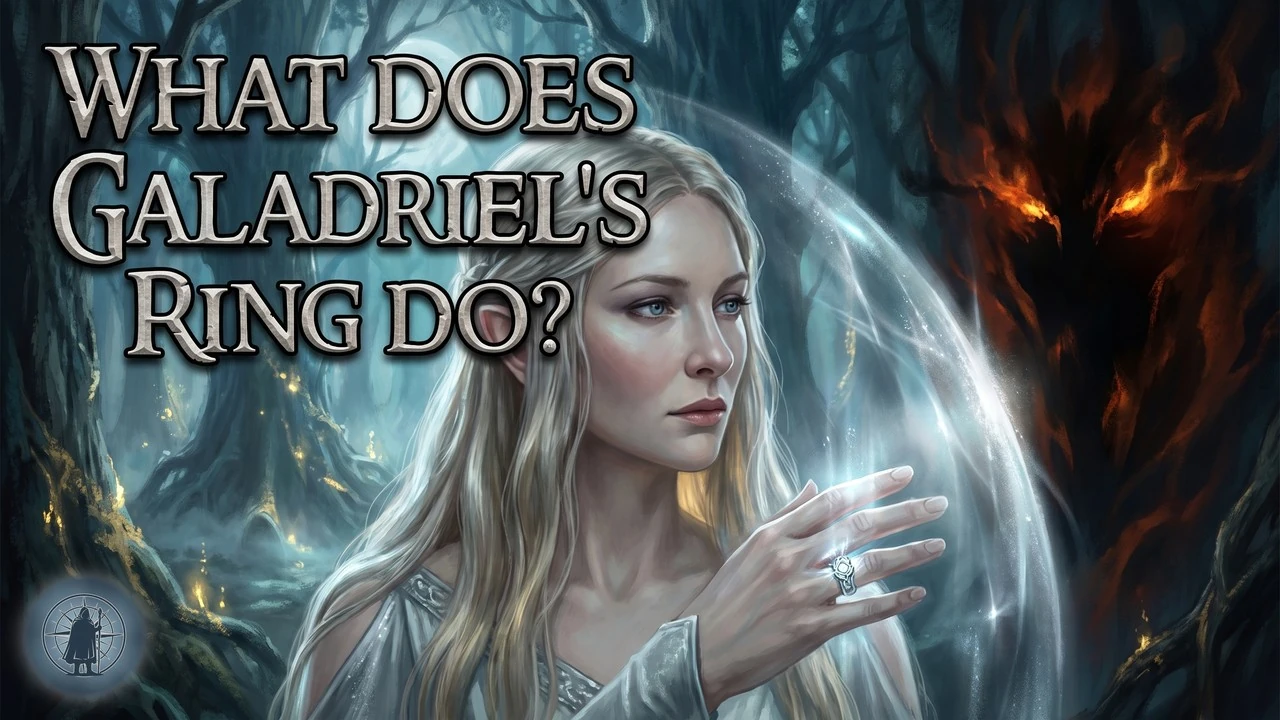 Watch the episode
Nenya: What Galadriel's Ring Actually Does
Watch the episode
Nenya: What Galadriel's Ring Actually Does
Research Notes: How Does Galadriel Know? Nenya and the Limits of Elven Perception
Overview
Galadriel is one of the most epistemically uncanny characters in Tolkien's legendarium. She reads minds, perceives Sauron across continents, conjures visions in a basin of water, and offers temptations so individually tailored that her victims feel violated. Yet the moment we look closely, the "magic" fragments into at least four overlapping sources: (1) the innate gifts of the Calaquendi, the Elves who saw the Light of the Two Trees, (2) tutelage by the Maia Melian in Doriath, (3) the universal Elvish faculty of ósanwë (thought-opening), and (4) Nenya, the Ring of Adamant, whose specific function Tolkien describes far more narrowly than fans assume — preservation and concealment, not omniscience.
The episode's question — "Is it the Ring, or something else entirely?" — is the right question, because Tolkien himself was unwilling to centralize the answer. The Mirror is not Nenya. Mind-reading is not Nenya. Foresight is not Nenya. Nenya does one specific thing extraordinarily well: it slows decay and hides Lothlórien. The rest is Galadriel. And even Galadriel has hard limits — she failed to detect Sauron-as-Annatar (or, in some accounts, suspected him but was overruled), she cannot guarantee what the Mirror will show, and she cannot foresee the outcome of the War of the Ring well enough to know whether she will diminish or be destroyed.
This is not a hole in the lore. It is the structure of the lore: Tolkien deliberately keeps Elvish power bounded, because the moral architecture of his world depends on free will surviving inside even the most gifted creatures.
Primary Sources
The Fellowship of the Ring, Book II, Chapter 7: "The Mirror of Galadriel"
The chapter is the load-bearing canonical text for nearly every claim about Galadriel's perception. Key passages:
On the Mirror itself (Galadriel to Sam and Frodo):
"Will you look into the Mirror? … For it is a thing that few mortals have looked upon. … For it shows things that were, and things that are, and things that yet may be. But which it is that he sees, even the wisest cannot always tell. Do you wish to look?"
"Many things I can command the Mirror to reveal, and to some I can show what they desire to see. But the Mirror will also show things unbidden, and those are often stranger and more profitable than things which we wish to behold. What you will see, if you leave the Mirror free to work, I cannot tell. For it shows things that were, and things that are, and things that yet may be."
On her warning about its danger:
"Remember that the Mirror shows many things, and not all have yet come to pass. Some never come to be, unless those that behold the visions turn aside from their path to prevent them. The Mirror is dangerous as a guide of deeds."
On her direct perception of Sauron (after Frodo sees the Eye):
"I know what it was that you last saw," she said; "for that is also in my mind. Do not be afraid! But do not think that only by singing amid the trees, nor even by the slender arrows of elven-bows, is this land of Lothlórien maintained and defended against its Enemy. I say to you, Frodo, that even as I speak to you, I perceive the Dark Lord and know his mind, or all of his mind that concerns the Elves. And he gropes ever to see me and my thought. But still the door is closed!"
This passage is the single most important quote in the entire research: she perceives Sauron partially (only "all of his mind that concerns the Elves"), the perception is mutual and contested (he gropes for hers), and her advantage is defensive ("still the door is closed").
On Nenya, when Frodo sees it:
"And you?" she said, turning to Sam. "For this is what your folk would call magic, I believe; though I do not understand clearly what they mean; and they seem also to use the same word of the deceits of the Enemy. But this, if you will, is the magic of Galadriel."
"On her finger was Nenya, the ring wrought of mithril, that bore a single white stone flickering like a frosty star. … Frodo gazed at the ring with awe; for suddenly it seemed to him that he understood. 'Yes,' she said, divining his thought, 'it is not permitted to speak of it, and Elrond could not do so. But it cannot be hidden from the Ring-bearer, and one who has seen the Eye.'"
The temptation scene:
"And now at last it comes. You will give me the Ring freely! In place of the Dark Lord you will set up a Queen. And I shall not be dark, but beautiful and terrible as the Morning and the Night! Fair as the Sea and the Sun and the Snow upon the Mountain! Dreadful as the Storm and the Lightning! Stronger than the foundations of the earth. All shall love me and despair!"
"I pass the test," she said. "I will diminish, and go into the West, and remain Galadriel."
The Silmarillion, "Of the Rings of Power and the Third Age"
"Those who had them in their keeping could ward off the decays of time and postpone the weariness of the world."
"But all those rings that he governed he perverted, the more easily since he had a part in their making … And of the Three Rings that the Elves had preserved untouched no open word was ever spoken among the Wise, and none save they knew where they were bestowed."
The Letters of J.R.R. Tolkien
Letter 131 (to Milton Waldman, c. 1951) — the foundational statement on what the Three are for:
"The chief power (of all the rings alike) was the prevention or slowing of decay (i.e. 'change' viewed as a regrettable thing), the preservation of what is desired or loved, or its semblance — this is more or less an Elvish motive."
"But also they enhanced the natural powers of a possessor — thus approaching 'magic', a motive easily corruptible into evil, a lust for domination."
Tolkien on Elvish motive: "Their 'magic' is Art, delivered from many of its human limitations: more effortless, more quick, more complete … And its object is Art not Power, sub-creation not domination and tyrannous re-forming of Creation."
On the Elves of Middle-earth and the Three: "The Elves of Middle-earth, the Eldar, were … in 'fading' mode … a kind of embalming … they wanted to have their cake and eat it: to live in the mortal historical Middle-earth because they had become fond of it (and perhaps because they there had the advantages of a superior caste), and so tried to stop its change and history, stop its growth, keep it as a pleasaunce, even largely a desert, where they could be 'artists'."
This is decisive: the Three are embalming devices. Lothlórien is preserved by Nenya the way a butterfly is preserved by amber. This frames everything.
Letter 246 (to Eileen Elgar, September 1963) — on Galadriel and the Ring:
"Galadriel's rejection of the temptation was founded upon previous thought and resolve … She was pondering what she would do, should the One Ring come within her grasp."
"Without the Ring, all that she had wrought with the aid of Nenya would fade and be forgotten."
Letter 320 (1971) — on Galadriel's character:
Tolkien explicitly compares her to Mary in late life, but earlier in the same letter calls her "in part a 'penitent'" — emphasizing she is not unfallen. Her perception coexists with a history of pride.
Unfinished Tales, "The History of Galadriel and Celeborn"
Christopher Tolkien presents this section explicitly as containing multiple irreconcilable versions — Tolkien rewrote Galadriel's biography repeatedly in the last years of his life. This is itself a research finding: there is no single "canonical" Galadriel.
Key passages on her perception:
"Galadriel … was the greatest of the Noldor, except Fëanor maybe, though she was wiser than he, and her wisdom increased with the long years."
On Annatar in Eregion (the most important text for the "limits of perception" theme):
"Sauron used all his arts upon Celebrimbor and his fellow-smiths, who had formed a society or brotherhood, very powerful in Eregion, the Gwaith-i-Mírdain … Galadriel … was not deceived: 'he was not in the train of Aulë,' she said, but no doubt during the Second Age, when the Eldar of Middle-earth were already long parted from those of Aman, his cunning was great enough to deceive any save herself … but she could not prevail against him, and at length she withdrew from Eregion and went to Lórinand."
So in this version: Galadriel saw through Annatar — but could not prove it, could not persuade Celebrimbor, and was effectively expelled from Eregion. Perception without authority is impotent.
In another late version (the "Concerning Galadriel and Celeborn" essay), Tolkien writes that her power was such that:
"She had dwelt with Melian, and had learned much of her … and Melian was a Maia of great power and wisdom."
And from the same essay on her stature:
"She was proud, strong, and self-willed, as were all the descendants of Finwë save Finarfin … She was the only woman of the Noldor to stand that day, tall and valiant among the contending princes."
Ósanwë-kenta (Vinyar Tengwar 39, c. 1959)
This is the late linguistic essay where Tolkien works out the metaphysics of mind-to-mind communication. It is the single most important non-LOTR text for understanding what Galadriel is doing when she "tests" the Fellowship.
Key principles (paraphrased from Tolkien's text): - Sanwë-latya ("thought-opening"): direct mind-to-mind communication, native to all incarnate rational beings (Elves, Men, Ainur in bodily form). - A mind can always close itself. The barrier is absolute — "not even by Melkor applying all his power and will" can a closed mind be forced open. - Three things strengthen ósanwë: affinity (love/kinship), urgency (need), and authority (rank/right). - Melkor's perversion: he learned to come "by stealth to a mind open and unwary, hoping to learn some part of its thought before it closed."
This is exactly what scholars accuse Galadriel of doing to the Fellowship — slipping into open, unguarded minds before the subjects realize they are being read. The ethical ambiguity is real and Tolkien is aware of it.
Timeline (relevant to perception abilities)
- Years of the Trees (Valinor): Galadriel born to Finarfin and Eärwen. Sees the Light of the Two Trees with her own eyes — making her one of the Calaquendi, the "Elves of the Light." This is the foundational source of her power; Tolkien repeatedly invokes it. - Y.T. ~1495: Exile of the Noldor. Galadriel rebels, crosses the Helcaraxë. - First Age: In Doriath she becomes the pupil of Melian the Maia, learning lore beyond ordinary Elven scope. - End of First Age: In late versions Tolkien has her refuse the pardon of the Valar out of pride. - Second Age c. 1200: Sauron arrives in Eregion as Annatar. Galadriel distrusts him from the start; her warnings are ignored. - Second Age c. 1500–1590: Celebrimbor forges the Three. Nenya is given to Galadriel — in some versions secretly, after Eregion has rejected her counsel. - S.A. 1697: Sack of Eregion. Sauron seeks the Three and fails to find Nenya. - Third Age ~1981: Galadriel and Celeborn assume rule of Lothlórien; Nenya begins actively shaping/preserving it. - T.A. 3019, February: Fellowship arrives. Mirror scene. Frodo offers her the Ring. She refuses. - T.A. 3021: After the destruction of the One, Nenya's power fades and Galadriel sails West.
Key Characters
Galadriel
- Race/origin: Noldor (with Vanyarin and Telerin ancestry), Calaquendi, born in Aman. - Lineage: Daughter of Finarfin, granddaughter of Finwë and Olwë. - Names: Sindarin "Galadriel" = "Maiden crowned with a garland of bright radiance" (Tolkien's own translation); Quenya "Artanis" = "noble woman"; mother-name "Nerwen" = "man-maiden"; Telerin "Alatáriel." - Relationships: Tutored by Melian; friends with Elrond and Gandalf (relevant for ósanwë-affinity); Celebrimbor's distant kinswoman. - Pivotal trait: Pride. Tolkien is emphatic — she is gifted and fallen. The Ring temptation is a real temptation.Sauron
- The opposite epistemic figure. Where Galadriel perceives by attention, he perceives by domination. He cannot read her, but he can grope. Note Gandalf in Return of the King on Sauron: "The only measure that he knows is desire, desire for power; and so he judges all hearts." That blindness is what protects Galadriel.Frodo
- The hobbit who can see Nenya on her finger because he is the Ring-bearer. This is itself a perception fact: bearing the One opens vision of the Three to the bearer alone.Sam
- The viewpoint character for the limit-test of the Mirror. His vision of the Shire is true (the Scouring will happen) but partial and dangerously misleading. He nearly abandons the Quest.Geography
- Lothlórien: The preserved realm. Tolkien repeatedly describes it as a place where time itself behaves differently. "On the land of Lórien no shadow lay." This is Nenya at work. - Caras Galadhon: The Mirror is in a hollow garden below Galadriel's house, fed by a silver stream. The location is liminal — gardens, water, twilight. - Doriath: Where Galadriel learned from Melian. The Girdle of Melian is the conceptual precursor of Nenya's preservation magic — a Maia's protective enclosure. Galadriel is consciously imitating her teacher. - Valinor: The light source. Calaquendi power flows ultimately from Aman.
Themes and Symbolism
1. Light vs. sight: Galadriel's perception is repeatedly metaphorized as light captured in matter. Her hair holds the light of Laurelin. Nenya bears a "white stone flickering like a frosty star." The Phial of Galadriel — her gift to Frodo — is literally the light of Eärendil's star captured in water. Perception in Tolkien is enlightening, not intruding. 2. Preservation as both gift and sin: Letter 131's word for what the Elves do is "embalming." Lothlórien is beautiful because it is dead-still. Nenya enables a kind of love-induced stasis. Tolkien clearly admires it and clearly judges it. 3. The closed door: Galadriel's defense is not aggressive obscurity but will. "Still the door is closed" is a moral image. Sauron cannot open it because he does not understand what closing means. 4. The Marian shadow: Tolkien's late analogy to the Virgin Mary is uncomfortable but real. Galadriel's late-life serenity, her intercessory role for Frodo (the Phial), her "diminishment" as a kind of self-emptying — all read as Catholic-inflected. 5. Mercy as the hidden faculty: When Galadriel "judges" the Fellowship, the text emphasizes she does so "with mercy and understanding." Mind-reading without mercy is what Sauron does. Mercy is the moral lens that makes perception not a violation.
Scholarly Perspectives
- Verlyn Flieger (Splintered Light, 1983): Tolkien's epistemology in Middle-earth is fundamentally about light — the Two Trees are not just plot devices but the metaphysical ground of all higher perception. Galadriel "sees" because she once saw. - Tom Shippey (The Road to Middle-earth): emphasizes that Tolkien uses "magic" as a deliberately undefined word; he wants the reader to feel the limit of explicability. Galadriel rebuking Sam's word "magic" is Tolkien rebuking us. - Jane Chance (Tolkien's Art): reads Galadriel as the resolved version of Fëanor — same gifts, opposite disposition. Where Fëanor's perception became possessiveness (Silmarils), Galadriel's becomes preservation (Lothlórien) and finally renunciation (sailing West). - Carl Hostetter (editor of Vinyar Tengwar and the linguistic papers): the Ósanwë-kenta essay is essential and underused; it shows Tolkien systematically working out the rules of telepathy in his world. Nothing Galadriel does violates those rules. - Recent online scholarship (TheOneRing.net, 2024): Tolkien's ósanwë framework defends Galadriel — she has authority in her own realm (one of the three legitimate strengtheners of mind-contact), and the Fellowship are her guests, which makes her interrogation legitimate even if uncomfortable. - The ethical critique (Sweating to Mordor, 2014): Galadriel's testing of the Fellowship "occupies ethically questionable territory" because it slips past consent. The author calls her method "remarkably similar" to Melkor's — though "for what appeared to be a better end."
Contradictions and Variants
This is the area where the topic is richest and where the script has the most room.
1. Did Galadriel detect Annatar? In the Unfinished Tales "Concerning Galadriel and Celeborn" version: yes, immediately, but powerlessly. In other late versions, she is more deceived. Tolkien did not finalize this. 2. Did she rebel in Aman? Early version (in The Silmarillion as Christopher edited it): yes, she joined Fëanor's revolt out of desire for her own kingdom. Late version (in The Road Goes Ever On and a 1971 letter): no, she opposed Fëanor but was caught in the kinslaying's fallout. The two versions imply two different "ceiling levels" of her pride — and therefore two different readings of why her perception failed her in Eregion. 3. Was Nenya given openly or secretly? Versions differ. The secret-gift version makes Nenya a kind of resistance act by Celebrimbor against the smiths who expelled her. 4. What Mirror "is": Tolkien never specifies whether the Mirror is enchanted by Nenya, by Galadriel's own art, by the water itself, or by something older that she found. The text's silence is structural. 5. Whether her mind-reading is innate or Ring-amplified: The most common assumption is that Nenya enhances pre-existing faculties, but Tolkien never says this explicitly. The Letters' phrase about Rings "enhancing the natural powers of a possessor" (Letter 131) is the closest evidence — and it cuts both ways.
Christopher Tolkien's editorial note in Unfinished Tales on Galadriel: "There is no part of the history of Middle-earth more full of problems than the story of Galadriel and Celeborn, and it must be admitted that there are severe inconsistencies." This is the writer's permission slip to discuss the ambiguity openly.
Linguistic Notes
- Galadriel (Sindarin): galad (radiance) + riel (crowned maiden). Note: NOT from galadh (tree), despite a common error Tolkien himself partly invited and later corrected. - Nenya (Quenya): from nén (water). The Ring of Adamant / Ring of Water. - Calaquendi (Quenya): cala (light) + quendi (speakers, i.e. Elves). Literally "Light-Elves." Their power is a function of having seen the Trees with their physical eyes. - Ósanwë (Quenya): ó- (together) + sanwë (thought). Lit. "co-thought" — the inherent telepathic faculty. - Sanwë-latya: "thought-opening." The act of permitting communication. - Apacenyë (Quenya): "foresight," literally "after-sight" — Tolkien's wry term for prophecy as seeing what will be visible. - Lothlórien: "Dream-flower." A name that already encodes the Nenya-induced quality of suspended-time beauty.
Additional Context
- Catholic resonance: Tolkien's late treatment of Galadriel borrows openly from Marian theology. The Phial is a Lourdes-grotto image; her "diminishment" parallels the Magnificat's humilitatem ancillae. This is not coincidental and shapes how Tolkien restricted her power: a Marian figure cannot be omniscient, only attentive and merciful. - The Lady of Pity: Tolkien's Letters cluster mercy-language around her ("judged with mercy and understanding"). This contrasts intentionally with Sauron's measureless perception of desire-only. - Mirror scrying tradition: Tolkien drew on the medieval and folkloric tradition of hydromancy — the Welsh llygad y dydd, the classical Narcissus pool, biblical "through a glass darkly" (1 Cor 13:12). The Mirror is deliberately in a literary tradition of partial divination. - The Embalming Critique: This is the deepest layer. Tolkien in Letter 154: "the Elvish weakness was in these terms naturally to regret the past and to become unwilling to face change." Nenya is a tool of that weakness. Galadriel knows this. Her sailing West is a renunciation of the embalming impulse.
Questions for Further Research
- The exact mechanism of the Phial of Galadriel and how it relates to her perception faculty. - Whether Vilya (Elrond's Ring) operates on the same principle of preservation, and how Elrond's foresight differs from Galadriel's. - The timeline of when Nenya was actually first used to "preserve" Lothlórien — pre- or post-Amroth? - Whether the "ósanwë" essay is technically canonical or only Tolkien's working notes.
Discrete Analytical Themes
Theme 1: The Calaquendi Ground — Why Galadriel Can See at All
Core idea: Galadriel's most fundamental perceptual gift is not Nenya but the Light of the Two Trees, which she physically saw in Valinor — making her one of a tiny remnant of Calaquendi still in Middle-earth by the Third Age. Evidence: - Tolkien Gateway / linguistics: Calaquendi literally = "Elves of the Light"; only Elves who saw the Trees qualify. - "Both lights of the Two Trees were captured in her tresses" — her body literally retains the Light. - Calaquendi are "consistently shown to be more powerful than Moriquendi" because of the Trees. - By T.A. 3019 only a handful of Calaquendi remain in Middle-earth — Galadriel, Glorfindel, Círdan (debated), perhaps Celeborn. Distinction: This is about INNATE METAPHYSICAL CAPACITY — pre-existing any Ring, any tutelage, any device. The substrate.Theme 2: What Nenya Actually Does (and Doesn't)
Core idea: Nenya's specific function is the prevention of decay and the concealment of a realm — not omniscience, mind-reading, or future-sight. The fan conflation of "Galadriel's powers" with "the Ring's powers" misreads Tolkien. Evidence: - Letter 131: "the chief power of all the rings alike was the prevention or slowing of decay … the preservation of what is desired or loved, or its semblance." - Silmarillion: "those who had them in their keeping could ward off the decays of time." - Tolkien's word for the Elvish project: "embalming" (Letter 131). - Nenya specifically described as "preservation and concealment from evil." - Letter 246: "without the Ring, all that she had wrought with the aid of Nenya would fade." Distinction: This is about the RING'S NARROW SCOPE — defining the boundary so that other powers can be attributed correctly.Theme 3: The Mirror Is Not Hers
Core idea: The Mirror of Galadriel is a divinatory device whose visions Galadriel explicitly cannot reliably control or interpret — it is closer to medieval scrying than to a personal power. Her own warning ("the Mirror is dangerous as a guide of deeds") is the canonical limit on her perception. Evidence: - "Many things I can command the Mirror to reveal … but the Mirror will also show things unbidden." - "What you will see, if you leave the Mirror free to work, I cannot tell." - "But which it is that he sees, even the wisest cannot always tell." - "Some never come to be, unless those that behold the visions turn aside." - Tolkien never explicitly attributes the Mirror's working to Nenya. - Sam's Shire-vision is true (Scouring) but actively dangerous (nearly makes him abandon the Quest). Distinction: This is about an EXTERNAL DEVICE with its own logic, contrasted with her direct faculties. The Mirror is a tool, not a power.Theme 4: Ósanwë and the Ethics of Mind-Touching
Core idea: Galadriel's "mind-reading" is the ordinary Elvish faculty of ósanwë (thought-opening) operating with three legitimate amplifiers — affinity, urgency, and authority — but her use of it on the Fellowship sits on the ethical edge Tolkien himself drew between Galadriel and Melkor. Evidence: - Ósanwë-kenta: minds can always close themselves — "not even by Melkor applying all his power and will" can break this. - Three legitimate strengtheners: affinity, urgency, authority. Galadriel has all three with the Fellowship as guests in her realm. - Melkor's perversion: "to come by stealth to a mind open and unwary, hoping to learn some part of its thought before it closed." - Boromir's reaction: "she thought to read our thoughts for her own good purpose; but almost I should have said she was tempting us." - Sam's reaction: like he "hadn't got nothing on." - Tolkien's own framing in late writings emphasizes she judged "with mercy and understanding" — distinguishing her from Sauron not by what she could do but by how she did it. Distinction: This is about TELEPATHY AS A SHARED ELVISH FACULTY plus its ethical wagering. Not unique to Galadriel; not derived from Nenya. The interesting thing is her use of it.Theme 5: Sauron Cannot Read Her — The Closed Door
Core idea: The asymmetric epistemic battle with Sauron is defensive, not offensive. She perceives him only insofar as his thoughts concern the Elves; he perceives her not at all. Her advantage is the closing of the door, not the opening of his. Evidence: - "I perceive the Dark Lord and know his mind, or all of his mind that concerns the Elves." (Bounded perception.) - "And he gropes ever to see me and my thought." (Mutual struggle.) - "But still the door is closed!" (Defensive triumph.) - Ósanwë-kenta: a closed mind is absolute — even Melkor cannot break it. - Sauron's blindness explained by Gandalf: he judges all hearts by desire for power; he cannot model a mind that is closing rather than seizing. - This explains why Sauron-as-Annatar deceived Celebrimbor but failed with Galadriel — and why she nonetheless could not save Eregion. Distinction: This is about the SAURON-GALADRIEL CONFLICT specifically — a chess-game of perception in which her win condition is opacity, not clairvoyance.Theme 6: The Limits — Where Galadriel Demonstrably Fails to Perceive
Core idea: Tolkien repeatedly shows Galadriel's perception failing in specific, instructive ways — she could not prove Annatar was Sauron, she cannot guarantee what the Mirror will show, and she cannot foresee the outcome of the Ring's destruction. Evidence: - Unfinished Tales: she suspected Annatar but "could not prevail against him" — perception without persuasion is impotent. - Mirror visions are explicitly unreliable: "even the wisest cannot always tell." - She does not know in advance whether she will pass or fail the Ring temptation: Letter 246 says her resolve was "founded upon previous thought" — i.e. a deliberate moral effort, not foreknowledge of her own outcome. - She does not foresee that diminishing will mean only sailing West, not death. The future of the Three after the One's destruction is uncertain to her. - She fails to foresee Boromir's later betrayal — she tests him but does not predict his actions. - Christopher Tolkien's editorial note: "there is no part of the history of Middle-earth more full of problems than the story of Galadriel" — even her biography is mutable. Distinction: This is about CANONICAL FAILURES — the specific cases where the lore says her perception ran out. The negative-space portrait of her power.Theme 7: Preservation as Tragedy — The Embalming Critique
Core idea: Nenya's gift of preservation is also Tolkien's named diagnosis of the Elven sickness — the desire to "stop change and history." Galadriel's perception is colored by mourning for the irrecoverable past, and her sailing West is the moral renunciation of the very faculty Nenya gave her. Evidence: - Letter 131: the Elves "wanted to have their cake and eat it … to stop its change and history, stop its growth, keep it as a pleasaunce." - Letter 154: "the Elvish weakness was naturally to regret the past and to become unwilling to face change." - Tolkien names this "embalming." - Lothlórien's preserved beauty is repeatedly described in language of stillness, twilight, suspended time — not life but life-arrested. - Galadriel's lament Namárië: the central image is loss, not preservation. - "I will diminish, and go into the West, and remain Galadriel" — accepting impermanence is the moral resolution. The Ring would have made her permanent and tyrannical; refusing it makes her finite and free. Distinction: This is about THE MORAL COST of the kind of perception/preservation Nenya enables. Not a power but a temptation. The conclusion of the arc.Theme 8: Mercy as the Differentiating Faculty
Core idea: The decisive distinction between Galadriel's perception and Sauron's is not capacity but mercy — Tolkien repeatedly says she "judges with mercy and understanding." This is the moral lens that converts perception from violation into wisdom. Evidence: - Wikipedia/Tolkien framing: Galadriel possessed "a marvellous gift of insight into the minds of others, but judged them with mercy and understanding." - Sauron's contrasting limitation (Letters 131, ROTK Gandalf): "the only measure that he knows is desire, desire for power; and so he judges all hearts." - Galadriel's gift to Frodo (the Phial) is mercy-as-light — perception offered, not extracted. - The temptation scene: she sees clearly that taking the Ring would make her "beautiful and terrible" — and refuses because she perceives the cost to others. - The Marian shadow in Tolkien's late letters reframes her perception as intercessory rather than dominating. - Ósanwë itself, Tolkien argues, is meant to operate through affinity (love) — Galadriel uses it that way; Sauron does not. Distinction: This is about THE MORAL FACULTY that turns the same neurological/spiritual capacity into either wisdom or violation. The hinge of the entire episode.Final Notes for the Writer
The episode's hook ("Is it the Ring — or something else entirely?") has a clean, surprising answer: mostly something else. Nenya does one thing — preserve and conceal. Almost everything else readers attribute to Galadriel — the Mirror, the mind-reading, the foresight, the testing of the Fellowship — comes from a stack of other sources: the Light of the Trees in her body, tutelage by Melian, the universal Elvish faculty of ósanwë, and her own moral character. The Ring is the smallest part of her power. The biggest part is that she once stood under the Light, and she still remembers it.
The single most underused canonical quote is the door line: "And he gropes ever to see me and my thought. But still the door is closed!" This contains the whole epistemology of the topic — perception as defense, will as boundary, mercy as the alternative to domination.
Sources Consulted: Galadriel, Nenya, and the Limits of Elven Perception
Primary Sources (Tolkien's own works)
The Lord of the Rings
- The Fellowship of the Ring, Book II, Chapter 7: "The Mirror of Galadriel" — load-bearing chapter for nearly every quote on the Mirror, Nenya, Galadriel's perception of Sauron, and the temptation scene. - The Fellowship of the Ring, Book II, Chapter 6: "Lothlórien" — Galadriel's first interrogation of the Fellowship. - The Fellowship of the Ring, Book II, Chapter 8: "Farewell to Lórien" — the gift of the Phial; Boromir/Gimli/Sam reactions to her testing. - The Return of the King, Appendix B (Tale of Years) — chronology of Nenya, Lothlórien, the War of the Ring.The Silmarillion
- "Of the Rings of Power and the Third Age" — the canonical short summary of the Three's purpose. - "Of Eldamar and the Princes of the Eldalië" — Galadriel's Aman origin, lineage, the Light of the Trees.The Letters of J.R.R. Tolkien (Carpenter, ed., 1981)
- Letter 131 (to Milton Waldman, c. 1951) — the foundational statement on the Three Rings as preservation/embalming, and on Elvish "magic" as Art not Power. Most-cited. - Letter 154 — Elvish weakness as regret of the past. - Letter 246 (to Eileen Elgar, Sept 1963) — Galadriel's prepared resistance to the Ring; Nenya's fading. - Letter 320 (1971) — Galadriel as "penitent," the Marian comparison.Unfinished Tales of Númenor and Middle-earth (Christopher Tolkien, ed., 1980)
- "The History of Galadriel and Celeborn" — multiple versions; Christopher's editorial admission of inconsistency; Annatar in Eregion; her tutelage by Melian; pardon refused. - Christopher Tolkien's editorial notes throughout — explicit acknowledgement that Galadriel's biography was never finalized.Ósanwë-kenta (Vinyar Tengwar 39, July 1998, ed. Carl F. Hostetter)
- The late linguistic essay on thought-transmission, sanwë-latya, the inviolability of closed minds, and Melkor's perversion of the faculty. Essential for understanding Galadriel's mind-touching ethically.The Road Goes Ever On (Tolkien & Donald Swann, 1968)
- Tolkien's prose commentary on the Namárië lament, including remarks on Galadriel's character and history.Secondary Sources (web)
Most useful
- Wikipedia: Galadriel — https://en.wikipedia.org/wiki/Galadriel — solid summary of her powers, perception, "mercy and understanding" framing, foresight failures (Annatar). - Wikipedia: Three Rings — https://en.wikipedia.org/wiki/Three_Rings — clear statement of preservation function; Letter 131 quotation. - Tolkien Gateway: Nenya — https://tolkiengateway.net/wiki/Nenya — fetches blocked but search results gave canonical summary: preservation and concealment from evil. - Tolkien Gateway: Mirror of Galadriel — https://tolkiengateway.net/wiki/Mirror_of_Galadriel — canonical mechanics of the Mirror. - Middle-earth & J.R.R. Tolkien Blog (xenite.org), "If Galadriel Could Read Sauron's Thoughts Why Could He Not Read Hers?" — https://middle-earth.xenite.org/if-galadriel-could-read-saurons-thoughts-why-could-he-not-read-hers/ — full Frodo/Sauron passage and analysis of asymmetric perception. - xenite.org, "How Does the Mirror of Galadriel Work?" — https://middle-earth.xenite.org/how-does-the-mirror-of-galadriel-work/ — emphasizes Tolkien's deliberate obscurity.Useful scholarly/analytical
- Sweating to Mordor, "Mind-Reading and Telepathy in Middle-earth – Comparing Galadriel to Melkor?" — https://sweatingtomordor.wordpress.com/2014/12/18/mind-reading-and-telepathy-in-middle-earth-comparing-galadriel-to-melkor/ — the ethical critique of Galadriel's interrogation method. - Sweating to Mordor, "Sam's Vision in the Mirror" — https://sweatingtomordor.wordpress.com/2014/11/12/sams-vision-in-the-mirror-just-what-the-hell-was-galadriel-thinking/ — limits of Galadriel's control over the Mirror. - Sweating to Mordor, "You Will Give Me the Ring Freely" — https://sweatingtomordor.wordpress.com/2014/11/17/you-will-give-me-the-ring-freely-galadriel-gets-freaky/ — temptation scene analysis. - Stephen Winter, "Wisdom from The Lord of the Rings: Galadriel's Silent Interrogation" — https://stephencwinter.com/2022/02/19/your-quest-stands-upon-the-edge-of-a-knife-galadriels-silent-interrogation-of-each-member-of-the-fellowship/ — per-character breakdown of the testing. - Stephen Winter, "I Will Diminish, and Go Into The West" — https://stephencwinter.com/2022/03/26/i-will-diminish-and-go-into-the-west-and-remain-galadriel-the-lady-galadriel-rejects-the-ring/ - TheOneRing.net, "Examining The Rings of Power through Tolkien's Concept of Ósanwe" (2024) — https://www.theonering.net/torwp/2024/08/25/119133-examining-the-rings-of-power-through-tolkiens-concept-of-osanwe/ — modern application of the Ósanwë-kenta framework. - CBR, "What Race of Elf Is Galadriel" — https://www.cbr.com/galadriel-elf-race-powers-lord-of-rings/ — Calaquendi origin and innate-power framing. - Ask Middle Earth (tumblr), "The Gift of Foresight" — https://askmiddlearth.tumblr.com/post/57371118521/the-gift-of-foresight — survey of foresight in the legendarium. - Reactor (formerly Tor.com), "Wisdom and Grace: Galadriel's Path to Redemption" — https://reactormag.com/wisdom-and-grace-galadriels-path-to-redemption/ — character arc framing (page returned 403; cited via search snippet only). - Seven Swords, "Galadriel vs Sauron: What the Lore Tells Us" — https://sevenswords.uk/galadriel-vs-sauron-lore/ — Annatar/Eregion confrontation. - xenite.org, "Why Would Galadriel Have Allowed Sauron To Stay In Eregion?" — https://middle-earth.xenite.org/why-would-galadriel-have-allowed-sauron-to-stay-in-eregion/Reference / fan wiki (used cautiously, cross-checked)
- Tolkien Gateway: Galadriel — https://tolkiengateway.net/wiki/Galadriel (403 on fetch; search results used). - Tolkien Gateway: Foresight — https://tolkiengateway.net/wiki/Foresight (403 on fetch). - Tolkien Gateway: Ósanwë — https://tolkiengateway.net/wiki/%C3%93sanw%C3%AB - Tolkien Gateway: Letter 131 — https://tolkiengateway.net/wiki/Letter_131 (403 on fetch). - Tolkien Gateway: Letter 246 — https://tolkiengateway.net/wiki/Letter_246 - One Wiki to Rule Them All (Fandom): Nenya, Mirror of Galadriel, Ósanwe-kenta — multiple pages, mostly 403 on direct fetch but search result snippets used for canonical confirmation.Notes on source quality
- Many Tolkien-Gateway and Fandom-wiki direct fetches returned 403 errors during research; canonical quotations were therefore reconstructed from web search snippets, the Wikipedia article (which itself heavily cites the primary sources), and the xenite.org and Sweating to Mordor blogs (both of which quote primary Tolkien text directly). - The single most important secondary insight came from the xenite.org "Sauron's thoughts" article, which preserves the full key passage from FOTR Book II Ch 7 verbatim. - For the Ósanwë-kenta essay (which is canonical but only published in Vinyar Tengwar), the secondary summaries are the practical entry point; the underlying primary text is paraphrased. - Christopher Tolkien's editorial commentary in Unfinished Tales is the most important under-cited source: it explicitly tells the reader that Galadriel's biography is multiform, which licenses the script to discuss the variants openly rather than smoothing them over.
Coverage assessment
Abundant: the Mirror chapter quotes; the temptation scene; Letter 131 on preservation; the asymmetric Sauron-Galadriel perception passage; Calaquendi/Two-Trees framing.
Adequate: Ósanwë-kenta mechanics (via secondary sources); Annatar/Eregion failure; Christopher Tolkien's editorial notes.
Thin: exact wording of late Unfinished Tales essays on Galadriel's pardon and powers; the exact mechanics of how Nenya relates (or does not) to the Mirror — Tolkien deliberately silent.
Productive gap for the script: Tolkien's silence on whether Nenya animates the Mirror is itself a finding — the writer can foreground that absence as evidence that the Mirror is older or other than the Ring.