
Transcript
The Stoors
Gollum's Forgotten Hobbit Family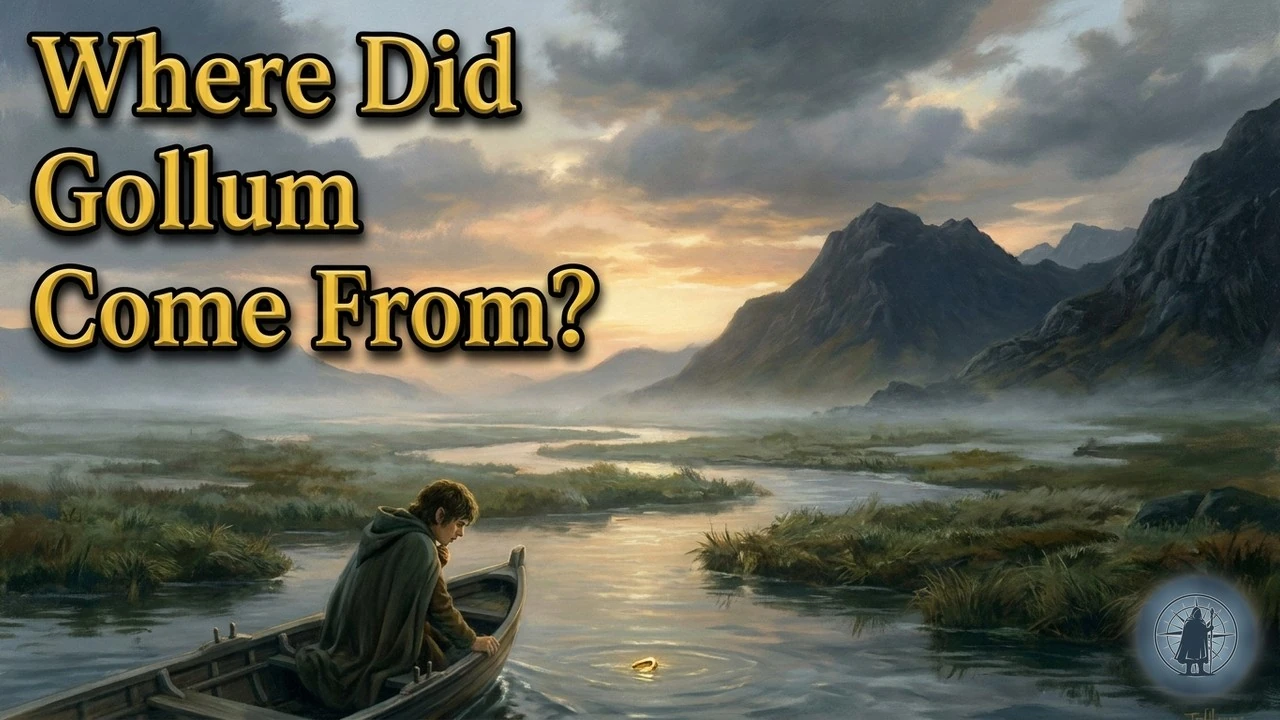 Watch the episode
The Stoors: Gollum's Forgotten Hobbit Family | Tolkien Explained
Watch the episode
The Stoors: Gollum's Forgotten Hobbit Family | Tolkien Explained
Main Narrative: The Stoors — Sméagol's Lost Kindred
"The Stoors lingered long by the banks of the Great River Anduin, and were less shy of Men."
That single line, buried in the Prologue to The Fellowship of the Ring, is one of the most consequential sentences Tolkien ever wrote about hobbits. Not because it tells us much on the surface — it's the sort of sentence readers skim past on a first read — but because everything in the Third Age, every turn of the Ring's long history, traces back to the folk described in it.
I'm your host at Ranger of the Realms, and today we're going to meet the third kindred of hobbits. The one almost nobody remembers. The one that produced Sméagol.
SECTION: The Hobbit Kindred Almost No One Remembers
Ask a Tolkien reader how many kinds of hobbits there are, and you'll often get a slightly uncertain answer. Most people remember the Harfoots, because Peter Jackson's films used the word and because The Rings of Power spent a whole season making them visible. A careful reader remembers the Fallohides, because Bilbo Baggins has Took blood and the Tooks are Fallohides and everyone knows the Tooks are a little odd.
But there's a third branch. And most readers, asked to name it on the spot, go quiet.
They were called the Stoors.
Tolkien describes them in the Prologue to The Lord of the Rings with unmistakable precision. "The Stoors were broader, heavier in build; their feet and hands were larger, and they preferred flat lands and riversides." Where the Harfoots were small, nimble, browner of skin, and partial to hillsides, and where the Fallohides were fair and slender and fond of woodlands, the Stoors were the stocky ones. The thick-wristed, broad-shouldered, heavy-booted branch of hobbit-kind. If the Fallohide was the scholar and the Harfoot was the farmer, the Stoor was the fenman. The peasant by the water. The one who could pick up a sack of grain in each hand.
They were also the only hobbits who could grow a beard. Or at least the first down of one — just enough to distinguish them from their kin, whom Tolkien describes, bluntly, as "beardless." This detail lives mostly in Tolkien's draft material, carefully preserved in The Peoples of Middle-earth by his son Christopher, but it has become settled tradition. If you meet a hobbit with a shadow on his chin, you are looking at Stoor blood.
And their habits, when you lay them out, start to feel almost heretical by Shire standards.
Other hobbits lived in holes. The Stoors often did not. Along the flat lands and beside the rivers, they built houses — of wood, of brick, of stone — right out on the surface of the earth where anyone could see them. They kept their doors at ground level. They did not burrow.
Other hobbits avoided water. The Stoors fished in it. They rowed boats. And — here is the line that ought to stop any serious reader cold — they swam. A proper Shire hobbit, faced with a river, reaches instinctively for the ferry rope. The Stoors climbed in.
They were also, Tolkien tells us, "less shy of Men." That phrase is doing a great deal of quiet work. Every other hobbit kindred defines itself partly by avoidance of the Big Folk. Harfoots hide. Fallohides befriend Elves instead. But the Stoors — the heaviest, the tallest, the most Man-shaped of the three — did not run from Men. They lived alongside them. They traded with them. Over time, as we'll see, they even began to speak like them.
What kind of hobbit is heavier, bearded, unafraid of Men, comfortable with boats, and perfectly happy to live in a stone house? The answer is: one who barely qualifies as a hobbit at all.
SECTION: The Road That Forked at the Mountains
By about the year 1050 of the Third Age, all three hobbit branches were living together in the upper Vales of Anduin — the ancestral homeland, a long green country east of the Misty Mountains and west of the forest then still called Greenwood the Great. It was a settled life. A good life. And then Greenwood began to darken.
A Shadow had crept into the southern reaches of the forest, nesting in a hill the Elves called Dol Guldur. The trees went sick. The creatures grew hostile. Greenwood, over the course of a century or so, earned the grimmer name by which we know it: Mirkwood. And the hobbits, who were not warriors, did what small folk have always done when the dark things stir nearby. They left.
They went west.
In T.A. 1150, the Harfoots were the first to cross the Misty Mountains. They used the High Pass, up near Rivendell. The Fallohides followed them shortly after, along the same route. Both branches pushed west into Eriador, settled in Bree and the surrounding lands, and began the long process that would eventually produce the Shire.
The Stoors did not follow.
The Stoors took a different road.
They moved south along the eastern side of the Misty Mountains and crossed at the Redhorn Pass — the high, treacherous pass beneath the mountain Caradhras. It is the same pass that the Fellowship, nearly two thousand years later, would fail to cross under Gandalf's leadership. The Stoors got through. They came down into Eriador well to the south of their cousins, and there they made their homes — in the Angle, a triangle of land between the Hoarwell and the Loudwater, south of Rivendell, and further south still into Dunland and the wetlands called the Swanfleet, around the old city of Tharbad.
For two centuries, that might have been the end of the story. Three kindreds, three different destinations, a slow settling into Eriador. But the Third Age was not kind to exiles.
In T.A. 1356, the war of the Witch-king of Angmar was grinding Eriador to pieces. The northern kingdom of Arnor was splintering. The Angle was no longer safe. And the Stoors living there had to choose: press further west and join the Harfoots and Fallohides in the lands that would one day become the Shire, or — — go back.
A significant portion of them went back.
They recrossed the Misty Mountains. They returned to the Vales of Anduin — the very land their ancestors had fled two hundred years before. And they settled in a wetland at the confluence of two rivers, the Gladden and the Anduin, that the Elves called Loeg Ningloron, the Pools of the Golden Water-flowers. We know it better by its English name: the Gladden Fields.
Sit with that sequence for a moment. Every other hobbit kindred was running away from the Shadow. The Stoors — under pressure, desperate, homesick — turned around and walked back toward it. Back toward Dol Guldur. Back toward Mirkwood. Back toward the very darkness that had driven them west in the first place.
No one else did that. Not the Harfoots. Not the Fallohides. No Men of the north, no Dwarves, no Elves. Only the Stoors made the journey home, knowing what was there.
Tolkien never quite explains why. A love of rivers. A memory of better days. A stubborn attachment to a country that had once been good. Perhaps all three. But the choice was made, and the consequences of it were going to outlast everyone who made it.
SECTION: The River That Waited
Here is a fact so quiet that most readers never put the pieces together.
In the year 2 of the Third Age — over two thousand years before the Stoors came back — a king named Isildur rode north from Minas Tirith with the One Ring on a chain around his neck. He was ambushed at the edge of a wetland by a band of orcs. Most of his guard died. Isildur himself, wearing the Ring, slipped into the river and tried to swim to safety. The Ring betrayed him. It slid from his finger. He rose, suddenly visible, and the orc-archers killed him in the water.
The Ring sank into the mud.
The wetland was called the Gladden Fields.
And in T.A. 1356 — one thousand three hundred and fifty-four years later — a community of short, heavy, bearded, river-loving hobbits walked back over the Misty Mountains and built their homes on top of the exact place where the Ring had gone down.
They did not know. They could not have known. The Ring had been lost for longer than any of them could remember. It had been lost for longer than their entire migration west and east again. It had been lost for longer than the kingdoms of Men that were falling apart above their heads. To them, the Gladden was simply good fishing-water — reeds, golden iris, fat fish, a slow bend of the Anduin. They set their boats in it and hauled their nets. And somewhere in the mud beneath their reed-boats lay a small gold ring, waiting.
It waited another eleven hundred years.
Consider who could actually have found it. Not a Harfoot — Harfoots stayed up in the hills and never went near deep water. Not a Fallohide — Fallohides lived in the woodlands and preferred paths to streams. Not a Man of the north — Men had moved out of the upper Anduin long ago. Not a Dwarf, not an Elf — neither went fishing in the Gladden.
It had to be someone who fished. It had to be someone who could pull a boat out into deep water. It had to be someone who would actually get wet. Only one culture in all of Middle-earth fit that description — and that culture had, by one of the more remarkable coincidences in Tolkien's entire legendarium, settled on top of the Ring's grave.
And so, on a summer day in T.A. 2463, two young Stoor cousins named Sméagol and Déagol went out in a boat on Sméagol's birthday. A fish took Déagol's line. The fish was a big one. It pulled. Déagol went over the side.
When he surfaced, spluttering, he was clutching something bright from the riverbed.
Everything that follows — the murder, the exile, the five centuries under the mountains, Bilbo, the Council of Elrond, the long walk to Orodruin — flows from that one moment on a Stoor fishing-boat. And the reason it could happen at all is that the Stoors were the one hobbit branch willing to climb into the water.
The trait everyone else thought of as quaint, or embarrassing, or un-hobbit-like, turned out to be the hinge of the age.
SECTION: The Grandmother by the Hearth
We have very little portrait of Stoor society. The text gives us fragments — a sentence here, a scene there, a handful of names. But one passage, in "The Shadow of the Past," opens a window for a moment, and through it we see more of Stoor home-life than Tolkien ever shows us anywhere else.
Gandalf is telling Frodo how Sméagol came by the Ring. And he pauses to describe Sméagol's family. Listen to it.
"There was among them a family of high repute, for it was large and wealthier than most, and it was ruled by a grandmother of the folk, stern and wise in old lore, such as they had. The most inquisitive and curious-minded of that family was called Sméagol."
Almost every word of that sentence is telling us something about what the Stoors of the Gladden were like.
"A family of high repute." There was social standing here. Some Stoor families were wealthier than others. This was not an egalitarian huddle of fisher-folk — there was a hierarchy, and Sméagol's people were near the top of it.
"Large." Extended kin. Cousins, aunts, second-cousins, the lot of them under one roof or one cluster of roofs. When Tolkien later, in Letter 214, clarifies that Déagol and Sméagol were "evidently relatives" rather than just friends, he is filling in the obvious: in a clan like this, your fishing companion is almost certainly your cousin.
"Ruled by a grandmother." This is the detail that changes everything. In Sméagol's household, the authority is not the father, not the eldest uncle, not some male headman. It is an elderly woman. A matriarch. She runs the family. She rules the folk. Tolkien is drawing here on a real pattern from Anglo-Saxon and Celtic rural society, where an elder widow could wield enormous clan authority — but in the context of hobbit-kind, it is striking. Nothing in the Shire looks like this. The Shire has Thains and Masters and patriarchal farm-holds. The Gladden had a grandmother.
"Stern and wise in old lore, such as they had." The qualifier at the end — such as they had — is almost tender. Their lore was not great. They were a small folk on the edge of a great world, with their own tales and their own memory, and the grandmother was the keeper of it. She knew what her people knew. She held the stories together.
"The most inquisitive and curious-minded of that family was called Sméagol."
This line ought to stop us. Before he was Gollum, Sméagol was the curious one. The asker of questions. The child who wanted to know. In another family, in another age, he might have been a scholar. He might have been sent to study with the Elves. He might have become the Brandybuck who first dared to ride a pony. Instead, his curiosity — set loose in the wrong place at the wrong time — became the thing that destroyed him.
We even know how the grandmother handled him at the end. When his whispering, his hiding, his thieving, his talking to himself had grown intolerable, she disowned him. She put him out of the family. She drove him into the mountains. Stoor clan discipline was not sentimental. If you broke the clan, the clan broke you off.
That is the last picture we have of a living Stoor society: a matriarchal, clan-based, oral-tradition, conservative village of river-folk, where the grandmother ruled and exile was the final sentence. It is the only such picture in all of Tolkien.
And from it came Gollum.
SECTION: Two Endings for a Vanished People
Somewhere in the drafts Tolkien left behind at his death, there is a question he never answered.
What happened to the Stoors of the Gladden Fields?
We know they were there in T.A. 2463, when Déagol found the Ring. We know they disowned Sméagol around T.A. 2470, sending him into the Misty Mountains where he would live for four and a half centuries as Gollum. And we know that by the War of the Ring, in T.A. 3018 — five and a half centuries after Sméagol's exile — the Gladden Stoors are gone.
But how they are gone, Tolkien wrote two different ways, and he never chose between them.
The source is a text called "The Hunt for the Ring," a late essay that describes how the Nazgûl, commanded by Sauron, rode north to the Gladden Fields to find the Ring's resting place. It exists in multiple drafts. Christopher Tolkien, acting as his father's editor, preserved both of them in Unfinished Tales.
In the first version — call it Version A — the Nazgûl arrive at the Gladden Fields and find the Stoor villages long deserted. The community has already dispersed. Whether they died out, or drifted away, or were pressured by orcs and worse things from Dol Guldur, we are not told. The villages are empty reed-boats and overgrown fields. The Stoors are simply gone. The Nazgûl ride away frustrated — the riverbed is theirs to search, but there is no one to question.
In the second version — Version B — the Stoors are still there. The Nazgûl arrive at a living community of hobbits, and what happens next is recorded in Tolkien's characteristically dry hand: the Riders "slaughtered or drove away" the remaining Stoors. The last Stoor settlement of the Anduin is destroyed by Sauron's chief servants, hunting for the Ring that one of their number had pulled out of the mud five hundred years before.
Either way, the Stoors of the east end.
But consider how different those two endings feel. In Version A, the Stoors quietly fade. The small folk by the water are simply no longer there — the way villages in our own world have emptied over centuries, leaving behind stone foundations and the shapes of old fields. It is the ending of an anthropological note. Of a people outlived by their country.
In Version B, the Stoors are murdered. The Nine come at them in the night, and the cousins of Déagol — the great-great-grandchildren of the grandmother by the hearth — are cut down. Sauron, without knowing it, annihilates the family that found his Ring.
Tolkien did not decide. In letter after letter, draft after draft, he circled back to the hobbit migrations, to the Stoors, to the Gladden. But on this — on how the line actually broke — he left the question open, and Christopher Tolkien, his son and editor, refused to close it for him.
Some Tolkien scholars have argued that Version A is truer to the quiet, elegiac mood Tolkien favored for the fading of small peoples. Others argue Version B fits the Ring's geography of evil — the Nazgûl clearing the last witnesses to cover their lord's shame. Both readings have merit. Neither resolves it.
What we are left with is arguably the single largest unresolved gap about the hobbits anywhere in the canon. A whole branch of a whole people, ended in two incompatible ways by the author himself. The Stoors of the Gladden are not just dead. They are dead in an unfinished sentence.
SECTION: Bearded Cousins in the Marish
So the eastern Stoors end. Whichever ending you prefer, they end.
And yet, if you go into the Shire and stand on the right patch of ground and look at the right hobbits, you are looking at the Stoors.
They did not all die. Some never went back east. In T.A. 1601, when the Fallohide brothers Marcho and Blanco led the great migration from Bree westward into the land the king granted them, the hobbits who came with them were not uniform. Fallohides were at the top of the procession, but there were Harfoots in the middle and — following behind, from Dunland and the old Swanfleet country — there were Stoors. They did not go back east. They pressed further west into the new country, and they settled in the bottom-lands: the fertile, flat, wet, river-cut corners of the Shire.
You know this region. It is called the Marish, and Buckland, and the Eastfarthing. It is where Farmer Maggot lives.
Look closely at it. Watch what the Bucklanders do. They live in a region cut by the Brandywine, and unlike every other hobbit family in the Shire, they have ordinary working relationships with boats. They ferry. They row. They have small rafts and big rafts and long reed-poles and nets. Meriadoc Brandybuck, raised in Buckland, is perfectly comfortable on the water — in a way that Pippin Took, his Fallohide-descended cousin, is not.
Look at where the Brandybucks live. It is not a hole. Not quite. Brandy Hall is a great hobbit-mansion, dug into the side of Buck Hill but so enormous and so elaborate that it is effectively a building. It has corridors, wings, family quarters, and above all — and this is unique in the Shire — it has doorways at ground level and corridors that are half above the surface. It is the only above-ground hobbit-mansion in all of hobbit history, and Tolkien names the Brandybucks specifically, in the Prologue, as "mostly of Stoorish blood, but with a Fallohide strain."
Of course they are. Of course Brandy Hall is half out of the ground. Of course Bucklanders can swim. That is Stoor cultural inheritance — diluted, softened, half-forgotten, but still doing its work five hundred years after the Gladden villages emptied.
And then there is Farmer Maggot. Remember the scene. Frodo and his companions flee across the Marish in the dark, and a Nazgûl — one of the very Riders who may or may not have slaughtered the Gladden Stoors two years before — comes to Maggot's farm looking for them. What does Maggot do?
He stands on his own threshold and tells the Black Rider to leave his land.
No Harfoot-descended hobbit would have done that. No ordinary Shire-hobbit would have done that. Maggot, big-built, mud-booted, stubborn, standing his ground against a wraith of Mordor — that is Stoor courage, expressed in a thick-shouldered Marish farmer, four thousand years after the Stoors came down from the hills. The branch that withered east still has living wood in the west.
Even the name "Stoor" tells you what to expect of them. Tolkien, in his Guide to the Names in The Lord of the Rings, explains it plainly: "Stoor. The name of the third kind of Hobbit, of more heavy build. This is early English stor, stoor 'large, strong,' now obsolete." It's cognate with the Old Norse stór, meaning big, mighty. The word for them is a word for "big and strong." And both the names of our only known Stoors — Sméagol and Déagol — are built from Old English, which within Tolkien's philological conceit is the same language-family he uses for Rohirric. Translate that into the story, and it means the Stoors of the upper Anduin spoke a tongue related to the speech of the northern Men. The horse-lords and the fishermen were distant linguistic cousins.
That is the final strangeness of the Stoors. They were the hobbit branch closest to Men — in build, in courage, in language, in temperament. Their descendants in Buckland are still the hobbits most like Men. And they are the ones who pulled the Ring out of the river.
SECTION: The Kindred That Delivered the World
Step back and look at the shape of it.
A branch of hobbit-kind that walked back toward the Shadow when everyone else fled. That settled on top of a lost artifact buried for a thousand years in mud. That was the only people in Middle-earth willing to wade into the Gladden's waters. That produced, from a "family of high repute" ruled by a stern grandmother, two young cousins on a birthday fishing trip — and that, through the murder that followed, lost the Ring out of its own hands into the shadows under the mountains, where a burglar named Bilbo would stumble on it one day in the dark.
Every one of those beats required the Stoors to be exactly who they were. Physically heavy. Bearded. Riverside. East-ward. Man-shaped. A little outside the neat, tidy, hole-dwelling mold of the other hobbits. The branch that did not quite fit was the branch that the world required.
And then, having served that purpose, they died. Quietly, or violently — Tolkien would not say — but they died. Their villages emptied. Their boats rotted. Their grandmothers' hearths went cold. Their names, apart from two, were not recorded.
Déagol. Dēagol, in Old English: secret, hidden.
The hidden one, who found the hidden thing, in the hidden river of the hidden people. Tolkien was many things, but a careless namer was not one of them.
There is a Catholic instinct running all through this. Tolkien believed that the grace of God tended to move through what looked insignificant — through the small, the forgotten, the marginal, the half-remembered. The whole Ring-quest runs on that logic. The mightiest servant of the Light is a short man with furred feet. The last bearer of the Ring is a half-mad exile. The decisive act at the Cracks of Doom is a scuffle between two hobbits over a piece of jewelry. And behind all of it, making it possible, is a whole branch of a people that vanished so completely most readers cannot remember them.
The branch that withered delivered the catastrophe that saved the world. The lost kindred did the saving work.
It's no accident that modern adaptations have started to feel the gap. The Rings of Power, in its second season, placed a settled community of Stoors in the far eastern region of Rhûn — a lost hobbit-village led by a figure called "The Gund," where Nori and Poppy meet the ancestors of their own people. It's an invention. Tolkien never put Stoors in Rhûn; he put them in the Vales of Anduin. But the show is working in the space Tolkien himself left open — the canonical silence about what exactly became of the eastern hobbits — and it is the first major adaptation to take that silence seriously. Whether or not the particulars land, the instinct is right. There is a missing piece in hobbit-kind, and the shape of it is Stoor-shaped.
The Stoors are the hobbits we lost. They are the folk who walked back into danger, who built houses instead of holes, who swam when no one else would, who ended in a sentence Tolkien never finished. Their last living children live in Buckland, tending pipes beside the Brandywine — and if you've ever wondered why Merry Brandybuck has more courage than he ought to have, why he can stab a Nazgûl king and walk away alive, why a single Marish farmer can face down a Rider of Mordor on his own threshold — — now you know.
It is Stoor blood, doing its old work.