
Research & Sources
The Stoors
Gollum's Forgotten Hobbit Family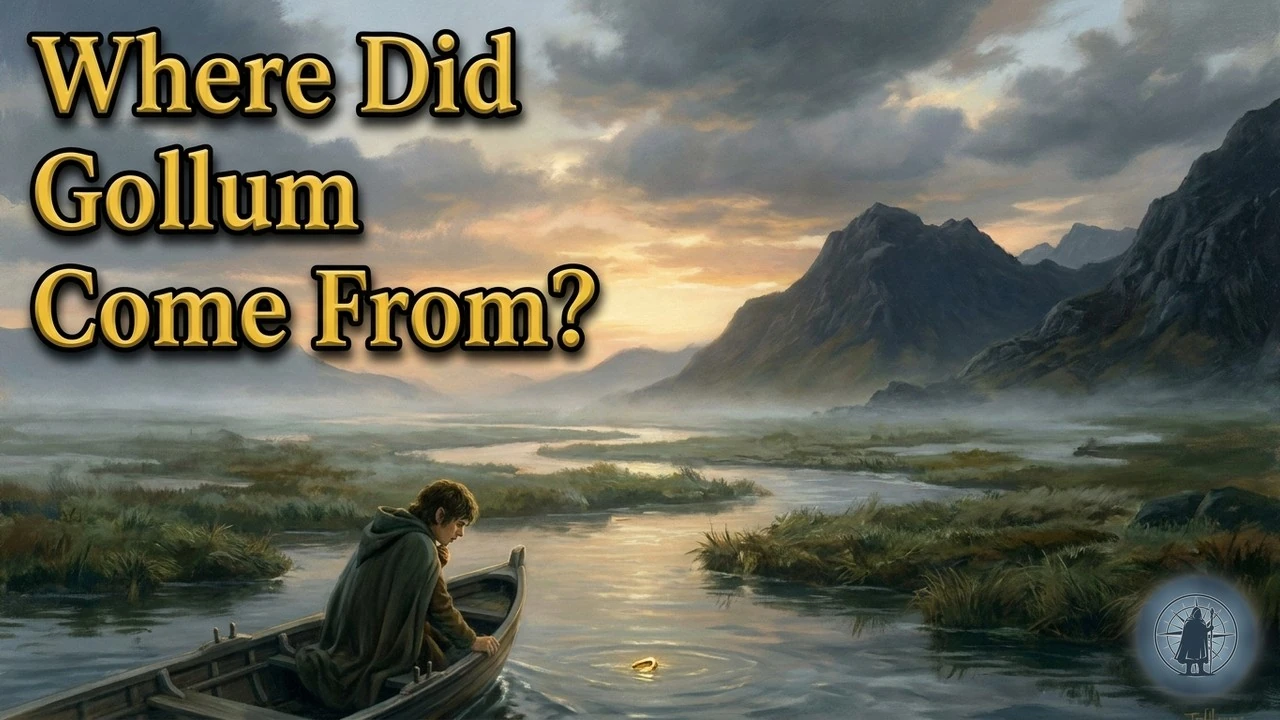 Watch the episode
The Stoors: Gollum's Forgotten Hobbit Family | Tolkien Explained
Watch the episode
The Stoors: Gollum's Forgotten Hobbit Family | Tolkien Explained
Research Notes: The Stoors — Sméagol's Lost Kindred
Overview
The Stoors are the least-discussed of the three hobbit kindreds described in the Prologue to The Lord of the Rings, and yet they sit at the center of the Ring's entire story. It was a Stoor — Déagol — who first rediscovered the One Ring in the muddy bed of the Gladden River in T.A. 2463. It was his cousin and friend, another Stoor named Sméagol, who murdered him for it and became Gollum. Every turn of the Third Age that follows flows from a dispute between two fisher-folk on an Anduin riverbank.
Tolkien tells us just enough about the Stoors to make them strange: broader, heavier, bearded, river-loving hobbits who walked east when most of their kin walked west, who lived in brick and stone houses as well as holes, who used boats and swam — a thing no sensible Shire-hobbit would do — and who "lingered long by the banks of the Great River Anduin, and were less shy of Men" (The Fellowship of the Ring, Prologue, "Concerning Hobbits"). They are the kindred that split, dispersed, and in their easternmost branch simply vanished from the record. The Stoors are hobbitkind's ghost limb.
This episode's hook — Amazon's The Rings of Power reintroducing a lost Stoor community in Rhûn — is the clearest signal that modern audiences are discovering what Tolkien readers have long suspected: the Stoors are the richest unexplored thread in hobbit lore.
Primary Sources
The Lord of the Rings — Prologue, "Concerning Hobbits"
The single most important canonical passage on the three kindreds. Tolkien writes:
"In the days of Bleeding Mountain they had found their way over the mountains... Before the crossing of the mountains the Hobbits had already become divided into three somewhat different breeds: Harfoots, Stoors, and Fallohides. The Harfoots were browner of skin, smaller, and shorter, and they were beardless and bootless; their hands and feet were neat and nimble; and they preferred highlands and hillsides. The Stoors were broader, heavier in build; their feet and hands were larger, and they preferred flat lands and riversides. The Fallohides were fairer of skin and also of hair, and they were taller and slimmer than the others; they were lovers of trees and of woodlands." (FOTR, Prologue §1, "Concerning Hobbits")
On the Stoors specifically:
"The Stoors lingered long by the banks of the Great River Anduin, and were less shy of Men." (FOTR, Prologue §1)
"The Stoors were the only Hobbits who had any beards... they were broader and heavier in build." (Prologue, summarizing from several paraphrases across Tolkien's texts; Tolkien Gateway)
Key detail on habit and habitation: the Prologue explicitly notes that while most hobbits lived in holes, the Stoors "in the flat lands and by the riversides" often built "houses of wood, brick, or stone" above ground — a practice that passed down into the Marish and Buckland.
The Lord of the Rings — "The Shadow of the Past" (Book I, Chapter 2)
Gandalf relates to Frodo the story of the Ring's finding. The passage contains the central Stoor scene in the entire legendarium:
"There was among them a family of high repute, for it was large and wealthier than most, and it was ruled by a grandmother of the folk, stern and wise in old lore, such as they had. The most inquisitive and curious-minded of that family was called Sméagol." (FOTR I.2, "The Shadow of the Past")
The exchange over the Ring:
"'Give us that, Déagol, my love,' said Sméagol, over his friend's shoulder.
'Why?' said Déagol.
'Because it's my birthday, my love, and I wants it,' said Sméagol.
'I don't care,' said Déagol. 'I have given you a present already, more than I could afford. I found this, and I'm going to keep it.'
'Oh, are you indeed, my love,' said Sméagol; and he caught Déagol by the throat and strangled him, because the gold looked so bright and beautiful." (FOTR I.2)
And Gandalf's crucial identification of what Sméagol actually was:
"I guessed then, without the telling, that Gollum's ring came out of the Great River; and I guessed also that he had held it for so long that... I wondered often how Gollum came by a Great Ring, as plainly it was — that at least was clear from the first. Then I heard Bilbo's strange story of how he had 'won' it, and I could not believe it... My dear Frodo! Hobbits really are amazing creatures, as I have said before. You can learn all that there is to know about their ways in a month, and yet after a hundred years they can still surprise you at a pinch." (FOTR I.2)
Gandalf, critically, classifies Sméagol as a hobbit: "I guessed from the first that he was of hobbit-kind; remote kinsmen of the fathers of the fathers of the Stoors, for so I now clearly see."
Unfinished Tales — "The Disaster of the Gladden Fields"
This late essay by Tolkien, edited by Christopher Tolkien, describes Isildur's death in the Gladden Fields in T.A. 2. It matters to the Stoor story in two ways:
1. It establishes that the Gladden Fields ("Loeg Ningloron" in Sindarin, "Fields of the Golden Water-flowers") were uninhabited at the time of Isildur's death — the Stoors would not return until T.A. 1356. 2. It means the Ring lay in Stoor water for over 2,400 years before one of them found it. The site of the kingdom's catastrophic loss became, centuries later, the fishing ground of the folk whose descendant would find it again.
Unfinished Tales — "The Hunt for the Ring"
Contains the most explicit account of what happened to the Stoors of the Gladden Fields. In the notes associated with this essay, Tolkien describes the Nazgûl returning to the Gladden Fields in T.A. 3018 seeking the Ring. Two versions exist in Christopher Tolkien's editorial notes:
- Version A: The Riders reached the Gladden Fields but found the Stoor villages "long deserted" — suggesting the community that produced Sméagol had already died out or dispersed by the time of the War of the Ring. - Version B (fragmentary): The Stoor settlements were still inhabited when the Nazgûl arrived, and the Riders "slaughtered or drove away" the remaining Stoors.
Either way, the implication is devastating: the Stoors of the Anduin are effectively extinct by the end of the Third Age.
The Letters of J.R.R. Tolkien
Letter 214 (to A.C. Nunn, draft, 1958–59) — Tolkien's most extensive post-publication commentary on hobbit social customs. Important for Stoor-related questions because Tolkien here confirms Déagol and Sméagol were "evidently relatives" — not merely friends — clarifying ambiguity in the main text. He also describes hobbit family structure, matriarchal elders, and gift-giving customs — relevant to Sméagol's grandmother as "ruler of the folk."
Guide to the Names in The Lord of the Rings (Tolkien's guide for translators, later published in A Tolkien Compass and reprinted in The Lord of the Rings: A Reader's Companion) — Tolkien here explains the name:
"Stoor. The name of the third kind of Hobbit, of more heavy build. This is early English stor, stoor 'large, strong', now obsolete." (Tolkien, Guide to the Names)
The History of Middle-earth
HoME XII, The Peoples of Middle-earth — contains earlier drafts of the Prologue and Appendices. In an earlier manuscript version of what became Appendix F, Tolkien writes that "the name Stoor seemed to have originally meant 'big'" and notes "Scandinavian stor- means 'big'." Christopher Tolkien preserves drafts showing that Tolkien experimented with different accounts of the hobbit migration before settling on the version in the published Prologue.
HoME VI, The Return of the Shadow — the earliest drafts of The Lord of the Rings show Tolkien refining his conception of the hobbit kindreds, with Stoors consistently presented as the riverside branch.
The Hobbit
No direct treatment of Stoors, but Bilbo Baggins' Brandybuck-related relations (the Tooks and Brandybucks) will later be retroactively given Stoorish and Fallohidish heritage in The Lord of the Rings Appendices, meaning even Bilbo is partly a Stoor by blood.
Key Facts & Timeline
- Pre-T.A. 1050 (unknown duration): Hobbits dwell in the upper Vales of Anduin. Already divided into three kindreds: Harfoots (most numerous, hillside), Stoors (heavier, riverside), Fallohides (fairest, woodland). - c. T.A. 1050: Shadow of Dol Guldur falls on Greenwood; it becomes Mirkwood. Hobbits begin migrating west. - T.A. 1150: Harfoots cross the Misty Mountains first via the High Pass. Fallohides follow shortly after. Stoors migrate last — and differently. They take the Redhorn Pass and move southwest, following the Loudwater (Mitheithel/Hoarwell). - T.A. 1150–1300: Stoors split. Some settle in the Angle of Eriador (between Mitheithel and Bruinen, south of Rivendell). Others continue to the lands around Tharbad and into Dunland (Swanfleet). - T.A. 1356: Under pressure from Angmar and the worsening climate, many Stoors of the Angle flee. A significant portion returns east over the Misty Mountains — back to the Vales of Anduin — and settles the Gladden Fields. This is the critical date: the founding of the community that will produce Sméagol. - T.A. 1356–1409: Continued Stoor dispersal from Eriador during the wars with Angmar. - T.A. 1601: The Fallohide brothers Marcho and Blanco lead the migration from Bree westward, founding the Shire. - c. T.A. 1630: Stoors of Dunland move north to join the new Shire, settling mostly in the Eastfarthing and Southfarthing (especially the Marish and later Buckland). - T.A. 2463: Déagol, a Stoor of the Gladden community, finds the One Ring while fishing with Sméagol on Sméagol's birthday. Sméagol murders him. - c. T.A. 2470: Sméagol, by now Gollum, is driven out by his grandmother and disappears into the Misty Mountains. - T.A. 2941: Bilbo finds the Ring in Gollum's cave. - T.A. 3018: Nazgûl return to the Gladden Fields. In either version of "The Hunt for the Ring," the Stoor community of the Gladden is finished — either already vanished or now destroyed. - T.A. 3019 and after: Stoorish blood persists only through the Marish-Bucklanders and, by tradition, some Bree-hobbits.
Significant Characters
- Sméagol / Gollum: The Stoor whose name we know best, and the proof that a hobbit can be twisted by the Ring without becoming a wraith — the Stoor constitution matters here. Gandalf: "remote kinsmen of the fathers of the fathers of the Stoors" (FOTR I.2). - Déagol: Stoor cousin/relative of Sméagol, the actual finder of the Ring after the fish drags him under. The only named Stoor of the Gladden community besides Sméagol. His murder is the pivot of the Third Age. - Sméagol's Grandmother: Unnamed. Matriarch of a "large and wealthier" Stoor clan, "stern and wise in old lore." She disowns Sméagol when his thieving and whispering become intolerable. She is the only glimpse we get of Stoor social structure: matriarchal, clan-based, extended-family, oral-tradition. - Gorhendad Oldbuck (later Brandybuck): Stoor-descended Shire-hobbit who crosses the Brandywine and founds Buckland. The Brandybucks are described in the Prologue as "mostly of Stoorish blood, but with a Fallohide strain" — which explains their unusual hobbit behaviors: boats on the Brandywine, swimming, houses above ground (Brandy Hall). - The Marish-folk (including Farmer Maggot): The living remnant of Stoorish culture in the Shire. Big of build, mud-knowledgeable, able to deal with strangers, and critically — as we see with Maggot — not afraid of Black Riders in the way that more timid Shire-hobbits would be.
Geographic Locations
- The Vales of Anduin (Wilderland / Rhovanion): The ancestral hobbit homeland. The Stoors lived on the flatter riverside here even before the division. - The Redhorn Pass (Caradhras): The route the Stoors took west over the Misty Mountains in T.A. 1150 — southward of the passes used by Harfoots and Fallohides. - The Angle of Eriador: Triangle of land between the Hoarwell and the Loudwater (Mitheithel and Bruinen), south of Rivendell. Stoor settlement c. T.A. 1150–1356. - Dunland / Swanfleet / Tharbad: Southernmost Stoor settlement. The Stoors of Dunland stayed longer than those of the Angle; their descendants eventually repopulated the Shire's Eastfarthing. - The Gladden Fields (Loeg Ningloron): Wetland at the confluence of the Gladden River and the Anduin. Isildur died here in T.A. 2. Stoors resettled it in T.A. 1356. Sméagol murdered Déagol here in T.A. 2463. The fact that the Ring was lost in Stoor fishing-grounds is the most important geographic coincidence in Middle-earth. - The Marish and Buckland (Eastfarthing/Shire): Where Stoorish culture survives into the Fourth Age — the only hobbits who boat, swim, keep farmland in flood-plain, and live in above-ground halls (Brandy Hall).
Themes & Symbolism
Water vs. Earth
Every other hobbit kindred distrusts water. Fallohides love woods; Harfoots love hills and holes. The Stoors love rivers. They fish. They swim. They row boats. When Pippin and Merry talk about Brandybucks being "queer" it is because Brandybuck Stoorishness makes them comfortable on the Brandywine — which most Shire hobbits cross only by ferry with held breath. This is not a minor trait. Water in Tolkien is always associated with fate, music, and the Ring: the Ring travels by river (Anduin to Gladden, then eventually up out of the water again). The one hobbit kindred comfortable with rivers is the one that produces the Ring-finder.The Shadow from the East
Tolkien's geography has a consistent moral valence: east is where evil lives. Dol Guldur rises in the east. Mordor is east. The hobbits' original migration is a flight from the east. The Stoors are the kindred that, uniquely, went east again — back to the Vales of Anduin. The clan that chose to live closest to the Shadow is the one that produced the Shadow's tool.The Uncategorizable Hobbit
Sméagol is important to the Ring's defeat because he breaks Sauron's categories: neither a power-seeker nor a cowed slave. That resistance comes from the hobbit nature — specifically the Stoor nature, which Tolkien characterizes as the heavier, tougher, more Man-like branch. The Stoors' physical robustness and their psychological affinity with Men ("less shy of Men") give Sméagol exactly the half-Man, half-hobbit quality that makes Gollum impossible to categorize.The Branch That Withered
The three hobbit kindreds follow a pattern common in Tolkien's races (Elves: Vanyar/Noldor/Teleri; Men: Edain/Middle/Easterling; Dwarves: various houses). In each triad one branch thrives, one adapts, one is diminished or lost. The Stoors are the lost branch: the most eastern, the most exposed, the most Man-like — and the one that dies out in the wild.Eucatastrophe Through the Lost Kindred
The lost branch is not, in fact, wasted. The Stoors' contribution to Middle-earth is the finding of the Ring — which, through the long chain of Bilbo's mercy and Frodo's pity, becomes the means of its destruction. The kindred that vanishes still delivers the catastrophe that saves the world. Grace works through the marginal and forgotten.Scholarly Interpretations & Theories
- The "Three Triads" Reading: Multiple scholars (e.g. contributors at Tolkien Gateway and the Middle-earth & J.R.R. Tolkien Blog by Michael Martinez) note the mirroring between the three hobbit kindreds and the three Elven kindreds (Vanyar / Noldor / Teleri). The parallel is explicit: Fallohides are elf-friends (like the Noldor are friends of the Valar), Harfoots are the numerous practical folk (Teleri-like), and Stoors — the riverside people — have no perfect elvish equivalent, which some scholars read as intentional: the hobbit triad is broken in a way the Elven triad is not. - High / Middle / Low Pattern (Wikipedia, Middle-earth peoples): Tolkien tends to sort each race into a "high, middle, low" tripartite structure. Fallohides read as "high" (tall, fair, noble, Took-line, royal); Harfoots as "middle" (numerous, ordinary); Stoors as "low" (earthy, heavy, Man-like, peasant). The Ring being found by a "low" hobbit is part of Tolkien's humility motif. - Catholic / Providential Reading: In Catholic-Tolkien readings (e.g. Tea with Tolkien, Peter Kreeft), the fact that God's providence operates through Sméagol — a corrupted, forgotten hobbit of a vanished kindred — is precisely the point. Grace comes from where no one is looking. - Rings of Power Interpretation: The Rings of Power Season 2 introduces the Stoors as a settled, burrow-dwelling community in Rhûn led by "The Gund" (dwell-leader), deliberately distinguishing them from the wandering Harfoots. The show invents a foundational Stoor migrant named Rorimas Burrows who left with "a caravan of followers" seeking "a place with endless streams of cold water and rolling hills so soft a family could dig a hole" — called the "Sûzat," which fans recognize as the Shire. This is an invention of the show (Tolkien places Stoors in the Vales of Anduin, not Rhûn, and the Shire is founded by Fallohide brothers), but it is consistent with Tolkien's hint that Stoors went east and were lost to history.
Contradictions & Different Versions
- Fate of the Gladden Stoors: Version A of "The Hunt for the Ring" (Unfinished Tales) has the Stoor villages already deserted by T.A. 3018; Version B has the Nazgûl destroying a still-living community. Tolkien did not settle the matter. - Cousin vs. Friend: In the main text of LOTR, Déagol is called Sméagol's "friend." In Letter 214, Tolkien calls them "evidently relatives." Most readers and the films go with "cousin"; the text itself is less specific. - Etymology: HoME XII preserves an earlier draft in which Tolkien derives "Stoor" from a Dale-word meaning "big"; the published Prologue derives it from obsolete English "stor / stoor." Both readings are consistent — the Old English was already connected to Germanic roots like Scandinavian "stor" — but Christopher Tolkien preserves the drafting process. - Did the Stoors have beards?: The Prologue says the Harfoots were "beardless"; it describes the Stoors as broader and heavier but does not explicitly say they had beards in the published text. Tolkien Gateway, citing draft materials, notes that the Stoors are the only hobbits who could grow "a down on the chin." Most fans treat Stoor beards as canonical even though the main-text evidence is thin. - Rings of Power vs. Canon: The show's placement of Stoors in Rhûn is a deliberate invention. There is no textual basis for Stoors in Rhûn. However, the show threads it carefully: the Stoors' eventual westward migration to "the Sûzat" maps onto Tolkien's actual account of western migration, just compressed and relocated.
Cultural & Linguistic Context
Etymology
- Stoor / Stoors: from obsolete English stor / stoor, meaning "large, strong, tall, mighty." Cognate with Old English stōr, Proto-Germanic stōraz, Scandinavian stor-. Tolkien chose the word precisely because the kindred is heavier and stronger than the other two. (Guide to the Names in The Lord of the Rings.) - Sméagol: Old English smygel, "burrow, place to creep into." Tolkien built both names in the Déagol/Sméagol pair out of Old English roots because, within the conceit of the Red Book, hobbit names have been "translated" from a hobbit tongue related to the Mannish languages of the upper Anduin. That Tolkien used Old English (his Rohirric stand-in) for Stoor names is a deep hint: the Stoors' language was related to the language of Rohan — i.e., to the northern Men of the upper Anduin. This is another piece of evidence that the Stoors were culturally the most Man-adjacent hobbits. - Déagol: Old English dēagol, "secret, hidden." An eerily apt name for the finder of the Secret Ring. - Gladden: From the plant "gladdon" (the yellow iris, Iris pseudacorus). Gladden Fields = Fields of the Yellow Iris. Sindarin: Loeg Ningloron, "Pools of the Golden Water-flowers." - Brandybuck / Oldbuck: Old English-style Stoorish names, continuing the pattern. "Brandy" from the Brandywine river — itself a hobbit corruption of Baranduin.
Real-World Parallels
- Tolkien consistently modeled hobbits on the English rural countrymen of his childhood in the West Midlands. The Stoors specifically correspond to the fenland or riverside villagers — peoples like those of the Welsh-English marches, or East Anglian fen-dwellers: people who lived with water, who fished, who were stockier and more conservative, who spoke with local dialects preserved long after the cities had standardized their English. The Marish-hobbits are essentially literary fen-folk. - The matriarchal Stoor family led by a "stern and wise" grandmother echoes several real medieval rural family structures, especially in Celtic and Anglo-Saxon contexts where elder women held clan authority after widowhood.
Questions & Mysteries
- What actually happened to the Gladden Stoors? Tolkien's two versions give contradictory answers, and he never chose between them. This is arguably the single largest unresolved mystery about the hobbits in the canon. - Did any Stoors survive east of the mountains into the Fourth Age? The Prologue says the easternmost Stoor community disappeared. Rings of Power fills this with a Rhûn Stoor community, but Tolkien himself leaves it open. - Why did the Stoors go back east when no one else did? Tolkien never fully explains the T.A. 1356 reverse-migration. Climate, war, and a preference for riverside living are all cited; none fully account for why a persecuted people would return toward the Shadow. - How much of Gollum's personality is specifically Stoor? Gandalf insists Gollum is "of hobbit-kind." But the Stoors' distinctive traits — affinity with Men, comfort with water, willingness to live in the open — would have shaped Sméagol's psychology before the Ring. How much of what we read as Gollum-madness is actually Stoor-nature in extreme conditions? - Are any Stoors still east by the Fourth Age? Left open. This is the gap Rings of Power is exploiting.
Compelling Quotes for Narration
1. "The Stoors lingered long by the banks of the Great River Anduin, and were less shy of Men." — The Fellowship of the Ring, Prologue, "Concerning Hobbits" 2. "The Stoors were broader, heavier in build; their feet and hands were larger, and they preferred flat lands and riversides." — FOTR, Prologue 3. "There was among them a family of high repute, for it was large and wealthier than most, and it was ruled by a grandmother of the folk, stern and wise in old lore, such as they had. The most inquisitive and curious-minded of that family was called Sméagol." — FOTR I.2, "The Shadow of the Past" 4. "'Because it's my birthday, my love, and I wants it,' said Sméagol." — FOTR I.2 5. "Hobbits really are amazing creatures, as I have said before. You can learn all that there is to know about their ways in a month, and yet after a hundred years they can still surprise you at a pinch." — Gandalf, FOTR I.2 6. "I guessed from the first that he was of hobbit-kind; remote kinsmen of the fathers of the fathers of the Stoors." — Gandalf, FOTR I.2 7. "Stoor. The name of the third kind of Hobbit, of more heavy build. This is early English stor, stoor 'large, strong', now obsolete." — Tolkien, Guide to the Names in The Lord of the Rings 8. "The Brandybucks were of mostly Stoorish blood, but with a Fallohide strain." — FOTR, Prologue
Visual Elements to Highlight
1. A Stoor fisherman pulling a reed-boat through the Gladden Fields at dusk — yellow flag-iris, misty Anduin, Misty Mountains in the distance. 2. Three lines of hobbits crossing the Misty Mountains at different passes in T.A. 1150 — Harfoots and Fallohides over the High Pass to the north, Stoors over the Redhorn far to the south. 3. Sméagol and Déagol in the boat, the fish pulling Déagol under — the moment of the Ring's re-entry into the world. 4. The stern grandmother matriarch by a hearth of above-ground brick house, stone-built, not a hole. 5. The abandoned Stoor village in the Gladden Fields: empty reed boats, overgrown fields, the Nazgûl arriving too late (or just in time, depending on the version). 6. Farmer Maggot in the Marish — the last living Stoor culture — standing unafraid on his own threshold as Black Riders withdraw. 7. Brandy Hall — the only above-ground hobbit mansion of note in the Shire, a cultural inheritance from the Stoors.
Sources Consulted
- The Lord of the Rings, Prologue "Concerning Hobbits" (primary) - The Lord of the Rings, Book I Chapter 2 "The Shadow of the Past" (primary) - The Lord of the Rings, Appendix B "The Tale of Years" (primary) - Unfinished Tales, "The Disaster of the Gladden Fields" - Unfinished Tales, "The Hunt for the Ring" (including Christopher Tolkien's editorial notes) - The Letters of J.R.R. Tolkien, Letter 214 - The History of Middle-earth, Volume XII The Peoples of Middle-earth (Christopher Tolkien, ed.) - Tolkien, Guide to the Names in The Lord of the Rings - Tolkien Gateway: "Stoors," "Déagol," "Sméagol," "Gladden Fields," "The Hunt for the Ring," "The Disaster of the Gladden Fields" - The One Wiki to Rule Them All (Fandom): "Stoors," "Déagol," "Gladden Fields," "Sméagol's grandmother" - Michael Martinez, Middle-earth & J.R.R. Tolkien Blog: "When Did Hobbits become Divided into Fallohides, Stoors, and Harfoots?"; "How Many Independent Hobbit Countries Were There In Middle-earth?" - Wikipedia: "Hobbit," "Gollum," "Middle-earth peoples" - Nerdist: "The Rings of Power's New Hobbit Tribe the Stoors" - ScreenRant: "Who Are The Stoors? The Rings Of Power Season 2's New Hobbits Explained" - Collider: "Who Are the Stoors, and How Are They Different From Harfoots and Hobbits?" - CBR: "Rings of Power Changed a Key Aspect of Hobbit Lore For a Good Reason"
Discrete Analytical Themes
Theme 1: The Third Kindred — What Makes a Stoor a Stoor
Core idea: The Stoors are canonically defined by a specific cluster of traits that distinguish them sharply from Harfoots and Fallohides — and those traits predict everything that happens to them. Evidence: - "The Stoors were broader, heavier in build; their feet and hands were larger, and they preferred flat lands and riversides." (FOTR Prologue) - Only hobbits who could grow facial hair (Tolkien Gateway, citing drafts; hinted in the Prologue's distinction from "beardless" Harfoots) - Only hobbits who built above-ground houses of brick and stone - Only hobbits who used boats and swam — fundamental taboos for other hobbits Distinction: This theme is about the physical and behavioral portrait of the Stoor, not their history or their descendants. Sets the baseline for everything that follows.Theme 2: The Reverse Migration — The Kindred That Walked Back East
Core idea: The Stoors are the only branch of hobbit-kind that reversed the westward migration — turning back toward the Shadow in T.A. 1356 and resettling the Vales of Anduin. Evidence: - T.A. 1150: Stoors cross the Misty Mountains westward via the Redhorn Pass, settle Angle and Dunland - T.A. 1356: Under pressure from Angmar, a significant faction returns east and settles the Gladden Fields (Tolkien Gateway, "Stoors") - This reverse migration places them closer to Dol Guldur than any other hobbits - The choice to return east directly enables the Ring's rediscovery Distinction: This theme is about geographic decision-making — the unique east-ward movement that no other hobbits made. Not about traits; about choices.Theme 3: The Hidden Cost of Loving Rivers — Why a Stoor Had to Find the Ring
Core idea: The Ring, lost in the Anduin since T.A. 2, could only be found by a people who fished and swam. The Stoors' riverside culture is not a coincidence of the story — it is a structural precondition for it. Evidence: - Isildur loses the Ring in the Gladden in T.A. 2 - Stoors resettle the exact same spot in T.A. 1356 - "a big fish pulled Déagol underwater. It was then that he discovered the One Ring, half-buried in the river-bed" (FOTR I.2) - No other hobbit kindred would ever have entered the water to find it Distinction: This theme is about narrative mechanism — how the Stoors' cultural signature (water) is the specific mechanism the plot required. Not about who they are; about what their being enabled.Theme 4: Sméagol's Grandmother and the Stoor Clan
Core idea: Our only sustained look at living Stoor society is the family Sméagol was born into — matriarchal, extended, clan-based, oral-tradition, conservative. Evidence: - "ruled by a grandmother of the folk, stern and wise in old lore" (FOTR I.2) - "large and wealthier than most" — suggesting stratified Stoor society - She disowns Sméagol, indicating strong clan discipline - Sméagol and Déagol fished together on his "birthday" — gift-customs suggesting elaborate social norms (cf. Letter 214) Distinction: This theme is about Stoor social structure and culture, the only canon we have. Not about the Ring event itself — about the society in which it happened.Theme 5: The Vanishing — What Happened to the Eastern Stoors
Core idea: The Stoors of the Anduin are effectively extinct by the end of the Third Age, and Tolkien left two incompatible accounts of how it happened. Evidence: - Version A (Hunt for the Ring): Stoor villages "long deserted" by T.A. 3018 - Version B (Hunt for the Ring): Nazgûl "slaughtered or drove away" the remaining Stoors - Tolkien never reconciled the two versions; Christopher Tolkien preserves both - By the Fourth Age, Stoorish blood survives only through the Marish-Bucklanders in the Shire Distinction: This theme is about canonical mystery — Tolkien's intentional or accidental ambiguity. The narrative gap itself is the substance.Theme 6: Stoorish Blood in the Shire — The Last Living Stoor Culture
Core idea: Though the Anduin Stoors vanished, Stoor culture survives in the Eastfarthing, the Marish, and Buckland — and shapes the hobbits we actually meet in the story. Evidence: - Brandybucks "mostly of Stoorish blood, but with a Fallohide strain" (FOTR Prologue) - Buckland is the only region of the Shire where hobbits boat and build above-ground halls (Brandy Hall) - Farmer Maggot's Marish courage — standing up to Black Riders — is Stoorish nature expressed - Stoor linguistic peculiarities persist in the Eastfarthing (Tolkien Gateway) Distinction: This theme is about cultural survival and diffusion — the Stoors live on, but diluted. Complements Theme 5 (total extinction of the eastern branch).Theme 7: The Etymology — What "Stoor" Means and Why It Matters
Core idea: The name "Stoor" comes from obsolete English "stor" meaning "large, strong" — and the philology is itself a clue to who these hobbits were meant to be. Evidence: - "This is early English stor, stoor 'large, strong', now obsolete" (Tolkien, Guide to the Names) - Cognate with Old Norse stór, Germanic roots meaning "big, mighty" - Stoor names (Sméagol, Déagol) built from Old English — the same language Tolkien uses for Rohirric - Implies Stoor speech was related to the Mannish tongues of the upper Anduin Distinction: This theme is about language and naming as canonical evidence — the philology tells us what the narrative does not. Not about their history or culture; about the meaning coded into the name itself.Theme 8: The Stoors and the Adaptation — Rings of Power's Gambit
Core idea: The Rings of Power Season 2's introduction of the Stoors in Rhûn is the first major adaptation to take the Stoor gap seriously — filling Tolkien's canonical silence with a speculative eastern community. Evidence: - Nori and Poppy encounter the Stoor community in Rhûn in Season 2 Episode 4 - The Stoors are led by "The Gund" (dwell-leader) and live in a settled burrow-village - The show invents an ancestral figure, Rorimas Burrows, who led a westward Stoor migration to "the Sûzat" (the Shire) - This invention is non-canonical (Tolkien places Stoors in the Vales of Anduin, not Rhûn) but uses Tolkien's actual silence about the eastern Stoors as space for the story Distinction: This theme is about adaptation and reception — how modern media fills a canonical vacuum. Brief, tailed-on, not the focus of the episode; serves as modern bookend.Sources: The Stoors — Sméagol's Lost Kindred
Primary Tolkien Sources
Most Useful
- J.R.R. Tolkien, The Lord of the Rings, Prologue §1 "Concerning Hobbits" — The foundational text. Contains the only systematic description of the three hobbit kindreds and the key phrase about Stoors lingering by the Anduin and being "less shy of Men." - J.R.R. Tolkien, The Lord of the Rings, Book I Chapter 2 "The Shadow of the Past" — Gandalf's account of Sméagol and Déagol. Contains the direct birthday dialogue, the matriarch-grandmother detail, and Gandalf's identification of Sméagol as a Stoor-kinsman. - J.R.R. Tolkien, The Lord of the Rings, Appendix B "The Tale of Years" — Provides the dates for hobbit migrations (T.A. 1150, 1356, 1601, 1630) and the Ring-finding (T.A. 2463). - J.R.R. Tolkien, Unfinished Tales of Númenor and Middle-earth, edited by Christopher Tolkien (1980), Part Three, "The Disaster of the Gladden Fields" — Establishes that the Gladden Fields were the site of Isildur's death and that the Ring lay there for 2,461 years before the Stoors resettled the area. - J.R.R. Tolkien, Unfinished Tales, Part Three IV "The Hunt for the Ring" — Contains Christopher Tolkien's editorial notes preserving two versions (A and B) of what happened to the Stoor villages of the Gladden when the Nazgûl returned in T.A. 3018. Single most important source on the fate of the eastern Stoors.Also Consulted
- J.R.R. Tolkien, The Letters of J.R.R. Tolkien, edited by Humphrey Carpenter with Christopher Tolkien (1981), Letter 214 (to A.C. Nunn, draft, 1958–59) — Clarifies that Déagol and Sméagol were "evidently relatives," not merely friends. Also important for hobbit social customs including gift-giving on birthdays. - J.R.R. Tolkien, Guide to the Names in The Lord of the Rings (Tolkien's translators' guide, reproduced in Jared Lobdell, ed., A Tolkien Compass (1975), and in Wayne G. Hammond & Christina Scull, The Lord of the Rings: A Reader's Companion (2005)) — Provides Tolkien's own etymology of "Stoor" from obsolete English "stor, stoor" meaning "large, strong." - J.R.R. Tolkien, The History of Middle-earth, Volume XII The Peoples of Middle-earth, edited by Christopher Tolkien (1996) — Contains earlier drafts of the Prologue and Appendix F, including an earlier etymology of "Stoor" and experimental versions of the hobbit migration narrative. - J.R.R. Tolkien, The History of Middle-earth, Volume VI The Return of the Shadow, edited by Christopher Tolkien (1988) — Earliest drafts of LOTR showing the development of the three-kindred concept.Reference / Scholarly Web Sources
Most Useful
- Tolkien Gateway: "Stoors" — https://tolkiengateway.net/wiki/Stoors — Comprehensive summary with citations to primary texts. The single best overview. - Tolkien Gateway: "Déagol" — https://tolkiengateway.net/wiki/D%C3%A9agol — Detail on Déagol specifically, the fish incident, and the relationship to Sméagol. - Tolkien Gateway: "Gladden Fields" — https://tolkiengateway.net/wiki/Gladden_Fields — Sindarin etymology (Loeg Ningloron), the site's history from Isildur's death to Stoor resettlement. - Tolkien Gateway: "The Hunt for the Ring" — https://tolkiengateway.net/wiki/The_Hunt_for_the_Ring — Explains both versions (A and B) of the Nazgûl's encounter with the Gladden Stoor villages. - Tolkien Gateway: "The Disaster of the Gladden Fields" — https://tolkiengateway.net/wiki/The_Disaster_of_the_Gladden_Fields - The One Wiki to Rule Them All (Fandom): "Stoors" — https://lotr.fandom.com/wiki/Stoors — Good cross-reference to Tolkien Gateway; includes lifestyle detail on boats, swimming, above-ground houses. - The One Wiki: "Sméagol's grandmother" — https://lotr.fandom.com/wiki/Sm%C3%A9agol's_grandmother — Compilation of every detail Tolkien gives about the matriarch. - Wikipedia: "Hobbit" — https://en.wikipedia.org/wiki/Hobbit — Scholarly overview including the three-kindred structure and literary analysis. - Wikipedia: "Gollum" — https://en.wikipedia.org/wiki/Gollum — Good on Sméagol's backstory and the textual history of "Shadow of the Past." - Wikipedia: "Middle-earth peoples" — https://en.wikipedia.org/wiki/Middle-earth_peoples — Scholarly discussion of Tolkien's "high-middle-low" tripartite pattern across races.Scholarly Blog Commentary
- Michael Martinez, Middle-earth & J.R.R. Tolkien Blog: "When Did Hobbits become Divided into Fallohides, Stoors, and Harfoots?" — https://middle-earth.xenite.org/when-did-hobbits-become-divided-into-fallohides-stoors-and-harfoots/ — Thoughtful discussion of the drafting history. - Michael Martinez: "How Many Independent Hobbit Countries Were There In Middle-earth?" — https://middle-earth.xenite.org/how-many-independent-hobbit-countries-were-there-in-middle-earth/ - Michael Martinez: "Rhudaur and the Little Folk" — https://middle-earth.xenite.org/rhudaur-and-the-little-folk/ — Relevant to Stoor settlement in the Angle. - The Starry Mantle, "Stoorish Bard" — https://starrymantle.wordpress.com/2012/03/23/stoorish-bard/ — Philological discussion of "stor/stoor." - Wiktionary: "stor" — https://en.wiktionary.org/wiki/stor — Germanic etymology confirming Tolkien's derivation. - The Tolkien Forum, "Why three races of hobbits?" — https://thetolkien.forum/threads/why-three-races-of-hobbits.17246/ — Discussion of the three-kindred structural parallel to Elves.Adaptation / Reception Sources (for the Rings of Power hook)
- Nerdist: "The Rings of Power's New Hobbit Tribe the Stoors and Their Harfoot Connection, Explained" — https://nerdist.com/article/the-rings-of-powers-new-hobbit-tribe-the-stoors/ - ScreenRant: "Who Are The Stoors? The Rings Of Power Season 2's New Hobbits Explained" — https://screenrant.com/lotr-rings-of-power-stoors-explained/ - Collider: "Who Are the Stoors, and How Are They Different From Harfoots and Hobbits?" — https://collider.com/rings-of-power-stoors-harfoots-hobbits-difference-explained/ - CBR: "Rings of Power Changed a Key Aspect of Hobbit Lore For a Good Reason" — https://www.cbr.com/rings-of-power-stoor-hobbit-change/ - The Mary Sue: "Who are the Stoors in 'The Rings of Power' season 2? Explained" — https://www.themarysue.com/who-are-the-stoors-in-the-rings-of-power-season-2-explained/ - Inverse: "Rings Of Power Is Finally Filling Its Biggest Blind Spot" — https://www.inverse.com/rings-of-power-season-2-rhun-hobbits-interview - ScreenRant: "The Rings Of Power Theory Reveals The Shire's Very First Hobbit 1000s Of Years Before LOTR" — https://screenrant.com/rings-of-power-nori-shire-theory-first-hobbit/
Notes on Source Quality
- Abundant: Descriptions of the three kindreds; Sméagol/Déagol incident; Stoor migration dates; etymology of "Stoor." - Scarce: Daily life of Stoors beyond Sméagol's family; internal political or religious structure; relations between Stoor settlements; what the Stoors looked like, dressed like, ate, sang about. Tolkien gave us silhouettes, not portraits. - Actively contradictory: The fate of the Gladden Stoor villages in T.A. 3018 (Version A vs. Version B of "The Hunt for the Ring"). Tolkien never resolved this, and Christopher Tolkien deliberately preserves both. - Speculative / Adaptation: The Rings of Power Season 2's Rhûn Stoor community is an invention, not a canonical source; useful only as the episode's framing hook.