Transcript
War of the Powers
How Tulkas Captured Melkor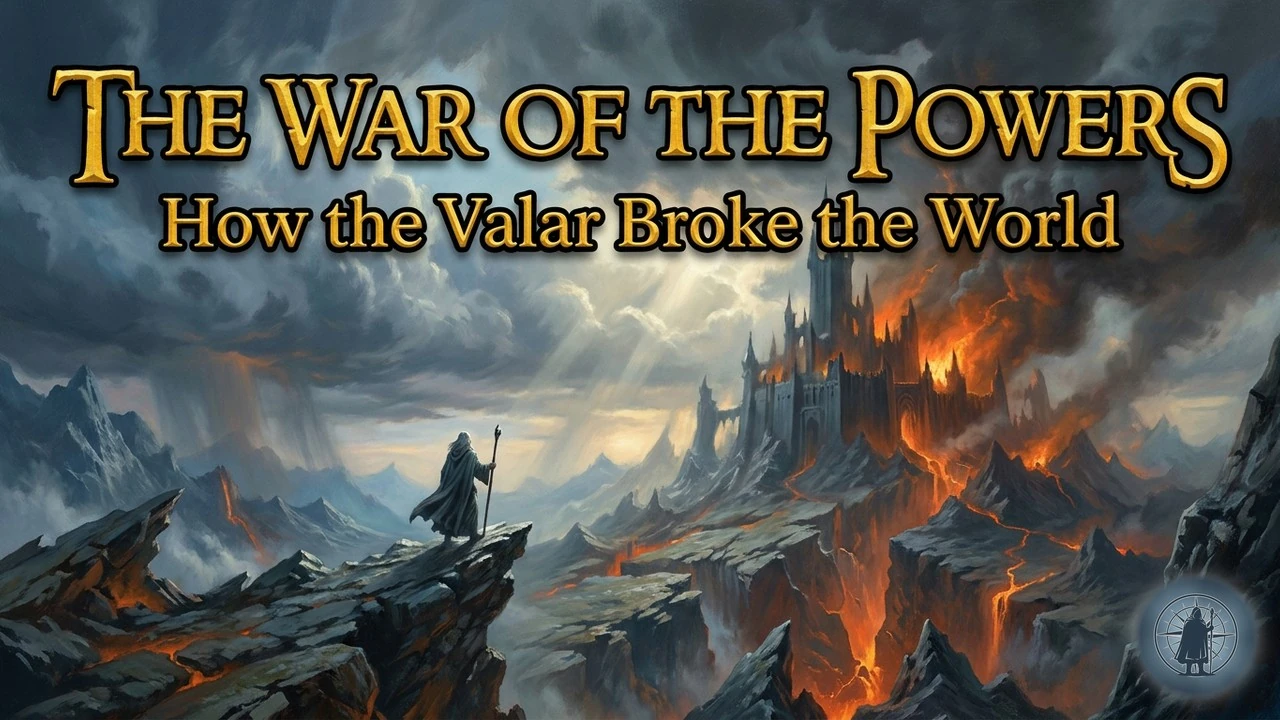 Watch the episode
War of the Powers: How Tulkas Captured Melkor | Silmarillion Explained
Watch the episode
War of the Powers: How Tulkas Captured Melkor | Silmarillion Explained
Main Narrative: The War of the Powers — When the Valar Broke the World to Save the Elves
There is a moment, very early in the history of Arda, when the gods of Tolkien's world march out of their western paradise in armed force. They cross the sea. They walk east across a continent they have not seen in an age. And for ten years they tear the north of Middle-earth apart in the first true war the world has ever known.
When it is over, the strongest of them throws their enemy face-down in a black pit beneath the world, and a smith locks a chain around his neck.
[IMAGE_CUE: A host of luminous, vast figures marching east across a dim continent under a sky full of new stars; ahead of them, a black mountain range smoking from underground fires, epic mythic concept art with cool blues and silvers in the host, deep reds in the distant fortress]
And then they let him go.
This is Ranger of the Realms. I'm going to tell you about the war that broke the world to save the Elves — the campaign that gave us the map of Middle-earth as we know it, the imprisonment that should have ended evil forever, and the single act of grace that made the entire First Age inevitable.
Because here is the strange thing about the War of the Powers. Tolkien tells us it was won. The gates of Utumno are broken. The halls are unroofed. Melkor is chained. The text says so plainly: "the world had peace for a long age."
And yet every tragedy you have ever read in this mythology — the death of the Two Trees, the theft of the Silmarils, the murder of Finwë, the Kinslaying at Alqualondë, the crossing of the Helcaraxë, the fall of Gondolin, the curse of Túrin — every single one of them is a downstream consequence of how this war ended.
The victory was real. So was the wound it left.
SECTION: A Council the King Did Not Want
To understand the War of the Powers, you have to understand who didn't want to fight it.
Manwë, King of the Valar, ruler of the winds, viceroy of Eru on Arda — Manwë did not want this war. The Valar had already broken the world once. In the earliest age, when the Two Lamps of Illuin and Ormal stood on their pillars at the north and south of Middle-earth, Melkor had cast them down. The light was lost. The seas rose in tumult. The symmetry of the continents was lost forever, and the Valar withdrew across the western sea to Aman to build a second paradise where Melkor could not reach them.
That was the lesson the Valar had carried for an age: open war with a fellow Ainu ruins the world for the Children who will live in it. So they waited. They watched. They built Valinor and lit the Two Trees and let Melkor have the dark continent to himself.
[IMAGE_CUE: Manwë seated on a high throne of pale stone on the summit of Taniquetil, eagles around him, looking east across a vast sea toward a distant dark continent, mythic painterly style, dawn light]
And then Oromë the Huntsman rode east on his great horse Nahar, into the wild lands of the world, and at the eastern shore of a great inland sea called Helcar, by a starlit water called Cuiviénen, he found something the Valar had been waiting for since the Music of the Ainur.
He found the Elves.
The Firstborn. The Children of Ilúvatar. Awakened under stars no Vala had hung, in a part of the world the gods had abandoned.
And he also found something else. He found that Melkor had found them first.
The corruption had already begun. Some of the Elves at the edges of Cuiviénen had been taken into the dark — dragged underground, broken by what the text calls "slow arts of cruelty," and remade into the first Orcs. The Children of Ilúvatar were being hunted, and twisted, and weaponized against themselves, while the gods who were supposed to be their stewards held council in Valinor and debated whether to act.
When Oromë returned and laid this before the throne, the council split. Yavanna, the Giver of Fruits, the Vala whose entire being is the flourishing of life, demanded action. Oromë, who had walked among the awakened Elves and seen the fear in their faces, demanded action. The argument that had held for an age — we must not war among ourselves, we will tear the world apart — collapsed against a simpler argument. The Children are awake. The Enemy is among them.
And so Manwë — the King who had spent that whole age trying not to fight this war — summoned the Valar to the Ring of Doom, and declared that they would, in the words of the Silmarillion, "at whatsoever cost, once again wage war on Melkor to retake mastery of Arda and deliver the Elves from his shadow."
Hear that phrasing. At whatsoever cost. That is not the language of a king choosing a campaign. That is the language of a king who has been overruled by necessity, by moral pressure, by the simple unavoidable fact that the alternative is worse.
The war of the Powers begins, in other words, with a Vala who would rather not.
That detail matters. Because the whole shape of what comes next is set by it.
SECTION: The Champion Who Laughed
Among the Valar who would now march east, there was one who had not been with them at the beginning.
He had come late. The Valaquenta puts it plainly. "He came last to Arda, to aid the Valar in the first battles with Melkor." Eru Ilúvatar had sent him specifically for this. The Music of the Ainur, the great theme that designed the world, had a Vala-shaped slot in it whose only purpose was to fight the first wars against the Enemy.
His name was Tulkas. He was surnamed Astaldo — the Valiant.
[IMAGE_CUE: A golden-bearded Vala, ruddy-skinned, immense, standing barefoot on dark stone with no armor and no weapon, just open hands, mythic concept art with a sense of stillness and contained power, warm golden light]
Tolkien gives him an unusual set of attributes. He has no horse, because he can outrun anything that runs on legs. He has no weapon, because his weapons are his hands. He is not, the text says with quiet honesty, useful as a counsellor. He has little patience for the past or the future. He is not a planner. He is not a strategist. He is what you bring when planning and strategy have already failed.
And then there is the detail that, when you sit with it, is genuinely strange.
Tulkas laughs.
He laughs in sport. He laughs in war. The Valaquenta says he laughed in the face of Melkor "in battles before the Elves were born." Not laughed after he won. Not laughed to keep up morale. Laughed during. In the middle of the fight, looking at the mightiest of the Ainur, the marrer of the Music itself — Tulkas thought that was funny.
And the text tells us, very specifically, that Melkor could not bear it.
In the early age, when Tulkas first arrived in Arda, Melkor fled before him. The Silmarillion doesn't say Melkor fled from his strength alone. It says he "fled before his wrath and his laughter."
The laughter is named. The laughter is part of the weapon.
This is one of the most distinctive theological moves Tolkien ever makes. Evil, in his mythology, is not defeated by superior darkness. It is not defeated by being more frightening than the frightening thing. It is defeated by a force evil literally cannot generate. Melkor can make terror. He can make domination. He can make ruin. But he cannot make joy. And joy, when it walks into the room as a physical being with golden hair and bare fists, undoes him from the inside.
This is the champion the Valar are bringing. Not a general. Not a wise counsellor. A laughing wrestler whose existence the Enemy finds intolerable.
When the Valar cross from Aman, Tulkas walks at the head of the host.
SECTION: Why a Vala Could Throw Down a God
Now we have to stop and answer an objection, because if you've been paying attention, you should be raising it.
Melkor was the mightiest of the Ainur. The Music of the Ainur is explicit about this. He had been given the greatest portion of Eru's gifts, "the greatest in power and knowledge, and he had a share in all the gifts of his brethren." He was, by design, more powerful than Manwë. More powerful than Aulë. More powerful, in his pure original nature, than Tulkas.
So how does a wrestling match end with him face-down on a stone floor?
Tolkien spent the last years of his life writing essays trying to work out the answer, and they are some of the most fascinating documents in the legendarium. The fullest version is in the volume Christopher Tolkien titled Morgoth's Ring. The argument runs like this.
[IMAGE_CUE: A dark continent seen from above, glowing veins of red and shadow running through the rock and the seas and the very air, as though the land itself were threaded with something malign, abstract mythic cartography with a sense of pervasive corruption]
Melkor, from the moment he entered Arda, had been pouring himself into the matter of the world. Not metaphorically. Literally. The corruption he worked into the rocks, into the rivers, into the seas, into the very air — that corruption was not free. It cost him. Every act of marring extracted a portion of his being and seeded it into Creation. The mountains he twisted carried a piece of him. The waters he poisoned carried a piece of him. The Orcs he made out of broken Elves carried, in their distorted flesh, a piece of him.
By the time the Valar marched on Utumno, this process had been running for ages. And Tolkien gives us a single sentence that captures the result. "The whole of Middle-earth was Morgoth's Ring."
Pause on that. Centuries before Sauron would forge the One Ring and pour his power into a circle of gold — centuries before — Melkor had done the same thing with an entire continent. He had taken his own being and bled it into the world. The world had become his vessel. The world had become his Ring.
And that was his strategic victory. By the time Tulkas walked into the deepest pit of Utumno, Middle-earth was permanently corrupted at the level of its physical substance. No future age could ever scour it clean, because the corruption had stopped being something Melkor did and started being something the world was.
But it was also his personal defeat. Because everything he had poured into the matter of Arda was no longer in him.
The Music of the Ainur had made him the mightiest. By the time of this war, the mightiest had spent himself. The person of Melkor, standing in his own fortress, was a hollowed-out version of what he had been at the beginning of the world. The accounts even say that when Manwë descended into Utumno and looked upon his brother, he was astonished — astonished at how much of Melkor's power had passed into the world, and how little was left in the figure he was looking at.
This is why a Vala could wrestle him to the ground. Tulkas had not spent himself. Tulkas was, in his person, undivided and undiluted. Melkor was a ghost of his own original might.
He had traded the war for the wound. And the wound would last forever.
SECTION: Long and Grievous — The Siege and the Pit
So the Valar march. They cross the sea from Aman to the shores of Middle-earth, and they move east through a world the Children at Cuiviénen cannot see them in. The Valar set a guard around the Water of Awakening so that the Elves who are the entire reason for this war will witness almost nothing of it. They will see, at most, distant fire on the northern horizon and feel the ground tremble. Their first generation will hear thunder they cannot interpret, coming from a war fought in their name by powers they do not yet know.
Tolkien gives us, on the war itself, exactly one sentence of detail.
"Long and grievous was the siege of Utumno, and many battles were fought before its gates of which naught but the rumour is known to the Elves."
[IMAGE_CUE: Black iron gates set into the side of a vast smoking mountain, ringed by a besieging host of bright armored figures, fire flickering in the gate vents, mythic siege imagery with extreme scale contrast]
That is all we get. Ten years, by the most careful reckoning. A decade of warfare on a scale no later war in the legendarium will ever match, because the combatants on both sides are Ainur — beings of pure power clothed in physical form, throwing mountains at each other, calling down the elements, opening the earth. The land of the north of Middle-earth is being rewritten in real time by what is happening at those gates. And Tolkien refuses to narrate it. He gives us the noun — siege — the adjectives — long, grievous — and then he steps back, because the people for whom this story is being told, the Elves, do not know the details. The narrator's distance is the Elves' distance.
What we do know is how it ends.
At last the gates of Utumno are broken. The halls are unroofed — the upper architecture is wrenched open to the sky, and the sky over the north of Middle-earth, in that moment, is the first thing to look down into Melkor's fortress in an age. And Melkor, the marrer, the mightiest of the Ainur in original gift, retreats. He goes down. Into the deepest pit beneath his own underworld, where the floors are black stone and no light has ever reached.
And Tulkas follows him.
There is no description of the fight. The Silmarillion gives it to us in a single sentence: "Then Tulkas stood forth as champion of the Valar and wrestled with him, and cast him upon his face."
Cast him upon his face. The mightiest of the Ainur, pressed face-down on the floor of his own deepest hall by a laughing Vala who has no weapon but his hands.
And then Aulë comes forward, the Smith, the maker of mountains, and he closes around Melkor's neck a chain. It has a name. Angainor — in the older drafts, Angaino, "the oppressor." It is wrought of iron, but it is more than iron. The earlier accounts say it is an alloy of six metals — copper, silver, tin, lead, iron, and gold — a chain composed of all the substances of the earth, as if Aulë had bound into one shape every honest material the world contains, to bind the being who had corrupted them all.
[IMAGE_CUE: A vast shadow-form pressed face-down on black stone in a cavern lit only by a faint forge-glow, a golden-bearded figure kneeling on its back, a third figure closing a luminous many-metaled chain around its neck, dramatic mythic chiaroscuro]
They lead him out. The Silmarillion does not linger on the procession, but the image is one of the most striking in the whole legendarium. The Lord of the Discord, the Enemy who had marred the Music itself, dragged in chains across a battlefield of his own ruin, north to south, then west across the sea, then through the gates of Valinor — and finally to the Ring of Doom, where the Valar's high court would pronounce his sentence.
The text concludes the chapter with a phrase that, on a first reading, sounds like a happy ending: "and the world had peace for a long age."
And it did.
But the Silmarillion already knows what is coming, because two paragraphs later it says something else.
SECTION: A World Re-Made by the Fight
Before we get to the sentence — before we get to what the Valar did with their prisoner — we need to look at what they did to the world to take him.
Because the War of the Powers is the second time Arda is broken.
The first time was the fall of the Lamps, ages earlier — Melkor's act, not the Valar's. When Illuin and Ormal came crashing down, their light spilled across Middle-earth in destroying flame. The Spring of Arda ended. The symmetry of the continents was lost. Two great inland seas — Helcar in the northeast, Ringil in the southwest — formed in the hollows where the lamp-pillars had stood. The world that was supposed to be a symmetrical, balanced thing of light and water became an asymmetric, scarred place.
The Valar withdrew west and let it heal in darkness. It did not fully heal.
[IMAGE_CUE: A before-and-after view of Arda from high above — left side showing a balanced, symmetric world with two great pillars of light, right side showing the same world after both lamps have fallen, asymmetric continents and inland seas, scarred and dimmer, mythic cartographic style]
And now, an age later, the Valar themselves are doing the same kind of damage. They are tearing the north of Middle-earth open to drag Melkor out of his hole. The early cosmological essays Tolkien wrote — gathered in the volume called The Shaping of Middle-earth — even include maps showing what the continent looked like before this war and after.
The Yellow Mountains, which had marched across the southern half of Middle-earth, are gone. The Mountains of the Wind are gone. The Great Gulf opens between what will become Beleriand and the lands to the south, splitting the continent. The Iron Mountains in the far north — the great wall Melkor had thrown up to defend his fortress — remain as a vast scar across the top of the world, and they will become the spine of every later war Morgoth fights from this part of the continent. The whole geography of the First Age, the whole map the Noldor will fight across when they return to Middle-earth, is being created in this decade by the Valar tearing the world open.
And here is the heartbreaking part. The Sea of Helcar, on whose eastern shore the Elves had awakened, the water by which they had taken their first words and seen their first stars — that sea will, in the centuries after the war, drain away. The seismic violence of the campaign cracks the basin. The water finds new paths. The Cuiviénen of the Children's awakening will, by the time the Noldor return to Middle-earth, be a memory and a rumor, with not even the lake left behind.
The Valar saved the Elves and dismantled the cradle.
Tolkien is unambiguous about what this means. The text says of the earlier breaking, the fall of the Lamps, that "the symmetry of the lands and seas... were never after restored." The War of the Powers finishes that sentence. It does not just confirm the asymmetry; it deepens it, ruptures it, makes it permanent.
Every map of Middle-earth in every later age — the map at the front of The Lord of the Rings, the map of Beleriand at the front of the Silmarillion, the maps the channel has put on screen in dozens of episodes — every one of them is, in the deepest sense, the war's tombstone. The continent itself is the corpse of this campaign. The shape of the world you have memorized is the shape this war left behind.
SECTION: What They Left in the Dark
Now we come to the part of the chapter that has, in my view, no equal in the legendarium for sheer narrative consequence. It is a short paragraph. It comes immediately after the chain is fastened and the prisoner led away. And it changes everything that follows.
"Nonetheless the Valar did not discover all the mighty vaults and caverns hidden with deceit far under the fortresses of Angband and Utumno. Many evil things still lingered there, and others were dispersed and fled into the dark and roamed in the waste places of the world, awaiting a more evil hour; and Sauron they did not find."
And Sauron they did not find.
Eight words. The most consequential sentence in the entire Silmarillion outside of the Music itself. Because of those eight words, the Second Age happens. Because of those eight words, the One Ring is forged. Because of those eight words, Númenor falls into the sea. Because of those eight words, Frodo Baggins walks out of the Shire.
[IMAGE_CUE: A single set of dark footprints leading deeper into the unswept halls of a ruined underground fortress, a faint trail of shadow stretching into blackness, while in the distance behind the figure, a host of bright Valar leads away their chained prisoner without looking back, mythic concept art with deep contrast]
The Valar had won the battle. They had broken the gates and unroofed the halls and pinned the King of Discord and chained him in iron and led him away. And while they did all of that, his lieutenant — the most talented of his Maiar, the one being in his service who fully understood what Melkor had been trying to do and how he had tried to do it — slipped out of the wreckage and disappeared.
We are not told how. We are not told whether he was at Angband when the western wing fell. We are not told whether he hid in the deep vaults the Valar never searched. We are not told whether he fled across the broken north while their attention was on the prisoner. Tolkien does not tell us, because the Elves whose memory this account preserves did not know, because the people of Aman from whom the Elves learned this story did not say, and because — I suspect — the gods themselves did not know. He was just gone.
And he was not the only one.
The Balrogs survived. The Maiar of fire and shadow whom Melkor had corrupted at the beginning — they were not at Utumno when the Valar broke its gates, or they slipped away when the gates broke, or they retreated into the unsearched vaults. They went to ground, somewhere in the deep places of the world, and they stayed there. For three ages of the Trees, they did not stir. They were waiting. And when Morgoth eventually walked back out of Mandos a free Vala, they came out with him.
One of them, you may remember, will still be hiding in a deep place several ages later, when a fellowship of nine walks into the mines of Moria.
This was not the grace mistake. This was a different mistake, and we should be clear about it. The pardon comes next — that's the choice Manwë makes deliberately, with the prisoner kneeling in chains at the Ring of Doom. But this — the unsearched vaults, the missed lieutenant, the hibernating fire-Maiar — this is not a deliberate moral choice. This is the simpler failure of incomplete victory. The Valar were tired. The Valar were horrified at what they had done to the world. The Valar had their prisoner and they wanted to be done. So they left the vaults sealed but not searched, and they sailed back west, and the dark places kept their inhabitants.
Tolkien is precise about this in a way that is easy to miss. He does not write that the Valar destroyed Utumno. He writes that the gates were broken and the halls unroofed. The structure remained. The lower vaults remained. The seals remained, in the sense that no one alive in the next several ages had any business going in there — but the structure, the cavities, the capacity of evil to have a home in the world remained. The Third Age's Dol Guldur, Sauron's Mordor, the deep places where the Balrog of Moria slept, the architecture of every later horror in the legendarium — all of it descends, in a real and traceable way, from the catacombs the Valar were too hurried to clear.
It is the first inheritance the saved generation will receive without knowing it. Their world has unswept basements.
SECTION: The Mercy and the Price
Which brings us, at last, to the choice itself.
Melkor is brought to the Ring of Doom — the high court of the Valar, a great open ring of stone in the heart of Valinor where all decisions of consequence are made. He kneels in the chain Angainor. The Valar sit in their thrones around him. Manwë speaks.
[IMAGE_CUE: A vast open ring of pale stones under a starlit sky in Valinor, fourteen luminous figures seated on great thrones around the circumference, a single chained shadow-figure kneeling in the center, mythic painterly composition with strong vertical light]
The sentence is three ages. The Halls of Mandos. The fastness, as the text calls it, "whence none can escape, neither Vala, nor Elf, nor mortal Man." And then — and this is the part the entire First Age hinges on — and then "he would be brought before Manwë once more" to face the question of his repentance.
Three ages. With the door open at the end.
Now. Why?
Why not death? Why not eternal binding? Why not — and this is the question Tolkien's readers have asked for seventy years — why not just end him?
Tolkien answers this in two places, and the answers are different but not contradictory. The first answer is metaphysical. The Ainur are not naturally killable in the way mortal things are killable. Their being is rooted in the realm beyond Arda. What you can do to them is limited.
The second answer is the one that matters, and Tolkien gives it in Chapter Six of the Silmarillion, looking back on this exact moment.
"For Manwë was free from evil and could not comprehend it, and he knew that in the beginning, in the thought of Ilúvatar, Melkor had been even as he; and he saw not to the depths of Melkor's heart, and did not perceive that all love had departed from him forever."
Read the structure of that sentence. Manwë was free from evil and could not comprehend it. The goodness of the King is not, in Tolkien's mythology, a quality that makes him wise. It is a structural limitation. A being who has never wanted to dominate, who has never wanted to corrupt, who has never wanted to mar — that being lacks the equipment to model a will whose only remaining motive is those things.
Manwë looks at Melkor in chains and remembers what Melkor was at the beginning of the Music. He remembers that Melkor was, originally, his brother. He cannot model a brother who has rotted out so completely from the inside that no love remains. So he opens the door. Three ages. And then we will see.
It is not stupidity. It is a moral logic Tolkien is deeply serious about. Judgment without the possibility of repentance, in his theology, is not justice. It is something colder than justice. It is the closing of a door Eru himself, in the Music, had left open. Manwë will not close that door, because closing it would make him into a smaller version of the thing he is judging — a being who decides, in advance, that another being cannot change.
So the door stays open. Three ages. And Mandos takes the prisoner away.
Three ages of the Trees pass. By the precise reckoning given in the late text known as the Annals of Aman, that is roughly three thousand solar years — long enough for the Elves to make the Great Journey from Cuiviénen to the western sea, long enough for some of them to refuse the journey and become the Avari, long enough for the Vanyar and Noldor and Teleri to be sundered from one another, long enough for the cities of Tirion and Alqualondë and Valmar to be built, long enough for Fëanor to be born and to grow and to begin his work in the forges. The whole interior architecture of the First Age — the kingdoms, the rivalries, the family of Finwë — exists because three ages were given as the term of a sentence.
At the end of those three ages, Melkor is brought before Manwë again, as the original sentence required. He kneels in feigned humility. He says all the right things. He says that he has repented, that he wants only to serve, that his heart is changed.
And Manwë — who cannot comprehend evil, who is constitutionally unable to model a being who would lie about repentance — believes him.
The text notes one detail, almost in passing. "Nienna aided his prayer, but Mandos was silent."
Nienna, the Lady of Pity, the Vala whose entire being is compassion, supports the pardon. Mandos, the Doomsman, the keeper of the Halls, the one Vala in the legendarium whose office is specifically to know the fates of beings — Mandos says nothing. Neither for, nor against. Just silent.
It is one of the quietest narrative cues in the Silmarillion, and it is devastating. The being whose job is to know what is going to happen does not endorse the pardon. He does not oppose it. He simply does not speak. And the King, looking only at compassion on one side and silence on the other, opens the door.
Melkor walks free into Valinor.
Within a hundred Valian Years — less than a thousand solar years — the Two Trees are dead. Ungoliant has drained them of their light. Finwë, High King of the Noldor, has been murdered at the doors of his own treasury. The Silmarils have been stolen. The Noldor have sworn an oath that will damn their House for an age. Melkor, now and forever called Morgoth, the Black Enemy, is back across the sea in his rebuilt fortress of Angband, where the Balrogs have been waiting for him all this time in the dark, and the First Age has begun.
Every tragedy that follows — the Kinslaying at Alqualondë, the burning of the swan-ships, the crossing of the Helcaraxë and the dead it claims, the long defeat of the Eldar in the wars of Beleriand, the fall of Gondolin, the breaking of Doriath, the doom of the children of Húrin, the destruction of the very continent of Beleriand itself in the War of Wrath at the end of the age — every one of those is a downstream effect of the door Manwë opened at the Ring of Doom.
And here is the thing about Tolkien that you have to sit with, because it is the deepest pattern in his whole imagination.
He never says the mercy was wrong.
He shows you the price. He counts the dead. He lets you watch the Trees die and Finwë fall and the Noldor curse themselves and the ice swallow the host on the Helcaraxë. He gives you the long defeat in detail. And he never, not once, in any of the texts, says that Manwë should have closed the door.
Because in his theology, the door is not a strategic decision. The door is what goodness is. A king who would not have opened it would not have been a worse king. He would have been a different kind of being entirely — a being whose justice was no longer justice but something colder. The price of having Manwë on the throne is that Manwë will open the door. That is the deal.
The First Age is the price of that deal.
And — this is the part you should hold in your mind alongside the cost — Tolkien also gives us, ages later, the other half of the same pattern. Bilbo, in a dark tunnel under the Misty Mountains, spares Gollum's life when he could have killed him. Gandalf, in Bag End, defends that mercy when Frodo questions it: "Pity? It was Pity that stayed his hand." Frodo, on the slopes of Mount Doom, spares Gollum again. And the same kind of grace that destroyed Valinor in the First Age destroys the Ring in the Third.
Same shape. Opposite outcome.
Tolkien lets the contradiction stand. He does not tell you that mercy is always vindicated. He does not tell you that pity is always catastrophic. He shows you both — at the cosmic scale, in this war and its aftermath, and at the small scale, in a hobbit's choice in a dark tunnel — and he leaves you to live in the space between.
The Valar broke the world to save the Elves. They won the war. They chained the Enemy. And then, because of who they were and could not stop being, they opened the door at the end of three ages — and the saving they had bought with the world's bones became the ruin of everything they had loved.
The cradle drained. The Trees died. The Silmarils burned. And the children at Cuiviénen, the ones for whom the gods had crossed the sea — they walked west into a paradise that, by the time their grandchildren reached it, was already counting down to its own undoing.