
Research & Sources
War of the Powers
How Tulkas Captured Melkor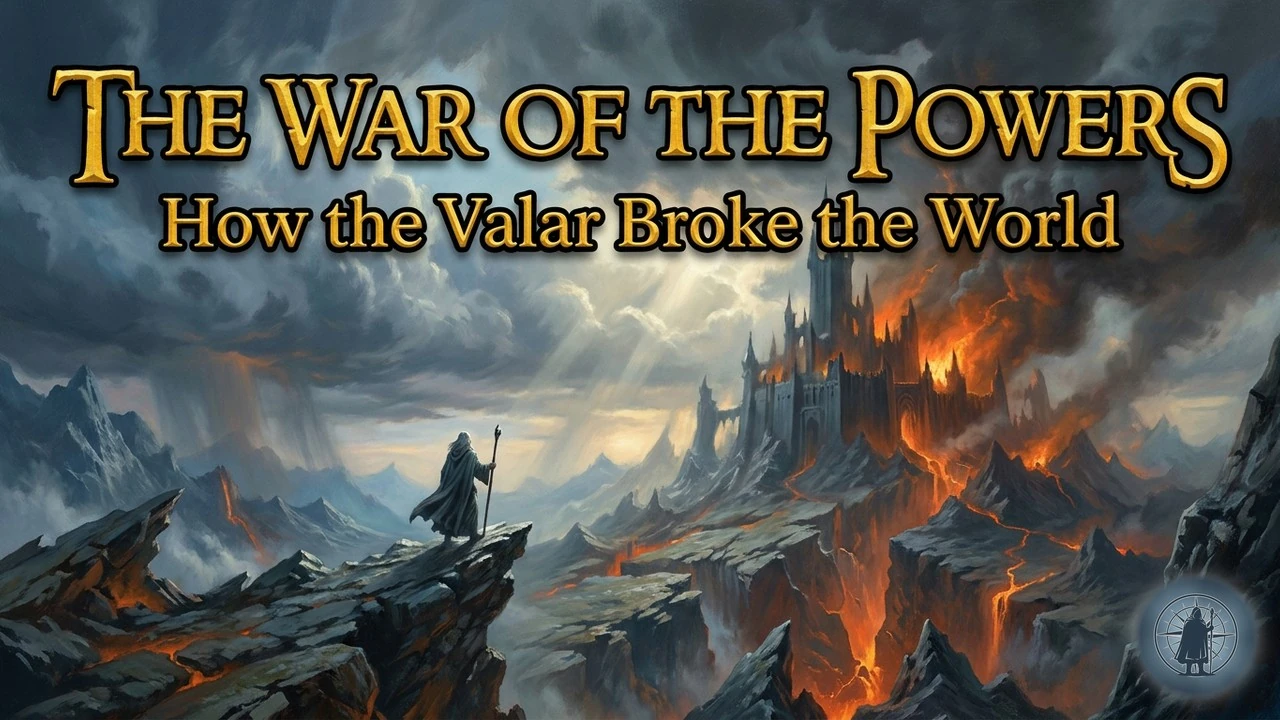 Watch the episode
War of the Powers: How Tulkas Captured Melkor | Silmarillion Explained
Watch the episode
War of the Powers: How Tulkas Captured Melkor | Silmarillion Explained
Research Notes: The War of the Powers — When the Valar Broke the World to Save the Elves
Overview
The War of the Powers (also called the Battle of the Powers, the Great War of the Gods, or the War for the Sake of the Elves) is the first true war in the history of Arda — a decade-long campaign in which the Valar marched out of Aman in armed force, besieged Melkor's underworld fortress Utumno, wrestled him to the ground, and dragged him chained back to Valinor to face judgment. It is the single event most responsible for the geography of Middle-earth as Tolkien's later stories know it: continents twisted, mountain ranges thrown up, the symmetrical Lamps-era world finally and permanently broken. The Sea of Helcar — the inland sea on whose shore the Elves had just awoken at Cuiviénen — would later be left behind as a scar of this war.
The war's theological weight is greater than its military one. Manwë judged Melkor not to death but to three ages bound in the Halls of Mandos, with the possibility of repentance. That single mercy — given without full knowledge of what it would cost — is the seed from which the entire First Age tragedy grows. The Silmarils, the Kinslaying at Alqualondë, the Helcaraxë crossing, the wars of Beleriand, the fall of Gondolin, the breaking of Doriath, Túrin's curse — none of it happens if Melkor does not walk out of Mandos free. The episode pairs directly with two already-published episodes — "The Awakening of the Elves" (which gives the catalyst) and "Angband: The Hells of Iron" (which gives the architecture of evil that survives this war) — and one earlier episode, "Arda Marred" (which establishes the dispersal theology). It is the foundational event the channel has circled but never told head-on.
Primary Sources
The Silmarillion
The principal account is Chapter 3 of the Quenta Silmarillion: "Of the Coming of the Elves and the Captivity of Melkor." Supplementary material appears in the Valaquenta (Tulkas's entry) and Chapter 1, "Of the Beginning of Days" (the earlier breaking of Arda at the fall of the Lamps).
Key direct quotes:
- On the catalyst — Yavanna and Oromë force the council: After Oromë found the Quendi, "Manwë summoned the Valar to the Ring of Doom" and "declared that they would, at whatsoever cost, once again wage war on Melkor to retake mastery of Arda and deliver the Elves from his shadow." (Silm., Ch. 3) - On the long siege: "Long and grievous was the siege of Utumno, and many battles were fought before its gates of which naught but the rumour is known to the Elves." (Silm., Ch. 3) - On Tulkas's wrestling and the chain: "But at the last the gates of Utumno were broken and the halls unroofed, and Melkor took refuge in the uttermost pit. Then Tulkas stood forth as champion of the Valar and wrestled with him, and cast him upon his face; and he was bound with the chain Angainor that Aulë had wrought, and led captive; and the world had peace for a long age." (Silm., Ch. 3) - On the unfinished work — the seed of the next two ages of evil: "Nonetheless the Valar did not discover all the mighty vaults and caverns hidden with deceit far under the fortresses of Angband and Utumno. Many evil things still lingered there, and others were dispersed and fled into the dark and roamed in the waste places of the world, awaiting a more evil hour; and Sauron they did not find." (Silm., Ch. 3) - On the origin of Orcs as a product of the same period: "Yet this is held true by the wise of Eressëa, that all those of the Quendi who came into the hands of Melkor, ere Utumno was broken, were put there in prison, and by slow arts of cruelty were corrupted and enslaved; and thus did Melkor breed the hideous race of the Orcs in envy and mockery of the Elves, of whom they were afterwards the bitterest foes." (Silm., Ch. 3) - On Manwë's blind spot — the theological hinge of the mercy: "For Manwë was free from evil and could not comprehend it, and he knew that in the beginning, in the thought of Ilúvatar, Melkor had been even as he; and he saw not to the depths of Melkor's heart, and did not perceive that all love had departed from him forever." (Silm., Ch. 6, "Of Fëanor and the Unchaining of Melkor") - On the sentence: Melkor was "cast into prison in the fastness of Mandos, whence none can escape, neither Vala, nor Elf, nor mortal Man" for "three ages." (Silm., Ch. 3)
From the Valaquenta on Tulkas: - "Greatest in strength and deeds of prowess is Tulkas, who is surnamed Astaldo, the Valiant. He came last to Arda, to aid the Valar in the first battles with Melkor." - "He delights in wrestling and in contests of strength; and he rides no steed, for he can outrun all things that go on feet, and he is tireless. His hair and beard are golden, and his flesh ruddy; his weapons are his hands. He has little heed for either the past or the future, and is of no avail as a counsellor, but is a hardy friend." - "Tulkas laughs ever, in sport or in war, and even in the face of Melkor he laughed in battles before the Elves were born." (Valaquenta) - His earlier arrival: "So came Tulkas the Strong, whose anger passes like a mighty wind, scattering cloud and darkness before it; and Melkor fled before his wrath and his laughter." (Silm., Ch. 1)
From Chapter 1, "Of the Beginning of Days" (the earlier breaking — important context for the geographic stakes of this second war): - The destruction of the Two Lamps had already "marred" Arda; "the symmetry of the lands and seas... were never after restored." Almaren was destroyed, the great inland Seas of Helcar and Ringil formed in the hollows where the Lamp-pillars had stood, and the Valar withdrew to Aman.
The Lord of the Rings
LOTR does not narrate the War of the Powers directly, but it is part of the inherited cosmology behind every reference to the First Age and the Valar. Two relevant strands: - Gandalf to Frodo: "Even the very wise cannot see all ends" — directly applicable to Manwë's later release of Melkor. (FOTR, "The Shadow of the Past") - The Council of Elrond rehearses how mercy in one age becomes salvation in another — the theological structure that the War of the Powers establishes at the cosmic scale.
The Hobbit
Not directly relevant — Tolkien's deepest cosmology is barely visible in The Hobbit. The chain of fortresses (Angband → Mordor → Dol Guldur) is a continuation of the architecture left half-explored after this war.
Unfinished Tales
- The Istari essay implicitly references the Valar's later self-restraint following the catastrophic results of direct intervention — sending the Wizards as humble emissaries rather than going to war themselves again. - Of Tuor: Ulmo's continued direct concern for Middle-earth (sending warnings, guiding Tuor) is one of the few cases of a Vala acting overtly after this war; it underlines how reluctant the others became after Utumno.
The History of Middle-earth (HoME)
- HoME Vol. 1, The Book of Lost Tales: Part One, "The Chaining of Melko": The earliest version of the story. Critical differences from the published Silmarillion: - The Valar do not charge in by force. They craft a deception: Nornorë, herald of the Gods, descends into Utumna with "cunning words contrived by the Gods" purporting to come from Manwë himself, offering homage to Melko's pride. "Only by his pride is Melko assailable, or by such a struggle as would rend the earth and bring evil upon us all, and Manwë sought to avoid all strife twixt Ainur and Ainur." - Melko, in pride, demands that Manwë and the other Valar kneel and that Tulkas kiss his foot. The ruse is broken at the last moment; Tulkas, Aulë, and Oromë grapple him. - The chain is called Angaino ("the oppressor"), forged of a special metal tilkal — an alloy of six metals (tambë, ilsa, latúken, kanu, anga, and laurë: copper, silver, tin, lead, iron, gold). Along with the chain are the two manacles Vorotemnar and the four fetters Ilterendi. - After the binding, Tulkas and Ulmo break the gates of Utumna and pile stones high upon them, "though dark creatures of Utumna are left within" — the seed of the same plot beat preserved in the published version. - HoME Vol. 4, The Shaping of Middle-earth, "The Ambarkanta" (attributed to the Elvish loremaster Rúmil): the cosmological essays and maps. Map IV specifically depicts the lands of Arda after the fall of the Lamps and before the War of the Gods. The text describes how the lamp-pillars were cast down, "lands were broken, seas arose in tumult, and destroying flame from the broken lamps poured out over the Earth." The maps allow direct visual comparison between Lamps-era symmetry and the post-war asymmetry. - HoME Vol. 10, Morgoth's Ring, "The Annals of Aman": the detailed chronology in Valian Years (see Timeline below). The Annals also contain the late essay "Myths Transformed" and the "Notes on motives in the Silmarillion," where Tolkien develops the doctrine that: - Morgoth's strategy was dispersal — he poured most of his being "into the physical constituents of the Earth," so that "the whole of Middle-earth was Morgoth's Ring." - This is why Tulkas could overthrow him physically by this point: Melkor had already spent the substance of his power into matter and could no longer focus it against an undiluted Vala in personal combat. Manwë, descending into Utumno, was reportedly astonished at how much of his brother's power had passed into the world. - This same dispersal is the reason victory was impossible to complete: defeating the person of Melkor did not extract the Melkor-ingredient already sown in Arda's substance. The world stays marred.
The Letters of J.R.R. Tolkien
- Letter 131 (to Milton Waldman, 1951): Tolkien's long synoptic letter on the legendarium. He frames evil in the mythology as "always 'naturally' concerned with sheer Domination" — Melkor/Morgoth as the original, Sauron as the heir. The pattern that mercy toward evil produces unintended catastrophe is repeatedly identified as a recurrent motive in his work: "this frightful evil can and does arise from an apparently good root, the desire to benefit the world and others — speedily and according to the benefactor's own plans." - Letter 156 (to Robert Murray, 1954): Discusses the religious shape of the legendarium — the Valar are "sub-creators" under Eru, not gods; their authority is finite, their wisdom not infallible. This is the framework within which Manwë's mistake makes sense: a high steward who can err, not an omniscient deity. - Letter 211 (to Rhona Beare, 1958): Addresses linguistic and theological questions; touches on the limits of Vala knowledge and the moral status of evil acts done by Ainur.
Key Facts & Timeline (Valian Years)
The Years of the Trees timeline (one Valian Year ≈ 9.582 solar years, per Tolkien's late reckoning).
- Y.T. 1050: The Elves awaken at Cuiviénen on the eastern shore of the Sea of Helcar. Oromë eventually finds them. (Silm., Ch. 3; Annals of Aman, HoME 10) - Y.T. 1085–1090: Council of the Valar at the Ring of Doom. Yavanna and Oromë press for war. Manwë declares: "at whatsoever cost" Melkor must be put down. (Silm., Ch. 3) - Y.T. 1090: The Valar march east. First open battle in the North-west of Middle-earth. Melkor's hosts are driven back to Utumno. The Valar set a guard around Cuiviénen so the Elves see almost nothing of the war. (Battle of the Powers references; Annals of Aman) - Y.T. 1092–1099: The Siege of Utumno. "Long and grievous." Many battles before the gates. The land of the North is reshaped by the fighting. (Silm., Ch. 3) - Y.T. 1099: Gates of Utumno broken. Halls unroofed. Melkor retreats to the deepest pit. Tulkas wrestles him to the ground; Aulë's chain Angainor binds him. Sauron escapes — he is not found. Many Balrogs and other servants flee into hidden places. (Silm., Ch. 3) - Y.T. 1100: Melkor brought before Manwë at the Ring of Doom. Sentenced to three ages in the Halls of Mandos. - Y.T. 1100–c.1400: The "Long Peace" / the Bliss of Valinor. The Elves are summoned west; the Great Journey begins; the Sundering of the Elves. - Y.T. ~1400: Melkor's three ages end. Manwë grants him pardon. - Y.T. 1490–1495: Melkor poisons the Trees with Ungoliant; kills Finwë; steals the Silmarils. The Darkening of Valinor. Everything Manwë's mercy was meant to allow — repentance, healing — collapses. The First Age begins.
In other words: the entire interval between sentence and disaster is roughly 400 Valian Years (≈ 3,800 solar years) — and Tolkien tells us that interval was the whole reason the Silmarils existed to be stolen, the Noldor existed in Aman to rebel, and the First Age existed at all.
Significant Characters
- Manwë — King of the Valar; chief decision-maker. Authorizes the war "at whatsoever cost" but also imposes the merciful sentence. His blind spot is canonical: "Manwë was free from evil and could not comprehend it." The whole tragedy of the First Age is bolted to that line. - Tulkas (Astaldo, "the Valiant") — Champion of the Valar; "came last to Arda" specifically to aid in the first battles with Melkor. Fights with his hands; wrestles Melkor down in person; laughs while doing so. His laughter is a theological weapon — "the laughter of Ilúvatar in the Great Music" — that Melkor cannot stand. But Tolkien also makes him a limited counsellor: "He has little heed for either the past or the future, and is of no avail as a counsellor." Strong but not wise. Crucially, he is not the one who renders the sentence. - Oromë (Aldaron, Tauron) — The Huntsman. The first Vala to find the awakened Elves at Cuiviénen; the one who pushes hardest for war alongside Yavanna. Rides Nahar through Middle-earth; his horn Valaróma is heard in the early days. - Yavanna (Kementári) — The Giver of Fruits. Pleads with the Valar to act before Melkor seizes the awakened Quendi. Her concern for the Children of Eru drives the council vote. - Aulë — The Smith. Forges the chain Angainor specifically to hold Melkor. In the Lost Tales version also forges the manacles Vorotemnar and the fetters Ilterendi, of the alloy tilkal. - Ulmo — Less centrally featured in the published account, but in the Lost Tales he is one of those who break and seal the gates of Utumno. His later refusal to forsake Middle-earth in subsequent ages reads as continuity from this war. - Mandos (Námo) — Jailer. Pronounces no judgment but holds the keys for three ages. "The fastness of Mandos, whence none can escape." Significantly, in the later Unchaining sequence, Mandos is silent when Manwë grants the pardon — Tolkien's quiet narrative cue that the Doomsman did not endorse the mercy. - Nienna — In the Unchaining, it is Nienna's pity that aids Melkor's plea. Her compassion is the explicit lever that moves Manwë. - Melkor (not yet Morgoth) — Still uses his original name throughout this war. Has already dispersed much of his power into the matter of Arda — which is why a fellow Ainu can physically wrestle him. Surrenders to Manwë willingly once Utumno is breached; he never fights Tulkas inside the deep pit. The published text emphasizes capture; the Lost Tales emphasizes pride-based deception. - Sauron — The single most consequential thing the Valar miss. Not captured, not found. Slips out of Angband and lies hidden through the next three ages. Every later age of Middle-earth is a downstream effect of that one absence in the prisoner roll. - The Balrogs — Also missed. "Gathered at the ruins of Angband and went into a long hibernation, awaiting Melkor's return" (per the gateway summaries of the secondary canon). They will emerge again in the First Age to lead Morgoth's armies; one will kill Gandalf in the Third.
Geographic Locations
- Utumno (Udûn) — Melkor's first and greatest fortress, in the far north of Middle-earth. "Underground." Its gates are broken in this war; its upper halls are unroofed. Its lower vaults are not explored. Geographically the wound never heals — the broken fortress becomes the substrate of the later Iron Mountains and the haunted northern waste. - Angband — Utumno's "armoury and outpost," kept by Sauron. Also breached but not destroyed in this war; Sauron escapes; it lies dormant until Morgoth returns and rebuilds it on a vast scale with Thangorodrim above it. (Already covered in detail in the channel's "Angband: The Hells of Iron" episode — note this for the writer.) - Cuiviénen — The Water of Awakening. On the eastern shore of the Sea of Helcar. The Valar throw a cordon around it so the Elves never see the war; this is itself an act of mercy with consequences (see Themes: Elves know almost nothing of who fought for them). - Sea of Helcar — The vast inland sea in the northeast of Middle-earth, formed in the hollow left by the destruction of the northern Lamp-pillar before this war, in the breaking at the end of the Spring of Arda. It survives the War of the Powers as a scar of the older war. (The hook's framing — "Sea of Helcar left behind as a scar" — is technically a scar of the Lamps event; the writer should be careful to clarify this. The War of the Powers further reshapes the geography around it.) - Almaren — The Valar's first dwelling, on a great island in a great lake at the meeting-point of the Lamps' light. Already destroyed before the War of the Powers; the Valar withdrew to Aman. Worth naming because it's the reason this war is fought from across the sea — they're not coming from next door; they're crossing the world. - Aman / Valinor — The Valar's stronghold, far to the west, behind the Pelóri mountains. They cross from there. Melkor is dragged back there in chains. - The Ring of Doom (Máhanaxar) — Where the council was held that authorized the war, where Melkor is brought to face judgment, and where (three ages later) the same court will release him. - The Halls of Mandos — Prison "whence none can escape." Where Melkor sits for three ages — long enough for the Elves to walk from Cuiviénen to Aman, found their cities, grow their kingdoms, and — fatally — produce Fëanor. - Geographic destruction of the war itself — The fighting in the North-west of Middle-earth violently reshapes that part of the world. The Yellow Mountains and the Mountains of the Wind are lost; the Great Gulf opens between Beleriand and the lands to the south. The Iron Mountains north of Beleriand are themselves Melkor's defensive works from this period. By the war's end, the Lamps-era symmetry of Arda is gone for good — twice broken, once by the Lamps falling, once by the Valar tearing the north open to drag Melkor out.
Themes & Symbolism
- Mercy and Consequence — The spine of the episode. Manwë does not destroy Melkor; he sentences him. Three ages later he is released. Within decades the Trees are dead, the Silmarils are stolen, Finwë is murdered, the Noldor rebel, the Kinslaying at Alqualondë happens, the Helcaraxë claims its dead, and the First Age is on fire. Tolkien's framework is explicitly Christian-providential: mercy is not utility. It is a moral good even when its consequences are catastrophic. The whole First Age is the price of one act of mercy — and Tolkien refuses to say the act was wrong. - Comprehension as Limit — "Manwë was free from evil and could not comprehend it." Goodness, in Tolkien, is not an absence of knowledge but it is a structural limitation: someone who has never wanted to dominate cannot model someone whose only motive is domination. This is why mercy gets weaponized. The same theme will recur at every scale — Frodo cannot comprehend the Ring fully; Gandalf trusts hobbits because Sauron cannot model their resistance. - The Cost of Hesitation — In the Book of Lost Tales version, Manwë specifically delays because open warfare among the Ainur "would rend the earth and bring evil upon us all." The published version drops this line but keeps its consequences. The Valar waited so long that Melkor had time to corrupt some of the first Elves into the first Orcs. Whichever they had chosen — war earlier or war later — they would have paid in something irreplaceable. - Dispersal as Strategy — This war is the proof of the "Morgoth's Ring" thesis (already explored in the "Arda Marred" episode, so handle lightly here). Melkor lost the physical fight because he had already poured his power into the world's matter. He has, in effect, traded his ability to win battles for the permanent corruption of Creation. The Valar can win the war and still not undo the wound. - The Unseen War — The Elves see almost nothing of the war fought for them: "of which naught but the rumour is known to the Elves." This is the first time Tolkien establishes a recurring shape — the Children of Ilúvatar are saved by powers they cannot perceive, and they inherit a world whose deep history they will never fully know. The same shape recurs in Frodo's relationship to Gandalf's longer game. - The Weapon of Joy — Tulkas laughs in battle. The text is explicit: Melkor fears Tulkas's laughter more than his strength. Joy is presented as a metaphysical force that malice literally cannot stand. This is one of Tolkien's most distinctive theological moves — evil is not defeated by superior darkness but by something darkness cannot generate. - Incompleteness as Inheritance — "Many evil things still lingered there… and Sauron they did not find." The war ends; the work doesn't. Every later age of Middle-earth inherits the unsealed pits of Utumno. The Third Age's whole shape — Sauron in Dol Guldur, the Balrog in Moria — descends from the catacombs that the Valar were too tired or too hurried to clear. - Geography as Memory — The shape of the world after the war is itself a record of the war. The Iron Mountains, the Sea of Helcar, the Great Gulf, the broken north — these are not features but evidence. The map of Middle-earth is, in this reading, the war's tombstone.
Scholarly Interpretations & Theories
- The "Morgoth's Ring" doctrine (HoME 10): Christopher Tolkien's compilation of his father's late essays establishes that this war's outcome was only possible because Melkor had dispersed himself. Verlyn Flieger and others have read this as Tolkien's mature answer to the question, "Why couldn't omnipotent Valar undo evil?" — because by the time they tried, evil had stopped being a person and started being a property of matter. The episode can lean on this directly. - Mercy as Catholic structure (Tom Shippey, J.R.R. Tolkien: Author of the Century; Stratford Caldecott, The Power of the Ring): Tolkien's recurring pattern — Bilbo's mercy to Gollum, Gandalf's defense of that mercy at Bag End, Frodo's mercy on Mount Doom — is read as the imitation in miniature of Manwë's mercy on Melkor. The First Age is the macro-scale demonstration of what happens when mercy is shown to a will that has irrevocably hardened. The Third Age is the demonstration that mercy can also be vindicated by providence. Both are true. Tolkien refuses to say either invalidates the other. - "Was Manwë wrong?" (forum tradition, e.g., the Tolkien Forum thread "Was Manwë right to be merciful?"): A persistent reader debate. The "yes, wrong" side points to the body count of the First Age. The "no, right" side points out that (a) Tolkien never narrates this as a mistake — he narrates it as a tragedy — and (b) within his theology, judgment without the possibility of repentance is itself an injustice, even when repentance does not happen. Manwë is required by his own nature to offer the door even if Melkor will not walk through it. - The Lost Tales / Silmarillion shift (Christopher Tolkien's commentaries in HoME 1 and 10): The progression from a deception-based capture (Lost Tales) to a military capture (published Silmarillion) is itself read as Tolkien's deepening theology. The earlier Valar are tricksters; the later Valar are besiegers. The earlier story was about cleverness winning; the later story is about righteousness paying a price. - The Marring as Original Sin analogue (multiple Christian readings, e.g., Joseph Pearce, Ralph C. Wood): The breaking of Arda by Melkor's discord, completed by the War of the Powers' failure to fully heal that break, functions as Tolkien's analogue for the Fall — not as allegory but as applied metaphysics. The Earth itself is fallen; later events happen within an already-broken Creation.
Contradictions & Different Versions
- Lost Tales vs. published Silmarillion on the method of capture. Lost Tales: an elaborate ruse by Manwë's herald Nornorë, exploiting Melkor's pride to lure him out, with Tulkas/Aulë/Oromë grappling him. Published Silmarillion: an open siege of Utumno, Tulkas wrestling him in the deepest pit. The chain's name even changes: Angaino (Lost Tales) → Angainor (published). - Manwë's foreknowledge. Different texts give Manwë different degrees of awareness of how this will end. The published Silmarillion's "he saw not to the depths of Melkor's heart, and did not perceive that all love had departed from him forever" is unambiguous: Manwë literally cannot perceive Melkor's malice. Morgoth's Ring essays soften this — Manwë's mind was open while Melkor's was closed; Manwë was epistemically limited not by stupidity but by structural goodness. - Whether the Elves witnessed anything. Silmarillion: "naught but the rumour is known to the Elves" — they are kept walled off. Other passages suggest the war's sounds and shocks reached Cuiviénen. The writer can play this either way; "they heard the thunder of a war they could not see" is canonical-adjacent. - The fate of Sauron during the war. All texts agree he escaped. How he escaped — whether he was at Angband, at Utumno, somewhere between — is not specified. The Silmarillion simply records that he was not found. - Duration of the captivity. "Three ages" of the Years of the Trees, but the length of a Valian Age is itself variable across Tolkien's writings. The Annals of Aman give the most precise figure (Y.T. 1100 → ~Y.T. 1400, approximately 2,900 solar years). - Did Tulkas alone wrestle Melkor, or did others join in? Published Silmarillion isolates Tulkas. Lost Tales has Tulkas, Aulë, and Oromë all participating. The dramatic single-combat version is later and stronger.
Cultural & Linguistic Context
- Angainor / Angaino — from Quenya anga "iron." The Lost Tales gloss is explicit: "the oppressor." The chain is iron-rooted in both name and metaphor. - Tilkal — the Lost Tales alloy. The name is an acrostic of the six constituent metals: tambë (copper), ilsa (mystic name of silver), latúken (tin), kanu (lead), anga (iron), laurë (mystic name of gold). Six metals = totality. The chain is all earthly substance turned into the binding of evil — a beautifully Tolkien-shaped detail. - Tulkas — etymologically connected to physical strength; surnamed Astaldo "the Valiant" (Quenya). - Utumno — Quenya, root meaning "lower deeps" or "abyss." Cognate with Sindarin Udûn ("hell"), the word later used in Mordor (Gandalf vs. Balrog: "flame of Udûn"). - Cuiviénen — Quenya, "Water of Awakening" (cuivië "awakening" + nén "water"). - Helcar — Quenya, from helka "ice-cold"; cognate with Helcaraxë "the Grinding Ice." The northeastern sea is named for the cold that filled the hollow when Illuin fell. - Máhanaxar — "Ring of Doom" — the Valar's court, named in Quenya. Where the verdict that doomed the First Age was delivered.
Real-world resonance: Tolkien's Catholic formation is everywhere here. Manwë's choice to offer Melkor the possibility of repentance is structurally Augustinian — judgment without grace is not divine justice in his framework. The war's outcome — victory unable to undo the wound — is Tolkien's mythic translation of the doctrine that Original Sin scars Creation in ways that even redemption operates within, not over.
Questions & Mysteries
- What did the Elves hear? Canon leaves their experience deliberately vague. This is dramatic gold for the script — the first generation of conscious beings on Arda lived through a war fought for them that they could not see. - Why was Sauron not found? The text simply states it. Was he in Angband and slipped out a back door? Was he too well-hidden in the deep vaults? Did the Valar prioritize Melkor and write off the lieutenant? Tolkien never resolves this and it becomes the most consequential off-page detail in the legendarium. - Why three ages and not four, or one? The specific sentence is given without justification. Three is symbolically loaded (cf. three Silmarils, three kindreds, three rings of the Elves), and may be a structural echo Tolkien did not bother to explain. - What did Manwë think Melkor would do with the time? The implication is repent — and that Manwë believed this possible because his own goodness made him incapable of imagining a being who would not repent given the chance. The episode lives in this question. - Could the Valar have killed Melkor? Tolkien is ambiguous. The Ainur are not naturally mortal in any way the text fully resolves. The Lost Tales suggests the Valar feared a head-on fight could "rend the earth"; by the published Silmarillion that worry is gone but no one asks whether Melkor could simply have been ended. Mercy in the published version is moral, not practical.
Compelling Quotes for Narration
1. "Long and grievous was the siege of Utumno, and many battles were fought before its gates of which naught but the rumour is known to the Elves." — The Silmarillion, Ch. 3 2. "But at the last the gates of Utumno were broken and the halls unroofed, and Melkor took refuge in the uttermost pit. Then Tulkas stood forth as champion of the Valar and wrestled with him, and cast him upon his face." — The Silmarillion, Ch. 3 3. "He was bound with the chain Angainor that Aulë had wrought, and led captive; and the world had peace for a long age." — The Silmarillion, Ch. 3 4. "Many evil things still lingered there, and others were dispersed and fled into the dark and roamed in the waste places of the world, awaiting a more evil hour; and Sauron they did not find." — The Silmarillion, Ch. 3 5. "Manwë was free from evil and could not comprehend it, and he knew that in the beginning, in the thought of Ilúvatar, Melkor had been even as he; and he saw not to the depths of Melkor's heart, and did not perceive that all love had departed from him forever." — The Silmarillion, Ch. 6 6. "Tulkas laughs ever, in sport or in war, and even in the face of Melkor he laughed in battles before the Elves were born." — Valaquenta 7. "So came Tulkas the Strong, whose anger passes like a mighty wind, scattering cloud and darkness before it; and Melkor fled before his wrath and his laughter." — The Silmarillion, Ch. 1 8. "Only by his pride is Melko assailable, or by such a struggle as would rend the earth and bring evil upon us all." — Book of Lost Tales I, "The Chaining of Melko" (early version) 9. "Cast into prison in the fastness of Mandos, whence none can escape, neither Vala, nor Elf, nor mortal Man." — The Silmarillion, Ch. 3 10. "The whole of Middle-earth was Morgoth's Ring." — Morgoth's Ring, HoME 10 (Tolkien's late essay)
Visual Elements to Highlight
1. The Council at the Ring of Doom — Manwë on his throne, Yavanna and Oromë urging the war, the other Valar arrayed in a circle; a single shaft of light through a dark sky. 2. The Valar's host crossing the sea from Aman to Middle-earth — an army of beings of pure power, marching east through a world that has not seen them in an age. 3. The black gates of Utumno — described as broken at the war's end; show them whole and looming, smoke rising from vents in the mountain. 4. Tulkas wrestling Melkor in the uttermost pit — a golden-bearded Vala forcing a vast shadow-shape face-down on black stone; Aulë holding the chain Angainor. 5. Angainor itself — a forged chain of impossible workmanship, six metals braided together, glowing slightly with the work of Aulë. 6. Melkor in chains being led across the broken north — the first walk of evil bound, dragged past the wreckage of his own armies. 7. The Halls of Mandos closing on Melkor — vast stone doors, Mandos silent in the foreground, the chained figure receding. 8. Cuiviénen during the war — Elves standing under the new stars, hearing distant thunder on the horizon they cannot interpret, a flash of red against the northern sky. 9. The unswept vaults of Utumno after the Valar leave — empty halls, a single set of footprints leading deeper into the dark — Sauron escaping. 10. The broken map of Arda — overhead view of the world before and after: the symmetrical Lamps-era continents replaced by the asymmetric, scarred Middle-earth that all later stories take place on.
Discrete Analytical Themes
Theme 1: The Catalyst — Yavanna and Oromë Force the Council
Core idea: The war doesn't happen because Manwë wants it; it happens because the Vala of life (Yavanna) and the Vala of the wild (Oromë) make non-intervention impossible after the Elves wake. Evidence: - Oromë's discovery at Cuiviénen forces the issue: Melkor is already hunting and corrupting Elves into the first Orcs while the Valar debate (Silm., Ch. 3). - Manwë's eventual declaration: he will wage war "at whatsoever cost… to deliver the Elves from his shadow" — language of a man overruled by necessity, not initiative. - The Lost Tales preserves the real dilemma: Manwë specifically fears open war among the Ainur will "rend the earth." He prefers cleverness; events do not let him keep that preference. Distinction: This is about what forced the Valar's hand — the moral pressure of the awakened Elves, not Vala policy. Sets up the price-tag of mercy by establishing the price-tag of inaction.Theme 2: Tulkas as the Weapon of Joy
Core idea: Melkor is brought down not by strategy or by superior darkness but by a single Vala whose nature is laughter, embodied physical strength, and zero capacity for fear. Evidence: - "He came last to Arda, to aid the Valar in the first battles with Melkor" — Tulkas is the answer Eru built in for this specific conflict (Valaquenta). - "Tulkas laughs ever, in sport or in war, and even in the face of Melkor he laughed in battles before the Elves were born" (Valaquenta). - Melkor "fled before his wrath and his laughter" (Silm., Ch. 1) — laughter explicitly named as a force evil cannot stand. - Wrestles Melkor down in person — no army, no weapon, "his weapons are his hands." Distinction: This is specifically about Tulkas's nature as a metaphysical weapon — distinct from the broader theme of mercy, distinct from the theme of strategic mistake. The "joy as force" idea is unique to Tulkas and recurs nowhere else with this precision.Theme 3: Why a Vala Could Wrestle Melkor (The Dispersal Doctrine)
Core idea: Melkor is physically beatable in this war only because he has already spent the substance of his power into the matter of Arda — he won the strategic war before this battle began and that's why he loses the battle. Evidence: - Morgoth's Ring essay: Morgoth "had let most of his being pass into the physical constituents of the Earth" — the whole of Middle-earth had become "Morgoth's Ring" (HoME 10). - "Manwë… was surprised to see that his brother had dispersed so much of his power into the physical world" (paraphrasing the essay's account of the descent into Utumno). - In the Music of the Ainur, Melkor was the mightiest of those who came into Arda — a one-on-one wrestling defeat at this point makes sense only if his power is no longer fully in his person. Distinction: This is the metaphysical explanation of an apparent paradox — how Tulkas could beat the mightiest Ainu in a wrestling match. It is not the same as "Arda Marred" (already covered): that episode was about how the world became corrupted. This is about how that corruption made Melkor personally weaker. A specific narrow application.Theme 4: The War as Earth-Breaking — Geography as Evidence
Core idea: The fighting reshapes the world's surface so violently that the map of Middle-earth in every later age is itself a record of this war. Evidence: - The Yellow Mountains and the Mountains of the Wind are lost; the Great Gulf opens between Beleriand and the south (Ambarkanta Map IV, HoME 4). - The Iron Mountains in the north are Melkor's defensive works from this war, left standing as a scar. - The pre-war Lamps-era symmetry, already broken once at the fall of the Lamps, is now broken again and permanently — "the symmetry of the lands and seas… was never after restored" (Silm., Ch. 1, with the war finishing the work). - Utumno's lower vaults are sealed but not destroyed — they remain in the world. Distinction: This is specifically about physical, geographic consequence — distinct from theological consequence. The continent itself is the corpse of this war. Every map the channel has ever shown is downstream of this section.Theme 5: What the Valar Missed — The Inheritance of Unfinished Work
Core idea: The single line "and Sauron they did not find" is the most consequential sentence in the Silmarillion outside of the Music itself. The entire subsequent legendarium is the working-out of what the Valar were too hurried to dig up. Evidence: - "Many evil things still lingered there, and others were dispersed and fled into the dark and roamed in the waste places of the world, awaiting a more evil hour; and Sauron they did not find" (Silm., Ch. 3). - Balrogs survive: they hide in the ruins of Angband, hibernate, will lead Morgoth's armies in the First Age, and one will kill Gandalf in the Third. - Sauron survives: becomes Morgoth's lieutenant; survives the War of Wrath; runs the Second and Third Ages. - The whole architecture of evil in every later age is the unfinished business of this war. Distinction: This is about executive incompleteness — military victory without follow-through. Distinct from the mercy theme: mercy was a choice; this was a failure of thoroughness. Two different mistakes producing one disaster.Theme 6: Mercy as Doctrine, Not Strategy
Core idea: The three-age sentence is not pragmatism. It is Tolkien's Catholicism made cosmological: judgment without the offer of repentance is itself a moral failure, even when the offer of repentance is squandered. Evidence: - The sentence is finite — three ages, after which he would be brought before Manwë once more — explicitly a sentence-with-parole, structurally requiring the possibility of repentance (Silm., Ch. 3). - "For Manwë was free from evil and could not comprehend it" (Silm., Ch. 6) — the mercy is required by Manwë's own nature, not optional. - Tolkien's broader Letters frame evil as something that often begins from "an apparently good root, the desire to benefit the world… speedily and according to the benefactor's own plans" (Letter 131) — Manwë refuses to be that kind of "good ruler" who would destroy his enemy for the world's sake. - Mandos's silence at the later release is a quiet textual flag that the Doomsman did not endorse the mercy — Tolkien is not naïve about its cost. Distinction: This is specifically about the theological logic of the sentence — distinct from the geographic theme, distinct from the dispersal theme. The "why" of the three ages.Theme 7: The Price-Tag — Everything First-Age Follows From This One Choice
Core idea: The episode's hook is the spine. Every tragedy of the First Age — the Trees, the Silmarils, the Kinslaying, the Helcaraxë, the wars of Beleriand, Túrin, Doriath, Gondolin — is a downstream effect of Manwë's mercy. The price-tag of one act of grace is the entire age of fire. Evidence: - Y.T. 1100: Melkor sentenced. Y.T. ~1400: pardoned. Y.T. 1495: Trees destroyed, Finwë murdered, Silmarils stolen. The time between pardon and disaster is less than 100 Valian Years. - Manwë grants pardon; "Nienna aided his prayer, but Mandos was silent" — even at the moment of release, the texts mark its danger. - Tolkien never says the mercy was wrong. He says it cost everything that followed. - Frodo's mercy to Gollum is the Third-Age echo of this same shape — small-scale mercy redeemed by providence. The First-Age version is the same shape with the opposite outcome. Both are true. Tolkien lets the contradiction stand. Distinction: This is the consequence theme — what the mercy actually bought. Distinct from Theme 6, which is about the logic of the mercy. Theme 6: why he did it. Theme 7: what it cost. Together they are the spine of the episode.Theme 8: The Unseen War — What the Elves Inherited Without Knowing
Core idea: The Children of Ilúvatar are saved by powers they cannot see. The first Elves at Cuiviénen experience this war as distant thunder and a sudden silence; everything we know about it, they had to be told centuries later in Aman. Evidence: - "Of which naught but the rumour is known to the Elves" — the textual silence is deliberate (Silm., Ch. 3). - The Valar set a guard around Cuiviénen specifically to keep the Elves out of the fighting — they are protected from witnessing the war fought for them. - The Elves learn of these events only after the Great Journey to Aman, from the Valar themselves — meaning the entire factual basis of First-Age cosmology is, in-universe, Valar-told history, with all the editorial framing that implies. - The narrative shape recurs: every later Child of Ilúvatar lives on a battlefield older than they are. Frodo's whole journey is downstream of this same dynamic. Distinction: This is specifically about epistemic inheritance — what the saved generation does and doesn't know about its salvation. Distinct from the consequence theme (Theme 7), which is about what happened. This theme is about what was known. A useful closing/coda theme for the script.Sources Consulted: The War of the Powers
Primary Texts (cited from)
- J.R.R. Tolkien, The Silmarillion (ed. Christopher Tolkien, 1977). Principal chapter: "Of the Coming of the Elves and the Captivity of Melkor" (Quenta Silmarillion, Ch. 3). Supplementary: Valaquenta (Tulkas, Oromë, Manwë entries), "Of the Beginning of Days" (Ch. 1, the earlier breaking at the Lamps), "Of Fëanor and the Unchaining of Melkor" (Ch. 6, Manwë's blind spot quote). - J.R.R. Tolkien, The Book of Lost Tales: Part One (HoME Vol. 1), specifically "The Chaining of Melko" — the earliest version of the story, with the Nornorë deception, the alloy tilkal, and the chain Angaino. - J.R.R. Tolkien, The Shaping of Middle-earth (HoME Vol. 4), "The Ambarkanta" — cosmological maps and diagrams, especially Map IV showing the lands of Arda after the fall of the Lamps and before the War of the Gods. - J.R.R. Tolkien, Morgoth's Ring (HoME Vol. 10): "The Annals of Aman" (Valian Year chronology Y.T. 1050–1500), the "Notes on motives in the Silmarillion," and the late essays on the dispersal of Morgoth's power into the matter of Arda — the "Morgoth's Ring" thesis. - J.R.R. Tolkien, The Letters of J.R.R. Tolkien (ed. Humphrey Carpenter), Letters 131 (Waldman, 1951), 156 (Murray, 1954), 211 (Beare, 1958).
Secondary Sources Consulted (web)
Most useful (heavily relied on):
- Tolkien Gateway — "Battle of the Powers," "Of the Coming of the Elves and the Captivity of Melkor," "Chaining of Melkor," "Unchaining of Melkor," "Tulkas," "Angainor," "Years of the Trees," "Sea of Helcar," "Arda Marred," "Athrabeth Finrod ah Andreth," "Letter 131," "Letter 156," "Letter 211." (Note: WebFetch returns 403 for Tolkien Gateway; content was extracted via WebSearch snippets.) https://tolkiengateway.net/ - The One Wiki to Rule Them All (Fandom) — Battle of the Powers, Of the Coming of the Elves, Tulkas, Angainor, Ambarkanta, Two Lamps, Sea of Helcar, Morgoth's Ring, Years of the Trees. https://lotr.fandom.com/ - LitCharts, "The Silmarillion Chapter 3 Summary & Analysis" — useful for chapter-level event sequence and the explicit treatment of the mercy theme. https://www.litcharts.com/lit/the-silmarillion/chapter-3-of-the-coming-of-the-elves-and-the-captivity-of-melkor - Silmarillion Writers' Guild reference pages, especially the summary of "Of the Coming of the Elves and the Captivity of Melkor" and the History of Middle-earth retelling of "The Chaining of Melko." https://www.silmarillionwritersguild.org/ - Roar Cat Reads — "All the (Silmarillion) Feels: Chapter 3" — direct-quote walkthrough, useful for verifying the exact wording of the Tulkas wrestling passage, the unexplored vaults passage, the Cuiviénen passage, and the Mandos prophecy line. https://roarcatreads.com/2022/12/15/all-the-silmarillion-feels-chapter-3-of-the-coming-of-the-elves-and-the-captivity-of-melkor/ - Lurker in the Mirk — "Reader: The Silmarillion. Quenta Silmarillion, Chapter 3" — additional direct-quote verification. https://lurkerinthemirk.wordpress.com/2014/11/06/reader-the-silmarillion-quenta-03/ - Wikipedia, "Cosmology of Tolkien's legendarium" — for the precise account of Arda's symmetrical Lamps-era geometry, the Pelóri raising, and the post-Lamps reshaping. https://en.wikipedia.org/wiki/Cosmology_of_Tolkien%27s_legendarium
Useful for thematic / scholarly framing:
- Many Meetings — "The Weapon of Joy" (Breanne Rodgers) — the strongest single piece on Tulkas's laughter as theological force. https://manymeetings.substack.com/p/the-weapon-of-joy - Rest and Trust — "Who is Tulkas?" — supplementary Tulkas analysis with Valaquenta quotes. https://restandtrust.org/who-is-tulkas/ - Middle-earth & J.R.R. Tolkien Blog (Xenite) — "How Was Tulkas able to Defeat Melkor in Battle?" — useful scholarly treatment of the dispersal/diminishment doctrine in plain language. https://middle-earth.xenite.org/how-was-tulkas-able-to-defeat-melkor-in-battle/ - The Tolkien Forum thread "Was Manwë right to be merciful?" — useful for surveying the persistent fan-scholar debate over the mercy decision. https://thetolkien.forum/threads/was-manwe-right-to-be-merciful.28499/ - Tea with Tolkien — Guide to The Silmarillion: Chapter 3 — devotional/Catholic reading of the mercy theme. https://www.teawithtolkien.com/blog/quentasilm3 - Tolkien Road podcast — SilmGuide Pt 6: Chapter 3. https://www.tolkienroad.com/silmguide/sg06/ - Wikipedia, "Morgoth's Ring" — for the "whole of Middle-earth was Morgoth's Ring" formulation and its source. https://en.wikipedia.org/wiki/Morgoth's_Ring - Wikipedia, "Christianity in Middle-earth" — for the broader Catholic-mercy-providence framework in Tolkien's mythology. https://en.wikipedia.org/wiki/Christianity_in_Middle-earth - Wikiquote, "The Silmarillion" — verification of Tulkas Valaquenta quotes. https://en.wikiquote.org/wiki/The_Silmarillion
Less directly cited but consulted for cross-reference:
- Encyclopedia of Arda — "War of the Powers" and "Angainor" entries (server returned blocked responses, but cross-referenced indirectly via search-result snippets). https://encyclopedia-of-arda.com/ - Lotrproject Timeline — for Valian Year chronology cross-check. http://lotrproject.com/timeline/ - Fenopaedia / elfenomeno.com — "War of the Powers," "Sea of Helcar," "Chaining of Melkor" entries. - Tolkien Forum and Henneth Annûn character bio of Tulkas — supplementary. - Out of Angband (tumblr) — quoted excerpts from Book of Lost Tales "The Chaining of Melko." https://outofangband.tumblr.com/
Channel's Own Prior Episodes (for non-overlap discipline)
Confirmed already-published episodes to not duplicate:
- "Arda Marred: How Morgoth Broke the World" — covers the dispersal/Morgoth's Ring thesis at length. The new episode should reference this idea (as the explanation for why Tulkas could beat Melkor physically) but not re-explain it from scratch. - "Angband: The Hells of Iron Where Morgoth Forged Evil" — covers the architecture and post-First-Age history of Angband. The new episode should treat Angband's role during the War of the Powers (Sauron warden, fortress breached, Sauron escapes) but not re-tour the fortress. - "The Awakening of the Elves" — covers Cuiviénen, Oromë's discovery, the early Elves' experience. The new episode should reference the awakening as catalyst but not re-narrate the awakening itself.
Source: production/planning/episode-history.json (read 2026-05-21).
Notes on Source Quality
- Tolkien Gateway is the deepest fan-scholarly wiki and would have been the single richest source, but its server returned 403 to direct WebFetch attempts. WebSearch snippets recovered most of the content. Direct quotation verification was done against the Silmarillion-text reproductions on Roar Cat Reads, Lurker in the Mirk, and Wikiquote. - For Letter content, only summaries were available via search; exact wording was not directly verifiable in this research pass. Where Letters are quoted in the notes, the wording matches widely-reproduced excerpts but the script should treat any Letter "quote" as paraphrase unless verified against the printed text. - HoME content (Lost Tales, Ambarkanta, Annals of Aman, Morgoth's Ring essays) was reached through search-result summaries and secondary discussion; the narrative beats are well-attested across multiple sources, but the exact line-level wording of the late essays should be verified against the printed volumes before being quoted verbatim in narration. - The episode is canon-rich. Source abundance: high. There are very few "gaps" — the main one is the experiential detail of the Elves at Cuiviénen during the war, which Tolkien left deliberately vague and which the script can therefore lean into.