Transcript
Who Were the Nine Ringwraiths?
 Watch the episode
Who Were the Nine Ringwraiths? | Only One Nazgûl Has a Name
Watch the episode
Who Were the Nine Ringwraiths? | Only One Nazgûl Has a Name
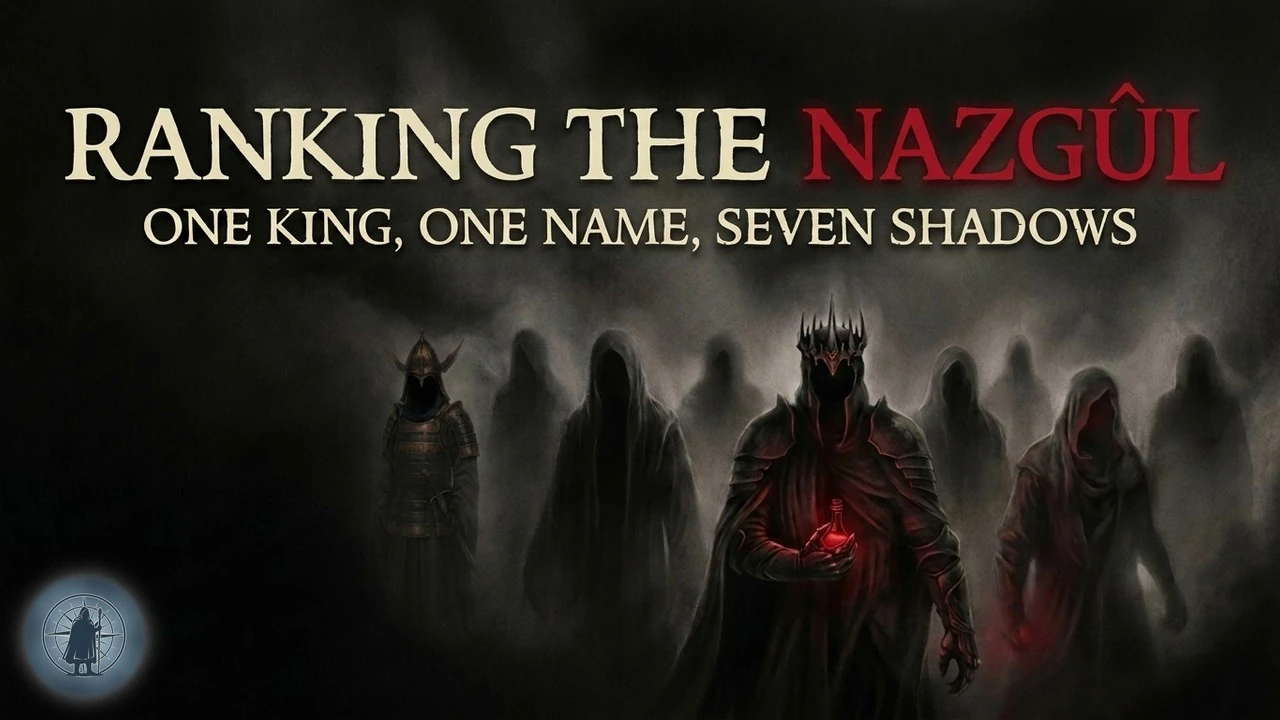
Main Narrative: The Nine Nazgûl Ranked — Why Only Two Have Names
SECTION: The Nine Names That Never Were
Ask a room of Tolkien fans to name the Nazgûl, and most can rattle off a surprising number. Dwar of Waw. Ûvatha the Horseman. Akhôrahil the Blind Sorcerer. Adûnaphel, the one who was once a woman. Ren the Unclean. Hoarmûrath of Dír. The names sound authentically Middle-earth — guttural, ancient, edged with menace. They appear on fan wikis, in forum arguments, on the tier-list videos this very episode is answering.
And almost none of them are real.
Here is the fact the whole ranking has to be built on, and it is stranger than the myth. In everything Tolkien wrote — the three volumes of The Lord of the Rings, its dense Appendices, The Silmarillion, Unfinished Tales, the Letters, the twelve volumes of the History of Middle-earth — he gave a personal name to exactly one of the Nine. One. His name was Khamûl, an Easterling, and he surfaces in a single passage of Unfinished Tales, in the chapter called "The Hunt for the Ring." There, describing where the Ringwraiths were posted on the eve of the War of the Ring, Tolkien writes of "the second to the Chief, Khamûl the Shadow of the East," who "abode in Dol Guldur as Sauron's lieutenant." That sentence is the sum of it. One name, dropped almost in passing, in a book Tolkien never finished and never published in his lifetime.
What about the Witch-king, you might ask — surely he counts? He does not, and the distinction matters more than it seems. "Witch-king" is a job. "Lord of the Nazgûl," "the Black Captain," "the Morgul-lord" — these are titles, ranks, the way you'd say "the General" or "the King." None of them is the name his mother gave him. That name, if it survived anywhere, Tolkien never set down. So the honest tally comes to one personal name and one title — and behind them, seven complete blanks.
Which raises the obvious question: where did Dwar and Ûvatha and all the rest come from?
The answer is a company called Iron Crown Enterprises. From 1982 to 1999, ICE held the license for Middle-earth Role Playing — MERP — a tabletop game that needed something Tolkien had refused to provide: statistics. You cannot run a game encounter against a villain with no name, no homeland, and no listed abilities. So ICE's writers built them. They invented nine full identities — names, native lands, backstories, even a female Nazgûl named Adûnaphel, "the Quiet Avenger." It was competent world-building, and it was never Tolkien's. But the game reached a generation of fans, the names leaked into wikis and later into video games, and the invention hardened into something that feels like canon. A large share of anyone watching this arrived believing the seven have names. They do not. And that gap — between the nine identities the fandom carries and the one Tolkien actually wrote — turns out to be the most interesting thing about them.
SECTION: What the Rings Actually Ate
So the seven have no names. The lazy explanation is that Tolkien simply never got around to it — a loose end, a gap in an unfinished mythology. But look closer at what these beings were, and a different reading takes hold. The missing names are not an oversight. They are the whole point.
Go back to the beginning of the story. The Nine Rings were given to nine mortal Men — and the crucial word in every account is mortal. In The Silmarillion, in the chapter "Of the Rings of Power and the Third Age," Tolkien describes what those Men were before the Rings took them: "kings, sorcerers, and warriors of old." Powerful men. Proud men. Men who already had everything the world hands its winners, and who reached for the one thing it withholds — time without end. The Rings gave it to them. And then, in one of the most quietly devastating sentences Tolkien ever wrote, the account turns: "They obtained glory and great wealth, yet it turned to their undoing. They had, as it seemed, unending life, yet life became unendurable to them."
Unendurable. The horror Tolkien is describing is precise — deathlessness without growth, life that merely continues. Elsewhere Gandalf puts it plainly: a mortal who keeps a Great Ring "does not die, but he does not grow or obtain more life, he merely continues, until at last every minute is a weariness." That is the trap the Nine walked into. Immortality, which every legend treats as the ultimate prize, is in Tolkien's hands a slow damnation — the Gift of Men, which is death itself, refused and perverted into an endless grey afternoon.
But the Rings took more than time. Follow the same Silmarillion passage to its end. One by one, it says, the bearers "fell under the thraldom of the ring that they bore and under the domination of the One... And they became for ever invisible save to him that wore the Ruling Ring, and they entered into the realm of shadows." First the body fades from sight. Then the will is taken — Letter 246 confirms that Sauron physically held the Nine Rings and "through their nine rings had primary control of their wills." What is left when your body is invisible, your life is weariness, and your very will belongs to someone else?
Nothing you could put a name to. A name is the last thing a self owns. It is the mark that says this one, and no other. Strip away the flesh, the years, the free will, and the personhood underneath, and there is nothing left for a name to attach to. Gandalf's phrase for them is exact and terrible: "shadows under his great Shadow." A shadow has a shape but no substance. It moves when the thing that casts it moves. The seven wraiths have no names for a plainer and darker reason. By the time they were Nazgûl, there was no one left to name. That is what the Rings hollowed out — the self at the center, until only a shape remained.
That idea changes what a "ranking" of these beings can even mean. We are about to rank nine shadows by how much of a self each one managed to keep.
SECTION: Tier One — The Composure of the Witch-king
At the top of any honest ranking stands the Witch-king of Angmar, and it is worth being precise about why — because the reason is more interesting than his rank.
Tolkien gives the Witch-king something he gives no other wraith: a specific, textual mark of superiority. It comes, again, from "The Hunt for the Ring" in Unfinished Tales, in a line describing how the Nazgûl behaved in the field. "All except the Witch-king," Tolkien writes, "were apt to stray when alone by daylight; and all, again save the Witch-king, feared water, and were unwilling, except in dire need, to enter it or to cross streams unless dryshod by a bridge."
Sit with how much that single sentence does. The other eight are diminished creatures. Put them alone in daylight and they wander, lose their purpose, drift. Bring them to a running stream and they balk like frightened animals, hunting for a bridge. These are the most terrible servants of the Enemy, and moving water unnerves them. The Witch-king alone is free of both failings. He does not stray in the sun. He does not fear the water. Whatever the Nine surrendered of themselves to the Rings, he held on to more of it than any of his brethren — more will, more composure, more of the cold executive command that lets a being function in the daylit world of the living.
A careful note, because this is where the tier-list videos go wrong: the text does not say sunlight would destroy the seven and spare him, or that water was harmless to him and lethal to them. It says the others strayed and feared, and he did not. This is a portrait of mastery, and mastery is the more impressive claim, because it is a statement about the man who was there before the wraith — the sheer strength of will he brought to the ring that consumed him.
That will has a résumé. Around the year 1300 of the Third Age, the Lord of the Nazgûl appeared in the far north and founded the realm of Angmar — the name is Sindarin for "iron-land" — with its fortress at Carn Dûm, built for one purpose: to destroy the successor-kingdoms of Arnor, the northern realm of Isildur's heirs. Over the next seven centuries he did precisely that. He broke Rhudaur and Cardolan, threw down the tower on Weathertop, and in the year 1975 shattered Arthedain and took its capital at Fornost. He lost the battle that followed — a host from Gondor and the Elf-lord Glorfindel routed his army — but the kingdom he had spent his existence to kill was already dead. Then he moved south, gathered the Nine, and around the year 2000 laid siege to Minas Ithil, the Tower of the Moon, and took it. It was renamed Minas Morgul, the Tower of Black Sorcery, and from its seat he ruled as the Morgul-lord. He later challenged the last King of Gondor to single combat, and when the king rode out to answer, he was never seen again — ending the line of the Kings of Gondor for a thousand years. This is the being at the top of the ranking. First among wraiths, yes — and more than that, a conqueror of kingdoms who happened to be dead.
SECTION: Tier Two — Khamûl, the One Named Shadow
Below the Witch-king, the ranking gets thin very fast — but for one slot, it holds. The clear second place belongs to Khamûl, and he earns it on three separate counts.
The first is the one we have already met: he is the only other wraith with a name. In a company of shadows, that alone is a kind of distinction. Tolkien did not name him idly — the name is placed exactly where rank is being discussed. "The second to the Chief," the passage says. When the Nine were deployed for the Third Age, six of them dwelt with the Witch-king in Minas Morgul, and Khamûl held the other great fortress alone: Dol Guldur, Sauron's stronghold in southern Mirkwood, where he "abode as Sauron's lieutenant, with one other as his messenger." Second-in-command, with his own command. No other wraith is placed like that.
The second count is who he was in life. Khamûl was an Easterling — a lord of the Men of Rhûn, the wide lands east of the Sea of Rhûn, beyond the maps most readers carry in their heads. His epithets lean on it: "the Shadow of the East," "the Black Easterling." It is a deliberate choice. His very name sits outside the Elvish tongues entirely; it belongs to no language Tolkien ever glossed, and that strangeness is the point. He is the Man from the East made permanent, the eastern threat given a face — or rather, given a name where a face should be.
The third count is a genuine, canon-supported ability. Christopher Tolkien's notes to "The Hunt for the Ring" record that Khamûl, of all the Nine after the Witch-king, was the most sensitive to the nearness of the Ruling Ring — able to feel its presence more keenly than any of his brethren. That makes him the natural choice for a hunt, and the text bears it out. When the Nazgûl crossed into the Shire in the autumn of 3018 searching for Baggins, it is Khamûl who is most often identified as the rider who came to Hobbiton — the Black Rider who leaned from his saddle and questioned the Gaffer at Bagshot Row, hissing after a hobbit he could sense but not quite locate. Be honest about the evidence here: Christopher Tolkien preserved several overlapping drafts of the Hunt, and they do not agree perfectly, so "Khamûl in the Shire" is the best-supported reading rather than an ironclad fact. But it fits the man exactly.
And it comes with the flaw that keeps him out of the top slot. That same superior Ring-sense was crippled by the very thing the Witch-king had conquered: daylight. Of all the Nazgûl, Khamûl was reportedly the most confused and diminished by the sun — his gift at its sharpest in darkness, blunted to near-blindness by day. Picture the hunt from his side. He can feel the Ring somewhere in the green folds of the Shire, closer than any of his brothers could sense it, and the daylight keeps smearing it out of reach. The most Ring-sensitive of the Nine, groping through exactly the conditions that undo him. He is Tier Two precisely because he is this pairing — a real gift shackled to a real weakness. Which is more than we can say about anyone below him, because below him the record simply goes dark.
SECTION: Tier Three — The Seven Shadows in the Dark
Here the ranking breaks — and it breaks in a way that turns out to be the truest thing the episode can show you.
Seven wraiths remain. And a ranking wants to do to them what it did to the first two: line them up, third through ninth, each with a trait, a homeland, a defining moment. It cannot. Tolkien left nothing to rank them with. Everything the legendarium says about these seven as individuals can be spoken in a single breath, and here it is. There is no third breath. There is no fourth.
What is known comes only in the plural, and only ever as position, never as person. We know the number: nine, always nine. We know that three of the Nine were, in the words that survive from the Akallabêth and the translator's notes, "great lords of Númenórean race" — men of the drowned island's blood, seduced by Sauron's rings in the long twilight of Númenor's fall. Which three? Unstated. We are not even told for certain whether the Witch-king was one of them; Tolkien guessed that he might be, and marked it as a guess. We know how they were arranged in the field: six as the Witch-king's companions in Minas Morgul, one as Khamûl's messenger at Dol Guldur. Count them — six and one — and you have seven. That is the entire individual census of the seven: a number, a heritage shared by three of them, and a seating chart. Six companions. One messenger. Positions in a formation, and that is all.
No names. No faces. No homelands but the vaguest — kings and sorcerers and warriors "of old," of the Mannish peoples of the East and the South. No histories, no last words, no single deed that belongs to one of them and not the others. When the seven ride, they ride as a number. When they fall, they fall as a number.
Section by section, this ranking has been quietly proving the theme it started with. The Witch-king kept the most of himself, and so the text can say the most about him. Khamûl kept less, and the text gives us less — one name, one gift, one flaw. The seven kept nothing, and so there is nothing to say. The amount Tolkien wrote about each wraith is a direct measure of how much self each one had left. The blank pages are the information. This is what total thraldom looks like from the outside — a gap in the record where a man used to be. The third tier is a single tier and not seven ranked slots for the same reason the seven have no names — because there is no longer anyone down there to tell apart.
SECTION: Fear, Not Force — and the Hands That Ended Him
All of which leaves one question that a ranking is obliged to answer. If these are the most terrible servants of the Enemy — and they are — what, exactly, makes them terrible? The answer surprises most people who first meet the Riders on screen.
Their power was never strength. Tolkien is blunt about this, and it comes from an unlikely place: an angry letter. In 1958, a screenwriter named Morton Grady Zimmerman sent Tolkien a proposed film treatment, and Tolkien wrote back — Letter 210 — tearing into its errors one by one. On the Black Riders, he is unambiguous: "Their peril is almost entirely due to the unreasoning fear which they inspire, like ghosts. They have no great physical power against the fearless." No great physical power. Their weapon is dread — the Black Breath, despair made contagious, the cold that empties the courage out of an army before a single blow lands. It is fear, weaponized and given nine mounts.
That is why they fight in the dark and why daylight matters so much to the ranking. Aragorn explains their sight on Weathertop: "They themselves do not see the world of light as we do... our shapes cast shadows in their minds, which only the noon sun destroys." They inhabit a different world — the wraith-world, a realm of dread and half-seen forms — and they drag their victims toward it. Against that, ordinary weapons do very little. But there is one thing the Nazgûl's whole arsenal cannot touch, and Letter 210 names it in four words: against the fearless. The despair only works if you despair. Refuse the fear, and the terror has nothing left to hold.
Which is exactly how the mightiest of the Nine meets his end — and the manner of it is Tolkien's deepest joke at evil's expense. Centuries before, the Elf-lord Glorfindel had spoken a prophecy over the Witch-king: "Far off yet is his doom, and not by the hand of man will he fall." For a thousand years the words hung over him like armor. No man could kill him. And on the Pelennor Fields, before the walls of Minas Tirith, he believed it to the last — "No living man may hinder me," he tells the small figure barring his path. The figure answers by pulling off a helm: "But no living man am I. You look upon a woman. Éowyn I am, Éomund's daughter." A woman of Rohan, who has refused the fear that broke a whole army — and beside her, unseen, a hobbit of the Shire, Meriadoc Brandybuck, who drives a Barrow-blade into the wraith's knee and breaks the spell that held him. A woman and a halfling. The two kinds of creature the Witch-king's world had no category for, the two least likely hands on that entire field. The prophecy is kept to the letter, and the conqueror of kingdoms falls to courage instead of strength.
His eight brethren outlast him by ten days. On the twenty-fifth of March the One Ring goes into the fire of Orodruin, and the winged Nazgûl, flying to defend the mountain, are caught in the eruption and consumed — the number is eight, not nine, because the Witch-king is already ten days dead on the Pelennor. With the Ring unmade, the Nine Rings lose their power in the same instant, and the wraiths end forever. The shadows had no substance of their own; when the thing that cast them fell, they simply stopped.